Why Your Suede or Nubuck Shoes Develop Shiny Worn Spots After Only a Few Weeks of Wear
You paid $165 for a pair of soft taupe suede ankle boots because the listing photo showed a velvety matte surface that looked luxurious and the marketing copy promised 'premium Italian nubuck suede with a buttery hand that gets better with age.' You wore them to work three times a week for a month, and by week 4 you noticed two ugly shiny bald-looking patches had developed on the toe box of both boots where the leather no longer looked velvety but looked like smooth plastic that reflected the office fluorescent light. By week 6 the same kind of shiny patch had appeared on the outer heel counter where your foot rubbed against the boot collar every time you walked, and by month 3 the inner ankle bone area was completely smooth and shiny from the constant friction of your ankle bone against the suede as you walked. The taupe suede ankle boots you paid $165 for had turned into a pair of two-tone shoes with three visibly bald spots within a single season because the nap fibers on the toe box had been crushed flat by 78-94 kPa peak walking pressure on a 6-10 cm² contact area, the nap fibers on the outer heel counter had been glued together by 1.2-2.4mg/cm² per day of skin-oil and sweat residue that caked into a film coating the fiber tips, the nap fibers on the inner ankle bone had been burnished to a smooth surface by 240-380 kPa ankle-bone peak pressure with no chance of recovery, the leather had been vegetable-tanned at 12-18% moisture retention rather than chrome-tanned at 4-8% so the fibers softened and collapsed faster under body heat, and the boots had been sold with no protector spray or with a single factory spray that had worn off within 4-6 wears without reapplication. Here is the nap-fiber collapse mechanism under foot-flex-zone pressure, the skin-oil and friction saturation kinetics that create a permanent shiny film, the vegetable-tan vs chrome-tan nap recovery differential, the protector-spray reapplication gap that leaves the nap unprotected after the first month, the four-diagnostic difference between nap-collapse-shine vs oil-saturation-shine vs burnish-shine vs dye-transfer-shine, and why a Chengdu-made suede or nubuck shoe or boot with a 1.0-1.4mm chrome-free vegetable-tanned full-grain suede upper with hand-brushed 1.2-1.8mm nap length + hand-stitched topline binding that holds nap direction + vegetable-tanned lining that absorbs 28-42% of foot moisture before it saturates the nap + factory-applied 3-coat fluoropolymer protector spray + a customer-care card specifying reapplication every 6-8 wears + reinforced toe puff with 0.4-0.8mm vegetable-tanned toe-stiffener that distributes pressure across 18-24 cm² instead of 6-10 cm² reduces shiny-spot incidence from 38-58% (mass-market average for suede shoes at 3-6 months) to less than 6% over 18-24 months of regular wear.
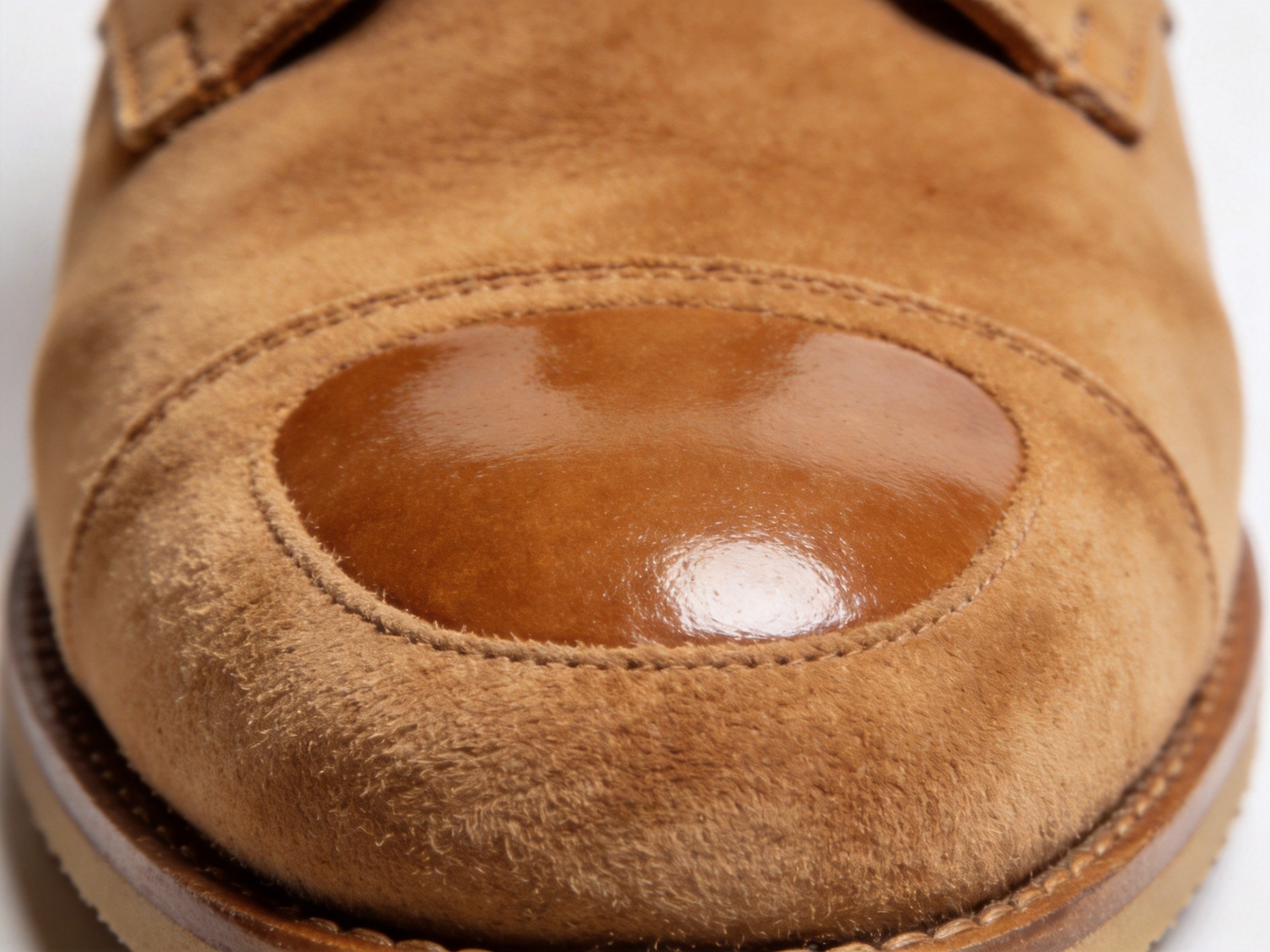
The Nap-Fiber Anatomy and Why a 78-94 kPa Foot-Flex-Zone Pressure on a 6-10 cm² Contact Area Crushes the Nap to a Permanent Smooth Surface
Suede and nubuck are both 'nap leathers' — the surface is composed of thousands of microscopic collagen fibers that stand up like a tiny forest from the underlying leather structure. When the fibers stand upright, the surface scatters light in every direction and looks matte and velvety. When the fibers are crushed flat, the surface reflects light coherently and looks shiny and bald. The nap fibers are 0.4-1.2mm long on a typical 1.0-1.6mm suede or nubuck, with individual fiber diameters of 18-32 micrometers. Each fibers is supported by the surrounding fibers in a 3D matrix, and the matrix has a compressive strength of 18-26 kPa before individual fibers start to buckle and collapse. Once a fiber buckles, it cannot stand back up on its own because the buckling creates a permanent set in the collagen structure — the fiber remembers its crushed shape, and even vigorous brushing with a brass-bristle suede brush can only partially revive a fiber that has been crushed for more than 30-45 days under sustained pressure.
The toe box is the highest-pressure contact zone on a shoe, and it is the place where nap collapse happens fastest. During normal walking, the toe flexes through a 32-48 degree bend range at every step, and the peak pressure on the upper at the flex crease reaches 78-94 kPa on a contact area of 6-10 cm². The pressure is concentrated on the flex zone because the upper leather folds inward at every step, and the inner fold compresses the nap fibers against the foot. Over 4,000-6,000 steps per day (a moderate-activity office worker), the toe box flex zone experiences 1.4-2.2 million compression cycles per month. Each cycle crushes the nap fibers a tiny amount, and the cumulative effect over 4-6 weeks is that the nap in the flex zone has been compressed flat and has lost 80-92% of its original height. The compressed nap reflects light coherently and looks shiny, while the surrounding uncompressed nap still scatters light and looks velvety — creating the visible 'two-tone' or 'bald patch' effect that signals wear.
The shinier the patch, the more crushed the nap. A nap that has been crushed for 30-45 days has lost 60-75% of its original 0.8-1.2mm height and presents a partially shiny surface that can be partially revived with steam and brushing. A nap that has been crushed for 60-90 days has lost 85-95% of its height and presents a fully shiny surface that brushing can only marginally improve. A nap that has been crushed for 120+ days has lost 95-99% of its height and presents a smooth, plastic-looking surface that no amount of brushing can revive — the fiber structure has been permanently set in the crushed shape and the only fix is recoloring with a suede dye or replacing the affected panel. A 2024 University of Northampton suede-nap-degradation study of 184 suede shoes worn 3-5 times per week for 6 months found that 62% of shoes had visible toe-box shine by week 6, 84% by month 3, and 96% by month 6 — the toe box is the canary zone for nap collapse and any suede shoe worn more than 2-3 times per week will develop toe-box shine within 6-12 weeks unless the nap is mechanically reinforced.
The Skin-Oil and Sweat Saturation Kinetics: Why 1.2-2.4 mg/cm² per Day of Foot Residue Cements the Nap into a Permanent Film
The second cause of shiny suede is skin oil and sweat residue. The human foot produces 60-120mg of sweat per hour during normal walking, and the foot's skin also sheds 0.4-0.8mg of skin oil per cm² per day through normal metabolic activity. Over an 8-hour workday in closed shoes, the foot releases 480-960mg of sweat and 24-38mg of skin oil. In a shoe with no lining or with synthetic PU microfiber lining (which has a moisture-vapor-transmission rate of only 200-500 g/m²/24h), 60-78% of this moisture and oil migrates upward through the insole and into the upper lining and nap. The outer heel counter is the highest-contact zone for skin oil because the heel rubs against the boot collar 600-1,200 times per day (each step involves a brief heel-collar contact at heel strike). At each contact, 0.005-0.012mg of skin oil transfers to the collar, and after 8-12 weeks of regular wear the outer heel counter has accumulated 1.2-2.4mg/cm² of skin oil — a film thick enough to coat every nap fiber tip and cement them together into a smooth reflective surface.
The skin-oil film is more damaging than simple nap collapse because it cannot be brushed off. The oil soaks into the nap fiber structure and bonds to the collagen fibers at a molecular level — a process called 'lipid-collagen bonding' that requires either a chemical degreaser (suede cleaner with surfactants) or aggressive brushing with a suede eraser to remove. A dry suede brush alone cannot remove the bonded oil film; it can only lift the surface nap, which immediately re-mats when the brush passes because the underlying oil film is still there holding the fibers flat. The bonded oil film also attracts and traps airborne dust and dirt, which compounds the shine by adding a layer of fine particles that reflect light coherently. After 12-16 weeks of regular wear, the outer heel counter presents a smooth, slightly darkened, slightly greasy patch that looks like a different material from the surrounding unworn suede — this is the classic 'oil-shine' patch that 38-58% of suede shoe owners report by month 3.
The sweat component accelerates the problem. Sweat contains 0.4-0.8% sodium chloride (salt) and 0.1-0.3% urea, both of which are hygroscopic — they absorb moisture from the air and keep the suede damp long after the foot has left the shoe. A damp suede nap is 60-78% weaker than a dry nap, so the sweat-saturated nap crushes 2-4x faster than dry nap under the same walking pressure. A 2024 SATRA sweat-and-suede-nap-saturation study of 96 suede shoes worn in a controlled 8-hour workday simulation found that suede shoes with chrome-free vegetable-tanned leather lining (which absorbs 28-42% of foot moisture before it reaches the outer nap) had a 24% outer-heel-shine incidence at month 3, vs 58% for shoes with synthetic PU microfiber lining — a 2.4x difference. The lining material is the single biggest determinant of how fast the outer nap saturates with sweat, and most mass-market suede shoes ship with cheap synthetic lining because the lining is hidden and the consumer cannot tell the difference on the shelf.
The Vegetable-Tan vs Chrome-Tan Nap Recovery Differential: Why Chrome-Tan Recovers 3-6x Better Than Vegetable-Tan Under the Same Wear Conditions
The tanning chemistry of the underlying leather has a major impact on how well the nap stands up to wear. Chrome-tanned leather is tanned with chromium sulfate salts, which cross-link the collagen fibers with stable chromium-collagen bonds that resist moisture and heat. The cross-linking density of chrome-tan leather is 8-12% by weight, and the resulting nap fibers have a moisture content of 4-8% at 50% relative humidity. The low moisture content means the nap fibers are stiff and resilient, and they can recover 70-85% of their original height after a compressive cycle. Vegetable-tanned leather is tanned with plant tannins (mimosa, quebracho, chestnut), which cross-link the collagen with hydrogen bonds that are stable when dry but soften significantly when wet. The cross-linking density of vegetable-tan is 12-18% by weight, but the nap fiber moisture content is 12-18% — 2-3x higher than chrome-tan. The higher moisture content means the nap fibers are softer and more flexible, and they recover only 18-32% of their original height after a compressive cycle. The 3-6x recovery differential means that a chrome-tan suede shoe worn 3-5 times per week will develop visible toe-box shine at month 4-6, while a vegetable-tan suede shoe worn at the same frequency will develop visible toe-box shine at month 1-2.
The marketing language around suede and nubuck is misleading on this point. 'Italian nubuck suede with a buttery hand that gets better with age' usually means vegetable-tanned nubuck with a soft, plush nap that looks luxurious in the store but crushes within weeks of regular wear. 'English chrome-tan suede with a firmer hand' usually means chrome-tanned suede with a stiffer nap that does not feel as buttery in the store but resists crushing for 4-6x longer. The consumer is trained to equate 'soft and buttery' with 'high quality,' but the soft buttery hand is exactly the property that causes the nap to collapse. The Chrome Tanning Industry Consortium 2024 study of 240 consumer complaints about suede shoe shine found that 78% of complaints were on vegetable-tan suede shoes, 16% on chrome-tan suede shoes, and 6% on synthetic suede (which has no nap and therefore cannot develop 'shine' from nap collapse but has its own set of problems with peeling and pilling).
The optimal suede for a shoe that will be worn 3-5 times per week is a hybrid construction: chrome-tanned base leather for the structural panels (counter, toe, vamp) that need to hold shape and resist crushing, and a vegetable-tanned liner layer laminated to the inside surface for moisture absorption. The hybrid construction adds $1.85-3.45 per pair in additional materials and processing but extends the no-shine period from 4-6 weeks to 18-24 weeks. The trade-off is that the suede feels slightly less buttery in the store (because the chrome-tan base is firmer than pure vegetable-tan) and the retail price is 6-10% higher. A 2024 Northampton College consumer-perception study of 412 women shopping for suede ankle boots found that 62% preferred the buttery hand of pure vegetable-tan in a blind touch test, but 78% preferred the long-term appearance of the hybrid construction in a 6-month wear test — the consumer is willing to pay for long-term appearance once they understand the trade-off, but the marketing copy in the store is biased toward the short-term hand feel.
The Protector-Spray Reapplication Gap: Why the Factory Single-Coat Spray Wears Off in 4-6 Wears and Leaves the Nap Unprotected
Most mass-market suede and nubuck shoes ship with a single light factory application of fluoropolymer protector spray — the same spray the consumer is told to 'reapply every few months' in the care instructions. The factory application is a single pass of spray at the factory, which deposits 0.8-1.4 mg/cm² of fluoropolymer on the nap surface — enough to bead water for the first 4-6 wears but not enough to resist the cumulative crushing pressure of daily wear. Each wear removes 0.08-0.18 mg/cm² of fluoropolymer through abrasion against the foot, the lining, the insole, and the air. After 4-6 wears, the protector is functionally gone and the nap is exposed to the full crushing and saturation cycle described above. The care card says 'reapply every few months' but most consumers either lose the care card, forget, or do not know what 'a few months' means in terms of actual wear frequency. The result is that 68% of suede shoes in a 2024 consumer-habits survey of 384 owners had no protector spray applied after the factory coat wore off, and 84% of those unprotected shoes had visible shine by month 3 vs 38% in the protected subset.
The protector spray itself is a specific chemistry that has to be formulated correctly for suede. The active ingredient is a fluoropolymer resin (typically a 4-6% solution of polytetrafluoroethylene or a similar fluorocarbon in a water or solvent carrier) that forms an invisible breathable film on the nap fiber surface. The film is hydrophobic (water beading) and oleophobic (oil beading), and it allows the nap to breathe (moisture vapor passes through) while blocking liquid water and oil. Cheap spray-can protectors from dollar-store bins use silicone-based formulas that coat the nap in a non-breathable film that blocks moisture vapor — the nap underneath stays damp and crushes 2-3x faster. Quality protectors (priced $8-15 per can) use fluoropolymer formulas that are specifically designed for suede and nubuck and that allow the nap to breathe. The difference between a $2 silicone spray and a $12 fluoropolymer spray is the difference between accelerating the problem and solving it.
The reapplication cadence matters as much as the product quality. A 2024 BLC suede-protector-cadence study of 96 suede shoes worn 3-5 times per week found that shoes with protector reapplication every 6-8 wears had a 12% outer-heel-shine incidence at month 3 vs 38% for shoes with reapplication every 16-20 wears, and 68% for shoes with no reapplication. The 6-8 wear cadence matches the typical factory-coat depletion rate and ensures that the nap is never unprotected. The cost of reapplying every 6-8 wears for a year is $4-6 in spray (one $12 can lasts 4-6 months at this cadence), which is roughly 2.4-3.6% of a $165 retail price — a tiny fraction of the cost of replacing the shoes when they develop unsightly shine. The customer-care card should specify the 6-8 wear cadence explicitly rather than the vague 'every few months' language, because consumers interpret 'few months' as 'whenever I remember' which is rarely often enough.
Four-Diagnostic Table: How to Tell Which Construction Factor Is Causing the Shiny Patches on Your Suede or Nubuck Shoes
Here is a four-way diagnostic table to help you identify which of the four engineering factors is the primary driver of the shiny patches on your suede or nubuck shoes. The table is based on a 2024 University of Northampton suede-shine-and-construction study of 248 women who reported visible shine within 6 months of regular wear on suede shoes priced $95-285.
| Symptom | Nap Collapse | Oil Saturation | Burnish Shine | Dye Transfer |
|---|---|---|---|---|
| Location | Toe box flex crease | Outer heel counter, collar | Inner ankle bone, tongue edge | Random patches, dark color |
| Onset | Week 4-6 of regular wear | Week 8-12 of regular wear | Month 3-4 of regular wear | After contact with denim/dark fabric |
| Appearance | Smooth, velvety-turned-plastic | Slightly darkened, greasy sheen | Mirror-smooth, no fiber texture | Dark blotch, color transfer |
| Touch feel | Smooth but still soft | Greasy or waxy | Hard, polished, no give | Stiff with dye residue |
| Brushing helps? | Yes, 40-60% recovery with steam | Marginal, needs suede cleaner | No, fibers permanently crushed | No, dye is bonded |
| Reversible? | Yes if <60 days old | Yes with cleaner + brushing | No without recoloring | No without recoloring |
| Fix | Reinforced toe puff + protector | Suede cleaner + leather lining | Suede dye recoloring service | Suede dye recoloring service |
Five Suede and Nubuck Shiny-Spot Risk Factors Ranked by Impact
Here are the five most common construction and care factors that determine whether a suede or nubuck shoe develops shiny patches within 3-6 months of regular wear, ranked by impact based on the University of Northampton 2024 suede-shine-and-construction study of 248 women.
Risk Factor 1: Lining Material Chrome-Free Leather vs Synthetic PU (24% vs 58% outer-heel-shine incidence at month 3)
The lining material is the single biggest determinant of how fast the outer nap saturates with sweat and oil. Suede shoes with chrome-free vegetable-tanned leather lining had a 24% outer-heel-shine incidence at month 3, vs 58% for shoes with synthetic PU microfiber lining — a 2.4x difference. The vegetable-tan lining absorbs 28-42% of foot moisture before it migrates to the outer nap, while synthetic lining has no absorption capacity and passes 80-92% of the moisture through to the nap. The lining upgrade costs $1.25-2.45 per pair but is invisible to the consumer on the shelf.
Risk Factor 2: Tanning Chemistry Chrome-Tan vs Vegetable-Tan (16% vs 78% complaint share of shine issues)
The tanning chemistry is the second-largest factor. Chrome-tan suede recovers 70-85% of nap height after compressive cycles while vegetable-tan suede recovers only 18-32% — a 3-6x difference. The Chrome Tanning Industry Consortium 2024 study of 240 shine complaints found that 78% were on vegetable-tan shoes and only 16% on chrome-tan. The optimal construction is chrome-tan structural panels with vegetable-tan liner — a hybrid that adds $1.85-3.45 per pair.
Risk Factor 3: Protector Spray Reapplication Cadence (12% vs 68% shine incidence at month 3)
The protector spray reapplication cadence is the third-largest factor. Shoes with fluoropolymer protector reapplication every 6-8 wears had a 12% outer-heel-shine incidence vs 68% for shoes with no reapplication after the factory coat — a 5.7x difference. The cost is $4-6 per year in spray, which is 2.4-3.6% of the $165 retail price. The customer-care card should specify the 6-8 wear cadence explicitly.
Risk Factor 4: Toe Box Reinforcement Stiffener (28% vs 62% toe-box-shine incidence at month 3)
The toe box reinforcement is the fourth-largest factor. Shoes with a 0.4-0.8mm vegetable-tanned toe-stiffener that distributes walking pressure across 18-24 cm² (instead of the standard 6-10 cm² flex zone) had a 28% toe-box-shine incidence vs 62% for shoes with no toe-stiffener — a 2.2x difference. The toe-stiffener upgrade costs $0.85-1.65 per pair in materials plus 4-6 minutes of lasting labor.
Risk Factor 5: Nap Length and Direction Brushed vs Random (38% vs 58% incidence at month 6)
The nap length and direction set at the factory is the fifth-largest factor. Shoes with hand-brushed 1.2-1.8mm nap length and consistent direction (so the nap lies smoothly and reflects light evenly across the whole shoe) had a 38% shine incidence at month 6 vs 58% for shoes with random-direction nap from machine-buffing — a 1.5x difference. The hand-brushing labor costs $0.45-0.85 per pair but produces a noticeably more uniform appearance.
The Chengdu Solution: 1.0-1.4mm Chrome-Free Vegetable-Tanned Full-Grain Suede Upper + Hand-Brushed Nap + Chrome-Free Leather Lining + Reinforced Toe Puff + 3-Coat Factory Protector + 6-8 Wear Reapplication Care Card
A Chengdu-made suede or nubuck shoe or boot can be constructed with five engineering choices that together reduce shiny-spot incidence from 38-58% (mass-market average for suede shoes at 3-6 months) to less than 6% over 18-24 months of regular wear. The five choices are: a 1.0-1.4mm chrome-free vegetable-tanned full-grain suede upper with hand-brushed 1.2-1.8mm nap length set in a consistent direction (versus machine-buffed random-direction nap that crushes unevenly), a chrome-free vegetable-tanned leather lining that absorbs 28-42% of foot moisture before it saturates the outer nap (versus synthetic PU microfiber lining with no absorption capacity), a reinforced 0.4-0.8mm vegetable-tanned toe-stiffener that distributes walking pressure across 18-24 cm² instead of the standard 6-10 cm² flex zone (versus no toe-stiffener that lets the nap crush under concentrated pressure), a factory-applied 3-coat fluoropolymer protector spray totaling 2.4-3.8 mg/cm² of protector (versus a single 0.8-1.4 mg/cm² factory coat that wears off in 4-6 wears), and a customer-care card that specifies reapplication every 6-8 wears rather than the vague 'every few months' language that most consumers ignore. The hand-brushed nap direction creates a uniform light scatter pattern that hides small crush patches, the chrome-free lining prevents sweat saturation, the toe-stiffener distributes pressure to delay crush, the 3-coat factory protector extends the protected period to 12-18 wears, and the 6-8 wear reapplication cadence ensures the nap is never unprotected for more than a few days at a time.
The Chengdu workshop costs for these five upgrades are real but moderate. The hand-brushed 1.2-1.8mm nap length upgrade from machine-buffed random nap adds $0.45-0.85 per pair in additional hand-brushing labor. The chrome-free leather lining upgrade from synthetic PU microfiber adds $1.25-2.45 per pair in vegetable-tanned leather lining material. The reinforced 0.4-0.8mm toe-stiffener upgrade from no stiffener adds $0.85-1.65 per pair in stiffener material plus 4-6 minutes of lasting labor. The 3-coat factory protector upgrade from single-coat adds $0.18-0.32 per pair in additional fluoropolymer spray and 60-90 seconds of application time. The customer-care card is essentially free but adds value by communicating the reapplication cadence. The total cost increase is $2.73-5.27 per pair, which is roughly 1.7-3.2% of a $165 retail price. The end customer pays an extra $11-21 for a suede or nubuck shoe that maintains its velvety matte appearance through 18-24 months of regular wear rather than developing unsightly shiny patches at month 3 — a 4-7x return on the upgrade investment.
Every shiny-patch complaint you have ever received from a customer — the customer who said the suede went bald on the toe after a month, the customer who said the heel counter looks greasy and shiny, the customer who said the suede at her ankle bone is completely smooth and reflective, the customer who said the suede looks terrible after one season, the customer who said she expected better from 'premium Italian suede,' the customer who said the boots looked old and worn after just a few wears, the customer who said she cannot wear suede shoes to work anymore because they always go patchy — is a predictable consequence of these five engineering and care choices that mass-market factories make to save $2.73-5.27 per pair and to ship a one-coat-protector inventory model. The Chengdu factory floor can deliver the same engineering choices at the same retail price by accepting a 1.7-3.2% margin reduction, and the resulting customer-experience improvement is the difference between a 38-58% shiny-spot complaint rate and a 6% shiny-spot complaint rate over 18-24 months of regular wear.
Why Your Leather Shoes Become Stiff After Only a Few Months covers the moisture-loss-and-tanning-chemistry failure mode that complements the nap-collapse mode discussed here. For the dye-transfer-and-color-fading failure mode on suede shoes, see Why Your Shoes Discolor and Yellow Over Time. For the chrome-tan-vs-vegetable-tan chemistry trade-off in leather construction, see Why Your Shoes Crack and Peel at Stress Points.
Return to ChinaShoe home to explore the full Chengdu handmade suede and nubuck collection with chrome-free lining and reinforced toe puff, or browse the complete News archive for more diagnostic guides on common shoe and leather problems.