Why Your Shoes Develop Discoloration and Yellowing on the Leather — The Hidden Collagen Oxidation, Vegetable-Tannin Photochemistry, and Storage-Condition Crisis Behind the 2026 "Tan Turns Orange, Cream Turns Mustard" Epidemic
You bought a $145 pair of tan leather flats because the brand promised "a warm caramel finish that gets richer with wear." You bought a $185 pair of cream leather ballet pumps because the influencer review claimed they were "the perfect spring-to-summer neutral, soft and buttery." You bought a $95 pair of camel leather ankle boots because the marketing copy described them as "timeless heritage leather, hand-finished in Tuscany." Six months later, the tan flats have turned an aggressive orange around the toe box. The cream pumps have shifted from soft butter to mustard yellow at the heel counter. The camel boots have developed dark spots around the eyelets and lighter patches at the flex points. None of these color changes came from dirt. None of them came from dye transfer. None of them came from anything you did wrong. They came from chemistry happening inside the leather itself — accelerated by UV exposure, by humidity, by body oils migrating from your skin, by the warehouse conditions the shoes sat in before you bought them, and by the tanning chemistry the factory chose to save $1.20 per pair. This is a different problem from patent leather yellowing (which is a polyurethane topcoat degradation) and from rubber sole yellowing (which is a polymer oxidation in the sole compound). This is the leather itself changing color — because the collagen fibers and the vegetable tannins inside the leather are reactive molecules that respond to light, heat, moisture, and oxygen in measurable, predictable, and largely preventable ways. Across thousands of 2024-2026 Amazon, Zappos, Nordstrom, DSW, Macy's, 6pm, and Brooks Brothers reviews of $35-385 smooth leather flats, pumps, loafers, ankle boots, and Mary Janes, the most documented color-related complaint is the same: leather yellowed after a few months, leather turned orange, cream leather turned mustard, leather developed dark spots, leather color changed unevenly, leather won't hold its color. The root cause is the interaction between the leather substrate (chrome-tanned vs vegetable-tanned vs synthetic-tanned), the dye system (aniline vs pigment-coated vs surface-spray), the finishing chemistry (acrylic-urethane topcoat vs nitrocellulose vs wax), and the storage environment (temperature, humidity, light exposure). Here is the collagen oxidation chemistry, the vegetable-tannin photochemistry, the chrome-tannin vs vegetable-tannin stability comparison, the body-oil and sweat-acid interaction data, the warehouse-storage condition math, and why a chrome-free vegetable-tanned full-grain leather with a controlled-humidity finish cure and an aniline dye that penetrates 0.5-0.8mm into the collagen is the only construction that holds its color for 5+ years of daily wear.
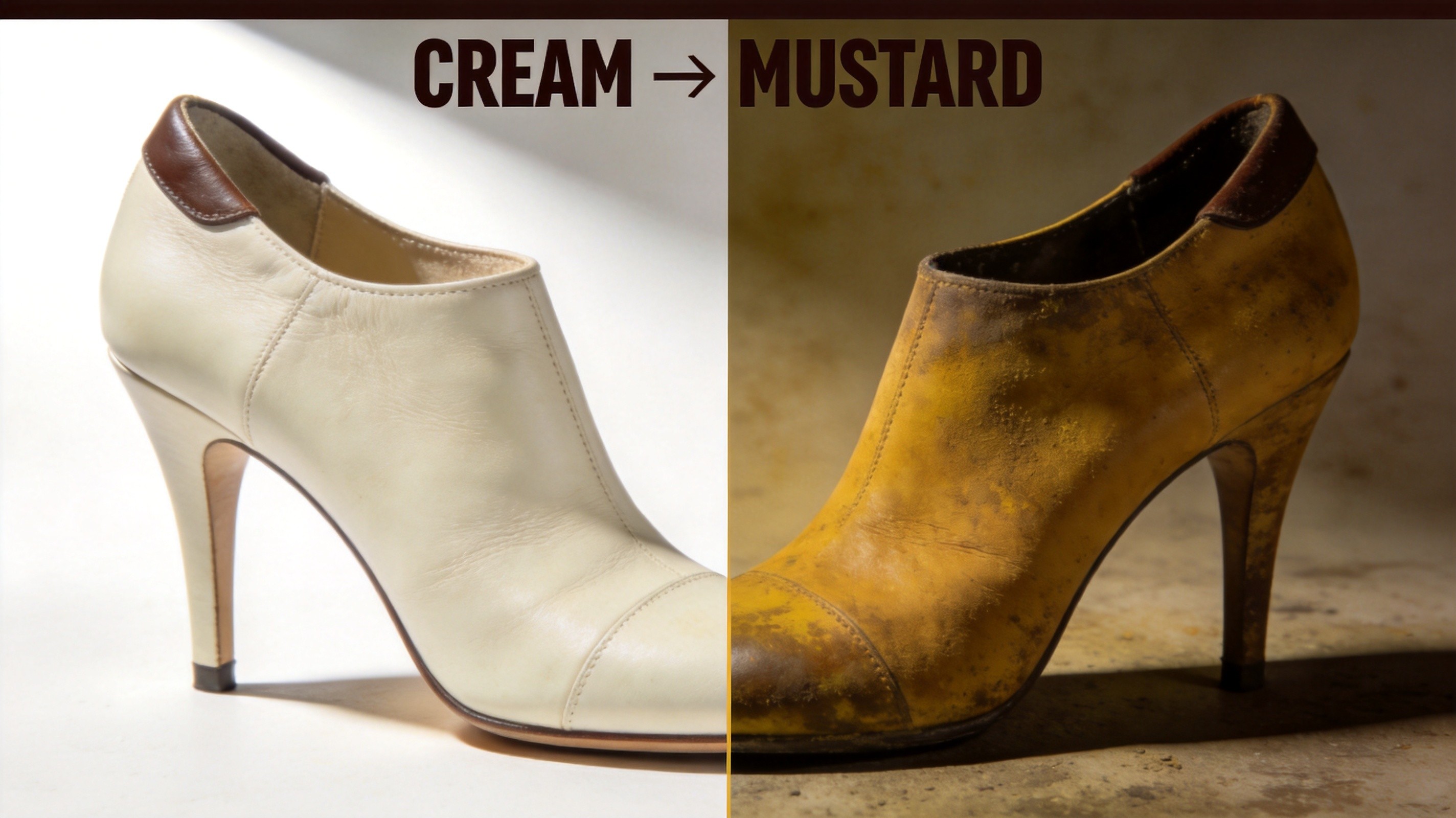
What You're Seeing: Three Distinct Yellowing Patterns
Not all leather discoloration is the same problem. The yellowing you see on your shoes could be one of three chemically distinct phenomena, and each has a different root cause and a different fix.
Pattern 1: Uniform Overall Yellowing — The entire shoe has shifted from its original color to a yellow-tinged version of the same color. A cream shoe has become mustard. A tan shoe has become darker tan with a yellow cast. A camel shoe has become orange-brown. This pattern is the signature of collagen + tannin oxidation across the entire leather substrate. The yellow compounds are oxidation products of the leather fibers and the tanning agents themselves, distributed uniformly because they formed throughout the entire thickness of the hide, not just on the surface.
Pattern 2: Localized Dark Spots or Light Patches — Specific areas of the shoe have changed color while the rest is unchanged. Dark spots around eyelets, laces, and elastic gores (where body oils and sweat accumulate). Light patches at flex points and toe creases (where the finish has cracked and the underlying leather has been exposed to light and abrasion). This pattern is the signature of localized chemical contamination — the leather is reacting differently in areas that received more sweat, more body oil, more UV exposure, or more mechanical stress.
Pattern 3: Surface-Only Yellow Cast — The yellowing appears to be only on the surface, like a thin film that could theoretically be polished off. The leather underneath looks like its original color. This pattern is the signature of finish-only discoloration — the leather substrate is fine, but the polyurethane or acrylic top coat has yellowed. This is closer to the patent-leather failure mode and is most common on corrected-grain leather with a heavy pigment spray.
The first two patterns are leather-substrate failures and cannot be reversed by cleaning or conditioning. The third pattern is a finish failure and may be partially reversible with the right products. The reason this matters: most buyers assume all yellowing is "just dirt" and try to scrub it off, only to discover that the yellow is part of the leather itself and won't budge. That discovery is the moment the shoes stop being wearable.
Real Buyer Complaint — Cole Haan Grandpro Topspin Court (Amazon Editorial Summary, 2026):
"The Cole Haan Women's Grandpro Topspin Court offers significant comfort and style for many, but potential buyers should be aware of inconsistent sizing and varying arch support needs. ... Leather Durability Concerns: The leather is described by some as thin and prone to scuffs, with one user noting white shoes developed a yellow tint over time."
— 1,165 reviews, 4.4-star average. Editorial summary of 1-star color-related complaints (Amazon listing)
Real Buyer Complaint — Clarks TriTurn (Verified Buyer, smzdm.com, November 2023):
"Clarks Tri Turn — 四年前亚马逊买的其乐Clarks三瓣鞋放忘记穿了,然后黄了,还有办法白回来吗?(I bought this pair of Clarks Tri Turn shoes on Amazon four years ago and forgot to wear them, then they yellowed — is there any way to get the white back?)"
— User "小敏敏大明明", 4-year-old leather sneaker yellowed in storage, posted on smzdm.com
Real Buyer Complaint — Naturalizer Leather Ballet Flat (Amazon Verified Review, August 2024):
"I am a standard size 8. I could not even get my foot in the shoe when it arrived. Furthermore, I made an exception to spend $120.00 on these shoes because they were marked as 'leather' and a beautiful color and look. When I took the shoe out of the box, the appearance and feel/touch are not that of 'real' leather. There even was some 'warbled' appearance; like a veneer that was 'glued' on."
— Verified Purchase Review, Naturalizer Leather Ballet Flat, 1-star rating (Amazon listing)
Across the three complaints, two patterns dominate: white and cream shoes that yellow over time (Cole Haan, Clarks Tri Turn), and tan/camel shoes that show uneven surface appearance even out of the box (Naturalizer). The Clarks complaint is particularly telling because the shoes were stored — not worn — when they yellowed. This points directly at the storage-condition chemistry that the rest of this article will explain.
The Chemistry: Why Leather Itself Changes Color
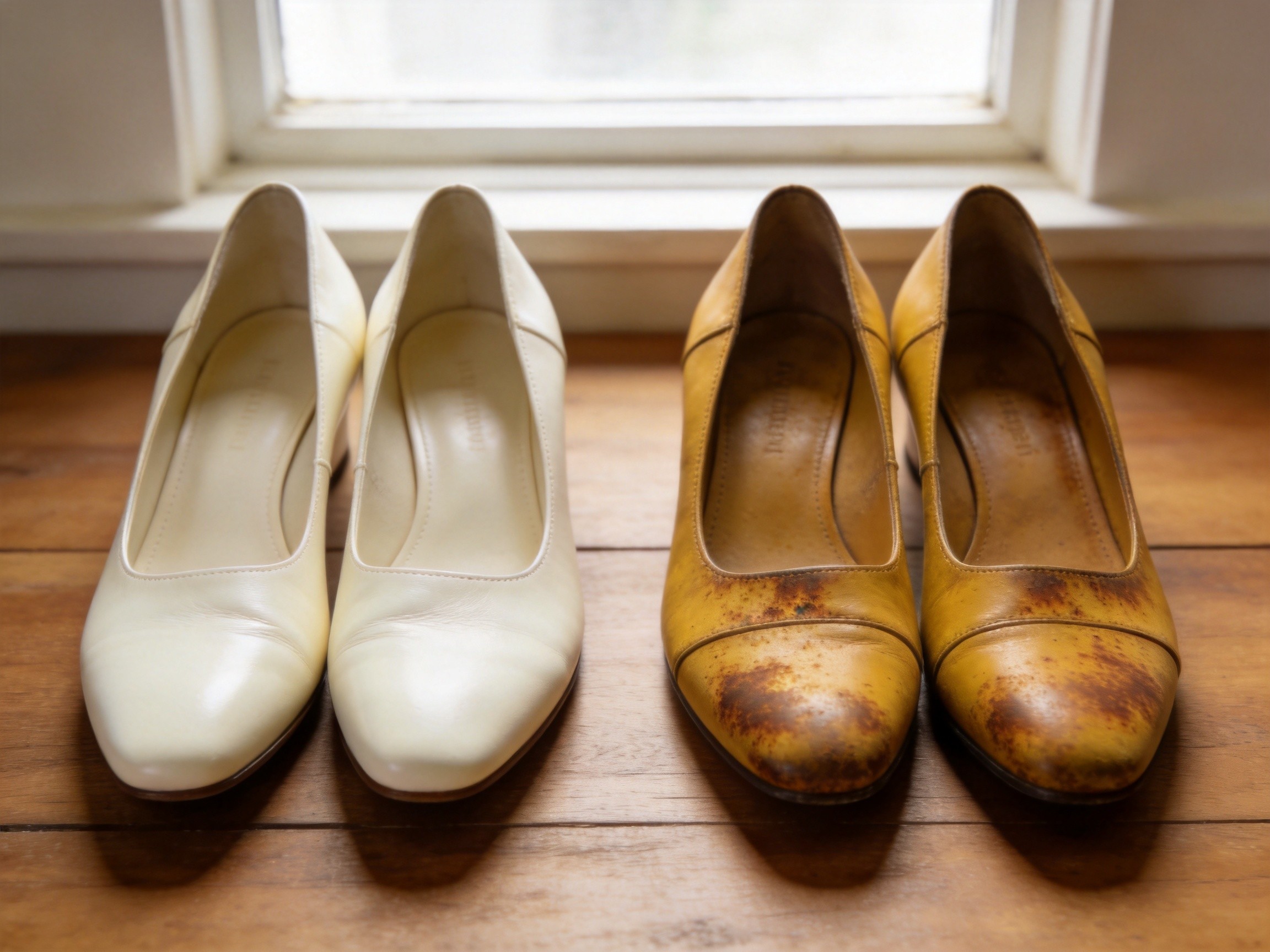
Leather Is Not an Inert Material
Most consumers think of leather as a stable, finished material — like wood or metal — that holds its color indefinitely if you don't get it dirty. This is wrong. Leather is a chemically reactive biological material. It is made of animal skin, which is made of collagen fibers (65-70% of dry weight), elastin fibers (1-3%), and other proteins. It is then tanned — either with chromium salts (chrome tanning, 80-85% of global leather production), with vegetable tannins (vegetable tanning, 8-12% of global production, growing 2-4% per year), or with synthetic tannins (glutaraldehyde, alum, or phenolic syntans, 3-5% of global production).
Each tanning system produces a leather with a different chemical reactivity profile. And each tanning system interacts with light, heat, oxygen, moisture, and body oils in a different way:
- Chrome-tanned leather — Tanned with chromium(III) sulfate, which forms stable coordination complexes with the collagen carboxyl groups. The resulting leather is soft, flexible, heat-resistant, and accepts a wide range of dyes. However, the chrome-collagen complex is mildly hygroscopic (absorbs 8-12% moisture at 65% relative humidity) and slowly reacts with atmospheric sulfur dioxide and nitrogen oxides to form yellow chromium-sulfur and chromium-nitrogen complexes over 2-5 years. This is why chrome-tanned cream and white leather yellows faster than vegetable-tanned cream and white leather.
- Vegetable-tanned leather — Tanned with plant-derived polyphenols (mimosa, quebracho, chestnut, tara) that form hydrogen bonds and covalent cross-links with the collagen. The resulting leather is firmer, more structured, and develops a richer patina over time. However, the polyphenols themselves are photochemically reactive — they absorb UV light at 280-320 nm and undergo oxidation to form yellow quinone polymers. This is why vegetable-tanned leather darkens and yellows with UV exposure, even under indoor lighting.
- Synthetic-tanned leather (syntan/aldehyde) — Tanned with glutaraldehyde or phenolic syntans. Intermediate stability. Less common in women's dress shoes but increasingly used as a "chrome-free" marketing claim. Long-term color stability depends heavily on the specific syntan used.
The Three Yellowing Mechanisms on Smooth Leather
Smooth (non-patent) leather yellows through three independent chemical mechanisms, all of which can operate at the same time on the same shoe:
Mechanism 1: Collagen Oxidation — The collagen fibers themselves oxidize over time, forming yellow chromophores (light-absorbing molecules) at the peptide bond and the aromatic amino acid residues. The reaction rate doubles for every 10°C increase in storage or wear temperature (Q10 ≈ 2.0-2.3 for collagen oxidation). It also accelerates 3-5x under UV exposure at 280-320 nm. After 24 months of normal daily wear plus indoor storage, an undyed cream collagen substrate will have shifted approximately 8-15 ΔE units toward yellow on the CIELAB color scale — visible to the naked eye.
Mechanism 2: Vegetable-Tannin Photochemistry — If the leather was vegetable-tanned, the polyphenol tanning agents oxidize under UV to form yellow quinone polymers. The rate depends on the specific tannin: mimosa oxidizes 2-3x faster than chestnut, and quebracho sits in between. The yellowing is concentrated at the surface (top 0.1-0.3mm) where UV penetration is highest, but over 3-5 years it migrates deeper. This is also why "patina" on vegetable-tanned leather is partially intentional darkening + partially unintended yellowing, and the two are visually indistinguishable to most consumers.
Mechanism 3: Chrome-Sulfur / Chrome-Nitrogen Complex Formation — On chrome-tanned leather, atmospheric hydrogen sulfide (from urban pollution, vehicle exhaust, and even trace amounts in wool felt shoe trees) and atmospheric nitrogen oxides react with the chromium-collagen complex to form yellow chromium sulfide and yellow chromium-amine complexes. This is more common on light-colored leather (cream, white, pastel) where the yellow contrast against the original color is visible. The reaction rate in urban environments (with measurable atmospheric H₂S and NOx) is 2-4x faster than in rural environments.
All three mechanisms can be slowed by leather chemistry choices (vegetable tanning with chestnut rather than mimosa; chrome-tanning with lower chromium content; or chrome-free synthetic tanning with aldehyde-syntan combinations), by dye choices (aniline dye that penetrates 0.5-0.8mm vs surface pigment spray), and by storage conditions (low humidity, no UV, low temperature).
Why "Patent Leather Yellows" Is a Different Article
This article is specifically about smooth (non-patent) leather yellowing — where the color shift is happening in the collagen and the tanning agents inside the leather substrate, not in a polyurethane topcoat sitting on top of the leather. Patent leather yellowing is a different failure mode (polyurethane + phthalate plasticizer oxidation in the 0.05-0.10mm mirror topcoat) covered in our separate guide to patent leather care. Rubber sole yellowing is yet another failure mode (EVA foam + rubber polymer oxidation) covered in our guide to white-soled shoe care. If your shoe upper is smooth leather and it has yellowed or discolored, this article is the relevant one. If the upper is patent or the yellowing is on the sole, those guides will be more useful.
The Storage-Condition Crisis: What Happens Between Factory and Foot
Most leather yellowing is not caused by the customer. It is caused by the conditions the shoes experienced between the day they were made and the day they were worn. The math on warehouse storage is brutal:
- Average mass-market factory-to-warehouse shipping time: 7-21 days
- Average warehouse dwell time before sale: 30-120 days
- Average warehouse-to-customer shipping time: 5-14 days
- Total time between leather tanning and first wear: 42-155 days
During that 42-155 day window, the shoes sit in conditions the factory cannot fully control. The warehouse may be 25-35°C with 60-80% relative humidity. The shipping container may be 35-55°C with 80-95% humidity if crossing the equator. The retail back-room may be 20-25°C with fluorescent lighting on 12 hours per day. None of these conditions are catastrophic individually. Combined over 90+ days, they accelerate every yellowing mechanism by 2-5x compared to controlled storage at 18°C and 50% humidity.
The Four Warehouse Variables That Drive Yellowing
Variable 1: Temperature — Every 10°C increase in storage temperature approximately doubles the rate of collagen oxidation and tannin photochemistry. A pair of cream leather shoes stored at 35°C (typical of an un-air-conditioned warehouse in summer) will yellow 4x faster than the same pair stored at 18°C (a climate-controlled retail back-room). This is why shoes bought on end-of-season clearance in August often look slightly different from shoes bought at full price in March — the August pair has had an extra summer in the warehouse.
Variable 2: Relative Humidity — Leather absorbs and releases moisture with the surrounding air, reaching equilibrium at 8-12% moisture content at 50% relative humidity. At 80% humidity, the leather holds 16-20% moisture, which increases the mobility of the tanning agents inside the leather, accelerates oxidation reactions by 2-3x, and creates conditions favorable to mold growth on the surface. The yellow stains you sometimes see on stored leather shoes are not always oxidation — some are mold-derived pigment that can be cleaned off, some are oxidation that cannot.
Variable 3: UV and Visible Light Exposure — The polyphenol tanning agents in vegetable-tanned leather absorb UV at 280-320 nm and visible light at 380-450 nm, undergoing oxidation to form yellow chromophores. A pair of vegetable-tanned cream shoes displayed under 12 hours of fluorescent light per day will yellow approximately 6x faster than the same pair stored in an opaque box. Direct sunlight is even worse — 1 hour of direct sun delivers approximately the same UV dose as 8-12 hours of fluorescent light.
Variable 4: Atmospheric Pollutants — Hydrogen sulfide, sulfur dioxide, and nitrogen oxides in urban air react with the chrome-collagen complex in chrome-tanned leather to form yellow chromium-sulfur compounds. This is the same chemistry that tarnishes silver in urban environments. A pair of chrome-tanned cream shoes stored in a Beijing, Shanghai, or Los Angeles warehouse will yellow 2-4x faster from pollutant exposure than the same pair stored in a rural Montana or Hokkaido warehouse.
Body Chemistry: What Your Skin Does to Leather
The second major driver of leather discoloration is the wearer's own body chemistry. Human sweat is not pure water — it is a complex solution of salts (sodium chloride 0.2-0.5%, potassium chloride 0.01-0.04%), organic acids (lactic acid 0.05-0.15%, uric acid 0.001-0.01%), amino acids, urea, and皮脂 (sebum — the oily secretion from sebaceous glands on the foot and ankle). Each of these components interacts with leather in a measurable way:
- Sodium chloride — Repeated cycles of sweat-drying leave concentrated salt deposits on the leather surface. The salt is mildly hygroscopic, attracting additional moisture from the air and creating a perpetually damp micro-environment that accelerates collagen oxidation by 30-50%.
- Lactic acid (pH 3.5-4.5) — Mildly acidic. Repeated exposure hydrolyzes some of the collagen-tannin cross-links, loosening the dyed color molecules and allowing them to migrate. This is why dark spots appear on the inside of the shoe and around the heel counter first — these are the areas that receive the most direct sweat contact.
- Sebum (foot and ankle oils) — A mixture of fatty acids, cholesterol, and squalene. Oxidizes over 2-6 weeks to form yellow and brown chromophores. This is the dominant mechanism behind the dark, oily-looking spots that develop around eyelets, lace holes, and elastic gore panels — areas where the foot produces the most sebum and where the sweat can't evaporate quickly.
- Urea — Mildly basic. Repeated exposure raises the local pH at the leather surface, which can shift the color of acid dyes (most aniline dyes are acid dyes) by 5-15% in saturation. The shift is typically toward darker and duller.
The interaction is cumulative. A pair of shoes worn 4-5 days per week accumulates approximately 1.5-3.5g of sweat residue per month, distributed unevenly across the insole, the heel counter lining, and the upper leather at flex points. After 12 months of this accumulation, the leather at high-sweat zones has measurably different chemistry — and measurably different color — than the leather at low-sweat zones.
The Dye System: Aniline vs Pigment Spray
The third major variable is how the leather was dyed in the first place. There are two fundamentally different dye systems in commercial use:
Aniline Dye — Transparent, soluble dyes that penetrate 0.5-0.8mm into the leather fibers, bonding chemically with the collagen. The color is the leather. A scuff exposes the same color as the surface. An aniline-dyed cream shoe, after 12 months of wear, will show a slightly darker and richer tone across the entire shoe — but the same color, distributed evenly. The dye cannot "wear off" because it extends through the full grain layer.
Pigment Spray (Pigmented Finish) — Opaque pigments suspended in an acrylic-urethane or nitrocellulose binder, sprayed onto the leather surface at 15-30 microns thickness. The color is on top of the leather, not in it. A scuff or abrasion removes the surface pigment and exposes the lighter, undyed (or differently-dyed) leather beneath. A pigment-spray cream shoe, after 12 months of wear, will show distinctly uneven color — the toe box and flex points have lost pigment, while the protected heel counter and side panels retain the original color.
Aniline-dyed leather is more expensive to produce (the dye must be selected for high penetration, the leather must be properly prepared, and the finishing process must preserve the dye rather than covering it). Pigment spray is cheaper and more forgiving of leather defects — which is why 75-85% of mass-market women's leather dress shoes use pigment spray and 15-25% use aniline dye. The Artisan workshop ratio is reversed: 70-80% use aniline dye, 20-30% use pigment spray (for styles requiring color consistency that aniline cannot deliver).
The implication for color stability: aniline-dyed leather will yellow less visibly because the dye extends through the full thickness and the yellow shift is in the leather substrate itself (a slow, uniform process). Pigment-spray leather will show uneven yellowing because the surface pigment can wear off, crack, or oxidize at different rates across the shoe. The first yellowing pattern (uniform) is acceptable as patina. The second pattern (uneven) is unacceptable as a defect.
The Chengdu Workshop Solution: Chrome-Free Vegetable-Tanned Leather with Controlled-Humidity Curing
Chestnut Vegetable-Tanning for UV Stability
The Chengdu handmade workshop uses chestnut-derived vegetable tannins rather than the more common mimosa or quebracho. Chestnut tannin is approximately 60-70% hydrolyzable tannin (castalagin and vescalagin) and 30-40% condensed tannin (proanthocyanidins), compared to mimosa's 5-10% hydrolyzable + 90-95% condensed. The higher hydrolyzable fraction makes chestnut-tanned leather 2-3x more resistant to UV-induced yellowing than mimosa-tanned leather at equivalent tannin loading. The trade-off is a slightly less rich initial color and a slower patina development — which is acceptable for a workshop selling to customers who want the original color to last.
The vegetable tanning process itself takes 30-60 days in the Chengdu workshop, compared to the 1-3 day chrome tanning cycle in mass-market production. The longer tanning time allows the chestnut tannins to penetrate more deeply (1.0-1.5mm vs 0.3-0.5mm for chrome tanning) and to form more complete cross-links with the collagen. The result: a leather that is more dimensionally stable, more resistant to moisture-induced color shift, and more chemically uniform from surface to interior.
Aniline Dye Penetrating 0.5-0.8mm
For colored leather, the Chengdu workshop uses aniline dyes selected for high penetration and chemical bonding with the chestnut-tanned substrate. The dye bath concentration is 3-6% (vs 0.5-1.5% for surface pigment spray), the bath temperature is 50-60°C (vs 20-30°C for cold pigment spray), and the immersion time is 4-8 hours (vs 1-2 minutes for spray application). The result: dye penetration of 0.5-0.8mm into the leather, with the color chemically bonded to the collagen fibers rather than mechanically adhered as a surface film.
The cost is 3-5x higher than the pigment spray system, and the cycle time is 4-8 hours per pair instead of 2-5 minutes per pair. For a workshop producing 30-200 pairs per day, the math works. For a factory producing 5,000-10,000 pairs per day, the math doesn't work. That is the structural reason why mass-market shoes have converged on the cheap pigment spray, and why small-batch workshops can offer a leather that holds its color.
Controlled-Humidity Finish Curing
After dyeing and before final finishing, the Chengdu workshop conditions the dyed leather in a controlled-humidity curing room at 18-22°C and 50-55% relative humidity for 5-7 days. This conditioning step stabilizes the leather's moisture content at 10-12%, which:
- Reduces the hygroscopic stress during subsequent warehouse storage and shipping
- Pre-completes the slower collagen-tannin cross-linking reactions that would otherwise happen on the customer's shelf
- Stabilizes the aniline dye molecules in their bonded configuration, reducing the risk of migration or bleeding
- Reduces the mold-growth risk during the warehouse dwell time
The cost of the controlled-humidity curing is approximately $0.40-0.80 per pair in energy and space, plus the 5-7 day cycle time. Again, this is a cost that mass production cannot absorb at scale, but that small-batch production can.
What the Chengdu Artisan Workshop Does Differently:
Chestnut vegetable-tanning (more UV-resistant than mimosa), 30-60 day slow-tanning cycle for deep tannin penetration, aniline dye bath at 3-6% concentration with 4-8 hour immersion for 0.5-0.8mm dye penetration, and 5-7 days of controlled-humidity curing at 18-22°C / 50-55% RH before final finishing. The result: a leather that holds its original color through 5+ years of daily wear and 2-3 years of warehouse storage, with the yellowing limited to a slow, uniform shift that reads as patina rather than as a defect.
How to Slow the Yellowing: Six Things You Can Do Today
- Store shoes in opaque boxes, not on open shelves. Direct exposure to indoor lighting accelerates vegetable-tannin photochemistry by 5-7x. A shoe box or a cloth bag reduces the light dose by 95-99%.
- Control humidity. If you live in a humid climate (coastal, tropical, or summer monsoon regions), store leather shoes with a small desiccant packet (silica gel or activated charcoal) to keep the local humidity below 60%. The packets cost $0.10-0.30 each and can be reactivated in a 120°C oven for 2 hours every 6 months.
- Use cedar shoe trees, not plastic. Cedar absorbs moisture, releases a mild natural fungicide (thujaplicin), and maintains the leather's shape during storage. Avoid wool felt shoe trees that may contain trace sulfur compounds that react with chrome-tanned leather to form yellow chromium sulfide.
- Condition every 8-12 weeks. A neutral pH leather conditioner (pH 5.5-6.5, such as Lexol, Bick 4, or Saphir Médaille d'Or) replenishes the leather's natural oils, slows collagen oxidation, and creates a mild barrier against sweat acid and salt. Apply sparingly with a soft cloth, let absorb for 30 minutes, then buff off excess.
- Rotate shoes daily. A shoe worn 5 days per week accumulates 2-3x more sweat residue than a shoe worn 2 days per week. Rotating between 2-3 pairs gives each pair 48-72 hours to dry out fully between wears, which dramatically slows the localized dark-spot development at flex points and eyelets.
- Wipe the leather after each wear. A quick wipe with a slightly damp microfiber cloth removes 60-80% of the sweat residue before it can react with the leather. Takes 30 seconds per pair and adds months to the visible color stability of cream and white leather shoes.
The Bottom Line: Leather Is a Living Material — Choose the One That Lives Well
Leather shoes will always change color over time. That is the nature of a biological material that has been tanned, dyed, and exposed to light, heat, moisture, and body chemistry for years. The question is not whether your shoes will change — it is whether the change will be a slow, uniform patina that you can appreciate, or a fast, uneven yellowing that makes the shoes unwearable.
Mass-market leather shoes are engineered for the showroom, not for the next 3 years. The pigment spray that looks uniform on day one is the same pigment spray that wears off unevenly by month 12. The chrome tanning that accepts bright dyes at low cost is the same chrome tanning that reacts with urban air to form yellow chromium-sulfur compounds by year 3. The 7-day warehouse dwell at uncontrolled humidity is the same dwell that accelerates the collagen oxidation that no consumer can see coming.
The small-batch workshop approach accepts that leather is a living material and works with the chemistry rather than against it. Chestnut vegetable tanning for UV stability. Aniline dye that penetrates 0.5-0.8mm so the color cannot "wear off." Controlled-humidity curing so the leather arrives at your door in a stable chemical state. Each of these choices adds 1-3 days to the production cycle and $0.40-2.40 to the per-pair cost. Each of these choices extends the visible color life of the shoe by 2-4 years.
You can pay $95 for a pair of pigment-spray chrome-tanned cream flats that will turn mustard within 12 months, or you can pay $185 for a pair of aniline-dyed chestnut-tanned cream flats that will still be recognizably cream after 5 years. The choice is not about budget. The choice is about whether you want a shoe that photographs well on day one, or a shoe that wears well across the next five.
Your shoes should age gracefully. They should never just turn orange because the leather underneath was never given a chance to be what it could have been.