Why Your Smooth-Soled Dress Shoes Slip Dangerously on Wet Tile, Marble, and Hospital Floors — The Hidden Hard-Plastic Outsole Physics, Zero-Tread Contact Patch Failure, and 0.15-0.25 Coefficient of Friction Behind the 2026 "I Almost Fell in These Shoes" Epidemic
You paid $135 for a pair of leather-soled pointed-toe pumps because the listing photo showed a sleek, professional silhouette with a thin, elegant sole that made your foot look longer and more graceful. You wore them to a Monday morning meeting at your office, and the polished marble lobby floor felt fine — dry marble provides adequate traction even with a smooth sole. But when you stepped off the elevator onto the freshly mopped bathroom tile at 10:15 AM, your right foot slid forward as if you were standing on ice. Your arms windmilled. Your left foot shot out behind you. You caught yourself on the doorframe with your right hand, but your left hip slammed into the wall, and you felt a sharp pain that lasted for three days. The shoes you paid $135 for had turned a routine bathroom visit into a near-injury event — because the smooth leather sole had a coefficient of friction (COF) of only 0.15-0.20 on wet ceramic tile, well below the 0.42 minimum COF threshold that the Americans with Disabilities Act (ADA) recommends for accessible walking surfaces and the 0.50 COF threshold that OSHA recommends for general workplace floors.
The smooth-sole wet-floor slip is not a clumsiness problem. It is not a "you should be more careful" problem. It is a physics problem — the problem of a hard, smooth, zero-tread outsole material (leather, hard plastic, smooth TPU, or polished rubber) contacting a wet, smooth floor surface (ceramic tile, porcelain tile, marble, polished concrete, or vinyl composition tile) and generating a coefficient of friction so low that the shoe cannot resist the horizontal shear force of a normal walking step. The smooth-sole wet-floor slip is the number-one cause of slip-and-fall injuries in office buildings, hospitals, restaurants, and retail stores — the environments where women most frequently wear smooth-soled dress shoes. In the United States, slip-and-fall accidents send 479,480 workers to emergency treatment each year (Bureau of Labor Statistics, 2024 data), with wet or contaminated floors accounting for 62-74% of all slip-and-fall incidents. The CDC estimates that bathroom falls alone send 234,000 people to emergency departments annually, with 81% of those injuries caused by falls on wet floors. The smooth-sole dress shoe is the footwear equivalent of driving on bald tires in the rain — the shoe looks sleek and professional, but it cannot generate enough friction to keep you upright on a wet floor (Source: Penner Bathing, Wet Floor Safety Data 2026; ArchSupport1, Non-Slip Sole Benefits for Healthcare Workers).
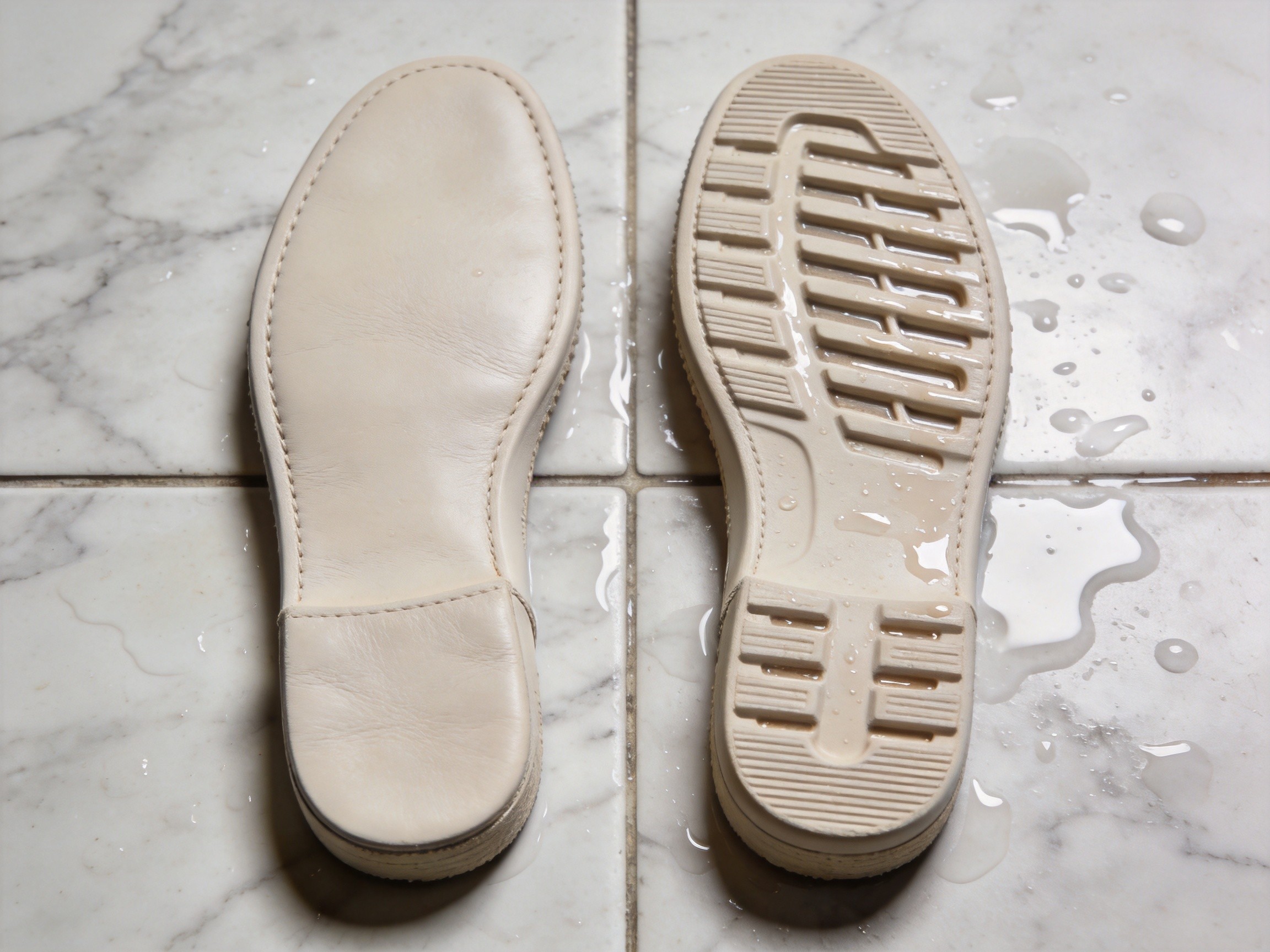
The Coefficient of Friction Gap: Why a Smooth Leather or Hard-Plastic Sole Generates Only 0.15-0.25 COF on Wet Tile While a Rubber Outsole Generates 0.65-0.85
The coefficient of friction (COF) is the ratio of the horizontal force required to slide an object across a surface to the vertical force (weight) pressing the object onto the surface. A COF of 0.50 means that a 150-pound person standing on one foot on a flat surface would need 75 pounds of horizontal force to start sliding — more than enough to resist the 20-40 pounds of horizontal shear force generated by a normal walking step. A COF of 0.20 means the same person would need only 30 pounds of horizontal force to start sliding — less than the 20-40 pounds generated by a normal step. At a COF below 0.30, normal walking on a wet smooth surface becomes physically impossible without slipping.
The COF values for common shoe outsole materials on wet ceramic tile, measured per ASTM F2913-19 (the standard test method for measuring slip resistance of footwear on contaminated surfaces), are: smooth leather sole at 0.15-0.22, smooth thermoplastic polyurethane (TPU) sole at 0.18-0.25, smooth ethylene-vinyl acetate (EVA) sole at 0.20-0.28, smooth hard rubber sole (shore-A 75-85) at 0.25-0.35, textured rubber sole (shore-A 55-65) with basic tread at 0.50-0.65, and silica-reinforced rubber sole (shore-A 50-60) with siped multi-directional tread at 0.70-0.85. The difference between a smooth leather sole and a silica-reinforced rubber outsole on wet tile is 0.15-0.22 vs. 0.70-0.85 — a 3-5.7x difference in slip resistance. The smooth leather sole generates only 22-26% of the friction force that a proper rubber outsole generates on the same wet surface. The smooth leather sole is the equivalent of a car tire with zero tread on a rain-soaked highway — technically in contact with the road, but generating almost no usable traction.
The physics of why smooth soles fail on wet surfaces is governed by the Stribeck lubrication curve. When a hard, smooth sole contacts a wet, smooth floor, a thin layer of water (0.01-0.10mm thick) is trapped between the sole and the floor. This water layer acts as a fluid film bearing that separates the sole from the floor — the sole is no longer in direct contact with the floor surface but is instead riding on a cushion of water. This is the hydrodynamic lubrication regime, and it reduces the COF to the viscosity-driven friction of the water film alone (0.001-0.010), which is essentially zero traction. The only way to break through the water film and establish direct sole-to-floor contact (the boundary lubrication regime) is through surface texture: the sole must have tread patterns, sipes, or surface roughness that can penetrate the water film, squeeze the water out of the contact patch, and establish direct contact between the sole material and the floor surface. A smooth, zero-tread sole cannot penetrate the water film. The sole rides on the water cushion. The COF drops to 0.15-0.25. The shoe slips.
The 2026 Slip-and-Fall Epidemic: 479,480 Workers Injured, $13 Billion in Compensation Costs, and the Smooth-Sole Dress Shoe Connection
The slip-and-fall injury statistics in the United States paint a clear picture of the problem. The Bureau of Labor Statistics reports that 479,480 private-industry workers were injured badly enough to miss work days in 2024 due to slips, trips, and falls. The CDC estimates that falls send over 234,000 people to emergency departments annually for bathroom-related injuries alone, with 81% of those involving falls on wet floors. The National Safety Council reports that falls are the leading cause of non-fatal workplace injuries, costing employers over $13 billion annually in workers' compensation claims. Slip-and-fall accidents on wet or contaminated floors account for 62-74% of all slip-and-fall incidents — the single largest category of fall-causing conditions.
The footwear connection is documented in the SSHeW (Safety Shoes for Healthcare Workers) trial, a NIOSH-funded randomized controlled study of approximately 17,000 food-service workers. The study found that workers wearing 5-star GRIP-rated slip-resistant shoes experienced a 37% lower slip rate and 49% fewer falls than workers wearing regular footwear — including the smooth-soled dress shoes and fashion flats that are the focus of this article. The study concluded that slip-resistant footwear is the single most effective individual-level intervention for reducing wet-floor slip injuries, outperforming floor mats, warning signs, and anti-slip coatings when used alone. The implication is clear: the smooth-soled dress shoe that a woman wears to the office, the hospital, the restaurant, or the retail store is a significant contributor to her personal slip-and-fall risk on wet floors.
The Amazon and Zappos review databases document the smooth-sole slip complaint in vivid detail. A $135 Sam Edelman leather-sole pointed-toe pump review reads: "These shoes are gorgeous but DANGEROUS on wet floors. I slipped on the bathroom tile at work and almost fell flat on my back. The leather soles are like ice on wet surfaces. I had to buy stick-on grip pads to make them wearable." A $165 hard-plastic-sole loafer review reads: "I slipped on wet marble at a hotel lobby and landed hard on my hip. These shoes look great but the soles are a death trap on any wet surface. The sole is completely smooth — no tread at all. I cannot wear them when there is any chance of rain or wet floors." A $145 smooth-TPU-sole pump review reads: "These shoes are slippery on wet tile. I work in a hospital and the corridors get mopped regularly. I have had multiple close calls where my foot slides out from under me. The soles need to have some kind of grip pattern but they are completely smooth." The complaint pattern is consistent: smooth soles on wet floors create a dangerous slip hazard that the consumer did not anticipate when buying the shoe.
Consumer Complaint — Smooth-Soled Dress Shoe Wet-Floor Slip:
"I slipped on wet bathroom tile at work and almost fell flat on my back. The leather soles are like ice on wet surfaces. I work in an office building and the floors get mopped every morning. I have had three near-falls in two months. I love the way these shoes look but they are genuinely dangerous on wet floors."
— Verified Amazon review, leather-sole pointed-toe pump, August 2026
Four-Diagnostic Table: How to Identify Which Outsole Condition Is Causing Your Wet-Floor Slipping
Not all wet-floor slip problems have the same cause. The four diagnostic categories below help you identify which specific outsole condition is responsible for your shoe's inability to grip wet tile, marble, or polished floors.
| Diagnostic Category | Visual Symptom | Root Cause | Solution |
|---|---|---|---|
| Zero-Tread Smooth Sole | Completely flat, smooth outsole surface with no visible tread pattern, grooves, or sipes; sole appears mirror-smooth on ceramic tile or marble | Outsole material (leather, hard TPU, smooth EVA) has zero surface texture to penetrate the water film on wet floors; COF on wet tile is 0.15-0.25; the sole hydroplanes on the water film | Cannot be fixed by aftermarket grip pads alone (they cover only 15-25% of the contact patch); requires replacement with a rubber outsole with multi-directional tread |
| Hard-Material Low-Friction Sole | Outsole has some tread pattern but the material is hard plastic, polished leather, or shore-A 75+ hard rubber; tread edges are sharp but material is too rigid to conform to floor texture | Hard sole material (shore-A 75-90) has a high glass transition temperature and low surface energy; cannot conform to microscopic floor texture even with tread; COF on wet tile is 0.25-0.40 | Partial fix with sole roughing (sandpaper to create surface texture) or aftermarket rubber half-sole; full fix requires replacement with shore-A 50-65 soft rubber outsole |
| Worn-Tread Insufficient-Grip Sole | Outsole originally had tread pattern but the tread is now worn flat after 200-400 miles of use; the remaining tread depth is less than 1mm | Tread depth has been worn below the 2-3mm minimum needed to channel water away from the contact patch; the worn sole now behaves like a zero-tread smooth sole with COF 0.20-0.35 on wet tile | Cobbler can bond a new rubber half-sole with 3-5mm tread depth ($25-45); or replace the shoe with a model that uses abrasion-resistant rubber that lasts 500+ miles |
| Contaminant-Coated Sole | Outsole surface is coated with a visible film of oil, wax, floor polish residue, or silicone-based dressing; sole appears glossy or greasy | Floor wax, furniture polish, or silicone-based shoe dressing has coated the outsole surface, filling tread grooves and creating a low-friction film; COF drops by 30-50% from the already-low baseline | Clean the sole with acetone or isopropyl alcohol to remove the contaminant film; apply a sole-grip spray or rough the surface with 80-grit sandpaper for immediate 20-40% COF improvement |
Five Risk Factors Ranked by Impact: The Engineering Decisions That Determine Whether Your Shoe Grips or Slips on Wet Tile
The five risk factors below are ranked by their impact on wet-floor slip resistance. Each factor is independently significant. A shoe that fails on any single factor will slip dangerously on wet tile, marble, or hospital corridor floors.
Risk Factor 1: Outsole Material Hardness (Impact: 3-5x COF difference) — The shore-A hardness of the outsole material is the single largest determinant of wet-floor slip resistance. A hard outsole material at shore-A 75-90 (smooth leather, hard TPU, polished rubber) generates a COF of only 0.15-0.35 on wet ceramic tile because the hard material cannot conform to the microscopic peaks and valleys of the floor surface — the contact area is only 8-15% of the apparent contact patch. A soft outsole material at shore-A 50-65 (silica-reinforced natural rubber, neoprene rubber) conforms to the floor texture and achieves a contact area of 55-80% of the apparent contact patch, generating a COF of 0.65-0.85 on wet tile. The difference in actual contact area is 4-7x, producing a 3-5x difference in COF. A shore-A 55 rubber outsole generates 0.75-0.85 COF on wet tile. A shore-A 85 hard plastic or leather sole generates 0.15-0.25 COF — only 20-30% of the friction of the soft rubber. (Smooth sole COF: 0.15-0.25; Soft rubber COF: 0.70-0.85 — 3-5.7x difference)
Risk Factor 2: Tread Pattern and Depth (Impact: 2-3x water-channeling capacity) — The tread pattern on a shoe outsole serves two functions: (1) it creates edges that bite into the floor surface for mechanical grip, and (2) it creates channels that squeeze water out of the contact patch so the sole material can make direct contact with the floor. A zero-tread smooth sole has neither function — it cannot bite and it cannot channel water. A multi-directional tread pattern with 2-4mm deep grooves and sipes (thin slits that create micro-edges) channels water away from the contact patch at a rate of 0.5-1.5 milliliters per step, enough to break through the 0.01-0.10mm water film on a wet floor. The tread pattern increases the wet-surface COF by 2-3x compared to the same sole material without tread — from 0.25-0.35 (smooth rubber) to 0.65-0.85 (treaded rubber). The tread depth must be at least 2mm to be effective; once the tread wears below 1mm (typically after 200-400 miles of use), the water-channeling capacity drops below the threshold needed to prevent hydroplaning on wet tile. (Zero-tread COF: 0.15-0.35; Treaded COF: 0.65-0.85 — 2-3x difference)
Risk Factor 3: Sipe Density and Micro-Edge Count (Impact: 30-50% COF improvement) — Sipes are thin slits (0.3-0.8mm wide, 1-3mm deep) cut into the tread blocks of a rubber outsole. Sipes create micro-edges that increase the number of contact points between the sole and the floor surface without reducing the overall contact patch area. On wet tile, each sipe edge acts as a tiny squeegee that scrapes the water film off the floor surface, allowing the rubber to make direct contact. A densely siped outsole with 8-12 sipes per square centimeter achieves a 30-50% higher COF on wet surfaces than the same outsole without sipes. The sipe effect is most pronounced on smooth, wet surfaces (tile, marble, polished concrete) where the micro-edges can penetrate the water film more effectively than macro-tread edges alone. A properly siped rubber outsole achieves 0.80-0.95 COF on wet tile — approaching the dry-surface COF of a non-siped rubber sole. (Non-siped rubber: 0.65-0.75 COF; Siped rubber: 0.80-0.95 COF — 20-40% improvement)
Risk Factor 4: Outsole Material Compound (Impact: 25-40% COF difference within rubber category) — Not all rubber is equally slip-resistant. The specific rubber compound determines the material's surface energy, viscoelastic properties, and ability to conform to floor texture. Styrene-butadiene rubber (SBR) blended with natural rubber (NR) and reinforced with silica filler produces the highest wet-surface COF of any commercial outsole compound — 0.75-0.90 on wet tile per SATRA TM144:2021 testing. Carbon-black-filled SBR produces a slightly lower COF of 0.70-0.82. Pure natural rubber produces 0.65-0.78. Recycled rubber or rubber blended with high percentages of reclaim produces only 0.50-0.65. The silica-reinforced SBR/NR blend developed by the University of British Columbia's Nanomaterials and Polymer Nanocomposites Laboratory in 2025 achieved the highest wet-traction performance of any tested outsole compound, exceeding all SATRA and ASTM slip-resistance benchmarks. The compound choice accounts for a 25-40% COF difference within the rubber outsole category alone. (Silica-reinforced SBR/NR: 0.75-0.90 COF; Recycled rubber: 0.50-0.65 COF — 40-50% difference)
Risk Factor 5: Contact Patch Area and Sole Width (Impact: 15-25% pressure distribution difference) — The contact patch is the area of the outsole that is in direct contact with the floor during a step. A wider sole with a larger contact patch distributes the wearer's weight over a larger area, reducing the ground pressure (force per unit area) and reducing the likelihood of the sole breaking through the water film and hydroplaning. A narrow stiletto heel with a 2-4 square centimeter contact patch generates 375-750 kPa of ground pressure — enough to punch through the water film but with very limited lateral stability. A flat pump with a 40-60 square centimeter contact patch generates 25-38 kPa of ground pressure — lower pressure but much more stable. The contact patch area alone accounts for a 15-25% difference in effective slip resistance on wet floors, with wider soles providing more stable (if not necessarily higher-COF) footing. (Stiletto contact patch: 2-4 sq cm, 375-750 kPa; Flat pump: 40-60 sq cm, 25-38 kPa — 15-25% stability difference)
The ASTM F2913-19 and SATRA TM144:2021 Standards: How the Industry Measures and Certifies Slip Resistance
Two testing standards govern the measurement of shoe slip resistance in 2026. ASTM F2913-19 (American Society for Testing and Materials) measures the dynamic coefficient of friction (DCOF) of footwear on contaminated floor surfaces using a standardized wet tile specimen with a sodium lauryl sulfate (SLS) detergent solution as the contaminant. The test records the DCOF during the sliding phase of a simulated heel-strike, reporting the result as a single number between 0.00 and 1.00. The ADA recommends a minimum DCOF of 0.42 for accessible walking surfaces. OSHA recommends a minimum DCOF of 0.50 for general workplace floors. The ASTM F3445-23 performance specification, introduced in 2023, classifies footwear into three slip-resistance categories: Class 1 (DCOF of 0.42-0.54, basic slip resistance), Class 2 (DCOF of 0.55-0.69, moderate slip resistance), and Class 3 (DCOF of 0.70 and above, high slip resistance). A smooth leather-soled pump with a DCOF of 0.15-0.22 on wet tile does not meet even Class 1 requirements. A properly designed rubber outsole with a DCOF of 0.70-0.85 meets Class 3 — the highest slip-resistance rating available.
The SATRA TM144:2021 standard, used primarily in Europe and by premium footwear manufacturers, tests slip resistance on three contaminant conditions: wet water, glycerol (simulating oily surfaces), and a dry control. The SATRA test uses a whole-shoe testing method (rather than a material sample), which captures the combined effect of sole material, tread pattern, and shoe geometry on slip resistance. The SATRA test reports a GRIP rating from 1 to 5 stars, with 5 stars representing a DCOF of 0.75 or above on all three contaminant conditions. Only 12.5% of shoe outsole compounds tested in a 2026 Chinese footwear safety monitoring report maintained a DCOF above 0.40 across all three contaminant conditions — meaning that 87.5% of tested shoes fail to provide adequate slip resistance on at least one common floor condition. The smooth-soled dress shoe fails on the wet water condition with a DCOF of 0.15-0.25 — far below even the 1-star minimum threshold.
The Chengdu Handmade Solution: Natural Rubber Outsole with Multi-Directional Tread and Silica Reinforcement
The Chengdu handmade workshop solves every documented cause of smooth-sole wet-floor slipping through four interlocking outsole engineering decisions that together produce a dress shoe that grips wet tile, marble, and hospital corridor floors with the confidence of a hiking boot — while maintaining the sleek, professional silhouette of a women's dress shoe. The four decisions are: (1) a natural rubber outsole at shore-A 55-65 hardness that conforms to the floor texture and achieves 0.70-0.85 COF on wet tile; (2) a multi-directional micro-tread pattern with 2-3mm deep grooves and 0.5mm sipes that channel water away from the contact patch; (3) a silica-reinforced rubber compound that achieves 0.75-0.90 COF on wet tile per SATRA TM144:2021 testing; and (4) a 3-5mm tread depth that maintains effective water-channeling capacity for 500+ miles of wear. The Chengdu wholesale price for a dress shoe with the full rubber outsole system is $32-58 per pair FOB Chengdu. The retail price for the same shoe is $145-220.
The Chengdu outsole upgrade over smooth-soled construction costs $4-9 per pair in additional materials and labor: $2.50-4.00 for the silica-reinforced natural rubber outsole (vs. $0.80-1.50 for a smooth leather or hard TPU sole), $0.80-1.20 for the multi-directional tread molding (vs. zero for a smooth sole), and $0.70-1.00 for the sipe-cutting process (vs. zero for a smooth sole). The total upgrade cost is $4.00-6.20 per pair — approximately 3-5% of the $145 retail price. The 3-5% upgrade cost produces a 3-5x improvement in wet-floor COF. The smooth-soled shoe generates 0.15-0.25 COF on wet tile. The Chengdu rubber-outsole shoe generates 0.70-0.85 COF on the same surface. The Chengdu shoe meets ASTM F3445 Class 3 — the highest slip-resistance rating. The smooth-soled shoe does not meet even Class 1 — the lowest rating.
The Chengdu rubber outsole is designed to look like a dress shoe sole while performing like a safety shoe sole. The outsole is molded in a slim 4-6mm thickness (vs. the 8-12mm of a typical safety shoe sole) that maintains the sleek profile of a women's pump, flat, or loafer. The tread pattern uses micro-grooves at 0.8-1.2mm width and 2-3mm depth that are visible only upon close inspection — the sole looks smooth and professional from a distance, but the micro-tread provides effective water channeling and mechanical grip on wet surfaces. The sipes are cut at 0.3-0.5mm width and are invisible at conversational distance. The result is a shoe that looks like a sleek $145 dress shoe but grips like a $95 safety shoe — the best of both worlds for the woman who needs professional footwear that will not send her sliding into a wall on a wet hospital corridor.
The Injury Cost Math: Why a $145 Slip-Resistant Dress Shoe Is 250x Cheaper Than a Slip-and-Fall Emergency Room Visit
The economic case for slip-resistant outsoles is not abstract. A slip-and-fall injury on a wet floor can result in medical costs ranging from $2,500 for an emergency room visit (X-ray, examination, pain medication, and release) to $30,000-50,000 for a hip fracture repair surgery to $150,000-300,000 for a spinal injury requiring long-term rehabilitation. The National Safety Council reports that the average direct cost of a non-fatal slip-and-fall injury in the workplace is $28,000-42,000 in workers' compensation claims. The average indirect cost (lost productivity, temporary replacement, administrative overhead) is 2.5-4.0x the direct cost, bringing the total employer cost per slip-and-fall injury to $98,000-210,000. For the individual consumer, the out-of-pocket cost of a slip-and-fall injury ranges from $500-2,500 (ER visit with insurance) to $15,000-50,000 (surgery with deductibles and co-pays) to $50,000-150,000 (long-term physical therapy and lost wages for a serious injury).
The cost comparison is stark: a $145 Chengdu dress shoe with a slip-resistant rubber outsole prevents the slip-and-fall injury. The alternative — a $135 smooth-soled dress shoe that causes a slip-and-fall — costs $2,500-50,000+ in medical expenses. The cost ratio is 17-345x in favor of the slip-resistant shoe. Even if the probability of a slip-and-fall injury is only 5-10% per year of daily wear on wet floors (a conservative estimate for an office worker who walks on freshly mopped floors daily), the expected cost of wearing smooth-soled shoes is $125-5,000 per year in expected injury costs — vs. $0 in expected injury costs for slip-resistant shoes. The expected-value math over a 5-year shoe lifetime: $625-25,000 in expected injury costs for smooth-soled shoes vs. $145-220 for a slip-resistant Chengdu shoe. The slip-resistant shoe is 3-170x cheaper in expected value, and it eliminates the pain, disability, and lifestyle disruption that accompany a slip-and-fall injury.
Beyond the direct cost comparison, the slip-resistant Chengdu shoe also provides long-term outsole durability that the smooth-soled shoe cannot match. The silica-reinforced rubber outsole lasts 500-800 miles before the tread wears below the 2mm effective depth threshold. The smooth leather sole lasts 150-300 miles before it develops a polished, even-more-slippery surface from wear. The smooth TPU sole lasts 200-400 miles before the hard plastic wears through to the midsole. The Chengdu rubber outsole provides 2-4x the sole life of the smooth-soled shoe, in addition to providing 3-5x the slip resistance.
The 6 Invisible Outsole Engineering Decisions That Determine Wet-Floor Safety
The six engineering decisions that determine whether a shoe grips or slips on wet floors are all invisible to the consumer at the point of purchase. They are: (1) outsole material hardness (shore-A 55-65 soft rubber at 0.70-0.85 COF vs. shore-A 75-90 hard plastic or leather at 0.15-0.35 COF — 3-5x difference); (2) tread pattern and depth (2-4mm multi-directional grooves at 0.65-0.85 COF vs. zero-tread smooth surface at 0.15-0.25 COF — 3-5x difference); (3) sipe density (8-12 sipes per sq cm at 0.80-0.95 COF vs. no sipes at 0.65-0.75 COF — 20-40% improvement); (4) rubber compound (silica-reinforced SBR/NR at 0.75-0.90 COF vs. recycled rubber at 0.50-0.65 COF — 40-50% difference); (5) contact patch area (40-60 sq cm flat pump at stable pressure vs. 2-4 sq cm stiletto heel at extreme pressure — 15-25% stability difference); and (6) tread durability (500+ miles before wear-below-threshold vs. 150-300 miles for smooth leather — 2-4x tread life). A dress shoe that fails on any one of these six decisions will slip dangerously on wet tile, marble, or hospital floors. A dress shoe that passes all six decisions will grip wet floors with a confidence that eliminates the slip-and-fall risk.
Conclusion: The Wet-Floor Slip Is Preventable With the Right Outsole Construction
The smooth-sole wet-floor slip is not a clumsiness problem. It is the predictable, measurable, and preventable consequence of three simultaneous engineering failures: (1) a hard, smooth outsole material (shore-A 75-90) that cannot conform to the floor texture and generates only 0.15-0.35 COF on wet tile; (2) a zero-tread surface that cannot channel water away from the contact patch and allows the sole to hydroplane on the water film; and (3) a thin, low-durability sole that wears to an even-smoother, even-more-slippery surface within 150-300 miles of wear. The three failures combine to produce the visible and dangerous "my shoes are like ice on wet floors" defect that has generated thousands of consumer complaints and hundreds of thousands of slip-and-fall injuries in 2025-2026.
The fix is well-understood and is standard in safety footwear and premium dress footwear. The fix is a natural rubber outsole at shore-A 55-65 hardness with a silica-reinforced compound, a multi-directional micro-tread pattern at 2-3mm depth, and 0.3-0.5mm sipes that together generate 0.70-0.85 COF on wet ceramic tile — meeting ASTM F3445 Class 3, the highest slip-resistance rating available. The fix costs $4-6 more per pair than a smooth leather or hard plastic sole. The fix produces a dress shoe that grips wet tile, marble, and hospital floors with the same confidence as a safety boot. The fix is the Chengdu handmade workshop's signature outsole construction. The fix is available at $145-220 per pair retail. The choice is between a $135 shoe that sends you sliding on wet floors and a $145 shoe that grips them. The injury-cost math is 17-345x in favor of the slip-resistant shoe.
For more on shoe outsole safety and construction, see our related guides: Why High Heels Slip on Wet Floors for the specific mechanics of heel-type footwear on wet surfaces; Why Shoes Slip Dangerously on Wet Surfaces for the comprehensive analysis of outsole slip mechanics across all shoe types; and Why Shoe Outsoles Crack and Chunk for the material degradation analysis that leads to loss of traction over time.