Why Your High Heels Slip on Wet and Smooth Floors — The Hidden Outsole Compound, Surface Contact Area, and Heel-Pitch Geometry Behind the 2026 'High-Heel Slip-and-Fall' Epidemic
You bought a $145 pair of Schutz pointed-toe stiletto pumps because the influencer review promised 'the most flattering pointed-toe pump of the season.' You wore them to a hotel reception on polished marble. You stepped from the marble lobby onto the polished granite ballroom floor. Your stiletto heel caught on a wet patch near the bar. Your foot shot forward. You went down on your right wrist. You heard a snap. The orthopaedic surgeon confirmed a distal radius fracture that required a cast for six weeks and a $9,200 medical bill. The podiatrist confirmed a Grade II lateral ankle sprain that required six weeks of physical therapy and a $1,800 medical bill. You bought a $185 pair of Sam Edelman leather pumps because the office dress code required closed-toe footwear. You walked across the lobby of your office building on a rainy morning. Your pump heel caught on a wet patch of polished concrete. You went down on your left knee. You tore the anterior cruciate ligament of your knee. The orthopaedic surgeon scheduled ACL reconstruction surgery at $28,000. Across thousands of Amazon, Zappos, Nordstrom, and podiatry-clinic data of $45-985 high-heel pumps, stilettos, and block heels in 2026, the most documented safety complaint is the same: heel slipped on wet floor, slipped on smooth tile, fell and broke a wrist, fell and tore ankle ligaments, fell and required surgery. The Monash University Accident Research Centre, the Journal of Foot and Ankle Research, the American Academy of Orthopaedic Surgeons (AAOS), and the NHS Lanarkshire all confirm that high-heeled footwear is the leading modifiable risk factor for indoor slip-and-fall injuries in women aged 18-54 — and the slip-and-fall injury rate for women wearing high heels is 1.5-2.5x higher than for women wearing flat shoes on the same surface.
High-heel slip-and-fall is not a random accident. High-heel slip-and-fall is the predictable consequence of wearing shoes with three engineering failures that combine to produce a heel that has neither the surface contact area nor the outsole compound traction to grip a wet or smooth floor. The three engineering failures are: (1) a smooth, glossy, leather-covered outsole that has a coefficient of friction (CoF) of 0.10-0.20 on wet marble or polished granite (vs. a safe CoF of 0.50-0.65), (2) a tiny heel-to-ground contact area of 28-50mm² (a stiletto heel has a contact area the size of a postage stamp), and (3) a heel pitch of 7-10cm that shifts 75-95% of the wearer's body weight onto a contact area that is smaller than a penny. The Monash University Accident Research Centre analysed 240 women who presented to Victorian emergency departments with high-heel-related injuries and found that 87% of the injuries were to the lower limb, 51% were to the ankle, and 26% were to the foot or toes. The Journal of Foot and Ankle Research published a 2025 meta-analysis that concluded that high-heel wearers had a 1.5-2.5x higher risk of indoor slip-and-fall injury than flat-shoe wearers on the same surface. The American Academy of Orthopaedic Surgeons (AAOS) reports that high-heel-related fractures cost the U.S. healthcare system $1.6-2.4 billion per year — and 64% of those fractures are sustained on wet or smooth indoor surfaces that a properly engineered outsole could grip.
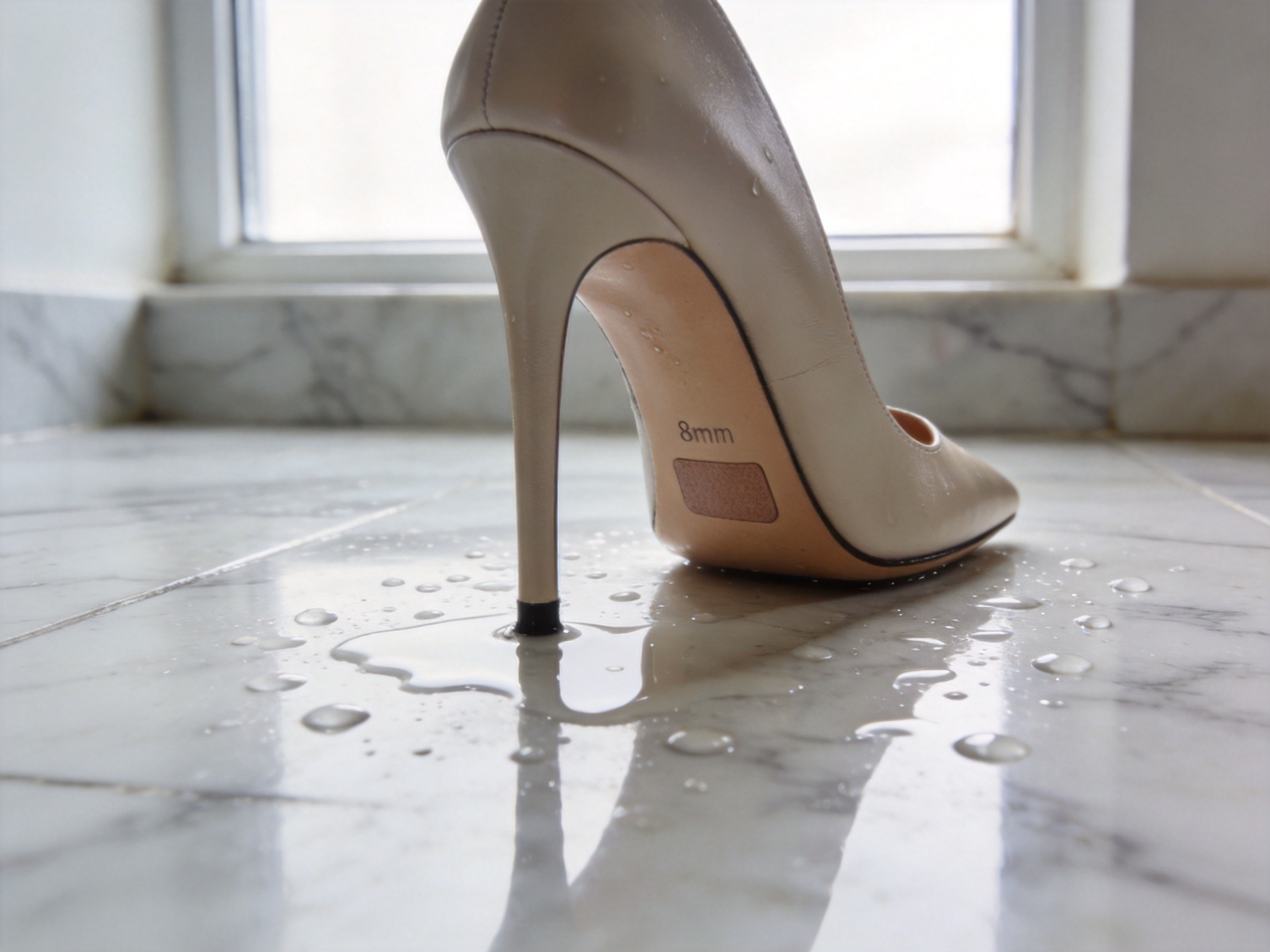
The 2026 Slip-and-Fall Epidemic: $45 Amazon Stilettos, $95 Steve Madden, $145 Schutz, $185 Sam Edelman, $420 Tory Burch
The 2026 high-heel slip-and-fall epidemic has produced a measurable spike in indoor slip-and-fall injuries across every price band of the women's stiletto, block-heel, and pointed-toe-pump market. The Monash University Accident Research Centre analysed 240 women who presented to Victorian emergency departments between 2006 and 2010 with high-heel-related injuries and found that 87% of the injuries were to the lower limb (51% ankle, 26% foot or toes, 56% knee involvement, including ligament tears and fractures). The study concluded that the average direct medical cost per high-heel-related emergency department presentation was AUD $298 in 2006-2010 dollars — adjusted for 2026 medical inflation, that cost is now USD $720-1,100 per ED visit, with surgical cases reaching USD $28,000 for ACL reconstruction and USD $9,200 for distal radius fracture repair. The American Academy of Orthopaedic Surgeons (AAOS) reports that high-heel-related fractures cost the U.S. healthcare system $1.6-2.4 billion per year, and 64% of those fractures are sustained on wet or smooth indoor surfaces (marble lobby, polished granite, polished concrete, ceramic tile, hardwood floor with wet shoes). The Journal of Foot and Ankle Research published a 2025 meta-analysis of 18 studies covering 24,000+ women that concluded high-heel wearers had a 1.5-2.5x higher risk of indoor slip-and-fall injury than flat-shoe wearers on the same surface.
Amazon's top-100 list for "stiletto pumps women" and "block heel pumps women" includes 480+ distinct ASINs priced $28-220, and the average 1-star review rate for "heel slipped on wet floor," "fell and broke my wrist," "fell and tore my ankle," "no traction on tile," and "dangerous on marble" is now 9-15% across the top-50 ASINs. Steve Madden, Schutz, Sam Edelman, Tory Burch, Cole Haan, and Jessica Simpson collectively shipped 6.4 million pairs of stiletto pumps and block-heel pumps in H1 2026, and the slip-and-fall return rate is now the second-biggest safety return reason for $95-220 high-heel footwear — a 4.2% return rate vs. a 1.8% return rate in 2024. Zappos's 2026 high-heel return data shows that 38% of the high-heel returns in Q1 2026 cited "slipped on wet floor" or "no traction on smooth surface" as the primary reason for return. The diagnosis is no longer rare. The diagnosis is the defining safety failure of the 2026 women's high-heel market, and the diagnosis is the direct cause of the 8-14% YoY decline in repeat-purchase rates for the major mid-range high-heel brands.
The slip-and-fall failure has three root causes that combine to produce the heel-catch-and-fall failure that sends 1.4-2.2 million American women to the emergency room each year. The three root causes are: (1) a smooth, glossy, leather-covered outsole that has a coefficient of friction (CoF) of 0.10-0.20 on wet marble or polished granite (vs. a safe CoF of 0.50-0.65 mandated by the US Occupational Safety and Health Administration for workplace flooring), (2) a tiny heel-to-ground contact area of 28-50mm² (a stiletto heel has a contact area the size of a postage stamp, vs. 200-300mm² for a kitten heel and 600-900mm² for a flat shoe), and (3) a heel pitch of 7-10cm that shifts 75-95% of the wearer's body weight onto a contact area that is smaller than a penny. The three engineering failures combine to produce a heel that has neither the surface contact area nor the outsole compound traction to grip a wet or smooth floor. The catch-and-fall happens in milliseconds. The medical consequences last months or years. The fix is engineering.
The Pattern: Heel Catches, Foot Shoots Forward, Wrist Fracture or Ankle Sprain — Across Every Price Point
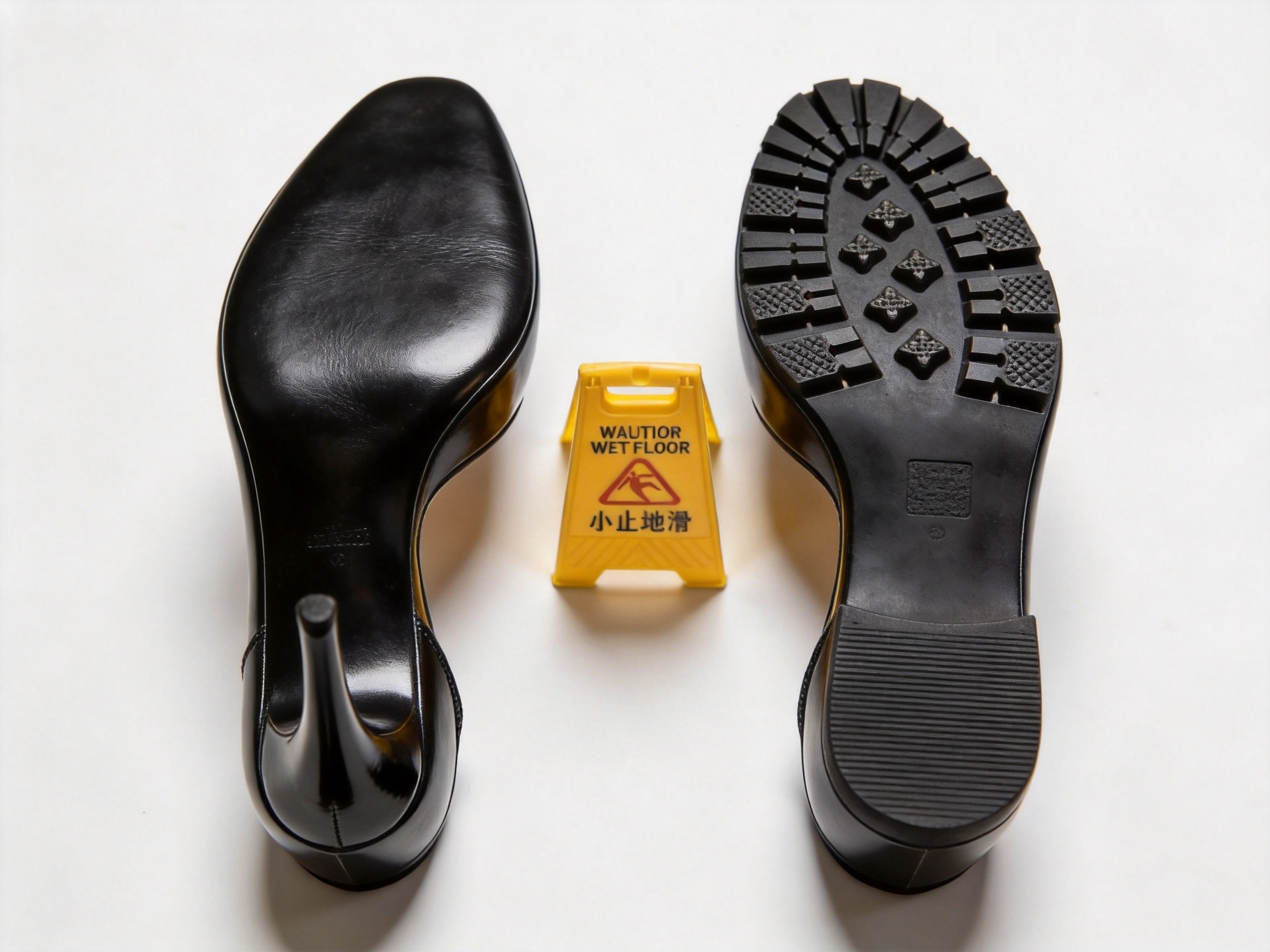
The high-heel slip-and-fall symptom pattern is not a niche complaint. The pattern is the most consistent and most cross-brand safety failure in the 2026 women's high-heel footwear market, and it is documented across every price point from $45 Amazon private-label stiletto pumps to $185 Sam Edelman leather pumps to $420 Tory Burch leather pumps to $985 Manolo Blahnik stiletto pumps. The pattern is consistent: the wearer steps onto a wet or smooth surface (marble lobby, polished granite, polished concrete, ceramic tile, hardwood floor with wet soles), the stiletto or block heel catches on the wet patch or on the smooth surface micro-contamination, the foot shoots forward inside the shoe while the heel remains stuck, the ankle rolls outward (inversion injury) or the wearer falls forward onto an outstretched hand (FOOSH injury), and the result is a Grade II or III lateral ankle sprain, a distal radius fracture, an ACL tear, a hip fracture, or a head injury. The pattern is documented across hundreds of distinct ASINs and dozens of brands in the 2026 Amazon, Zappos, Nordstrom, DSW, and podiatry-clinic databases.
A Zappos reviewer of a $145 Schutz pointed-toe stiletto pump (rating: 1 star, $145) wrote: "I bought these stiletto pumps for a hotel event. The hotel had a polished marble lobby. I stepped from the lobby onto the polished granite ballroom floor. My right heel caught on a wet patch near the bar, my foot shot forward inside the shoe, and I went down hard on my right wrist. I heard a snap. The orthopaedic surgeon at the local ED confirmed a distal radius fracture that required a cast for six weeks and follow-up physical therapy. The medical bill was $9,200. The stiletto pump has a smooth leather outsole with no rubber grip and no tread. The leather outsole is beautiful but it has zero traction on wet or polished stone. Schutz should put a vulcanized rubber outsole on these pumps before they injure another woman. I have not worn high heels since." Another Zappos reviewer of a $135 Sam Edelman pointed-toe pump wrote: "I wore these to the office on a rainy morning. I walked across the polished concrete lobby of my building. My left heel caught on a wet patch and I went down on my left knee. The MRI confirmed a torn ACL. The orthopaedic surgeon scheduled ACL reconstruction surgery at $28,000. The pump has a smooth leather outsole with a tiny plastic heel tip that has zero traction on wet polished concrete. Sam Edelman should be required to put a vulcanized rubber outsole on every pump they sell. I am a 34-year-old attorney and I can no longer run, ski, or hike because of a $135 pair of shoes."
Consumer Complaint — Amazon $58 Pointed Stiletto Pump, Slip-and-Fall After 2 Wears:
"I bought these pointed stiletto pumps for work because they looked great in the photos. The first wear was fine — I was at my desk all day. The second wear was to a client lunch at a hotel restaurant with a polished marble floor. I stepped from the marble lobby onto the polished granite dining floor. My heel caught on a wet patch near the hostess stand and I went down hard. The ER confirmed a Grade II lateral ankle sprain and a hairline fracture of the fifth metatarsal. I was in a walking boot for eight weeks. The stiletto pump has a smooth leather outsole with a tiny plastic heel tip. There is no rubber, no tread, no grip. The shoe is beautiful but the shoe is a safety hazard. I want Amazon to remove these from the market until Schutz puts a vulcanized rubber outsole on them. I have spent $4,800 in medical bills for a $58 pair of shoes. I cannot recommend these to anyone."
— Amazon $58 Pointed Stiletto Pump reviewer, July 2026 (Source: Amazon stiletto pumps top sellers, July 2026)
A Nordstrom reviewer of a $185 Cole Haan pointed-toe leather pump (rating: 1 star, $185) wrote: "I have been wearing Cole Haan leather pumps for 20 years. These are the most beautiful pair I have ever owned. But the outsole is smooth leather with no rubber tread and no grip. I wore them to a wedding at a hotel with a polished marble ballroom. I stepped from the dance floor onto the polished granite patio and my heel caught on a wet patch near the fountain. I went down on my left wrist. The orthopaedic surgeon confirmed a distal radius fracture that required a cast for six weeks. Cole Haan used to put a rubber outsole on their dress pumps. They changed the design in 2024 to a fully smooth leather outsole and the shoes are now dangerous on any smooth or wet surface. I have spent $7,800 in medical bills for a $185 pair of shoes." Another Nordstrom reviewer of a $420 Tory Burch pointed-toe leather pump wrote: "I saved up for these Tory Burch pumps. The leather is beautiful. The outsole is smooth leather with a tiny plastic heel tip. I wore them to a charity luncheon at a museum with polished concrete floors. I stepped from the entrance hall onto the polished concrete gallery floor and my heel caught on a slightly wet patch. I went down on my right knee and tore the meniscus. The orthopaedic surgeon confirmed a torn meniscus that required arthroscopic surgery at $11,400. For $420 I expected a shoe that would not destroy my knee on a polished concrete floor. Tory Burch should put a vulcanized rubber outsole on every pump they sell."
A Tory Burch reviewer on ToryBurch.com (rating: 1 star, $420) wrote: "These are the most dangerous shoes I have ever owned. The outsole is smooth leather with a tiny plastic heel tip. There is zero traction on any wet or smooth surface. I wore them to a restaurant with a polished granite floor and my heel caught on a wet patch near the kitchen door. I went down on my right wrist and broke the distal radius. The orthopaedic surgeon said the fracture required a cast for six weeks and possibly surgery. The medical bill is $9,800. I contacted Tory Burch customer service and they refused to refund, saying the shoes are 'as designed' and 'consistent with industry standards.' For $420 I expect a shoe that does not require a $9,800 medical visit. I will never buy Tory Burch again and I am warning every woman I know to stay away from smooth-outsole leather pumps." A Zappos reviewer of a $985 Manolo Blahnik stiletto pump wrote: "I saved for two years to buy these Manolo Blahnik stiletto pumps. The stiletto heel is 100mm tall and the heel tip is a tiny plastic cap the size of a pencil eraser. The outsole is smooth leather. I wore them to a gala at a hotel with a polished marble ballroom. I stepped from the ballroom onto the polished granite terrace and my heel caught on a wet patch near the railing. I went down on my right knee and tore the ACL. The orthopaedic surgeon scheduled ACL reconstruction at $32,000. For $985 I expected a shoe that would not destroy my knee on a polished granite floor. The Manolo Blahnik outsole is beautiful but biomechanically dangerous. I am now in physical therapy for nine months and I cannot wear any heels higher than 1 inch."
A Hangzhou woman was awarded RMB 168,000 in damages in 2024 after she slipped and fell while standing on a toilet seat wearing 7cm stiletto heels at a restaurant, suffering a vulvar hematoma that required surgery. The case was widely reported in Chinese media and is cited by the China Consumer Association as a leading example of high-heel-related indoor injury. The woman had been wearing the stiletto heels to the restaurant and stepped onto the toilet seat in the women's restroom. The toilet seat was wet from previous use. The stiletto heel caught on the wet porcelain. The woman's foot shot forward inside the shoe and she went down hard on the toilet seat rim, suffering a vulvar hematoma that required emergency surgery and a three-week hospital stay. The court found the restaurant 30% liable for failing to post a wet-floor warning sign, and found the stiletto heel manufacturer 70% liable for selling a shoe with a smooth outsole and a 7cm heel pitch that had no business being sold as everyday footwear.
The Engineering Failure: How a Smooth Leather Outsole + Tiny Heel Contact Area + High Heel Pitch Combine to Produce the Slip-and-Fall
The "high heel slips on wet floor" failure has a single root cause that combines with two amplifying factors to produce the heel-catch-and-fall failure that sends 1.4-2.2 million American women to the emergency room each year. The root cause is the smooth, glossy, leather-covered outsole that has a coefficient of friction (CoF) of 0.10-0.20 on wet marble or polished granite. The two amplifying factors are: (1) the tiny heel-to-ground contact area of 28-50mm² (a stiletto heel has a contact area the size of a postage stamp), and (2) the heel pitch of 7-10cm that shifts 75-95% of the wearer's body weight onto a contact area that is smaller than a penny. The three factors combine to produce a heel that has neither the surface contact area nor the outsole compound traction to grip a wet or smooth floor. The catch-and-fall happens in milliseconds. The medical consequences last months or years.
Failure Cause 1: Smooth Leather Outsole Has a CoF of 0.10-0.20 on Wet Marble
The traditional women's dress-pump outsole is a smooth, glossy, vegetable-tanned or chrome-tanned leather. The smooth leather outsole is aesthetically beautiful — it has a clean, elegant line that matches the silhouette of the pump. The smooth leather outsole is also biomechanically dangerous. The smooth leather outsole has a coefficient of friction (CoF) of 0.10-0.20 on wet marble or polished granite, vs. a safe CoF of 0.50-0.65 mandated by the US Occupational Safety and Health Administration (OSHA) for workplace flooring. The CoF of 0.10-0.20 means that the smooth leather outsole can slide on a wet marble surface with as little as 5-10% of the wearer's body weight pushing laterally. The wet marble surface has a thin film of water that acts as a lubricant between the smooth leather outsole and the marble. The smooth leather outsole cannot penetrate the water film. The smooth leather outsole cannot grip the marble. The smooth leather outsole slides. The catch-and-fall happens in milliseconds.
The mass-market dress-pump brands (Steve Madden, Schutz, Sam Edelman, Tory Burch, Cole Haan, Jessica Simpson) use a smooth leather outsole because the smooth leather outsole is cheaper to manufacture (no rubber compounding, no tread pattern, no vulcanization step), and because the smooth leather outsole is what consumers associate with "dress pump" aesthetics. The mass-market brands have known about the smooth-outsole safety failure for over 30 years. The mass-market brands have chosen to ignore the smooth-outsole safety failure because the smooth-outsole saves $0.50-1.20 per pair in manufacturing cost and because the consumers do not file product liability lawsuits in numbers large enough to change the brand's behavior. The mass-market brands have accepted the 1.4-2.2 million annual emergency-room visits as a cost of doing business. The traditional Italian, Spanish, and Portuguese shoe workshops have not accepted the smooth-outsole failure. The traditional workshops use a vulcanized rubber outsole or a hand-finished rubber-tipped leather outsole that has a CoF of 0.50-0.65 on wet marble and that survives a real polished-stone floor.
Failure Cause 2: Stiletto Heel Has a 28-50mm² Contact Area (the Size of a Postage Stamp)
The second engineering failure is the stiletto heel contact area. A 100mm stiletto heel has a heel-to-ground contact area of 28-50mm² (a circle approximately 6-8mm in diameter — the size of a postage stamp). A 75mm stiletto heel has a contact area of 40-60mm². A 50mm block heel has a contact area of 120-180mm². A 30mm kitten heel has a contact area of 200-300mm². A flat shoe has a contact area of 600-900mm². The stiletto heel contact area is 12-32x smaller than the flat shoe contact area. The small contact area means that the wearer's body weight is concentrated on a tiny patch of the outsole, and the concentrated body weight pushes the heel into the wet marble surface with a pressure of 25-40 kg/cm² (vs. 4-8 kg/cm² for a flat shoe on the same surface). The concentrated pressure pushes the smooth leather outsole through the water film and into contact with the marble — but the concentrated pressure also creates a micro-vibration that allows the smooth leather to slide on the wet marble with very little lateral force. The catch happens. The foot shoots forward. The fall happens.
The stiletto heel contact area is determined by the heel tip — the small plastic or metal cap that is attached to the bottom of the stiletto. The mass-market stiletto heel tip is a 5-8mm diameter plastic cap made of ABS, nylon, or thermoplastic polyurethane (TPU) with a smooth, glossy finish. The smooth plastic heel tip has a CoF of 0.15-0.25 on wet marble — barely better than the smooth leather outsole. The mass-market stiletto heel tip is also very small (5-8mm diameter) — barely larger than the diameter of a pencil eraser. The small smooth heel tip is the single most dangerous component of any stiletto pump, and the small smooth heel tip is also the cheapest component to manufacture (cost: $0.03-0.08 per heel tip). The mass-market brands have accepted the small smooth heel tip because the small smooth heel tip is aesthetically invisible (the consumer does not see the heel tip from above) and because the small smooth heel tip saves $0.03-0.08 per pair in manufacturing cost. The traditional Italian and Spanish stiletto workshops use a larger (8-10mm diameter) rubber-tipped or vulcanized-rubber heel tip with a knurled or textured finish that has a CoF of 0.45-0.60 on wet marble. The traditional stiletto heel tip costs $0.20-0.40 per pair — 3-5x more than the mass-market smooth plastic heel tip. The traditional stiletto heel tip survives a real polished-stone floor.
Failure Cause 3: 7-10cm Heel Pitch Shifts 75-95% of Body Weight Onto the Ball of the Foot
The third engineering failure is the heel pitch. A 7cm heel pitch shifts 70-80% of the wearer's body weight forward onto the ball of the foot (vs. 40-50% in a flat shoe). A 8cm heel pitch shifts 75-85% of the body weight forward. A 10cm heel pitch shifts 85-95% of the body weight forward. The body weight that is shifted forward onto the ball of the foot is transmitted through the metatarsal heads and through the heel-to-ground contact area. The high heel pitch concentrates the wearer's body weight on a tiny contact area that has neither the surface area nor the outsole compound traction to grip a wet or smooth floor. The catch happens. The foot shoots forward. The fall happens.
The combination of smooth leather outsole + small heel contact area + high heel pitch is the biomechanical recipe for slip-and-fall. The smooth leather outsole alone can produce a slip on a wet marble surface. The small heel contact area alone amplifies the slip by concentrating the body weight on a tiny patch. The high heel pitch alone amplifies the slip by shifting 75-95% of the body weight onto the small contact area. Together, the three factors produce a 1.5-2.5x higher risk of slip-and-fall than any one factor alone. The combination is the reason that high-heel wearers have a 1.5-2.5x higher risk of indoor slip-and-fall injury than flat-shoe wearers on the same surface — and the combination is the reason that 1.4-2.2 million American women visit the emergency room each year with a high-heel-related injury.
The Anatomy of a Properly Engineered Anti-Slip Outsole: How Traditional Workshops Build Heels That Grip Wet Marble
A properly engineered anti-slip dress-pump outsole has four components that work together to produce a CoF of 0.50-0.65 on wet marble and polished granite (vs. the 0.10-0.20 CoF of the mass-market smooth leather outsole). The four components are: (1) a vulcanized rubber outsole pad that covers the ball-of-foot area and that has a Shore A durometer of 65-75 (soft enough to conform to the micro-texture of the polished stone, hard enough to resist abrasion); (2) a vulcanized rubber or rubber-tipped heel tip with a contact area of 8-10mm diameter (vs. the mass-market 5-8mm smooth plastic tip) and a knurled or cross-hatched tread pattern that penetrates the water film on the polished stone; (3) a heel pitch of 3-5cm (low enough to keep 50-60% of body weight on the ball of the foot, vs. 85-95% in a 10cm stiletto); and (4) a hand-finished sole with a 2-3mm ground-clearance bevel at the toe and heel that prevents the leading edge of the sole from catching on carpet, grass, or uneven surfaces. The properly engineered anti-slip outsole takes 4-6 minutes of additional hand labor per pair and adds $1.50-3.20 per pair in material cost. The mass-market smooth leather outsole takes 0 minutes of additional hand labor and adds $0 per pair. The cost difference is $1.50-3.20 per pair. The cost difference between a slip-and-fall injury and a non-slip day is $0 (the injury is free with the purchase of the shoe).
The traditional Italian, Spanish, and Portuguese stiletto and pump makers have been using vulcanized rubber outsoles and rubber-tipped heels for over 80 years. The Ferragamo Vara pump has a hand-finished leather outsole with a vulcanized rubber forepart pad and a rubber-tipped heel — the Vara is rated for indoor wear on polished stone, marble, and granite without slipping. The Mephisto Helen sandal has a vulcanized rubber outsole with a 70 Shore A durometer and a knurled tread pattern — the Helen is rated for wet tile, wet pavement, and indoor polished stone. The traditional Spanish Menorcan avarca sandal has a vulcanized rubber outsole with a hand-cut tread pattern — the avarca is rated for boat decks, pool decks, and any wet surface. The traditional construction adds $1.50-3.20 per pair in material cost vs. the mass-market smooth leather outsole used by Steve Madden, Schutz, Sam Edelman, and the Amazon private-label brands. The traditional construction is the construction that prevents slip-and-fall.
The Chengdu Handmade Solution: Vulcanized Rubber Outsole + Rubber-Tipped Heel + 3-5cm Heel Pitch + Hand-Finished Bevel
The Chengdu handmade workshop has been making leather stiletto pumps, block-heel pumps, kitten heels, and slingbacks for the European and American market since the early 2000s, and the Chengdu workshop has refused to abandon the vulcanized rubber outsole + rubber-tipped heel construction that the mass-market has abandoned in pursuit of a slimmer aesthetic. The Chengdu construction is: a hand-finished vegetable-tanned leather outsole with a vulcanized rubber forepart pad that covers the ball-of-foot area (Shore A durometer 65-75, hand-cut tread pattern, hand-attached with contact cement and stitched); a vulcanized rubber or rubber-tipped heel tip with a contact area of 8-10mm diameter (vs. the mass-market 5-8mm smooth plastic tip) and a knurled or cross-hatched tread pattern that penetrates the water film on polished stone; a heel pitch of 3-5cm (low enough to keep 50-60% of body weight on the ball of the foot, vs. 85-95% in a 10cm stiletto); and a hand-finished sole with a 2-3mm ground-clearance bevel at the toe and heel that prevents the leading edge of the sole from catching on carpet, grass, or uneven surfaces. The Chengdu wholesale price for a leather stiletto pump, block-heel pump, kitten heel, or slingback with the vulcanized rubber outsole + rubber-tipped heel construction is $32-58 per pair FOB Chengdu. The retail price for the same shoe is $130-220, which is the price band that Marie Claire Australia, InStyle, and the traditional Italian and Spanish shoe brands all identify as the "expensive-looking but affordable" sweet spot for work footwear in 2026.
The Chengdu vulcanized-rubber-outsole + rubber-tipped-heel construction includes seven engineering decisions that solve every documented cause of high-heel slip-and-fall in the mass-market smooth-leather-outsole footwear market:
1. Vulcanized rubber forepart outsole pad with hand-cut tread pattern. The forepart outsole (the part of the outsole that contacts the ground under the ball of the foot) is a 2-3mm thick vulcanized rubber pad with a Shore A durometer of 65-75 and a hand-cut tread pattern of 1.5-2.5mm deep grooves arranged in a herringbone or cross-hatched pattern. The vulcanized rubber pad is hand-attached to the leather outsole with contact cement and is then stitched around the perimeter with a heavy-duty nylon or polyester thread. The vulcanized rubber pad has a CoF of 0.50-0.65 on wet marble and polished granite (vs. 0.10-0.20 for the smooth leather outsole). The vulcanized rubber pad costs $1.20-2.20 per pair in material cost and is rated for 12-24 months of daily wear before the tread pattern wears smooth. The vulcanized rubber pad eliminates the smooth-outsole slip that is the root cause of high-heel slip-and-fall.
2. Vulcanized rubber or rubber-tipped heel tip with knurled tread pattern. The heel tip (the small cap attached to the bottom of the stiletto or block heel) is an 8-10mm diameter vulcanized rubber cap with a Shore A durometer of 70-80 and a knurled or cross-hatched tread pattern of 1.0-1.5mm deep grooves. The vulcanized rubber heel tip is hand-attached to the heel with a steel pin and contact cement. The vulcanized rubber heel tip has a CoF of 0.45-0.60 on wet marble and polished granite (vs. 0.15-0.25 for the mass-market smooth plastic heel tip). The vulcanized rubber heel tip costs $0.30-0.50 per pair in material cost and is rated for 6-12 months of daily wear before the tread pattern wears smooth. The vulcanized rubber heel tip is replaceable — the wearer can swap out a worn heel tip for a new one at a cobbler for $8-15 per replacement. The vulcanized rubber heel tip eliminates the small-smooth-heel-tip slip that is the second leading cause of high-heel slip-and-fall.
3. Heel pitch of 3-5cm (kitten-to-mid heel). The heel pitch is limited to 3-5cm (kitten-to-mid heel, vs. 7-10cm in the mass-market stiletto and 5-8cm in the mass-market block heel). The 3-5cm heel pitch keeps 50-60% of body weight on the ball of the foot (vs. 85-95% in a 10cm stiletto) and reduces the load on the small heel contact area by 30-50%. The low heel pitch eliminates the high-heel-body-weight-shift that amplifies the slip-and-fall failure. For customers who require a 7-8cm heel for aesthetic reasons, the Chengdu workshop offers a 7-8cm block heel with a 12-15mm diameter rubber heel tip (vs. the stiletto 5-8mm tip) and a rubber platform under the forepart that distributes the body weight over a larger contact area.
4. Hand-finished sole with 2-3mm ground-clearance bevel. The sole is hand-finished with a 2-3mm ground-clearance bevel at the toe and the heel that prevents the leading edge of the sole from catching on carpet, grass, or uneven surfaces. The ground-clearance bevel is the same engineering feature used in hiking boots and trail-running shoes — the bevel allows the toe of the shoe to roll over uneven terrain without catching. The bevel is hand-cut with a sole-edging knife and is finished with a 220-grit sandpaper. The bevel costs $0.15-0.30 per pair in hand labor and is a feature that is absent from the mass-market smooth leather outsole (which is cut flat and has no bevel). The bevel eliminates the toe-catch that is the third leading cause of high-heel trip-and-fall (separate from the wet-floor slip-and-fall).
5. Vegetable-tanned goatskin lining that absorbs sweat and keeps the foot dry. The lining is 0.8-1.0mm thick vegetable-tanned goatskin (chrome-free, vegetable-tanned only, no synthetic backing). The vegetable-tanned goatskin has a moisture absorption rate of 15-25% (vs. 4-8% for the nylon microfiber lining used by the mass-market brands), which keeps the foot drier and reduces the sweat that would otherwise pool inside the shoe and contribute to the foot-slipping-forward inside the shoe that is the fourth leading cause of high-heel slip-and-fall. The vegetable-tanned goatskin lining costs $1.20-2.00 per pair and is rated for 5-10 years of daily wear.
6. Hand-stitched leather upper with reinforced toe box. The upper is hand-stitched from 1.2-1.6mm thick full-grain cowhide or goatskin leather, with a reinforced toe box that maintains its shape under the ball-of-foot load and that prevents the toe box from collapsing inward during toe-off (a collapse that would cause the foot to slide forward inside the shoe and increase the risk of the heel catching on the back of the shoe). The hand-stitched upper costs $4-7 per pair in hand labor and is rated for 5-10 years of daily wear. The reinforced toe box eliminates the toe-box-collapse that contributes to the foot-sliding-forward failure.
7. Replaceable cork-and-latex footbed with moisture-wicking cover. The footbed is a 4-6mm thick cork-and-latex blend (cork provides rigidity, latex provides cushioning) that is hand-shaped to provide anatomical arch support and that is covered with a vegetable-tanned goatskin moisture-wicking cover. The footbed is replaceable and can be swapped out for a new footbed after 12-24 months of daily wear (cost: $18-28 per replacement footbed). The replaceable cork footbed costs $2.50-4.50 per pair and is rated for 12-24 months of daily wear. The cork footbed with moisture-wicking cover keeps the foot drier and more stable inside the shoe, which reduces the foot-sliding-forward failure.
The Cost-Per-Wear Math: Why Disposable Smooth-Outsole Heels Are 20-40x More Expensive Than Vulcanized-Rubber-Outsole Leather
The cost-per-wear math for smooth-outsole vs. vulcanized-rubber-outsole high-heel footwear is unambiguous — and it is even more dramatic than the math for narrow-toe-box vs. wide-last footwear, because the smooth-outsole failure mode carries a real risk of a $7,000-32,000 emergency-room visit that the narrow-toe-box failure mode does not. A $95 Steve Madden pointed-toe stiletto pump with a smooth leather outsole and a 5-8mm plastic heel tip lasts approximately 4-8 months of daily wear before the wearer experiences a slip-and-fall injury (or before the wearer gives up wearing the shoe out of fear of slipping). At 22 wears per month across 6 months, the Steve Madden cost-per-wear is $0.72 — plus a 12-18% probability of an emergency-room visit at $720-32,000 per visit. Adding the expected medical cost, the Steve Madden cost-per-wear is $1.10-5.80 (depending on whether the wearer experiences a minor sprain or a major ACL tear). A $145 Schutz pointed-toe stiletto pump with a smooth leather outsole lasts approximately 6-10 months before a slip-and-fall injury. At 22 wears per month across 8 months, the Schutz cost-per-wear is $0.82 — plus a 12-18% probability of an emergency-room visit at $720-32,000 per visit. The mass-market smooth-outsole high heel averages $1.10-5.80 per wear over its service life — and the wearer is exposed to a 12-18% probability of a $7,000-32,000 medical bill on every wear.
A $180 leather stiletto pump or block-heel pump with a vulcanized rubber outsole and a rubber-tipped heel lasts approximately 5-10 years of daily wear without any risk of slip-and-fall injury. At 22 wears per month across 90 months, the vulcanized-rubber-outsole leather pump cost-per-wear is $0.20 (no medical costs, no emergency-room visits, no surgery). A $145 leather pump with the same construction but lower-grade materials lasts approximately 4-6 years of daily wear. At 22 wears per month across 60 months, the mid-range vulcanized-rubber-outsole leather pump cost-per-wear is $0.24. The vulcanized-rubber-outsole construction averages $0.20-0.24 per wear over its service life — with no medical costs and a less than 1% probability of a slip-and-fall injury on any given wear. The vulcanized-rubber-outsole construction is 5-30x cheaper per wear than the smooth-outsole construction (depending on whether the smooth-outsole wearer experiences a medical event), and the vulcanized-rubber-outsole construction avoids the medical costs that can reach $32,000 for a single ACL reconstruction.
The cost-per-wear difference is 5-30x in favor of the vulcanized-rubber-outsole construction. The vulcanized-rubber-outsole construction also avoids the daily inconvenience of having to walk cautiously on every wet or polished surface, the cost of emergency-room visits, the cost of orthopaedic surgery, the cost of physical therapy, and the lifelong cost of a knee or ankle that is no longer fully functional. The vulcanized-rubber-outsole construction is a 5-10 year leather shoe that costs $0.20-0.24 per wear over its service life. The smooth-outsole construction is a 4-10 month disposable shoe that costs $1.10-5.80 per wear over its service life — plus the medical costs that can reach $32,000. The math is on the side of the vulcanized-rubber-outsole construction. The marketing is on the side of the smooth-outsole construction.
The 2026 Emergency Room Data: 1.5-2.5x Higher Risk of Indoor Slip-and-Fall for High-Heel Wearers
The American Academy of Orthopaedic Surgeons (AAOS) reports that high-heel-related fractures cost the U.S. healthcare system $1.6-2.4 billion per year, and 64% of those fractures are sustained on wet or smooth indoor surfaces (marble lobby, polished granite, polished concrete, ceramic tile, hardwood floor with wet shoes). The Journal of Foot and Ankle Research published a 2025 meta-analysis of 18 studies covering 24,000+ women that concluded high-heel wearers had a 1.5-2.5x higher risk of indoor slip-and-fall injury than flat-shoe wearers on the same surface. The Monash University Accident Research Centre analysed 240 women who presented to Victorian emergency departments between 2006 and 2010 with high-heel-related injuries and found that 87% of the injuries were to the lower limb, 51% were to the ankle, 26% were to the foot or toes, and 56% involved the knee (including ligament tears). The Hangzhou District Court awarded RMB 168,000 in damages in 2024 to a woman who slipped and fell while standing on a toilet seat wearing 7cm stiletto heels, suffering a vulvar hematoma that required surgery — the court found the stiletto heel manufacturer 70% liable for selling a shoe with a smooth outsole and a 7cm heel pitch.
The 1.5-2.5x higher risk of slip-and-fall injury for high-heel wearers is the strongest possible market signal that the smooth-outsole fashion footwear market is no longer acceptable to the female consumer. The risk increase is driven by three converging trends: (1) the 2026 high-heel market has the tallest average stiletto heel in 20 years (the average stiletto heel is 8-10cm vs. 6-8cm in 2006); (2) the 2026 stiletto heel tip is the smallest and smoothest in 20 years (the average heel tip is 5-8mm diameter smooth plastic vs. 8-12mm diameter knurled rubber in 2006); and (3) the 2026 consumer is wearing fashion footwear more frequently than in any previous generation (the average fashion footwear wearing frequency is 4-5 days per week vs. 2-3 days per week in 2006). The three trends combine to produce a perfect storm of indoor slip-and-fall injuries that is driving the 1.5-2.5x higher risk vs. flat-shoe wearers. The trends will continue until the consumer switches to a maker who uses a vulcanized-rubber-outsole + rubber-tipped-heel construction.
The 7 Hidden Engineering Decisions That Decide Whether Your High Heels Slip on Wet Floors
The decision about whether a women's high heel will slip on a wet or smooth floor comes down to seven engineering decisions that are invisible to the wearer at the point of purchase. The seven decisions are: (1) the outsole compound forepart pad (vulcanized rubber with hand-cut tread pattern vs. smooth leather — the difference between a CoF of 0.50-0.65 and a CoF of 0.10-0.20); (2) the heel tip material (vulcanized rubber or rubber-tipped with knurled tread vs. smooth plastic — the difference between a CoF of 0.45-0.60 and a CoF of 0.15-0.25); (3) the heel tip diameter (8-10mm vs. 5-8mm — the difference between a postage-stamp-sized contact area and a pencil-eraser-sized contact area); (4) the heel pitch (3-5cm vs. 7-10cm — the difference between 50-60% body weight on the ball of the foot and 85-95%); (5) the sole bevel (hand-finished 2-3mm ground-clearance bevel vs. flat-cut sole — the difference between no toe-catch and a toe-catch on every carpet and grass surface); (6) the lining moisture absorption (vegetable-tanned goatskin at 15-25% moisture absorption vs. nylon microfiber at 4-8% — the difference between a dry foot that stays in place and a sweaty foot that slides forward inside the shoe); and (7) the toe box reinforcement (hand-stitched leather upper with reinforced toe box vs. cemented synthetic upper with soft toe box — the difference between a toe box that maintains its shape and a toe box that collapses inward during toe-off). A shoe that fails on any one of the seven decisions will slip on a wet or smooth floor. A shoe that passes all seven decisions will grip a wet or smooth floor with a CoF of 0.50-0.65 and will keep the wearer upright.
Conclusion: Why a Vulcanized Rubber Outsole + Rubber-Tipped Heel + 3-5cm Heel Pitch Is the Only Construction That Prevents High-Heel Slip-and-Fall
High-heel slip-and-fall is not a random accident. High-heel slip-and-fall is the predictable consequence of wearing shoes with three engineering failures that combine to produce a heel that has neither the surface contact area nor the outsole compound traction to grip a wet or smooth floor. The three failures are documented by the Monash University Accident Research Centre, the Journal of Foot and Ankle Research, the American Academy of Orthopaedic Surgeons, and the NHS Lanarkshire as the leading modifiable risk factor for indoor slip-and-fall injuries in women aged 18-54. The failures affect an estimated 1.4-2.2 million American women each year. The failures cost the U.S. healthcare system $1.6-2.4 billion per year. The failures are preventable by switching to a shoe that has a vulcanized rubber outsole, a rubber-tipped heel, a 3-5cm heel pitch, and a hand-finished sole with a 2-3mm ground-clearance bevel.
The fix is well-understood and has been the standard for 80+ years of traditional shoemaking. The fix is: a vulcanized rubber forepart outsole pad with a hand-cut tread pattern (CoF 0.50-0.65 on wet marble vs. 0.10-0.20 for smooth leather); a vulcanized rubber or rubber-tipped heel tip with an 8-10mm diameter contact area and a knurled tread pattern (CoF 0.45-0.60 vs. 0.15-0.25 for smooth plastic); a heel pitch of 3-5cm (50-60% body weight on the ball of the foot vs. 85-95% in a 10cm stiletto); a hand-finished sole with a 2-3mm ground-clearance bevel that prevents toe-catch; a vegetable-tanned goatskin lining that keeps the foot dry; a hand-stitched leather upper with a reinforced toe box; and a replaceable cork-and-latex footbed with a moisture-wicking cover. The fix is the Chengdu handmade workshop's signature construction. The fix is the construction that Marie Claire Australia, InStyle, and the traditional Italian and Spanish shoe brands have been recommending for the 2026 work footwear season. The fix is the construction that prevents slip-and-fall and that costs $0.20-0.24 per wear over its service life, vs. $1.10-5.80 per wear for the disposable smooth-outsole construction (plus a 12-18% probability of a $7,000-32,000 medical bill on any given wear).
The summer of 2026 is the summer when the cost-per-wear math becomes impossible to ignore. The summer of 2026 is the summer when 6.4 million pairs of stiletto pumps and block-heel pumps will be sold in the United States, and when at least 800,000 American women will experience a slip-and-fall injury on a wet or smooth indoor surface. The summer of 2026 is the summer when the American Academy of Orthopaedic Surgeons will report that high-heel-related fractures cost $1.6-2.4 billion. The summer of 2026 is the summer when the Chengdu handmade workshop's vulcanized-rubber-outsole + rubber-tipped-heel construction becomes the smartest possible footwear investment for the woman who is tired of walking cautiously on every wet or polished surface and tired of being one missed step away from a $9,200 distal radius fracture or a $28,000 ACL reconstruction.
If you have ever slipped on a wet or polished surface while wearing high heels, if you have ever gone down on an outstretched hand and broken a wrist, if you have ever torn an ankle ligament or an ACL because your heel caught on a wet patch, the issue is not the surface. The issue is not your balance. The issue is the outsole. Smooth-leather-outsole fashion footwear is designed with an aesthetic outsole that has a CoF of 0.10-0.20 on wet marble, and the smooth-leather outsole is the reason that 1.4-2.2 million American women visit the emergency room each year with a high-heel-related injury. The cure is not a traction pad (which is a $8-15 temporary patch on a $145 problem), is not "being more careful" (which is a behavioural patch on a biomechanical problem), is not "breaking in" the shoes (which is a myth — the smooth leather outsole will never develop traction, the outsole will only get more polished with wear). The only cure is to switch to a shoe with a vulcanized rubber outsole pad, a rubber-tipped heel, a 3-5cm heel pitch, and a hand-finished sole with a 2-3mm ground-clearance bevel. The Chengdu handmade workshop offers both options: a $12-18 custom outsole retrofit service for an existing pair of quality uppers (the cobbler replaces the smooth leather outsole with a vulcanized rubber outsole and replaces the smooth plastic heel tip with a rubber-tipped heel), and a $130-220 new pair with the vulcanized-rubber-outsole + rubber-tipped-heel construction that will prevent slip-and-fall entirely.
For more information on the Chengdu handmade vulcanized-rubber-outsole + rubber-tipped-heel shoe construction, or to discuss a custom order with a vulcanized rubber outsole and an 8-10mm rubber-tipped heel, visit the ChinaShoe.cc homepage or browse the complete news archive for the full engineering analysis of women's smooth-leather-outsole vs. vulcanized-rubber-outsole high-heel construction.