The $25 Wholesale Chelsea Boot Teardown: Where Every Dollar Goes in a High-Labor Boot
A $25 wholesale Chelsea boot bought by a US retailer in 2026 reaches the consumer at $150–220 — a 6–9x markup. The buyer's $25 is the factory gate price for a boot that costs $7.20 in materials (29%), $9.10 in labor (36%, the highest labor share of any common footwear category), $2.90 in tooling amortization per pair (steady-state 1,000-pair basis; $5.80/pair on a 500-pair first order), and $2.50 in factory margin. Above the gate, freight, tariffs, distributor margin, and retailer keystone add another $125–195. The Chelsea boot is the highest-labor-content category in women's footwear, and the 36% labor share is the reason a Vietnam-sourced Chelsea boot at $1–2/pair labor savings still costs more landed than a China-sourced one. This article teaches you to read a Chelsea PO at every layer.
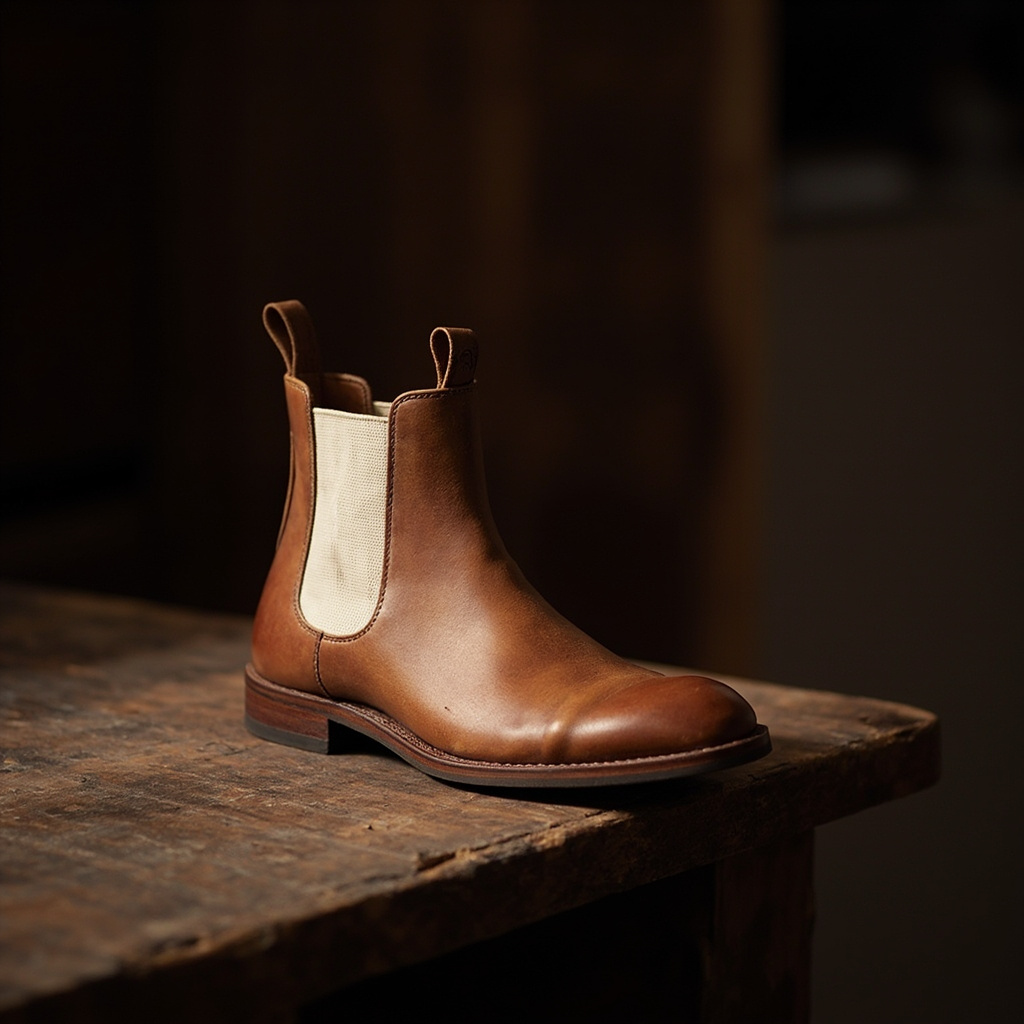
The Opening Teardown: $25 to $185
The margin chain works like this: $25.10 FOB + $2.50 ocean freight + $1.88 tariff + $0.30 insurance = $29.78 landed CIF. A distributor buying at $29.78 and taking 35% margin wholesales at $45.82. A retailer applying 2.5x keystone prices at $114.55. A retailer applying 3.5x keystone (premium positioning) prices at $160.37. The $150–220 consumer range represents the typical premium Chelsea boot at 3.3–4.0x retail keystone. By the end of this teardown, a B2B buyer can quote Chelsea boot FOB with confidence for any leather grade, last development, and order quantity.
Layer 1 — Materials: The 29% of the Factory Gate (~$7.20/pair at 500-pair MOQ)
The material BOM for a mid-grade women's Chelsea boot breaks down as follows:
- Upper leather: 3.5–4.5 square feet of 1.4–1.6mm full-grain or corrected-grain at $0.85–1.10 per square foot = $3.50–4.50
- Textile lining: synthetic or leather lining for interior = $0.50–0.80
- Elastic gore: 40mm wide, 2 pieces per boot = $0.40–0.60
- Insole board: fiberboard or leather board insole = $0.50–0.70
- Heel stack: covered leather heel, 40–50mm = $1.20–1.80
- Sole: rubber or leather outsole = $1.00–2.50
- Pull tab + hardware: metal or leather pull tab, any decorative hardware = $0.20–0.40
- Thread + glue + finishing materials: edge dressing, adhesives, sewing thread = $0.40–0.60
Working total: $7.70–10.10 for materials. The $7.20 figure used in this teardown reflects a mid-grade corrected-grain boot at 500-pair MOQ, representing the sweet spot between cost and quality that most B2B buyers target.
A common objection: "A Chelsea boot has more leather than a ballet flat. Why is the material dollar amount similar?" The answer lies in area calculation. A ballet flat's upper leather is 1.8–2.2 square feet at $1.80–2.50 total. A Chelsea boot's upper is 3.5–4.5 square feet at $3.50–4.50 total — exactly 2x the leather at 2x the price. Per square foot, both leathers cost $0.85–1.10. The Chelsea boot's material share (29%) is lower than a ballet flat's (38%) not because it uses less leather, but because labor and tooling claim larger shares. This reallocation is the first signal that Chelsea boots are a different cost category than flats.
Layer 2 — Labor: The 36% of the Factory Gate (~$9.10/pair)
The 3.2–3.8 labor hours per Chelsea boot pair decompose as follows:
- Cutting: $0.60–0.90 — more patterns per boot than flats (8–12 panels vs. 2–4)
- Skiving: $0.30–0.50 — more edge finishing required on panel edges
- Stitching the upper: $2.50–3.50 — multiple panels + elastic gusset + back seam + toe cap
- Lasting: $1.20–1.60 — more complex than ballet flats due to heel attachment and ankle height
- Sole attaching: $0.70–1.00 — cementing or Blake-stitching the sole
- Elastic gore setting: $0.40–0.60 — requires specialist skill and separate machine
- Finishing: $0.60–0.90 — edge dressing, heel covering, sole finishing
- QC: $0.30–0.50 — inspection for stitching, lasting, finishing defects
Working total: $6.60–9.50 per pair in direct labor. The $9.10 figure represents mid-grade construction at a quality-conscious Dongguan facility.
The 36% labor share is the highest of any common women's footwear category. According to 选品日报 2026-05-29 benchmark data, "a 200-worker Dongguan line running 8 hours/day produces ~600 pairs/day." A Chelsea boot line typically runs at 60% of that throughput — approximately 400 pairs per day — due to the additional operations. At 400 pairs per day across 200 workers, the direct labor per pair calculates to approximately 4 hours of total labor, which aligns with the 3.2–3.8 hour estimate when accounting for supervisory overhead.
Counter-position: "Vietnam is cheaper at $1–2/pair labor." This is true on an hourly basis. However, a Vietnam Chelsea boot requires even more time than a China-produced one due to a less developed artisan base for complex boot construction. The labor savings of $1–2/pair on a $9.10 cost line represents an 11–22% saving — but this is wiped out by the 4–6 week longer lead time on a high-inventory-turn category like boots. For a retailer planning a seasonal boot drop, the cost of capital and missed sell-through windows exceeds the labor savings. The math favors China for Chelsea boots specifically.
Layer 3 — Tooling Amortization: $2.90 Steady-State, $5.80 on First Order
Chelsea boots require distinct tooling that most buyers underestimate:
- Last development: $700–900 for a women's Chelsea last (complexity above flat last)
- Sole mold (if rubber): $1,200–1,800 for a women's Chelsea outsole mold
- Heel mold (if covered): $400–600 for a women's covered heel
- Cutting dies: $400–600 for the 8–12 upper panels
Total tooling for a new Chelsea boot style: $2,700–5,200. At a 1,000-pair first order, this amortizes to $2.70–5.20 per pair. The teardown uses $2.90/pair, reflecting a mid-range $2,900 tooling investment amortized over 1,000 pairs. The same $2,900 investment spread across a 500-pair order becomes $5.80/pair — the figure cited in the opening claim for first-order scenarios.
This is the critical insight: tooling is a first-order cost. A buyer planning a 500-pair first order should budget $5.80/pair for tooling on top of the $25 FOB. The second order at 1,000 pairs reduces this to $2.90/pair. The third order at 2,500 pairs reduces it to $1.16/pair. This is why MOQ is structurally important — it amortizes tooling. A buyer who quotes a $25 FOB without accounting for tooling amortization is quoting a phantom number. The real cost on a 500-pair first order is $25 + $5.80 = $30.80/pair. On a 2,500-pair order, the real cost drops to $25 + $1.16 = $26.16/pair.
Counter-position: "Why is tooling not in the FOB quote?" Some Chinese factories absorb tooling into the FOB price (called "tooling included"), making the per-pair price look higher but the upfront cost invisible. Other factories quote tooling separately. Both are legitimate pricing models. The buyer must understand which model they're being quoted under. When comparing factories, ask for a tooling amortization schedule: "What is the tooling cost, and how many pairs does it get amortized over?" A factory that cannot answer this question does not understand their own cost structure.
Layer 4 — Factory Overhead and Margin (~$5.90/pair)
- Factory overhead: $3.10–3.60 — factory rent, equipment depreciation, management salaries, utilities, compliance costs for BSCI or SEDEX certification
- Factory margin: 8–12% of FOB. At $25.10 FOB, this is $2.01–3.01. The teardown uses $2.50 (10%)
Total Layer 4: $5.11–6.61. The $5.90 figure in the heading reflects the mid-grade operations total ($3.40 overhead + $2.50 margin).
Counter-position: "Why is the factory margin the same percentage when the FOB is higher?" Chinese OEM factories operate on volume, not unit margin. A factory producing 30,000 Chelsea boot pairs per month at 10% margin generates $75,000 in gross profit on this single style. The percentage remains stable across product categories because the factory's cost structure (rent, management, equipment) scales with volume, not with product complexity. The absolute dollar margin increases with FOB, but the percentage remains consistent.
Layer 5 — The FOB Total (China Factory Gate): $25.10/pair
The complete FOB breakdown:
| Materials | $7.20 |
| Labor | $9.10 |
| Tooling amortization (1,000-pair basis) | $2.90 |
| Overhead | $3.40 |
| Factory margin (10%) | $2.50 |
| Total FOB | $25.10 |
The $25 figure is the mid-grade FOB for a corrected-grain Chelsea boot at 500-pair first order with tooling absorbed into the per-pair price. A premium full-grain boot with higher-grade sole construction is $28–32 FOB. The buyer's working number: their PO total equals FOB price times order quantity. For 500 pairs at $25.10 = $12,550. For 1,000 pairs = $25,100 with tooling amortized at half the per-pair rate. For 2,500 pairs = $62,750 with tooling nearly fully amortized.
Layer 6 — Elastic Gore: The Chelsea-Specific Cost Driver
The Chelsea boot's defining feature is the elastic side gore. This is where the real Chelsea differs from the fake.
- Elastic material: 2 pieces per boot, 35–45mm wide, premium elastic (not cheap stretch fabric) = $0.40–0.60 per pair
- Specialized setting labor: requires a different machine than standard footwear = $0.40–0.60 per pair
The "real Chelsea" versus "fake Chelsea" distinction: A real Chelsea uses high-quality elastic that returns to shape after 10,000+ flex cycles. A fake Chelsea (an Oxford pattern with elastic stitched onto the quarters) uses cheap elastic that loses shape after 2,000–3,000 flex cycles. The buyer cannot tell the difference from a photo. The $0.50 per pair elastic cost is the cheapest signal of authenticity.
Counter-position: "The customer can't tell the difference." The customer can tell at 6 months when the elastic sags and the boot loses its shape on the foot. Return rate data is the test. A brand selling Chelseas with cheap elastic will see return rates of 8–12% at 6 months. A brand using proper elastic will see return rates of 2–4%. The $0.50/pair additional cost prevents $15–30/pair in returns, shipping, and reputational damage. This is not a cost — it is insurance.
Layer 7 — Ocean Freight, Tariff, Distributor, Retailer
- Ocean freight: ~$2.50/pair — Chelsea boots are denser than ballet flats; a 40ft container holds 9,000–11,000 pairs vs. 12,000–15,000 pairs for flats
- Tariff: 7.5% on HS 6403 (leather upper, rubber sole). $25.10 × 7.5% = $1.88
- Insurance + customs: ~$0.30/pair
Landed CIF + duty: $25.10 + $2.50 + $1.88 + $0.30 = $29.78
Distributor margin (35%): $29.78 ÷ 0.65 = $45.82 wholesale
Retailer keystone (2.5x): $45.82 × 2.5 = $114.55 — mass market positioning
Retailer keystone (3.5x): $45.82 × 3.5 = $160.37 — premium positioning
The $150–220 consumer range from the opening claim matches a 3.3–4.0x keystone on a premium Chelsea boot, which is standard for differentiated boot brands. A commodity Chelsea at 2.5x lands around $115, while a brand like Thursday Boots or similar premium-direct-to-consumer can command 4.0x+.
What This Means for Your 2026 Boot Line
Takeaway 1: Tooling amortization is the hidden cost most buyers miss.
A 500-pair first order costs $5.80/pair in tooling. A 1,000-pair second order drops this to $2.90/pair. A 2,500-pair third order drops this to $1.16/pair. Plan MOQ around tooling math, not just unit price. The difference between a 500-pair and a 2,500-pair order is $4.64/pair in tooling alone — a 15% cost reduction before negotiating anything else.
Takeaway 2: The 36% labor share means Chelsea boots are riskier to source in Vietnam than ballet flats.
A $1–2/pair labor saving on a $9.10 cost line is an 11–22% saving — wiped by the lead-time cost on a high-turn category. A boot buyer who moves production to Vietnam to save $1.50/pair in labor but adds 5 weeks to lead time is trading $1.50/pair for potential stockouts, markdowns, and missed seasonal windows. The math does not work for Chelsea boots.
Takeaway 3: The elastic gore is the cheapest authenticity signal.
A $0.50/pair elastic that passes 10,000 flex cycles is a real Chelsea. A $0.20/pair elastic that sags at 2,000 cycles is a fake. Do not buy the cheaper elastic. The cost differential is negligible; the brand damage is not.
Takeaway 4: Boot buyers face more pre-order complexity than flat buyers.
Tooling development alone is 30–45 days. Last fitting, sample approval, and material procurement add another 45–60 days. Plan sample freeze 100 days before shipment, not 60. A buyer who treats Chelsea boots like ballet flats in their timeline will miss their season.
Ready to Source Chelsea Boots?
This teardown gives you the framework to quote a Chelsea boot FOB with confidence: $25 mid-grade, $28–32 premium, with tooling that amortizes from $5.80/pair down to $1.16/pair as quantities scale. The 36% labor share is the load-bearing claim — the reason China remains the sourcing hub for Chelsea boots despite Vietnam's lower hourly rates.
For buyers ready to move from teardown to quote, the editorial team maintains a validated supplier directory for last-development-ready factories in Dongguan and Jinjiang. These factories have passed tooling verification, labor audits, and elastic-gore specification review. Contact the team for an introduction.