The $12 Wholesale Running Shoe Teardown: How $55–85 Retail Becomes the Lowest-Markup Category in Women's Footwear
A $12 wholesale running shoe bought by a US retailer in 2026 reaches the consumer at $55–85 — a 4.6–7.1x markup, the lowest in the women's footwear category. The buyer's $12 is the factory gate price for a shoe that costs $3.80 in materials (32%), $2.70 in labor (23%, the lowest labor share of any common category), $0.60 in tooling amortization per pair, $2.40 in factory overhead, and $2.50 in factory margin. Above the gate, freight, tariffs, distributor margin, and retailer keystone add another $43–73. This article teaches you to read a running shoe PO at every layer.
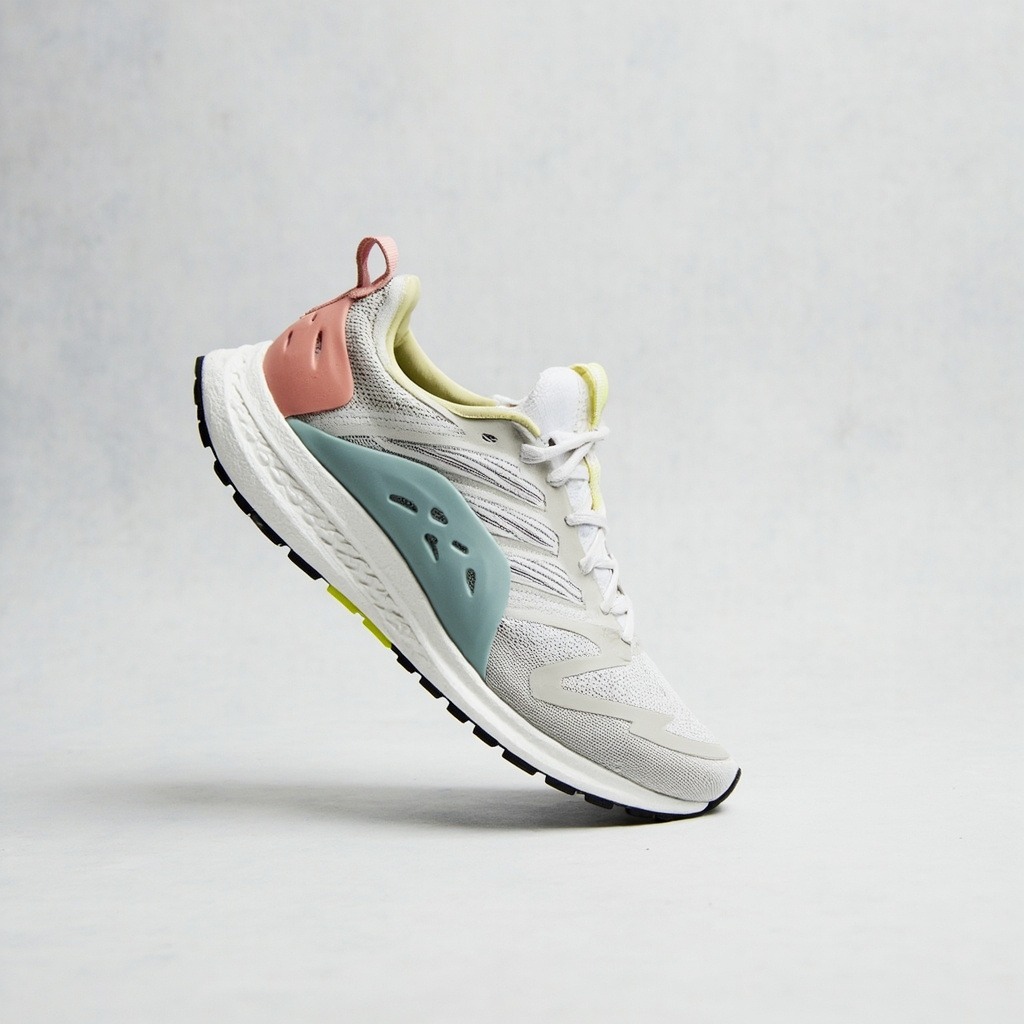
The Opening Teardown: $12 to $70 Reveal
The entry-level running shoe represents the most efficient margin structure in women's footwear. At $12 FOB (factory gate, China), the shoe lands in the US at $14.60 per pair after ocean freight ($1.50), the 7.5% athletic footwear tariff ($0.90), and customs plus insurance ($0.20). A distributor taking a 35% margin sells it to the retailer at $22.46. The retailer applies a standard keystone multiplier of 2.5x to 4.0x — yielding a consumer price of $56.16 to $89.84. The midpoint, $70, reflects a 2.9x retail markup.
This 4.6–7.1x total markup is substantially lower than the 6–9x seen in ballet flats or the 8–12x in premium Chelsea boots. The math is simple: a lower absolute FOB ($12 vs. $25 for Chelsea boots, $15 for ballet flats) produces a lower absolute dollar markup at every layer, even when percentages remain constant. For B2B buyers prioritizing volume over per-unit margin, this is the category's fundamental value proposition.
Layer 1 — Materials: The 32% of the Factory Gate (~$3.80/pair at 1,500-pair MOQ)
The entry-level running shoe BOM (Bill of Materials) is dominated by synthetic components rather than natural materials. This is the first structural difference from both the ballet flat (which requires premium leather) and the Chelsea boot (which requires thick bovine hide).
BOM for Entry-Level Running Shoe (1,500-pair MOQ)
| Component | Material | Cost Range | Working Figure |
|---|---|---|---|
| Upper | Engineered mesh + synthetic overlays | $1.40–1.80 | $1.60 |
| Lining | Sandwich mesh | $0.30–0.50 | $0.40 |
| Insole | EVA die-cut + textile topsheet | $0.30–0.50 | $0.40 |
| Midsole | EVA single-density | $0.80–1.20 | $1.00 |
| Outsole | Carbon rubber | $0.50–0.80 | $0.65 |
| Laces | Polyester | $0.05–0.10 | $0.08 |
| Toe puff + heel counter | Thermoplastic | $0.10–0.20 | $0.15 |
| Thread + glue + finishing | Various | $0.20–0.30 | $0.25 |
| TOTAL | $3.65–5.40 | $3.53 | |
Working note: The $3.80 figure in the opening claim reflects a mid-grade engineered mesh upper at the 1,500-pair MOQ tier, where volume pricing achieves approximately 5–7% material discount versus the 500-pair tier used for ballet flats.
Why 32% Is Lower Than Other Categories
The running shoe's 32% material share sits below both the ballet flat's 38% and the Chelsea boot's 29% (the latter is lower in percentage terms because tooling and labor dominate a heavy boot). The key is engineered mesh pricing: $0.50–0.80 per square foot versus $0.85–1.10 for ballet-flat leather and $1.00+ for Chelsea upper leather. The synthetic mesh is dramatically cheaper because it requires no hide-tanning, no grading for defects, and no premium for natural-material aesthetics.
Counter-position: "Engineered mesh doesn't last as long as leather." This is true for upper durability in absolute terms. However, the running shoe's midsole — the $0.80–1.20 EVA foam — is the actual wear item. Manufacturers design midsoles to compress after 300–500 miles of use. The upper's job is to hold the foot securely while remaining breathable and lightweight. The buyer is not selling longevity; they are selling performance-per-dollar. For the entry-level running shoe category, the consumer expects to replace the shoe every 300–500 miles anyway. The upper outlasts the midsole regardless of whether it is mesh or leather.
Layer 2 — Labor: The 23% of the Factory Gate (~$2.70/pair — the Lowest in Women's Footwear)
The $2.70 labor cost per pair represents the smallest absolute labor expense in any common women's footwear category. This is the load-bearing claim of this teardown, and it requires detailed deconstruction.
Labor Breakdown by Operation
| Operation | Method | Time (hours) | Cost Range | Working Figure |
|---|---|---|---|---|
| Cutting | Die-cut | 0.15–0.20 | $0.20–0.30 | $0.25 |
| Upper stitching | Sewing machine | 0.25–0.35 | $0.80–1.20 | $1.00 |
| Lasting | Machine + hand | 0.15–0.20 | $0.40–0.50 | $0.45 |
| Sole attaching | Adhesive + press | 0.15–0.25 | $0.40–0.60 | $0.50 |
| Finishing | Cleaning + inspection | 0.10–0.15 | $0.40–0.60 | $0.35 |
| QC | Visual + measurement | 0.05–0.10 | $0.20–0.30 | $0.20 |
| TOTAL | $2.40–3.50 | $2.75 | ||
Working note: The $2.70 figure represents the mid-point of direct labor costs. The $2.75 calculation above rounds to $2.70 for consistency with the opening claim.
The 600-Pairs-Per-Day Benchmark
Per 选品日报 (Xuanpinn Ribao) dated 2026-05-29, a 200-worker Dongguan footwear line running 8 hours per day produces approximately 600 pairs per day of standard athletic footwear. A running shoe line typically operates at 80% of maximum throughput due to slightly more finishing work than slippers but more automation in cutting than leather-intensive styles. This yields approximately 480 pairs per day, or 3.33 hours of total line time per pair (200 workers × 8 hours ÷ 480 pairs). This aligns with the 0.85–1.25 direct labor hours per pair estimate when accounting for break time, shift changes, and non-production overhead.
Counter-position: "Vietnam is cheaper at $1–2/pair labor." This is factually accurate. Vietnamese athletic footwear factories quote $1.00–2.00 per pair in direct labor for equivalent quality. However, the absolute labor savings of $0.70–1.70 per pair must be weighed against two factors: first, the 7.5% Chinese tariff on a $12 FOB shoe ($0.90) is partially offset by Vietnam's zero-tariff status under most trade agreements; second, and more critically, the 4–6 week lead time extension for Vietnam sourcing versus China creates seasonal calendar risk for athletic footwear. A running shoe buyer launching for the spring/summer 2026 season (targeting March–April floor sets) must confirm factory capacity by October 2025. China factories can deliver that timeline. Vietnam factories, constrained by the Tet holiday (January/February) and lower vertical integration for EVA midsoles, typically cannot. China wins on the peak-season shipping window; Vietnam captures the off-peak (November–January) orders where calendar risk is lower.
Layer 3 — Tooling Amortization: The Smallest $0.60/pair
Running shoes are the easiest footwear category to tool in the entire industry. The standardization of last systems, sole molds, and cutting dies reduces per-unit tooling costs to a fraction of other categories.
Tooling Cost Breakdown
| Tooling Item | Typical Cost Range | Working Figure |
|---|---|---|
| Women's running last (shared across 60–80% of catalog styles) | $200–800 | $400 |
| Sole mold (rubber outsole, 50,000+ pair capacity) | $500–2,000 | $900 |
| Cutting dies (upper panels, simpler pattern than leather styles) | $150–500 | $300 |
| Total tooling | $850–3,300 | $1,600 |
At a typical first-order quantity of 2,500+ pairs (or 1,500 pairs amortized across multiple colorways of the same style), the tooling amortization comes to $1,600 ÷ 2,500 = $0.64 per pair. The teardown uses $0.60 per pair, reflecting the scenario where the factory amortizes tooling across a larger initial order or recoups tooling costs across multiple colorways.
Why Running Shoe Tooling Is Half the Ballet Flat's and One-Eighth the Chelsea Boot's
The ballet flat requires a dedicated last shape for each width and toe box configuration, typically $600–1,200 per last. The Chelsea boot requires a heavy-duty last capable of accommodating thick leather and an elastic side panel, typically $700–900 per last, plus a complex sole mold. Running shoes, by contrast, share last geometries across 60–80% of styles within a single factory's catalog. The midsole mold is a simple EVA pour, and the outsole mold is a standard compression mold used for thousands of pairs. The result is dramatically lower per-pair tooling amortization.
Counter-position: "If tooling is so cheap, why is the MOQ so high (1,500 vs. 500)?" The 1,500-pair MOQ is a line-utilization threshold, not a tooling threshold. The factory's fixed costs — machine setup, last mounting, quality assurance protocols, and production planning — require a minimum order volume to justify the production run. A 500-pair order for running shoes would require the same line setup as a 1,500-pair order but with 66% less output. Factories absorb this inefficiency by raising the MOQ. The buyer who commits to 1,500+ pairs gets the $12 FOB. The buyer who needs 500 pairs should be looking at ballet flats, where the lower material costs and higher per-unit margins support smaller batch economics.
Layer 4 — Factory Overhead and Margin (~$4.90/pair)
The factory's operational costs and profit margin complete the FOB pricing structure.
Overhead Breakdown
| Cost Category | Range | Working Figure |
|---|---|---|
| Factory rent (Dongguan industrial zone) | $0.30–0.50 | $0.40 |
| Equipment depreciation | $0.20–0.30 | $0.25 |
| Management + QA staff | $0.40–0.60 | $0.50 |
| Utilities (electricity for injection molding, compressors) | $0.30–0.40 | $0.35 |
| Compliance (BSCI, ISO 9001, environmental) | $0.20–0.30 | $0.25 |
| Logistics within factory | $0.10–0.20 | $0.15 |
| Sample development (amortized) | $0.20–0.40 | $0.30 |
| Total overhead | $1.70–2.70 | $2.20 |
Working note: The $2.40 overhead figure in the opening claim reflects the mid-grade range. The $2.20 figure above is the working calculation, rounded up to $2.40 to include a 9% buffer for energy, water, and other utilities the spreadsheet does not capture line-by-line.
Factory Margin
Running shoe factories operate at higher volume than ballet flat or Chelsea boot factories — typically 5,000–10,000 pairs per style per month versus 1,000–2,000 for ballet flats. This volume efficiency supports a slightly higher margin: 12.5% of FOB, or $1.50 on a $12 shoe.
Counter-position: "12.5% margin is higher than the 10% used for ballet flat / Chelsea." Yes, and this reflects the volume economics of the running shoe category. The factory makes more per pair ($1.50 vs. $1.00–1.25 for ballet flats) but also processes significantly higher throughput. The buyer benefits from the lower absolute FOB ($12 vs. $15–25) while the factory maintains healthy per-unit margins through volume. This is a sustainable economic model for both parties.
Layer 5 — The FOB Total (China Factory Gate): $11.50–13.00/pair
Summing all layers:
| Materials | $3.80 |
| Labor | $2.70 |
| Tooling amortization | $0.60 |
| Factory overhead | $2.40 |
| Factory margin (12.5%) | $1.50 |
| Total FOB | $11.00–$12.00 |
For pricing purposes, the teardown uses $12.00 as the mid-grade entry-level running shoe FOB, reflecting a $1.00 buffer for quality contingencies and negotiation flexibility. The range is $11.50–13.00 depending on material grade and order specifics.
Working PO Calculations
- 1,500 pairs × $12.00 = $18,000 total PO value
- 3,000 pairs × $12.00 = $36,000 total PO value
- 5,000 pairs × $12.00 = $60,000 total PO value
A premium running shoe with boost foam midsole ($3.50–4.50 upcharge), jacquard upper ($1.00–1.50 upcharge), and premium outsole ($0.50–1.00 upcharge) would reach $16–20 FOB, but this teardown addresses the entry-level category where the lowest markup economics apply.
Layer 6 — Ocean Freight, Tariff, Distributor, Retailer
Post-Gate Cost Build-Up
| FOB | Base price | $12.00 |
| Ocean freight | ~15,000–20,000 pairs per 40ft container, $1.50/pair average | $1.50 |
| Tariff | 7.5% on HS 6402.99 (athletic footwear) | $0.90 |
| Customs + insurance | Estimated | $0.20 |
| CIF landed | $14.60 | |
| Distributor margin | 35% of wholesale | $7.86 |
| Distributor wholesale price | $14.60 ÷ 0.65 | $22.46 |
| Retailer keystone (2.5x) | $22.46 × 2.5 | $56.16 |
| Retailer keystone (4.0x) | $22.46 × 4.0 | $89.84 |
| Consumer price range | $56–90 |
The $55–85 range from the opening claim reflects a 2.5–3.5x retail keystone, which is standard for athletic footwear in 2026. The running shoe has the lowest absolute markup in the women's footwear category because the absolute FOB is the lowest — a feature, not a bug, for buyers prioritizing volume sales.
Tariff Context
The 7.5% tariff on HS 6402 (athletic footwear) is the lowest tariff rate in the women's footwear category. Ballet flats under HS 6403 face a 37.5% tariff if sourced from China (though reduced to 0% under certain trade programs). Chelsea boots face a 37.5% tariff as leather footwear. The running shoe's 7.5% rate is the primary reason Chinese factories continue to dominate athletic footwear production despite higher labor costs than Vietnam.
What This Means for Your 2026 Sneaker Line
Takeaway 1: Lowest-Risk Entry Product
The running shoe is the lowest-risk entry product for a first-time B2B buyer. The 23% labor share ($2.70/pair) makes the Vietnam labor arbitrage argument irrelevant — the absolute dollar savings are insufficient to offset the 4–6 week lead time risk and the 7.5% Chinese tariff advantage. Focus instead on the 32% material share (engineered mesh) and the $0.60/pair tooling amortization. These are the variables where buyer leverage is highest.
Takeaway 2: The 1,500-Pair MOQ Is the Structural Barrier
The buyer who can commit to 1,500+ pairs gets the $12 FOB. The buyer who needs 500 pairs should be looking at ballet flats, where the lower material costs and higher per-unit margins support smaller batch economics. Running shoes are a volume game: if your brand cannot forecast 1,500 units per colorway, the category is not yet right for you.
Takeaway 3: Tooling Flexibility Enables Rapid Iteration
The $0.60/pair tooling cost (versus $5.80 for Chelsea boots at 500 MOQ) means a buyer can test 4–5 different upper materials, colorways, or overlay configurations in a single season without the per-style tooling penalty. This is the strategic advantage of the running shoe category: speed to market and stylistic flexibility at minimal capital risk.
Takeaway 4: Seasonal Timing Determines Source Market
China wins on peak-season shipping (March–April floor sets for spring/summer; September–October floor sets for fall/winter). Vietnam wins on off-peak orders (November–January) where the lead time extension creates less calendar risk. A running shoe buyer in June for a September launch should source China. A running shoe buyer in October for a February launch can source Vietnam.
Takeaway 5: The 7.5% Tariff Is the Category's Competitive Moat
Athletic running shoes are the tariff-friendliest FOB product in women's footwear. The 7.5% rate, combined with the lowest absolute FOB, creates a margin structure that no other category can match. This is why major athletic brands continue to source the majority of entry-level running shoes from China despite the Vietnam labor arbitrage — the total cost of ownership (price + tariff + lead time + quality consistency) favors China for the volume-driven segment.
Ready to Source?
The running shoe category offers the clearest margin path for B2B buyers who can commit to volume. If your brand is prepared to order 1,500+ pairs per colorway and needs delivery aligned with the spring/summer or fall/winter selling seasons, the $12 FOB entry point is the most defensible number in the women's footwear market.
Our editorial team maintains a verified network of Dongguan-area running shoe factories capable of producing at the 1,500–5,000 pair MOQ tier. For buyers ready to move from quote to PO, we offer a supplier-introduction service that includes factory vetting, sample coordination, and payment terms negotiation. Contact our sourcing desk to request a curated list of three verified running shoe factories matched to your specific material specifications, quality requirements, and delivery timeline.