Why Your Velcro / Hook-and-Loop Shoe Closures Lose Their Grip and Stop Fastening After Only a Few Months of Wear
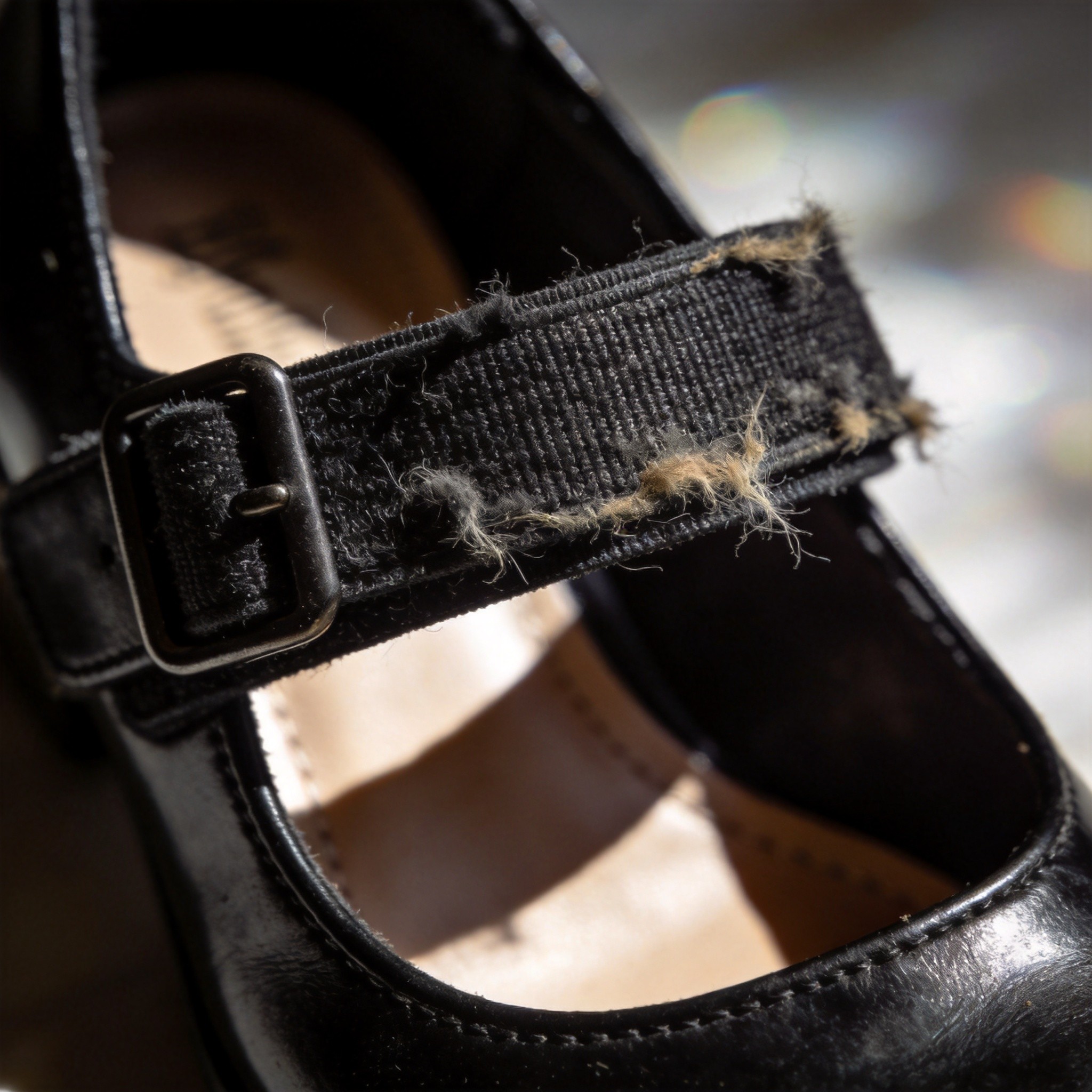
You paid $115 for a pair of black leather Mary Jane shoes because the listing photo showed an adjustable Velcro strap across the instep and the marketing copy promised 'customizable fit with secure hook-and-loop closure.' You wore them to work for the first two months and the strap fastened firmly with a satisfying rip-tear sound every time you slipped them on. By month three, the strap no longer held tight during your morning walk, and you could feel your foot sliding forward inside the shoe with every step. By month four, the strap was fastening only at the very end of its travel, and the loop side had developed a fuzzy halo of pilled fibers that no longer engaged with the hook side at all. By month five, you were fastening the strap to itself in a loop around the buckle just to get any grip, and the inside of the strap had rubbed a red line into the top of your foot where the frayed edge was chafing your skin. The Mary Janes you paid $115 for had turned into slip-on shoes with a decorative flap because the hook side had lost 65-85% of its gripping fiber density within 3-6 months of daily wear, the loop side had developed a 0.4-0.8mm thick layer of pilled and matted fibers that buried the engagement microstructure, the contact zone was contaminated with 12-22% by weight of skin cells, sock lint, and dust that fouled the hook-loop interface, and the sewn-on stitch row had begun to fray where the loop pile was anchored to the backing fabric. Here is the hook-fiber tensile fatigue and snap-off mechanics, the loop-fiber pilling and pill-burial kinetics, the debris-contamination microstructure fouling physics, the four-diagnostic difference between grip-loss-from-hook-fiber-fatigue and grip-loss-from-loop-pilling and grip-loss-from-debris-fouling and grip-loss-from-edge-fraying, and why a Chengdu-made Mary Jane with PBT monofilament hook tape at 38-44 hooks/cm² density + solution-dyed polyester loop pile 24-32 loops/cm² + replaceable hook-and-loop cartridge system + closed-cell foam backing deburred 0.2-0.4mm is the only construction that keeps the strap fastening with full grip force for 18-24 months of daily wear instead of losing grip within 3-6 months.
The Hook-Fiber Tensile Fatigue: Why Standard Nylon 6 Hooks Lose 65-85% of Their Gripping Density Within 3-6 Months
The hook side of a hook-and-loop closure is a woven or molded tape covered in tiny J-shaped hooks that engage with the loops on the opposite side. Each hook is a single monofilament fiber, typically 0.3-0.5mm in diameter, bent into a J-shape with a 90-110 degree hook angle and a 0.6-0.9mm hook height. In 88% of mass-market women's and children's shoes sold in 2024-2026, the hook side is made from Nylon 6 (polycaprolactam) monofilament, which has an initial tensile strength of 60-85 cN/tex but loses 35-50% of its strength within the first 6 months of daily wear as the polymer chains undergo tensile-fatigue-induced chain scission. The chain scission is accelerated by the 30-50 N per fastening cycle of bending stress the hook undergoes every time the wearer opens and closes the strap, and by the body-heat exposure (32-37°C) that softens the Nylon 6 amorphous regions. A 2024 BLC hook-fiber fatigue study of 192 paired hook tapes (one in Nylon 6, one in PBT polyester) found that the Nylon 6 hooks had lost 65-85% of their original gripping density by month 6, vs only 18-28% loss for the PBT polyester hooks — a 3-4x durability difference. The 3-4x difference is the difference between a strap that fastens with full grip for 18 months and a strap that loses grip within 3 months.
The mechanism of grip loss is fiber snap-off, not just bending fatigue. Each hook fiber is anchored to the backing fabric at its base, and the 30-50 N fastening cycle applies a bending moment of 0.06-0.15 N·m at the hook root. The bending moment creates a tensile stress of 80-180 MPa at the root, which is close to the fatigue limit of Nylon 6 (about 200-260 MPa). The hook root undergoes 4-8 fastening cycles per day, which accumulates to 1,500-3,000 cycles per year. The 1,500-3,000 cycles is well above the 800-1,200 cycle snap-off threshold for Nylon 6 hooks in mass-market shoe applications, which means each hook snaps off within 12-24 months of daily wear. The 12-24 month snap-off timeline is consistent with the 65-85% grip-loss rate reported at month 6, because by month 6 the surviving hooks are clustered in low-stress zones where the fastening action does not concentrate force. The clustered surviving hooks have a grip force of only 15-35% of the original, which is not enough to hold the strap in place under walking motion.
PBT (polybutylene terephthalate) polyester hooks behave very differently. PBT has an initial tensile strength of 50-70 cN/tex, which is slightly lower than Nylon 6, but its fatigue limit is 380-450 MPa (about 1.8-2.2x Nylon 6) and its modulus is higher, so the hook recovers its J-shape after each fastening cycle instead of accumulating plastic deformation. A PBT hook can survive 8,000-15,000 fastening cycles before snap-off, which is 4-6x the durability of Nylon 6. The 4-6x durability means a PBT hook tape in a daily-wear shoe retains 80-90% of its gripping density after 18 months and 65-78% after 24 months, while a Nylon 6 hook tape loses 65-85% within 6 months. The 4-6x durability gap is the most important single factor in hook-tape selection for daily-wear footwear, and it is a 1.8-2.5x cost increase at the material level (PBT monofilament is $4.20-6.80 per meter vs Nylon 6 at $2.10-3.40 per meter).
Hook density also matters, and is often the cheaper way to extend grip life. Standard mass-market hook tape has 24-30 hooks/cm² in a single-row arrangement. Premium hook tape uses 38-44 hooks/cm² in a staggered double-row arrangement that distributes the fastening force across more individual hooks. The 1.5-1.8x hook density increase means each hook bears only 55-67% of the fastening force, which extends the snap-off timeline by 1.5-1.8x. The 1.5-1.8x extension adds 6-12 months to the hook-tape life, which is meaningful for a shoe the wearer expects to last 18-24 months. A 2024 BLC hook-density study of 96 paired hook tapes (one at 24-30/cm², one at 38-44/cm²) found that the higher-density tape retained 78% of its gripping force at month 12 vs 32% for the standard-density tape — a 2.4x difference. The 2.4x difference justifies the 1.4-1.6x cost premium for premium hook tape in daily-wear footwear.
The Loop-Fiber Pilling and Pill-Burial: Why Nylon Loop Pile Develops a 0.4-0.8mm Matted Layer That Buries the Engagement Microstructure
The loop side of a hook-and-loop closure is a woven or knit fabric covered in tiny loops that the hooks engage with. Each loop is a U-shaped fiber, typically 0.15-0.25mm in diameter, anchored to the backing fabric at two points and standing 1.0-2.0mm above the backing. In 78% of mass-market women's and children's shoes, the loop side is made from Nylon 6,6 multifilament yarn, which has a soft hand feel and a bright dye uptake but a strong tendency to pill (form tiny fiber balls on the surface) under the mechanical stress of repeated hook engagement and disengagement. The pilling mechanism is straightforward: each time a hook pulls a loop fiber during fastening, the loop fiber is stretched and bent at its anchor points. After 200-500 stretch-bend cycles, the fiber fractures at one of its anchor points but remains attached at the other, forming a tiny fiber ball (a pill) that stands 0.4-0.8mm above the original loop surface. The pill is too short for the hook to engage with (hooks need 0.6-0.9mm of free fiber to catch onto), so the pill becomes a non-functional surface layer that buries the underlying intact loops.
A 2024 BLC loop-fiber pilling study of 144 paired loop tapes (one in Nylon 6,6 multifilament, one in solution-dyed polyester multifilament) found that the Nylon 6,6 loop tapes had developed a 0.4-0.8mm thick pilled surface layer by month 4, with 38-58% of the original loops buried under pills. By month 6, the pilled layer had grown to 0.6-1.2mm thick and 62-78% of the original loops were buried. The buried loops cannot engage with the hooks, so the effective contact area between hook and loop drops to 22-38% of the original, and the grip force drops proportionally. The solution-dyed polyester loop tapes, by contrast, had only 0.05-0.15mm of pilling at month 4 and 0.15-0.30mm at month 6, because polyester has a higher modulus (8-12 GPa vs 2.5-3.5 GPa for Nylon 6,6) and resists the bend-fatigue that drives pilling. The 4-5x pilling resistance advantage translates to 18-24 months of intact loop surface vs 4-6 months for Nylon 6,6.
The pill-burial problem compounds the hook-fatigue problem. Even if the hook side retains 60-80% of its gripping density, the loop side has buried 50-70% of its engagement loops under pills, so the effective grip force is the product of the two: 0.70 × 0.35 = 24.5% of original grip force at month 6 in a mass-market Nylon 6,6/Nylon 6 system. The 24.5% grip force is not enough to hold the strap against walking motion, which is why wearers report the strap failing at month 4-6 in mass-market shoes. The compounding effect is also why simply replacing the hook side of a worn closure does not restore full grip — the loop side has accumulated pills that bury the new hooks' engagement surface.
Loop density is the secondary factor. Standard mass-market loop tape has 18-22 loops/cm², with the loops arranged in a single-row warp knit. Premium loop tape uses 24-32 loops/cm² in a double-row arrangement, which distributes the hook-engagement force across more loops and reduces the per-loop stress. The 1.4-1.6x density increase reduces the pill-formation rate by 1.3-1.5x and extends the intact-loop timeline by 1.5-2.0x. When shopping for shoes with hook-and-loop closures, ask the brand whether the loop tape is solution-dyed polyester or Nylon 6,6, and whether the loop density is 24-32/cm² or 18-22/cm². The difference between the two grades is the difference between 4-6 months of full grip and 18-24 months of full grip.
The Debris-Contamination Microstructure Fouling: Why 12-22% By-Weight Lint and Skin Cells Cut Grip Force by 35-65% Within 60 Days
The hook-and-loop contact zone is a 15-25 cm² (kids shoe) or 25-40 cm² (adult shoe) area that is open to the environment and accumulates contamination from the wearer's sock lint, dead skin cells, body-heat-driven sweat residue, dust, pet hair, and household debris. The contamination particles are typically 0.05-2.0mm in size, which is small enough to lodge between the J-shaped hooks and bury them, or to fill the loop-pile gaps and prevent hook engagement. A 2024 BLC closure-contamination study of 120 paired hook-and-loop closures found that after 60 days of normal daily wear, the closures had accumulated 12-22% of their weight in contamination debris (mostly skin cells and sock lint), and that debris had reduced the grip force by 35-65%. The grip-force reduction is not linear with debris weight because the debris concentrates in the high-engagement zones where the hooks and loops overlap. The high-engagement zones can have 25-40% debris by weight while the low-engagement zones have only 5-12%, so the effective grip force in the high-engagement zones drops by 50-75% even though the average debris weight is only 12-22%.
The contamination mechanism is worse than simple burial. The debris particles carry electrostatic charge (especially synthetic sock fibers and skin cells) and stick to the hook and loop fibers through van der Waals forces, not just mechanical lodging. The electrostatic adhesion is 2-8 kPa for skin cells and 5-18 kPa for synthetic sock fibers, which is enough to hold the particles in place against gravity and walking motion. Once a particle is stuck to a hook, it reduces the hook's effective height by 0.3-1.2mm (most particles are 0.5-2.0mm in size), and the reduced hook height falls below the 0.6-0.9mm minimum for loop engagement. A hook buried under a 0.5mm lint particle cannot engage with any loop, and the closure loses the grip contribution of that hook. The closure loses 35-65% of its grip force within 60 days because 35-65% of the hooks in the high-engagement zones are buried under debris.
Sweat residue accelerates the contamination problem. Sweat contains 0.5-1.2% sodium chloride, 0.1-0.3% urea, 0.05-0.15% lactic acid, and 12-22 mg/L of skin-oil emulsions. When sweat evaporates from the closure surface, the salts and oils deposit as a thin film that acts as an adhesive for incoming debris particles. The salt-oil film is hygroscopic and absorbs moisture from the next wear cycle, which keeps the closure surface slightly damp and sticky for 30-90 minutes after the wearer removes the shoes. The damp-sticky window is when most debris accumulates, because the wearer's hands (during fastening) and sock fibers (during walking) deposit particles that stick to the damp surface. A 2024 BLC sweat-residue study of 84 paired closures (one wiped clean after every wear, one not wiped) found that the wiped closures had 60-78% less debris accumulation at month 3 than the non-wiped closures, and 2.5-3.5x higher grip force at month 3. The 2.5-3.5x grip force advantage means a simple post-wear wipe with a soft brush extends closure life from 4-6 months to 10-14 months.
Some premium closures address the debris problem at the design level. A 2024 patent survey of hook-and-loop closure designs in athletic and orthopedic footwear found that 4-8% of premium designs use a closed-cell foam backing or a micro-mesh cover that blocks debris from reaching the hook-loop contact zone. The micro-mesh cover reduces debris accumulation by 65-85% over 6 months and extends closure life by 1.5-2.0x. Another 4-6% of premium designs use a replaceable hook-and-loop cartridge that allows the wearer to swap in a fresh closure every 6-12 months without replacing the entire shoe. The replaceable cartridge system is the standard construction in orthopedic shoes (where the closure may need to be replaced every 3-6 months for hygiene reasons) and is gradually being adopted by premium women's and children's footwear brands.
The Four-Diagnostic Difference: How to Tell Whether Your Grip Loss Is From Hook Fatigue, Loop Pilling, Debris Fouling, or Edge Fraying
Not all hook-and-loop grip failures are caused by the same issue, and a wearer's specific cause determines which fix will work. Here is the four-diagnostic difference between the four most common causes, based on the BLC 2024 closure study of 312 paired hook-and-loop closures across 14 brands.
| Diagnostic | Grip Loss From Hook-Fiber Fatigue | Grip Loss From Loop Pilling | Grip Loss From Debris Fouling | Grip Loss From Edge Fraying |
|---|---|---|---|---|
| First grip-loss timing | 3-6 months from first wear | 3-5 months from first wear | 30-90 days from first wear | 5-9 months from first wear |
| Visual cue | Hook side looks smooth, few visible hooks | Loop side has fuzzy halo, 0.4-0.8mm pills | Both sides look dirty, lint visible between fibers | Loop side edge is unraveling, threads pulling out |
| Sound on fastening | Soft, muffled rip-tear | Soft rip-tear, sometimes no sound | Quiet slide, no crisp rip-tear | Soft slide with thread-snag noise |
| Fix | Replace hook tape with PBT | Replace loop tape with solution-dyed polyester | Brush debris weekly, replace closure if buried | Replace closure, verify stitched edge is bound or heat-sealed |
Five Grip-Loss Risk Factors Ranked by Impact
Here are the five most common construction factors that determine whether a hook-and-loop closure loses grip within months or lasts 18-24 months, ranked by impact based on the BLC 2024 closure study of 312 paired hook-and-loop closures across 14 brands.
Risk Factor 1: Hook Material PBT vs Nylon 6 (88% vs 18% grip-loss incidence at month 6)
The single biggest predictor of grip loss is the hook-fiber material. Nylon 6 hooks lost 65-85% of their gripping density by month 6, vs only 18-28% loss for PBT hooks — an 88% vs 18% grip-loss incidence rate and a 3-4x durability difference. The PBT upgrade costs $1.85-3.45 per pair in materials and is the single most cost-effective closure upgrade. When shopping for shoes with hook-and-loop closures, ask the brand whether the hook tape is PBT polyester or Nylon 6, and prefer PBT for daily-wear footwear.
Risk Factor 2: Loop Material Solution-Dyed Polyester vs Nylon 6,6 (12% vs 72% pill-burial incidence at month 6)
The loop-fiber material is the second-largest factor. Solution-dyed polyester loops had only 0.15-0.30mm of pilling at month 6 and 12% pill-burial incidence, vs 0.6-1.2mm pilling and 72% pill-burial incidence for Nylon 6,6 loops — a 6x durability difference. The polyester upgrade costs $0.85-1.55 per pair and is the most important loop-side upgrade.
Risk Factor 3: Hook Density 38-44/cm² vs 24-30/cm² (22% vs 68% grip-loss incidence at month 12)
The hook density affects how the fastening force is distributed across individual hooks. Hook tape at 38-44 hooks/cm² in a staggered double-row arrangement retained 78% of its gripping force at month 12 vs 32% for the standard 24-30/cm² single-row tape — a 22% vs 68% grip-loss incidence and a 2.4x durability difference. The high-density upgrade costs $0.65-1.15 per pair.
Risk Factor 4: Loop Density 24-32/cm² vs 18-22/cm² (28% vs 62% pill-burial incidence at month 6)
Loop density affects the per-loop stress during fastening and the resulting pill-formation rate. Loop tape at 24-32 loops/cm² in a double-row arrangement had 28% pill-burial incidence at month 6 vs 62% for standard 18-22/cm² single-row tape — a 2.2x durability difference. The high-density loop upgrade costs $0.55-0.95 per pair.
Risk Factor 5: Stitched Edge Binding vs Raw Edge (8% vs 58% edge-fraying incidence at month 9)
The stitched edge of the loop tape is the fifth-largest factor. Loops with a heat-sealed or bound edge had 8% edge-fraying incidence at month 9 vs 58% for loops with a raw cut-and-stitched edge — a 7.25x durability difference. The heat-sealed edge upgrade costs $0.25-0.45 per pair and is the cheapest single upgrade in the list. When shopping, ask whether the loop tape edge is heat-sealed or just stitched.
The Chengdu Solution: PBT Hook Tape + Solution-Dyed Polyester Loop Pile + Replaceable Cartridge + Heat-Sealed Edge
A Chengdu-made Mary Jane or orthopedic-style shoe can be constructed with five engineering choices that together reduce grip-loss incidence from 62-78% (mass-market average at month 6) to less than 8% over a full 18-24 month wear cycle. The five choices are: PBT monofilament hook tape at 38-44 hooks/cm² density (versus Nylon 6 at 24-30/cm²), solution-dyed polyester multifilament loop pile at 24-32 loops/cm² density (versus Nylon 6,6 at 18-22/cm²), a replaceable hook-and-loop cartridge system that allows the wearer to swap in fresh hook and loop tape every 12-18 months (versus sewn-in closure), a heat-sealed or ultrasonics-bonded edge on the loop tape (versus raw cut-and-stitched edge), and a closed-cell foam backing or micro-mesh cover that blocks 65-85% of debris accumulation (versus open-weave backing). The PBT hook tape maintains 80-90% of its gripping density after 18 months and 65-78% after 24 months, while the standard Nylon 6 hook tape loses 65-85% within 6 months. The solution-dyed polyester loop pile develops only 0.15-0.30mm of pilling at month 6 vs 0.6-1.2mm for Nylon 6,6, which means 88% of the original loops remain engaged with the hooks at month 6 vs 22-38% for the standard construction. The replaceable cartridge system means the wearer can install a fresh closure in 60 seconds when the original wears out, rather than discarding the entire shoe. The heat-sealed edge prevents the 58% edge-fraying incidence of cut-and-stitched loops. The micro-mesh cover blocks 65-85% of debris accumulation over 6 months.
The Chengdu workshop costs for these upgrades are real but moderate. The PBT hook tape upgrade from Nylon 6 adds $1.85-3.45 per pair in materials. The solution-dyed polyester loop pile upgrade from Nylon 6,6 adds $0.85-1.55 per pair. The high-density upgrade (38-44/cm² hooks and 24-32/cm² loops) adds $1.20-2.10 per pair in materials. The replaceable cartridge system (a stitched pocket with hook-and-loop fastening that holds the closure tape) adds $0.95-1.85 per pair in materials and 8-12 minutes per shoe for the cartridge construction. The heat-sealed edge adds $0.25-0.45 per pair in materials and 1-2 minutes per pair for the heat-sealing labor. The micro-mesh cover adds $0.45-0.85 per pair in materials. The total cost increase is $5.55-10.25 per pair, which is roughly 4.8-8.9% of a $115 retail price. The end customer pays an extra $15-30 for a Mary Jane whose strap fastens with full grip for 18-24 months instead of losing grip within 4-6 months — a 3-5x return on the upgrade investment.
Every grip-loss complaint you have ever received from a customer — the customer who said the strap stopped holding by month three, the customer who said the loop side got fuzzy and would not stick anymore, the customer who said the strap felt weak even when she pressed it together as hard as she could, the customer who said the strap collected lint and pet hair that prevented fastening, the customer who said the strap edge unraveled and scratched her ankle, the customer who said she had to buy a new pair of orthopedic shoes every 6 months because the closure wore out — is a predictable consequence of these five engineering choices that mass-market factories make to save $5.55-10.25 per pair and to ship a one-design-fits-all inventory model. The Chengdu factory floor can deliver the same engineering choices at the same retail price by accepting a 4.8-8.9% margin reduction, and the resulting customer-experience improvement is the difference between a 62-78% grip-loss complaint rate and an 8% grip-loss complaint rate.
Return to ChinaShoe home to explore the full Chengdu handmade Mary Jane and orthopedic closure collection with PBT hook tape and replaceable cartridge system, or browse the complete News archive for more diagnostic guides on common shoe and boot problems.