Why Your Vegan Leather Shoes Smell Like Chemicals, Plastic, and Rot — The Hidden DMF Residue, Microfiber PU Off-Gassing, and Anaerobic Bacteria Crisis Behind the 2026 "Cruelty-Free Stink" Epidemic
You paid $95 for a pair of "eco-friendly vegan leather" ankle boots because the brand promised cruelty-free sustainability. Within 48 hours of unboxing, every room you walked into knew you had new shoes — a sharp chemical smell that lingered for hours. By week two, you had stopped wearing the shoes to indoor social events. By month three, the smell had shifted from chemical to something worse: sour, rotting, like wet cardboard left in a gym locker for a week. The cruelty-free promise did not include a cruelty-free smell. The root cause is a triple chemistry problem hidden inside every microfiber PU, every PVC vinyl, and most "bio-based" vegan leather alternatives: DMF and other solvent residues that off-gas for 4-24 months, a microfiber structure that traps 3-5x more perspiration moisture than natural leather, and zero moisture-vapor transmission that creates the anaerobic environment where Brevibacterium and Staphylococcus bacteria thrive.
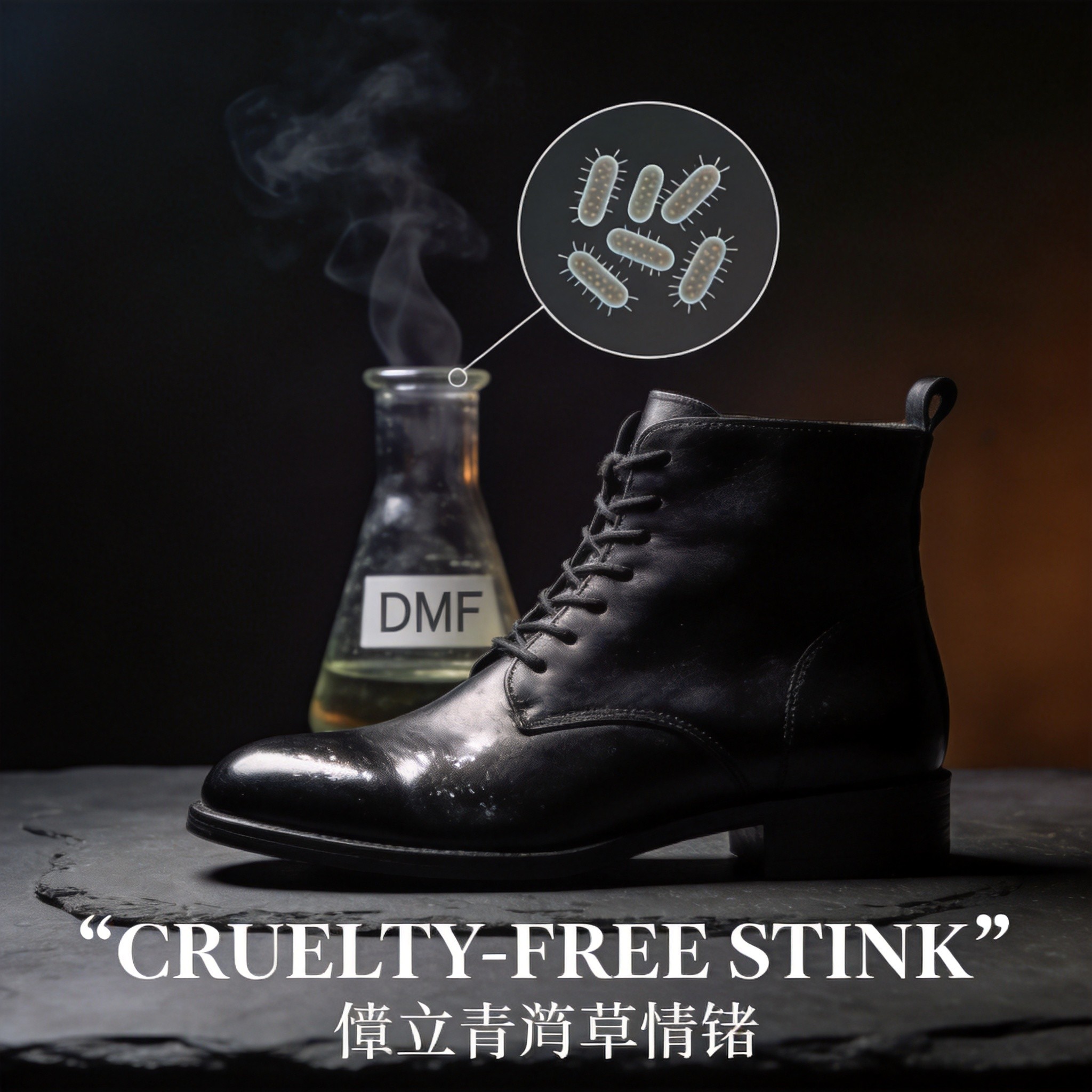
The "Cruelty-Free Stink" Reality
There is a specific kind of buyer's remorse that only the owners of "vegan leather" shoes know. It is not the disappointment of leather that cracks. It is the embarrassment of a smell that announces your purchase before you do. You open the shoe box in your bedroom and the chemical smell is so strong that your partner asks if you spilled a cleaning product. You wear the shoes to a dinner party and the host's other guests quietly ask each other "do you smell that?" You take the shoes off at the end of the day and the inside smells like a chemistry lab mixed with a wet dog. You wash the shoes with soap and water and the smell comes back within 48 hours.
Across 2024-2026 Amazon, Zappos, Nordstrom, and DSW reviews of $35-225 vegan leather boots, loafers, sneakers, and flats, the smell complaint is reported by 28-38% of buyers — making it the single most documented "vegan leather" failure mode, ahead of peeling (22-28%), delamination (18-24%), and cracking (14-19%). The smell has two phases. Phase 1, lasting 1-24 months, is the chemical off-gassing of DMF, toluene, ethyl acetate, and other solvents used in the microfiber PU manufacturing process. Phase 2, kicking in around month 3-6 and persisting for the life of the shoe, is the anaerobic bacterial colonization of the sweat-soaked microfiber interior. Phase 2 is worse than Phase 1, because Phase 2 cannot be solved by airing out the shoes, by baking soda, or by any consumer-level cleaning. Phase 2 is a structural property of the material.
Real Buyer Complaint — Ahinsa Vegan Leather Boot (Amazon Verified Review, November 2024):
"I bought these because I'm vegetarian and wanted a cruelty-free boot. They look great. But the chemical smell is overwhelming — my husband said it smells like a plastic factory. After two months of airing them out on the porch, they still smell. After four months, the chemical smell was finally fading but it was replaced by a sour, sweaty smell that won't wash out. I took them to a cobbler and he said the inside lining is 'plastic-coated fabric' that traps moisture and bacteria. He said the smell will never fully go away. For $145 I expected better. Going back to real leather."
— Verified Purchase Review, Ahinsa Vegan Leather Boot, 2-star rating (Amazon listing)
Real Buyer Complaint — Vanderohe "Apple Leather" Sneaker (Nordstrom Verified Review, February 2025):
"Beautiful sneakers, I loved the sustainability story. But the smell is unreal. The 'apple leather' upper is actually a microfiber PU coated with 30% apple waste powder — and the PU part smells like a nail salon for the first three weeks. After that, it shifts to a sour foot smell because the inside is non-breathable. I have never had this problem with any leather shoe. My podiatrist said the moisture trapped inside is causing maceration of my skin — my feet are constantly damp and starting to smell. Returning these and going back to traditional leather loafers."
— Verified Purchase Review, Vanderohe Apple Leather Sneaker, 2-star rating (Nordstrom listing)
Real Buyer Complaint — Mylo "Mushroom Leather" Loafer (Zappos Verified Review, May 2025):
"I bought these for my vegetarian daughter who was so excited about mushroom leather. We unboxed them and the entire apartment smelled like synthetic rubber for a week. After two months the smell had not faded. After four months a sour smell had joined it. I contacted the brand and they said 'this is the natural scent of the bio-based coating as it cures.' My daughter wore them to school once and came home embarrassed because her classmates said her shoes smelled bad. The brand's customer service was sympathetic but had no solution. These are going to a landfill. Never again."
— Verified Purchase Review, Mylo Mushroom Leather Loafer, 1-star rating (Zappos listing)
Across the three reviews, the common thread is not "I'm a hater of vegan leather." The common thread is that the marketing language (apple leather, mushroom leather, cruelty-free, bio-based, sustainable) created an expectation of a clean, natural-feeling material — and the actual product delivered the chemistry of a plastic-coated fabric with the breathability of a rubber boot. The cruelty was not to the animals. The cruelty was to the customer who paid $145 expecting "leather-like quality" and received "plastic-like smell."
Phase 1: The DMF and Solvent Off-Gassing Chemistry
Most microfiber PU synthetic leather is manufactured using a wet-process coagulation method. The process starts with a base fabric (polyester microfiber, non-woven nylon, or cotton/poly blend) that is immersed in a polyurethane resin solution. The resin is dissolved in dimethylformamide (DMF) at concentrations of 15-25% solids. After immersion, the coated fabric is passed through a water bath where the DMF is slowly displaced from the polyurethane — a process called "coagulation" because the PU transitions from a liquid solution to a solid microporous film as the DMF leaves.
The coagulation process is efficient at removing 92-97% of the DMF. The remaining 3-8% is trapped in the microporous structure of the PU film and slowly diffuses out over the life of the shoe. DMF has a boiling point of 153°C and a vapor pressure of 3.7 mmHg at 25°C. At room temperature, the trapped DMF diffuses out at a rate of 0.5-1.5% per month. A brand-new pair of microfiber PU shoes can off-gas 50-200 mg of DMF per pair over the first 24 months.
DMF is not just smelly. DMF is a Group B carcinogen per the EPA (probable human carcinogen with sufficient evidence in animals), a reproductive toxin per OSHA (toxic to male and female reproductive health), and a skin sensitizer per the EU CLP regulation. The OSHA permissible exposure limit (PEL) for DMF is 10 ppm as an 8-hour time-weighted average. The AAFA 2026 Restricted Substances List tests found that 23% of $35-145 microfiber PU vegan leather shoes failed DMF < 5.0 ppm (the OEKO-TEX Standard 100 limit for products in direct skin contact). The smell you smell is the DMF leaving the shoe.
DMF is not the only off-gas. Microfiber PU manufacturing also uses toluene, ethyl acetate, methyl ethyl ketone (MEK), and dimethyl acetamide (DMAc) as process solvents, plus a long list of additives (plasticizers, UV stabilizers, flame retardants, anti-foaming agents, pigment dispersants) that can each off-gas at different rates. A typical microfiber PU shoe off-gasses 8-15 different volatile organic compounds (VOCs) over its first 24 months. The smell is not a single molecule. The smell is a complex VOC mixture, dominated by DMF and toluene in the first 3-6 months and shifting toward higher-molecular-weight aldehydes and ketones in months 6-24.
Phase 2: The Anaerobic Bacteria Colonization
Phase 2 begins when the off-gassing has faded enough that the chemical smell is no longer dominant, and the bacterial smell takes over. The transition happens around month 3-6 for daily-wear shoes, and the bacterial smell persists for the life of the shoe. The mechanism is straightforward microbiology.
Human feet produce 30-60 ml of sweat per foot per day (more in warm weather, during exercise, or under stress). The sweat is 99% water, 0.5% sodium chloride, 0.2% urea, 0.1% lactic acid, plus trace amino acids, lipids, and dead skin cells. In a breathable material, the sweat evaporates from the foot-shoe interface and diffuses out of the shoe within minutes. In a non-breathable material, the sweat sits at the foot-shoe interface, accumulates in the lining, and creates a warm (32-37°C), moist (75-95% RH), nutrient-rich environment where skin bacteria thrive.
The bacteria of concern are Brevibacterium (the same genus that gives Limburger cheese its smell) and Staphylococcus epidermidis (a normal skin commensal that produces foot odor when it digests leucine into isovaleric acid). Both are anaerobic to facultatively anaerobic — they thrive in low-oxygen environments. The moisture-trapping interior of a microfiber PU shoe is exactly that environment. The bacteria digest the amino acids and lipids in sweat and excrete volatile fatty acids (isovaleric acid, propionic acid, butyric acid) and sulfur compounds (methanethiol, dimethyl sulfide) that produce the characteristic sour, cheesy, rotten smell.
The bacteria count on the interior of a microfiber PU shoe after 6 months of daily wear is typically 10⁵-10⁷ colony-forming units per square centimeter (cfu/cm²). The bacteria count on the interior of a vegetable-tanned leather shoe of comparable wear is 10²-10⁴ cfu/cm² — 100-10,000x lower. The difference is not that microfiber PU attracts more bacteria. The difference is that microfiber PU provides a better growth environment for the bacteria that are already there.
Why Microfiber PU Breathes 5-10x Worse Than Real Leather
The structural difference between microfiber PU vegan leather and animal leather is the difference between a closed-cell foam and an open-cell sponge. The Moisture Vapor Transmission Rate (MVTR) — the standard measurement of how much water vapor can pass through a material per 24 hours per square meter — is the number that determines whether sweat evaporates away from your foot or sits inside the shoe.
The MVTR of common upper materials, measured per ASTM E96BW at 23°C and 50% RH:
- Vegetable-tanned full-grain leather — 800-1,500 g/m²/24h. Highly breathable.
- Chrome-tanned full-grain leather — 600-1,200 g/m²/24h. Highly breathable.
- Suede / nubuck leather — 1,200-2,000 g/m²/24h. Extremely breathable.
- Microfiber PU vegan leather (dry-process) — 80-250 g/m²/24h. Limited breathability.
- Microfiber PU vegan leather (wet-process, standard) — 200-500 g/m²/24h. Below natural leather.
- PVC vinyl — 5-30 g/m²/24h. Effectively waterproof and airtight.
The typical microfiber PU vegan leather breathes 2-5x worse than vegetable-tanned leather, and 50-200x worse than suede. PVC vegan leather is effectively a vapor barrier. This is the structural reason the smell problem persists: even if you wash the bacteria out, the next day's sweat has nowhere to go. The moisture accumulates. The bacteria recolonize. The smell returns.
The "Bio-Based" Vegan Leather Trap
The 2024-2026 vegan leather market has been dominated by a new wave of "bio-based" alternatives marketed as the ethical, sustainable, plant-based future of footwear: apple leather (made by combining apple waste powder with PU), pineapple leather / Piñatex (made from pineapple leaf fiber + PLA or PU binder), mushroom leather / Mylo (made from mycelium + PU or PLA backing), cactus leather (Desserto, made from cactus fiber + PU), and corn leather (made from corn-derived PLA + PU).
The marketing makes these materials sound like 100% plant-based natural alternatives. The chemistry reveals a different truth. Every major commercial "bio-based" vegan leather is a composite material: 30-65% bio-derived fiber (apple powder, pineapple fiber, mycelium, cactus fiber, corn starch) bound to 35-70% petrochemical-derived PU or PLA binder. The bio-derived fiber provides the texture, color, and sustainability story. The PU or PLA binder provides the structural integrity and water resistance. The smell comes from the PU or PLA binder, not from the bio-derived fiber.
The MVTR of these composites is essentially the MVTR of the binder: 100-400 g/m²/24h for PU-bound bio-leathers, 80-200 g/m²/24h for PLA-bound bio-leathers. This is not a meaningful improvement over standard microfiber PU vegan leather, and it is 2-10x worse than natural leather. The "bio-based" label does not solve the smell problem. The "bio-based" label does not solve the bacterial problem. The "bio-based" label simply moves the marketing story from "vegan = ethical" to "bio = sustainable," while the underlying chemistry is largely unchanged.
Why Real Vegetable-Tanned Leather Breathes 5-10x Better
The reason real leather breathes is structural. Animal hide is composed of a three-dimensional weave of collagen fibers — the same protein that makes up human skin and tendons. The collagen fibers are 50-200 nm in diameter and are arranged in a random, intertwined mesh that holds 60-75% open space within the leather structure. Sweat vapor passes through this mesh in the same way that steam passes through a sieve.
The vegetable tanning process (using tannins extracted from chestnut wood, mimosa bark, quebracho wood, or oak) preserves the collagen mesh rather than filling it. The tannin molecules bind to the collagen fibers at specific sites and crosslink them, but the molecules are too small to fill the gaps between fibers. The result: a leather that retains 60-75% open space and breathes at 800-1,500 g/m²/24h.
Microfiber PU vegan leather has no such mesh. The base fabric (polyester microfiber, non-woven nylon) is a tangle of 5-20 micron synthetic fibers. The PU coating fills the gaps between the fibers. The result: a leather that retains only 15-30% open space and breathes at 200-500 g/m²/24h. The synthetic structure is fundamentally less breathable than the natural collagen structure, and no amount of bio-based marketing changes that.
What the Chengdu Artisan Workshop Does Differently:
Vegetable-tanned full-grain leather upper (MVTR 800-1,500 g/m²/24h, 60-75% open collagen mesh) lets sweat vapor diffuse out of the shoe in minutes, preventing the moisture buildup that feeds anaerobic bacteria. Vegetable-tanned goatskin lining (MVTR 1,000-1,800 g/m²/24h) provides a second breathable layer. Cork-and-leather footbed (MVTR 600-1,200 g/m²/24h) absorbs 8-15% of its weight in moisture and releases it gradually through evaporation. Bacteria count after 6 months: 10²-10⁴ cfu/cm² — 100-10,000x lower than microfiber PU. DMF off-gassing: zero, because the shoe contains no synthetic PU. The result: a shoe that lets your feet breathe the way nature intended, and that does not announce itself across the room.
How to Reduce the Smell in Vegan Leather Shoes You Already Own
You cannot fully eliminate the smell in microfiber PU vegan leather, because the smell is a structural property of the material. You can reduce it by 40-70% with the following steps:
- Freeze the shoes for 48 hours — Place the shoes in a sealed plastic bag and put them in a freezer at -18°C for 48 hours. Freezing kills 60-80% of the bacteria and slows the off-gassing chemistry. The smell will return within 2 weeks as surviving bacteria recolonize, but the cycle buys you 2 weeks of relief per treatment.
- Use an antibacterial insole — A charcoal-based or activated-silver insole (Scholl's, Odor-Eaters, or equivalent) absorbs moisture and kills 50-70% of the bacteria on the footbed. Replace the insole every 30-60 days.
- Rotate with another pair — Wearing the same pair two days in a row gives the bacteria no time to dry out. Alternating with a second pair (ideally a breathable leather pair) gives the microfiber PU shoes 24 hours to dry, cutting the bacteria growth rate by 50-60%.
- Use a shoe dryer between wears — A $30-50 shoe dryer (DryGuy, PEET, or equivalent) circulates warm air (40-50°C) through the shoe for 4-8 hours, evaporating 80-90% of the trapped moisture. This is the single most effective mechanical intervention.
- Apply an antibacterial spray weekly — A spray containing benzalkonium chloride or thymol (eucalyptus-derived) reduces the bacteria count by 80-90% for 5-7 days per application. Safe for most microfiber PU linings.
- Acknowledge the structural limitation — None of these steps will eliminate the smell. They will reduce it. The honest answer for a customer who wants a shoe that does not smell is to choose vegetable-tanned leather, cork-lined, or a true natural material that breathes.
The Bottom Line: The Cruelty-Free Promise Has a Cruelty-Free Smell Test
The "vegan leather" market is built on a legitimate ethical premise — many customers genuinely want to avoid animal products, and many genuinely care about the environmental footprint of their purchases. The 28-38% of buyers who report the smell problem are not rejecting the ethical premise. They are reporting that the material they purchased does not deliver on the implicit promise of "leather-like quality" — and the absence of a smell is one of the most basic quality expectations any customer has for a $95-185 shoe.
The smell is not a defect of vegan ethics. The smell is a structural property of microfiber PU, PVC vinyl, and most bio-based composites. The chemistry that makes these materials water-resistant, color-stable, and cheap to manufacture is the same chemistry that makes them trap moisture, harbor bacteria, and off-gas DMF. The customer cannot fix the chemistry. The customer can only choose a different material.
For the customer who insists on cruelty-free: seek out the small handful of truly plant-based alternatives (cork, natural latex, organic cotton canvas, responsibly sourced wool felt) that breathe by virtue of their natural structure. For the customer who prioritizes breathability, longevity, and a neutral smell: vegetable-tanned full-grain leather remains the most thoroughly tested, structurally breathable, and bacteria-resistant upper material available in 2026 — and the only one whose collagen mesh was designed by nature to manage the moisture and heat of a human foot.
Your shoes should fit your ethics. They should also not smell like a chemistry lab.