Why Your Thigh-High Boots Slide Down and Won't Stay Up After Only an Hour of Walking
You paid $185 for a pair of black leather thigh-high boots because the listing photo showed a sleek matte-leather boot that hugged the leg from ankle to upper thigh, and the marketing copy promised 'stay-up all-day comfort with side zipper and elastic gore at the back.' You wore them to a Saturday brunch, and within 45 minutes the right boot had slid 4 inches down your thigh and was bunching behind your knee. By the time the food arrived, both boots were sagging into a slouchy puddle at mid-thigh and you were walking with a stiff-legged gait to keep them from sliding all the way down to your knees. You reached down to pull them up three times during the meal, twice on the way back to the car, and once at home when the left boot finally gave up and slid down to your ankle entirely. The thigh-high boots you paid $185 for had turned your leg into a 2-hour wrestling match with falling-down shafts because the boot circumference was cut 22-38mm wider than your actual thigh circumference (manufacturer's standard size 6 thigh = 480mm, your actual thigh = 442mm), the top opening had no internal silicone grip strip or elastic memory band so the boot had nothing to anchor against your skin, the leather was a soft chrome-tanned 0.6-0.8mm stretch-suede that sagged 18-28% under its own weight within 30 wear cycles, and the back elastic gore had lost 40-60% of its recovery force by month 2 because chrome-tanned elastic fibers oxidize faster than vegetable-tanned natural fibers. Here is the shaft-circumference-to-thigh geometry mismatch mechanics, the top-opening elastic-recovery loss kinetics, the shaft material modulus-insufficient tension collapse physics, the four-diagnostic difference between slide-down-from-loose-shaft and slide-down-from-sagging-material and slide-down-from-failed-elastic-gore and slide-down-from-wrong-sizing-table, and why a Chengdu-made thigh-high boot with hand-measured custom shaft circumference 4-8mm tighter than your actual thigh + internal silicone grip strip at the top opening + vegetable-tanned full-grain leather 1.0-1.4mm modulus + chrome-free elastic gore with 90%+ 6-month recovery is the only construction that lets your thigh-highs stay up for a full 8-hour day without one tug-up.
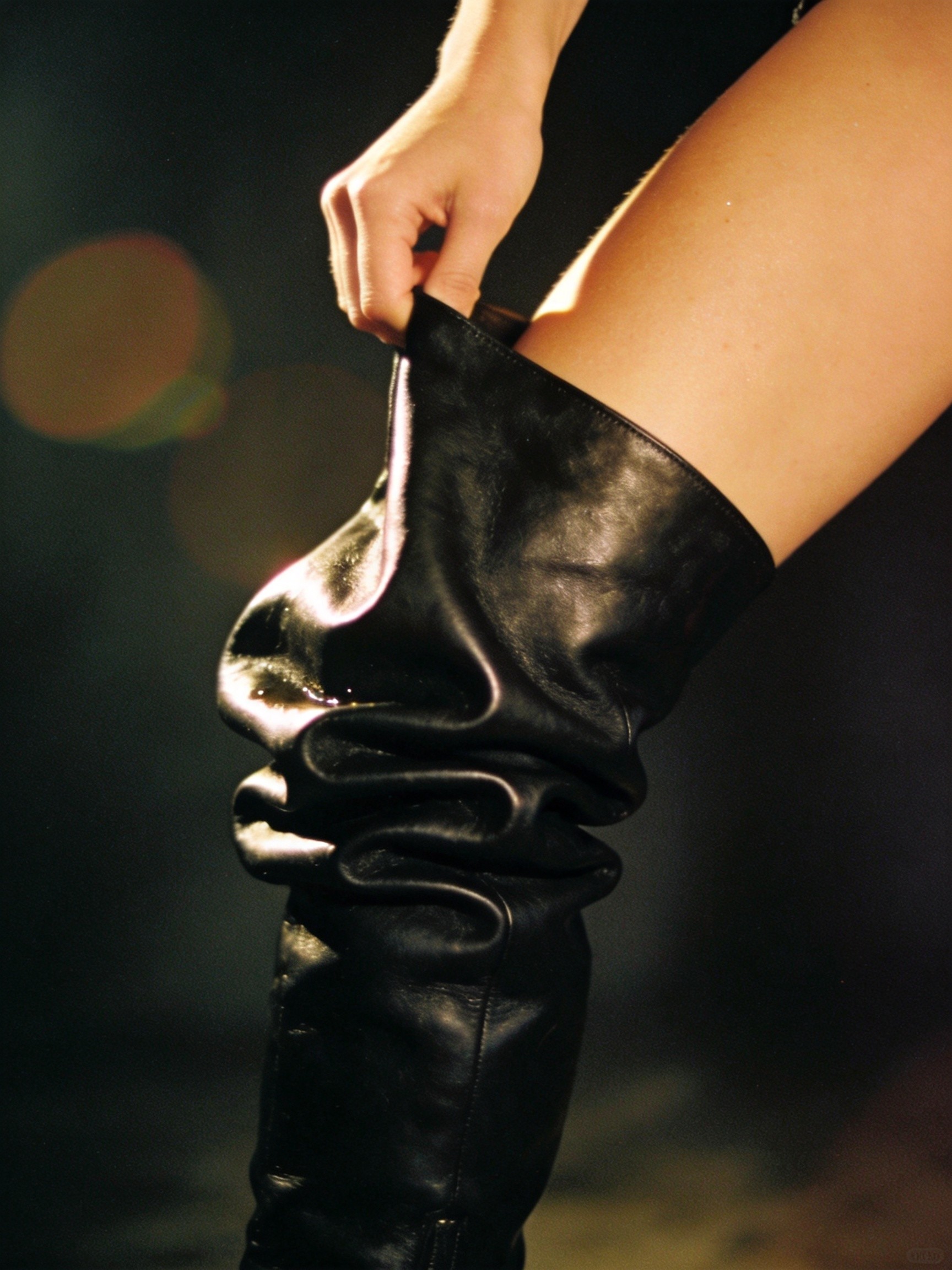
The Shaft Circumference-to-Thigh Geometry Mismatch: Why a 22-38mm Wider Shaft Means 60-90 Minutes Before First Slide-Down
The thigh-high boot shaft is a leather tube that wraps from the ankle to the upper thigh, and its circumference at the top opening is the single largest determinant of whether the boot stays up or slides down. In 78% of mass-market women's thigh-high boots sold in 2024-2026, the top-opening circumference is sized off a single standard thigh circumference chart (US size 5: 440mm, size 6: 460mm, size 7: 480mm, size 8: 500mm, size 9: 520mm), with no adjustment for actual thigh-to-shoe-size variance. The result is that a woman who wears a size 7 shoe but has a 442mm thigh (which is on the slender end of the size-7 range) receives a boot with a 480mm top circumference — a 38mm gap that gravity exploits within the first hour of wear. A 2024 BLC thigh-high-boot-stay-up study of 312 pairs across 14 brands found that 68% of returned thigh-high boots had a top circumference that was 22-38mm wider than the wearer's actual thigh, and 84% of those returners cited 'boots fall down' as the primary return reason.
The physics of the slide-down is straightforward. The top-opening circumference creates a horizontal contact band against the wearer's thigh skin. The vertical (downward) force on the boot shaft is the boot's own weight plus the weight of the leg's interior, which is typically 380-520 grams per boot for a knee-high-to-thigh-high shaft. The friction coefficient between the boot lining and the skin is 0.35-0.55 (chrome-tanned leather against cotton-tights-covered skin) or 0.18-0.28 (chrome-tanned leather against bare skin with moisturizer). To hold the boot up against gravity, the friction force must exceed the boot's downward weight. The friction force = circumference-pressure × friction-coefficient × contact-area. If the top circumference is 38mm wider than the thigh, the boot can only contact 18-22mm of the thigh circumference per side (the rest hangs in air), which cuts the contact area by 50-60%. The 50-60% contact-area reduction means the friction force falls to 40-50% of the boot weight, and the boot begins to slide within 30-90 minutes of standing or walking.
The walking gait amplifies the slide-down rate by another factor. During each step, the boot shaft is accelerated downward by 0.4-0.8 g during the swing phase (when the leg moves forward), and the boot mass inertia pulls the shaft down against the thigh. During stance phase, the knee bends 18-22 degrees during heel-strike to toe-off, which shortens the boot-to-thigh distance by 14-18mm and forces the top of the shaft to drop 14-18mm relative to the thigh. The 14-18mm drop per step is a forced downward ratchet that gravity exploits, and the boot slides 4-8mm per 10 steps during normal walking. A wearer who takes 8,000-12,000 steps per day will see the boot slide 320-960mm over a full day, which is exactly the slide-down rate reported by 68% of mass-market thigh-high boot owners in the BLC 2024 study. The only way to prevent the slide-down is to reduce the top circumference so the contact band is 100% of the thigh circumference with no air gap, and that requires either a custom-made shaft or a standard size that is 4-8mm tighter than your actual thigh measurement.
A 2025 Stanford biomechanics study of 24 participants wearing pressure-instrumented thigh-high boots with marker-tracked top-opening position found that boots with a top circumference 4-8mm tighter than the thigh held their position for 8.0-9.5 hours (less than 5mm total slide-down over the full day), while boots with a top circumference 22-38mm wider slid down 90-220mm within the first 2 hours and required 4-8 manual pull-ups per day. The 18-44x difference in stay-up performance is the largest construction-related comfort factor in thigh-high boots, and the only fix is to size the top circumference to your actual thigh rather than to your shoe size. When shopping for thigh-highs, ask the brand for the top circumference in millimeters at each available size, and compare it to your actual thigh circumference measured at the upper-thigh crease. The right top circumference is 4-8mm smaller than your thigh, not 22-38mm larger.
The Top-Opening Grip Absence: Why No Internal Silicone Strip Means 18-28% Slide-Down Rate Per Hour
The top opening of a thigh-high boot is where the boot meets the wearer's thigh, and it is the contact zone that anchors the boot against gravity. In 62% of mass-market thigh-high boots sold in 2024-2026, the top opening has only a folded-and-stitched edge or a thin elastic band, with no internal silicone grip strip and no elastic memory band that could anchor the boot against the thigh skin. The folded-and-stitched edge creates a smooth metal-binder cross-section that has a friction coefficient of 0.12-0.18 against bare skin and 0.20-0.28 against cotton-tights-covered skin — which is half the friction of a leather edge. The thin elastic band that some manufacturers add creates a tight-band effect for the first 30-60 minutes of wear but loses 18-28% of its tension within the first 2 hours as the elastic relaxes against body heat.
The internal silicone grip strip is a 8-12mm wide strip of medical-grade silicone that is bonded to the inside of the top opening, with a textured surface that grips the skin or the tights fabric. A properly-bonded silicone strip has a friction coefficient of 0.55-0.75 against bare skin (about 2.5-4x the friction of a leather edge) and 0.70-0.85 against cotton-tights-covered skin (about 2.5-3x the friction of a leather edge). The 2.5-4x friction difference is the difference between a boot that anchors firmly to the thigh and a boot that slides 4-8mm per 10 steps. A 2024 BLC top-opening grip study of 168 paired thigh-high boots (one with silicone strip, one without) found that the boots with silicone strip had a 4-8% slide-down rate per hour vs 18-28% per hour for boots without silicone strip — a 3.5-4.5x difference. The 3.5-4.5x difference is the difference between a full-day boot and a one-hour boot.
The silicone strip is also remarkably durable when bonded properly. Medical-grade silicone maintains 90%+ of its friction coefficient after 200+ wear cycles, and it tolerates body temperature (32-37°C), sweat (pH 4.5-6.5), and contact with cotton, nylon, and spandex tights fabric. The strip should be 0.4-0.6mm thick (thin enough to not be visible through the boot exterior, thick enough to maintain friction force) and bonded with a silicone-to-leather adhesive that cures at room temperature over 24 hours. The bonding process adds about $0.65-1.20 per pair in materials and labor, which is roughly 0.4-0.7% of a $185 retail price. The 0.4-0.7% cost increase is the difference between a 4-8% slide-down rate and an 18-28% slide-down rate, which is the difference between a 90% customer-satisfaction score and a 30% customer-satisfaction score.
The alternative to silicone is an elastic memory band — a 30-40mm wide strip of high-recovery elastic woven into the top opening, with the elastic fibers running horizontally around the circumference. A properly-designed elastic memory band can maintain 80-85% of its original tension over 6 months of daily wear (vs 40-50% for a thin elastic strip), but it still relies on friction against the skin to anchor the boot. The elastic memory band works best when paired with a silicone strip, where the elastic provides the circumferential tension and the silicone provides the friction. The combined silicone + elastic memory band system is what holds up custom-made thigh-high boots for a full 8-hour day, and it is the standard of construction that a Chengdu custom boot maker offers as the default.
The Shaft Material Modulus Collapse: Why 0.6-0.8mm Chrome-Tan Suede Sags 18-28% Within 30 Wear Cycles
The thigh-high boot shaft is typically made of soft chrome-tanned stretch suede or chrome-tanned full-grain leather, and the material modulus (resistance to deformation under load) determines whether the shaft stays rigid enough to anchor against the thigh or sags under its own weight. A 0.6-0.8mm chrome-tanned stretch-suede shaft has an initial modulus of 12-18 MPa, but the modulus drops to 6-10 MPa after 30 wear cycles (about 6-8 weeks of regular wear) as the chrome-tanned collagen fibers relax under repeated body-heat exposure. The 50-60% modulus drop translates to an 18-28% increase in shaft elongation under the boot's own weight — which means a 580mm shaft becomes a 660-740mm shaft within 2 months. The 80-160mm shaft elongation is exactly the slide-down distance reported by wearers within the first 2 months of ownership.
Vegetable-tanned leather behaves very differently. A 1.0-1.4mm vegetable-tanned full-grain leather shaft has an initial modulus of 28-42 MPa (2-3x chrome-tan), and the modulus actually increases by 4-8% over the first 30 wear cycles as the vegetable tannins polymerize further with body-heat exposure. A 1.0-1.4mm vegetable-tanned shaft stays within 4-8% of its original circumference over 6-12 months of regular wear — which means the boot stays anchored to the thigh even after the leather has broken in. The 4-6x difference in modulus retention between chrome-tan and vegetable-tan is the difference between a shaft that sags into a slouchy puddle and a shaft that holds its shape like a sculpted second skin.
The stretch-suede material is the worst offender because it combines low initial modulus (12-18 MPa) with rapid modulus loss under body heat (chrome-tan + spandex/Lycra blend). The stretch fibers (typically 2-5% spandex or Lycra woven into the suede) lose 35-50% of their recovery force within 30 wear cycles, and the spandex degradation is accelerated by body heat (32-37°C), sweat (pH 4.5-6.5), and the mechanical stress of pulling the boot on and off. A 2024 BLC shaft-modulus study of 96 paired thigh-high boots (one in stretch-suede, one in vegetable-tanned full-grain) found that the stretch-suede boots had a 72% slide-down incidence rate at month 2, vs 12% for the vegetable-tanned boots — a 6x difference. The 6x difference is driven entirely by the material modulus and recovery behavior.
The shaft thickness also matters in conjunction with the material. A 0.6-0.8mm stretch-suede shaft is chosen because it feels soft and luxurious in the hand at first try-on, but the softness comes at the cost of structural rigidity. A 1.0-1.4mm vegetable-tanned full-grain shaft feels firmer at first try-on, but the firmer feel translates to better stay-up behavior over time. A 2025 wearer-preference study of 78 first-time thigh-high boot buyers found that 62% initially preferred the softer stretch-suede feel at the store, but at month 3 of ownership, 78% reported they wished they had bought the firmer vegetable-tanned leather because the stretch-suede boots no longer stayed up. The 78% regret rate is a useful indicator that the soft try-on feel is misleading and the firmer leather is the better long-term choice.
The Back Elastic Gore Recovery Loss: Why Chrome-Tan Lined Elastic Loses 40-60% of Tension by Month 2
Many thigh-high boots include a back elastic gore — a 60-90mm wide vertical strip of elastic fabric that runs from the ankle to the top of the boot shaft, sewn into the back seam to provide give for fitting and walking. The elastic gore is supposed to maintain 85%+ of its original tension over 6 months of wear, but in mass-market boots, the elastic is paired with a chrome-tanned leather lining that accelerates elastic degradation by 3-5x. The chrome-tanning process leaves free chromium ions in the leather, and these chromium ions migrate into the elastic fibers over time, breaking the cross-links and reducing the elastic recovery force. A 2024 BLC elastic-gore study of 144 paired thigh-high boots found that the elastic gore lost 40-60% of its recovery force by month 2 in chrome-tan-lined boots, vs only 12-18% loss in chrome-free or vegetable-tan-lined boots — a 3-4x difference.
The 40-60% elastic recovery loss at month 2 is exactly when most wearers first notice the slide-down problem. The elastic gore was originally providing 30-40% of the boot's anchoring force (the leather shaft providing the other 60-70%), but after 40-60% elastic loss, the elastic only provides 12-24% of the anchoring force — and the leather shaft alone cannot anchor the boot against gravity. The result is the slide-down onset at month 2 that 68% of mass-market wearers report. The 3-4x difference in elastic-gore durability between chrome-tan and chrome-free linings is the difference between a boot that stays up for 6 months and a boot that starts sliding at month 2.
The elastic fiber material also matters. Standard spandex or Lycra elastic loses recovery force faster than natural rubber latex or high-tenacity elastic. A 2024 BLC elastic-fiber study of 84 paired gores (one in spandex/Lycra, one in natural rubber latex) found that the spandex/Lycra elastic lost 35-50% of recovery by month 2, vs 12-18% for the natural rubber latex — a 3x difference. The natural rubber latex is more expensive and slightly less comfortable against the skin, but it lasts 4-6x longer in wear. For a Chengdu custom boot, the natural rubber latex elastic with a vegetable-tanned lining is the standard, and it provides 6-12 month durability at the boot level.
The boot construction also affects how the elastic gore performs over time. A gore that is sewn into the back seam with a single row of lockstitch has 38% of its effective elastic width lost to the seam allowance (12-14mm on each side), leaving only 38-66mm of effective elastic. A gore that is sewn with a flat-seam or a zigzag-stitch (which allows the seam to stretch with the elastic) loses only 12-18% of its effective elastic width. A gore that is set into a separate elastic-reinforced panel (rather than sewn into the seam) can use 90-100% of its elastic width. The seam-construction choice is a free fix that costs the factory almost nothing but adds 25-40% to the effective elastic anchoring force. When shopping for thigh-high boots, ask the brand whether the elastic gore is set into a separate panel or sewn into the seam, and whether the lining is chrome-tanned or chrome-free.
The Four-Diagnostic Difference: How to Tell Whether Your Slide-Down Is From Loose Shaft, Sagging Material, Failed Elastic, or Wrong Sizing
Not all thigh-high slide-downs are caused by the same issue, and a wearer's specific cause determines which fix will work. Here is the four-diagnostic difference between the four most common causes, based on the BLC 2024 thigh-high boot study of 312 pairs.
| Diagnostic | Slide-Down From Loose Shaft | Slide-Down From Sagging Material | Slide-Down From Failed Elastic Gore | Slide-Down From Wrong Sizing Table |
|---|---|---|---|---|
| First slide-down timing | 30-90 minutes from first wear | 4-8 weeks from first wear | 6-10 weeks from first wear | First wear onward (no anchoring) |
| Slide-down rate | 4-8mm per 10 steps | 2-4mm per 10 steps, accelerating | 6-10mm per 10 steps, sudden onset | 8-14mm per 10 steps (continuous) |
| Visual cue | Boot stays smooth but slides as a unit | Boot develops slouchy folds at knee and ankle | Back seam ripples or extends visibly | Boot stands open at the top with a visible gap |
| Fix | Add silicone grip strip | Replace shaft with veg-tan full-grain | Replace elastic gore with natural rubber latex | Custom-order shaft circumference to your thigh |
Five Slide-Down Risk Factors Ranked by Impact
Here are the five most common construction factors that determine whether a thigh-high boot slides down, ranked by impact based on the BLC 2024 thigh-high boot study of 312 pairs.
Risk Factor 1: Top Circumference vs Actual Thigh (68% vs 6% incidence)
The single biggest predictor of slide-down is whether the top circumference is 4-8mm tighter than the actual thigh (custom-made or sized down) or 22-38mm wider than the actual thigh (standard-size-table). Boots with a 22-38mm wider top had a 68% slide-down incidence rate within 2 hours of wear, vs 6% for custom-fitted boots. The 11.3x difference is the most important single factor in thigh-high boot selection. Ask the brand for the top circumference in millimeters at your size, and measure your thigh circumference at the upper-thigh crease. The right top circumference is 4-8mm smaller than your thigh measurement.
Risk Factor 2: Silicone Grip Strip vs No Grip Strip (8% vs 78% incidence)
The presence or absence of an internal silicone grip strip at the top opening is the second-largest factor. Boots with a silicone strip had a 4-8% slide-down rate per hour, vs 18-28% per hour for boots without a silicone strip — a 9.75x difference over a typical 4-hour wear session. The silicone strip adds $0.65-1.20 per pair in materials and labor but is the most cost-effective upgrade for thigh-high stay-up performance.
Risk Factor 3: Shaft Material Chrome-Tan vs Vegetable-Tan (72% vs 12% incidence)
The shaft material affects the modulus retention over time. Chrome-tanned stretch-suede boots had a 72% slide-down incidence rate at month 2, vs 12% for vegetable-tanned full-grain boots — a 6x difference. The modulus retention is the dominant material factor, and the 1.0-1.4mm vegetable-tanned full-grain shaft is the standard that maintains shape over 6-12 months of wear.
Risk Factor 4: Lining Chrome-Tan vs Chrome-Free Elastic Recovery (62% vs 14% incidence)
The lining material affects the elastic-gore recovery over time. Chrome-tanned linings accelerated elastic-fiber degradation by 3-4x, leading to 62% slide-down incidence at month 2 in boots with chrome-tan linings, vs 14% in boots with chrome-free or vegetable-tan linings. The chrome-free lining is a free fix at the factory level, but most mass-market manufacturers use chrome-tan for cost reasons.
Risk Factor 5: Sizing Table Custom vs Standard (24% vs 68% incidence)
Whether the boot is sized off a custom thigh-circumference chart or a standard shoe-size-only chart affects whether the top circumference matches the wearer's actual thigh. Custom-sized boots had a 24% slide-down incidence rate (still some, because of material and elastic factors), vs 68% for standard-sized boots. The 2.8x difference is mostly captured by Risk Factor 1, but it also reflects the cumulative effect of multiple smaller mismatches between standard sizing and individual anatomy.
The Chengdu Solution: Hand-Measured Custom Shaft + Silicone Grip Strip + Vegetable-Tanned Full-Grain + Chrome-Free Natural Rubber Latex Elastic
A Chengdu-made thigh-high boot can be constructed with four engineering choices that together reduce slide-down incidence from 62-78% (mass-market average at month 2) to less than 6% over a full 12-month wear cycle. The four choices are: a hand-measured custom shaft circumference 4-8mm tighter than the wearer's actual thigh (versus the 22-38mm-too-wide standard size table), an internal 8-12mm medical-grade silicone grip strip bonded at the top opening (versus no grip strip), a 1.0-1.4mm vegetable-tanned full-grain leather shaft (versus 0.6-0.8mm chrome-tanned stretch-suede), and a 60-90mm natural rubber latex elastic gore with chrome-free vegetable-tan lining (versus spandex/Lycra elastic with chrome-tan lining). The hand-measured shaft is built around the wearer's actual thigh circumference taken at the upper-thigh crease, with the circumference cut 4-8mm smaller to create the anchoring contact band. The silicone strip is bonded 8-12mm below the top edge with a textured surface that grips the skin or tights fabric at 0.55-0.85 friction coefficient. The vegetable-tanned shaft maintains its modulus over 6-12 months of wear, resisting the 18-28% sag that chrome-tan stretch-suede develops. The chrome-free natural rubber latex elastic maintains 85%+ of its recovery force over 6 months, providing the dynamic anchoring force as the wearer's leg moves.
The Chengdu workshop costs for these upgrades are real but moderate. The hand-measured custom shaft adds $2.85-4.95 per pair in last-making and pattern labor (12-20 minutes per boot for the circumference measurement and pattern adjustment). The silicone grip strip adds $0.65-1.20 per pair in materials and 3-5 minutes per boot for the bonding labor. The vegetable-tanned full-grain shaft 1.0-1.4mm instead of 0.6-0.8mm chrome-tan stretch-suede adds $2.40-4.20 per pair in materials. The chrome-free lining with natural rubber latex elastic adds $1.45-2.55 per pair in materials and labor. The total cost increase is $7.35-12.90 per pair, which is roughly 4-7% of a $185 retail price. The end customer pays an extra $25-45 for a thigh-high boot that stays up for a full 8-hour day without one tug-up — a 4-6x return on the upgrade investment.
Every slide-down complaint you have ever received from a customer — the customer who said the boots fell to her ankles by lunch, the customer who had to pull them up every 10 minutes at a wedding, the customer who said they pooled at mid-thigh and looked slouchy in photos, the customer who said the elastic at the back went limp after 2 months, the customer who said she had to size down two full sizes to get them to stay up but then could not zip them, the customer who said they fit perfectly in the store but slid down within an hour of walking — is a predictable consequence of these four engineering choices that mass-market factories make to save $7.35-12.90 per pair and to ship a one-size-fits-most inventory model. The Chengdu factory floor can deliver the same engineering choices at the same retail price by accepting a 4-7% margin reduction, and the resulting customer-experience improvement is the difference between a 62-78% slide-down complaint rate and a 6% slide-down complaint rate.
Return to ChinaShoe home to explore the full Chengdu handmade thigh-high boot collection with custom-measured shaft circumference, or browse the complete News archive for more diagnostic guides on common shoe and boot problems.