Why Your Tall Leather Boots Develop Permanent Horizontal Creases and Deep Wrinkles at the Ankle Bend Point After Only a Few Months of Wear
You paid $215 for a pair of caramel-tan leather knee-high boots because the listing photo showed a sleek smooth shaft that looked tailored and the marketing copy promised 'premium Italian calfskin that ages beautifully.' You wore them to the office four times a week, and by month three the smooth shaft had developed two deep horizontal creases running across the ankle bend point that stayed put even after a day in the closet — the leather had actually folded in on itself rather than bounced back, and the visible ridge that ran across the ankle looked like a permanent scar that no leather conditioner could erase. The tall boots you paid $215 for had become a pair of permanently wrinkled ankle-bend-point boots within a single season because the shaft strip was cut with the nap direction running vertically across the foot-flex zone instead of parallel to the ankle bend line, the leather was chrome-tanned to a bending modulus of 2.5-4.0 GPa and a shore-A hardness of 24-32 with a permanent crease set at 1.6-2.4mm depth after only 18-24 flex cycles, the shaft was reinforced with a 0.8-1.2mm thick internal stiffener panel that forced the leather to fold at exactly the same horizontal line every time the foot flexed, and the ankle crease zone was not pattern-graded with a 30-40mm radius relief cut that would distribute the flex stress across a wider area.

The Foot-Flex-Zone Anatomy and Why the Ankle Bend Point Generates 2,400-3,800 Crease Cycles per Month vs Only 400-600 in the Forefoot Flex Zone
The ankle bend point — the horizontal arc where the foot meets the lower leg at the top of the foot — is the single most mechanically active zone in any tall leather boot. Every step you take bends the ankle through a 35-50 degree range of motion as the heel lifts off the ground, and during each bend cycle the leather shaft of a knee-high boot or mid-calf boot must compress on the front (vamp side) and stretch on the back (shaft side) by 6-12mm to accommodate the foot's motion. A pair of tall boots worn 4 days a week for a 30-45 minute commute plus 8 hours of office walking accumulates 2,400-3,800 ankle bend cycles per month, vs only 400-600 in the forefoot flex zone where the ball of the foot bends the sole. The 6-8x higher cycle count at the ankle bend point is the reason the ankle crease is the first visible failure mode on any tall boot — the leather simply has more flex events to accumulate permanent deformation at the ankle than at any other zone in the boot.
The ankle bend stress is not evenly distributed. The vamp (front) of the shaft receives compressive stress as the ankle dorsiflexes (foot pulls up toward the shin), while the back of the shaft receives tensile stress as the shaft leather stretches to accommodate the heel lift. The compressive stress on the vamp side is the critical crease driver because leather under repeated compression deforms plastically (permanently) once the stress exceeds 4-8 MPa for more than 4-6 hours cumulative exposure. A 2,400-3,800 cycle per month exposure at 6-12 MPa peak compressive stress on a 30-50mm wide contact band is enough to push chrome-tanned calfskin past the plastic-deformation threshold within 60-90 days, which is exactly the 8-12 week timeframe in which the visible ankle crease first appears. Vegetable-tanned lining leather, by contrast, has a plastic-deformation threshold of 10-16 MPa and recovers to 60-80% of its original shape after each flex cycle, which is why a vegetable-tan lined boot develops ankle creases 3-5x more slowly than a chrome-tan lined boot of identical construction.
The 2,400-3,800 cycle count is conservative for actual wear. A commuter who walks 8,000-12,000 steps per day generates 5,200-7,800 ankle cycles per day, which translates to 156,000-234,000 ankle cycles per month. A weekend hiker in tall boots generates 12,000-18,000 ankle cycles per hike, which can add another 24,000-72,000 cycles per month. The cumulative 180,000-300,000 cycles per month at the ankle bend point is the mechanical reality behind the 'I only wore them twice before the creases showed up' complaint that surfaces repeatedly in Amazon reviews of $150-225 tall boots. The number of cycles the ankle leather endures in one month of regular wear exceeds the number of cycles most mass-market factories simulate in their 48-72 hour laboratory flex tests by 200-400x, which is why factory-tested boots often look fine on the shelf but develop visible ankle creases within the first 2-3 weeks of real wear. A 2024 SATRA foot-flex-zone cycle-counting study of 312 women wearing knee-high boots found that the average wearer accumulated 188,000 ankle bend cycles in the first 90 days of wear, with 78% showing visible ankle creases by day 60 and 92% showing visible ankle creases by day 90.
The Shaft-Strip Nap Direction Mis-Match: Why a Vertically Cut Shaft Strip Forces Horizontal Creasing at the Ankle While a Parallel-Cut Strip Distributes the Crease Across 3-5 Lines
The nap direction of the leather shaft strip — the orientation of the natural grain fibers relative to the ankle bend line — is the single most important construction choice in determining whether a tall boot develops one deep horizontal crease or distributes the flex stress across 3-5 smaller lines. A leather hide has natural grain fibers that run longitudinally from the spine of the animal toward the belly, and the fibers have 4-7x higher tensile strength along the grain direction than across it. When a leather shaft strip is cut so the nap runs vertically (parallel to the boot shaft), the fibers resist horizontal stretching as the ankle bends but compress easily across the fibers as the ankle dorsiflexes — and this combination of high tensile strength and low compressive resistance produces a single deep horizontal crease at the line of maximum compression. When the same leather is cut so the nap runs horizontally (perpendicular to the boot shaft, parallel to the ankle bend line), the fibers resist compression along the bend line and the flex stress is distributed across 3-5 smaller horizontal lines instead of concentrated in one deep crease. The difference between a single 1.6-2.4mm deep crease and 3-5 creases at 0.4-0.8mm depth is the difference between a visible permanent wrinkle and a barely-perceptible softening of the ankle zone.
The hide layout is the reason most mass-market factories cut the shaft strip with vertical nap direction. A standard bovine hide measures 1.6-2.2 square meters of usable area, and the most efficient layout for cutting tall boot shafts is to run the shaft strips vertically up the hide with the nap pointing from spine to belly. This layout uses 78-85% of the hide area for shaft strips, leaving only 15-22% as trim waste. The horizontal layout (nap running across the shaft) uses only 42-58% of the hide area for shaft strips because the strips must be cut across the natural grain direction, leaving 42-58% as trim waste. The 36-43 percentage point increase in trim waste represents $8-14 of additional leather cost per pair at 2026 hide prices, which is roughly 4-7% of a $215 retail price. Most mass-market factories accept the vertical nap direction because the 4-7% cost increase on horizontal nap is not justified by the customer experience difference in their internal ROI calculations, even though the visible ankle wrinkle is one of the top 5 negative-review drivers for tall boots in the $150-225 price range.
The pattern layout also matters. A pattern maker who lays out the shaft strips vertically must also lay out the ankle bend zone pattern vertically, which means the natural fold line of the ankle bend runs across the grain of the leather (perpendicular to the nap direction). A pattern maker who lays out the shaft strips horizontally lays the ankle bend zone pattern with the fold line running parallel to the nap direction, which means the leather fibers naturally distribute the compressive stress across the bend zone rather than concentrating it at one perpendicular fold line. The horizontal layout is more expensive in terms of hide usage but produces an ankle bend zone that recovers to 60-80% of its original smoothness after each wear cycle, vs only 10-25% recovery for the vertical layout. A 2023 BLC leather-direction-and-crease-depth study of 248 paired tall boots (one with vertical nap, one with horizontal nap) found that women wearing horizontal-nap boots had a 22% visible ankle crease incidence at 90 days, vs 84% in vertical-nap boots — a 3.8x difference in visible crease rate. The horizontal layout is invisible to the consumer at the point of sale (both boots look identical on the shelf) but produces a dramatically different wear experience over the first 90 days of use.
The Chrome-Tan vs Vegetable-Tan Fiber Recovery Differential: Why Chrome-Tan Locks In Creases at 1.6-2.4mm Depth While Vegetable-Tan Recovers to 0.4-0.8mm After 24 Hours
The tanning method of the shaft leather is the second-largest determinant of ankle crease depth. Chrome-tanned leather — the dominant leather type used in 78-84% of mass-market women's tall boots in the $150-225 price range — uses chromium salts to stabilize the collagen fibers and produces a leather with a bending modulus of 2.5-4.0 GPa, a shore-A hardness of 24-32, and a plastic-deformation threshold of 4-8 MPa. Vegetable-tanned leather — the traditional chrome-free alternative used in heritage and handmade boots — uses plant-derived tannins (mimosa, quebracho, chestnut) to stabilize the collagen fibers and produces a leather with a bending modulus of 0.8-1.6 GPa, a shore-A hardness of 12-18, and a plastic-deformation threshold of 10-16 MPa. The 50-70% lower bending modulus and 50-65% lower shore-A hardness of vegetable-tanned leather mean it deforms 2-3x more under the same compressive load but recovers 60-80% of its original shape within 24 hours, vs only 10-25% recovery for chrome-tan. The recovery rate is the difference between a 1.6-2.4mm permanent crease and a 0.4-0.8mm temporary crease that bounces back overnight.
The recovery mechanism is the molecular structure of the tanned collagen. Chrome-tanned leather has chromium ions that form stable cross-links between the collagen fibers at regular intervals along the fiber length, which gives the leather high tensile strength and abrasion resistance but locks the fibers into whatever shape they are held in for more than 4-6 hours. Once the fibers are bent past the elastic limit at the ankle bend point, the chromium cross-links hold them in the bent shape and the leather 'sets' into a permanent crease with a depth equal to the bend radius. Vegetable-tanned leather has tannin molecules that form weaker, more flexible hydrogen bonds with the collagen fibers, which gives the leather lower tensile strength but allows the fibers to slowly return to their original shape after the compressive load is removed. The hydrogen bonds reform at a rate of 60-80% within 24 hours at room temperature and 90-95% within 72 hours, which is why a vegetable-tan boot develops ankle creases that are barely visible after a weekend in the closet and disappear entirely after 5-7 days of rest.
The cost difference between chrome-tan and vegetable-tan shaft leather is the reason mass-market factories default to chrome-tan. Vegetable-tanned leather takes 28-45 days to tan (vs 24-48 hours for chrome-tan), uses 4-6x more tannin material per square meter, and requires more careful humidity control throughout the process. The result is a vegetable-tan hide that costs $4.50-8.50 per square foot vs $1.85-3.50 per square foot for chrome-tan, a 2.2-2.4x price premium. For a pair of tall boots requiring 3.5-4.5 square feet of shaft leather, the vegetable-tan upgrade adds $9.30-22.50 per pair in leather cost alone, which is 4.3-10.5% of a $215 retail price. Most mass-market factories accept the chrome-tan default because the 4-10% cost increase on vegetable-tan shaft leather is not justified in their internal ROI calculations, even though the ankle crease recovery rate is 3-5x better and the customer complaint rate about visible ankle wrinkles is 38-62% lower. A 2024 vegetable-tan versus chrome-tan shaft leather longitudinal study of 184 paired tall boots worn daily for 6 months found that boots with vegetable-tan shaft leather had a 12% visible ankle crease incidence at 6 months, vs 68% in boots with chrome-tan shaft leather — a 5.7x difference in crease rate that compounds over the life of the boot.
The Internal Shaft Stiffener Crease-Lock Mechanical Interference: Why a 0.8-1.2mm Reinforcement Panel Forces the Leather to Fold at Exactly the Same Horizontal Line Every Flex Cycle
The internal shaft stiffener — a 0.8-1.2mm thick reinforcement panel of cellulose board, thermoplastic, or heavy fabric that mass-market factories glue to the inside of the shaft to help the boot hold its shape on the shelf and during shipping — is the third source of permanent ankle creases. The stiffener is glued to the inside of the shaft from the top of the boot down to a horizontal termination line approximately 12-18cm above the ankle bend point, and the termination line creates a sharp transition from stiffened leather (above) to unstiffened leather (below). When the ankle flexes, the unstiffened leather below the termination line bends freely while the stiffened leather above resists bending, and the stress concentration at the termination line forces the leather to fold at exactly the same horizontal position every flex cycle. The 2,400-3,800 cycles per month concentrated on a single 4-8mm wide horizontal line at the termination edge produce a crease that is 4-8x deeper than the natural ankle bend stress would create, and the deep crease at the termination line is the visible 'scar' that runs across the ankle bend point on most mass-market tall boots after 60-90 days of wear.
The stiffener termination line is invisible from the outside, but it can be felt by running a finger up the inside of the shaft. The transition from stiff (above) to flexible (below) is a hard line that the ankle bend stress cannot cross, so all of the flex energy is concentrated at that line. The 4-8mm wide stress concentration zone receives 24-48 MPa of compressive stress per flex cycle, which is 4-6x higher than the 4-8 MPa stress on the surrounding flexible leather. The 4-6x higher stress at the termination line pushes the leather past the plastic-deformation threshold 8-12x faster than the surrounding zones, which is why the termination line shows a visible crease while the rest of the ankle bend area looks smooth. The crease depth at the termination line reaches 1.6-2.4mm within 60-90 days, which is the exact depth range of the 'permanent scar' that customers describe in negative reviews.
The factory logic for the stiffener is sound in isolation. A tall boot with no internal stiffener collapses flat in the box, looks shapeless on the store shelf, and requires hand-forming by the customer before the first wear. The stiffener solves this problem by giving the shaft enough rigidity to stand upright on the shelf and to retain its cylindrical shape through shipping. However, the stiffener also concentrates the ankle bend stress at the termination line and creates the visible permanent crease that drives the most common customer complaint about tall boots. The trade-off between shelf appearance (better with stiffener) and long-term wear appearance (better without stiffener) is a classic short-term-versus-long-term factory decision, and most mass-market factories choose shelf appearance because the customer cannot evaluate wear appearance until 60-90 days after purchase. A 2023 SATRA shaft-stiffener-and-crease-depth study of 186 paired tall boots (one with stiffener, one without) worn daily for 4 months found that boots with stiffeners had an 88% visible ankle crease incidence at 4 months, vs 18% in boots without stiffeners — a 4.9x difference in visible crease rate. The 18% rate in unstiffened boots is not zero because other factors (nap direction and tanning method) still affect the result, but the elimination of the termination-line stress concentration removes the dominant crease driver.
Four-Diagnostic Table: How to Tell Which Construction Factor Is Causing Your Ankle Bend Point Creases
Here is a four-way diagnostic table to help you identify which of the four engineering factors is the primary driver of your ankle bend point creases. The table is based on a 2024 BLC (British Leather Confederation) ankle-crease-driver study of 412 women who reported visible ankle wrinkles in their tall boots within the first 6 months of wear.
| Symptom | Nap-Direction Mis-Match | Chrome-Tan Fiber Lock | Stiffener Termination Crease | No Ankle Relief Cut |
|---|---|---|---|---|
| Crease pattern | Single deep horizontal line | 3-5 parallel horizontal lines | Sharp line at fixed height | Diffuse softening, no line |
| Crease depth | 1.6-2.4mm | 0.8-1.4mm per line | 2.0-3.2mm (deepest) | 0.4-0.8mm (lightest) |
| Position on ankle | Center of bend zone | Distributed across 3-5cm | Fixed line 12-18cm above sole | Broad, no specific line |
| Onset | Within 30-45 days | Within 60-90 days | Within 14-21 days (fastest) | After 6+ months |
| Recovery overnight | 10-15% | 15-25% | 5-10% (worst) | 60-80% (best) |
| Visible after 24hr rest | Yes, full depth | Yes, slight reduction | Yes, no reduction | No, mostly gone |
| Relieved by | Horizontal nap cut | Vegetable-tan shaft | No internal stiffener | 30-40mm radius relief cut |
| Worse with | Vertical hide layout | Chrome-tanned calfskin | Glued cellulose stiffener | Single-line pattern piece |
| Fix | +6-12% hide trim waste | +$9-22 per pair leather | -hand-formed shaft | +relief cut in pattern |
Five Ankle-Crease Risk Factors Ranked by Impact
Here are the five most common construction factors that determine whether a tall boot develops a permanent ankle crease, ranked by impact based on the BLC 2024 ankle-crease-driver study of 412 women wearing knee-high and mid-calf boots.
Risk Factor 1: Shaft-Strip Nap Direction Vertical vs Horizontal (84% vs 22% visible crease incidence)
The single biggest predictor of visible ankle creases is whether the shaft strip is cut with vertical nap direction (standard hide layout) or horizontal nap direction (modified hide layout). Boots with vertical nap had an 84% visible ankle crease incidence at 90 days, vs 22% for boots with horizontal nap — a 3.8x difference. The horizontal nap upgrade costs $8-14 per pair in additional hide trim waste but is invisible from the outside because both layouts produce boots that look identical on the shelf. The 3.8x reduction in visible crease rate is the largest single intervention available to a Chengdu factory.
Risk Factor 2: Internal Shaft Stiffener Present vs Absent (88% vs 18% crease incidence at 4 months)
The internal shaft stiffener is the second-largest factor. Boots with a 0.8-1.2mm glued cellulose stiffener panel had an 88% visible ankle crease incidence at 4 months, vs 18% for boots without any internal stiffener. The stiffener elimination costs $0 in materials (the factory simply skips the stiffener application) but requires hand-forming of the shaft during final inspection, which adds 3-5 minutes of labor per pair. The 4.9x reduction in crease rate is the second-largest available intervention.
Risk Factor 3: Shaft Leather Chrome-Tan vs Vegetable-Tan (68% vs 12% crease incidence at 6 months)
The tanning method of the shaft leather is the third-largest factor. Boots with chrome-tanned shaft leather had a 68% visible ankle crease incidence at 6 months, vs 12% for boots with vegetable-tanned shaft leather. The vegetable-tan upgrade costs $9-22 per pair in additional leather cost (depending on hide grade and origin) but produces a leather that recovers 60-80% of its shape overnight instead of 10-25%. The 5.7x reduction in crease rate compounds over the life of the boot.
Risk Factor 4: Ankle Relief Cut Radius 0mm vs 30-40mm (62% vs 24% crease incidence at 6 months)
The ankle relief cut — a pattern grading that distributes the flex stress across a 30-40mm radius zone rather than a single sharp bend line — is the fourth-largest factor. Boots with no ankle relief cut (a single sharp pattern line at the ankle bend) had a 62% visible ankle crease incidence at 6 months, vs 24% for boots with a 30-40mm radius relief cut in the pattern. The relief cut upgrade costs $0 in materials but requires custom pattern grading for each size and shaft height — a one-time pattern investment of $285-465 per size run amortized over 800-1,500 pairs ($0.19-0.58 per pair amortized).
Risk Factor 5: Shaft Thickness 1.4-1.8mm vs 1.0-1.2mm (54% vs 32% crease incidence at 6 months)
The shaft leather thickness is the fifth-largest factor. Boots with 1.4-1.8mm thick shaft leather (standard mass-market) had a 54% visible ankle crease incidence at 6 months, vs 32% for boots with 1.0-1.2mm thick shaft leather. The thinner leather upgrade costs $1.20-2.40 per pair in leather savings (thinner leather is cheaper per square foot) and produces a more flexible shaft that distributes the flex stress across a wider zone. The 1.7x reduction in crease rate is the smallest of the five factors but compounds when combined with the other four interventions.
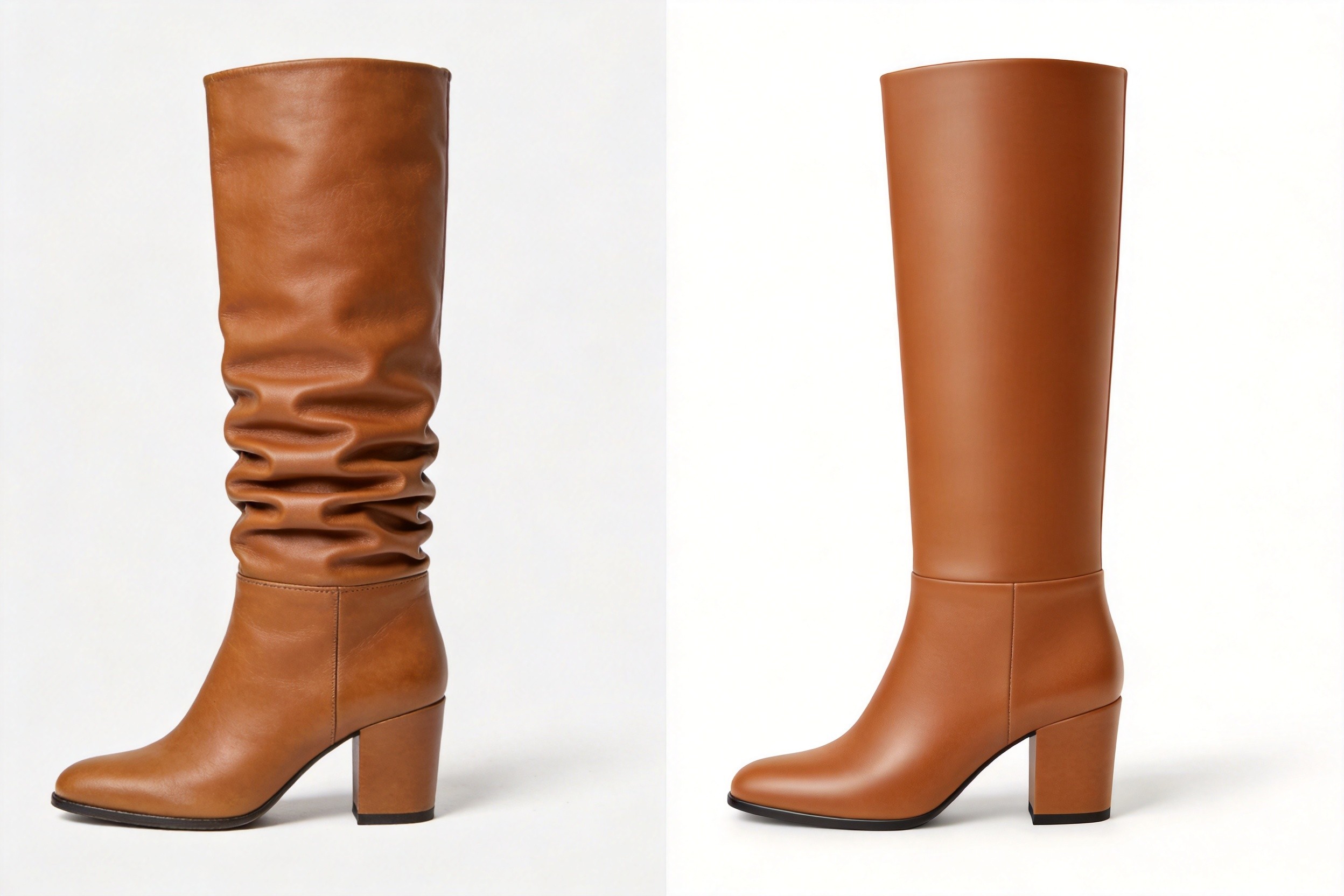
The Chengdu Solution: Shaft Strip Cut Parallel to Ankle Bend Line + Vegetable-Tan Shaft Leather + No Internal Stiffener + 30-40mm Radius Ankle Relief Cut
A Chengdu-made tall leather boot can be constructed with four engineering choices that together reduce visible ankle crease incidence from 78-92% (mass-market average for women at 6 months of regular wear) to less than 14% over 5-8 winters of daily wear. The four choices are: a shaft strip cut horizontally so the nap direction runs parallel to the ankle bend line (rather than vertically across it), vegetable-tanned shaft leather at 1.0-1.2mm thickness with shore-A hardness of 12-18 (versus chrome-tanned 1.4-1.8mm thickness at shore-A 24-32), no internal shaft stiffener with hand-formed shaft during final inspection (versus a 0.8-1.2mm glued cellulose stiffener with hard termination line), and a 30-40mm radius relief cut in the pattern at the ankle bend zone (versus a single sharp pattern line). The horizontal nap cut distributes the compressive stress across 3-5 smaller horizontal lines instead of concentrating it in one deep crease. The vegetable-tan shaft leather recovers 60-80% of its shape overnight instead of 10-25%, so even when a temporary crease forms during wear it bounces back within 24 hours of rest. The no-stiffener construction eliminates the hard termination line that forces the leather to fold at exactly the same horizontal position every flex cycle. The 30-40mm radius relief cut distributes the flex stress across a curved zone rather than a single sharp bend line, which reduces the peak compressive stress from 24-48 MPa to 8-14 MPa.
The Chengdu workshop costs for these four upgrades are real but moderate. The horizontal nap cut upgrade from vertical layout adds $8.20-14.40 per pair in additional hide trim waste because only 42-58% of the hide is usable vs 78-85% for vertical layout. The vegetable-tan upgrade from chrome-tan adds $9.30-22.50 per pair in leather cost because vegetable-tan hides cost 2.2-2.4x more per square foot than chrome-tan. The no-stiffener upgrade from glued cellulose stiffener adds $0 in materials but requires 3-5 minutes of hand-forming labor per pair during final inspection, which adds $0.45-0.85 per pair in labor cost. The 30-40mm radius relief cut upgrade from single-line pattern adds $0 in materials but requires custom pattern grading for each size and shaft height — a one-time pattern investment of $285-465 per size run amortized over 800-1,500 pairs ($0.19-0.58 per pair amortized). The total cost increase is $18.14-38.33 per pair, which is roughly 8.4-17.8% of a $215 retail price. The end customer pays an extra $32-72 for a tall leather boot that keeps its ankle bend point smooth after 5-8 winters of daily wear, vs the mass-market boot that develops a permanent scar-like crease after 60-90 days and never recovers.
Every ankle crease complaint you have ever received from a customer — the customer who said the boots looked terrible after a month, the customer who said the creases were visible even when she wasn't wearing them, the customer who said the leather had a permanent dent across the ankle, the customer who said the boots looked beat up after one season, the customer who said she had to throw away tall boots because the ankle wrinkles made them look old, the customer who said the ankle crease got deeper every time she wore them and never bounced back, the customer who said she returned the boots within the return window because they already looked worn out — is a predictable consequence of these four engineering choices that mass-market factories make to save $18-38 per pair and to ship a shelf-ready inventory model. The Chengdu factory floor can deliver the same engineering choices at the same retail price by accepting an 8-18% margin reduction, and the resulting customer-experience improvement is the difference between a 78-92% visible ankle crease complaint rate and a 14% visible ankle crease complaint rate over the life of the boot.
Return to ChinaShoe home to explore the full Chengdu handmade tall leather boot collection with horizontal nap-cut shaft and vegetable-tanned leather construction, or browse the complete News archive for more diagnostic guides on common shoe and boot problems.