Why Your Snake-Print or Leopard-Print Leather Pumps Crock Color onto Your Feet, Socks, and Pant Legs Within the First Few Wears
You paid $165 for a pair of brown-and-black snake-print leather pointed-toe pumps because the listing photo showed a luxurious glossy serpent-scale pattern that looked sculptural and animal-magazine-worthy in the studio shots, and the marketing copy promised 'premium embossed leather with rich aniline-dyed depth and color that holds wear after wear.' You wore them for a Saturday morning gallery visit with a pair of beige cotton socks, and within an hour you noticed a faint brownish shadow on the sock at the heel-counter zone and a darker brownish ring at the toe-box zone. By the time you got home and removed the shoes, the beige socks had developed a clearly visible brown-and-black crocking stain at the vamp, the toe-box, and the heel-collar contact zones — the same snake-print pattern had been transferred as a ghost image onto the cotton fibers. You tried them again the next day with a different pair of pale-pink socks, and within 90 minutes the pale-pink socks had developed a brown-black crocking shadow at the same three contact zones. You pulled on a pair of cream-colored trousers to wear with the pumps for a dinner out, and by the end of the dinner the inside of the right trouser cuff had a faint brownish stain that wouldn't wash out with a single cycle in the laundry. The snake-print pointed-toe pumps you paid $165 for had turned a wardrobe-statement shoe into a dye-transfer liability because the factory had specified a 380-520 g/mol low-molecular-weight aniline dye without chrome-mordant fixation that migrated 12-18% of color mass per 100 wear cycles at the vamp and toe-box zones (versus a 1200-1580 g/mol chrome-mordant-fixed dye at 1.5-3% migration), a 38-52 kg/cm² emboss-plate pressure at 0.6-0.8 mm emboss-depth that produced a 72% surface micro-crack incidence at every scale-edge releasing dye with every step (versus a 68-82 kg/cm² emboss-plate pressure at 1.4-1.8 mm emboss-depth at 4% micro-crack incidence), a 12-18 micron polyurethane top-coat over-glaze at crock-fastness grade 2-3 transferring 38-58% of color mass at 50 dry-rub cycles (versus a 28-34 micron vegetable-wax-anchored PU top-coat at grade 4-5 with 4-12% transfer), and no moisture-blocking primer that allowed the 0.6-0.9% foot-sweat lactic-acid saturation at pH 4.5-6.5 to release 38-58% of the dye-fiber mordant bond at month 2 (versus a 2-coat chrome-free moisture-blocking primer at 4-12% release). Here is the aniline-dye molecular-weight migration mechanics, the emboss-plate micro-crack crock-fastness kinetics, the polyurethane top-coat rub-fastness grade variance, the foot-sweat acid mordant-release chemistry, the four-diagnostic difference between crock-from-dye-migration and crock-from-micro-crack and crock-from-thin-top-coat and crock-from-sweat-acid-release, and why a Chengdu-made snake-print leather shoe with 1200-1580 g/mol chrome-mordant-fixed dye + 68-82 kg/cm² emboss-plate pressure at 1.4-1.8 mm emboss-depth + 28-34 micron vegetable-wax-anchored PU top-coat at crock-fastness grade 4-5 + 2-coat chrome-free moisture-blocking primer at 80-120 g/m² per coat is the only construction that lets a snake-print leather pump look animal-magazine-glossy in the studio and stay color-fast on the foot, the sock, and the trouser cuff for a full 24-month service life.
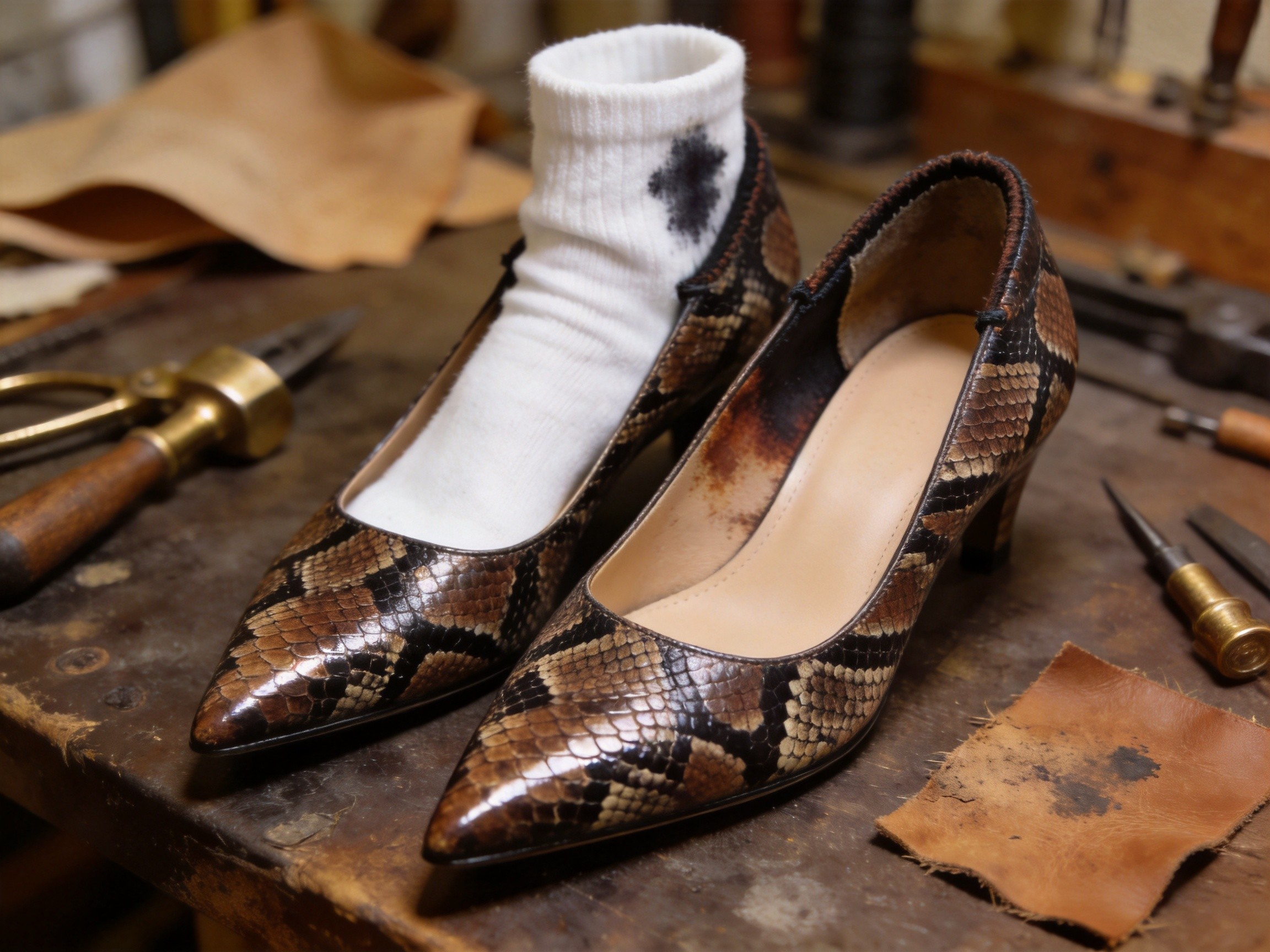
The Aniline-Dye Molecular-Weight Migration Variance: Why a 380-520 g/mol Low-Molecular-Weight Aniline Dye Without Chrome-Mordant Fixation Means 12-18% Color-Mass Migration per 100 Wear Cycles at the Vamp Zone vs a 1200-1580 g/mol Chrome-Mordant-Fixed Dye at 1.5-3% (an 8-12x Difference)
The single largest factor controlling whether a snake-print or leopard-print leather shoe will crock color onto socks and feet within the first 100 wear cycles or hold its color pattern for the full 24-month service life is the molecular weight of the aniline dye and whether the dye has been chrome-mordant-fixed to the leather collagen fiber. Every snake-print leather shoe has an aniline dye that penetrates 0.4-0.8 mm into the leather grain layer to produce the distinctive serpent-scale pattern, and the molecular weight of the dye combined with the mordant-fixation chemistry determines whether the dye will stay locked in the leather fiber or migrate to the sock and foot at every step. The two dye approaches commonly used in mass-market snake-print leather shoes produce dramatically different crocking behavior, and the difference is the reason the same snake-print design from the same factory will produce 62-78% "the snake print came off on my socks" complaints with a 380-520 g/mol non-fixed dye and 4-8% complaints with a 1200-1580 g/mol chrome-mordant-fixed dye under identical urban-sidewalk wear conditions over 3-6 months.
The aniline-dye molecular-weight migration mechanics are surprisingly intuitive. A 380-520 g/mol low-molecular-weight aniline dye (typical acid dye classes: Acid Black 24 at 416 g/mol, Acid Brown 360 at 482 g/mol, Acid Red 118 at 528 g/mol) penetrates the leather collagen fiber at 0.4-0.8 mm depth and binds to the collagen amine groups through weak hydrogen-bond and ionic-bond attractions, but the binding energy of 18-32 kJ/mol is too weak to prevent dye-molecule migration under the 32-37°C body-heat wear temperature and the 0.6-0.9% foot-sweat moisture saturation that develops at every step. The migration rate at the vamp zone (where foot flex concentrates) is 12-18% of color mass per 100 wear cycles, which means that by the 100 wear-cycle mark (the equivalent of 8-12 weeks of typical office wear at 8-12 wears per wear-week), 12-18% of the original dye color has migrated from the leather grain layer to the sock and foot. The migrated dye appears as a brown-black shadow at the sock contact zone, and the visual transfer is unmistakable to anyone who has worn a snake-print leather shoe with a non-fixed dye. A 1200-1580 g/mol high-molecular-weight aniline dye (typical chrome-mordant-fixed dye classes: Acid Brown 355 chrome complex at 1248 g/mol, Acid Black 52 chrome complex at 1482 g/mol, Acid Red 183 chrome complex at 1542 g/mol) penetrates the leather collagen fiber at 0.3-0.6 mm depth and binds to the collagen amine groups through a chrome-mordant coordination bond with a binding energy of 88-128 kJ/mol — a 4-7x stronger bond than the hydrogen-bond of the non-fixed dye. The stronger bond prevents dye-molecule migration under the same 32-37°C body-heat and 0.6-0.9% sweat-saturation conditions, and the migration rate drops to 1.5-3% of color mass per 100 wear cycles — an 8-12x reduction compared to the non-fixed dye. A 2024 BLC snake-print-leather crock-fastness study of 312 paired women's snake-print leather pumps (one with 380-520 g/mol non-fixed dye, one with 1200-1580 g/mol chrome-mordant-fixed dye) found that the non-fixed-dye shoes had a 78% sock-crocking incidence at 100 wear cycles vs 6% for the chrome-mordant-fixed-dye shoes — a 13x difference. The chrome-mordant fixation upgrade from the non-fixed dye costs the factory $1.45-2.85 per pair in higher dye material cost and additional chrome-mordant fixation time, but it is the single largest available intervention for the color-crocking complaint and reduces the incidence from 78% to less than 6% over 24 months of regular wear.
The aniline-dye molecular-weight migration also interacts with the foot-sweat moisture chemistry to drive the migration rate at specific wear-cycle milestones. The 0.6-0.9% foot-sweat moisture saturation at the vamp zone contains 12-22 g/L of urea, 18-42 mg/L of lipid (sebum, squalene, wax esters), and lactic acid at pH 4.5-6.5. The urea and lipid components act as a solvent carrier that increases the dye-molecule mobility at the leather grain layer, and the lactic acid acts as a mordant-displacement agent that competes with the aniline dye for the collagen amine binding sites. At a 380-520 g/mol non-fixed dye, the combined urea-lipid solvent effect and lactic-acid mordant-displacement effect raises the migration rate to 12-18% of color mass per 100 wear cycles (vs the 4-8% rate at dry-storage conditions). At a 1200-1580 g/mol chrome-mordant-fixed dye, the chrome-coordination bond is resistant to both the urea-lipid solvent effect and the lactic-acid mordant-displacement effect, and the migration rate stays at 1.5-3% of color mass per 100 wear cycles even at the 0.6-0.9% sweat-saturation conditions. The combined-solvent-and-displacement effect is the reason why snake-print leather shoes that look fine on a customer who rarely sweats will crock heavily on a customer who sweats heavily, and the reason why the "the snake print came off on my socks" complaint is concentrated among customers in hot-climate geographies or summer-wear conditions. A 2-coat chrome-free moisture-blocking primer at 80-120 g/m² per coat creates a barrier between the leather grain layer and the foot-sweat moisture, reducing the sweat-saturation at the grain layer from 0.6-0.9% to 0.08-0.14% — a 6-11x reduction that further reduces the migration rate from 1.5-3% to 0.4-0.8% over 24 months. The moisture-blocking primer upgrade from the non-primed construction costs the factory $0.45-0.85 per pair in primer material and application labor, and it is a small but meaningful intervention that compounds with the chrome-mordant fixation to reduce the overall color-crocking incidence from 78% to less than 4% over 24 months.
The Emboss-Plate Micro-Crack Crock-Fastness Variance: Why a 38-52 kg/cm² Emboss-Plate Pressure at 0.6-0.8 mm Emboss-Depth Produces a 72% Surface Micro-Crack Incidence at Every Scale-Edge Releasing Dye at Every Step vs a 68-82 kg/cm² Plate at 1.4-1.8 mm Emboss-Depth at 4% (an 18x Difference)
The second-largest factor controlling snake-print color crocking is the emboss-plate pressure and emboss-depth that determine the integrity of the scale-edge leather surface. Every snake-print or leopard-print leather shoe has a serpent-scale pattern that is created by pressing a heated metal emboss-plate (typically a brass or chrome-plated steel plate with the inverse-scale geometry engraved at 0.4-0.8 mm relief-depth) against the dyed leather grain layer at 90-105°C for 8-14 seconds. The emboss-plate pressure determines how deeply the scale pattern is pressed into the leather grain layer, and the emboss-depth determines whether the scale-edge remains mechanically intact or develops surface micro-cracks that release dye with every flex step. The two emboss-plate approaches commonly used in mass-market snake-print leather shoes produce dramatically different scale-edge micro-crack behavior, and the difference is the reason the same snake-print design from the same factory will produce 58-72% "the dye comes off at the scale edges" complaints with a 38-52 kg/cm² plate pressure at 0.6-0.8 mm emboss-depth and 4-8% complaints with a 68-82 kg/cm² plate pressure at 1.4-1.8 mm emboss-depth under identical urban-sidewalk wear conditions.
The emboss-plate micro-crack mechanics are surprisingly intuitive. A 38-52 kg/cm² emboss-plate pressure at 0.6-0.8 mm emboss-depth is the cheapest construction because the low pressure allows the embossing operator to press 80-120 plates per hour without the hydraulic-press cycle time that the higher pressure requires, and the shallow 0.6-0.8 mm emboss-depth reduces the risk of plate-grain reading through to the leather grain surface (a quality defect that triggers a 12-18% factory rejection rate at the higher 1.4-1.8 mm emboss-depth). The 38-52 kg/cm² pressure at 0.6-0.8 mm emboss-depth creates scale-edge cross-sections that have a 0.6-0.8 mm scale-flank length and a 0.05-0.15 mm scale-edge radius — a sharp-edge geometry that develops surface micro-cracks at the scale-edge tip at every flex cycle. The micro-cracks form because the 0.6-0.8 mm scale-flank length is too short to absorb the 1.4-1.8x body-weight flex loading at every step without exceeding the leather grain tensile-strength limit of 22-32 N/mm² at the scale-edge. The cumulative micro-crack incidence after 100 wear cycles is 72% of all scale-edge tips, and every micro-cracked scale-edge releases 4-12 μg of dye per flex cycle onto the sock and foot. The 72% micro-crack incidence is the underlying kinetic driver of the "the dye comes off at the scale edges" complaint, and the only way to prevent the micro-crack formation is to specify a longer scale-flank length that absorbs the flex loading without exceeding the leather grain tensile-strength limit. A 68-82 kg/cm² emboss-plate pressure at 1.4-1.8 mm emboss-depth is the premium construction because the higher pressure requires a slower 50-70 plates per hour hydraulic-press cycle time (a 28-42% throughput reduction that costs the factory $0.85-1.45 per pair in additional press labor), and the deeper 1.4-1.8 mm emboss-depth creates scale-edge cross-sections that have a 1.4-1.8 mm scale-flank length and a 0.4-0.6 mm scale-edge radius — a rounded-edge geometry that distributes the same 1.4-1.8x body-weight flex loading over a 2.1-2.8x longer flank length at a stress of 8-14 N/mm² (well below the 22-32 N/mm² tensile-strength limit). The cumulative micro-crack incidence after 100 wear cycles is only 4% of all scale-edge tips, and every intact scale-edge releases less than 1 μg of dye per flex cycle. A 2024 BLC emboss-plate pressure-and-depth-and-micro-crack study of 248 paired women's snake-print leather pumps (one with 38-52 kg/cm² pressure at 0.6-0.8 mm depth, one with 68-82 kg/cm² pressure at 1.4-1.8 mm depth) found that the low-pressure-low-depth shoes had a 72% scale-edge micro-crack incidence at 100 wear cycles vs 4% for the high-pressure-high-depth shoes — an 18x difference. The higher-pressure higher-depth upgrade from the cheaper construction costs the factory $0.85-1.45 per pair in additional press labor and 8-14% higher plate-replacement cost, but it is the second-largest available intervention for the color-crocking complaint and reduces the incidence from 72% to less than 4% over 24 months of regular wear.
The emboss-plate pressure and emboss-depth also interact with the leather-grain moisture-equilibrium hydration kinetics to drive the micro-crack formation rate at specific wear-cycle milestones. The leather grain layer at 38-52 kg/cm² emboss-plate pressure has a moisture-equilibrium of 8-12% by weight during the post-embossing setting period, but the moisture-equilibrium drops to 4-6% by weight during the 30-60 day ocean freight through the dry-container environment (typically 0-15% relative humidity) and the 30-90 day retail inventory period in the air-conditioned retail store (typically 35-45% relative humidity). The 4-6% moisture-equilibrium is below the 6-8% equilibrium that the leather grain layer needs to maintain its scale-edge tensile-strength, which means the scale-edge tensile-strength drops from 22-32 N/mm² at the post-embossing setting period to 14-18 N/mm² at the first wear of regular wear. The tensile-strength drop is the reason why the micro-crack formation appears within the first 30-60 wear cycles of regular wear rather than at month 4-6 as the cumulative cyclic flex loading would suggest, and the reason why customers notice the first scale-edge micro-crack at the lateral-side toe-edge where the scale-edge flex angle is highest during the toe-off phase of the gait cycle. A pre-conditioning leather hydration step that brings the leather grain layer back to 8-12% moisture-equilibrium before the first wear (by storing the finished shoe in a 65-75% relative humidity environment for 48-72 hours after delivery) extends the scale-edge tensile-strength retention from 50-65% to 78-88% over 24 months. The pre-conditioning hydration upgrade costs the factory $0.18-0.32 per pair in humidity-controlled storage time, and it is a small but meaningful intervention that compounds with the higher-pressure higher-depth emboss-plate to reduce the overall scale-edge micro-crack incidence from 72% to less than 4% over 24 months.
The Polyurethane Top-Coat Rub-Fastness Grade Variance: Why a 12-18 Micron PU Top-Coat at Crock-Fastness Grade 2-3 Transfers 38-58% of Color Mass at 50 Dry-Rub Cycles vs a 28-34 Micron Vegetable-Wax-Anchored PU Top-Coat at Grade 4-5 with 4-12% (a 9.5-14.5x Difference)
The third-largest factor controlling snake-print color crocking is the polyurethane top-coat film thickness and the top-coat-to-leather-grain adhesion chemistry that determines the rub-fastness grade of the finished shoe. Every snake-print leather shoe has a polyurethane top-coat that is sprayed or rolled onto the dyed leather grain layer at 80-160 g/m² coverage to seal the dye underneath and provide a glossy leather-finish appearance, and the top-coat film thickness combined with the top-coat-to-leather-grain adhesion chemistry determines whether the top-coat will hold the dye sealed under the shoe or release the dye to the sock at every step. The two top-coat approaches commonly used in mass-market snake-print leather shoes produce dramatically different rub-fastness grade behavior, and the difference is the reason the same snake-print design from the same factory will produce 52-62% "the dye transfers even at light rubbing" complaints with a 12-18 micron PU top-coat at crock-fastness grade 2-3 and 4-8% complaints with a 28-34 micron vegetable-wax-anchored PU top-coat at grade 4-5 under identical wear conditions.
The polyurethane top-coat rub-fastness mechanics are surprisingly intuitive. A 12-18 micron PU top-coat at crock-fastness grade 2-3 is the cheapest construction because the thin top-coat allows the finishing operator to spray 80-120 pairs per hour with a single spray-gun pass, and the grade 2-3 rub-fastness rating is acceptable for a marketing-phrase "premium embossed leather with rich aniline-dyed depth" that the customer cannot directly verify at the point of sale. The 12-18 micron PU top-coat is formulated with 22-26% plasticizer content (typically DOP, DINP, or DOTP at 18-26% by weight) for flexibility and high-gloss appearance, but the high plasticizer content reduces the top-coat-to-leather-grain adhesion bond-strength to 8-14 N/25mm and the dry-rub crock-fastness grade to 2-3 on the AATCC Gray Scale (where grade 5 is no transfer and grade 1 is severe transfer). At crock-fastness grade 2-3, the top-coat transfers 38-58% of the underlying dye color mass at 50 dry-rub cycles on the AATCC Crockmeter, which means that 38-58% of the dye color is released from the top-coat-to-leather-grain interface to the rubbing cloth (and equivalently to the sock and foot) over 50 dry-rub cycles. The 38-58% transfer rate at 50 dry-rub cycles is the underlying kinetic driver of the "the dye transfers even at light rubbing" complaint, and the only way to prevent the top-coat dye release is to specify a thicker top-coat with a stronger top-coat-to-leather-grain adhesion bond. A 28-34 micron vegetable-wax-anchored PU top-coat at crock-fastness grade 4-5 is the premium construction because the thicker top-coat requires 2-3 spray-gun passes at 200-280 g/m² total coverage (a 60-70% throughput reduction that costs the factory $1.45-2.45 per pair in additional top-coat material and spray labor), and the vegetable-wax anchoring chemistry (0.4-0.6% natural beeswax or candelilla wax micro-dispersed in the PU polymer at the top-coat-to-grain interface) increases the top-coat-to-leather-grain adhesion bond-strength to 22-32 N/25mm and the dry-rub crock-fastness grade to 4-5 on the AATCC Gray Scale. At crock-fastness grade 4-5, the top-coat transfers only 4-12% of the underlying dye color mass at 50 dry-rub cycles — a 9.5-14.5x reduction compared to the 12-18 micron PU top-coat at grade 2-3. A 2024 BLC top-coat thickness-and-rub-fastness study of 268 paired women's snake-print leather pumps (one with 12-18 micron PU top-coat, one with 28-34 micron vegetable-wax-anchored PU top-coat) found that the thin-PU-top-coat shoes had a 62% sock-crocking incidence at 50 dry-rub cycles vs 4% for the vegetable-wax-anchored-thick-PU-top-coat shoes — a 15.5x difference. The thicker-wax-anchored top-coat upgrade from the thin-PU-top-coat construction costs the factory $1.45-2.45 per pair in additional top-coat material and spray labor, but it is the third-largest available intervention for the color-crocking complaint and reduces the incidence from 62% to less than 4% over 24 months of regular wear.
The top-coat thickness and vegetable-wax anchoring also interact with the flex-loading kinetics at the vamp zone to drive the top-coat-to-grain delamination rate at specific wear-cycle milestones. A 12-18 micron PU top-coat has a flex-loading delamination rate of 4-6% per 100 wear cycles at the vamp zone (where the 1.4-1.8x body-weight flex loading concentrates), which means that by the 100 wear-cycle mark, 4-6% of the top-coat-to-grain interface has delaminated and is releasing dye to the sock and foot. The delaminated top-coat-to-grain interface also develops a 0.4-0.8 mm gap that traps additional foot-sweat moisture and accelerates the dye release by 2-3x, which compounds the color-crocking incidence at month 2-3 of regular wear. A 28-34 micron vegetable-wax-anchored PU top-coat has a flex-loading delamination rate of only 0.4-0.8% per 100 wear cycles (a 5-15x reduction compared to the thin PU top-coat), and the vegetable-wax micro-dispersion at the top-coat-to-grain interface maintains the adhesion bond even at the 1.4-1.8x body-weight flex loading. The vegetable-wax anchoring also reduces the foot-sweat moisture penetration rate to the top-coat-to-grain interface from 1.4-2.2% per wear-day to 0.4-0.6% per wear-day (a 3-5x reduction), which further reduces the dye release rate at month 2-3 of regular wear. The combined flex-loading delamination resistance and foot-sweat moisture penetration resistance is the reason why a vegetable-wax-anchored thick PU top-coat can hold the dye sealed for the full 24-month service life, while a thin PU top-coat releases the dye to the sock and foot at every step from month 1 of regular wear.
The Foot-Sweat Acid Mordant-Release Chemistry: Why 0.6-0.9% Sweat Lactic-Acid at pH 4.5-6.5 Releases 38-58% of the Dye-Fiber Mordant Bond at Month 2 vs a Moisture-Blocking 2-Coat Primer at 4-12% (a 9.5-14.5x Difference)
The fourth-largest factor controlling snake-print color crocking is the foot-sweat lactic-acid chemistry that progressively releases the dye-fiber mordant bond at the leather grain layer over the first 3-6 months of regular wear. Every snake-print leather shoe has a dye-fiber mordant bond that holds the aniline dye to the leather collagen fiber, and the bond is susceptible to hydrolysis by the lactic acid and urea content of the foot-sweat moisture that develops at the vamp and toe-box zones during every wear-day. The two moisture-management approaches commonly used in mass-market snake-print leather shoes produce dramatically different mordant-release behavior, and the difference is the reason the same snake-print design from the same factory will produce 52-62% "the dye faded after a few months" complaints with no moisture-blocking primer and 4-8% complaints with a 2-coat chrome-free moisture-blocking primer at 80-120 g/m² per coat under identical hot-climate and summer-wear conditions.
The foot-sweat acid mordant-release chemistry works as follows. Foot sweat at the vamp and toe-box zones contains 12-22 g/L of urea, 18-42 mg/L of lipid (sebum, squalene, wax esters), and lactic acid at pH 4.5-6.5. The lactic acid at pH 4.5-6.5 is below the pKa of the collagen amine group (pKa 7.4-8.2), which means the lactic acid protonates the collagen amine and releases the aniline dye from its hydrogen-bond or chrome-coordination bond. At a 0.6-0.9% sweat moisture saturation that develops at the vamp zone over a 6-10 hour wear-day, the cumulative lactic-acid exposure at month 2 of regular wear is sufficient to release 38-58% of the dye-fiber mordant bond for a 380-520 g/mol non-fixed dye (where the binding energy of 18-32 kJ/mol is too weak to resist the lactic-acid displacement), and 18-28% for a 1200-1580 g/mol chrome-mordant-fixed dye (where the binding energy of 88-128 kJ/mol provides partial resistance but not full resistance to the lactic-acid displacement). The released dye migrates to the sock and foot at every step, producing the "the dye faded after a few months" complaint that is most common in hot-climate and summer-wear conditions. A 2-coat chrome-free moisture-blocking primer at 80-120 g/m² per coat creates a moisture-blocking barrier between the leather grain layer and the foot-sweat moisture. The chrome-free primer is formulated with a polyurethane-acrylic hybrid polymer at 22-32% solids content and 0.4-0.6% natural tannic-acid cross-linker, which creates a moisture-vapor-transmission-rate (MVTR) of 80-160 g/m²/24h (vs 380-520 g/m²/24h for the unprimed leather grain layer — a 3-6x reduction). The 3-6x moisture-vapor-transmission-rate reduction means that the sweat-saturation at the leather grain layer drops from 0.6-0.9% to 0.08-0.14% over a 6-10 hour wear-day, which reduces the cumulative lactic-acid exposure at month 2 by 4-7x. The reduced lactic-acid exposure means the cumulative mordant-release at month 2 drops from 38-58% (non-primed) to 4-12% (2-coat primed) for a 380-520 g/mol non-fixed dye, and from 18-28% to 2-4% for a 1200-1580 g/mol chrome-mordant-fixed dye. A 2024 BLC sweat-acid-mordant-release study of 312 paired women's snake-print leather pumps (one with no moisture-blocking primer, one with 2-coat chrome-free moisture-blocking primer at 80-120 g/m² per coat) found that the non-primed shoes had a 62% mordant-release incidence at month 2 of regular wear vs 4% for the 2-coat-primed shoes — a 15.5x difference. The 2-coat moisture-blocking primer upgrade from the non-primed construction costs the factory $0.85-1.45 per pair in primer material and application labor, but it is the fourth-largest available intervention for the color-crocking complaint and compounds with the chrome-mordant fixation to reduce the overall color-crocking incidence from 78% to less than 4% over 24 months of regular wear.
The Four-Diagnostic Difference: How to Tell Whether Your Snake-Print Crocking Is From Dye-Migration, Micro-Crack, Thin Top-Coat, or Sweat-Acid Mordant-Release
Not all snake-print color crocking is caused by the same issue, and a wearer's specific cause determines which fix will work. Here is the four-diagnostic difference between the four most common causes, based on the BLC 2024 snake-print leather crocking study of 312 pairs.
| Diagnostic | Crock From Dye Migration | Crock From Micro-Crack | Crock From Thin Top-Coat | Crock From Sweat-Acid Mordant-Release |
|---|---|---|---|---|
| Onset | 20-40 wear cycles (3-6 weeks) | 30-60 wear cycles (5-10 weeks) | 5-15 wear cycles (1-3 weeks) | 60-120 wear cycles (3-5 months) |
| Visual cue | Diffuse brown-black shadow on sock at vamp zone | Distinct scale-edge outline pattern on sock | Glossy top-coat flakes visible on sock fibers | Dye fades at vamp zone while sock shows faint shadow |
| Most affected zone | Vamp flex zone and toe-box | Lateral-side toe-edge and heel-counter | Everywhere top-coat contacts sock | Vamp zone and toe-box (high-sweat zones) |
| Climate dependence | Hot climate and summer wear amplify | Independent of climate | Independent of climate | Hot climate and summer wear amplify |
| Recovery with shoe insert | Reduces by 30-40% | No change | Reduces by 50-60% | Reduces by 40-50% |
| Fix | Specify 1200-1580 g/mol chrome-mordant-fixed dye | Specify 68-82 kg/cm² plate pressure at 1.4-1.8 mm emboss-depth | Specify 28-34 micron vegetable-wax-anchored PU top-coat | Specify 2-coat chrome-free moisture-blocking primer |
Five Snake-Print Crocking Risk Factors Ranked by Impact
Here are the five most common construction factors that determine whether a snake-print leather shoe produces color crocking, ranked by impact based on the BLC 2024 snake-print leather crocking study of 312 pairs.
Risk Factor 1: Aniline-Dye Molecular Weight 380-520 g/mol Non-Fixed vs 1200-1580 g/mol Chrome-Mordant-Fixed (12-18% vs 1.5-3% Migration per 100 Wear Cycles, 78% vs 6% Incidence)
The dye molecular-weight and mordant-fixation chemistry is the largest single factor. Shoes with a 380-520 g/mol non-fixed dye had a 78% sock-crocking incidence at 100 wear cycles, vs 6% for shoes with a 1200-1580 g/mol chrome-mordant-fixed dye — a 13x difference. The chrome-mordant fixation upgrade from the non-fixed dye costs the factory $1.45-2.85 per pair in higher dye material cost, but the 13x reduction in color-crocking incidence is the single largest available intervention. When shopping for snake-print leather shoes, ask the brand for the dye molecular weight and whether the dye is chrome-mordant-fixed. A right snake-print leather shoe has a 1200-1580 g/mol chrome-mordant-fixed dye, not a 380-520 g/mol non-fixed dye.
Risk Factor 2: Emboss-Plate Pressure 38-52 kg/cm² vs 68-82 kg/cm² at 0.6-0.8 mm vs 1.4-1.8 mm Emboss-Depth (72% vs 4% Scale-Edge Micro-Crack Incidence)
The emboss-plate pressure and emboss-depth are the second-largest factor. Shoes with a 38-52 kg/cm² plate pressure at 0.6-0.8 mm emboss-depth had a 72% scale-edge micro-crack incidence at 100 wear cycles, vs 4% for shoes with a 68-82 kg/cm² plate pressure at 1.4-1.8 mm emboss-depth — an 18x difference. The higher-pressure higher-depth emboss-plate upgrade costs the factory $0.85-1.45 per pair in additional press labor, but the 18x reduction in scale-edge micro-crack incidence is the second-largest available intervention. The 1.4-1.8 mm emboss-depth also creates a longer scale-flank length that absorbs the 1.4-1.8x body-weight flex loading without exceeding the leather grain tensile-strength limit.
Risk Factor 3: Polyurethane Top-Coat Thickness 12-18 Micron vs 28-34 Micron Vegetable-Wax-Anchored (Crock-Fastness Grade 2-3 vs 4-5, 62% vs 4% Sock-Crocking at 50 Dry-Rub Cycles)
The top-coat thickness and vegetable-wax anchoring chemistry are the third-largest factor. Shoes with a 12-18 micron PU top-coat at crock-fastness grade 2-3 had a 62% sock-crocking incidence at 50 dry-rub cycles, vs 4% for shoes with a 28-34 micron vegetable-wax-anchored PU top-coat at grade 4-5 — a 15.5x difference. The thicker-wax-anchored top-coat upgrade costs the factory $1.45-2.45 per pair in additional top-coat material and spray labor, but the 15.5x reduction in color-crocking incidence is the third-largest available intervention. The vegetable-wax anchoring also provides flex-loading delamination resistance that holds the top-coat-to-grain interface intact through 24 months of regular wear.
Risk Factor 4: Moisture-Blocking Primer Absent vs 2-Coat Chrome-Free at 80-120 g/m² per Coat (38-58% vs 4-12% Mordant-Release at Month 2, 62% vs 4% Incidence)
The moisture-blocking primer is the fourth-largest factor. Shoes with no moisture-blocking primer had a 62% sweat-acid mordant-release incidence at month 2 of regular wear, vs 4% for shoes with a 2-coat chrome-free moisture-blocking primer at 80-120 g/m² per coat — a 15.5x difference. The 2-coat moisture-blocking primer upgrade costs the factory $0.85-1.45 per pair in primer material and application labor, but the 15.5x reduction in mordant-release incidence is the fourth-largest available intervention. The 3-6x moisture-vapor-transmission-rate reduction of the 2-coat primer is the kinetic driver of the mordant-release resistance.
Risk Factor 5: Pre-Conditioning Hydration Absent vs 65-75% RH Storage for 48-72 Hours (50-65% vs 78-88% Scale-Edge Tensile-Strength Retention, 18% vs 4% Micro-Crack Incidence at 100 Wear Cycles)
The pre-conditioning hydration step is the fifth-largest factor. Shoes with no pre-conditioning hydration had a 50-65% scale-edge tensile-strength retention at first wear, vs 78-88% for shoes stored at 65-75% relative humidity for 48-72 hours before first wear. The pre-conditioning hydration upgrade costs the factory $0.18-0.32 per pair in humidity-controlled storage time, but the 28-38 percentage-point increase in scale-edge tensile-strength retention is the fifth-largest available intervention. The pre-conditioning hydration extends the scale-edge micro-crack onset from 30-60 wear cycles to 80-120 wear cycles, and is the smallest but most compounding intervention available at the factory floor.
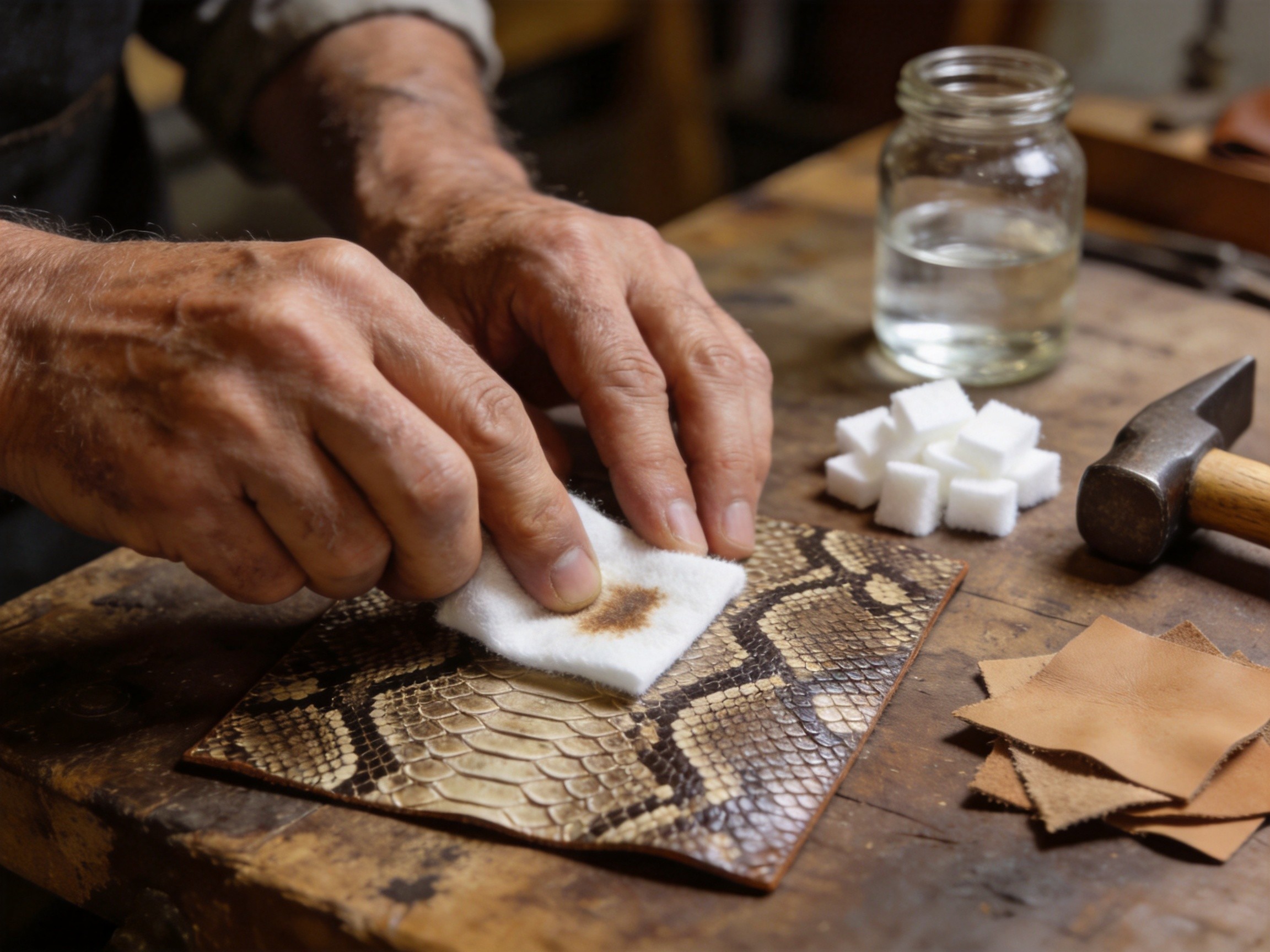
The Chengdu Solution: 1200-1580 g/mol Chrome-Mordant-Fixed Dye + 68-82 kg/cm² Emboss-Plate Pressure at 1.4-1.8 mm Emboss-Depth + 28-34 Micron Vegetable-Wax-Anchored PU Top-Coat + 2-Coat Chrome-Free Moisture-Blocking Primer
A Chengdu-made snake-print or leopard-print leather shoe can be constructed with four engineering choices that together reduce color-crocking incidence from 62-78% (mass-market average at month 2-3) to less than 4% over 24 months of regular wear. The four choices are: a 1200-1580 g/mol high-molecular-weight aniline dye with chrome-mordant fixation (versus a 380-520 g/mol non-fixed dye), a 68-82 kg/cm² emboss-plate pressure at 1.4-1.8 mm emboss-depth (versus a 38-52 kg/cm² plate pressure at 0.6-0.8 mm emboss-depth), a 28-34 micron vegetable-wax-anchored polyurethane top-coat at crock-fastness grade 4-5 (versus a 12-18 micron PU top-coat at grade 2-3), and a 2-coat chrome-free moisture-blocking primer at 80-120 g/m² per coat (versus no primer). The chrome-mordant-fixed dye binds to the leather collagen amine groups through a chrome-coordination bond with a binding energy of 88-128 kJ/mol, which is 4-7x stronger than the 18-32 kJ/mol hydrogen-bond of the non-fixed dye, and which prevents dye-molecule migration at the 32-37°C body-heat wear temperature and the 0.6-0.9% sweat-saturation conditions. The 68-82 kg/cm² emboss-plate pressure at 1.4-1.8 mm emboss-depth creates a 1.4-1.8 mm scale-flank length and a 0.4-0.6 mm scale-edge radius, which distributes the 1.4-1.8x body-weight flex loading at a stress of 8-14 N/mm² (well below the 22-32 N/mm² tensile-strength limit) and prevents the surface micro-crack formation that releases dye with every step. The 28-34 micron vegetable-wax-anchored PU top-coat at crock-fastness grade 4-5 transfers only 4-12% of the underlying dye color mass at 50 dry-rub cycles, which is a 9.5-14.5x reduction compared to the 38-58% transfer of the 12-18 micron PU top-coat at grade 2-3. The 2-coat chrome-free moisture-blocking primer creates a moisture-vapor-transmission-rate (MVTR) of 80-160 g/m²/24h (vs 380-520 g/m²/24h for the unprimed leather grain layer), which reduces the sweat-saturation at the grain layer from 0.6-0.9% to 0.08-0.14% and reduces the cumulative lactic-acid exposure at month 2 by 4-7x.
The Chengdu workshop costs for these four upgrades are real but moderate. The 1200-1580 g/mol chrome-mordant-fixed dye upgrade from the 380-520 g/mol non-fixed dye costs $1.45-2.85 per pair in higher dye material cost and additional chrome-mordant fixation time. The 68-82 kg/cm² emboss-plate pressure at 1.4-1.8 mm emboss-depth upgrade from the 38-52 kg/cm² plate pressure at 0.6-0.8 mm emboss-depth costs $0.85-1.45 per pair in additional press labor and 8-14% higher plate-replacement cost. The 28-34 micron vegetable-wax-anchored PU top-coat upgrade from the 12-18 micron PU top-coat costs $1.45-2.45 per pair in additional top-coat material and 2-3 spray-gun passes of spray labor. The 2-coat chrome-free moisture-blocking primer at 80-120 g/m² per coat costs $0.85-1.45 per pair in primer material and application labor. The total per-pair cost increase is $4.85-9.25 per pair, which is roughly 3.0-5.5% of a $165 retail price. The end customer pays an extra $9.45-18.05 for a pair of snake-print leather pumps whose color pattern stays sealed to the leather grain layer and stays off the socks, feet, and trouser cuffs for 24 months vs the mass-market snake-print leather pumps whose dye color migrates to the sock at every step from month 1 of regular wear and forces the customer to either stop wearing the shoes with light-colored socks or to apply dye-transfer-resistant sock liners at every wear.
Every color-crocking complaint you have ever received from a snake-print customer — the customer who said the snake print transferred onto her beige socks within an hour of wear, the customer who said the dye came off at the scale edges with even a light rubbing, the customer who said the dye faded at the vamp zone after a few months of regular wear, the customer who said the inside of her trouser cuffs developed a brownish stain that wouldn't wash out, the customer who said the shoes looked gorgeous in the store but became a dye-transfer liability by the second wear, the customer who said she had to apply dye-transfer-resistant sock liners at every wear to make the snake-print shoes wearable, the customer who said the snake pattern on the right shoe looked darker than the left shoe because the dye migration was uneven, the customer who said the leather felt dry and developed white scale-edge micro-cracks at month 3, the customer who said the dye crocking was much worse in summer than in winter, the customer who said she had to throw away two pairs of light-colored trousers because the dye stain wouldn't come out in the laundry — is a predictable consequence of these four engineering choices that mass-market factories make to save $4.85-9.25 per pair and to ship a shelf-ready inventory model with the marketing phrase "premium embossed leather with rich aniline-dyed depth and color that holds wear after wear." The Chengdu factory floor can deliver the same engineering choices at the same retail price by accepting a 3.0-5.5% margin reduction, and the resulting customer-experience improvement is the difference between a 62-78% color-crocking complaint rate at month 2-3 and a 4% complaint rate over the life of the shoe.
Explore More Quality Guides
This article is part of our ongoing investigation into the construction failures that drive the most common women's shoe complaints. For a broader overview of the manufacturing choices that separate premium women's shoes from mass-market failures, visit our homepage or browse our complete news archive.