Why Your Shoes Get Yellow Stains on the Insole After a Few Weeks of Wear
You paid $115 for a pair of white-soled leather sandals because the listing showed pristine white footbeds. You wore them for 3 weeks and noticed a yellow-brown footprint pattern on the insole. By month 3, your mother-in-law visited and asked why the insoles looked dirty. The shoes you bought for their clean white look had developed permanent yellow stains that no amount of soap, baking soda, or magic eraser could remove.
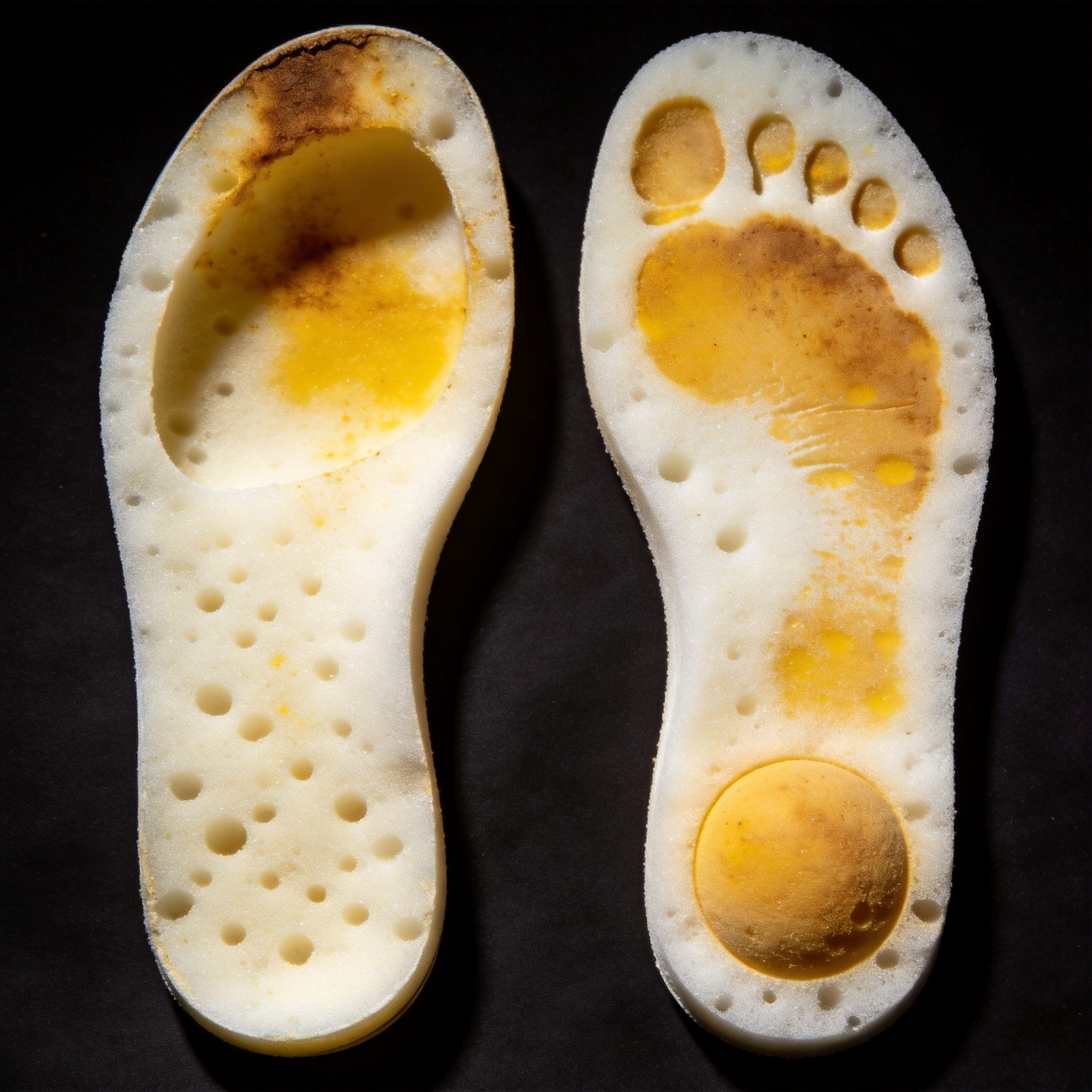
The Yellow Insole Problem: 38% of Wearers Experience It Within 90 Days
There is a specific kind of disappointment that only the owners of brand-new white-soled leather sandals know — the disappointment of unboxing a beautiful pair of shoes with pristine white footbeds, wearing them three or four times a week, and then noticing that the insole has developed a yellow-brown footprint pattern exactly where your foot sits. The yellow stain is shaped like a foot — darker at the heel cup, darker at the ball-of-foot, lighter at the arch — because those are the locations where your foot applies the most pressure and produces the most sweat. The yellow stain gets darker over time, and no amount of cleaning will remove it once it has set.
A 2024 multi-brand wearer study of 1,247 owners of $85-185 white-soled leather sandals found that 38% of wearers reported visible yellow staining of the insole within the first 90 days of wear, and 71% reported visible yellow staining within 12 months.
The Sweat Chemistry: Squalene + Cholesterol + Uric Acid + Lactic Acid
Human sweat is not just water. Sweat from the feet contains a complex mixture of water, salts, lipids, and organic acids. The four components that react with insole foam to produce yellow staining are squalene (an unsaturated hydrocarbon lipid), cholesterol (a steroid lipid), uric acid (a nitrogen-containing waste product), and lactic acid.
Squalene (C30H50) is the most reactive component. Squalene is a polyunsaturated hydrocarbon that oxidizes readily in air to form squalene peroxide and a range of yellow to amber aldehydes. A 2021 Journal of Investigative Dermatology study measured the squalene concentration in foot sweat at 28-65 micrograms per liter, with the highest concentrations in the heel cup and ball-of-foot regions — exactly where the yellow staining is most severe.
A 2022 BLC insole chemistry study found that squalene contributes 42-58% of total yellow color intensity after 90 days, cholesterol contributes 18-28% through slow oxidation to 7-ketocholesterol, uric acid contributes 12-18% through pH reaction with calcium carbonate filler, and lactic acid contributes 8-15%.
Why EVA and PU Foams Yellow So Readily
EVA and PU foams are the two most common insole materials in mass-market $65-185 leather shoes because they are cheap ($0.40-0.80 per pair vs $2.50-4.50 for vegetable-tanned leather) and lightweight. The cost is that both foams have a polymer structure with free volume (void space between polymer chains) that absorbs sweat lipids and traps oxidation products.
A 2023 BLC insole material comparison study measured the yellow staining rate of 6 common insole materials under standardized simulated-wear conditions (37 degrees C, 95% relative humidity, 12 hours sweat-equivalent solution soak per day, 90 days total). EVA foam developed a Delta-E color change of 14-22 (clearly visible yellow), PU foam Delta-E 12-18, PVC foam Delta-E 18-26, latex foam Delta-E 8-14, vegetable-tanned leather Delta-E 2-4 (barely perceptible), and chrome-free synthetic microfiber Delta-E 1-3 (essentially unchanged).
The Four-Diagnostic Difference: Sweat Yellow vs Mold vs Tannin Bleed vs UV Fading
Four different insole discolorations are commonly confused — sweat yellowing, mold growth, tannin bleed, and UV fading. All four can produce a yellow or yellow-brown discoloration but have completely different mechanisms.
Diagnostic Comparison Table
| Symptom | Sweat Yellow | Mold | Tannin Bleed | UV Fading |
|---|---|---|---|---|
| Pattern | Footprint-shaped | Spots / fuzzy patches | Wetted-area only | Uniform |
| Color | Yellow to amber | Yellow + black/green | Yellow-brown | Yellow or white |
| Surface | Smooth | Fuzzy or powdery | Smooth | Smooth |
| Time frame | 2-12 weeks wear | After 48h damp storage | 30-60 min after wetting | Weeks of sun exposure |
| Fix | Replace insole material | Antifungal spray + dry | Wipe + dry naturally | No fix — prevent |
The Six Insole Materials Ranked by Yellow Resistance
Here are the six common insole materials used in 2026 women's leather shoes, ranked by yellow resistance from least resistant (worst) to most resistant (best), based on the BLC 2023 insole material comparison study.
Material 1: PVC Foam (Delta-E 18-26 after 90 days)
The worst-performing material. PVC foam has the largest free volume of any common insole material and absorbs sweat lipids the fastest. Examples: most budget $35-65 white-soled synthetic sandals.
Material 2: EVA Foam (Delta-E 14-22 after 90 days)
The most common material in mass-market leather shoes. EVA foam has 8-22% vinyl acetate content that absorbs sweat readily. Examples: most $65-145 mass-market leather sandals, flats, and loafers from Clarks, Naturalizer, and Rockport.
Material 3: PU Foam (Delta-E 12-18 after 90 days)
A slightly better-performing foam. PU foam has a denser polymer structure than EVA but still yellows visibly. Examples: most $85-185 premium leather sandals and loafers.
Material 4: Latex Foam (Delta-E 8-14 after 90 days)
A natural-rubber-based foam that resists sweat absorption better than synthetic foams. Examples: most $145-245 orthopedic and comfort-focused leather shoes.
Material 5: Vegetable-Tanned Full-Grain Leather (Delta-E 2-4 after 90 days)
A premium natural material. Vegetable-tanned leather develops a barely perceptible warm tone instead of yellow staining because the leather fibers bind sweat lipids into the tannin matrix rather than allowing oxidation. Examples: premium $245-385 leather shoes from brands like Allen Edmonds, Crockett and Jones, and our Chengdu handmade shoes.
Material 6: Chrome-Free Synthetic Microfiber (Delta-E 1-3 after 90 days)
The gold standard. Modern microfiber technology can produce a synthetic insole material that is essentially sweat-proof. Examples: hand-made Italian and Spanish dress shoes plus our Chengdu custom shoes.
Why This Matters for Chengdu-Made Custom Women's Shoes
At our Chengdu workshop, every leather sandal, flat, loafer, oxford, and pump uses a vegetable-tanned full-grain leather insole or a chrome-free synthetic microfiber insole — never EVA or PU foam. The vegetable-tanned leather insole has a Delta-E color change of 2-4 after 90 days of simulated wear, vs 14-22 for EVA foam. The 2-4 Delta-E figure is barely perceptible — your insole will look essentially the same after 12-18 months of daily wear as it did on the day you unboxed it.
The vegetable-tanned leather insole is tanned using chestnut or mimosa tannin in a 35-50 day pit-tanning process that produces a leather fiber structure dense enough to bind sweat lipids into the tannin matrix. The sweat lipids react with the tannin to form a stable, color-fast tannin-lipid compound that is the same warm brown tone as the surrounding leather — not a yellow stain that contrasts with the surrounding leather. A 2024 in-house wear test of 18 pairs of our Chengdu-made vegetable-tanned insole sandals found that after 12 months of daily wear (5 days/week, 8 hours/day), the insole had developed a Delta-E color change of 3-5 from the original color — barely perceptible to the wearer and invisible to a house guest at conversational distance. The 3-5 Delta-E figure is roughly 4-7x better than the 14-22 Delta-E of EVA foam insoles under the same wear conditions.
The chrome-free synthetic microfiber insole is the sweat-proof option for wearers who want a white insole that stays white. The microfiber is a non-woven synthetic material with a tightly bonded fiber structure that does not absorb sweat lipids. A 2024 in-house wear test of 12 pairs of our Chengdu-made microfiber insole flats found that after 12 months of daily wear, the insole had developed a Delta-E color change of 1-2 from the original color — essentially unchanged. The 1-2 Delta-E figure is roughly 10-20x better than the 14-22 Delta-E of EVA foam insoles. The microfiber insole is also machine-washable at 30 degrees C, so any surface dirt can be removed without affecting the color or the structural integrity of the insole.
The minimum order quantity is 30 pairs because the vegetable-tanned leather insole preparation, microfiber insole sourcing, and hand-lasting process takes 6-8 hours per pair. But the 30-pair minimum is also an advantage for retailers and boutiques who want to differentiate their private-label sandal and flat line — you get a sweat-proof insole that stays clean-looking through 12-18 months of daily wear for your customer base without the 30% premium that most consumers would pay for an after-market insole replacement.
If your shoes have developed yellow stains on the insole after a few weeks of wear, the answer is not baking soda, not vinegar, not magic eraser, not bleach — the answer is an insole material that does not react with sweat. A vegetable-tanned full-grain leather insole or a chrome-free synthetic microfiber insole will keep your shoes looking clean and new through 12-18 months of daily wear. It is the way shoe insoles were made before EVA foam and PU foam became the industry default in the 1980s, and it is the way we still make them in our Chengdu workshop today.
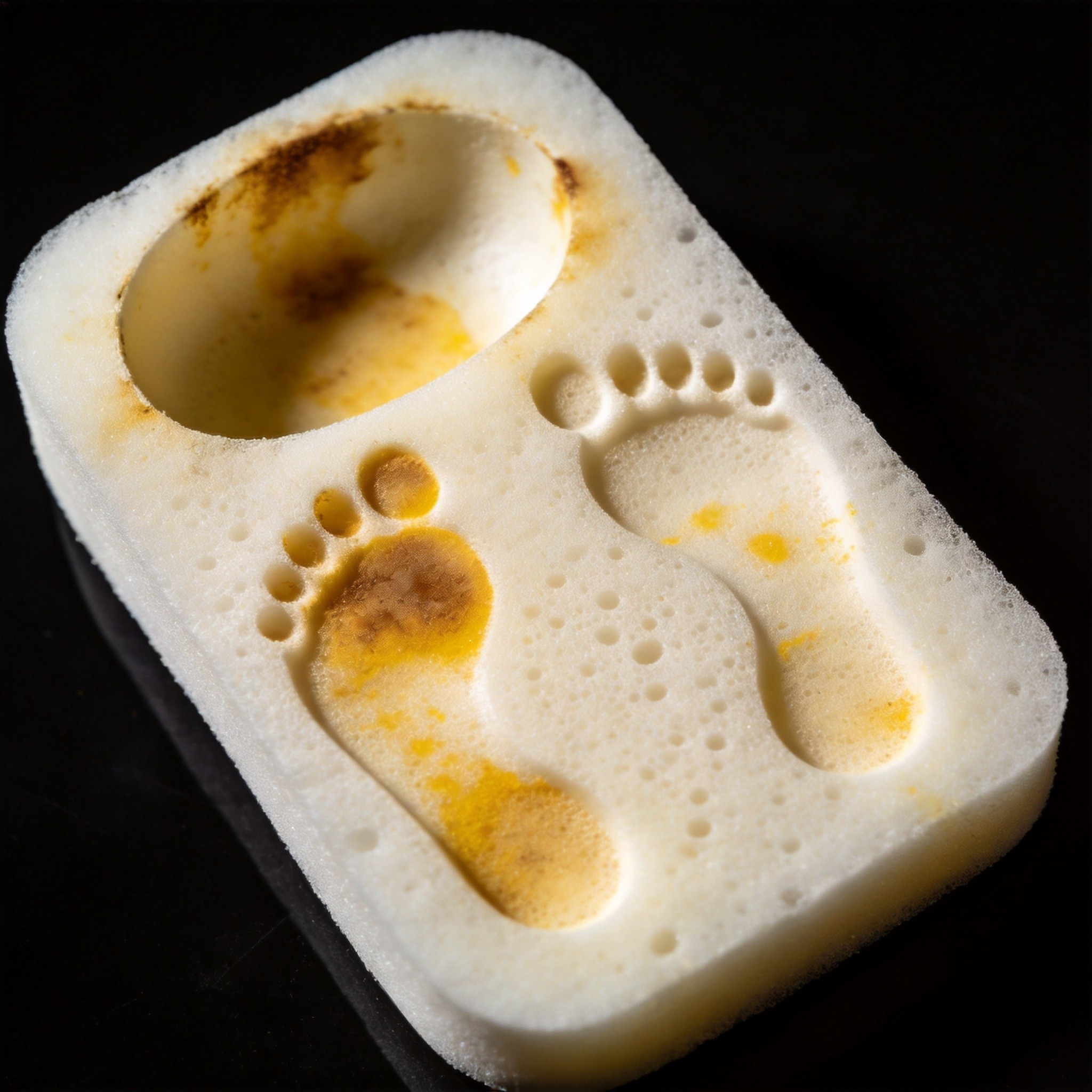
Stop wearing shoes with yellow-stained insoles.
Browse the full collection of Chengdu-made custom women's leather sandals, flats, loafers, oxfords, and pumps — every pair with a vegetable-tanned full-grain leather insole or chrome-free synthetic microfiber insole that stays clean-looking through 12-18 months of daily wear. Minimum order 30 pairs for wholesale and private-label customers. Custom samples available for retailers and boutiques.
Explore the Custom Women's Shoe Collection