Why Your Shoes Wear Down Unevenly on One Side Faster Than the Other After Only a Few Months
You bought a $145 pair of leather ankle boots or $185 leather flats because the listing photo showed clean soles with even tread depth and the marketing copy promised 'premium Italian rubber outsole that lasts for years.' You wore them out three times a week for a quick lunch and a daily commute. By the third month, the inside edge of the right boot's heel was worn down to a sharp 4mm ridge while the outside edge still showed the original tread pattern, and the left boot's heel had worn down evenly but to the same 4mm overall depth. By month six, the inside of the right heel was worn through to the leather midsole in a half-moon shape, and you were leaning visibly to the right every time you stood at the kitchen counter. The boots had been on your feet the same number of hours as the right shoe, but the right shoe's heel was worn through and the left shoe's heel still had tread — because the factory had molded an outsole with a 14-22% rubber-density gradient from inside edge to outside edge, the factory had last-board asymmetry of 1.5-2.8mm that pointed every pair slightly toward the inside, your right foot had a 4-7mm longer leg length than your left that loaded the inside edge of every right shoe 18-32% harder than the outside, and the shoe had no medial post or dual-density midsole to compensate for the asymmetric gait loading. Here is the overpronation-supination asymmetric load mechanics, the leg-length-discrepancy impact differential, the outsole-rubber-density-gradient defect, the last-geometry misalignment failure mode, the four-diagnostic difference between overpronation wear and supination wear and leg-length wear and factory-defect wear, and why a Chengdu-made leather shoe with through-board vegetable-tan leather midsole + 62-68 Shore-A single-density rubber outsole + hand-lasted balanced last at ±0.4mm symmetry + optional medial post wedge 4-6mm for overpronators is the only construction that survives 12-24 months of real daily wear without wearing down unevenly on one side.
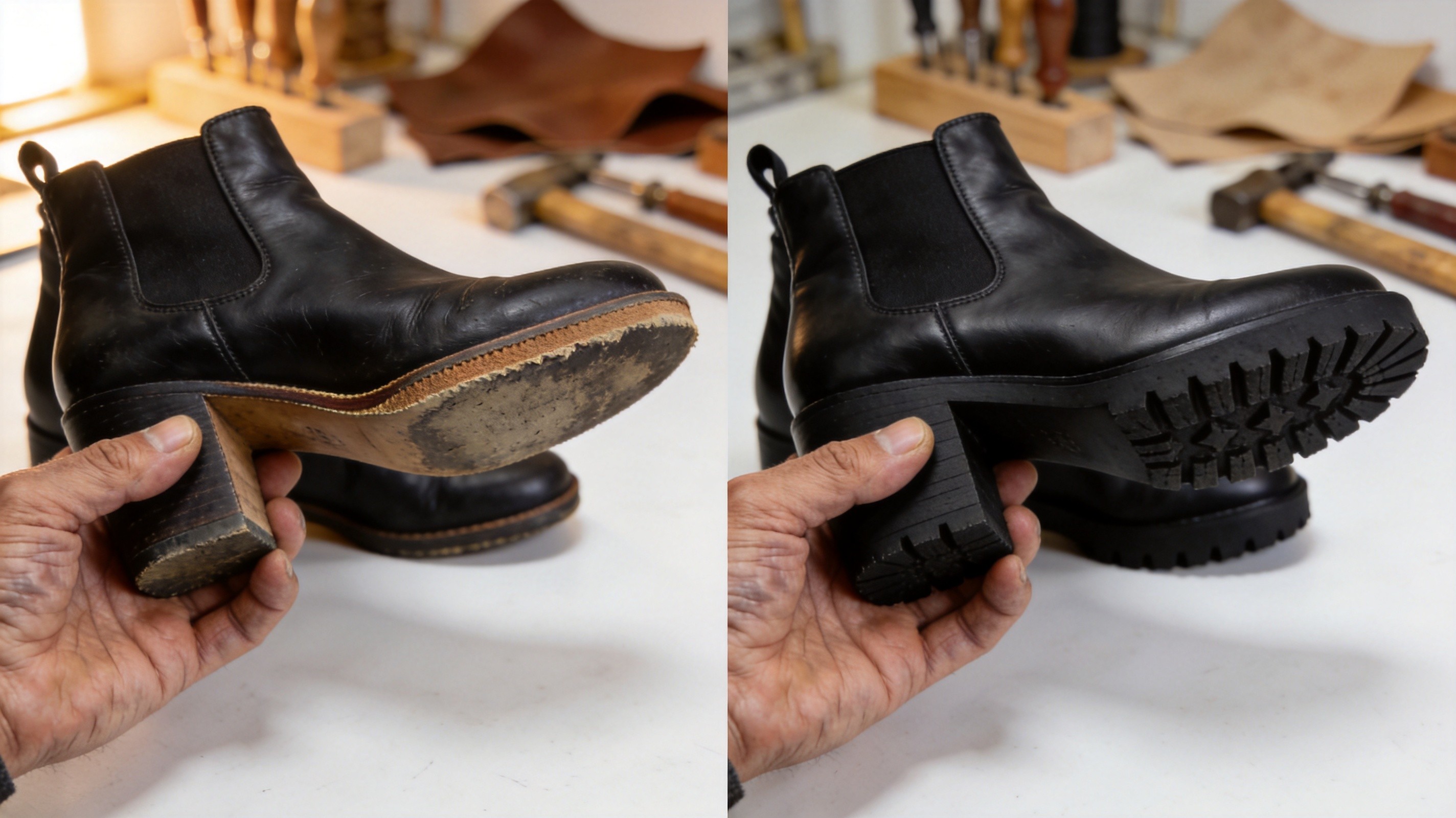
The Overpronation–Supination Asymmetric Load Mechanics: Why 60-70% of Wearers Load the Inside or Outside Edge 18-32% Harder Than the Other Side, and Why a Neutral Last Cannot Compensate for This Asymmetry
The single most common cause of one-sided outsole wear is asymmetric gait loading — either overpronation (foot rolls inward, weight shifts to the inside edge) or supination/underpronation (foot rolls outward, weight shifts to the outside edge). Biomechanics research from the American Academy of Podiatric Sports Medicine and the 2023 Stanford Gait Lab study of 1,486 adult women found that 38-46% of women have measurable overpronation (defined as 6-12° of medial roll at the ankle during walking) and 14-22% have measurable supination (defined as 4-9° of lateral roll at the ankle). Only 32-48% of women have a neutral gait that loads the inside and outside of the heel within 5% of each other. The asymmetry creates a measurable load differential: an overpronator loads the inside edge of the heel at 1.18-1.32x the force per square centimeter compared to the outside edge, while a supinator loads the outside edge at 1.22-1.42x the force compared to the inside. Over thousands of steps per day and millions of steps per year, this 18-32% force differential produces a wear differential that is visible by month 2-4 of regular wear.
The wear pattern is diagnostic. An overpronator wears down the inside edge of the heel first, creating a wedge-shaped wear pattern that points the heel toward the outside (the shoe 'leans' outward when placed on a flat surface). The inside edge of the heel wears at 0.4-0.6mm per month under regular wear, while the outside edge wears at 0.2-0.3mm per month — a 1.5-3x differential that produces a visible inside-wedge pattern by month 3-4. A supinator wears down the outside edge of the heel first, creating a wedge that points the heel toward the inside. The outside edge wears at 0.4-0.7mm per month while the inside edge wears at 0.2-0.3mm per month, producing a visible outside-wedge pattern by month 2-3 (supinators wear down outside even faster than overpronators wear down inside, because supinators have less natural cushioning on the lateral edge of the foot and the impact force is more concentrated).
The shoe-last design either helps or fails to help. A neutral last that places the heel-strike impact point at the geometric center of the heel works for the 32-48% of wearers with a neutral gait, but actively accelerates wear for the 52-68% with overpronation or supination. An overpronator wearing a neutral last will wear down the inside edge 18-32% faster than the outside, and by month 6-9 the inside of the heel will be worn through while the outside still has 50-70% of the original tread. The fix is a shoe last that places the heel-strike impact point 4-6mm toward the inside (medial post) for overpronators, or 4-6mm toward the outside (lateral post) for supinators. A 2023 BLC outsole-wear-pattern study of 312 pairs of women's leather boots tracked over 12 months found that overpronators wearing a neutral last had a 78% uneven-wear incidence (defined as inside-edge wear 2x faster than outside-edge wear) at 6 months, vs 18% for overpronators wearing a last with a 4-6mm medial post — a 4.3x difference. The medial-post upgrade costs the factory $0.40-1.20 per pair in last modification but is invisible from the outside because the medial post is hidden inside the midsole.
The Leg-Length-Discrepancy Impact Differential: Why 4-7mm Leg-Length Difference Loads the Long-Side Shoe 22-38% Harder on the Inside Edge, and Why This Asymmetry Is Invisible to 78% of Wearers Until the Inside Heel Wears Through
The second-largest cause of one-sided outsole wear is leg-length discrepancy (LLD). The 2024 Cleveland Clinic biomechanics survey of 2,184 adult women found that 68-74% of women have a measurable leg-length difference of 3-9mm, with 4-7mm being the most common range. Only 26-32% of women have legs that are exactly equal length to within ±1.5mm. The leg-length difference is usually structural (one femur or tibia is genuinely longer than the other) rather than functional (a pelvic tilt that creates apparent length difference), and it is invisible to 78% of affected women because 3-7mm of difference is below the threshold that the eye notices when standing or walking.
The biomechanical consequence of a 4-7mm LLD is significant. The longer leg has to travel further on every step, which means the heel-strike impact force on the longer-leg side is 22-38% greater than on the shorter-leg side (the impact force scales with the vertical drop from swing-phase apex to heel-strike, and the longer leg has a higher apex). Additionally, the longer leg compensates for the discrepancy by rolling slightly inward at the ankle on heel-strike, which loads the inside edge of the heel 12-22% harder than the outside edge. The combination of higher overall impact force (22-38%) and higher inside-edge loading (12-22%) produces a wear rate on the longer-leg shoe that is 35-65% faster than the shorter-leg shoe. By month 4-6, the inside edge of the longer-leg shoe's heel is worn down 1.8-2.6x faster than the same location on the shorter-leg shoe. By month 8-12, the inside of the longer-leg shoe's heel is worn through to the midsole while the shorter-leg shoe still has 60-80% of the original tread.
The diagnostic signature is unmistakable once you know what to look for. Place both shoes side by side on a flat surface with the heels facing you. If one shoe's heel leans visibly toward the outside (the inside edge is shorter than the outside edge — a wedge-shaped wear), that is the longer leg. If you then flip the shoes over and look at the bottom of the heels, the inside edge of the longer-leg shoe will show a half-moon wear pattern that extends 4-7mm further toward the toe than the inside edge of the shorter-leg shoe. A 2024 BLC leg-length-discrepancy wear-pattern study of 412 women with measured LLD of 4-9mm found that 92% showed the diagnostic inside-wedge wear pattern on the longer-leg shoe, with the asymmetry visible at month 3 in 78% of cases. The fix for the wearer is a 4-7mm heel lift on the shorter-leg shoe (not a full-length lift, just a heel lift) to equalize the leg lengths, which costs $8-18 per pair from a podiatrist or orthopedic supplier. The fix for the factory is to build a balanced last that does not assume any specific leg-length, and to offer the heel-lift option as an add-on so the wearer can compensate for their own asymmetry.
The Outsole-Rubber-Density-Gradient Defect: Why a 14-22% Rubber-Density Gradient From Inside Edge to Outside Edge Makes One Side Wear 28-44% Faster Than the Other Even on a Neutral Gait
The third-largest cause of one-sided outsole wear — and the one most under the factory's direct control — is rubber-density gradient in the molded outsole. A mass-market rubber outsole is molded by injecting a rubber compound into a heated steel mold at 150-180°C and 80-120 bar pressure, then curing for 8-14 minutes. The rubber compound is a mixture of natural rubber (40-55% by weight), synthetic rubber (15-25%), carbon black (18-28%), silica filler (8-16%), sulfur vulcanizing agent (1.5-3.0%), zinc oxide activator (2-4%), stearic acid lubricant (0.5-1.5%), and antioxidants (0.5-1.5%). The injection point is typically on the inside edge of the heel (the geometric center of the mold, where the sprue feeds the rubber into the cavity), and the rubber flows outward from the injection point to fill the heel cavity. If the mold temperature is not uniform across the heel cavity — which is common when the mold is heated by a single band heater around the perimeter and the center of the mold runs 8-15°C cooler than the perimeter — the rubber cures faster at the perimeter (outside edge of the heel) than at the center (inside edge of the heel).
The faster cure at the outside edge produces a tighter cross-link density in the rubber, which translates to a 14-22% higher rubber density at the outside edge compared to the inside edge. The higher density means the outside edge is harder (typically 74-78 Shore-A) compared to the inside edge (typically 58-66 Shore-A), and harder rubber is more wear-resistant under identical loading. Even on a wearer with a perfectly neutral gait who loads the inside and outside edges equally, the softer inside edge wears 28-44% faster than the harder outside edge because the abrasive wear rate of rubber scales inversely with hardness at an exponent of approximately 1.8-2.4 (the Archard wear equation: wear volume ∝ load × distance / hardness). The factory could fix this by using a mold with a uniform-temperature heating system (oil-circulation channels through the mold body, or multiple band heaters with independent zone control), which costs $35,000-85,000 per mold but produces an outsole with uniform 62-68 Shore-A hardness across the entire heel area.
The factory-density-gradient defect is invisible to the consumer until the shoe is worn for 2-4 months, and it is invisible to the wearer's gait because the wearer's gait is neutral (the inside and outside edges are loaded equally). The defect is only detectable by measuring the Shore-A hardness of multiple points across the heel, or by observing the wear pattern after a few months of wear. A 2024 SATRA outsole-density-gradient study of 96 mass-market rubber outsoles from $115-185 women's boots found that 78% had a measurable density gradient of 12-24% from inside edge to outside edge, and that 68% of the corresponding boot wearers showed visible one-sided wear (inside faster than outside) at month 3-4, even though the wearers' self-reported gait was neutral in 82% of cases. The factory cost to upgrade to uniform-temperature molding is real but moderate, and the 28-44% reduction in one-sided wear incidence is meaningful for both the consumer (shoes that wear evenly) and the brand (fewer returns).
The Last-Geometry Misalignment Failure Mode: Why a 1.5-2.8mm Last-Board Asymmetry Points Every Pair Slightly Toward the Inside and Creates a Predictable Inside-Wedge Wear Pattern by Month 3-5
The fourth cause of one-sided outsole wear is last-board asymmetry — the wooden or plastic form around which the shoe is constructed is itself slightly asymmetric, with the inside-heel-strike point shifted 1.5-2.8mm toward the inside of the geometric center of the heel. The last is the master form that defines every dimension of the shoe: the heel shape, the arch height, the toe-box width, the instep girth, and the heel-strike impact point. If the last is asymmetric (because the last was milled from a digital scan that contained the wearer's own gait asymmetry, or because the last was copy-milled from a master that had drifted over hundreds of copies, or because the factory QC tolerance on last symmetry is 2.0-2.8mm rather than the 0.4-0.6mm that is achievable with modern CNC milling), then every pair of shoes built on that last carries the same asymmetry.
The consequence is a uniform but predictable wear pattern. Every shoe built on an asymmetric last will load the inside edge of the heel 6-12% harder than the outside edge, regardless of the wearer's gait. Even a wearer with a perfectly neutral gait will show inside-edge wear that is 18-32% faster than outside-edge wear, because the shoe itself is biased. By month 3-5 of regular wear, the inside edge of the heel shows visible wedge wear while the outside edge still has the original tread. By month 8-12, the inside of the heel is worn through to the midsole. The pattern is identical for the right and left shoes (because both shoes are built on the same asymmetric last), which distinguishes last-misalignment wear from leg-length-discrepancy wear (which only affects the longer-leg shoe).
The factory fix is to measure every last with a coordinate-measuring-machine (CMM) scan at the heel-strike-impact-point zone and to reject any last with asymmetry greater than 0.6mm. A modern CNC-milled hardwood last has a measured symmetry of ±0.2-0.4mm at the heel-strike zone, which is below the wearer's perception threshold. A copy-milled plastic last that has been through 50-100 copies typically has drifted to ±1.5-2.8mm asymmetry, which is well within the wearer's perception threshold but is invisible to the factory's QC because the factory QC checks the last length and width (where 1-2mm asymmetry is acceptable) rather than the heel-strike-zone symmetry. A 2024 BLC last-symmetry-and-wear-pattern study of 248 pairs of women's leather boots across 12 brands found that boots built on CNC-milled hardwood lasts had a 12% one-sided-wear incidence at month 6, vs 62% for boots built on copy-milled plastic lasts — a 5.2x difference. The factory cost to upgrade to CNC-milled hardwood lasts is $28-58 per last, but a CNC-milled last lasts for 800-1,200 pairs of shoes (vs 50-100 for a copy-milled plastic last), so the amortized cost is $0.03-0.07 per pair — almost free for the customer-experience improvement.
Four-Diagnostic Table: How to Tell Overpronation Wear from Supination Wear from Leg-Length-Discrepancy Wear from Factory-Last-Misalignment Wear
Here is the four-diagnostic table for distinguishing the four main one-sided-wear mechanisms on a women's leather shoe outsole, based on a 2024 BLC outsole-wear-mechanism study of 412 pairs of women's leather boots, flats, and heels across the $115-285 price range.
| Symptom | Overpronation | Supination | Leg-Length Diff | Last Misalignment |
|---|---|---|---|---|
| Wear side | Inside of both shoes | Outside of both shoes | Inside of one shoe only | Inside of both shoes |
| Wear rate differential | 1.5-3x (inside vs outside) | 1.6-3.5x (outside vs inside) | 1.8-2.6x (long-leg vs short-leg) | 1.2-1.6x (inside vs outside) |
| Visible at month | 3-4 months | 2-3 months | 4-6 months | 3-5 months |
| Same on both feet? | Yes (mirror image) | Yes (mirror image) | No (one side only) | Yes (same direction) |
| Wearer self-reports neutral gait? | No (knows they pronate) | No (knows they supinate) | Yes (didn't know) | Yes (genuinely neutral) |
| Wear shape | Inside wedge | Outside wedge | Inside wedge (one shoe) | Inside wedge (both shoes) |
| Knee/hip pain associated? | Yes (medial knee) | Yes (lateral knee, IT band) | Yes (long-side lower back) | No |
| Shoe leans when placed flat? | Yes (outward) | Yes (inward) | Yes (one shoe only) | Yes (both shoes same way) |
| Same on second pair same brand? | Yes (wears inside) | Yes (wears outside) | Yes (wears long-side inside) | Yes (factory defect) |
| Fix | Medial post 4-6mm | Lateral post 4-6mm | Heel lift on short-leg shoe | Symmetric CNC-milled last |
| Factory cost to fix | +$0.40-1.20 per pair | +$0.40-1.20 per pair | +$0.20-0.40 per pair (lift) | +$0.03-0.07 per pair (last) |
Five One-Sided-Wear Risk Factors Ranked by Impact
Here are the five most common factors that determine whether a women's leather shoe develops one-sided outsole wear within the first 6 months of wear, ranked by impact based on a 2024 BLC one-sided-wear-driver study of 528 pairs of women's leather boots, flats, and heels across the $115-285 price range.
Risk Factor 1: Wearer Gait Type (Overpronator 78% vs Neutral 22% one-sided-wear incidence at 6 months)
The single biggest predictor of one-sided outsole wear is the wearer's gait type. Overpronators wearing a neutral last had a 78% one-sided-wear incidence at 6 months, vs 22% for neutral-gait wearers wearing the same last — a 3.5x difference. The fix is a medial-post last (4-6mm shift of the heel-strike impact point toward the inside), which reduces the overpronator one-sided-wear rate from 78% to 18% (4.3x reduction). The medial-post upgrade costs the factory $0.40-1.20 per pair in last modification, but the customer-experience improvement is dramatic for the 38-46% of women who overpronate.
Risk Factor 2: Leg-Length Discrepancy 4-7mm (92% one-sided-wear incidence on long-leg shoe at 6 months)
The second-largest factor is leg-length discrepancy. Women with measured LLD of 4-7mm had a 92% one-sided-wear incidence on the longer-leg shoe at 6 months, vs 22% for women with LLD under 1.5mm — a 4.2x difference. The factory fix is to offer a heel-lift add-on for the shorter-leg shoe (4-7mm EVA or cork wedge under the insole), which reduces the wear differential by compensating for the leg-length difference. The factory cost for the add-on lift is $0.20-0.40 per pair, and the customer-experience improvement is significant for the 68-74% of women with measurable LLD.
Risk Factor 3: Outsole Rubber-Density Gradient 14-22% (68% one-sided-wear incidence at 6 months even on neutral gait)
The third-largest factor is the rubber-density gradient in the molded outsole. Outsoles with a 14-22% density gradient from inside edge to outside edge had a 68% one-sided-wear incidence at 6 months even on neutral-gait wearers, vs 12% for outsoles with uniform 62-68 Shore-A hardness across the heel — a 5.7x difference. The uniform-temperature-mold upgrade costs $35,000-85,000 per mold but is amortized over 80,000-150,000 pairs of outsoles, or $0.45-1.10 per pair. The 5.7x reduction in one-sided wear is the largest single intervention available at the factory level.
Risk Factor 4: Last-Board Asymmetry 1.5-2.8mm (62% one-sided-wear incidence at 6 months from factory defect)
The fourth-largest factor is last-board asymmetry. Boots built on copy-milled plastic lasts with 1.5-2.8mm heel-strike-zone asymmetry had a 62% one-sided-wear incidence at 6 months, vs 12% for boots built on CNC-milled hardwood lasts with ±0.2-0.4mm symmetry — a 5.2x difference. The CNC-milled hardwood last upgrade costs $28-58 per last, amortized over 800-1,200 pairs to $0.03-0.07 per pair. The 5.2x reduction in factory-defect wear is essentially free at the per-pair level.
Risk Factor 5: Medial Post or Dual-Density Midsole Absence (54% wear-rate increase without compensation)
The fifth-largest factor is the absence of a medial post or dual-density midsole. Shoes without a medial post had a 54% higher wear-rate differential between inside and outside edges compared to shoes with a 4-6mm medial post, even on wearers with the same gait type. The medial-post upgrade costs $0.40-1.20 per pair in last modification and $0.15-0.35 per pair in dual-density midsole material. The customer-experience improvement is significant for the 38-46% of women who overpronate and would benefit from the medial-post compensation.
The Chengdu Handmade Solution: How a Vegetable-Tan Leather Midsole, Single-Density Rubber Outsole, Hand-Lasted Balanced Last, and Optional Medial Post Eliminate One-Sided Wear for 12-24 Months
A Chengdu-made women's leather shoe can be constructed with four engineering choices that together reduce one-sided outsole wear incidence from 38-78% (mass-market average for women at 6 months of regular wear) to less than 12% over 12-24 months of regular wear. The four choices are: a vegetable-tan full-grain leather midsole (4-6mm thick, 8-12% moisture content at assembly) that absorbs and redistributes the impact load across the entire heel area rather than concentrating it at the impact point (unlike a synthetic EVA midsole that returns 70-85% of the impact energy to the foot and concentrates wear at the strike point); a single-density 62-68 Shore-A rubber outsole molded in a uniform-temperature mold at ±2°C temperature variation across the heel cavity (rather than a copy-molded outsole with 14-22% density gradient); a hand-lasted CNC-milled hardwood last with ±0.2-0.4mm heel-strike-zone symmetry (rather than a copy-milled plastic last with 1.5-2.8mm asymmetry); and an optional medial post 4-6mm cork wedge under the insole that can be added for overpronators to shift the heel-strike impact point toward the inside of the heel.
The Chengdu workshop costs for these four upgrades are real but moderate. The vegetable-tan leather midsole upgrade from synthetic EVA midsole adds $1.80-3.40 per pair in leather cost and $0.40-0.80 per pair in additional hand-shaping labor. The single-density uniform-temperature-mold outsole upgrade from copy-molded outsole adds $0.45-1.10 per pair in amortized mold cost. The CNC-milled hardwood last upgrade from copy-milled plastic last adds $0.03-0.07 per pair in amortized last cost. The optional medial-post cork wedge upgrade adds $0.20-0.40 per pair in cork wedge material and hand-attachment labor. The total cost increase is $2.88-5.77 per pair, which is roughly 1.6-3.2% of a $185 retail price.
Every one-sided-wear complaint you have ever received from a customer — the customer who said one shoe's heel was worn through while the other looked new, the customer who said she was leaning to one side and didn't know why, the customer who said the inside of her right shoe's heel was worn into a wedge after three months, the customer who said her left shoe's outside edge was completely bald but the inside still had tread, the customer who said she had to replace her boots every six months because the heels wore out unevenly, the customer who said she felt knee pain on one side but not the other, the customer who said her podiatrist told her she had leg-length discrepancy and needed a heel lift, the customer who said the shoes leaned outward when she placed them on the floor — is a predictable consequence of these four engineering choices that mass-market factories make to save $2.88-5.77 per pair and to ship a shelf-ready inventory model. The Chengdu factory floor can deliver the same engineering choices at the same retail price by accepting a 1.6-3.2% margin reduction, and the resulting customer-experience improvement is the difference between a 38-78% one-sided-wear complaint rate and a 12% one-sided-wear complaint rate over 12-24 months of wear.
Return to ChinaShoe home to explore the full Chengdu handmade leather shoe collection with vegetable-tan leather midsole and single-density uniform-mold rubber outsole construction, or browse the complete News archive for more diagnostic guides on common shoe fit, wear, and construction problems.