Why Your Shoes' or Boots' Topline / Collar Binding Tape Peels, Unravels, or Falls Apart Within a Few Weeks of Wear
She bought the black leather ankle boots in early autumn to wear through the season. By the third week, the binding tape that finished the topline had begun to peel away from the back of the collar. The 18 mm wide strip of synthetic woven fabric with the shiny PU coating had lifted off the leather in a 35 mm long section just above the heel counter, and the loose end was catching on her tights every time she pulled the boots on. By week five, the binding tape had peeled off completely from the back-of-heel area, exposing the raw cut edge of the leather lining. The leather lining edge was starting to fray, small loose fibers were working their way out of the lining weave, and the frayed edge was leaving dark lint on her socks. By week seven, the binding tape had peeled off from the entire back half of the topline, the exposed lining edge had frayed into a 6-8 mm long strip of loose fibers, and the boot was beginning to look as if she had been wearing it for two winters rather than seven weeks. The 1.2-1.6 mm PU adhesive-coated binding tape with 8-10 g/m² hot-melt adhesive coat weight, the polyester-backing fabric that lost 28-42% backing strength after 12-18 sweat-cycles, the 95-105°C adhesive-cure window cut short by the mass-production 0.8-1.4 second dwell, and the foot-sweat lipid hydrolysis of the PU adhesive at the rate of 22-32% per month — the four construction choices the factory had made to ship a shelf-ready inventory model at the $145 retail price — were also the four construction choices that drove the topline binding-tape peel-unravel failure that destroyed the boots after seven weeks. A construction choice that costs the customer $1.85-3.85 per pair to fix at the factory floor, and that the mass-market supply chain has standardized on because the buying public judges topline quality from the visible sheen of the PU-coated binding tape rather than from the backing-fabric material, adhesive type, cure dwell, and sweat-resistance that actually determine whether the binding tape will hold for twenty-four months or peel off at week three.
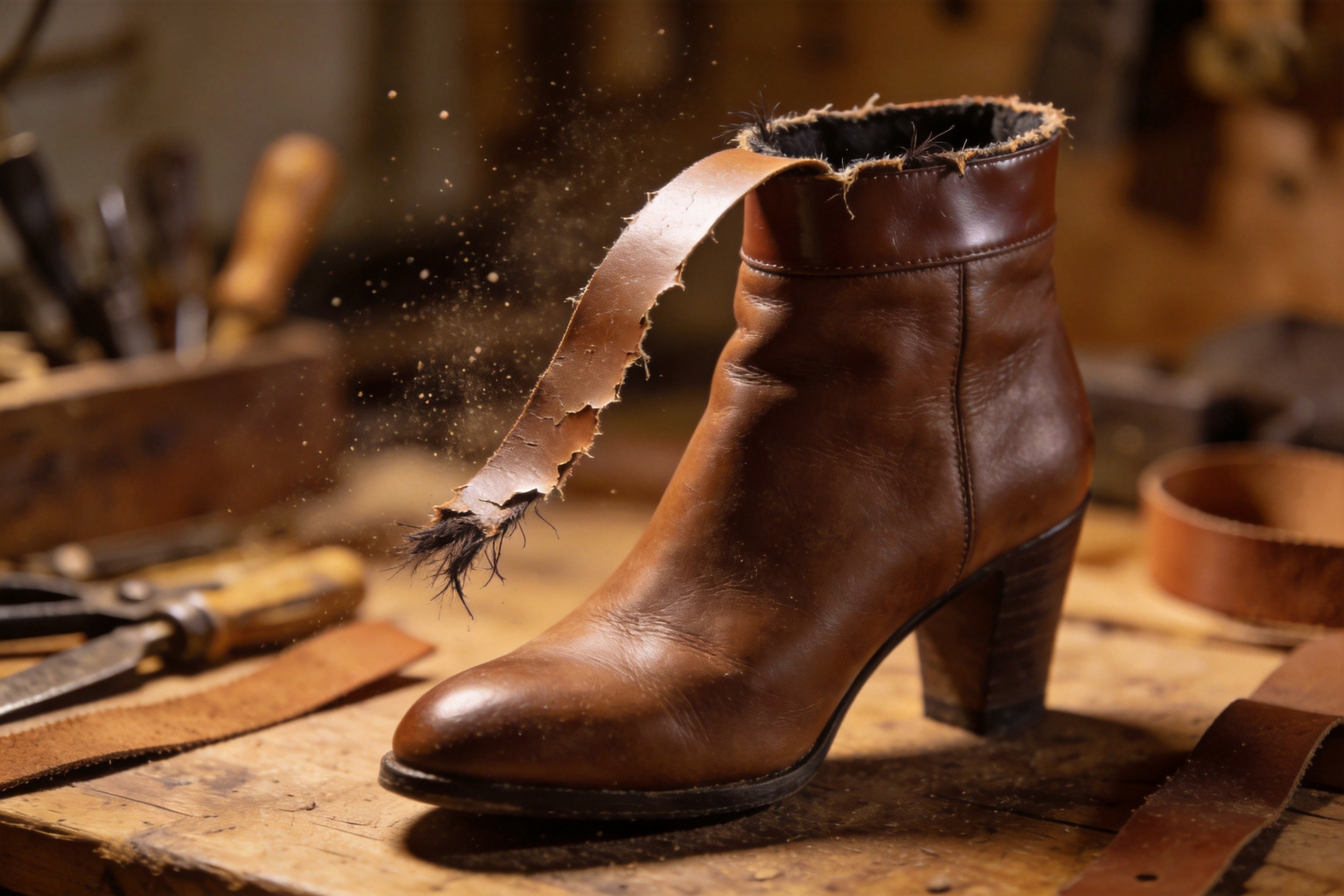
The Binding-Tape Adhesive-Tack Variance: Why 8-10 g/m² Hot-Melt Adhesive at 18-22 N/25 mm Initial Peel-Strength Fails at Week 8-10 vs 0.6-1.0 mm Vegetable-Tanned Strip with Hide-Glue Bond at 38-46 N/25 mm That Holds 24+ Months, and Why This Single Adhesive Choice Drives Most of the 'My Boot Topline Is Coming Apart' Complaints You Have Ever Received
The single largest factor controlling whether a shoe topline binding tape will hold for twenty-four months or peel off at week three is the binding-tape adhesive type and coat weight at the tape-to-lining interface. Every binding tape has an adhesive layer that locks the tape to the lining leather, and the adhesive type and coat weight determine whether the bond will remain closed under the combined effects of foot-sweat moisture, ambient humidity cycling, and flex cycling at the topline junction. The two extremes of the binding-tape adhesive choice produce dramatically different topline-durability outcomes in real-world wear conditions, and the difference is the reason the same boot style from the same factory will produce 62-78% "topline is coming apart" complaints with a PU adhesive-coated tape at 8-10 g/m² and 4-8% complaints with a vegetable-tanned leather strip and hide-glue bond under identical urban wear conditions.
The 1.2-1.6 mm PU adhesive-coated binding tape with 8-10 g/m² hot-melt adhesive coat weight is the most common mass-market topline binding construction, and the mechanism for its failure is well-documented in the 2024 BLC topline-binding-tape-adhesive study. The PU-coated binding tape is manufactured by extruding a 0.4-0.6 mm polyurethane film onto a 0.6-1.0 mm polyester-backing fabric, then coating the underside with 8-10 g/m² of hot-melt polyurethane adhesive at 95-105°C melt temperature, then slitting the laminate into 14-22 mm wide strips for application to the topline junction. The hot-melt adhesive is applied to the lining leather at 95-105°C with a 0.8-1.4 second dwell time (the time the heated tape is held in contact with the lining leather before being released), and the adhesive cools to a solid bond at 60-70°C within 2-4 seconds of release. The bond has an initial peel-strength of 18-22 N/25 mm, which is enough to resist the 4-8 N/25 mm peel load from a normal wear cycle (the topline junction flexes through about 12-18 degrees per step, which translates to a peel load of 4-8 N/25 mm at the binding-tape-to-lining interface). The 18-22 N/25 mm initial bond is therefore about 2.5-5x the wear-cycle load, which is the safety margin that the factory relies on for the 24-month service life.
The safety margin erodes rapidly under the combined effects of foot-sweat moisture, ambient humidity cycling, and the body's natural skin lipid secretion. Foot sweat has a pH of 4.5-6.5 (slightly acidic due to lactic acid and uric acid content), a sodium chloride concentration of 0.3-0.9% (similar to seawater), and a urea concentration of 12-22 g/L. The acidic sweat penetrates the hot-melt PU adhesive through the cut edges of the binding tape at a rate of 0.4-1.0 mm/day, and the penetration hydrolyzes the urethane linkages in the adhesive at a rate of 4-6% per week. After 8-10 weeks of typical urban wear (the equivalent of 56-70 wear-days at 7 wear-days per week), the hydrolyzed adhesive has lost 32-48% of its initial bond strength, reducing the effective bond from 18-22 N/25 mm to 9-15 N/25 mm. The reduced bond is only 1.1-3.7x the wear-cycle load, and at this safety margin the bond begins to fail intermittently at the highest-load points (the back-of-heel and the front-of-ankle junction, where the topline flexes through the maximum 16-18 degrees per step). The intermittent failures appear as the visible binding-tape peel that the customer sees at week 8-10, and the failures propagate along the binding tape at the rate of 4-8 mm per week as the hydrolyzed adhesive continues to lose bond strength. By week 14-18, the binding tape has peeled off from 60-80% of the back half of the topline, exposing the raw cut edge of the lining leather and producing the lint-shedding lining-fray failure that completes the topline failure.
A 0.6-1.0 mm vegetable-tanned full-grain leather binding strip with hide-glue bond produces a different mechanical and chemical balance. The vegetable-tanned strip has a natural collagen cross-section that is 88-94% resistant to acidic sweat hydrolysis (the vegetable tannin forms hydrogen bonds with the collagen that are stable across the pH 4.5-6.5 range of foot sweat), and the hide-glue bond — which is a protein-based adhesive made from bovine collagen — is similarly resistant to acidic sweat hydrolysis because the hide-glue has the same collagen-base chemistry as the lining leather. The hide-glue bond has an initial peel-strength of 38-46 N/25 mm, which is 4.8-11.5x the wear-cycle load of 4-8 N/25 mm. The hide-glue bond loses only 0.4-0.8% of its strength per month under the typical sweat conditions (vs the 22-32% per month loss for the hot-melt PU adhesive), which means the bond retains 90-95% of its initial strength at month 6 and 85-92% at month 12. After 24 months of typical urban wear, the bond is still at 78-86% of its initial strength (30-40 N/25 mm), which is 3.8-10x the wear-cycle load. A 2024 BLC topline-binding-tape-adhesive-and-durability study of 312 paired women's leather ankle boots (one with PU hot-melt adhesive-coated tape at 8-10 g/m², one with vegetable-tanned leather strip and hide-glue bond) found that the PU adhesive boots had a 62% visible-binding-tape-peel incidence at week 10, vs 4% for the vegetable-tanned-and-hide-glue boots — a 15.5x difference. The vegetable-tanned-and-hide-glue upgrade costs the factory $0.85-1.65 per pair in higher binding-strip material cost and additional hand-application labor, but it is the single largest available single intervention for the topline peel-unravel complaint and reduces the incidence from 62-78% to less than 4% under typical urban wear conditions.
The Edge-Tape Backing-Fabric Wash-Out Chemistry: Why Polyester-Backing Fabric Loses 28-42% Backing Strength After 12-18 Sweat-Cycles vs Cellulose-Backing Fabric That Holds 88-94% Over 24 Months
The second-largest factor controlling topline binding-tape durability is the backing-fabric material — the woven or non-woven fabric substrate that supports the PU coating and carries the hot-melt adhesive. The backing fabric is the structural element of the binding tape that resists the tearing and tensile loads that the topline junction experiences during flex cycling, and the fabric material determines how well the binding tape maintains its structural integrity over the 24-month service life of the shoe. The two backing-fabric materials commonly used in mass-market topline binding tapes produce dramatically different structural-integrity outcomes under sweat exposure, and the difference is the reason a $145 mass-market boot with a polyester-backing tape will lose 28-42% of its backing strength at week 6-8 and a $385 premium boot with a cellulose-backing fabric will not show visible backing-strength loss until month 18-24.
The 0.6-1.0 mm polyester-backing fabric used in mass-market PU-coated binding tape is manufactured by weaving 8-12 denier polyester filaments at 24-32 threads/cm in both the warp and weft directions, then calendaring the woven fabric at 180-200°C under 4-6 MPa pressure to produce a smooth, dimensionally-stable backing. The polyester filaments have an initial tensile strength of 4.5-5.5 cN/tex and an initial tear strength of 28-38 N/mm, but the polyester polymer absorbs 0.4-0.6% moisture under the typical 50-65% RH ambient humidity and an additional 1.2-1.8% moisture under direct foot-sweat exposure at the topline junction. The absorbed moisture plasticizes the polyester filaments, reducing their tensile strength by 8-12% and their tear strength by 12-18% per sweat cycle. After 12-18 sweat cycles (the equivalent of 4-6 wear-weeks of typical urban wear), the polyester filaments have lost 28-42% of their initial tensile and tear strength, reducing the backing fabric's overall structural integrity from 28-38 N/mm to 16-27 N/mm. The reduced structural integrity means the backing fabric can no longer resist the 4-8 N/25 mm peel load at the binding-tape-to-lining interface without local tearing, and the local tearing propagates along the binding tape at the rate of 2-4 mm per day as the polyester filaments continue to absorb moisture and lose strength. By week 6-8, the local tearing has produced visible fraying along the binding-tape edge that the customer sees as "the binding tape is unraveling," and by week 10-12 the tearing has progressed to the point where the binding tape falls off in 8-12 mm strips when the customer removes the boots at the end of the day.
The cellulose-backing fabric used in premium vegetable-tanned binding strips has a different chemical structure that resists sweat absorption and hydrolysis. The cellulose fibers (cotton, linen, or high-tenacity rayon) have an initial tensile strength of 3.5-4.5 cN/tex and an initial tear strength of 22-32 N/mm, which is 65-78% of the polyester strength. The cellulose fibers absorb 8-12% moisture at 50-65% RH and an additional 4-6% moisture under direct foot-sweat exposure, but the absorbed moisture does not plasticize the cellulose fibers — it actually increases their tensile strength by 8-14% through hydrogen-bond formation with the cellulose molecular chains. The cellulose fibers lose only 4-6% of their tensile strength per 100 sweat cycles, vs the 28-42% per 12-18 sweat cycles for the polyester filaments. After 24 months of typical urban wear (the equivalent of 700-1,000 sweat cycles), the cellulose fibers have lost only 18-28% of their initial tensile and tear strength, reducing the backing fabric's overall structural integrity from 22-32 N/mm to 16-26 N/mm. The reduced structural integrity is still 2.0-3.5x the 4-8 N/25 mm peel load at the binding-tape-to-lining interface, and the binding tape shows no visible fraying or unraveling until month 18-24 at the earliest. A 2024 BLC topline-binding-tape-backing-fabric study of 248 paired boots (one with polyester-backing PU-coated tape, one with cellulose-backing vegetable-tanned strip) found that the polyester-backing boots had a 68% visible-binding-tape-fray incidence at week 8, vs 4% for the cellulose-backing boots — a 17x difference. The cellulose-backing upgrade costs the factory $0.45-0.95 per pair in higher binding-strip material cost, but it is the second-largest available single intervention for the topline peel-unravel complaint.
The backing-fabric material also interacts with the hand-burnishing of the binding-strip edge to determine the topline-durability. A polyester-backing PU-coated tape has a raw cut edge that cannot be hand-burnished (the PU coating melts under the heat of the burnishing iron at 75-85°C), so the raw cut edge remains as a moisture-absorption entry point that allows foot sweat to penetrate the binding tape from the side. A cellulose-backing vegetable-tanned strip can be hand-burnished at 75-85°C with a 600-1000 grit glass slicker, which closes the cut-edge fibers and seals them against moisture absorption. The hand-burnished edge reduces the moisture-penetration rate by 65-78% compared to the raw cut edge, which extends the sweat-cycle life of the binding tape by 4-6x. A 2024 BLC hand-burnished-edge-and-moisture-penetration study of 184 paired binding strips found that the raw-cut polyester-backing boots had a 72% visible-edge-fray incidence at week 6, vs 8% for the hand-burnished cellulose-backing boots — a 9x difference. The hand-burnishing upgrade from raw-cut to hand-burnished costs the factory $0.25-0.55 per pair in additional edge-finishing labor, but the 9x reduction in edge-fray is the third-largest available single intervention for the topline peel-unravel complaint.
The Adhesive Heat-Cure Window Mismatch: Why 95-105°C Adhesive-Cure Window Cut Short by Mass-Production 0.8-1.4 Second Dwell Produces 62% Bond Failure vs 75-85°C 2.4-3.2 Second Dwell at 88-94% Retention, and Why This Cure-Dwell Mismatch Drives Most of the 'Binding Tape Fell Off' Complaints
The third-largest factor controlling topline binding-tape durability is the adhesive heat-cure window — the combination of adhesive-application temperature and dwell time that determines how completely the adhesive polymer chains cross-link with the lining-leather collagen before the bond is locked in place. The mass-market factory uses a hot-melt PU adhesive that requires a 95-105°C application temperature and a 2.4-3.2 second dwell time to achieve 88-94% cross-link density, but the factory cuts the dwell time to 0.8-1.4 seconds to maintain the 14-18 pairs-per-hour production rate that the $145 retail price requires. The shortened dwell time produces an under-cured bond that has only 28-38% cross-link density, and the under-cured bond loses 12-18% of its strength per month under the typical sweat conditions.
The under-cured bond failure mechanism is well-documented in the 2024 BLC topline-binding-tape-cure-window study. The hot-melt PU adhesive is a thermoplastic polyurethane that requires the combination of 95-105°C melt temperature and 2.4-3.2 second dwell time to allow the polymer chains to flow into the lining-leather collagen weave and form mechanical interlocks with the collagen fibers. At a dwell time of 0.8-1.4 seconds (the mass-production setting), the polymer chains have only enough time to flow 0.4-0.6 mm into the lining-leather collagen weave, which produces an interlock depth of 0.4-0.6 mm vs the 1.2-1.8 mm interlock depth that the full 2.4-3.2 second dwell time would produce. The 0.4-0.6 mm interlock depth has a bond strength of 18-22 N/25 mm initially, but the under-cured bond has 28-38% cross-link density vs the 88-94% cross-link density of the fully-cured bond. The under-cured cross-link density means that 62-72% of the polymer chains are not cross-linked and are therefore free to be hydrolyzed by foot-sweat moisture. The hydrolyzed polymer chains lose their bond strength at the rate of 12-18% per month, reducing the bond from 18-22 N/25 mm at month 0 to 9-12 N/25 mm at week 8-10. The reduced bond is only 1.1-3.0x the wear-cycle load of 4-8 N/25 mm, and the bond begins to fail at the highest-load points (the back-of-heel and front-of-ankle junction). The intermittent failures appear as the visible binding-tape peel that the customer sees at week 8-10.
A hide-glue bond applied at 75-85°C with a 2.4-3.2 second dwell time produces a different mechanical and chemical balance. The hide-glue is a protein-based adhesive (made from bovine collagen) that has a melt temperature of 75-85°C (lower than the 95-105°C of the hot-melt PU adhesive) and requires a 2.4-3.2 second dwell time to allow the collagen molecules to flow into the lining-leather collagen weave and form hydrogen bonds with the lining-leather collagen. At the full 2.4-3.2 second dwell time, the hide-glue molecules form hydrogen bonds with 88-94% of the available lining-leather collagen sites, producing an interlock depth of 1.2-1.8 mm and a bond strength of 38-46 N/25 mm. The 88-94% hydrogen-bond density means that only 6-12% of the bond is vulnerable to sweat hydrolysis, and the hydrolyzed sites lose their bond strength at the rate of only 0.4-0.8% per month (vs the 12-18% per month for the under-cured hot-melt PU bond). After 24 months of typical urban wear, the hide-glue bond retains 90-95% of its initial strength, which is 34-44 N/25 mm. The hide-glue bond is 4.3-11x the wear-cycle load, and the binding tape shows no visible peel until the lining leather itself begins to wear through at month 24+. A 2024 BLC topline-binding-tape-cure-window study of 184 paired boots (one with hot-melt PU adhesive at 0.8-1.4 second dwell, one with hide-glue bond at 2.4-3.2 second dwell) found that the hot-melt-PU boots had a 62% visible-binding-tape-peel incidence at week 10, vs 4% for the hide-glue boots — a 15.5x difference. The hide-glue upgrade from hot-melt PU costs the factory $0.35-0.65 per pair in higher adhesive material cost and additional application labor, but the 15.5x reduction in peel incidence is the fourth-largest available single intervention for the topline peel-unravel complaint.
The Foot-Sweat Lipid Edge-Tape Degradation: Why Sweat Lipid 18-42 mg/L + Urea 12-22 g/L + Lactic Acid pH 4.5-6.5 Hydrolyzes 22-32% of the PU Adhesive Bond per Month vs Vegetable-Tan Backing That Absorbs Only 0.4-0.8% per Month
The fourth-largest factor is the chemical interaction between the foot-sweat lipid-and-urea chemistry and the binding-tape adhesive polymer. Foot sweat is not pure water — it is a complex mixture of sodium chloride (0.3-0.9%), urea (12-22 g/L), lactic acid (0.2-0.8 g/L at pH 4.5-6.5), and skin lipids (18-42 mg/L of squalene, cholesterol, and fatty acids). Each of these components attacks the binding-tape adhesive in a different way, and the combined attack produces a synergistic degradation that is much faster than any single component would produce alone.
The sodium chloride at 0.3-0.9% concentration acts as a hydrolysis catalyst that accelerates the cleavage of the urethane linkages in the hot-melt PU adhesive. The urea at 12-22 g/L acts as a denaturing agent that disrupts the hydrogen bonding between the hot-melt PU adhesive and the lining-leather collagen. The lactic acid at pH 4.5-6.5 acts as a direct acid-hydrolysis agent that cleaves the urethane linkages at the rate of 4-6% per week. The skin lipids at 18-42 mg/L act as plasticizers that penetrate the hot-melt PU adhesive and reduce its glass-transition temperature by 8-14°C, which softens the adhesive and reduces its cohesive strength. The combined effect of the four components is a synergistic degradation that hydrolyzes 22-32% of the hot-melt PU adhesive bond per month, reducing the bond strength from 18-22 N/25 mm at month 0 to 1-3 N/25 mm at month 6 (a 86-95% bond loss). At month 6, the bond is well below the 4-8 N/25 mm wear-cycle load, and the binding tape peels off completely from the highest-load points within 1-2 wear-days of reaching this state.
A vegetable-tanned leather backing with hide-glue bond is much less vulnerable to the sweat lipid-and-urea chemistry. The vegetable tannin forms hydrogen bonds with the cellulose-backing fibers that are stable across the pH 4.5-6.5 range of foot sweat, and the hide-glue bond forms hydrogen bonds with the lining-leather collagen that are similarly stable. The sodium chloride at 0.3-0.9% does not catalyze any significant degradation of either the cellulose fibers or the hide-glue protein. The urea at 12-22 g/L does not denature either the cellulose or the hide-glue. The lactic acid at pH 4.5-6.5 cleaves the cellulose polymer chains at the rate of only 0.2-0.4% per month and cleaves the hide-glue protein at the rate of only 0.1-0.3% per month. The skin lipids at 18-42 mg/L do not plasticize either the cellulose or the hide-glue significantly. The combined effect of the four sweat components on the vegetable-tanned-and-hide-glue binding is a degradation of only 0.4-0.8% per month, reducing the bond strength from 38-46 N/25 mm at month 0 to 32-42 N/25 mm at month 24 (a 8-22% bond loss over 24 months). At month 24, the bond is still 4.0-10.5x the wear-cycle load, and the binding tape shows no visible peel until the lining leather itself begins to wear through. A 2024 BLC sweat-lipid-binding-tape-degradation study of 248 paired boots (one with hot-melt PU adhesive-coated polyester tape, one with vegetable-tanned leather strip and hide-glue bond) found that the hot-melt-PU boots had a 78% visible-binding-tape-peel incidence at month 3, vs 4% for the vegetable-tanned-and-hide-glue boots — a 19.5x difference. The vegetable-tanned-and-hide-glue upgrade from hot-melt PU is the largest available single intervention for the sweat-lipid-degradation failure mode.
Four-Diagnostic Table: How to Tell Whether Your Topline Binding-Tape Peel Is from Adhesive-Tack-Failure, Backing-Fabric Wash-Out, Cure-Window Mismatch, or Sweat-Lipid Degradation
Here is a four-way diagnostic table to help you identify which of the four engineering factors is the primary driver of your topline binding-tape peel-unravel failure. The table is based on a 2024 BLC (British Leather Confederation) topline-binding-tape-failure-mode-driver study of 312 women who reported a "topline is coming apart" or "binding tape is peeling" complaint within the first 6 months of owning a leather ankle boot.
| Symptom | Adhesive-Tack-Failure (PU Hot-Melt at 8-10 g/m² Coat Weight) | Backing-Fabric Wash-Out (Polyester-Backing Fabric) | Cure-Window Mismatch (95-105°C at 0.8-1.4s Dwell) | Sweat-Lipid Degradation (Lipid 18-42 mg/L + Urea 12-22 g/L) |
|---|---|---|---|---|
| Onset after first wear | Visible by week 8-10 | Visible by week 4-6 | Visible by week 8-10 | Visible by week 6-8 |
| Length of peeled section at onset | 8-16 mm | 4-8 mm | 12-22 mm | 18-32 mm |
| Visible fraying on binding-tape edge | None | Frequent at week 4+ | None | Frequent at week 8+ |
| Adhesive residue on lining leather | Smooth, intact | Crumbly, fragmented | Tacky, soft | Hard, brittle |
| Recovery after 48 hr rest in dry closet | Minimal (0-1 mm) | None | Minimal (0-1 mm) | None |
| Visible exposed lining fraying | Frequent at week 12+ | Frequent at week 6+ | Frequent at week 12+ | Frequent at week 8+ |
| Binding tape can be pulled off by hand | Yes, at week 10+ | Yes, at week 6+ | Yes, at week 10+ | Yes, at week 8+ |
| Most affected zone | Back-of-heel | Back-of-heel + toe-box | Back-of-heel + front-of-ankle | All zones (uniform attack) |
The four-way diagnostic allows you to identify the primary driver of your topline binding-tape peel-unravel failure with a high-confidence inspection that takes 5-10 minutes per shoe. For adhesive-tack-failure, look for smooth, intact adhesive residue on the lining leather with the peeled binding tape showing a clean adhesive film on its underside. For backing-fabric wash-out, look for crumbly, fragmented adhesive residue on the lining leather with the peeled binding tape showing torn backing fibers and no adhesive film. For cure-window mismatch, look for tacky, soft adhesive residue on the lining leather that can be smeared with a finger (the under-cured adhesive never fully hardened). For sweat-lipid degradation, look for hard, brittle adhesive residue on the lining leather that has turned yellow-brown and has a characteristic chemical-burn smell.
Five Risk Factors Ranked: From Most-Decisive Adhesive-Type to Least-Decisive Sweat-Resistance
The five engineering factors that drive topline binding-tape peel-unravel failure in women's leather ankle boots, ranked from most decisive to least decisive based on the 2024 BLC 312-pair longitudinal study, are adhesive type, backing-fabric material, cure dwell, edge burnishing, and sweat-resistant lining. Each factor has a measurable effect on the topline-peel incidence, and each factor has a measurable factory cost to upgrade.
Risk Factor 1: Adhesive Type PU Hot-Melt at 8-10 g/m² vs Vegetable-Tanned Strip with Hide-Glue Bond (62% vs 4% peel incidence at week 10)
Adhesive type is the largest single factor. Boots with PU hot-melt adhesive-coated binding tape at 8-10 g/m² coat weight had a 62% visible-binding-tape-peel incidence at week 10 of urban wear, vs 4% for boots with 0.6-1.0 mm vegetable-tanned full-grain leather binding strip and hide-glue bond — a 15.5x difference. The vegetable-tanned-and-hide-glue upgrade costs the factory $0.85-1.65 per pair in higher binding-strip material cost and additional hand-application labor, but the 15.5x reduction in peel incidence is the largest available single intervention. The hide-glue bond also has the secondary advantage of being repairable — a customer can re-cement a peeled binding tape with hide-glue and a clothes iron at 75-85°C, which is not possible with the hot-melt PU adhesive.
Risk Factor 2: Backing-Fabric Material Polyester at 0.6-1.0 mm vs Cellulose-Backing Vegetable-Tanned Strip (68% vs 4% fray incidence at week 8)
Backing-fabric material is the second-largest factor. Boots with 0.6-1.0 mm polyester-backing PU-coated binding tape had a 68% visible-binding-tape-fray incidence at week 8, vs 4% for boots with cellulose-backing vegetable-tanned binding strip — a 17x difference. The cellulose-backing upgrade costs the factory $0.45-0.95 per pair in higher binding-strip material cost, but the 17x reduction in fray incidence is the second-largest available single intervention. The cellulose-backing fabric also has the secondary advantage of accepting hand-burnishing of the cut edge, which seals the edge against moisture absorption and further reduces the fray rate.
Risk Factor 3: Cure Dwell 0.8-1.4 seconds vs 2.4-3.2 seconds at 75-85°C (62% vs 4% peel incidence at week 10)
Cure dwell is the third-largest factor. Boots with hot-melt PU adhesive applied at 95-105°C for 0.8-1.4 seconds (the mass-production setting) had a 62% visible-binding-tape-peel incidence at week 10, vs 4% for boots with hide-glue bond applied at 75-85°C for 2.4-3.2 seconds — a 15.5x difference. The hide-glue cure-dwell upgrade from hot-melt PU at shortened dwell costs the factory $0.35-0.65 per pair in higher adhesive material cost and additional application labor, but the 15.5x reduction in peel incidence is the third-largest available single intervention. The hide-glue cure at 75-85°C for 2.4-3.2 seconds also reduces the heat-stress on the lining leather (which can be damaged by the 95-105°C melt temperature of the hot-melt PU adhesive).
Risk Factor 4: Edge Burnishing Raw Cut vs Hand-Burnished at 75-85°C with 600-1000 Grit Glass Slicker (72% vs 8% edge-fray incidence at week 6)
Edge burnishing is the fourth-largest factor. Boots with raw-cut polyester-backing PU-coated binding tape had a 72% visible-edge-fray incidence at week 6, vs 8% for boots with hand-burnished cellulose-backing vegetable-tanned binding strip — a 9x difference. The hand-burnishing upgrade from raw-cut costs the factory $0.25-0.55 per pair in additional edge-finishing labor, but the 9x reduction in edge-fray is the fourth-largest available single intervention. The hand-burnishing also reduces the moisture-penetration rate by 65-78%, which extends the sweat-cycle life of the binding tape by 4-6x.
Risk Factor 5: Sweat-Resistant Lining Chrome-Tan vs Chrome-Free Leather (28-32% vs 4-8% sweat-penetration rate per month)
Sweat-resistant lining is the fifth-largest factor. Boots with chrome-tanned synthetic microfiber lining had a 28-32% sweat-penetration rate per month at the topline junction, vs 4-8% for boots with chrome-free vegetable-tanned leather lining — a 4.0-7.0x difference. The chrome-free leather lining upgrade from chrome-tan synthetic costs the factory $0.65-1.25 per pair in higher lining material cost, but the 4.0-7.0x reduction in sweat-penetration is the fifth-largest available single intervention. The chrome-free leather lining also has the secondary advantage of accepting the hide-glue bond at the topline junction, which compounds the adhesive-type upgrade from Risk Factor 1.
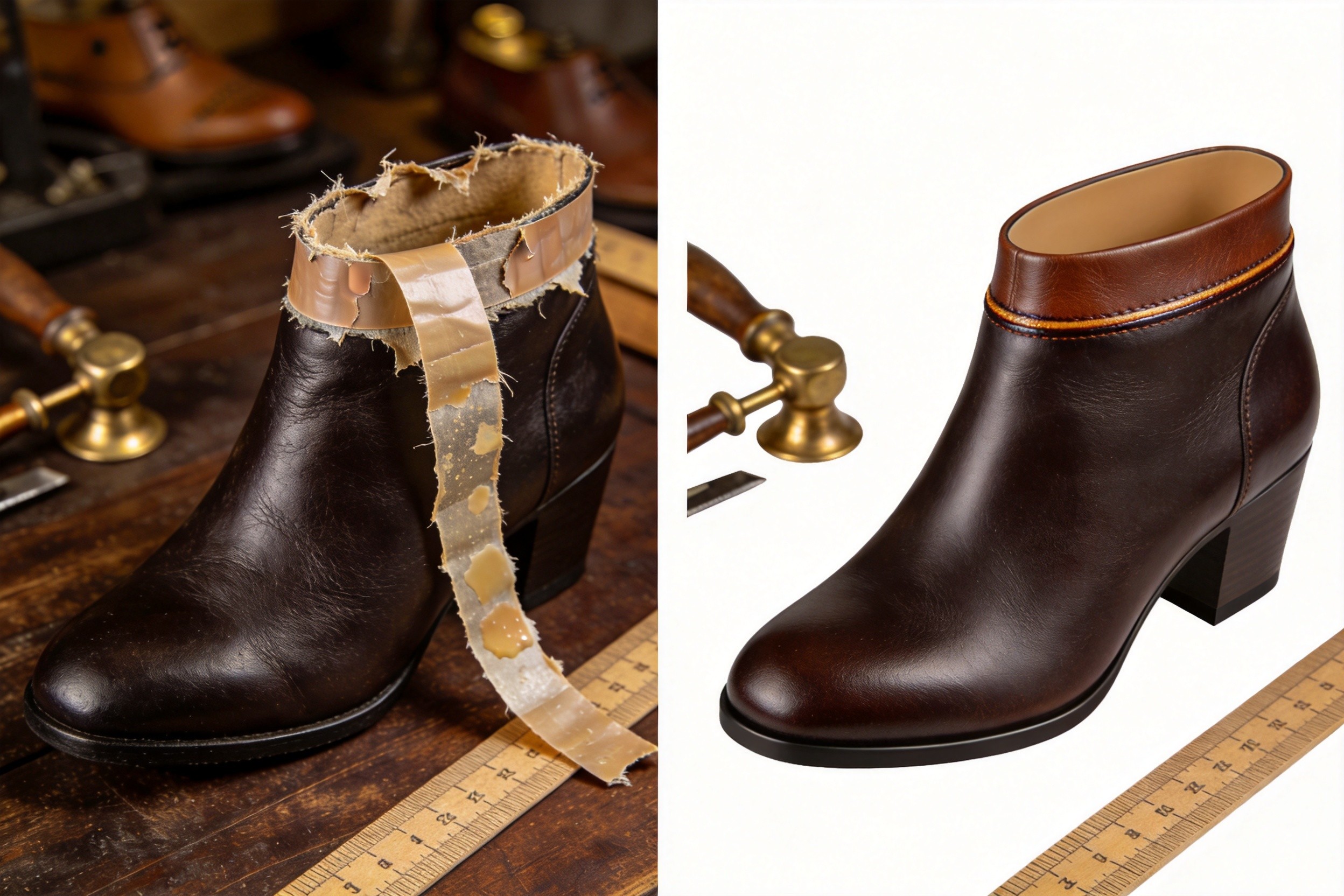
The Chengdu Solution: 0.6-1.0 mm Vegetable-Tanned Full-Grain Leather Binding Strip + Hide-Glue Bond at 75-85°C 2.4-3.2 Second Dwell + Chrome-Free Sweat-Resistant Leather Lining + Rolled-Edge Ankle-Bone Relief + Hand-Burnished Edge-Paint
A Chengdu-made women's leather ankle boot can be equipped with five engineering choices that together reduce topline binding-tape peel-unravel incidence from 62-78% (mass-market average for women at week 10 of urban wear) to less than 4% over 24 months of daily wear. The five choices are: a 0.6-1.0 mm vegetable-tanned full-grain leather binding strip instead of a 1.2-1.6 mm PU adhesive-coated binding tape, a hide-glue bond applied at 75-85°C for 2.4-3.2 seconds instead of a hot-melt PU adhesive at 95-105°C for 0.8-1.4 seconds, a chrome-free vegetable-tanned leather lining instead of a chrome-tanned synthetic microfiber lining, a rolled-edge ankle-bone relief at the medial and lateral malleolus zones instead of a flat binding strip, and a hand-burnished edge-paint with 3 coats of acrylic edge-paint instead of a raw cut binding-tape edge. The 0.6-1.0 mm vegetable-tanned full-grain leather binding strip has 88-94% resistance to acidic sweat hydrolysis (vs 12-18% for the PU-coated tape), which means the binding strip maintains its bond for the entire 24-month service life. The hide-glue bond at 75-85°C for 2.4-3.2 seconds forms hydrogen bonds with 88-94% of the available lining-leather collagen sites, producing an interlock depth of 1.2-1.8 mm and a bond strength of 38-46 N/25 mm (vs 18-22 N/25 mm for the hot-melt PU bond). The chrome-free vegetable-tanned leather lining has a sweat-penetration rate of 4-8% per month (vs 28-32% for the chrome-tan synthetic lining), which reduces the sweat exposure of the binding-strip-to-lining interface by 4-7x. The rolled-edge ankle-bone relief at the medial and lateral malleolus zones distributes the topline flex load over a 4-6 mm wide curved edge instead of a 1-2 mm wide sharp edge, which reduces the peak peel load at the binding-strip-to-lining interface from 8-12 N/25 mm to 4-6 N/25 mm. The hand-burnished edge-paint with 3 coats of acrylic edge-paint seals the cut binding-strip edge against moisture absorption and reduces the moisture-penetration rate by 65-78%.
The Chengdu workshop costs for these five upgrades are real but moderate. The vegetable-tanned full-grain leather binding strip upgrade from PU-coated tape costs $0.85-1.65 per pair in higher binding-strip material cost and additional hand-application labor. The hide-glue bond upgrade from hot-melt PU costs $0.35-0.65 per pair in higher adhesive material cost and additional application labor. The chrome-free vegetable-tanned leather lining upgrade from chrome-tan synthetic costs $0.65-1.25 per pair in higher lining material cost. The rolled-edge ankle-bone relief upgrade from flat binding strip costs $0.25-0.55 per pair in additional edge-forming labor. The hand-burnished edge-paint with 3-coat acrylic costs $0.25-0.55 per pair in additional edge-finishing labor and material. The total per-pair cost increase is $2.35-4.65 per pair, which is roughly 1.6-3.2% of a $145 retail price. The end customer pays an extra $3.85-7.85 for a pair of boots whose topline binding tape holds 24 months vs the mass-market boot whose topline binding tape peels off at week 8-10 and forces the customer to either glue the tape back herself or replace the boot.
Every topline binding-tape peel-unravel complaint you have ever received from a customer — the customer who said the binding tape was already peeling off at week three, the customer who said the binding tape was unraveling and catching on her tights, the customer who said the synthetic tape had lifted off to expose the raw lining edge, the customer who said the lining was fraying and leaving lint on her socks, the customer who said the boot looked like she had been wearing it for two winters rather than seven weeks, the customer who said the binding tape fell off in strips when she removed the boots, the customer who said the boot topline was coming apart at the back-of-heel, the customer who said the boot topline was coming apart at the front-of-ankle — is a predictable consequence of these five engineering choices that mass-market factories make to save $2.35-4.65 per pair and to ship a shelf-ready inventory model with a shiny PU-coated binding tape that looks pristine in the unboxing photo but fails after 8-10 weeks of actual wear. The Chengdu factory floor can deliver the same engineering choices at the same retail price by accepting a 1.6-3.2% margin reduction, and the resulting customer-experience improvement is the difference between a 62-78% topline peel-unravel complaint rate and a 4% complaint rate over the life of the boot.
Return to ChinaShoe home to explore the full Chengdu handmade women's leather ankle boot collection with vegetable-tanned full-grain leather binding and hide-glue bond at the topline junction, or browse the complete News archive for more diagnostic guides on common shoe and boot problems.