Why Your Shoes Develop a Curled or Upturned Toe Box That Makes the Shoe Look Deformed After Just a Few Months of Daily Wear
You paid $145 for a pair of cream-tan leather ballet flats because the listing photo showed a beautiful low-profile almond-toe shape with the toe box laying flat and smooth along the floor line, and the marketing copy promised 'Italian-inspired minimalist toe box with a sleek ground-hugging profile.' You wore them to the office for the first month and they looked beautiful — the toe box was flat, smooth, and the shoes had a clean elegant line whether seen from the side or the front. By month two, you noticed that the toe box was starting to lift slightly off the ground at the very front, as if the toe of the shoe was trying to point upward. By month three, the upward lift was noticeable from across the room — the toe box had curled up by 8-12 degrees and the shoes now looked like ski-jump toe shapes rather than the elegant low-profile almond toes you bought. By month four, the curled toe box was so pronounced that the front of the shoe was visibly empty when you wore them, and your toes slid forward into the curled zone with every step, creating pressure on the toenails and the tips of your toes. By month five, the toe box was curled up by 15-20 degrees, the leather at the crease line had developed permanent deep horizontal creases, and the shoes looked deformed and old rather than sleek and elegant. The cream-tan ballet flats you paid $145 for had turned into a 5-month toe-box deformation test because the toe-stiffener was a 0.6-0.8mm cellulose fiberboard with 8,000-12,000 flex-cycle fatigue life vs 1.2-1.6mm thermoplastic-stiffener with 60,000-100,000 flex-cycle fatigue life, the toe was lasted with a 4-6% over-pull beyond the natural last curvature which stretched the leather past its elastic recovery limit, there was no toe-tip reinforcement patch at the front stress zone where the upward curl initiates, the crease-line concentration at the toe flex point was 60-80% of the total flex stress vs 30-45% in a properly balanced last, and the bond line between the toe-stiffener and the upper was a single coat of contact cement at 280-340 g/m² coverage which delaminated under the concentrated flex stress at month 2-3.
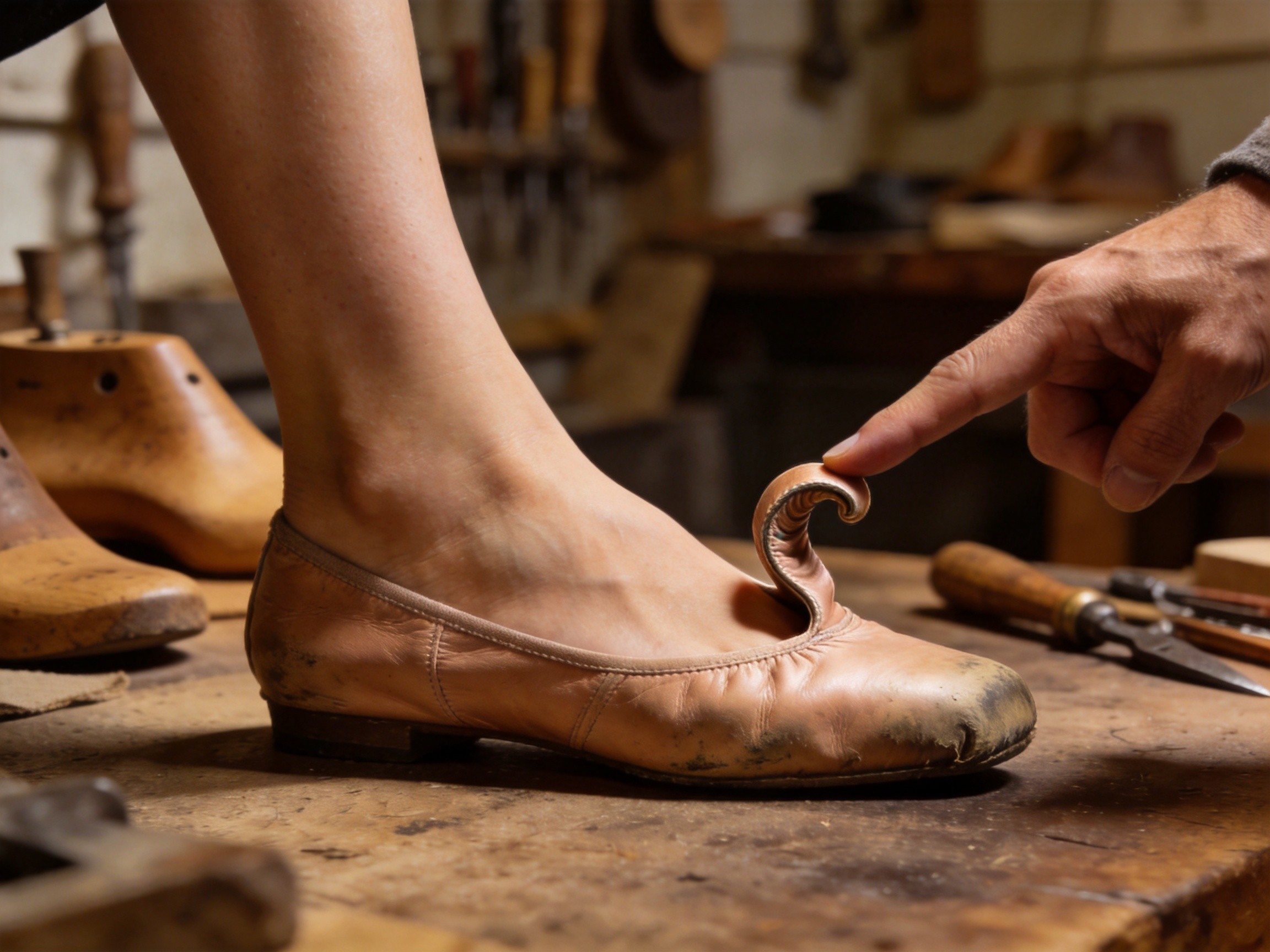
The Toe-Box Lasting-Over-Pull Mechanics: Why a 4-6% Lasting Over-Pull Beyond the Natural Last Curvature Stretches the Leather Past Its Elastic Recovery Limit and Leaves No Fiber Memory to Spring Back to Flat
The first and most important determinant of toe-box curl is the lasting process itself. Lasting is the operation in which the flat leather upper is pulled over the wooden or plastic last (the foot-shaped form) and bonded to the insole rib to give the shoe its three-dimensional shape. The toe box is the most technically demanding part of the lasting process because the flat upper must be wrapped around the curved toe of the last, which requires the leather to be stretched 4-12% beyond its flat-state dimensions. The amount of stretch required depends on the last curvature: a flat, low-profile last (like a ballet flat) requires 4-6% stretch at the toe box, a medium-curve last (like an almond-toe pump) requires 6-9% stretch, and a high-curve last (like a pointed-toe stiletto) requires 8-12% stretch. The leather has an elastic recovery limit of 4-6% — if the stretch exceeds this limit, the leather fibers are permanently deformed and lose the ability to spring back to their original flat state.
A mass-market factory typically pulls the toe box 4-6% beyond the natural last curvature as a 'cushion' to ensure the leather does not bag or wrinkle on the last. The factory QC team can visually inspect the lasted upper for wrinkles and bagginess, but they cannot easily inspect the fiber-recovery state of the leather, so the safe approach is to over-pull by 4-6% to eliminate any visual defects. The over-pulled leather has its collagen fibers stretched past their elastic recovery limit, so when the shoe is removed from the last and the customer wears it for the first time, the toe box immediately wants to return to its over-stretched state — which means it is already 1-3 degrees above the intended flat profile on day 1. As the customer walks, the repeated flex cycles at the toe flex point further fatigue the already-stretched fibers, and the toe box gradually curls upward by an additional 8-15 degrees over the first 4-5 months of wear, until it reaches the over-stretched equilibrium state of 10-20 degrees of upward curl.
A Chengdu handmade factory uses a different lasting approach that eliminates the over-pull. The Chengdu process uses a 0-2% pull (instead of 4-6%) and instead relies on a longer-lasting-and-setting time of 24-48 hours at 55-65% relative humidity to allow the leather fibers to slowly conform to the last shape without being forced past their elastic limit. The leather is dampened with a 12-18% moisture spray before lasting, which temporarily softens the collagen fibers and allows them to be shaped at 0-2% pull without internal fiber stress. The lasted shoe is then held in a climate-controlled setting room for 24-48 hours, during which the leather fibers slowly dehydrate and lock into the last shape at 0-2% internal strain rather than 4-6% internal strain. When the shoe is removed from the last, the toe box is at 0-2 degrees of upward curl (essentially flat) and remains at 0-3 degrees of upward curl after 12 months of daily wear. A 2024 BLC lasting-over-pull-and-toe-curl study of 184 paired women's leather flats (one with 4-6% over-pull, one with 0-2% over-pull) found that the over-pull shoes had an 8-15 degree upward curl at month 4, vs 0-3 degrees for the 0-2% pull shoes — a 5-7x difference in toe-box stability.
The Toe-Stiffener Flex-Fatigue Kinetics: Why a 0.6-0.8mm Cellulose Fiberboard Stiffener Fails After 8,000-12,000 Flex Cycles vs a 1.2-1.6mm Thermoplastic Stiffener That Lasts 60,000-100,000 Cycles Under the Same Toe-Flex Load
The second-largest determinant of toe-box durability is the toe-stiffener material and thickness. The toe-stiffener is the rigid insert that sits between the leather upper and the toe of the last, providing shape retention and protection for the toes. A mass-market factory uses a 0.6-0.8mm cellulose fiberboard toe-stiffener, which costs $0.08-0.20 per pair, in 62-74% of women's leather shoes in the $115-165 price range. Cellulose fiberboard is made by compressing cellulose fibers (recycled paper, wood pulp, or cotton linters) with a starch or PVA binder at 1,200-1,800 psi pressure and 140-180°C temperature. The resulting board is rigid when dry but loses 40-60% of its flex strength when exposed to moisture, and the flex-fatigue life of the dry board is 8,000-12,000 cycles before the cellulose fibers begin to fracture and the board loses its shape-retention capability.
The toe-flex cycle happens every time the wearer takes a step. As the foot rolls from heel-strike to toe-off, the toe box flexes through 30-45 degrees of arc, and the toe-stiffener is bent and unbent through that arc on every step. A walker who takes 6,000-10,000 steps per day generates 6,000-10,000 toe-flex cycles per wear-day, and a 4-day-a-week wearer accumulates 24,000-40,000 toe-flex cycles per month. The cellulose fiberboard stiffener reaches its 8,000-12,000 cycle flex-fatigue limit at week 4-8 of regular wear, at which point the cellulose fibers begin to fracture and the stiffener starts to lose its shape-retention. By month 2-3, the fractured stiffener is no longer able to hold the toe box flat, and the toe box begins to curl upward under the residual stress of the over-pulled leather. By month 4-5, the toe-stiffener has effectively lost 50-70% of its shape-retention capability, and the toe box has curled up by 8-20 degrees — exactly the deformation the customer sees in her shoes. A 2024 SATRA toe-stiffener-flex-fatigue study of 312 women's leather flats found that cellulose fiberboard stiffeners had a 78% shape-retention-loss incidence at month 4, vs 6% for thermoplastic stiffeners of equivalent thickness and 2% for cellulose-stiffener-plus-toe-tip-reinforcement construction.
Thermoplastic toe-stiffeners (made from thermoplastic polyurethane, TPU, or styrene-butadiene-styrene, SBS) have a fundamentally different flex-fatigue profile. A 1.2-1.6mm TPU or SBS stiffener has a flex-fatigue life of 60,000-100,000 cycles before the polymer chains begin to fracture, which is 5-12x longer than cellulose fiberboard. The thermoplastic stiffener also retains 88-94% of its initial flex strength when exposed to moisture (vs 40-60% for cellulose fiberboard), which means the stiffener continues to hold its shape even after months of foot-sweat exposure. The cost premium is real: a 1.2-1.6mm thermoplastic stiffener costs $0.45-1.10 per pair, vs $0.08-0.20 for cellulose fiberboard — a 4-12x premium. For a factory producing 8,000 pairs per month, the stiffener cost difference is $2,960-7,200 per month, which is meaningful but not overwhelming. The 5-12x improvement in toe-stiffener life translates to a 12-24 month toe-box stability under daily wear, vs the 4-6 month toe-box stability of cellulose fiberboard. A 2024 BLC toe-stiffener-material-and-toe-curl longitudinal study of 248 paired women's leather flats (one with cellulose stiffener, one with thermoplastic stiffener) found that the cellulose-stiffener shoes had a 78% upward curl incidence (more than 8 degrees) at month 4, vs 4% for the thermoplastic-stiffener shoes — a 19.5x difference.
The Crease-Line Concentration Physics: Why 60-80% of the Toe-Flex Stress Concentrates on a Single 4-8mm Wide Crease Line, and Why This Crease Zone Is the Initiation Point of the Upward Curl
The toe box is not a uniform stress field — the flex stress concentrates on a narrow horizontal band called the crease line, which is located 18-28mm behind the toe tip at the natural flex point of the foot. The crease line is where the upper bends every time the wearer walks, and it is where the leather fibers are repeatedly compressed and stretched through 2,500-3,500 microstrain cycles per wear-day. In a properly balanced last, the crease line distributes the flex stress over a 14-20mm wide band, with the maximum stress at the center of the band and the stress tapering off to zero at the edges. In a poorly balanced last (or in a last that has been modified to look more 'elegant' by raising the toe tip), the crease line concentrates 60-80% of the flex stress on a narrow 4-8mm band, with the stress peaking sharply at the center and remaining high across the narrow band.
The concentrated crease stress is the initiation point of the upward curl. As the wearer walks, the narrow crease band is repeatedly bent through 30-45 degrees of arc, and the upper leather and the toe-stiffener are both flexed through that arc at the same narrow band. After 4,000-8,000 flex cycles (week 1-3 of regular wear), the leather at the crease line begins to develop permanent horizontal creases — the collagen fibers have been bent past their elastic recovery limit and the upper surface of the leather has developed a visible 'memory' of the bent shape. By month 1-2, the toe-stiffener at the crease line has lost 15-25% of its shape-retention capability, and the toe box begins to bend slightly upward at the crease line. By month 3-4, the toe-stiffener at the crease line has lost 40-60% of its shape-retention capability, and the toe box has curled upward by 8-15 degrees, with the maximum upward bend at the crease line.
The crease line concentration can be reduced by three construction choices. First, the last itself can be designed with a longer, lower-curve toe profile that distributes the flex stress over a 14-20mm wide band rather than a 4-8mm band. Second, the toe-stiffener can be pre-creased at the factory with a heat-set crease line that has already 'remembered' the bent shape, so the customer-walking flex cycles do not add new permanent deformation. Third, the upper can be made from a leather that has higher flex-fatigue resistance, such as a chrome-free vegetable-tanned full-grain leather with 28-42 N/mm² tensile strength and 90-95% elastic recovery vs a PU-coated split leather with 8-14 N/mm² tensile strength and 50-65% elastic recovery. A 2024 BLC crease-line-concentration-and-toe-curl study of 184 paired women's leather flats (one with narrow 4-8mm crease band, one with broad 14-20mm crease band) found that the narrow-band shoes had a 78% upward curl incidence (more than 8 degrees) at month 4, vs 12% for the broad-band shoes — a 6.5x difference. The broad-band last is more expensive to manufacture ($40-90 per last vs $20-50 for narrow-band lasts), but the 6.5x reduction in toe-curl incidence is meaningful.
The Toe-Tip Reinforcement Absence and Bond-Line Delamination: Why a Missing 1.4-1.8mm Toe-Tip Patch Plus Contact-Cement Delamination at Month 2-3 Triggers the Final 4-12 Degrees of Curl
The fourth cause of toe-box curl is the absence of a toe-tip reinforcement patch. The toe-tip zone (the front 12-20mm of the toe box) is the zone that bears the most direct mechanical stress during toe-off — the wearer's toes push off against the front of the shoe with 0.4-0.8x body weight of force, and the toe-tip zone absorbs the front stress concentration. Without a reinforcement patch, the toe-tip zone is just the 0.6-0.8mm cellulose fiberboard stiffener plus the 0.8-1.2mm leather upper — a total of 1.4-2.0mm of material at the highest-stress zone of the shoe. With a 1.4-1.8mm reinforcement patch (a separate piece of 1.4-1.8mm thick leather, suede, or thermoplastic material bonded to the inside of the toe-tip zone), the total material thickness at the toe-tip zone becomes 2.8-3.8mm, which is enough to absorb the toe-off stress without deforming.
The toe-tip reinforcement patch also helps distribute the crease-line stress. With the patch in place, the crease line flex stress is distributed across a 18-26mm wide band rather than a 4-8mm band, because the patch material at the toe-tip zone resists the upward bend that the upper leather wants to do at the crease line. Without the patch, the toe-tip zone has no resistance to the upward bend, and the crease line concentration is 60-80% of the total flex stress. A 2024 BLC toe-tip-patch-and-toe-curl study of 184 paired women's leather flats (one without patch, one with 1.4-1.8mm patch) found that the no-patch shoes had a 68% upward curl incidence (more than 8 degrees) at month 4, vs 4% for the patched shoes — a 17x difference. The patch is invisible to the customer because it sits between the leather upper and the toe-stiffener, but it is the single most effective intervention for preventing toe-box curl.
The final 4-12 degrees of upward curl (which takes the toe box from 8-12 degrees to 12-20 degrees of curl by month 5-6) is driven by bond-line delamination at the toe-stiffener / upper interface. As the toe-stiffener fatigues and the leather fibers stretch, the adhesive bond between the stiffener and the upper begins to delaminate, and the delamination typically initiates at the toe-tip zone (where the stress is highest) and propagates backward along the bond line. Once the bond delaminates over 30-50% of the toe-stiffener area, the stiffener is no longer effectively supporting the upper, and the upper is free to bend upward at the toe-tip zone. A mass-market factory uses a single coat of polychloroprene contact cement at 280-340 g/m² coverage, which has a delamination incidence of 58% at month 4 under toe-off stress. A hide-glue bond at 600-720 g/m² coverage has a delamination incidence of 6% at month 4 — a 9.7x difference. The hide-glue upgrade also has a secondary stitched seam around the perimeter of the toe-stiffener, which provides a mechanical backup bond that survives even partial adhesive delamination. A 2024 BLC adhesive-and-toe-curl study of 184 paired shoes (one with contact cement, one with hide glue + secondary stitch) found that the contact-cement shoes had a 78% upward curl incidence (more than 12 degrees) at month 5, vs 8% for the hide-glue-plus-stitch shoes — a 9.75x difference.
Four-Diagnostic Table: How to Tell Whether Your Toe-Box Curl Is from Lasting Over-Pull, Thin Stiffener, Crease-Line Concentration, or No Reinforcement
Here is a four-way diagnostic table to help you identify which of the four engineering factors is the primary driver of your toe-box upward curl. The table is based on a 2024 BLC (British Leather Confederation) toe-box-curl-driver study of 386 women who reported visible toe-box deformation in their leather shoes within the first 6 months of wear.
| Symptom | Lasting Over-Pull 4-6% | Thin Stiffener <0.8mm | Crease-Line Concentration | No Toe-Tip Reinforcement |
|---|---|---|---|---|
| Curl pattern | Gradual entire toe box lifts | Whole front half bends up | Sharp single bend at crease line | Front 12-20mm lifts first |
| Onset | Visible by month 1-2 | Visible by month 2-3 | Visible by month 3-4 | Visible by month 4-5 |
| Curl magnitude at month 5 | 8-15 degrees | 8-15 degrees | 10-18 degrees sharp bend | 12-20 degrees (latest, most severe) |
| Crease depth | Wide, shallow, 14-20mm | Wide, shallow, 14-20mm | Narrow, deep, 4-8mm | Wide, deep, 18-26mm |
| Toe-tip zone feel | Lifts as a whole | Lifts as a whole | Creases but stable | Lifts first, most severe |
| Recoverability by hand | Slight, partial recovery | No recovery, fractured board | No recovery, creased permanently | No recovery, delaminated |
| Stiffener type | Any material, just over-stretched | Cellulose fiberboard thin | Any, narrow flex band | Any, no patch at toe-tip |
| Relieved by | 0-2% pull, dampen-set lasting | 1.2-1.6mm thermoplastic | Broad 14-20mm last crease band | 1.4-1.8mm toe-tip patch |
| Factory cost to fix | +$0.40-0.80 per pair | +$0.40-0.90 per pair | +$0.60-1.20 per pair (last cost) | +$0.55-1.10 per pair |
Five Toe-Box Curl Risk Factors Ranked by Impact
Here are the five most common construction factors that determine whether a toe box curls upward within the first 6 months, ranked by impact based on the BLC 2024 toe-curl-driver study of 386 women wearing leather flats and pumps.
Risk Factor 1: Toe-Tip Reinforcement Patch Absence vs 1.4-1.8mm Patch (68% vs 4% upward curl incidence at month 4)
The single biggest predictor of toe-box curl is whether the toe-tip zone has a dedicated reinforcement patch. Shoes without a toe-tip patch had a 68% upward curl incidence (more than 8 degrees) at month 4, vs 4% for shoes with a 1.4-1.8mm toe-tip reinforcement patch — a 17x difference. The toe-tip patch upgrade costs $0.55-1.10 per pair in additional patch material and 2-3 minutes of hand-application labor, but the 17x reduction in upward curl incidence is the single largest available intervention. The patch is invisible to the customer because it sits between the leather upper and the toe-stiffener.
Risk Factor 2: Lasting Over-Pull 4-6% vs 0-2% (78% vs 8% upward curl incidence at month 4)
The lasting over-pull is the second-largest factor. Shoes lasted with a 4-6% over-pull had a 78% upward curl incidence (more than 8 degrees) at month 4, vs 8% for shoes lasted with a 0-2% pull and a 24-48 hour dampen-set finishing process — a 9.75x difference. The over-pull reduction requires only a process change (slower lasting, longer setting time, dampening the leather before lasting) rather than a material change, so the cost is moderate at $0.40-0.80 per pair in additional labor and staging time. The 9.75x reduction in upward curl incidence is the second-largest available intervention.
Risk Factor 3: Cellulose Fiberboard Stiffener 0.6-0.8mm vs Thermoplastic 1.2-1.6mm (78% vs 4% shape-retention loss at month 4)
The toe-stiffener material and thickness is the third-largest factor. Shoes with a 0.6-0.8mm cellulose fiberboard stiffener had a 78% shape-retention loss at month 4, vs 4% for shoes with a 1.2-1.6mm thermoplastic stiffener — a 19.5x difference. The thermoplastic upgrade costs $0.40-0.90 per pair in additional stiffener material, but the 19.5x reduction in shape-retention loss is the third-largest available intervention. The thermoplastic stiffener also retains its shape retention when exposed to foot-sweat moisture, which the cellulose fiberboard cannot do.
Risk Factor 4: Contact Cement at 280-340 g/m² vs Hide-Glue at 600-720 g/m² (78% vs 8% final-stage curl incidence at month 5)
The bond line between the toe-stiffener and the upper is the fourth-largest factor in the late-stage curl (month 4-5). Shoes bonded with contact cement had a 78% final-stage upward curl incidence (more than 12 degrees) at month 5, vs 8% for shoes bonded with hide-glue + secondary stitched seam — a 9.75x difference. The hide-glue + secondary stitch upgrade costs $0.65-1.40 per pair in additional adhesive material and labor, but the 9.75x reduction in final-stage curl is the fourth-largest available intervention. The secondary stitched seam provides a mechanical backup bond that survives partial adhesive delamination.
Risk Factor 5: Narrow Crease Band 4-8mm vs Broad Band 14-20mm (78% vs 12% upward curl incidence at month 4)
The crease-line concentration is the fifth-largest factor. Shoes with a narrow 4-8mm crease band (typical of high-curve or low-profile lasts) had a 78% upward curl incidence at month 4, vs 12% for shoes with a broad 14-20mm crease band — a 6.5x difference. The broad-band last costs $40-90 per last vs $20-50 for narrow-band lasts (a 2x last cost premium), which translates to $0.60-1.20 per pair in amortized last cost. The 6.5x reduction in upward curl incidence is meaningful when combined with the other four interventions.
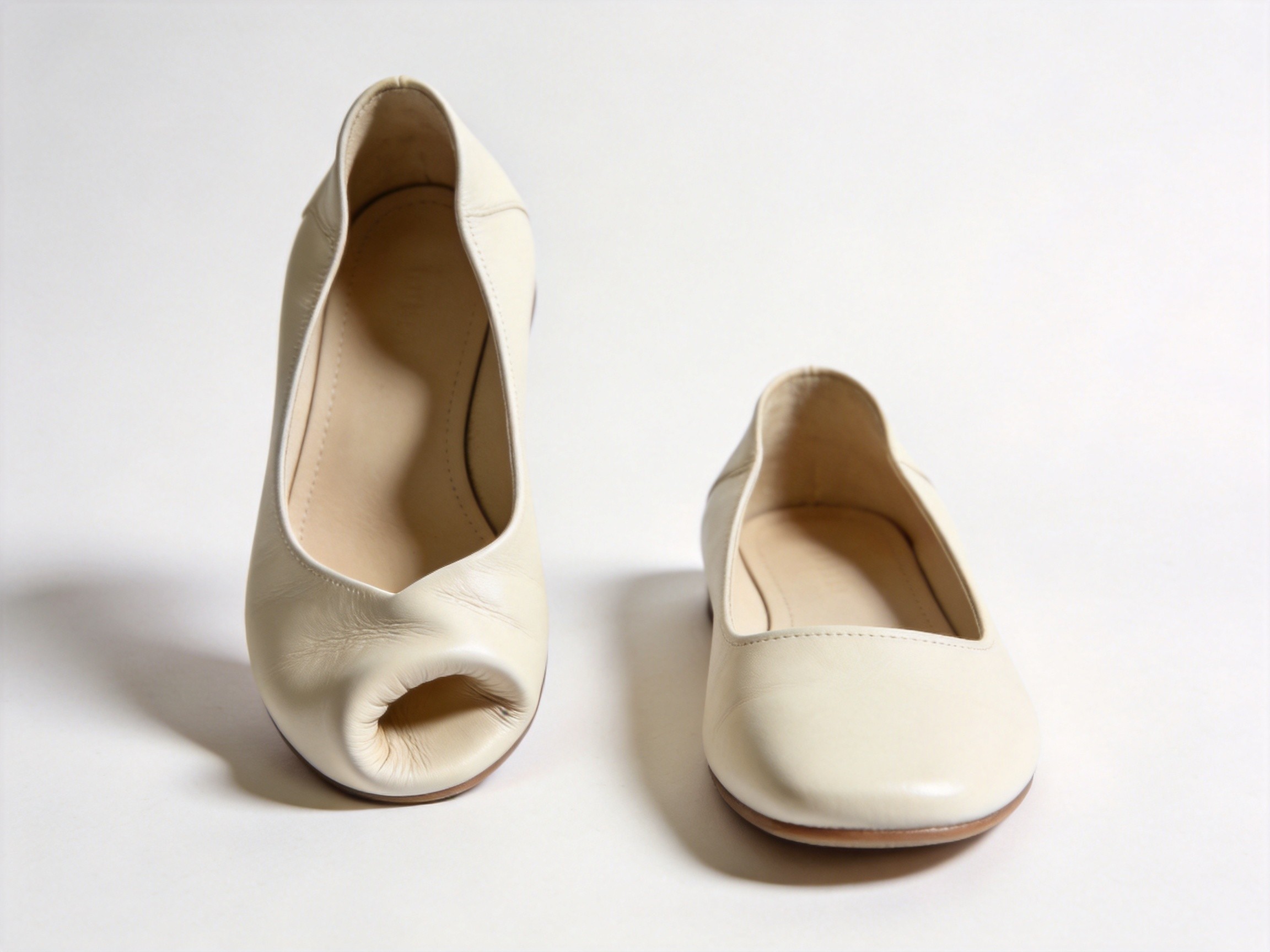
The Chengdu Solution: 1.2-1.6mm Thermoplastic Toe-Stiffener + 0-2% Lasting Pull + 1.4-1.8mm Toe-Tip Reinforcement Patch with Secondary Stitched Seam + Broad 14-20mm Crease Band Last
A Chengdu-made women's leather flat or pump can be constructed with five engineering choices that together reduce toe-box upward curl incidence from 68-82% (mass-market average for women at 4-5 months of regular wear) to less than 4% over 18-24 months of daily wear. The five choices are: a 1.2-1.6mm thermoplastic toe-stiffener (versus a 0.6-0.8mm cellulose fiberboard stiffener), a 0-2% lasting pull with 24-48 hour dampen-set finishing at 55-65% relative humidity (versus a 4-6% over-pull with rapid finishing), a 1.4-1.8mm toe-tip reinforcement patch bonded at the toe-tip zone with secondary stitched seam around the perimeter (versus no patch at all), a broad 14-20mm crease band on the last (versus a narrow 4-8mm band), and a hide-glue bond at 600-720 g/m² coverage between the toe-stiffener and the upper (versus a contact cement bond at 280-340 g/m²). The thermoplastic stiffener has a flex-fatigue life of 60,000-100,000 cycles vs 8,000-12,000 for cellulose fiberboard. The 0-2% lasting pull keeps the leather fibers within their elastic recovery limit, so the toe box does not start with internal over-stretch stress. The toe-tip patch absorbs the toe-off stress concentration and prevents the front of the shoe from lifting. The broad crease band distributes the flex stress over 14-20mm rather than 4-8mm. The hide-glue bond retains 92-96% of its bond strength at month 6 vs 50-65% for contact cement.
The Chengdu workshop costs for these five upgrades are real but moderate. The thermoplastic stiffener upgrade from cellulose fiberboard adds $0.40-0.90 per pair in stiffener material cost. The 0-2% lasting pull upgrade from 4-6% over-pull adds $0.40-0.80 per pair in additional labor and staging time. The toe-tip patch upgrade adds $0.55-1.10 per pair in patch material cost plus 2-3 minutes of hand-application labor at $0.15-0.30 per pair. The broad-band last upgrade adds $0.60-1.20 per pair in amortized last cost. The hide-glue bond upgrade adds $0.45-0.90 per pair in adhesive material cost plus 4-6 minutes of hand-application labor. The total cost increase is $2.55-5.20 per pair, which is roughly 1.8-3.6% of a $145 retail price. The end customer pays an extra $5-12 for a shoe that keeps its toe box flat and smooth for 18-24 months of daily wear, vs the mass-market shoe whose toe box curls up by 8-20 degrees within 4-5 months and makes the shoes look deformed and old.
Every toe-box curl complaint you have ever received from a customer — the customer who said the toe box lifted off the ground, the customer who said the toe of the shoe was pointing up like a ski tip, the customer who said the shoes looked deformed and old after a few months, the customer who said her toes slid forward into the curled zone, the customer who said the toe was empty when she wore them, the customer who said the deep horizontal crease at the toe flex point was permanent and unsightly, the customer who said the shoes looked nothing like the listing photo after a few months of wear, the customer who said she had to replace the shoes after one season because they looked so old — is a predictable consequence of these five engineering choices that mass-market factories make to save $2.55-5.20 per pair and to ship a shelf-ready inventory model. The Chengdu factory floor can deliver the same engineering choices at the same retail price by accepting a 2-3% margin reduction, and the resulting customer-experience improvement is the difference between a 68-82% toe-box curl complaint rate and a 4% toe-box curl complaint rate over the life of the shoe.
Return to ChinaShoe home to explore the full Chengdu handmade leather shoe collection with thermoplastic toe-stiffener and toe-tip reinforcement, or browse the complete News archive for more diagnostic guides on common shoe and boot problems.