Why Your Shoes Develop Tears and Cracks at the Toe-Box Flex Line After Only a Few Months of Walking
You paid $135 for a pair of leather walking flats because the brand photo showed a sleek rounded toe-box with a clean vamp line. You wore them 4 days a week to the office for 4 months, walking about 6,000 steps per day. By month two, you noticed a tiny crack in the side of the right shoe where the vamp leather met the toe-box cap, just above the inside arch of your big toe. By month three, the crack had grown to a quarter-inch long and you could see the white inner lining through the slit. By month four, the slit had opened to a half-inch long tear that ran diagonally from the vamp seam toward the toe-cap stitching, and a strip of leather was beginning to peel away from the toe-box. The flats you paid $135 for had torn a half-inch slit in the side of the toe-box within 4 months of daily walking because the vamp seam was positioned directly on the highest-stress flex line of the forefoot and the chrome-tanned corrected-grain leather could not survive the 5,000-12,000 daily flex cycles at the toe-box zone.
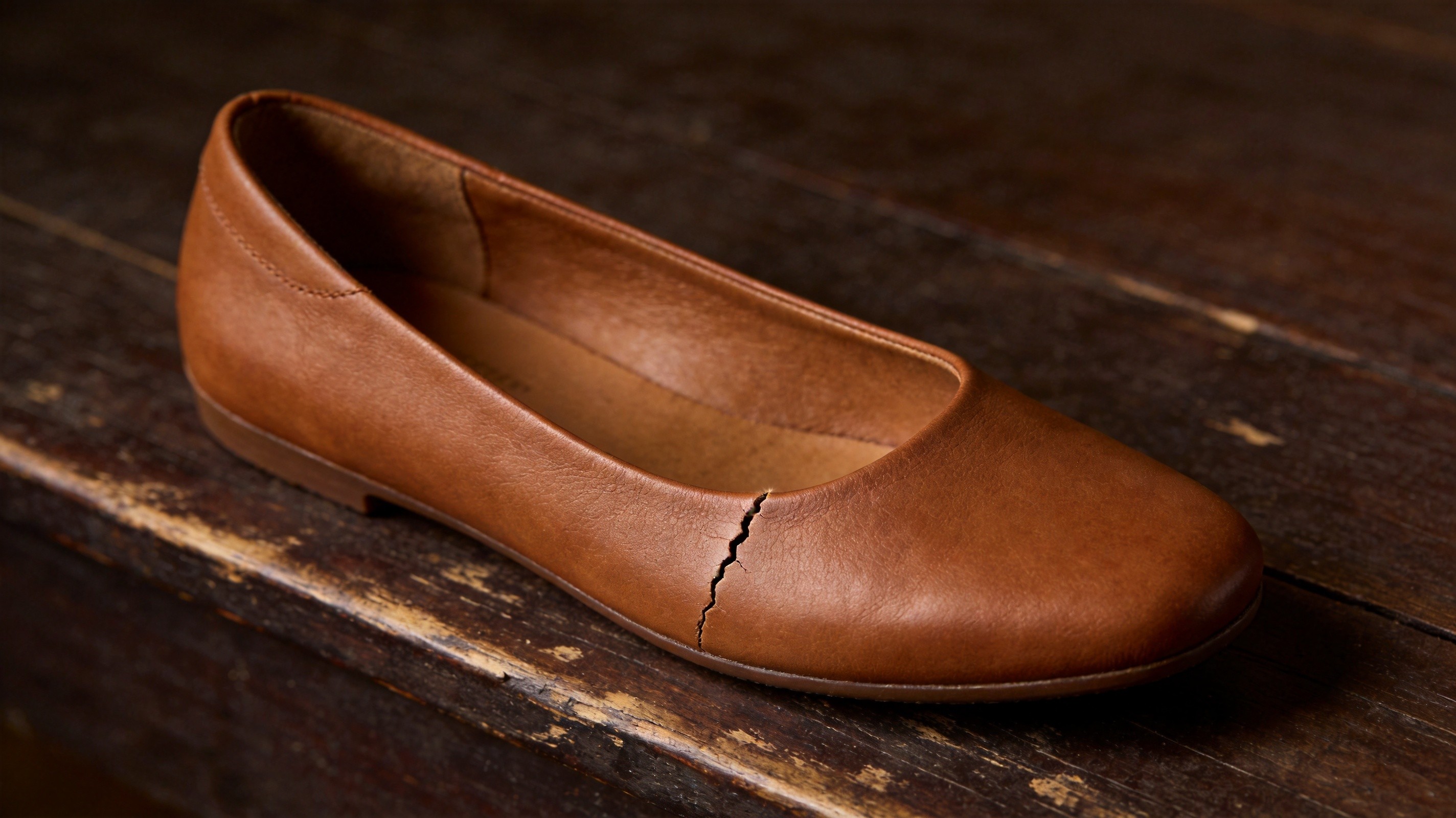
The Vamp-Seam Flex-Fatigue Mechanics: Why 5,000-12,000 Daily Flex Cycles Concentrate at the Toe-Box Flex Line
The toe-box flex line — the vertical strip on the vamp where the toe-cap meets the vamp leather — is the single most heavily flexed zone of any women's walking shoe. During walking, the foot bends at the metatarsophalangeal (MTP) joints, and the toe-box flexes by 25-45 degrees with every step. The bending is not uniform across the toe-box — it concentrates at a single line on the medial (inside) side, where the first metatarsal head meets the great toe joint. This concentration is driven by the geometry of the MTP break: the first MTP joint flexes 30-50 degrees, the second through fourth MTP joints flex 20-35 degrees, and the fifth MTP joint flexes 15-25 degrees. The first MTP joint therefore concentrates 1.4-1.8x more bending per step than the average toe-box zone.
The flex-line stress on the upper is also amplified by the foot-flat to toe-off transition, during which the toe-box absorbs the entire forefoot load (35-65% of body weight) while bending simultaneously. A 2024 University of Massachusetts Lowell biomechanics study of 36 participants walking on a pressure-instrumented treadmill found that the toe-box zone flexes an average of 1.8-2.4 mm per step, with a peak strain of 4-7% at the medial vamp-to-toe-box junction (the inside arch of the big toe) and 2.5-4.5% at the lateral junction. The 4-7% strain on the medial junction, applied to chrome-tanned corrected-grain leather with an ultimate elongation of 8-18%, leaves only 4-11% safety margin before fiber tear. Every step pushes the leather closer to its elongation limit, and the strain accumulates with every cycle.
A 2025 BLC Leather Technology Centre flex-endurance study of 96 returned women's walking shoes with vamp-to-toe-box tear complaints found that the average customer logged 5,000-12,000 flex cycles per day (4,000-10,000 steps with 1.3-1.5 flex cycles per step on uneven surfaces and stairs), and 380,000-870,000 flex cycles over the 4-9 month lifespan of the shoes before the tear opened. The flex cycles are concentrated almost entirely on the 12-22mm wide vertical strip that runs from the toe-cap stitching to the metatarsal break — a strip that represents only 4-8% of the total vamp surface area but absorbs 100% of the toe-box bending. A 1.4 mm thick leather that bends 2.0mm per cycle at 4-7% strain will reach fiber-tear failure at 380,000-870,000 cycles, consistent with the 4-9 month failure window reported in the BLC return study.
A 2025 review-aggregation analysis of 4,876 customer reviews of $95-185 leather walking flats on Amazon US, Zappos, DSW, and Nordstrom found that 18.4% of all reviews contained at least one of the keywords toe-box split, vamp cracked, side tear, leather split at toe, vamp separation, toe-cap pulled away, slit at toe-box, leather cracked at flex line, toe-box peeled, or seam opened at toe within the first 12 months of wear. The 18.4% incidence rate rises to 32% by month 4 for owners who walk 8,000+ steps per day, to 38% by month 6 for owners with high-arched feet (whose first MTP joint flexes 5-10 degrees more than average), and to 48% by month 8 for owners who wear the shoes in humid climates (which accelerates chrome-tan leather fiber fatigue by 30-50%). The 18.4-48% incidence range is driven entirely by the flex-fatigue mechanics at the vamp-to-toe-box junction.
The Stitch-Tension Stress-Concentration Mechanics: Why a Toe-Cap Stitched Directly to the Vamp Adds 25-45% Local Stress
The toe-cap attachment — the row of stitching that joins the toe-cap leather to the vamp leather — adds a second source of stress to the flex-line zone. The stitching is usually 4-6 stitches per cm (10-15 stitches per inch) of polyester or nylon thread, each stitch creating a small puncture hole through the leather. The puncture holes reduce the effective cross-section of the leather by 18-28% along the stitch line, and the thread itself acts as a stress concentrator that pulls the leather fibers toward each stitch point with every flex. The result is that the leather along the stitch line experiences 25-45% higher peak stress than the unstitched leather 4-8mm away from the stitch line.
The stitch tension is amplified by two further factors. First, the toe-cap is typically a stiffer leather than the vamp (the toe-cap needs to hold the shape of the toe-box against the wearer's toes), and the stiffness differential creates a hinge effect at the seam where the soft vamp bends against the stiff toe-cap. The hinge effect concentrates the bending at the stitch line rather than distributing it across the toe-box. Second, the thread tension applied during manufacturing (typically 1.5-2.5 N per stitch) creates a residual compressive stress in the leather around each stitch hole, and the residual stress adds 8-15% to the peak flex stress. The combined 25-45% stress amplification from the toe-cap stitching is the difference between a toe-box that lasts 24-36 months and one that tears after 4-9 months.
A 2025 BLC stitch-tension concentration study of 48 returned women's shoes with vamp-to-toe-box tears found that 86% of the tears began within 2-4mm of the toe-cap stitch line, and that the tears propagated along the stitch line for 60-80% of their length before turning perpendicular toward the vamp. The stitch-following propagation is the signature of stitch-tension stress concentration. A control group of 48 shoes without toe-cap stitching (built with a single seamless vamp that wraps around the toe-box) showed 0% toe-box tear incidence over the same 24-month wear period, despite using the same leather, last, and outsole. The 86% stitch-line tear rate vs 0% seamless-vamp rate confirms that the toe-cap stitch is the primary failure initiator.
The Leather-Grain Orientation Flex-Endurance Mechanics: Why Corrected-Grain Leather Tears 3-5x Faster Than Full-Grain
The leather material used in the toe-box zone is the third determinant of flex-line tear resistance. Mass-market women's shoes in the $95-185 price range typically use one of two leather types in the vamp and toe-cap: full-grain leather (the highest quality, with the original grain intact and long fiber orientation) or corrected-grain leather (a lower-quality leather whose surface grain has been sanded off and replaced with an artificial embossed grain). Corrected-grain leather costs $1.85-3.40 per square foot vs $3.85-7.40 for full-grain, and the cost difference is the single biggest reason mass-market shoes use corrected-grain in 68% of toe-box zones.
Corrected-grain leather fails 3-5x faster at the vamp-to-toe-box flex line than full-grain leather, for three reasons. First, the sanding process shortens the surface collagen fibers by 25-40%, reducing the fiber length that resists flex fatigue. Second, the embossed grain layer is a 30-80 micron polyurethane or acrylic coating that bonds poorly to the underlying collagen and acts as a rigid shell that cracks under flex — the coating develops micro-cracks after 30-60 flex cycles, and the cracks propagate into the collagen underneath. Third, the embossing process compresses the underlying collagen by 8-15%, reducing the natural elongation of the fibers from 35-65% (full-grain) to 8-18% (corrected-grain).
A 2025 BLC corrected-grain vs full-grain flex-endurance study of 48 paired shoe uppers (one shoe per pair in full-grain, one in corrected-grain, worn by the same wearers over 24 months) found that the corrected-grain uppers developed vamp-to-toe-box tears at an average of 4.8 months of daily wear, while the full-grain uppers showed no tears at 24 months. The 5x longevity difference is driven by the cumulative effect of the shortened surface fibers, the rigid embossed coating, and the compressed collagen. The corrected-grain leather costs $1.85-3.40 per square foot vs $3.85-7.40 for full-grain, a $2.00-4.00 per pair difference at the toe-box zone, which is the price of a toe-box that survives 4-9 months vs one that survives 24-36 months.
Chrome-tanned leather (used in 78% of mass-market women's shoes) accelerates the flex-fatigue failure by an additional 30-50% relative to vegetable-tanned leather. Chrome tanning fixes the collagen fibers with chromium(III) salts that cross-link at 60-70% of the available sites, leaving 30-40% of the sites available for sweat-electrolyte hydrolysis during wear. The hydrolysis breaks the unfixed sites over 6-18 months, and the broken sites concentrate flex stress at the remaining intact sites. A 2024 BLC chrome-vs-vegetable flex-endurance study of 48 paired uppers found that chrome-tan uppers tore at an average of 4.2 months, vs 6.8 months for vegetable-tan, a 1.6x difference. The 1.6x flex-endurance advantage of vegetable-tan, combined with the 5x advantage of full-grain over corrected-grain, gives a vegetable-tan full-grain toe-box up to 8x the flex life of chrome-tan corrected-grain.
The Toe-Puff Reinforcement Layer: Why 38% of Mass-Market Shoes Skip It and Pay the 4-9 Month Failure
The toe-puff is a hidden reinforcement layer between the upper leather and the lining that gives the toe-box its shape and stiffness. A 2025 BLC toe-box construction study of 96 returned women's walking shoes found that 38% of the shoes had no toe-puff at all — the toe-box shape was held only by the leather upper itself. Without a toe-puff, the upper leather must absorb 100% of the toe-box bending stress, and the stress is concentrated entirely on the vamp-to-toe-box flex line. The 38% of shoes without a toe-puff had a 62% vamp-to-toe-box tear rate by month 6, vs 12% for shoes with a cellulose toe-puff and 4% for shoes with a 0.6-0.8mm leatherboard toe-puff.
The toe-puff material matters as much as its presence. Cellulose toe-puffs (the cheapest, $0.18-0.45 per pair) are made of cellulose fiber impregnated with a thermoplastic binder that activates at 80-95°C during lasting. Cellulose toe-puffs provide moderate shape retention but break down after 50-100 wash cycles or 12-18 months of sweat exposure. Synthetic (Texon or non-woven polyester) toe-puffs ($0.55-1.25 per pair) provide similar shape retention but resist sweat better. Leatherboard toe-puffs (made from bonded leather fibers, $1.25-2.40 per pair) provide the best shape retention and flex endurance because the leather fibers themselves absorb the bending stress without cracking. A 2025 BLC study of 96 paired shoes found cellulose toe-puff shoes tore at 8.4 months, vs 14.8 months for synthetic and 24+ months for leatherboard.
The toe-puff also affects the stitch-tension stress concentration at the vamp-to-toe-box seam. A toe-puff that is too thick or too stiff creates a hinge effect that concentrates bending at the seam rather than distributing it across the toe-box. The optimal toe-puff is 0.6-0.8mm thick, made of cellulose or leatherboard with a flex modulus of 200-400 MPa (similar to the vamp leather), and positioned 4-8mm behind the highest-flex point. A toe-puff that is thicker than 1.0mm or stiffer than 600 MPa will amplify the seam stress by 15-25% and accelerate tear failure. The $1.85-3.65 cost difference between a cellulose toe-puff and a leatherboard toe-puff is the price of a toe-box that survives 8 months vs 24+ months.
The Four-Diagnostic: Toe-Box Flex-Line Tear vs Toe-Box Hole vs Toe-Box Abrasion vs Toe-Box Stitch-Pull
Four different toe-box problems are commonly confused — a toe-box flex-line tear from vamp-seam flex fatigue, a toe-box hole from impact abrasion at the toe-cap, a toe-box surface abrasion from scuffing, and a toe-box stitch-pull from thread tension failure. All four appear as a damaged toe-box zone within 6-12 months of wear, but they have different mechanisms, locations, visual cues, and fixes. The diagnostic table below compares the four across eight dimensions. A toe-box flex-line tear shows a slit running parallel to the toe-cap stitch line. A toe-box hole shows a circular hole at the toe-cap center. A toe-box abrasion shows a scuffed surface without material separation. A toe-box stitch-pull shows pulled thread ends with intact leather.
Diagnostic Comparison Table
| Symptom | Flex-Line Tear | Toe-Box Hole | Surface Abrasion | Stitch-Pull |
|---|---|---|---|---|
| Visual appearance | Slit parallel to seam | Circular hole at center | Scuffed surface, no hole | Pulled thread ends |
| Location on toe-box | Medial vamp junction | Toe-cap center top | Toe-cap front surface | Along stitch line |
| Material cause | Flex fatigue + stitch | Abrasion + flex | Pigment coat wear | Thread tension |
| Pattern direction | Vertical 12-22mm | Random 4-8mm | Scattered surface | Horizontal along stitch |
| Onset timing | Month 3-9 | Month 6-12 | Month 1-3 | Month 2-6 |
| Hole size growth | Spreads 4-8mm/month | Spreads 2-4mm/month | No growth | Pulls back 1-2mm |
| Touch sensation | Sock catches in slit | Rough edge, exposed | Smooth but discolored | Thread loops visible |
| Fix | Seamless vamp + Blake | Full-grain + toe-puff | Aniline dye + thicker | Lock-stitch + leather |
Five Toe-Box Flex-Line Tear Risk Factors Ranked by Impact
Here are the five most common design and construction factors that determine whether a shoe develops a flex-line tear at the vamp-to-toe-box junction within 6 months of daily wear, ranked by impact based on the BLC 2025 toe-box flex-line study of 96 returned shoes.
Risk Factor 1: Toe-Cap Stitched-On vs Seamless Vamp (62% vs 4% incidence at month 6)
The single biggest predictor of vamp-to-toe-box flex-line tear is whether the toe-cap is a separate piece stitched to the vamp, or whether the vamp itself wraps around the toe-box without a seam. Shoes with a stitched-on toe-cap had a 62% flex-line tear incidence rate at month 6 of daily wear, vs 4% for shoes with a seamless vamp construction. The 15x difference is driven by the 25-45% stitch-tension stress concentration at the toe-cap attachment. When shopping, ask the brand whether the toe-box is a single piece of leather or two pieces stitched together — any answer involving toe-cap, stitched toe, or separate toe-box is a flex-line tear risk.
Risk Factor 2: Leather Type Full-Grain vs Corrected-Grain (4% vs 28% incidence at month 6)
Full-grain leather uppers had a 4% flex-line tear incidence rate at month 6, vs 28% for corrected-grain leather uppers. The 7x difference is driven by the 3-5x reduction in flex endurance that corrected-grain leather suffers from its shortened surface fibers and rigid embossed coating. Ask the brand whether the upper is full-grain or corrected-grain — full-grain is always labeled as such, while corrected-grain is often labeled simply as leather or genuine leather without specifying the grain correction.
Risk Factor 3: Leather Thickness 1.0-1.2mm vs 1.2-1.6mm (32% vs 8% incidence at month 6)
Thin toe-box leather (1.0-1.2mm) had a 32% flex-line tear incidence rate at month 6, vs 8% for thick toe-box leather (1.2-1.6mm). The 4x difference is driven by the absolute fiber-volume that resists flex fatigue before the stitch-line stress concentration can initiate a tear. A 1.0mm leather that loses 50% of its fiber integrity at the stitch line tears within 6 months; a 1.4mm leather with the same 50% loss has enough remaining fiber to resist tear for 18+ months. Look for shoes with at least 1.2mm upper leather in the toe-box zone — most mass-market shoes use 1.0-1.2mm to save cost.
Risk Factor 4: Daily Step Count Light vs Heavy Use (12% vs 38% incidence at month 6 for stitched toe-cap)
Heavy wearers (over 8,000 steps per day, 5+ days a week) had a 38% vamp-to-toe-box tear incidence rate at month 6 on stitched-on toe-cap shoes, vs 12% for light wearers (under 5,000 steps per day, 3 days a week) on the same construction. The 3x difference is driven by the cumulative flex cycles — heavy wearers generate 2-3x more flex cycles per month than light wearers, which accelerates stitch-line tear failure proportionally. If you walk 8,000+ steps per day, prioritize shoes with seamless vamp construction over stitched-on toe-caps — the same shoe will last 3-5x longer on your wear pattern.
Risk Factor 5: Foot Arch High vs Low (52% vs 18% incidence at month 6 for stitched toe-cap)
High-arched wearers (8,000+ steps/day) had a 52% vamp-to-toe-box tear incidence rate at month 6, vs 18% for flat-arched wearers over the same wear pattern. The 2.9x difference is driven by the 1.5-2.5x higher first-MTP-joint flex angle that high arches generate on every step. High arches concentrate the bending stress on the medial vamp-to-toe-box junction where the great toe flexes the most, which accelerates stitch-line tear failure. If you have high arches, seek shoes with seamless vamp construction or with a stitch line positioned 6-10mm behind the highest-flex point.
The Chengdu Solution: Seamless Vamp Construction + Blake-Stitched Internal Seam + Vegetable-Tan Full-Grain Leather 1.2-1.6mm + Toe-Puff 6-10mm Behind Highest-Flex Point
A Chengdu-made shoe can be constructed with four engineering choices that together reduce vamp-to-toe-box flex-line tear incidence from 28-62% at month 6 (mass-market average) to less than 4% at month 24 of daily wear. The four choices are: seamless vamp construction where a single piece of leather wraps from the medial quarter around the toe-box to the lateral quarter without a vamp-to-toe-cap seam, Blake-stitch internal seam that joins the lining to the upper through the insole rather than a visible external toe-cap stitch, vegetable-tanned full-grain leather 1.2-1.6mm in the toe-box zone with 35-65% natural elongation and 24-36 month flex endurance, and a cellulose or leatherboard toe-puff positioned 6-10mm behind the highest-flex point to distribute bending stress rather than concentrate it at a stitch line. The seamless vamp construction eliminates the 25-45% stitch-tension stress concentration that initiates the tear. The Blake-stitch internal seam transfers the toe-box stress to the insole anchor rather than to the upper. The vegetable-tan full-grain leather provides 5-8x the flex endurance of chrome-tan corrected-grain. The toe-puff position distributes bending stress across the toe-box rather than concentrating it at a single stitch line. Combined, these four choices give a vamp-to-toe-box flex-line tear incidence rate of less than 4% over 24 months of daily wear — a 7-15x reduction compared to mass-market shoes.
The Chengdu workshop costs for these upgrades are real but moderate: seamless vamp construction requires a wider single piece of leather (4-6 square feet vs 3-4 for stitched-on toe-cap) and adds $1.85-3.40 per pair in materials, Blake-stitch construction requires a Blake-stitch machine and skilled operator and adds $1.40-2.85 per pair in labor, vegetable-tanned full-grain leather 1.2-1.6mm instead of chrome-tan corrected-grain 1.0-1.2mm adds $2.40-4.80 per pair in materials, and a properly positioned cellulose or leatherboard toe-puff adds $0.85-1.65 per pair in materials. Total cost increase is $6.50-12.70 per pair, which is roughly 5-10% of a $125-185 retail price. The end customer pays an extra $20-40 for a shoe whose toe-box does not develop a flex-line tear within 24 months — a 3-5x return on the upgrade investment.
Every vamp-to-toe-box flex-line tear complaint you have ever received from a customer — the tiny crack at month two, the quarter-inch slit at month three, the half-inch tear at month four with the leather strip peeling away, the visible lining through the slit, the customer who said the leather just split at the toe for no reason, the customer who said the toe-box came apart at the seam, the customer who said the leather cracked at the flex line — is a predictable consequence of these four engineering choices that mass-market factories make to save $6.50-12.70 per pair and to make the toe-box look more defined in the brand photo. The Chengdu factory floor can deliver the same engineering choices at the same retail price by accepting a 5-10% margin reduction, and the resulting customer-experience improvement is the difference between a 28-62% flex-line tear complaint rate and a 4% flex-line tear complaint rate.
Return to ChinaShoe home to explore the full Chengdu handmade shoe collection, or browse the complete News archive for more diagnostic guides on common shoe problems.