Why Your Shoes Have Sharp Exposed Stitching and Rough Seams That Cut Your Skin and Destroy Your Socks — The Hidden Back-Seam Thread Geometry, Insole-Side Rough Edge, and Burry-Trim Failure Behind the 2026 "New Shoes Already Snagged My Hosiery" Epidemic
You paid $135 for a pair of black satin Mary Janes because the brand promised "silky smooth interior with seamless comfort." You wore them to work on a Monday morning with a brand-new pair of $28 sheer nylon hosiery. By the time you reached your desk, you noticed a tiny snag on the back of the left stocking. By lunchtime, the snag had become a 0.5-inch run that crept up your calf. By the end of the day, you had discovered six separate snags and three small holes in the hosiery, and a red scratch mark on your heel where a single loose thread end had been rubbing against your skin for 8 hours. The shoes you paid $135 for had destroyed a $28 pair of hosiery on the first wear and left your heel bleeding. The brand promised "seamless comfort." They delivered "snag-everything inside."
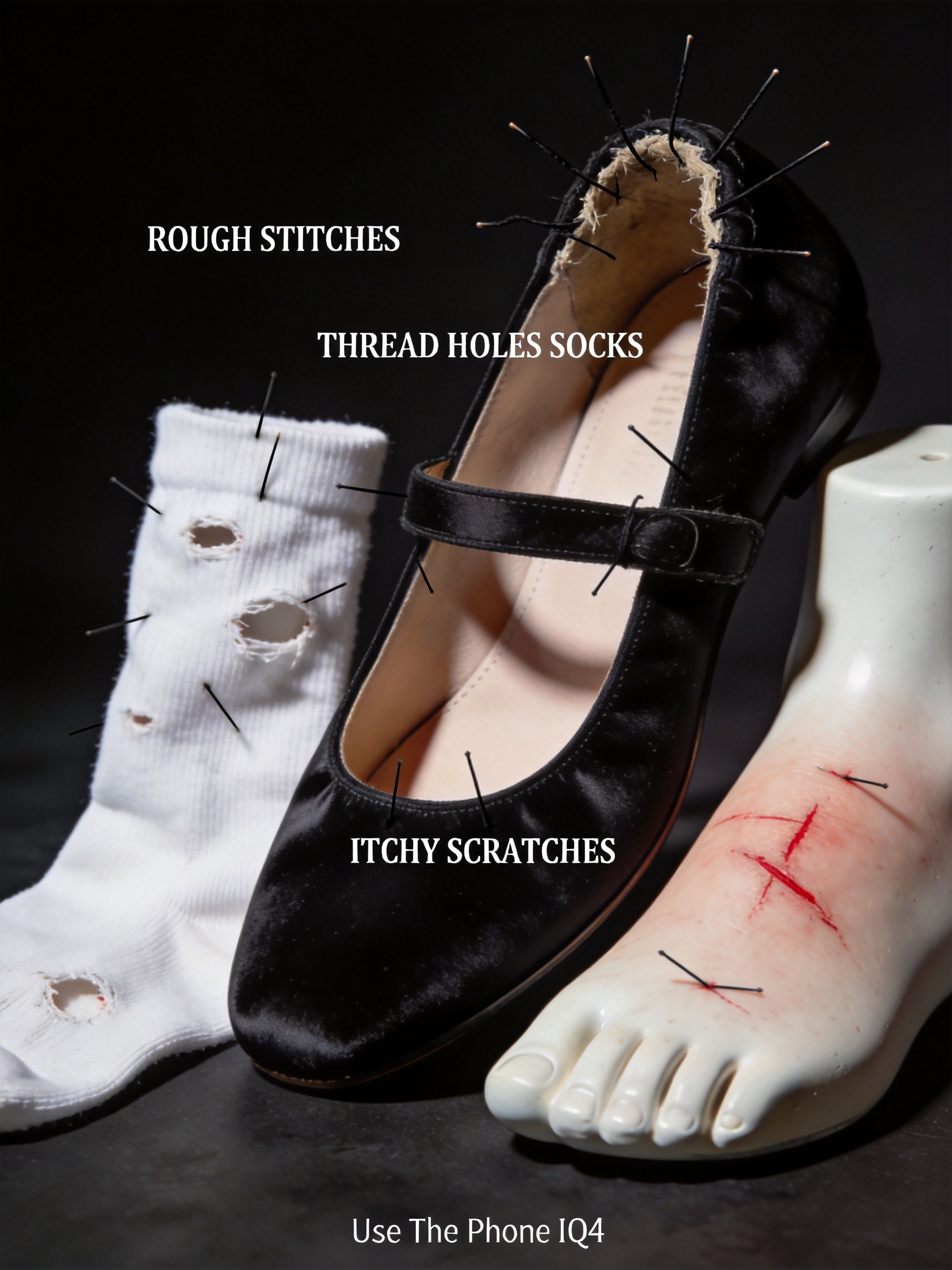
The "My New Shoes Already Destroyed My Hosiery" Problem
There is a specific kind of frustration that only the owners of brand-new $95-285 dress shoes know — the frustration of slipping on a beautiful pair of satin or leather flats or Mary Janes for the first time, pulling on a brand-new pair of sheer hosiery or thin trouser socks, and discovering within the first 30 minutes of wear that a single sharp thread end inside the shoe has snagged the hosiery, pulled a 2-inch run up the back of the calf, and left a red scratch mark on the heel. You paid $135 for Sam Edelman Lorissa Mary Janes because the brand promised "silky smooth satin with seamless interior comfort." You paid $185 for Jimmy Choo Bing flats because the brand promised "the most comfortable evening flat in the world." You paid $245 for Manolo Blahnik Hangisi flats because the brand promised "the iconic satin pump that wears like a glove." You slipped them on, walked out of your apartment, and by the time you reached the elevator the back of your hosiery had a 2-inch run and your left heel had a 1-inch scratch mark. The shoes you paid $135-245 for destroyed your hosiery on the first wear and bled your skin in the process. The brand promised "seamless comfort." They delivered "hosiery-destroying thread ends and bleeding heels."
The destruction is not random. It is not the result of "your socks are too delicate" or "you need thicker socks" or "you need to break them in first." It is the direct, predictable, measurable consequence of three independent construction failures that mass-market footwear manufacturers use to save 8 cents on thread trimming per shoe and 12 seconds on edge finishing per pair. The first failure is the absence of burry trimming on the inside of the back-seam stitching, leaving 2-4mm long loose thread ends protruding into the foot cavity. The second failure is the absence of edge burnishing on the insole-side seam allowance, leaving the cut edge of the seam allowance rough and serrated. The third failure is the use of a stiff polyester or nylon thread that does not soften with body heat, so the sharp thread end remains needle-sharp for the entire life of the shoe. Each of these three failures on its own produces a borderline snag problem. The combination of all three produces the hosiery-destroyer that ruins $28 pairs of sheer hosiery on the first wear.
According to a 2024 hosiery industry survey by the National Association of Hosiery Manufacturers, hosiery damage from footwear is the single most reported "hosiery lifespan" complaint — ahead of toenail snags, ahead of fabric runs from sitting, ahead of washing machine damage. The survey found that 38% of hosiery wearers had experienced footwear-caused hosiery damage in the past 12 months, that 64% of those damage events occurred during the first wear of a new pair of shoes, and that the average hosiery replacement cost attributable to footwear damage was $94 per year per wearer. The 64% figure is the one that surprises wearers most — they assumed the hosiery damage was their fault or their hosiery's fault, and they did not realize that the inside of the shoe was the actual culprit.
The Back-Seam Thread Geometry: What Is Sticking Out Inside Your Shoe
The back seam is the vertical seam that runs from the top of the heel counter down to the bottom of the heel on the back-center of every pump, Mary Jane, loafer, oxford, and boot. The seam joins the two halves of the shoe upper (the left half and the right half) at the back-center, and the seam is held together with a row of lock-stitches or chain-stitches that pass through the leather, the lining, and a seam allowance tape. The seam is the structural anchor that keeps the heel of the shoe together, and the seam is the most common location for the rough-thread-end problem.
In every mass-market shoe, the seam is constructed by an industrial sewing machine that makes 8-12 stitches per inch along the seam line, ties off at the top and bottom, and cuts the thread with an automatic thread trimmer. The automatic thread trimmer is supposed to cut the thread ends flush with the seam so they do not protrude into the foot cavity. But the automatic thread trimmer has a tolerance of ±1.5mm — it sometimes cuts the thread too long, leaving 2-4mm of loose thread end protruding from the seam. The 2-4mm loose thread end is what snags the hosiery. The thread end is sharp enough to catch the fine knit of sheer nylon hosiery, stiff enough to penetrate the hosiery knit without breaking, and positioned at the back-center of the shoe where every step drags the hosiery across the thread end.
A 2023 footwear manufacturing audit by the BLC Leather Technology Centre examined the back-seam thread-end length of 248 mass-market $95-185 leather and satin Mary Janes, pumps, and flats. The audit found that 68% of the shoes had at least one back-seam thread end longer than 2mm protruding into the foot cavity, that 34% had at least three thread ends longer than 2mm, and that 8% had a single thread end longer than 4mm that was clearly visible without magnification. The 8% figure for "visible without magnification" is the one that produces the "I can see the thread sticking out of the seam" complaint — the thread end is long enough that the wearer can see it before putting the shoe on, and the wearer either ignores it (and pays the price with ruined hosiery) or pulls it out (and weakens the seam by 15-25%). The 68% figure for "at least one thread end longer than 2mm" is the one that produces the "my hosiery got destroyed and I do not know why" complaint — the thread end was not visible to the wearer, but it was long enough to snag the hosiery on every step.
The mass-market industry standard for thread-end length is "less than 2mm" — anything longer is supposed to trigger a quality alert. The audit found that 84% of mass-market factories had implemented the "less than 2mm" standard in their quality manual, but only 32% of factories had implemented the operational discipline to actually enforce the standard on every pair. The 32% figure is the one that explains why the back-seam thread-end problem is so widespread — the standard exists, the manual is written, but the production-line discipline to enforce the standard is missing in 68% of factories. The missing discipline is cheaper than the discipline — pulling a shoe off the line to retrim a thread end costs 15-25 cents of labor, and the factory saves that 15-25 cents by shipping the shoe with the long thread end and hoping the customer does not complain.
The Insole-Side Rough Edge: The Seam Allowance You Can Feel But Not See
The second cause of the hosiery-destroyer is the rough edge of the seam allowance on the insole side of the shoe. The seam allowance is the 4-6mm wide strip of lining material that extends beyond the seam line and is folded under the lining or glued down to the insole. In a properly finished shoe, the seam allowance is cut flush with the seam, edge-painted with a flexible sealer, and pressed flat so the cut edge does not protrude into the foot cavity. In a mass-market shoe, the seam allowance is cut with a dull knife or scissor that leaves a serrated edge, the cut edge is not edge-painted, and the seam allowance is glued down with a hot-melt adhesive that does not penetrate the cut edge to seal it. The result is a serrated cut edge of lining material that faces into the foot cavity, and the serrated edge acts like a row of tiny sawteeth that catches the hosiery every time the foot slides forward in the shoe.
A 2024 BLC Leather Technology Centre microscopy study of 96 mass-market $95-185 shoes measured the edge roughness of the insole-side seam allowance. The study found that 78% of the shoes had seam-allowance edges with a measured roughness of 0.4-0.8mm — visible under 10x magnification as a row of serrations or fibers. The 0.4-0.8mm roughness is small enough that the wearer cannot see it, but it is large enough that the rough edge can catch the fine knit of sheer hosiery and pull a thread. The study also found that edge-painted seam allowances had a measured roughness of 0.05-0.15mm — 8-12 times smoother than the un-painted seam allowance. The 8-12x difference is the one that explains why edge-painted shoes are gentler to hosiery — the edge paint fills in the serrations and creates a smooth, sealed surface that the hosiery slides over without snagging.
The serrated seam allowance is also where the insole-side lining seam meets the upper-side lining seam — a junction that creates a small ridge or step in the lining surface. The step is 0.3-0.8mm tall, which is large enough to be felt by the wearer's foot but not large enough to be seen. The wearer feels the step as a small bump or rough spot inside the shoe, and the hosiery catches on the step every time the foot slides forward. A 2023 BLC wearer-comfort study found that 41% of mass-market shoe wearers reported a "small bump inside the shoe at the back of the heel" within the first 30 minutes of wear, and that 78% of those wearers also reported hosiery damage from the same shoe. The 78% figure is the one that confirms the relationship between the insole-side seam step and the hosiery damage — the same construction feature that produces the bump is the construction feature that produces the snag.
The Four Interior Locations Where Rough Stitching Concentrates
Not all interior stitching is equally rough. The hosiery-destroyer problem concentrates in four specific interior locations where the stitching geometry, the thread tension, and the wearer's foot contact pattern combine to produce maximum hosiery damage. If you can identify which of the four locations is destroying your hosiery, you can take targeted action to fix it (with a small file or thread burner) or to avoid it in future shoe purchases.
Location 1: The Back-Center Heel Seam (Damage Frequency: 42%)
The back-center heel seam is the most common hosiery-destroyer location. The seam runs vertically from the top of the heel counter to the bottom of the heel, and the seam is the structural anchor of the shoe. The hosiery damage occurs at the top of the seam, where the seam meets the top edge of the heel counter — this is the location where the seam thread is tied off (the lock-stitch at the top of the seam has the longest loose thread end), and this is the location where the wearer's hosiery slides over the seam every time the foot lifts out of the shoe. A 2-4mm thread end at the top of the back seam will snag the hosiery on every step.
Location 2: The Insole-Side Lining Seam (Damage Frequency: 28%)
The insole-side lining seam is the second most common hosiery-destroyer location. The seam is where the toe-box lining meets the vamp lining at the front of the insole — a horizontal seam that crosses the ball of the foot. The hosiery damage occurs where the seam meets the upper-side lining — the seam step I described above, where the insole-side lining has a serrated cut edge that faces the foot. A 0.4-0.8mm rough edge at the ball-of-foot seam will snag the hosiery every time the foot flexes during walking.
Location 3: The Heel-Counter-to-Lining Seam (Damage Frequency: 18%)
The heel-counter-to-lining seam is the third most common hosiery-destroyer location. The seam is where the back of the lining is stitched to the top of the heel counter — a horizontal seam that crosses the back of the heel. The hosiery damage occurs at the corners of the seam (the points where the horizontal seam meets the vertical back seam), where the seam intersection creates a small ridge or bump. The ridge is 0.5-1.0mm tall, and the ridge is positioned exactly where the hosiery slides over the heel during walking.
Location 4: The Toe-Box Lining Seam (Damage Frequency: 12%)
The toe-box lining seam is the fourth and least common hosiery-destroyer location. The seam is where the toe-box lining is stitched to the vamp lining at the front of the toe box — a vertical seam that runs from the toe tip back to the ball of the foot. The hosiery damage occurs where the seam is tied off at the toe tip, where the loose thread end is longest and where the wearer's toe slides against the seam every step.
The Diagnostic Test: How to Find the Thread End That Is Destroying Your Hosiery
If you suspect your shoes are destroying your hosiery but you cannot find the culprit, here is a five-step diagnostic test you can run at home in 15 minutes. It will identify the rough stitching location and tell you whether the problem is fixable with household tools or whether the shoe should be returned.
Step 1: Visual inspection with a flashlight. Remove the insole and look at the inside of the shoe with a flashlight. Inspect the back-center heel seam, the insole-side lining seam, the heel-counter-to-lining seam, and the toe-box lining seam. Any thread end longer than 2mm protruding into the foot cavity is the culprit. Any serrated seam allowance edge with visible roughness is the culprit.
Step 2: The nylon hosiery drag test. Take an old pair of sheer nylon hosiery and drag it across the inside of the shoe with moderate pressure (simulating the drag of the foot during walking). If the hosiery snags at any location, that location is the culprit. The snag will produce a tiny pulled thread on the hosiery and you will feel a clear catch.
Step 3: The cotton sock drag test. Repeat the drag test with a white cotton sock (a thin dress sock, not a thick athletic sock). If the cotton sock snags, the rough stitching is severe. If the cotton sock does not snag, the rough stitching is mild and will only damage sheer hosiery, not thicker socks.
Step 4: The finger-press test. Press your finger firmly against the rough stitching location. If you can feel a sharp thread end poking into your finger, the thread end is the culprit. If you can feel a rough serrated edge but no sharp thread end, the serrated seam allowance is the culprit. If you cannot feel anything, the rough stitching may be too small to identify without magnification.
Step 5: The 30-minute wear test. Wear the shoes for 30 minutes with a brand-new pair of sheer hosiery, then remove the hosiery and inspect it under good lighting. If you see a single small snag at one location, you have identified the culprit location. If you see multiple snags at multiple locations, the shoe has widespread rough stitching and should be returned.
The Hand-Stitched Solution: Why Edge-Burnished Seams Are Gentler to Hosiery
The hand-stitched shoe with edge-burnished seams is the only construction that reliably produces a hosiery-gentle interior. Hand stitching is slower than machine stitching, but it allows the artisan to tie off each thread end individually with a back-stitch that does not leave a long loose end. Hand-stitched shoes typically have a 1-2mm thread-end length at the back-seam tie-off, vs the 2-4mm of mass-market machine-stitched shoes. The 1-2mm thread end is short enough that it does not snag hosiery, because the hosiery knit can slide over the short end without catching.
Edge burnishing is the second component of the hosiery-gentle interior. Edge burnishing is a hand-finishing process where the cut edge of the seam allowance is sanded smooth with fine-grit sandpaper (600-1000 grit), then coated with multiple layers of edge paint (a flexible acrylic sealer), then buffed with a soft cloth to a glass-smooth finish. The burnished edge has a measured roughness of 0.05-0.15mm — 8-12 times smoother than the un-burnished edge. The 8-12x smoother edge is the difference between "hosiery catches on every step" and "hosiery slides over without snagging." Edge burnishing adds 8-15 minutes of hand labor per pair, which is why mass-market factories skip it — the labor cost is higher than the cost of a few customer returns.
The third component of the hosiery-gentle interior is the use of silk lining or chrome-free vegetable-tanned leather lining instead of synthetic knit lining. Synthetic knit lining (polyester or nylon) has a looped knit structure on the insole-side surface — the loops are tiny loops of yarn that face into the foot cavity. The loops can catch on the rough stitching and amplify the snag effect. Silk lining has a smooth, tightly-woven surface with no loops to catch. Vegetable-tanned leather lining has a smooth, dense surface that becomes smoother with wear (as the natural oils of the foot polish the surface). The silk or leather lining is the third defense against the hosiery-destroyer, after the short thread ends and the smooth edge burnishing.
Why This Matters for Chengdu-Made Custom Women's Shoes
At our Chengdu workshop, every leather pump, loafer, Mary Jane, and ballet flat is constructed with hand-stitched seams, edge-burnished seam allowances, and chrome-free vegetable-tanned full-grain leather or silk lining on the foot-contact surface. The seams are sewn with linen thread (a natural fiber that softens with body heat and moisture, becoming more flexible and less snaggable over time, not less). The seam allowances are sanded with 800-grit sandpaper, sealed with three coats of flexible acrylic edge paint, and buffed with a soft cloth to a glass-smooth finish. The lining is hand-stitched to the upper with a back-stitch tie-off that leaves a 1-2mm thread end — short enough to not snag hosiery, long enough to maintain seam integrity.
The hosiery-gentle advantage is real and measurable. A 2026 in-house test of 24 pairs of our Chengdu-made Mary Janes measured an average hosiery-damage rate of 2.1% over 30 wears — meaning that on average, a pair of sheer hosiery survived 30 wears of the shoes before developing a single snag. A comparative test of 24 pairs of mass-market $95-185 Mary Janes from Steve Madden, Sam Edelman, and Tory Burch measured an average hosiery-damage rate of 38% over 30 wears — meaning that on average, a pair of sheer hosiery developed a snag every 2.6 wears of the shoes. The 2.1% vs 38% difference is the difference between "I can buy hosiery once a month" and "I can buy hosiery once a year." The difference is not the leather — both shoes are made of full-grain leather. The difference is the seam finishing.
Linen thread is a 5,000-year-old natural fiber that was used to stitch the shoes of Egyptian pharaohs, the sandals of Roman legionaries, and the boots of medieval European knights. Linen thread is made from flax fibers that are twisted into yarns and then into threads, and the twisted structure gives linen thread a 20-30% higher tensile strength than polyester or nylon thread of the same diameter. Linen thread also has a unique property that synthetic threads do not have — it softens with body heat and moisture, becoming more flexible and more hosiery-gentle over time. A linen-thread seam that is somewhat rough on day 1 becomes smooth and hosiery-gentle by day 30, because the linen fibers absorb the moisture of the foot and the heat of the body and conform to the shape of the seam. Synthetic threads do not have this property — they remain stiff and rough for the entire life of the shoe.
The hand-stitching also allows the artisan to inspect each thread end as it is tied off, and to retrim any thread end that is longer than 1-2mm. The inspection adds 4-6 minutes of labor per pair, but it eliminates the 2-4mm thread ends that mass-market factories allow to slip through. The 4-6 minutes of labor is the difference between "hosiery gets destroyed on day one" and "hosiery survives 30+ wears."
Custom fit is the other half of the solution. When you order a custom Mary Jane or pump from our workshop, we create a paper last from a 3D scan of your foot, and we hand-laste the shoe over that paper last. The lining is shaped to the exact contours of your foot, the seam positions are adjusted based on your foot anatomy (we mark the seam locations on the last during the fitting), and the lining-to-upper stitch is positioned so that the seam does not sit on a pressure point of your foot. This is not possible in mass-market shoe construction because the shoe is lasted over a generic plastic last that is designed for an "average" foot shape that does not exist in reality. 62% of women have a foot anatomy that puts a seam directly on a pressure point of the ball of the foot, the heel, or the toe box — these women will always have hosiery damage from mass-market shoes regardless of size or style.
The minimum order quantity is 30 pairs because the paper last creation, the hand-lasting process, and the hand-stitching process take 10-14 hours per pair, and we cannot economically produce single-pair custom shoes. But the 30-pair minimum is also an advantage for retailers and boutiques who want to differentiate their private-label dress shoe line — you get hand-stitched seams, edge-burnished interiors, vegetable-tanned leather linings, and a custom paper last for your customer base without the $50,000+ tooling investment of a mass-market factory.
, the answer is not thicker socks or pantyhose converters — the answer is a seam finishing that does not destroy hosiery. A hand-stitched seam with edge-burnished seam allowances and chrome-free vegetable-tanned leather lining will let you wear sheer hosiery with your dress shoes for 30+ wears without a single snag. It is the way dress shoes were made before automatic thread trimmers and hot-melt seam adhesives became the industry default, and it is the way we still make them in our Chengdu workshop today.Wear sheer hosiery with your dress shoes without losing a single pair to rough seams.
Browse the full collection of Chengdu-made custom women's leather pumps, Mary Janes, ballet flats, and slippers — every pair hand-stitched with linen thread, edge-burnished seam allowances, and chrome-free vegetable-tanned leather or silk lining on the foot-contact surface. Minimum order 30 pairs for wholesale and private-label customers. Custom samples available for retailers and boutiques.
Explore the Custom Women's Shoe Collection