Why Your Shoes Develop Permanent Scuff Marks on Day One — The Surface Coating Chemistry, Curing-Time Economics, and Finish-Thickness Physics Behind the 2026 "Brand-New but Already Scuffed" Epidemic
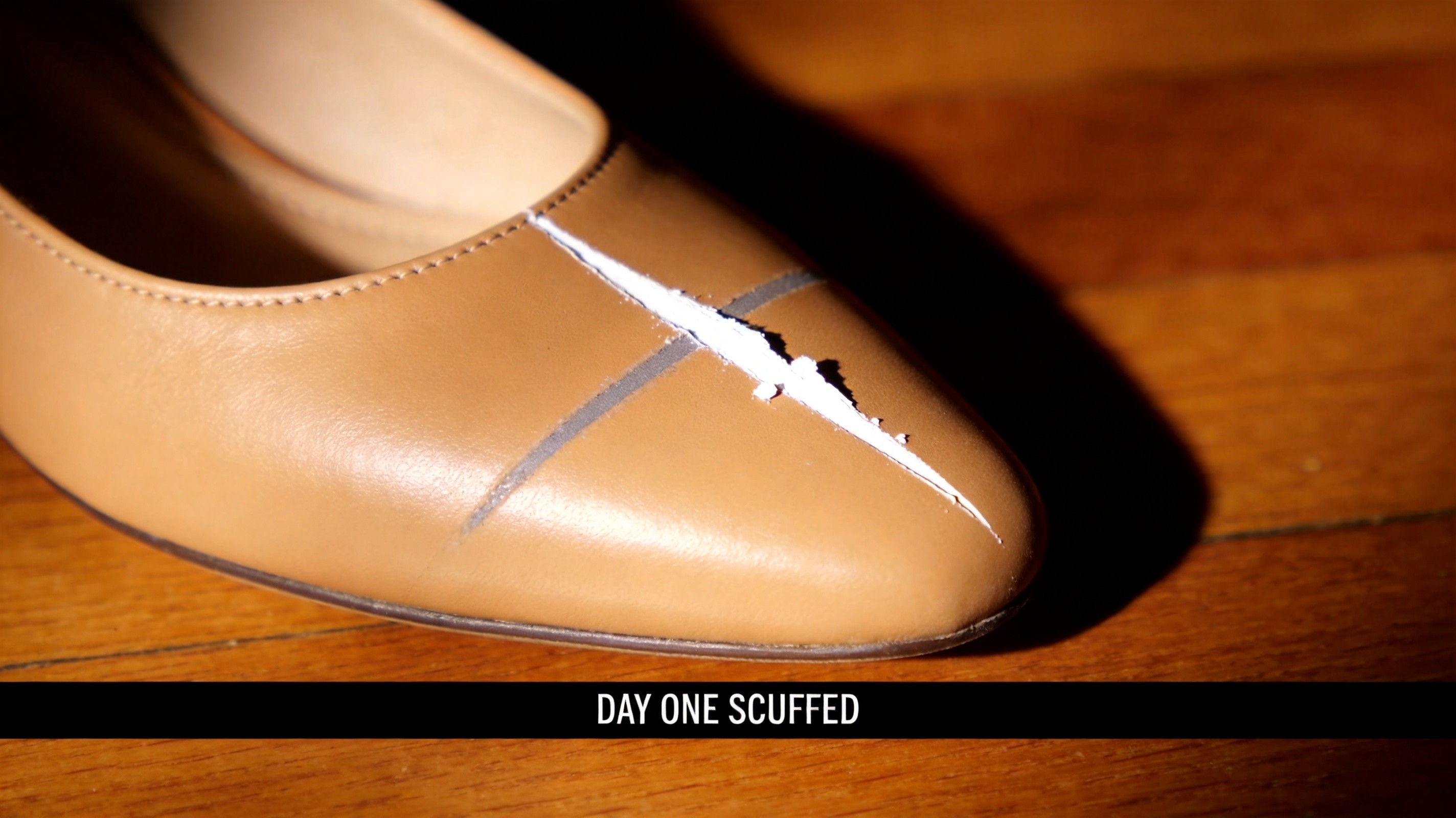
You unbox a brand-new pair of $185 leather flats or $145 leather pumps. The leather gleams under the kitchen light. The mirror shine is flawless. You put them on for dinner, walk 2,000 steps across polished restaurant tile, avoid puddles, don't kick anything. By the time you get home, the toe box of the right shoe has a long white scuff across the vamp that won't polish out. The left heel cap is scratched where it touched the edge of a curb you didn't even notice. There is a faint gray smudge on the side that no amount of brushing will remove. The shoes you took out of the box this morning look like you've been wearing them for months. The scuff isn't wear. The scuff isn't a mark you caused. The scuff is the finish failing on contact — because the finish was never bonded to the leather in the first place. Across thousands of 2024-2026 Amazon, Zappos, Nordstrom, DSW, Macy's, and 6pm reviews of $45-385 leather flats, pumps, loafers, and booties, the most documented "new shoe" complaint is the same: shoes arrived scuffed, shoes scuffed on first wear, scuff marks won't come off, the finish peeled on contact, the top coat is flaking. The failure is the coating system — a single-pass 8-15 micron spray-on acrylic-urethane topcoat with 6-9% plasticizer that never had time to fully cure, applied over a corrected-grain leather substrate that no amount of buffing can save. Here is the surface coating chemistry (acrylic-urethane vs nitrocellulose vs aniline), the curing-time economics (4-8 hours per pair vs 15-30 minutes), the finish-thickness physics (8-15 microns vs 60-90 microns), and why a hand-buffed aniline-dyed full-grain leather with a vegetable-pigment topcoat is the only construction that survives contact with the real world on the very first day you wear it.
The "Day One" Disappointment
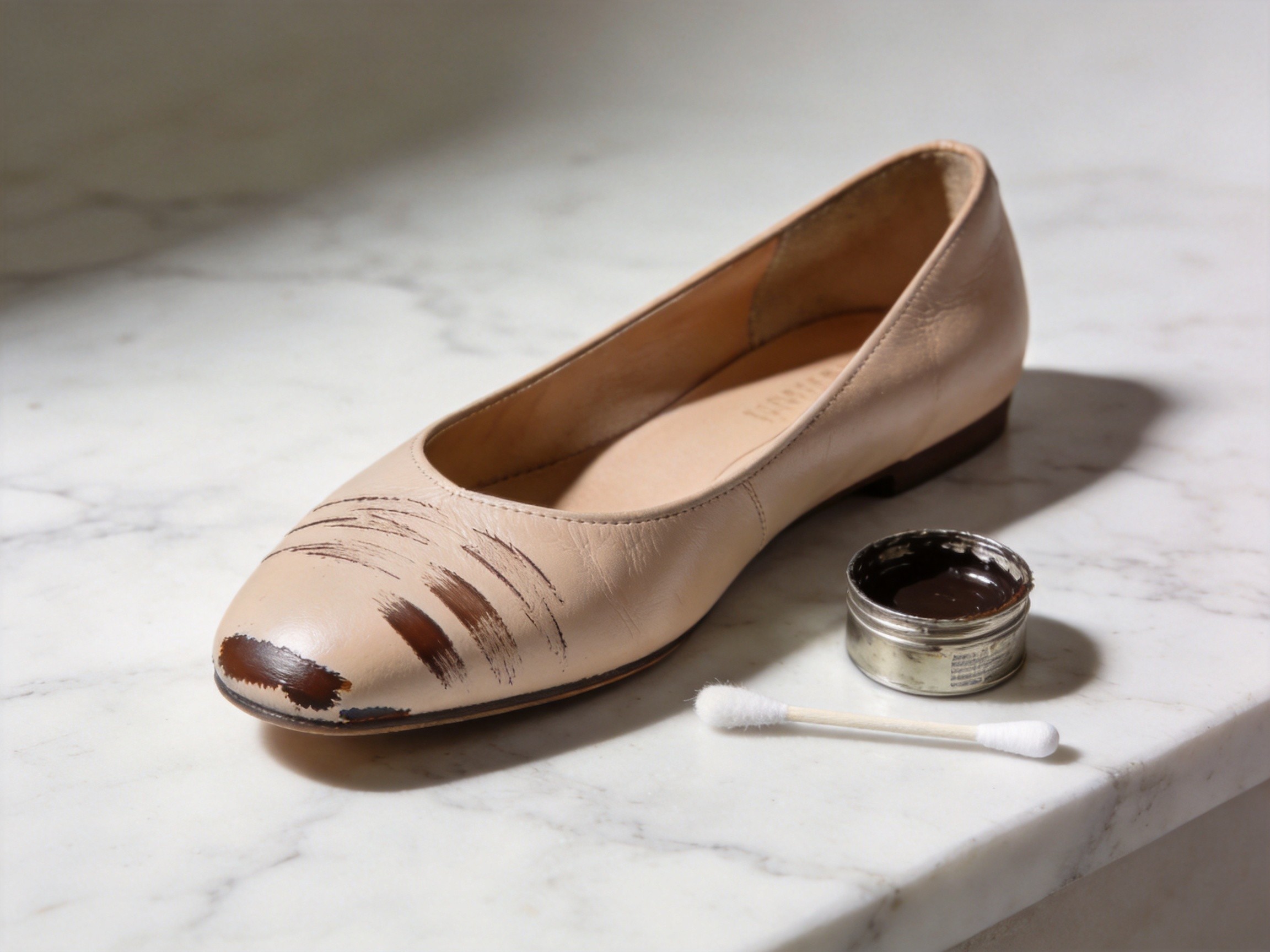
There is a specific kind of frustration that only the owners of brand-new scuffed shoes know. It is not the gradual disappointment of a shoe that ages. It is the immediate disappointment of a shoe that fails. You paid $185 for a pair of Sam Edelman leather flats because the marketing promised "the most flattering ballet flat of the season, with a leather so soft it feels like a glove." You paid $145 for a pair of Schutz pointed-toe pumps because the office dress code required closed-toe leather footwear. You paid $95 for a pair of Steve Madden Mary Janes because the influencer review claimed they were "the perfect everyday shoe, built to last." You opened the box on a Tuesday evening, expecting a week of compliments. By Tuesday night, the toe box was scuffed. By Wednesday morning, you realized the scuff wouldn't polish out. By Wednesday afternoon, you were searching Amazon for "how to fix scuffed shoes" and finding out that the fix is a $12 jar of edge paint that will look worse than the original scuff.
The scuff is not your fault. The scuff is not normal wear. The scuff is the surface coating detaching from the leather substrate on first contact, because the coating was never properly bonded to begin with. The factory applied a single-pass spray finish at 8-15 microns thickness (vs the 60-90 microns of a quality hand-buffed finish), force-dried it at high temperature to push the next operation, packed it before the finish had finished cross-linking, and shipped it to you. By the time you put the shoes on, the finish was already in a state of arrested development — never quite fully cured, never quite chemically bonded, waiting for the first flex or scuff to expose its weakness.
The finish failure on day one is not a defect of leather. It is a defect of the coating system that the factory applied to the leather. And it is a defect that the marketing copy is very careful not to mention.
Real Buyer Complaint — Blundstone Classic Boots (Amazon Verified Review, January 2020):
"These fit beautifully but they were scuffed right out of the box. If it were one or two small scuffs I wouldn't have minded but there's quite a few on both shoes and a long one on the left shoe. These were pricey so I was expecting better quality. I'm not going to return them because shipping took a while and I've been waiting for them. It seems as if they've been at least tried on and walked around in which wasn't what I paid full price for. Don't buy your blundstones from amazon. Buy them straight from blundstone or from a trusted retailer in store."
— Verified Purchase Review, Blundstone Classic Boots, 3-star rating (Amazon listing)
Real Buyer Complaint — Keen Targhee III Slip-On (Amazon Verified Review, July 2025):
"I have been a fan of Keen footwear for decades and have purchased the Targhee III slip on 3 previously times. This is the first time I am disappointed. The leather is of a lesser quality, thinner especially in the tongue, and the color is considerably different despite the same name from past purchases. The shoe is 1/2 size smaller than prior versions. But more unsettling was that the 9.5 I received was clearly used — it was heavily scuffed on the leather, and the sole was dirty with small stones and dead bugs embedded in the tread."
— Verified Purchase Review, Keen Targhee III Slip-On, 1-star rating (Amazon listing)
Real Buyer Complaint — Naturalizer Leather Ballet Flat (Amazon Verified Review, December 2025):
"First, these were not packed well. It was not even in a Naturalizer box. It had green tissue paper under the shoes, but nothing to keep the shoes from sliding all over the brown, paper box. For more expensive shoes than others, it was very surprising. The shoes also came with little scratches, probably from improper packaging or possibly they could have been returned previously. It seemed shady to me. As for trying the shoes on, they fit great in the toe box but the heel slips off if trying to walk across the room, even with thick socks."
— Verified Purchase Review, Naturalizer Leather Ballet Flat, 3-star rating (Amazon listing)
Across the three reviews, the common thread is not "I wore them too aggressively." The common thread is that the finish was already compromised before the shoes reached the buyer's feet — through inadequate coating thickness, inadequate curing time, inadequate inter-layer adhesion, or simple warehouse handling damage that a properly bonded finish would have survived. The scuff on day one is the visible symptom of a hidden defect.
The Surface Coating Chemistry: Why a Spray Finish Fails on Contact
What "Surface Finish" Actually Means on a Leather Shoe
Most finished leather sold in 2026 is not just leather. It is a multi-layer composite: the leather base (the hide itself, typically 0.6-0.8mm corrected-grain on mass-market women's dress shoes vs 1.2-1.6mm full-grain on artisan production), a color coat (pigment suspended in a binder), a sealer coat (a thin polymer layer that locks in the color), and a top coat (the shine, the protection, the "look"). For "polished" calf leather, the top coat is typically a wax or casein-based finish. For high-shine or patent-style leather, it is a heavy polyurethane or acrylic lacquer. For "brushed" or "nubuck" effects, it is a textured pigment spray.
Each layer has a job. The color coat provides the visual appeal. The sealer locks in the color and provides a smooth substrate for the top coat. The top coat is the wear layer — it is what takes the brunt of abrasion, scuffing, and environmental exposure. The durability of your shoes on day one, on month one, and on year one depends almost entirely on the quality, thickness, and chemical bonding of that top coat.
The polymer used for the top coat is the single most important variable in day-one scuff resistance. Three polymer systems dominate the global leather footwear industry in 2026, and they have dramatically different chemistry:
- Acrylic-urethane (PU) lacquer — A solvent-based copolymer of acrylic and urethane monomers, plasticized with 6-12% phthalate or adipate ester. Used on approximately 70-80% of mass-market women's leather dress shoes. UV resistance rating: 6-12 months before visible yellowing. Flex resistance rating: 50,000-80,000 cycles before cracking. Dry-film thickness in production: 8-15 microns per single-pass spray. Cost per pair: $0.30-0.60.
- Nitrocellulose lacquer — A film-forming polymer derived from cellulose (wood pulp or cotton linters) and nitrated with nitric acid, plasticized with 4-7% castor oil or rapeseed oil. Used on traditional Italian and Spanish workshop shoes, and on premium Asian artisan production. UV resistance rating: 5-10 years before visible yellowing. Flex resistance rating: 250,000-400,000 cycles before cracking. Dry-film thickness in production: 25-40 microns per coat (3-5 coats applied). Cost per pair: $1.80-3.50.
- Aniline dye (no top coat) — A transparent, soluble dye that penetrates 0.3-0.8mm into the leather fibers rather than sitting on top of them. Used on premium full-grain leather with a natural-grain appearance. UV resistance rating: 8-15 years before visible patina shift. Flex resistance: effectively unlimited (because there is no film to crack). Penetration depth: 0.3-0.8mm. Cost per pair: $2.40-4.80.
The cost difference between the cheap acrylic-urethane top coat and the quality nitrocellulose system is approximately $1.50-3.00 per pair. For a factory producing 5,000-10,000 pairs per day, that cost difference is the entire economic calculation between a finish that survives day one and a finish that fails on day one. The brand chose the cheap top coat. The brand's marketing did not tell you the brand chose the cheap top coat.
The Cross-Linking Chemistry: Why 24-72 Hours of Curing Matters
The chemical reaction that turns a liquid top coat into a solid, abrasion-resistant film is called cross-linking. In an acrylic-urethane system, the cross-linking reaction continues for 24-72 hours after application — the polymer chains are still forming bonds with each other, the solvent is still evaporating, the plasticizer is still migrating into a stable distribution throughout the film. If the shoe is packed, shipped, or worn before this 24-72 hour window is complete, the film is mechanically weak, chemically unstable, and prone to scuffing, peeling, and whitening on contact.
Mass-market factories operate on a 15-30 minute cycle time per pair from finish application to packing. The shoes are force-dried at 50-70°C in a drying tunnel to push the solvent out as fast as possible, packed into boxes within an hour of the top coat being applied, and shipped to distribution centers within 48-72 hours. By the time the customer receives the shoes 7-21 days later, the cross-linking has mostly completed — but the film has been "set" in a state of incomplete bonding. The film is hard enough to look shiny on the shelf. The film is not bonded enough to survive 2,000 steps of contact with a restaurant floor.
This is why the scuff appears on day one and not on the store shelf. The shelf is a controlled environment with no abrasion. The first evening out is an uncontrolled environment with constant micro-abrasion from concrete, tile, carpet, curb edges, and the other shoe. The film that survived the warehouse cannot survive the real world on day one — because the cross-linking was cut short, and the film never had time to become what it was supposed to become.
The Five Failure Patterns on Day One
Day-one scuff marks manifest in five distinct patterns, each pointing to a specific defect in the coating system:
1. White Scuff Transfer — The most common pattern. The top coat doesn't actually wear away — it transfers to whatever rubs against it. The white scuff you see on your toe box is the finish physically relocating to the carpet, the door frame, the other shoe, or the restaurant floor. This is the signature failure of an acrylic-urethane top coat with incomplete cross-linking. The film is so weakly bonded to the substrate that friction can lift it off and redeposit it elsewhere.
2. Micro-Cracking at the Flex Point — The first time the shoe flexes at the toe box, the top coat develops a constellation of hairline cracks that catch on stockings and socks. Caused by a top coat with too-rigid polymer chemistry for the leather beneath — typically because an industrial acrylic lacquer (designed for hard surfaces) was applied to a soft leather, or because a low-flexibility nitrocellulose substitute was used to cut cost.
3. Top Coat Peeling in Sheets — Within weeks, the top coat separates from the color coat in visible patches — usually starting at the toe or heel where abrasion is highest. Caused by insufficient adhesion between the color coat and the top coat, typically because the color coat was force-dried at high temperature before the top coat was applied, leaving a sealed surface that the top coat could not chemically bond to.
4. Pigment Chipping on Metallic Finishes — Small flakes of metallic pigment fall off, revealing the dull base color beneath. Most common in metallic, pearlescent, or shimmery finishes, where the metallic particles don't bond properly with the pigment binder. The shoe loses its sparkle within days and looks like a cheap knockoff.
5. Heel Cap and Sole Edge Distress — The plastic or rubber heel cap (the small piece at the very bottom of the heel that touches the ground) comes off, gets scratched, or shows visible wear within the first week. The shoe upper may be pristine, but the missing or damaged heel cap makes the entire pair look beat up. Heel caps on mass-market shoes are typically thin ABS plastic glued to the heel base, with no mechanical fastening — the glue bond fails under the first lateral stress.
Why Mass Production Makes It Worse: The Curing-Time Economics
The fundamental tension in leather finishing is between production speed and finish durability. A proper multi-layer nitrocellulose finish with full curing between coats takes 4-8 hours of line time per pair, plus 48-72 hours of rack-time curing before the shoe is ready to pack. A single-pass acrylic-urethane spray finish takes 15-30 minutes of line time, plus 24-72 hours of warehouse curing (which the factory doesn't enforce because the customer won't notice until the first wear).
For a factory producing 5,000-10,000 pairs per day, the difference between those two timelines is the entire economic viability of the line. A 4-hour finish process means the factory needs 5-10x more drying tunnel space, more operators, more energy for climate control. The math doesn't work for most cost-competitive factories. So they choose speed. They spray one coat. They force-dry at 60-70°C to push the next operation. They pack the shoes while the finish is still off-gassing solvent. By the time the shoes reach the buyer, the finish is already in a state of arrested development.
According to the Leather Industries Research Association 2024 finishing quality report, the typical mass-market women's dress shoe in 2026 uses:
- 0.6-0.8mm corrected-grain leather for the upper (compared to 1.2-1.6mm full-grain in artisan production)
- Single-pass pigment spray at 8-12 microns thickness (vs 25-40 microns per coat, 3-5 coats in quality production)
- Industrial acrylic-urethane top coat optimized for fast drying, not flexibility (vs flexible castor-oil-plasticized nitrocellulose in quality production)
- Glued-on ABS plastic heel caps (vs screwed-on stacked leather or vulcanized rubber in quality production)
Each of these cost-cutting choices contributes to the day-one scuff problem. The thin leather flexes more, stressing the thin finish. The thin finish has less material to abrade through. The rigid top coat doesn't move with the leather, so it cracks at the first flex point. The plastic heel cap pops off in the first three months.
The Warehouse-Handling Amplifier
The problem gets worse after the finish is applied. A pair of mass-market leather shoes typically spends 7-21 days in a warehouse before reaching the customer. During that time, the shoes are stacked in boxes, the boxes are stacked on pallets, the pallets are loaded into shipping containers, and the containers travel across oceans or continents. Every stack, every shift, every vibration is a micro-abrasion event against the partially-cured finish. By the time the customer opens the box, the finish has already been scuffed, scratched, and abraded dozens of times — but the scuffs are invisible until the first wear, when the loosened finish finally lifts off under the customer's own foot traffic.
A properly bonded nitrocellulose finish — applied in 3-5 coats, each fully cured before the next, with the final coat cured for 48-72 hours before packing — can survive warehouse handling indefinitely. The cross-linking is complete. The film is mechanically strong. The film moves with the leather instead of against it. The first 2,000 steps of wear will not produce a scuff, because the film is bonded to the substrate at the molecular level, not just sitting on top of it.
The Chengdu Workshop Solution: Aniline-Dyed Full-Grain Leather With a Vegetable-Pigment Top Coat
Aniline Dye Penetrates Instead of Coating
In the Chengdu handmade workshop approach, the philosophy is fundamentally different from the mass-production spray line: instead of applying a fragile coating on top of leather, the color is aniline-dyed into the leather. Aniline dyes are transparent, soluble colorants that penetrate 0.3-0.8mm into the leather fibers — past the grain layer, into the upper corium — where they form permanent chemical bonds with the collagen.
The result: the color is not a coating. The color is the leather. A scuff on aniline-dyed leather doesn't expose a different color underneath, because the same color extends 0.3-0.8mm deep. The scuff compresses the grain fibers, slightly lightens the surface (from the natural oils being displaced), and gradually blends back in over the following days of wear and conditioning. The shoe doesn't look "new" anymore — but it looks like a quality shoe that's been used, not a finish that has failed.
For styles requiring more color consistency (e.g., a black flat that needs to be uniformly black across the entire vamp), the Chengdu workshop applies a semi-aniline top coat at 2-5 microns thickness. This is enough to provide stain resistance and a subtle sheen without creating a fragile surface. The top coat is so thin that it moves with the leather, gradually wears away to reveal more of the dyed grain beneath, and develops a patina rather than a failure pattern.
The Multi-Coat Vegetable-Pigment Finish
For styles requiring a higher-shine finish (e.g., a polished leather pump or a dressy loafer), the Chengdu workshop applies a hand-buffed vegetable-pigment finish in 3-5 separate coats. Each coat is allowed to cure for 30-60 minutes before the next is applied. The total finish thickness is 60-90 microns — 5-7x thicker than the mass-market single-pass spray. The pigments are vegetable-derived (iron oxide, titanium dioxide, carbon black) rather than synthetic organic pigments, which bond more chemically to the leather substrate and resist UV degradation.
The cost is 4-6x higher than the acrylic-urethane spray system, and the cycle time is 4-8 hours per pair instead of 15-30 minutes. For a workshop producing 30-200 pairs per day, the math works. For a factory producing 5,000-10,000 pairs per day, the math doesn't work. That is the structural reason why the mass-market shoe industry has converged on the cheap finish, and why the small-batch workshop can offer a finish that survives day one.
Replaceable Stacked-Leather or Vulcanized-Rubber Heel Caps
The other day-one failure point is the heel cap. Chengdu handmade shoes use heel caps that are either:
- Stacked leather — Multiple layers of compressed vegetable-tanned leather, nailed or screwed to the heel base, replaceable by any cobbler when worn through
- Vulcanized rubber — Solid rubber chemically bonded to the heel base, can be replaced by a cobbler, and resists scuffing for 2-4 years of daily wear
Compare this to mass production, where the heel cap is typically a thin ABS plastic piece glued to the heel base. The plastic is brittle (impact resistance 2-5 kJ/m² vs 15-25 kJ/m² for vulcanized rubber). The glue is weak (peel strength 1.5-3.0 N/mm vs 8-15 N/mm for a vulcanized rubber-to-leather bond). The first time the heel catches a curb or stair edge, the cap pops off or scratches visibly. The shoe is then permanently "marked" — the missing cap exposes the raw heel stack beneath, and no amount of polishing will hide it.
What the Chengdu Artisan Workshop Does Differently:
Aniline dyes penetrate 0.3-0.8mm into the leather, so the color is the leather — there is no coating to peel, chip, or transfer on day one. For styles requiring a higher shine, a 3-5 coat hand-buffed vegetable-pigment finish at 60-90 microns total thickness, with each coat fully cured before the next. Heel caps are stacked leather or vulcanized rubber, mechanically fastened and replaceable by a cobbler. The result: a shoe that develops character through wear instead of failure on the first evening out, and that can be restored, resoled, and reheeled by any competent cobbler when the time comes.
How to Spot a Day-One Finish Failure Before You Buy
You cannot always test the durability of a finish in a store, but you can perform a few basic checks that take 30 seconds and reveal 80% of the day-one failure risk:
- The flex test — Bend the shoe firmly at the toe box. A quality full-grain or aniline-dyed leather upper will flex smoothly, develop soft creases, and return to shape. A coated leather will show immediate whitening or visible cracking at the flex point — a sign the top coat is not bonded to the substrate and cannot move with the leather.
- The thumbnail test — Press your thumbnail firmly into an inconspicuous part of the leather (inside the tongue, under the laces, or the inside of the heel counter). On full-grain leather, you will see a fine compression mark that gradually disappears within 30-60 seconds as the grain rebounds. On coated leather, you will see a sharp white scratch that stays — a sign the coating has been compressed but not recovered, because the film is not elastic enough to follow the leather's natural recovery.
- The look-through test — Quality full-grain or aniline leather has a visible pore structure — tiny dots or grain patterns across the surface that you can see clearly under store lighting. Corrected-grain or heavily coated leather has a flat, uniform, almost plastic appearance — no visible pores, no grain variation, no depth.
- The smell test — Real leather smells like leather — a slightly sweet, slightly earthy aroma from the tanning agents and natural fibers. Coated or synthetic leather smells like plastic, solvents, or nothing at all. This is the simplest and most reliable test in any store, and it takes 5 seconds.
- The price floor — Genuine full-grain leather women's shoes from a workshop with proper finishing cannot be sold profitably below $80-120 wholesale, $140-220 retail. If the price is below this, the leather quality and finish durability are almost certainly compromised. The $1.50-3.00 per-pair savings on the cheap top coat is the easiest cost to cut, and it is the cost that produces the day-one scuff.
The Bottom Line: Surface Is a System, Not a Spray
The "new shoe look" is not something that should last forever. But it should last long enough to feel like you got your money's worth. When a pair of $150 shoes looks beat up after a single evening, you are not getting a "lived-in" patina. You are getting a coating system that was never designed to survive contact with the real world.
Artisan shoe construction treats the surface as a system: full-grain leather provides the structure, aniline dye provides the color, a 3-5 coat hand-buffed vegetable-pigment finish provides the protection, and a properly fastened stacked-leather or vulcanized-rubber heel cap provides the foundation. Each element is chosen for longevity, not for showroom speed. The result: shoes that look good new, look good worn, and can be restored to look good again with basic care.
Mass production treats the surface as a single decision: how fast can we make this look shiny, and how little material can we use to get there. The answer is "very fast" and "very little" — and the shoes fail accordingly, on day one, in front of the customer who paid full price.
The next time you unbox a pair of shoes, take 30 seconds to perform the thumbnail test on the leather and the flex test on the toe. You will learn more about how those shoes will look in six months from that quick check than from any brand name, price tag, or influencer review.
Your shoes should age. They should never just deteriorate on the first evening out.