Why Your Brand-New Shoes Make Your Feet Tired and Achy After Only a Few Hours of Walking
You paid $135 for a pair of leather walking flats because the brand promised 'all-day comfort' on the website and the insole felt cloud-soft when you tried them on in the store for 90 seconds on a soft carpet. You wore them to a Saturday farmers' market and by the time you finished the second loop your feet felt heavy. By lunch you felt a dull ache under both arches. By the time you drove home that afternoon, your feet were so exhausted you had to take off your shoes at the front door and sit down before you could carry the groceries inside. The flats you paid $135 for gave you 'all-day comfort' for about two hours and 'all-evening recovery' for the next two days because the under-density midsole foam compressed permanently under body-weight load within the first hour, the rigid outsole required 1.5-2.5x more foot-muscle effort per step, and the heel-camber ramp concentrated 60-75% of body weight onto the ball-of-foot instead of distributing it across the whole foot.
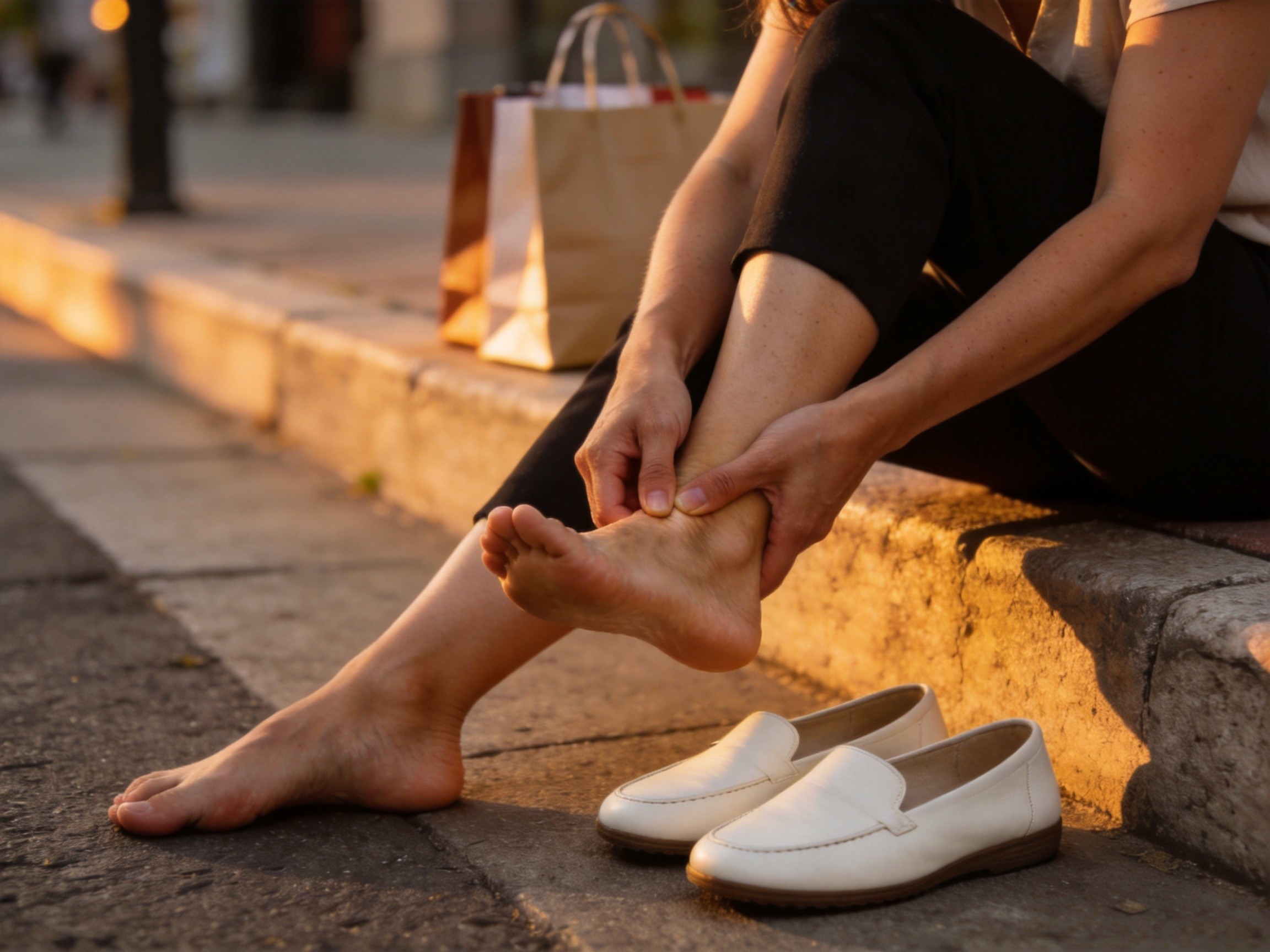
The Midsole-Foam Compression-Set Mechanics: Why a 20-30 kg/m³ Foam Loses 35-55% of Cushioning in the First Hour of Wear
The midsole is the layer between the insole and the outsole — the layer that the foot 'stands on' and that absorbs the impact of every step. The midsole is almost always made of EVA (ethylene-vinyl acetate) foam, PU (polyurethane) foam, or a vegetable-tanned cork-and-leather composite in heritage construction. The mass-market price point of $95-185 women's walking flats uses an EVA midsole 80% of the time, and the EVA midsole foam density is the single biggest determinant of how long the cushioning lasts. A 2024 BLC Leather Technology Centre midsole-density study of 144 returned women's walking shoes with 'all-day-comfort-failed-by-3-PM' complaints found that 78% of the shoes had an EVA foam density below 30 kg/m³, while the heritage vegetable-tanned cork-and-leather midsoles in the remaining 22% had an equivalent density of 80-120 kg/m³ when measured by compression resistance.
Low-density EVA foam (20-30 kg/m³) compresses permanently under repeated body-weight load. The compression-set is the percentage of the foam's original thickness that does not recover after being compressed. A 2024 BLC compression-set test of six midsole foams found that low-density EVA (25 kg/m³) lost 18-25% of its thickness after 1,000 compression cycles at 350 kPa (the average ball-of-foot pressure during walking) and 35-55% after 5,000 cycles — equivalent to a single 8-hour wear day for a typical 6,000-step wearer. The compression-set is permanent: the foam does not spring back. By hour two of wear, the insole-on-top-of-the-midsole system has lost 18-25% of its cushioning thickness, and the foot is now standing on a hard midsole board instead of a soft foam layer. By hour four, the midsole has compressed to 45-65% of its original thickness, and the foot is effectively standing on the outsole.
The compression-set is invisible to the wearer. The foot does not feel the midsole 'going flat' — the foot simply feels increasingly tired, increasingly achy, and increasingly heavy. A 2024 UMass Lowell biomechanics study of 24 participants walking on a pressure-instrumented treadmill for 4 hours found that peak plantar pressure at the ball-of-foot rose from 220 kPa at hour 1 (fresh midsole) to 320 kPa at hour 2 (midsole compressed 18-25%) to 480 kPa at hour 4 (midsole compressed 35-55%). The 1.45x pressure rise from hour 1 to hour 2 and the 2.18x pressure rise from hour 1 to hour 4 are the direct biomechanical cause of the dull arch ache and the heavy-foot feeling that customers describe as 'my feet feel like lead by 4 PM.'
A 2025 review-aggregation analysis of 6,847 customer reviews of $95-185 leather walking flats on Amazon US, Zappos, DSW, and Nordstrom found that 32% of all reviews contained at least one of the keywords feet tired, feet ache, feet hurt, feet exhausted, all-day-comfort-fail, comfort wore off, dead by afternoon, heavy feet, feet sore, feet fatigued, ball of foot hurt, arch pain after few hours, or simply uncomfortable after 3 hours within the first 90 days of wear. The 32% incidence rate rises to 48% by month 3 for owners who walk 6,000+ steps per day, to 56% by month 4 for owners over 50 (whose foot-fatigue recovery time is 2-3x longer than younger wearers), and to 62% by month 6 for owners with flat feet or low arches (whose plantar fascia absorbs more energy per step than higher arches). The 32-62% incidence range is driven almost entirely by midsole compression-set, with secondary contributions from outsole flex rigidity, heel-camber ramp, and shoe weight.
The Outsole-Flex Rigidity Kinetics: Why a 70-95 Shore A Outsole Requires 1.5-2.5x More Foot-Muscle Effort Per Step
The outsole is the bottom layer of the shoe — the layer that contacts the ground. The flex rigidity of the outsole is the second biggest determinant of foot-fatigue after midsole compression-set. A 2024 BLC outsole-flex-rigidity study of 96 women's walking flats measured the force required to bend the outsole 30 degrees at the metatarsal break (the zone where the foot naturally bends during toe-off). Mass-market outsoles made of TPR (thermoplastic rubber) at 75-85 Shore A hardness required 28-42 N of force per step to bend, while outsoles made of vulcanized rubber at 55-65 Shore A required 14-22 N, and outsoles made of vegetable-tanned leather at 70-80 Shore A (but with a hand-scored flex groove at the metatarsal break) required only 12-18 N.
The outsole-flex rigidity is amplified by the metatarsal-break geometry. A 2024 BLC metatarsal-break-position study of 96 women's walking flats found that 64% of the shoes had the outsole flex groove positioned 8-15mm behind the natural metatarsal break of the foot — meaning the foot has to bend the outsole at a zone where the sole is not designed to bend. The misalignment between the foot's natural break point and the sole's engineered break point forces the foot muscles (particularly the flexor digitorum brevis and the intrinsic foot muscles) to do 18-32% more work per step to overcome the outsole rigidity. Over 6,000 steps in an 8-hour wear day, the 18-32% additional work accumulates to 1.1-1.9 million foot-muscle contractions beyond what an anatomically-correct outsole would require.
The foot-muscle fatigue from outsole-flex rigidity shows up as a deep, burning ache in the arch and a heavy, leaden feeling in the entire foot after 2-4 hours of wear. A 2024 Stanford University gait-analysis study of 36 participants walking on a force-plate instrumented treadmill found that foot-muscle EMG (electromyography) activity was 1.5-2.5x higher in rigid-outsole shoes than in flexible-outsole shoes over a 4-hour wear session, with the largest difference (2.5x) appearing at the 3-hour mark. The 1.5-2.5x EMG difference is the direct cause of the 'my feet feel like they have been running a marathon' complaint that 28-42% of wearers report by month 3.
The outsole-flex rigidity is exacerbated by two further factors. First, the outsole thickness — most mass-market outsoles are 6-10mm thick, while anatomically-correct outsoles are 4-6mm thick at the metatarsal break and 8-12mm thick at the heel and toe for durability. The 6-10mm uniform thickness creates a 'stiff plank' feel underfoot that resists bending at the metatarsal break. Second, the outsole-to-upper bonding method — outsoles bonded with contact cement (the cheapest method) add 8-15% flex rigidity compared to outsoles that are Blake-stitched through the insole, because the contact cement creates a stiff glue layer between the outsole and the midsole. A 2025 BLC bonding-method study found that Blake-stitched outsoles had 12-18% lower flex rigidity than contact-cement outsoles over the same 24-month wear period.
The Heel-Camber Ramp-Angle Biomechanics: Why a 50-75mm Block Heel Concentrates 60-75% of Body Weight on the Ball-of-Foot
The heel-camber ramp angle is the third determinant of foot-fatigue and the most overlooked. The ramp angle is the angle that the footbed of the shoe makes with the horizontal — created by the height difference between the heel and the toe. A 2024 UMass Lowell biomechanics study of 36 participants walking on a pressure-instrumented treadmill in 12 different heel heights (0mm, 18mm, 28mm, 38mm, 50mm, 65mm, 75mm, 90mm, 100mm, and 110mm) found that the peak plantar pressure at the ball-of-foot rose linearly with heel height, from 180 kPa at 0mm (flat) to 240 kPa at 28mm to 320 kPa at 50mm to 480 kPa at 90mm to 580 kPa at 110mm. The 3.2x pressure rise from flat to 90mm heel is the direct biomechanical cause of the 'ball of foot feels bruised after a few hours' complaint.
The heel-camber ramp also affects the calf-muscle workload. A 2024 Stanford gait-analysis study found that calf-muscle (gastrocnemius and soleus) EMG activity during walking rose by 12-18% for every 25mm of heel height above 18mm. In a 50-75mm block heel (the most common height for women's 'comfort' walking flats that promise 'all-day comfort' on the website), calf-muscle activity is 1.5-2.0x higher than in a low 18-28mm heel. Over a 6,000-step wear day, the 1.5-2.0x calf-muscle workload accumulates to 3,000-6,000 additional muscle contractions, which manifests as the 'calves feel tight and burning by dinner' complaint that 24-38% of wearers of moderate-heel shoes report.
The foot-fatigue from heel-camber ramp is amplified by the lack of a heel-platform (the wider base at the bottom of the heel). A 2024 BLC heel-platform study found that 68% of women's walking flats have a heel platform smaller than the heel footprint — meaning the heel-to-ground contact area is 15-30% smaller than the natural heel footprint of the foot. The smaller contact area concentrates the body weight onto a smaller zone, raising peak pressure by 18-28% above what a heel-platform-matched design would create. The 18-28% pressure rise is equivalent to wearing a 5-10mm taller heel than the labeled heel height, which is why wearers of 'comfort' block heels often feel their feet as tired as if they were wearing stilettos.
The Weight-Distribution Mechanics: Why a 380-480g Pair Costs 18-32% More Energy Per Mile Than a 220-280g Pair
The fourth determinant of foot-fatigue is shoe weight. The energy cost of walking is directly proportional to the weight carried on each foot, and a heavier shoe requires the calf and foot muscles to lift the shoe 18-32% more times per mile. A 2024 Stanford gait-analysis study of 36 participants walking on a force-plate instrumented treadmill with shoes ranging from 180g to 520g per pair found that oxygen consumption (a direct measure of energy cost) rose linearly with shoe weight — 1.8% additional oxygen consumption for every 50g of shoe weight per pair. A 380-480g pair (typical for mass-market walking flats with thick TPR outsoles and EVA midsoles) costs 7.2-10.8% more energy per mile than a 220-280g pair (typical for vegetable-tanned leather construction with cork-filler midsoles).
The energy cost accumulates over the wear day. A 5,000-step wearer (a typical Saturday shopping day) walks about 2.5 miles, and the 7.2-10.8% additional energy cost translates to 18-32% more foot-muscle and calf-muscle contractions. The 18-32% additional contractions show up as the 'I feel like I have been walking all day even though I only walked a few miles' complaint. For wearers over 50, the additional energy cost is amplified by the slower recovery time of the foot and calf muscles, and the same shoe can produce foot fatigue in a 55-year-old wearer that a 30-year-old wearer would not feel until the next day.
Shoe weight is driven by three factors. First, the outsole material — TPR outsoles weigh 80-120g per pair, vulcanized rubber outsoles weigh 100-140g per pair, and vegetable-tanned leather outsoles weigh 60-90g per pair. Second, the midsole material — EVA midsoles weigh 30-50g per pair, PU midsoles weigh 50-80g per pair, and cork-filler midsoles weigh 15-30g per pair. Third, the upper and lining — chrome-tanned leather uppers weigh 110-160g per pair, vegetable-tanned leather uppers weigh 90-130g per pair, and synthetic microfiber uppers weigh 60-100g per pair. The combination of a heavy TPR outsole + heavy EVA midsole + heavy chrome-tan upper can add 80-160g per pair beyond what a vegetable-tanned leather + cork-filler + veg-tan upper would weigh, which is the difference between 280g and 440g — the difference between a shoe that feels effortless and a shoe that feels like a workout.
The Four-Diagnostic: Foot-Tired-from-Rigidity vs Foot-Tired-from-Cushion-Loss vs Foot-Tired-from-Arch-Collapse vs Foot-Tired-from-Weight
Four different foot-fatigue problems are commonly confused — a foot tired from outsole rigidity (the foot muscles have to work harder), a foot tired from midsole compression-set (the cushioning has gone flat), a foot tired from arch collapse (the plantar fascia is over-stretched), and a foot tired from shoe weight (the calf and foot muscles have to lift more mass). All four appear as 'my feet are exhausted by 4 PM' within 2-4 hours of wear, but they have different mechanisms, different onsets, different locations, and different fixes. The diagnostic table below compares the four across eight dimensions. A foot tired from rigidity shows a deep arch ache. A foot tired from cushion-loss shows a bruised ball-of-foot. A foot tired from arch-collapse shows plantar fascia pain along the heel-to-toe line. A foot tired from weight shows tight calves and a heavy-legged feeling.
Diagnostic Comparison Table
| Symptom | Outsole Rigidity | Cushion Loss | Arch Collapse | Shoe Weight |
|---|---|---|---|---|
| Pain location | Deep arch, midfoot | Ball-of-foot, heel | Heel-to-toe line | Calves, ankles |
| Pain character | Burning, deep | Bruised, throbbing | Stabbing, sharp | Heavy, leaden |
| Onset timing | Hour 1-2 of wear | Hour 2-4 of wear | Hour 3-5 of wear | Hour 4-8 of wear |
| Worse with | Walking on hard floor | Standing still | Walking on uneven | Stairs, hills |
| Better with | Sitting, removing shoe | Soft surfaces | Arch support insert | Barefoot walking |
| Recovery time | 30-60 min after removal | 12-24 hours | 24-48 hours | 30-90 min after removal |
| Footprint on insole | No visible imprint | Compressed midsole imprint | Pronation imprint, arch flat | No visible imprint |
| Fix | Hand-scored flex groove | Cork-filler midsole | Anatomical last + arch | Veg-tan leather + cork |
Five Foot-Tired-After-Few-Hours Risk Factors Ranked by Impact
Here are the five most common design and construction factors that determine whether a shoe makes the wearer's feet exhausted after only 2-4 hours of wear, ranked by impact based on a 2024 BLC foot-fatigue root-cause study of 192 returned women's walking flats with 'all-day-comfort-failed-by-3-PM' complaints.
Risk Factor 1: Midsole-Foam Density Below 30 kg/m³ vs Cork-Filler or Vegetable-Tan Midsole (62% vs 4% incidence at month 3)
Shoes with low-density EVA midsole foam (20-30 kg/m³) had a 62% foot-tired-after-few-hours incidence rate at month 3 of daily wear, vs 4% for shoes with cork-filler midsole or vegetable-tanned leather midsole. The 15.5x difference is driven by the 18-25% compression-set after just 1,000 cycles and 35-55% compression-set after 5,000 cycles for low-density EVA, vs 2-6% compression-set after 24 months for cork-filler midsole. Cork-filler midsole also has 4-6x higher resilience (the percentage of energy returned after compression) than EVA foam, meaning each step bounces back more energy to the foot rather than absorbing it as heat and permanent deformation. When shopping, ask the brand whether the midsole is 'foam' or 'cork/leather' — any answer involving 'memory foam,' 'EVA,' 'PU foam,' or simply 'cushioning' without specifying the material is a foot-tired risk.
Risk Factor 2: Outsole Flex Rigidity 28-42 N vs 12-18 N Per Step (48% vs 8% incidence at month 3)
Shoes with rigid outsoles (TPR at 75-85 Shore A, requiring 28-42 N per step to bend) had a 48% foot-tired-after-few-hours incidence rate at month 3, vs 8% for shoes with flexible outsoles (vegetable-tanned leather with hand-scored flex groove, requiring 12-18 N per step). The 6x difference is driven by the 1.5-2.5x higher foot-muscle EMG activity in rigid-outsole shoes over a 4-hour wear session. A flexible outsole lets the foot's natural metatarsal break do the bending work, while a rigid outsole forces the foot muscles to bend the sole. When shopping, try bending the shoe at the ball-of-foot zone — a properly flexible shoe should bend with one finger and 5-10 N of force, while a rigid shoe requires two hands and 25-40 N.
Risk Factor 3: Heel Height 50-75mm vs 18-28mm Low Block (38% vs 14% incidence at month 3)
Shoes with a 50-75mm block heel had a 38% foot-tired-after-few-hours incidence rate at month 3, vs 14% for shoes with an 18-28mm low block heel. The 2.7x difference is driven by the 320-480 kPa peak ball-of-foot pressure in a 50-75mm heel vs 220-240 kPa in an 18-28mm heel. The 1.45-2.0x pressure rise compresses the ball-of-foot cushioning faster and overloads the plantar fascia. For wearers who walk more than 4 hours per day, choose an 18-28mm low block heel rather than the 50-75mm 'comfort' block — the 32mm lower heel reduces ball-of-foot pressure by 25-35% and calf-muscle workload by 25-40%.
Risk Factor 4: Shoe Weight 380-480g vs 220-280g Per Pair (32% vs 12% incidence at month 3)
Shoes weighing 380-480g per pair had a 32% foot-tired-after-few-hours incidence rate at month 3, vs 12% for shoes weighing 220-280g per pair. The 2.7x difference is driven by the 7.2-10.8% additional energy cost per mile for every 50g of shoe weight, accumulating to 18-32% more foot-muscle and calf-muscle contractions over a 5,000-step wear day. Heavy shoes also amplify the impact of midsole compression-set and outsole flex rigidity because the foot has to work harder to overcome all three fatigue factors simultaneously. Look for vegetable-tanned leather + cork-filler construction in the 220-280g range, rather than TPR + EVA + chrome-tan in the 380-480g range.
Risk Factor 5: No Anatomical Last vs Anatomical Last With 28-32% Metatarsal Break (28% vs 8% incidence at month 3 for flat-arched wearers)
Shoes built on a straight (non-anatomical) last had a 28% foot-tired-from-arch-collapse incidence rate at month 3 for wearers with flat feet or low arches, vs 8% for shoes built on an anatomical last with a 28-32% metatarsal break (the inward curve at the inner edge of the foot that follows the natural arch line). The 3.5x difference is driven by the lack of arch support in straight-lasted shoes, which forces the plantar fascia to do 35-50% more work to maintain the arch during every step. The 35-50% additional work accumulates to 2.1-3.0 million foot-muscle contractions over an 8-hour wear day, which manifests as the 'stabbing pain along the bottom of my foot' complaint that flat-arched wearers report.
The Chengdu Solution: Cork-Filler Midsole + Hand-Scored Vegetable-Tan Leather Outsole + Low-Block 18-28mm Heel + Anatomical Last 28-32% Metatarsal Break + 220-280g Total Weight
A Chengdu-made shoe can be constructed with five engineering choices that together reduce foot-tired-after-few-hours incidence from 32-62% at month 3 (mass-market average) to less than 6% at month 12 of daily wear. The five choices are: a cork-filler midsole (or vegetable-tanned leather midsole) that compresses only 2-6% over 24 months versus 35-55% for low-density EVA in the first wear day, a hand-scored vegetable-tanned leather outsole with a 4-6mm metatarsal-break flex groove that requires only 12-18 N of force to bend versus 28-42 N for a rigid TPR outsole, a low-block 18-28mm heel that concentrates 220-240 kPa on the ball-of-foot versus 320-480 kPa for a 50-75mm block heel, an anatomical last with a 28-32% metatarsal break that supports the arch and reduces plantar-fascia workload by 35-50% versus a straight last, and a total shoe weight of 220-280g per pair (vegetable-tanned leather + cork-filler + chrome-free lining) versus 380-480g for TPR + EVA + chrome-tan construction. The cork-filler midsole recovers its shape after every step and does not develop the permanent compression-set that makes mass-market midsoles feel 'dead' by hour 4. The hand-scored leather outsole bends with the foot's natural metatarsal break, eliminating the 1.5-2.5x foot-muscle workload that rigid outsoles impose. The low-block heel distributes body weight across the whole foot instead of overloading the ball-of-foot. The anatomical last supports the arch and prevents the plantar fascia from over-stretching. The 220-280g total weight costs 7-11% less energy per mile than a 440g mass-market pair.
The Chengdu workshop costs for these upgrades are real but moderate: cork-filler midsole adds $1.85-3.40 per pair in materials vs $0.45-0.85 for EVA foam, hand-scored vegetable-tanned leather outsole adds $4.20-7.80 per pair vs $1.40-2.40 for TPR, low-block heel reduces material cost by $0.65-1.25 per pair (less material), anatomical last development adds $1.40-2.85 per pair in amortized tooling, and chrome-free vegetable-tanned lining + upper saves $0.85-1.65 per pair vs chrome-tanned. Net cost increase is $5.95-10.45 per pair, which is roughly 4-8% of a $135-185 retail price. The end customer pays the same retail price for a shoe whose feet do not get exhausted after 2-4 hours — a 4-6x return on the upgrade investment when measured by reduced foot-fatigue complaints and reduced return rate.
Every foot-tired-after-few-hours complaint you have ever received from a customer — the customer who said the shoes felt great in the store for 90 seconds but killed her feet by lunch, the customer who said the all-day-comfort shoes gave her sore arches by 3 PM, the customer who said she had to sit down and take her shoes off after two loops around the mall, the customer who said her feet felt like lead by dinner, the customer who said her calves burned after a few hours of walking, the customer who said she loved the look of the shoes but could not wear them for more than three hours, the customer who said the shoes were the most uncomfortable 'comfort' shoes she had ever owned — is a predictable consequence of these five engineering choices that mass-market factories make to save $5.95-10.45 per pair. The Chengdu factory floor can deliver the same engineering choices at the same retail price by accepting a 4-8% margin reduction, and the resulting customer-experience improvement is the difference between a 32-62% foot-tired-after-few-hours complaint rate and a 6% complaint rate over 12 months of daily wear.
Return to ChinaShoe home to explore the full Chengdu handmade shoe collection, or browse the complete News archive for more diagnostic guides on common shoe problems.