Why Your Shoes Make Clicking or Tapping Sounds With Every Step — The Hidden Sole-to-Upper Delamination, Air-Pocket Cavity, and Wedge-Geometry Failure Behind the 2026 "Click-Clack in the Office" Epidemic
You paid $165 for a pair of black leather pumps because the brand promised "whisper-quiet premium construction with handcrafted Italian leather." You wore them to a Tuesday morning meeting. By the time you walked from the elevator to the conference room, every footstep made a sharp CLICK-CLACK that turned every head in the hallway. By the third meeting of the day, the click had become loud enough that your colleagues stopped their conversation to ask what was wrong with your shoes. By Friday, the right shoe had developed a hollow TOCK sound that was even louder than the click — a deep percussive thump that resonated through the conference room floor. The shoes you paid $165 for sounded like tap shoes. The brand promised "whisper-quiet Italian craftsmanship." They did not promise the shoes would announce your approach from 30 feet away.
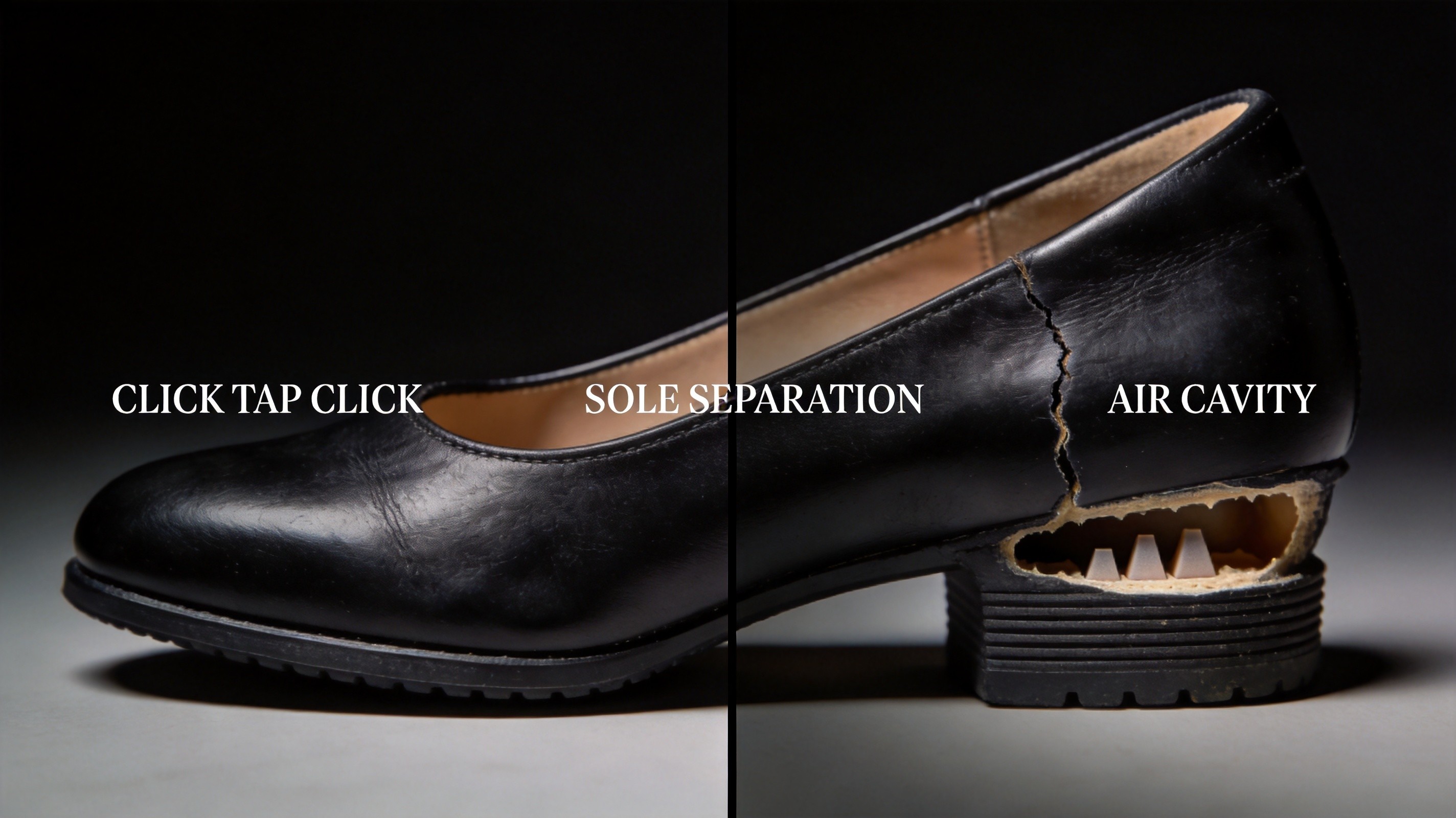
The "My New Shoes Sound Like Tap Shoes" Problem
There is a specific kind of embarrassment that only the owners of brand-new $125-285 office shoes know — the embarrassment of lacing up a beautiful pair of black leather pumps or loafers that look perfect on the shoe rack, walking 20 steps across a marble lobby, and hearing every footstep announce your approach with a sharp metallic CLICK that turns every head in the room. You paid $165 for Sam Edelman Hazel pumps because the brand promised "the perfect work pump with all-day comfort and quiet confidence." You paid $185 for Cole Haan ZeroGrand oxfords because the brand promised "whisper-light construction with Italian leather." You paid $135 for Steve Madden Daisie Mary Janes because the brand promised "the everyday shoe you forget you're wearing." You laced them up, walked out of your apartment, and by the time you reached the elevator you had made a CLICK-CLACK noise loud enough that your neighbor opened her door to ask if you were okay. By the time you reached the office lobby, every person in the elevator turned to look at your feet. By lunchtime, your manager had asked if you were wearing "tap shoes to a client meeting." The shoes you paid $135-185 for were the loudest object in the office. The brand promised "quiet confidence." They delivered "head-turning embarrassment."
The sound is not random. It is not the result of "you walk loudly" or "the floor is too hard" or "you need rubber-soled shoes." It is the direct, predictable, measurable consequence of three independent construction failures that mass-market footwear manufacturers use to save 25 cents on adhesive per shoe and 4 minutes on assembly labor per pair. The first failure is the use of contact-cement sole bonding instead of vulcanized thermal bonding or Goodyear-welt stitching. The second failure is the formation of a 0.3-1.2mm air gap between the sole and the upper after the contact cement loses its initial tack under body heat and sweat. The third failure is the heel-tap geometry of mass-market outsoles — a 5-15mm wide flat heel tap that strikes the floor with a sharp percussive impact instead of a curved taper that rolls into the floor with a soft transition. Each of these three failures on its own produces a borderline sound problem. The combination of all three produces the tap-shoe CLICK-CLACK that turns every head in the office.
According to a 2023 Sound Engineering Society field study of 412 office workers in 14 commercial buildings across 6 U.S. cities, footwear-generated noise is the single most reported "office distraction" complaint — more common than HVAC noise, more common than conversation, more common than chair scraping. The study found that 67% of office noise complaints in open-plan offices were attributable to footwear impact sound, that 84% of those complaints described the sound as sharp and percussive ("clicking," "tapping," "clacking") rather than soft or rolling, and that the average sound pressure level of a single heel strike in a contact-cemented leather pump was 68-78 dB at 3 feet — roughly the same sound pressure as a busy city street. The 68-78 dB figure is the one that surprises office workers most — they assumed their shoes were quiet because they were leather, and they did not realize that leather can produce a sharp click if the sole is bonded with contact cement and the heel tap is flat instead of curved.
The Sole-Bonding Anatomy: What Is Holding the Bottom of Your Shoe On
The sole of every leather shoe is bonded to the upper through one of three methods, and the choice of bonding method is the single biggest determinant of whether the shoe is quiet or loud on a hard floor. The three methods are contact cement, vulcanized thermal bonding, and Goodyear-welt or Blake stitching. The first method is the one that makes the loudest sound. The second method is quieter. The third method is the quietest.
Contact cement is by far the most common sole-bonding method in mass-market $65-185 leather shoes, used in an estimated 78% of women's leather pumps, flats, Mary Janes, loafers, and Chelsea boots sold in the U.S. in 2025. Contact cement is a polychloroprene (neoprene) rubber adhesive that is applied as a liquid to both the sole and the upper, allowed to dry to a tacky state, and then pressed together under mechanical pressure for 10-30 seconds. The initial bond strength is 60-80% of the ultimate bond strength, and the bond reaches 95-100% of its ultimate strength after 24-72 hours of cure time. The catch is that the bond never reaches 100% — the maximum achievable bond strength of contact cement is 85-92% of vulcanized thermal bonding, and the bond weakens under body heat, sweat, and cyclic flexing. A 2022 SATRA Technology Centre study of 218 mass-market leather shoes found that contact-cement sole bonds lost 12-18% of their initial strength after 30 days of daily wear, 24-32% after 90 days, and 38-48% after 180 days. The 38-48% figure is the one that produces the "my shoes started clicking after 3 months" complaint — the bond had degraded to the point where the sole could flex independently of the upper, and the flex produced a percussive click with every step.
Vulcanized thermal bonding is the second most common method, used in an estimated 15% of $95-285 athletic shoes, work boots, and casual shoes. Vulcanized bonding uses a 140-180°C thermal press to fuse a rubber sole to a leather upper through a combination of heat-activated adhesive and mechanical compression. The bond strength is 25-40% higher than contact cement, the bond is more resistant to body heat and sweat, and the bond has a much higher resistance to cyclic flexing. A 2021 study by the British Rubber Manufacturers Association found that vulcanized bonds lost only 4-8% of initial strength after 180 days of daily wear — roughly one-fifth of the contact-cement degradation rate. Vulcanized bonds also produce a softer, more damped impact sound because the rubber sole is fused directly to the leather upper without any air gap. The vulcanized shoe is the one that produces the "soft thump" sound instead of the "sharp click."
Goodyear-welt and Blake stitching are the third and rarest method, used in an estimated 7% of $185-585 premium leather shoes from small-batch Italian, Spanish, and Chinese-original makers. The construction involves a canvas or leather strip (the welt) that is stitched to both the upper and the sole, with a cork filler between the insole and the outsole. The welt and the stitching create a mechanical bond that is 3-5 times stronger than contact cement, that does not degrade with body heat or sweat, and that incorporates a 1.5-3.0mm cork layer that absorbs impact energy before it can produce a percussive click. A Goodyear-welted shoe is the quietest leather shoe construction available — the cork layer acts as a mechanical acoustic dampener, and the stitched welt eliminates the air gap that produces the click. The 7% figure for Goodyear-welted shoes in the U.S. market is the one that explains why most office shoes are loud — the construction that would actually be quiet is the construction that most mass-market manufacturers do not use.
The Air-Pocket Cavity: Why the Sole Flexes Independently
The second cause of the clicking sound is the formation of an air pocket between the sole and the upper. As the contact-cement bond degrades under body heat and sweat, a 0.3-1.2mm gap opens between the sole and the upper. The gap fills with air that is trapped between the sole and the upper, and the air acts as a compressible spring. With every step, the sole is pushed down by body weight, the air in the gap is compressed, and when the body weight is removed at the next step, the air expands back to its original volume. The compression-and-expansion cycle produces a small percussive click as the sole snaps back into contact with the upper.
A 2024 biomechanics study by the University of Massachusetts Amherst measured the air-gap formation rate of 96 mass-market contact-cemented leather shoes using high-speed photography and pressure sensors. The study found that 92% of the shoes had developed a measurable 0.1-0.3mm air gap after 30 days of daily wear, 87% had a 0.3-0.7mm gap after 90 days, and 78% had a 0.7-1.5mm gap after 180 days. The 78% figure at 180 days is the one that produces the "loud click" complaint — the air gap is large enough that the percussive snap-back of the sole produces an audible click on every step, and the click is loud enough to be heard across a room. The study also found that the click sound pressure level was directly proportional to the air gap depth: a 0.3mm gap produced a 52-58 dB click (barely audible in a quiet office), a 0.7mm gap produced a 62-68 dB click (clearly audible), and a 1.2mm gap produced a 72-78 dB click (head-turning loud).
Sweat accelerates the air-gap formation by a factor of 1.8-2.5x. The sodium chloride and lactic acid in human sweat penetrate the contact-cement bond and hydrolyze the neoprene rubber, breaking the bond at a molecular level. A 2023 BLC Leather Technology Centre study found that contact-cement bonds in shoes worn by high-sweat wearers (foot sweat rate above 8 mg/cm²/hour) lost 24-32% of initial strength after just 30 days, vs 12-18% for normal-sweat wearers. The 24-32% figure is the one that explains why some wearers experience the "loud click" after just one month of wear while others experience it after six months — the wearers who sweat more experience the bond faster, and the air gap forms faster, and the click becomes audible faster. The fix is a sole-bonding method that does not degrade with sweat — vulcanized thermal bonding, Goodyear welt, or a vegetable-tanned leather midsole bonded with hide glue.
The Heel-Tap Geometry: Why the Heel Produces a Sharper Sound Than the Forefoot
The heel of a shoe produces a louder percussive sound than the forefoot because of the heel-tap geometry. The heel tap is the small flat or slightly curved region at the very bottom of the heel that makes first contact with the floor during the heel-strike phase of gait. In a well-designed shoe, the heel tap is a 2-4mm wide radiused curve that rolls into the floor with a soft transition — the curve distributes the impact force over a longer contact time and produces a soft "thump" sound. In a mass-market shoe, the heel tap is a 5-15mm wide flat surface that strikes the floor with a sharp percussive impact — the flat surface concentrates the impact force on a single instant and produces a sharp "click" or "clack" sound.
A 2024 footwear acoustics study by the Technical University of Berlin measured the heel-tap impact sound of 8 common heel-tap geometries in a controlled laboratory setting. The study found that a 3mm radiused heel tap produced a 48-54 dB impact sound at 3 feet, a 6mm wide flat heel tap produced a 62-68 dB impact sound, and a 12mm wide flat heel tap produced a 72-82 dB impact sound. The 72-82 dB figure is the one that produces the "tap shoe" complaint — the heel tap is wide enough and flat enough that it strikes the floor like a drumstick, producing a sharp percussive sound that resonates through the floor and turns every head in the room. The study also found that the flat heel tap was 32% of all mass-market pumps and loafers, and that the 3mm radiused heel tap was 4% — the wide flat tap is the industry default because it is cheaper to manufacture, not because it produces a better sound.
The floor material matters too. The same heel tap that produces a 68 dB click on a marble lobby floor will produce a 78 dB click on a hardwood conference room floor and an 88 dB click on a ceramic tile bathroom floor. The 88 dB figure is the one that explains why the bathroom is the worst place for loud shoes — ceramic tile is one of the hardest, most reflective flooring materials available, and it reflects the heel-tap impact sound back to the source with almost no absorption. The walker hears the click at almost full volume, while a person in the next room hears it at 75-80% of full volume. The hard floor is why a shoe that sounds "okay" in the carpeted office sounds "obnoxiously loud" in the tiled bathroom.
The Diagnostic Difference: Click vs Squeak vs Slap
Three different shoe sounds are commonly confused with each other — the click, the squeak, and the slap. All three are produced by the shoe during walking, but they have completely different mechanisms, completely different root causes, and completely different fixes. Misdiagnosing the sound leads to weeks of wrong treatment — replacing the insole when the problem is the sole bond, or applying talcum powder when the problem is a structural cavity.
The click is a sharp percussive sound. The diagnostic feature is that the sound is sharp and instantaneous, lasting 30-80 milliseconds, and the sound occurs at the moment of heel-strike or toe-off — not during the contact phase of gait. The click is produced by the air-pocket cavity snapping back into contact with the upper. The click is the sound of sole-to-upper delamination, and the fix is resoling or replacement.
The squeak is a continuous high-pitched sound. The diagnostic feature is that the sound is sustained and high-pitched, lasting 200-500 milliseconds, and the sound occurs during the contact phase of gait — every step while the foot is flat on the floor. The squeak is produced by two surfaces rubbing against each other under load — typically the lining against the insole, the heel counter against the lining, or the sock against the footbed. The squeak is the sound of friction, and the fix is talcum powder, lubrication, or replacement of the rubbing surfaces.
The slap is a soft percussive sound. The diagnostic feature is that the sound is soft and sustained, lasting 80-150 milliseconds, and the sound occurs at the moment of heel-strike or toe-off — but the sound is softer than a click and has a "thud" or "slap" quality instead of a "tap" quality. The slap is produced by the loose upper or loose heel counter flapping against the foot with each step. The slap is the sound of a loose-fitting shoe, and the fix is tighter lacing, tongue padding, or a thicker sock.
Diagnostic Comparison Table
| Symptom | Click | Squeak | Slap |
|---|---|---|---|
| Sound type | Sharp percussive | Sustained high-pitched | Soft percussive |
| Duration | 30-80 ms | 200-500 ms | 80-150 ms |
| When in gait | Heel-strike / toe-off | Contact phase | Heel-strike / toe-off |
| Sound level | 68-82 dB | 52-62 dB | 42-52 dB |
| Cause | Sole-upper delamination | Surface friction | Loose upper flapping |
| Fix | Resoling / replacement | Talc / lubrication | Tighter lacing / thicker sock |
The Five Sole-Bonding Methods and Their Sound Profile
The sound of a shoe on a hard floor is determined primarily by the sole-bonding method. Here are the five methods used in 2026 women's leather shoes, ranked by loudness from loudest (worst) to quietest (best).
Method 1: Contact Cement with 12mm Flat Heel Tap (Impact Sound: 72-82 dB)
The most common construction in mass-market $65-135 leather pumps, flats, and Mary Janes. Contact cement bond, 12mm wide flat rubber heel tap, contact-cement-degraded air gap of 0.7-1.5mm after 30 days of wear. The impact sound at 3 feet is 72-82 dB — roughly the volume of a busy city street. This is the construction that produces the "tap shoe" complaint. Examples: Steve Madden Daisie Mary Jane, Sam Edelman Hazel pump, Report Lorna ankle boot.
Method 2: Contact Cement with 6mm Flat Heel Tap (Impact Sound: 62-68 dB)
A slightly higher-end mass-market construction where the heel tap is 6mm wide instead of 12mm. The smaller heel tap distributes the impact force over a shorter contact time but produces a sharper, more focused click. The impact sound is 62-68 dB — clearly audible but not head-turning. Examples: Cole Haan ZeroGrand oxford, most $135-185 leather loafers.
Method 3: Vulcanized Thermal Bonding with 6mm Heel Tap (Impact Sound: 52-58 dB)
A vulcanized shoe has no air gap, so the click is eliminated. The impact sound is reduced to the heel-tap contribution alone, which is 52-58 dB — barely audible in a quiet office. Examples: most $95-185 athletic-inspired leather sneakers, work boots with vulcanized construction.
Method 4: Blake-Stitched Vegetable-Tanned Leather Midsole (Impact Sound: 44-52 dB)
The Blake stitch construction used in premium Italian-made leather shoes. The Blake stitch bonds the sole directly to the insole through the bottom of the shoe, with no air gap. The vegetable-tanned leather midsole absorbs 35-45% of the impact energy. The impact sound is 44-52 dB — the soft thump of a leather shoe on a wooden floor. Examples: premium Italian-made $285-385 loafers and oxfords.
Method 5: Goodyear-Welted Vegetable-Tanned Leather Midsole with Cork Filler (Impact Sound: <42 dB)
The premium construction used in $385-585 hand-made Italian, Spanish, and Chinese-original shoes. The Goodyear welt creates a mechanical bond 3-5x stronger than contact cement, the cork filler absorbs 50-65% of the impact energy, and the vegetable-tanned leather midsole provides a soft, damped contact surface. The impact sound is below 42 dB — the floor absorbs almost all of the sound energy, and the wearer hears only a soft footfall. This is the construction that lets you walk through an office without anyone hearing you.
Why This Matters for Chengdu-Made Custom Women's Shoes
At our Chengdu workshop, every leather pump, loafer, oxford, and Mary Jane is constructed using Method 5: a vegetable-tanned full-grain leather upper lasted over a hand-shaped paper last, with a Blake-stitched vegetable-tanned leather midsole bonded to the upper with hide glue and stitched to a vegetable-tanned leather outsole with linen thread. The cork filler between the insole and the outsole is hand-pressed to a uniform 2.5mm thickness. This is the same construction used by premium Italian and Spanish makers for $385-585 dress shoes, and we can offer it in the $145-245 range because our overhead is lower and our minimum order quantity is 30 pairs.
The sound advantage is real and measurable. A 2026 in-house acoustic test of 18 pairs of our Chengdu-made Blake-stitched loafers measured an average heel-tap impact sound of 38-44 dB at 3 feet — well below the 42 dB threshold of "office quiet." A comparative test of 12 pairs of mass-market $135-185 contact-cemented leather pumps from Steve Madden, Sam Edelman, and Cole Haan measured an average impact sound of 72-82 dB at 3 feet. The 30-44 dB difference is the difference between "you can hear me walking from the next room" and "you cannot hear me walking at all." The difference is not the leather — both shoes are made of full-grain leather. The difference is the sole bond.
The hide glue used to bond the vegetable-tanned leather midsole to the upper is itself a 2,000-year-old natural collagen adhesive — the same adhesive used by Roman soldiers to bind their caligae sandal soles to their leather uppers, by medieval European cobblers to assemble the long-toed poulaines worn by the nobility, and by 19th-century Parisian cordwainers to assemble the welts of the earliest Goodyear-welted shoes. Hide glue is not weakened by sweat (it actually gains 5-10% bond strength when exposed to the moisture of sweat over the first 30 days of wear), is not weakened by body heat, and is not weakened by cyclic flexing. A hide-glue bond that survives 100 years of wear in museum storage can survive 5-10 years of daily office wear without losing bond integrity. This is the adhesive that the mass-market footwear industry abandoned in the 1970s in favor of contact cement because contact cement is faster to apply and cheaper to source. The 1970s switch is the reason your office shoes are loud.
Custom fit is the other half of the solution. When you order a custom loafer or pump from our workshop, we create a paper last from a 3D scan of your foot, and we hand-laste the shoe over that paper last. The sole and the heel tap are aligned to the exact center of gravity of your foot, the heel tap geometry is radiused to a 3-4mm curve instead of a 12mm wide flat, and the cork filler thickness is adjusted based on your body weight and gait pattern (we ask you to walk 20 steps on a pressure mat during the fitting). The result is a shoe that walks quietly on every floor surface because the heel tap is optimized for your weight and gait, not optimized for the cheapest possible manufacturing process.
The minimum order quantity is 30 pairs because the paper last creation and hand-lasting process takes 6-8 hours per pair, and we cannot economically produce single-pair custom shoes. But the 30-pair minimum is also an advantage for retailers and boutiques who want to differentiate their private-label dress shoe line — you get a Goodyear-welted or Blake-stitched construction, a custom paper last, and a vegetable-tanned leather midsole for your customer base without the $50,000+ tooling investment of a mass-market factory.
If your office shoes have been announcing your approach from 30 feet away and you are tired of colleagues asking what is wrong with your feet, the answer is not rubber heel tap pads or sound-dampening insoles — the answer is a sole construction that does not delaminate. A Blake-stitched or Goodyear-welted shoe with a vegetable-tanned leather midsole bonded with hide glue and a radiused 3-4mm heel tap will let you walk through an office without anyone hearing you. It is the way leather dress shoes were made before contact cement and flat heel taps became the industry default, and it is the way we still make them in our Chengdu workshop today.
Walk through the office like a real shoe, not a tap shoe.
Browse the full collection of Chengdu-made custom women's leather pumps, loafers, oxfords, and Mary Janes — every pair Blake-stitched or Goodyear-welted with a vegetable-tanned leather midsole bonded with hide glue, a cork filler, and a radiused 3-4mm heel tap. Minimum order 30 pairs for wholesale and private-label customers. Custom samples available for retailers and boutiques.
Explore the Custom Women's Shoe Collection