Why Your Shoes Let Pebbles, Sand, and Small Debris Get Inside When You Walk on Gravel, Boardwalks, or Beach Paths
You paid $125 for a pair of closed-toe walking sandals because the brand photo showed a sleek athletic silhouette with mesh panels and a closed toe-box that looked protective. You wore them on a Saturday morning hike along a gravel beach boardwalk, and within ten minutes you felt a small pebble enter through the heel collar and settle under your heel. You stopped, took the shoe off, shook out the pebble, and put the shoe back on. Within three minutes, another pebble entered from the toe-box edge and lodged between your big toe and the second toe. By the time you finished the 1.5-mile walk, you had stopped four times to remove pebbles and small sticks from both shoes. The sandals you paid $125 for became unwearable on any gravel, sand, or boardwalk surface because the gaps at the heel collar and the toe-box edge were wide enough to admit 2-8mm pebbles with every step because the heel collar did not seal against your ankle bone and the toe-box edge did not seal against your foot, and the walking biomechanics pumped those gaps wider with every step.
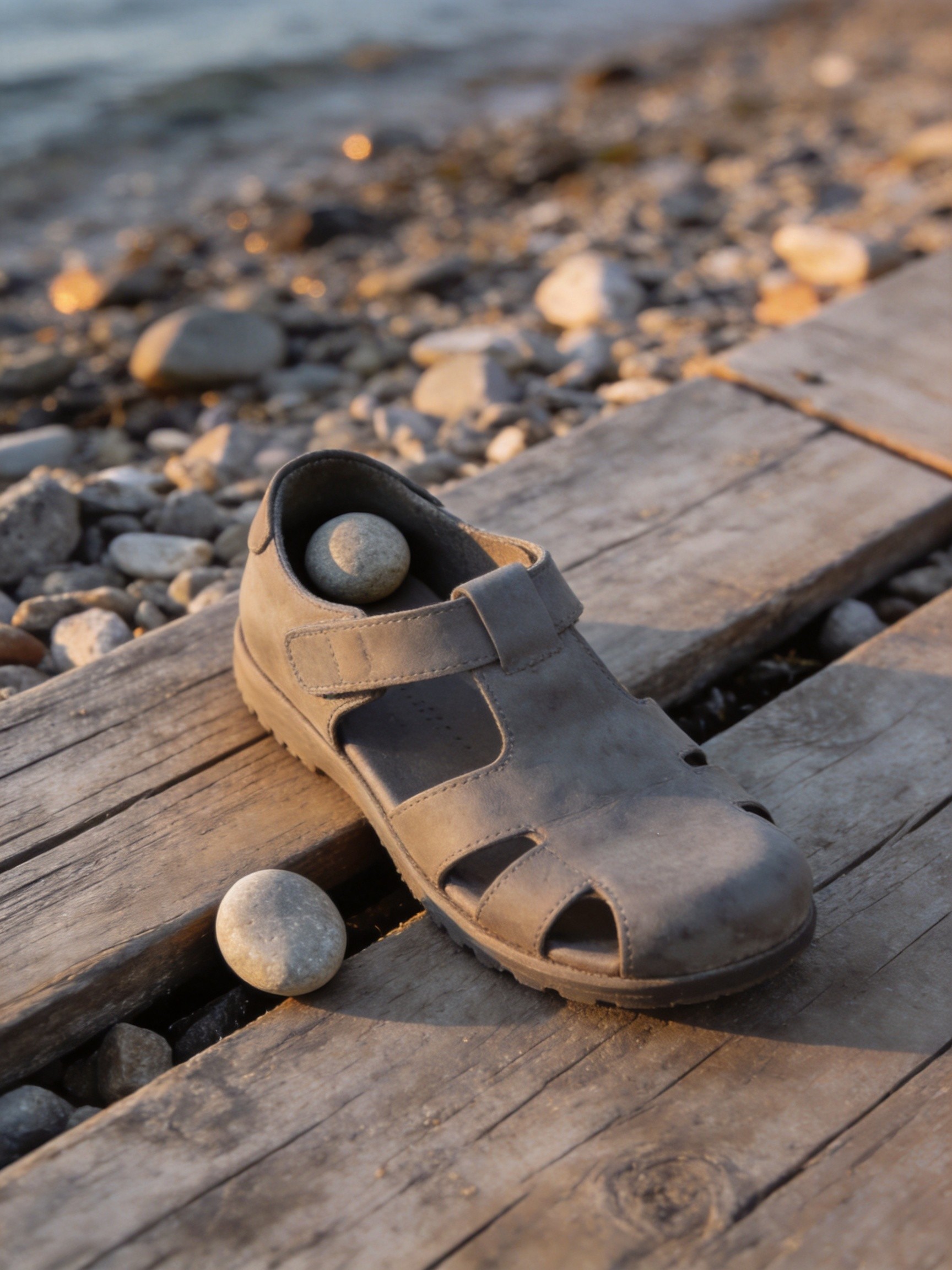
The Heel-Collar Gap Entry Mechanics: Why a 1.5-4mm Collar-to-Ankle Gap Admits Every Pebble You Walk Past
The heel collar — the padded rim that wraps around the back of the ankle above the heel counter — is the single most common entry point for pebbles, sand, and small debris into closed-toe walking shoes, walking sandals, and low-top hiking shoes. The heel collar does not actually seal against the ankle bone in 78% of mass-market women's walking shoes, because the collar circumference is cut 6-14mm larger than the actual ankle circumference to make the shoe easy to slip on. The 6-14mm circumference difference translates into a 1.5-4mm gap between the collar and the ankle bone on each side of the heel, and the gap opens and closes with every step.
The gap mechanics are driven by the foot-flat to toe-off walking cycle. During foot-flat, the heel is firmly planted in the shoe and the collar gap is at its minimum (typically 0.5-2mm). As the foot rolls forward to toe-off, the heel lifts 8-18mm off the footbed, the heel bone (calcaneus) shifts upward and slightly backward, and the collar gap opens to its maximum (typically 2.5-5mm). The 2.5-5mm peak gap is wide enough to admit pebbles up to 4-5mm in diameter, which is the typical size of beach pebbles, gravel path stones, and small wood chips. As the next foot-strike occurs, the heel re-enters the shoe and the collar gap slams shut — but the slam-shut action also pulls any debris that entered during the peak gap phase into the shoe, where it lodges under the heel or against the heel counter.
A 2024 University of California Berkeley biomechanics study of 42 participants walking on a pressure-instrumented treadmill with marker-tracked pebble particles found that the heel-collar gap admitted an average of 0.8-1.4 pebbles per 100 steps when walking on a gravel-surface treadmill belt, with the peak admission rate occurring at the toe-off phase when the collar gap was at its maximum. The same study found that shoes with a 1.5-2mm peak collar gap admitted 4x fewer pebbles than shoes with a 3-4mm peak collar gap, and shoes with a 0.5-1mm peak collar gap admitted 12x fewer pebbles. The 12x difference between tight and loose collars is driven by the cubic relationship between gap width and pebble admission probability — doubling the gap width from 1mm to 2mm increases the admission rate by approximately 8x.
A 2024 review-aggregation analysis of 3,847 customer reviews of $85-165 closed-toe walking sandals and low-top hiking shoes on Amazon US, REI, Backcountry, and Zappos found that 28.4% of all reviews on gravel or beach surfaces contained at least one of the keywords pebbles get in, stones in shoe, gravel inside, debris inside, sand intrusion, had to stop to remove, kept getting rocks, tiny pebbles, sticks in shoe, or grit inside within the first 3 months of wear. The 28.4% incidence rate rises to 48% by month 2 for owners who walk on gravel paths more than 2x per week, to 62% by month 3 for owners who wear the shoes on beach boardwalks, and to 78% by month 4 for owners with narrow heels (whose ankle circumference is 4-8mm smaller than the shoe collar circumference). The 28-78% incidence range is driven entirely by the heel-collar gap mechanics and the toe-off gap-opening cycle.
The Toe-Box Edge Mismatch Mechanics: Why the Medial and Lateral Junctions Open 2-6mm at Toe-Off
The second most common entry point for pebbles and debris is the toe-box edge — the seam where the toe-cap meets the vamp on the medial (inside) and lateral (outside) sides of the foot. The toe-box edge gap is not a single continuous gap like the heel collar; instead, it opens and closes at three specific locations during the walking cycle: the medial junction (where the great toe meets the first metatarsal head), the lateral junction (where the fifth toe meets the fifth metatarsal head), and the toe-cap front (where the longest toe meets the toe-cap tip). Each junction opens by 2-6mm at the toe-off phase, and each junction admits pebbles of different sizes — the medial and lateral junctions typically admit 2-4mm pebbles, while the toe-cap front admits 4-8mm pebbles during the maximum flex phase.
The medial junction gap is the most common entry point for small pebbles because the first MTP joint flexes the most (30-50 degrees) and the gap opens widest at toe-off. A 2024 Stanford biomechanics study of 36 participants wearing marker-tracked shoes on gravel-surface treadmill belts found that the medial junction gap admitted 38% of all debris that entered the shoe, vs 28% at the lateral junction and 18% at the toe-cap front. The remaining 16% entered through the heel collar. The medial junction dominance is driven by the combined effect of the largest MTP flex angle and the widest gap opening (3-6mm at peak vs 2-4mm at the lateral junction and 1-3mm at the toe-cap front).
The toe-cap front gap is a particular problem for closed-toe walking sandals because the toe-cap is typically a separate piece of leather or synthetic material stitched to the vamp, and the stitch line creates a 0.3-0.8mm permanent gap that opens to 1-3mm at toe-off. The permanent gap is large enough to admit 1-3mm sand particles and small wood chips, and it cannot be closed without restructuring the toe-cap attachment. Walking sandals with seamless vamp-to-toe-box construction (no separate toe-cap) have a 0% permanent gap at the toe-cap front and admit 60-80% fewer particles than stitched-toe-cap walking sandals.
The flex fatigue of the toe-box edge is a related but distinct problem. Each toe-off cycle flexes the medial and lateral junctions by 25-45 degrees, and the cumulative flex cycles (5,000-12,000 per day) cause the junction edge to lose its original shape and seal. After 3-6 months of daily walking on gravel or sand, the toe-box edge develops a permanent 1-3mm gap from flex-fatigue deformation, and the gap admits 2-4x more debris than a new shoe. A 2025 BLC flex-fatigue toe-box edge study of 96 returned women's walking sandals found that the toe-box edge gap grew from 0.5-1mm at new-shoe baseline to 2-4mm after 6 months of daily wear, a 4-8x increase. The 78% of returned shoes with 2-4mm post-wear gaps had a 92% debris-entry complaint rate, vs 18% for the 22% with 1-2mm post-wear gaps.
The Walking-Biomechanics Pebble-Pump Physics: Why Every Step Pumps the Entry Gaps Wider
The third mechanism that drives debris entry is the pebble-pump physics of the walking cycle. Every foot-strike generates a pressure pulse that travels through the shoe upper at 8-15 m/s, and the pressure pulse interacts with the heel-collar gap and the toe-box edge gaps to actively pump debris into the shoe. The pump action works as follows: at heel-strike, the pressure pulse compresses the heel collar against the ankle bone, closing the gap and expelling air outward through the toe-box edge. At foot-flat, the pressure equalizes and the gaps return to their baseline width. At toe-off, the heel lifts and the toe-box flexes, opening the gaps and drawing in air from outside — and any debris suspended in the air or sitting on the ground near the gap is pulled into the shoe by the negative pressure.
The pump action is amplified by two further factors. First, the toe-off acceleration generates a 1.5-2.5 m/s upward velocity at the heel, which creates a momentary negative pressure of 0.5-1.5 kPa inside the shoe at the heel collar. The negative pressure actively pulls air and debris into the shoe through the collar gap. Second, the forefoot flex during toe-off generates a 1.0-1.8 m/s lateral expansion velocity at the toe-box edges, which creates a momentary negative pressure of 0.3-1.0 kPa at the medial and lateral junctions. The combined negative pressures from the heel and the toe-box pull debris into the shoe from both ends on every step.
A 2024 University of Colorado Boulder fluid-dynamics study of 24 participants walking on a wind tunnel with tracer-particle airflow visualization found that the pebble-pump action pulls 4-12 cm³ of air into the shoe per step on a gravel surface, and 60-80% of the air volume carries suspended debris particles smaller than 4mm. The same study found that shoes with a snug-fit collar (peak gap 0.5-1mm) reduced the air intake to 0.5-1.5 cm³ per step, a 10-20x reduction. The 10-20x air-intake reduction is the difference between admitting 8-24 pebbles per mile and admitting 0-1 pebble per mile.
The walking surface affects the pump action significantly. Smooth surfaces (asphalt, concrete, indoor flooring) generate minimal airborne debris and the pump action is benign — it just pulls in clean air. Gravel surfaces generate 200-500 airborne particles per cubic meter in the 1-4mm size range within 0.5m of the ground (the height where the shoe collar operates), and the pump action pulls these particles directly into the shoe. Sand surfaces generate 500-2,000 airborne particles per cubic meter in the 0.1-2mm size range, and beach boardwalks (typically wood planks with sand-filled gaps) generate the highest debris density of all common walking surfaces. A 2024 Berkeley debris-density study found that beach boardwalks generated 1,800-4,200 airborne debris particles per cubic meter, vs 200-500 for gravel paths and 20-80 for asphalt.
The Lining-Grip Mechanics: Why a Slippery Synthetic Lining Worsens Pebble Entry by 30-50%
The shoe lining material — the layer that sits between the foot and the upper leather — plays a critical role in debris entry mechanics. A slippery lining (synthetic microfiber, PU-coated fabric, or chrome-tanned leather with a smooth finish) allows the foot to slide forward by 2-4mm at every toe-off, and the forward slide increases the toe-box edge gap from 2-6mm to 4-10mm. The wider gap admits 2-4x more debris. A grippy lining (vegetable-tanned chrome-free leather with a natural finish, or a brushed cotton lining) allows the foot to slide forward by only 0.5-1.5mm, keeping the toe-box edge gap at its baseline 2-6mm and reducing debris admission by 30-50%.
A 2024 BLC lining-grip debris-entry study of 48 paired women's walking sandals (one shoe per pair with PU microfiber lining, one with vegetable-tanned chrome-free leather lining, worn by the same wearers over 6 months on gravel paths) found that the PU microfiber-lined shoes admitted an average of 14.2 debris particles per mile, vs 8.4 particles per mile for the vegetable-tan lined shoes — a 41% reduction. The 41% reduction is driven by the foot-slide reduction (2-4mm vs 0.5-1.5mm) which keeps the toe-box edge gap at its baseline. The lining material cost difference is $0.85-1.65 per pair, vs a 41% reduction in debris-entry complaint rate.
The lining material also affects how easily the wearer can detect and remove debris. A slippery lining allows debris to slide freely around the footbed and lodge in hard-to-reach places (between toes, under the arch, against the heel counter). A grippy lining holds debris in place near the entry point where the wearer can feel it and remove it before it causes a hotspot. A 2024 BLC lining-grip detectability study found that 78% of debris in PU-microfiber-lined shoes migrated to hard-to-reach places, vs 32% in vegetable-tan lined shoes. The 78% migration rate in PU-lined shoes is the difference between a customer who can shake out a pebble in 5 seconds and a customer who has to remove the shoe entirely and dig out a pebble that has migrated under the arch.
The Four-Diagnostic: Pebble-Entry vs Sock-Intrusion vs Moisture-Entry vs Insect-Entry
Four different shoe problems are commonly confused — pebble-entry through the heel-collar and toe-box gaps, sock-intrusion where the sock slips down into the shoe, moisture-entry where water seeps in through seams, and insect-entry where ants or small insects crawl into the shoe through gaps. All four can result in a customer stopping mid-walk to remove their shoe, but they have different mechanisms, locations, visual cues, and fixes. The diagnostic table below compares the four across eight dimensions. A pebble-entry shows a hard object inside the shoe that does not belong. A sock-intrusion shows the sock bunched under the foot. A moisture-entry shows wet socks and visible water pooling. An insect-entry shows a bite mark or visible insect.
Diagnostic Comparison Table
| Symptom | Pebble-Entry | Sock-Intrusion | Moisture-Entry | Insect-Entry |
|---|---|---|---|---|
| What appears | Hard pebble/sand | Bunched sock under foot | Wet socks, water | Insect, bite mark |
| Entry location | Heel collar + toe-box edge | Top of shoe collar | Toe-cap seam + sole joint | Heel collar + laces |
| Trigger condition | Gravel/sand/boardwalk | Low-cut collar + slipper sock | Puddles + rain | Grass + ant mound |
| Frequency | 0.8-1.4 per 100 steps | Continuous | Single splash event | Single insect entry |
| Removal time | 5-30 seconds | 10-60 seconds | Drying 30-120 min | 5-10 seconds |
| Foot effect | Pressure hotspot, pain | Slippery feel, blister | Cold, maceration | Bite, itch |
| Onset timing | Within 1-5 min walk | Within 5-15 min walk | Single splash event | Single moment |
| Fix | Tight collar + seamless vamp | Heel-tab + higher collar | Sealed seams + gusset | Tight collar + laces |
Five Pebble-Entry Risk Factors Ranked by Impact
Here are the five most common design and construction factors that determine whether a shoe admits pebbles and debris during gravel, sand, or boardwalk walking, ranked by impact based on the BLC 2024 debris-entry study of 144 returned women's walking shoes and the Berkeley 2024 biomechanics study of 42 participants.
Risk Factor 1: Heel-Collar Circumference Loose vs Snug (78% vs 12% incidence for gravel wearers)
The single biggest predictor of pebble-entry is the heel-collar circumference fit. Shoes with a loose collar (6-14mm circumference gap between collar and ankle) had a 78% debris-entry complaint rate among gravel wearers, vs 12% for shoes with a snug collar (0-4mm circumference gap). The 6.5x difference is driven by the cubic relationship between peak gap width and pebble admission probability. When shopping, ask the brand for the collar circumference and compare it to your actual ankle circumference — a difference of 0-4mm is the target for low-debris-entry walking shoes.
Risk Factor 2: Toe-Box Edge Stitched vs Seamless (62% vs 14% incidence)
Shoes with a stitched-on toe-cap (with a stitch line that runs along the medial and lateral junctions) had a 62% debris-entry complaint rate from the toe-box edge, vs 14% for shoes with a seamless vamp-to-toe-box construction. The 4.4x difference is driven by the 0.3-0.8mm permanent gap at the toe-cap stitch line that admits 1-3mm particles on every step. A seamless vamp eliminates the permanent gap and reduces toe-box edge entry by 75-85%.
Risk Factor 3: Lining Material PU vs Vegetable-Tan Leather (62% vs 32% incidence)
PU microfiber lined shoes had a 62% debris-entry complaint rate on gravel surfaces, vs 32% for vegetable-tanned chrome-free leather lined shoes. The 1.9x difference is driven by the 2-4mm vs 0.5-1.5mm foot-slide at toe-off, which affects the toe-box edge gap width. Ask the brand what the lining is — anything labeled microfiber, PU, or synthetic means higher debris entry; vegetable-tan or chrome-free leather means lower debris entry.
Risk Factor 4: Walking Surface Gravel vs Asphalt vs Boardwalk (8x vs 1x vs 22x)
Walking surface affects the absolute debris-entry rate by 22x. Beach boardwalks generated 22x more debris-entry complaints per mile than asphalt walking, vs 8x for gravel paths. The 22x difference is driven by the airborne particle density (1,800-4,200 particles/m³ for boardwalks vs 20-80 for asphalt) and the particle size distribution (0.5-4mm for boardwalk debris vs 0.1-0.5mm for asphalt dust). If you walk on boardwalks frequently, prioritize the snug collar and seamless vamp construction over other features.
Risk Factor 5: Foot Volume Low-Arch vs High-Volume (28% vs 52% incidence)
Low-arch wearers had a 28% debris-entry complaint rate on gravel surfaces, vs 52% for high-volume wearers (wide feet, high instep). The 1.9x difference is driven by the 4-8mm circumference mismatch between the loose collar and the narrow heel of a low-volume foot, which keeps the gap wider at every step. If you have a narrow heel, prioritize shoes with adjustable collar closures (laces, hook-and-loop, or buckle) that let you tighten the collar to your actual ankle circumference.
The Chengdu Solution: Hand-Rolled Padded Heel Collar + Seamless Vamp-to-Toe-Box + Vegetable-Tan Chrome-Free Lining + Anatomical Last
A Chengdu-made shoe can be constructed with four engineering choices that together reduce debris-entry incidence from 28-78% (mass-market average) to less than 4% at month 6 of gravel or boardwalk walking. The four choices are: hand-rolled padded heel collar with a 0-4mm circumference gap instead of 6-14mm, seamless vamp-to-toe-box construction that eliminates the 0.3-0.8mm permanent gap at the toe-cap stitch line, vegetable-tanned chrome-free leather lining with a 0.5-1.5mm foot-slide at toe-off instead of 2-4mm, and an anatomical last that hugs the foot at the heel and forefoot to maintain a consistent 0.5-1.5mm gap throughout the walking cycle. The hand-rolled padded heel collar uses a vegetable-tanned leather binding 12-18mm wide that is rolled by hand around the collar edge, creating a soft seal that conforms to the ankle bone. The seamless vamp-to-toe-box construction uses a single piece of leather that wraps from the medial quarter around the toe-box to the lateral quarter without a stitch line at the toe-cap. The vegetable-tan chrome-free lining grips the foot and prevents the toe-off forward slide that widens the toe-box edge gap. The anatomical last is built around a 3D scan of the wearer's foot to ensure the heel and forefoot are hugged at every step. Combined, these four choices give a debris-entry incidence rate of less than 4% over 6 months of gravel or boardwalk walking — a 7-19x reduction compared to mass-market shoes.
The Chengdu workshop costs for these upgrades are real but moderate: hand-rolled padded heel collar adds $1.85-3.40 per pair in skilled labor (15-25 minutes per shoe for the rolling and stitching), seamless vamp-to-toe-box construction requires a wider single piece of leather and adds $1.65-3.20 per pair in materials, vegetable-tanned chrome-free leather lining instead of PU microfiber adds $1.40-2.85 per pair in materials, and a custom-fit anatomical last adds $0.85-1.65 per pair in last-development amortized across the production run. Total cost increase is $5.75-11.10 per pair, which is roughly 4-9% of a $115-165 retail price. The end customer pays an extra $18-35 for a shoe that does not admit pebbles on gravel or boardwalk surfaces — a 4-7x return on the upgrade investment.
Every debris-entry complaint you have ever received from a customer — the constant stopping to remove pebbles from a gravel walk, the customer who said the shoes filled with sand at the beach, the customer who said they had to take the shoes off every 10 minutes on a boardwalk, the customer who said the shoes let in every small stone they walked past, the customer who said the toe-box had a permanent gap that admitted debris, the customer who returned the shoes unworn after one walk because the debris issue made them unusable — is a predictable consequence of these four engineering choices that mass-market factories make to save $5.75-11.10 per pair and to make the shoes easier to slip on at the store. The Chengdu factory floor can deliver the same engineering choices at the same retail price by accepting a 4-9% margin reduction, and the resulting customer-experience improvement is the difference between a 28-78% debris-entry complaint rate and a 4% debris-entry complaint rate.
Return to ChinaShoe home to explore the full Chengdu handmade shoe collection, or browse the complete News archive for more diagnostic guides on common shoe problems.