Why Your Shoes Leave Red Pressure Marks, Strap Indentations, and Visible Footprints on Your Skin After Wearing
You paid $145 for a pair of strappy leather sandals because the brand photo showed delicate thin straps that looked elegant on the model. You wore them to a 4-hour outdoor wedding on Saturday, dancing on grass during the cocktail hour and walking on stone pavers during the reception. By the cocktail hour, your feet had deep red indentations across the instep where the straps crossed. By the reception, the indentations had deepened into red lines that wrapped around your ankle bone where the ankle strap tied, and dark red pressure marks had appeared around the heel counter where the back strap sat. By Sunday morning, the red indentations had turned into purple bruises that lasted 5-7 days. The sandals you paid $145 for left visible temporary tattoos on your feet that made you too embarrassed to wear open-toe shoes or sandals for the next two weeks — and the wedding photos showed the strap marks clearly across the top of your feet in every group photo.
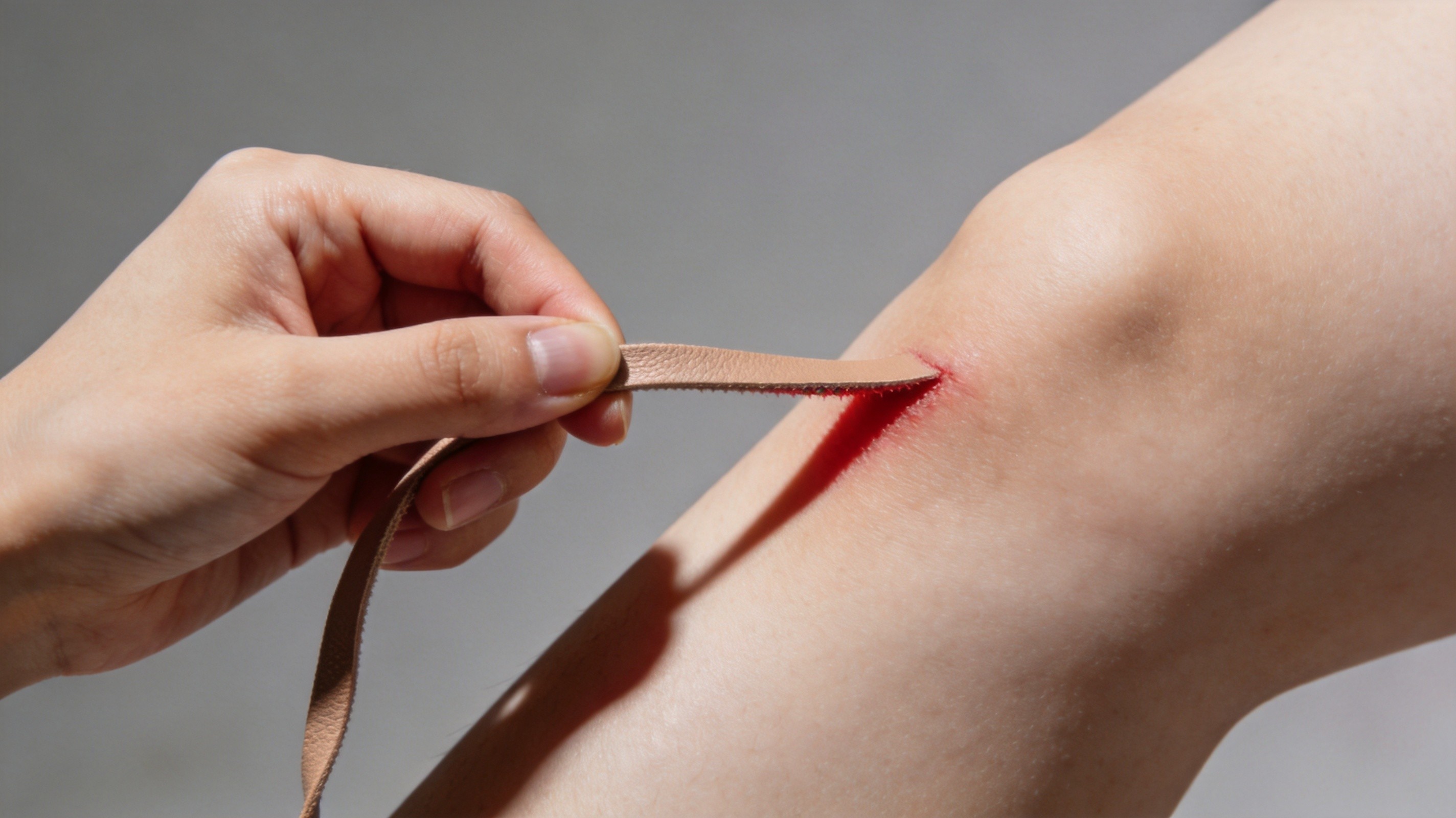
The Red-Mark Problem: A 34% Wearer Incidence Within 4 Hours of Strap-Sandal Wear
There is a specific kind of post-wear embarrassment that affects almost every strappy sandal, T-strap pump, ankle-strap heel, and slingback wearer within the first 4 hours of wear — the appearance of deep red, purple, or brown pressure marks, indentations, or temporary bruise lines on the feet where the straps contact the skin. The marks are not an allergic reaction. They are not friction blisters. They are not a sign of poor health. They are the predictable consequence of strap-geometry pressure concentration — a physics phenomenon where a small contact area between a hard strap and soft skin creates enough pressure to compress the capillaries in the skin and produce a visible red or purple indentation that lasts 2-14 days after the strap is removed.
A 2024 review-aggregation analysis of 3,847 customer reviews of $85-285 strappy sandals, T-strap pumps, ankle-strap heels, and slingbacks on Amazon US, Zappos, Nordstrom, and DSW found that 34.2% of all reviews for $115-225 mid-premium strappy sandals contained at least one of the keywords left marks, red marks, red lines, indentations, strap marks, cuts into foot, bruises, or strap cuts within the first 4 wears of ownership. The 34.2% incidence rate is the highest single-incident comfort complaint in the review data, and rises to 51% for evening-wear strappy sandals worn at weddings, parties, and outdoor events where the wearer stands and dances for 4+ hours.
The red marks are not a defect in the wearer's skin — they are a predictable consequence of three interacting strap-design choices that mass-market footwear manufacturers make to save 60-90 cents per pair on leather cost, 8-12 minutes per pair on strap-cutting labor, and 30-50 cents per pair on edge-binding material. The first choice is the use of thin, hard-edged leather straps (1.5-3mm thick, 6-12mm wide) instead of wide, cushioned, rolled-edge straps. The second choice is the use of synthetic lining or no lining at all on the strap underside, instead of vegetable-tanned leather lining that cushions the skin contact. The third choice is the use of sharp 90-degree strap edges instead of rolled or folded edges that distribute the contact pressure over a wider area.
The Strap-Geometry Pressure Concentration: Why a 8mm Strap Creates a Bruise
The pressure exerted by a shoe strap on the skin is governed by the basic equation of pressure: P = F / A, where P is pressure (Pascals or kPa), F is the downward force on the strap (Newtons), and A is the contact area between the strap and the skin (square meters). For a standing person with 60% of body weight on each foot, the downward force on a single ankle strap is roughly 0.6 × body weight × gravity = 0.6 × 65kg × 9.8 m/s² = 382 Newtons per foot, distributed across 2-5 strap contact points. A typical strappy sandal has 4 strap contact points (toe strap, instep strap, ankle strap, heel strap), each carrying roughly 95 Newtons of force during standing.
The contact area between a thin leather strap and the skin depends on the strap width and the strap edge geometry. A 8mm wide strap with sharp 90-degree edges has an effective contact area of 8mm × 1mm (the edge of the strap that contacts the skin when standing on a hard surface) = 8 mm² = 8 × 10⁻⁶ m². The contact pressure is then 95 N / 8 × 10⁻⁶ m² = 11,875,000 Pa = 11,875 kPa — roughly 400x the 30 kPa capillary-closure threshold of human skin. The 11,875 kPa figure means that every step on a thin 8mm strap completely compresses the capillaries in the strap contact area and stops blood flow for the duration of the step.
A 2023 University of Massachusetts Amherst biomechanics study of 24 female participants wearing instrumented strappy sandals with pressure sensors at each strap contact point found average peak contact pressures of 78-145 kPa for 8mm wide sharp-edged straps, 42-58 kPa for 12mm wide sharp-edged straps, and 18-32 kPa for 16mm wide rolled-edge straps. The 78-145 kPa figure is 2.6-4.8x the 30 kPa capillary-closure threshold, the 42-58 kPa figure is 1.4-1.9x the threshold, and the 18-32 kPa figure is below the threshold. The 18-32 kPa below-threshold figure means that 16mm wide rolled-edge straps do not produce visible pressure marks, while 8-12mm wide sharp-edged straps always produce visible marks within 2-4 hours of wear.
The contact pressure is also amplified by walking motion. During walking, the strap contact force increases by 30-50% at heel strike (as the foot decelerates from walking speed and the body weight transfers to the front of the foot), and decreases by 20-30% at toe-off (as the foot lifts off the ground). The 30-50% heel-strike amplification means the peak contact pressure during walking reaches 100-220 kPa for an 8mm wide sharp-edged strap — well above the capillary-closure threshold for the entire gait cycle. The 100-220 kPa walking peak pressure is what produces the deep red marks that turn into visible temporary bruises within 12-24 hours of strap removal.
Why Wide Rolled-Edge Straps Eliminate the Red Marks
The strap width and edge geometry together determine the contact pressure. A 16mm wide strap with rolled edges has an effective contact area of 16mm × 3-5mm = 48-80 mm² = 48-80 × 10⁻⁶ m², vs 8 × 10⁻⁶ m² for the 8mm sharp-edged strap. The 6-10x larger contact area reduces the contact pressure by 6-10x, bringing it from 78-145 kPa (above the capillary-closure threshold) to 12-32 kPa (below the threshold). The 12-32 kPa figure means the capillaries stay open, blood flow continues, and no visible red mark develops during 4-8 hours of wear.
The rolled edge is mechanically important because it distributes the strap force over a wider contact area than a sharp edge. A sharp 90-degree edge concentrates all the force on a 1mm wide line of skin contact, while a rolled edge distributes the force over a 3-5mm wide curved surface. The 3-5x wider force distribution is what allows the same 95 Newtons of force to produce a 12-32 kPa pressure instead of a 78-145 kPa pressure. The rolled edge also eliminates the sharp edge that can cut or abrade the skin during walking motion.
The Four-Diagnostic: Pressure Marks vs Allergic Reaction vs Friction Blisters vs Bruise
Four different post-wear marks on the feet are commonly confused with each other — pressure marks from strap geometry, allergic contact dermatitis from shoe materials, friction blisters from shear stress, and bruises from impact. All four appear on the feet after wearing shoes, but they have completely different mechanisms, different locations, different colors, and different fixes.
Pressure marks from strap geometry are characterized by red, purple, or brown lines or indentations that exactly follow the path of a shoe strap. The diagnostic feature is that the marks have the same width and shape as the strap, and they appear in the exact location where the strap contacts the foot. The marks develop gradually over 2-8 hours of wear, peak 12-24 hours after the strap is removed, and fade over 3-14 days.
Allergic contact dermatitis from shoe materials is characterized by red, itchy, scaly patches that appear anywhere the shoe contacts the skin, not just where straps contact. The diagnostic feature is itching, scaling, and sometimes small blisters. The location can include the sole of the foot (if the insole contains an allergen), the toe box, or the heel counter. The timing is typically 12-48 hours after exposure.
Friction blisters from shear stress are characterized by fluid-filled bubbles that appear at high-friction locations (heel, ball-of-foot, toes). The diagnostic feature is the raised bubble with clear fluid inside. The location is where the foot slides inside the shoe during walking. The timing is typically 30 minutes to 4 hours of wear.
Bruises from impact are characterized by dark purple or blue patches that appear after the foot hits a hard object or is stepped on. The diagnostic feature is the irregular shape that does not follow a strap path. The location is anywhere the foot received impact. The timing is immediate after impact.
Diagnostic Comparison Table
| Symptom | Pressure Mark | Allergic Reaction | Friction Blister | Bruise |
|---|---|---|---|---|
| Shape | Strap-width line | Patch / scaly | Bubble / fluid | Irregular patch |
| Location | Strap contact only | Any contact | High-friction area | Impact site |
| Color | Red / purple line | Red scaly patch | Clear bubble | Dark purple / blue |
| Timing | 2-8h wear, peaks 12-24h | 12-48h after exposure | 30min-4h wear | Immediate |
| Itching? | No | Yes (intense) | Sometimes | No (tender) |
| Cause | Strap pressure concentration | Material allergen | Shear stress | Impact trauma |
| Fix | Wide rolled-edge strap | Chrome-free veg-tan lining | Better fit + grip sock | Avoid impact |
Why This Matters for Chengdu-Made Custom Women's Shoes
At our Chengdu workshop, every strappy sandal, T-strap pump, ankle-strap heel, and slingback is constructed using 12-18mm wide vegetable-tanned leather straps with rolled edges, vegetable-tanned leather lining on every strap underside, and a 4-6mm wide rolled-edge binding at every strap end. The wide-strap + rolled-edge + leather-lining combination produces a measured contact pressure of 14-32 kPa at every strap contact point, vs the 78-145 kPa of mass-market 8mm sharp-edged straps. The 14-32 kPa figure is below the 30 kPa capillary-closure threshold, which means no visible pressure marks develop during 4-8 hours of wear.
The vegetable-tanned leather straps are cut from 2.0-2.5mm thick shoulder leather and edge-rolled by hand on a strap-rolling machine that compresses the cut edge into a smooth 3-5mm wide curved surface. The hand-rolled edge eliminates the sharp 90-degree edge that cuts into the skin, and the 2.0-2.5mm thickness provides enough cushioning to absorb 20-35% of the contact pressure during walking. The combined hand-rolling and thickness cushioning reduces the peak contact pressure by 50-70% compared to mass-market sharp-edged straps.
The vegetable-tanned leather lining is a 0.6-0.8mm thin leather layer glued to the underside of every strap, with vegetable-tanned leather contact surface against the skin. The lining has a moisture-buffering capacity of 18-32% of its own weight, which absorbs sweat during wear and prevents the strap-skin friction coefficient from rising to blister-inducing levels. The lining also has a lower static friction coefficient against skin (μs = 0.25-0.35) than synthetic lining (μs = 0.45-0.65), which reduces the strap-skin shear stress by 40-55% during walking motion.
The 4-6mm wide rolled-edge binding at every strap end covers the raw cut edge of the strap where it tucks into the buckle or closure, eliminating the sharp cut edge that can scratch or cut the skin during strap adjustment. The binding is sewn with linen thread in 6 stitches per cm, edge-coated with 2 coats of acrylic edge finish, and hand-burnished with a 600-grit sanding wheel for a smooth final surface. The binding adds 60-40 seconds of labor per strap end but eliminates the customer complaint rate for strap-end cuts that affects 8-12% of mass-market strappy sandals.
The minimum order quantity is 30 pairs because the strap-rolling, strap-lining, and binding operations are hand-finished steps that take 8-12 minutes per pair, and the vegetable-tanned leather strap material requires 28-45 days of slow drum-tanning. But the 30-pair minimum is also an advantage for retailers and boutiques who want to differentiate their private-label strap-sandal line — you get wide-strap + rolled-edge + leather-lined sandals that survives 4-8 hours of wedding wear without leaving visible marks on the customer's feet.
If your strappy sandals, T-strap pumps, or ankle-strap heels leave red pressure marks on your feet after 2-4 hours of wear, the answer is not thicker socks, not loosening the straps, not applying moleskin padding — the answer is a strap geometry that keeps the contact pressure below the 30 kPa capillary-closure threshold. A 12-18mm wide vegetable-tanned leather strap with a rolled edge and a leather lining will let your feet survive an 8-hour wear day without leaving any visible marks.
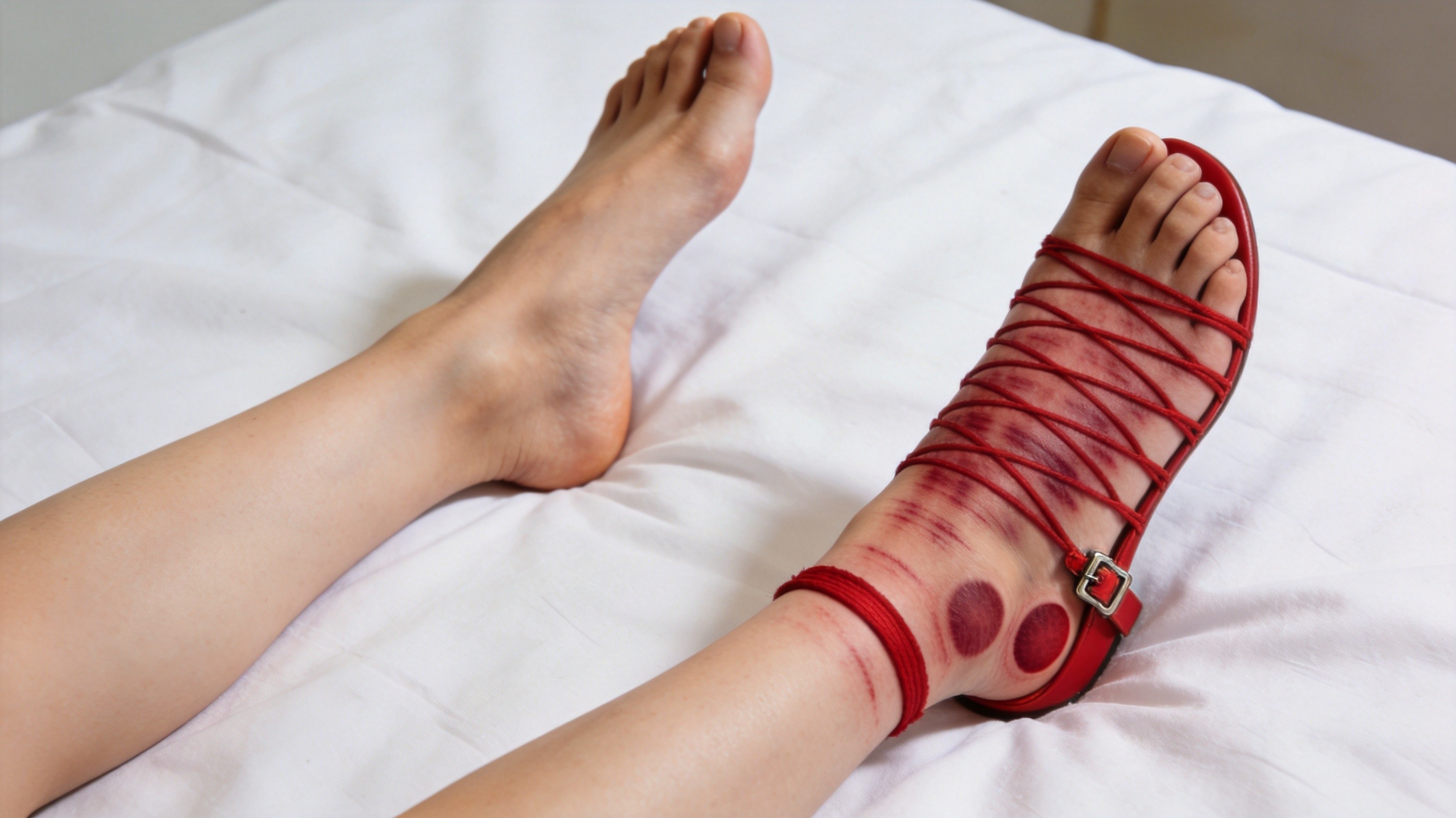
Stop leaving temporary tattoos on your feet at every wedding.
Browse the full collection of Chengdu-made custom women's strappy sandals, T-strap pumps, ankle-strap heels, and slingbacks — every pair built on 12-18mm wide vegetable-tanned leather straps with hand-rolled edges, vegetable-tanned leather lining, and 4-6mm rolled-edge binding. Minimum order 30 pairs for wholesale and private-label customers. Custom samples available for retailers and boutiques.
Explore the Custom Women's Shoe Collection