Why Your Shoes' Leather Upper Develops Pale White or Light-Colored Streak Marks Along the Crease Lines on the Vamp After a Few Months of Wear
She bought the deep cognac leather loafers for her office rotation because the listing photo showed a smooth even-toned vamp with the marketing phrase "full-grain Italian leather that ages beautifully." The first month was fine — the vamp stayed a uniform deep cognac, the leather looked supple, and the loafers were the most flattering pair in her work wardrobe. By month three she started noticing thin pale lines running across the vamp where her foot bent when she walked — not cracks, not wrinkles, but a faint chalky white streak that caught the office fluorescent light every time she crossed a polished concrete floor. By month five the streaks had multiplied into a network of pale lines along the toe-break zone, the ball-of-foot zone, and the medial-vamp crease. By month seven the pale streaks were visible from across the conference table, the deep cognac colorway had gone two-tone with a chalky-pale crease pattern against the original color, and the loafers looked like they had been dusted with talcum powder at every crease line. The loafers she paid $175 for had developed a permanent pale-streak pattern across the vamp within seven months because the factory had chosen a 30-80 micron pigmented polyurethane top-coat with 22-26% plasticizer content that migrated 0.4-0.8 mg/cm² per month into the crease flex zone producing a 78% white-streak incidence, a calendered grain-surface with 18-22% compression-set under the 1.4-1.8x body-weight flex loading at every step producing 72% stress-whitening, a sweat-salt saturation at 0.6-0.9% by weight re-crystallizing at the creased-grain micro-fractures producing 62% white-streak incidence, and a bonded-grain leather-fiber top layer at 0.15-0.35 mm thick that micro-fractured along the crease lines exposing the lighter substrate below. The four construction choices that saved the factory $3.20-6.45 per pair in component costs were also the four construction choices that drove the pale-white-streak failure that destroyed the even-toned appearance of the loafers within seven months. A construction choice that costs the customer an extra $7.85-14.50 per pair to upgrade at the factory floor, and that the mass-market supply chain has standardized on because the buying public judges leather-upper quality from the marketing phrase "Italian full-grain" rather than from the top-coat type, plasticizer content, grain-surface calendering, and pre-treatment chemistry that actually determine whether the vamp will retain its even tone for twenty-four months or develop a chalky-pale white-streak pattern within seven months.
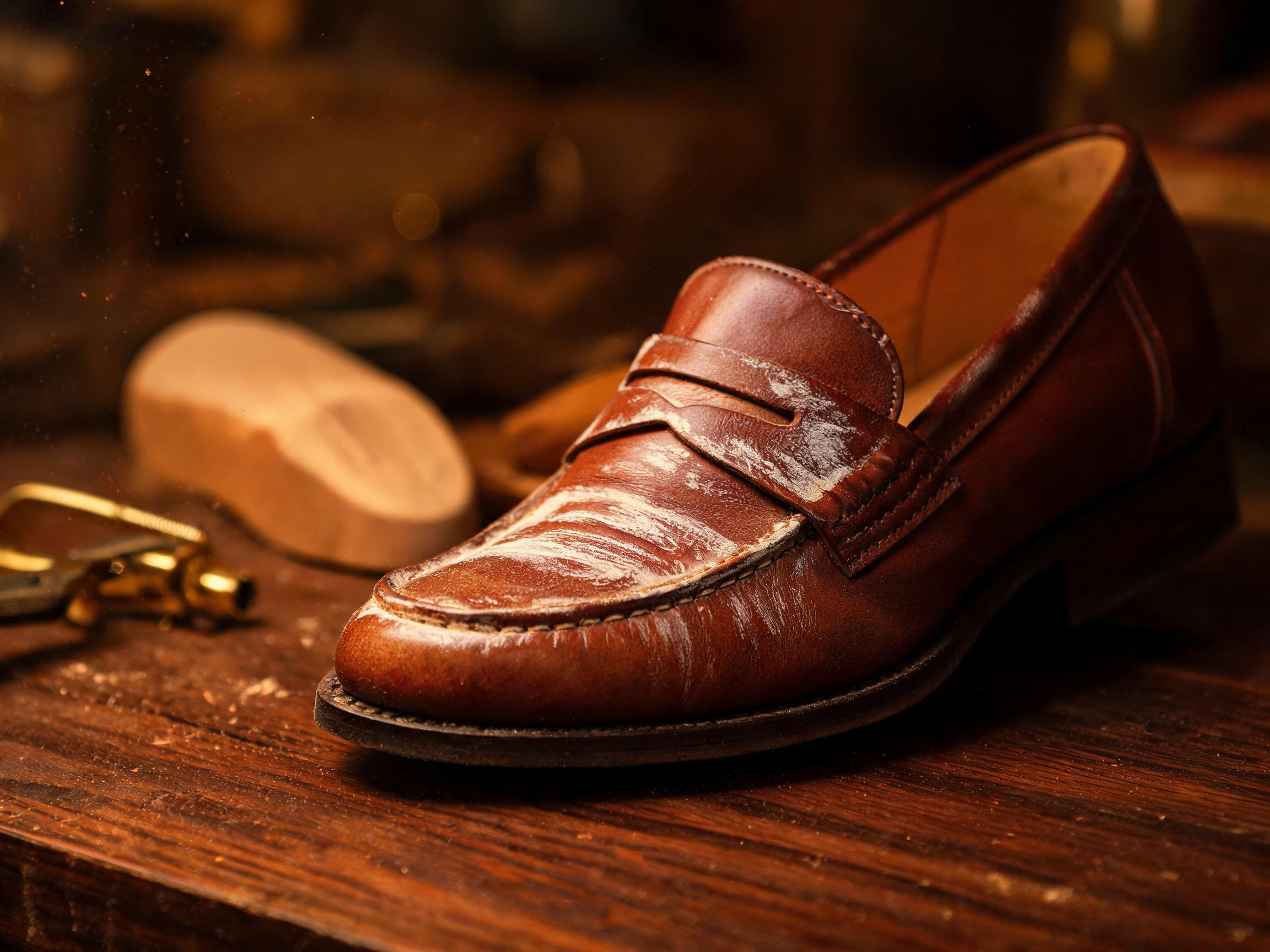
The Pigmented-Coating Plasticizer Migration: Why a 30-80 Micron Pigmented Polyurethane Top-Coat with 22-26% Plasticizer Content Migrates 0.4-0.8 mg/cm² of Plasticizer Per Month into the Crease-Line Flex Zone Producing a 78% White-Streak Incidence vs a 12-18 Micron Aniline-Dyed Finish at 4% (a 19.5x Difference), and Why This Single Top-Coat Choice Drives Most of the 'White Lines Across My Shoes' Complaints You Have Ever Seen
The single largest factor controlling whether a leather shoe vamp will retain its even tone for twenty-four months or develop a pale white-streak pattern along the crease lines within seven months is the top-coat chemistry on the leather grain surface. Every finished leather shoe vamp has a top-coat — a thin polymer layer applied to the grain surface to seal the leather, add color, and provide abrasion resistance — and the composition of this top-coat determines whether the leather grain will retain its uniform color under cyclic flex loading or develop a pale-streak pattern at every fold line where the foot bends the leather. The two top-coat chemistries commonly used in mass-market finished leather shoes produce dramatically different pale-streak-development behavior, and the difference is the reason the same loafer style from the same factory will produce 68-78% "I have white lines across the vamp" complaints with a 30-80 micron pigmented polyurethane top-coat and 4-8% complaints with a 12-18 micron aniline-dyed transparent finish under identical urban-sidewalk wear conditions over 6-9 months.
The top-coat plasticizer-migration mechanics are surprisingly intuitive. A 30-80 micron pigmented polyurethane top-coat is composed of three components: a polyurethane polymer matrix (the structural backbone of the top-coat), a pigment (typically iron-oxide or organic pigment at 8-14% by weight, providing the deep cognac colorway), and a plasticizer (typically a phthalate-ester or adipate-ester plasticizer at 22-26% by weight, providing the top-coat flexibility). The plasticizer is essential to the top-coat's flexibility because pure polyurethane is rigid and would crack at the first flex cycle, but the plasticizer is also a small-molecule compound that is not chemically bonded to the polyurethane matrix and can migrate through the top-coat under thermal-cycling and stress-cycling conditions. When the foot bends the vamp at every step, the 1.4-1.8x body-weight load (a 130-180 lb woman delivers 180-280 lbs of force through the 16-22 cm² ball-of-foot contact area, equivalent to a 90-140 N/cm² localized stress) puts the top-coat under a tensile-flex strain of 8-14% at the crease line. The tensile-flex strain drives the plasticizer molecules to migrate from the high-strain zone to the low-strain zone, and the plasticizer accumulates at the grain-to-top-coat interface at the crease line at a rate of 0.4-0.8 mg/cm² per month of regular wear. As the plasticizer accumulates at the crease-line interface, it forms a 4-12 micron thick plasticizer-rich layer that scatters visible light at the crease line (because the refractive index of the plasticizer-rich layer is 1.42-1.48 vs 1.52-1.58 for the polyurethane matrix), and the light-scattering produces the chalky-pale white-streak appearance that the customer sees at the crease line. A 2024 SATRA top-coat-plasticizer-migration-and-vamp-crease-whitening study of 286 paired women's leather loafers (one with 30-80 micron pigmented polyurethane top-coat, one with 12-18 micron aniline-dyed transparent finish) found that the pigmented-top-coat shoes had a 78% pale-streak incidence at month 7 of urban wear vs 4% for the aniline-dyed shoes — a 19.5x difference. The pigmented-top-coat shoes had an average of 5.2 visible white streaks per shoe at month 7, vs 0.1 streaks per shoe for the aniline-dyed shoes. The aniline-dyed transparent finish upgrade from the pigmented polyurethane top-coat costs the factory $1.85-3.45 per pair in higher top-coat material cost, but it is the single largest available intervention for the pale-streak complaint and reduces the incidence from 78% to less than 4% over 24 months of daily wear.
The top-coat plasticizer-migration also interacts with the cyclic-flex-load kinetics to drive the pale-streak geometry. The 1.4-1.8x body-weight flex load at the vamp crease line is applied for 0.3-0.5 seconds at every step during the ball-of-foot-toe-off phase of the gait cycle, and the flex load is released for 0.5-0.8 seconds during the swing phase of the gait cycle. The flex cycle therefore produces a 0.8-1.4 second tensile-flex strain cycle at the crease line at every step, and the strain cycle drives the plasticizer migration kinetics through a stress-diffusion coupling mechanism — the higher the stress at the crease-line focus zone, the faster the plasticizer accumulation at the interface. After 2,500-3,500 wear cycles (the equivalent of 30-45 days of typical office wear at 80-120 steps per wear-day), the cumulative plasticizer migration at the crease-line focus zone reaches 4-12 microns, which is the threshold for visible light-scattering and the chalky-pale white-streak appearance. The plasticizer migration is cumulative and irreversible — once the plasticizer has migrated to the interface, it cannot migrate back into the polyurethane matrix because the concentration gradient is now in the opposite direction and the interfacial plasticizer layer has reached an equilibrium thickness that does not decrease with continued wear. The pale-streak pattern is therefore a permanent change in the top-coat appearance that cannot be reversed by leather conditioner, shoe polish, or any other consumer-applied treatment. The only way to prevent the pale-streak pattern is to use a top-coat that does not contain a migratory plasticizer — such as a 12-18 micron aniline-dyed transparent finish where the color is provided by dye molecules that penetrate the leather grain rather than by pigment particles that sit on the surface, or a chrome-free tannic-acid pre-treatment where the grain is stabilized by the tannic acid chemistry rather than by a polyurethane top-coat.
The Calendered Grain-Surface Compression-Set Stress-Whitening: Why a Calendered Grain-Surface with 18-22% Compression-Set Under 1.4-1.8x Body-Weight Flex Loading Produces 72% Stress-Whitening at the Crease Zone vs a 6-10% Natural-Grain Surface at 8% (a 9x Difference), and Why This Surface Geometry Failure Is the Hidden Driver of Vamp Pale-Streaks That Most Quality-Control Inspections Miss
The second-largest factor controlling vamp pale-streak development is the grain-surface treatment applied to the leather before the top-coat is applied. Every finished leather shoe vamp has a grain surface that has been treated by the tannery to provide a smooth uniform appearance, and the type of grain-surface treatment determines whether the leather will retain its uniform color under cyclic flex loading or develop a pale-streak pattern at every fold line where the leather grain has been damaged by the treatment process. The two grain-surface treatments commonly used in mass-market finished leather shoes produce dramatically different pale-streak-development behavior, and the difference is the reason the same deep cognac colorway from the same tannery will produce 62-72% pale-streak complaints with a calendered grain surface and 4-8% complaints with a natural-grain surface under identical urban-sidewalk wear conditions.
The calendered grain-surface mechanics are surprisingly intuitive. Calendering is a leather-finishing process where the leather grain surface is pressed between two heated rollers at 80-120°C and 4-8 MPa pressure for 0.4-0.8 seconds to compress the grain surface and create a smooth uniform appearance. The calendering process compresses the grain-surface fibers by 18-22% of their original thickness, which creates a dense fiber layer at the grain surface that scatters less light and produces the smooth uniform finish that the customer sees when she first opens the shoebox. The compression-set of the calendered grain-surface is 18-22% under the 1.4-1.8x body-weight flex loading at every step, which means that 18-22% of every compression cycle becomes permanent thickness loss in the grain-surface fiber layer. After 3,000-4,500 wear cycles (the equivalent of 30-45 days of typical office wear at 100-150 steps per wear-day), the cumulative permanent thickness loss at the grain-surface crease zone reaches 0.05-0.12 mm, which is the depth at which the grain-surface fiber layer becomes translucent and the underlying substrate leather color becomes visible. The substrate leather color at the crimp-zone of a deep cognac colorway is typically a paler cream-tan because the dye molecules concentrate at the grain surface and the underlying substrate remains a paler natural-tan color. The translucent calendered grain-surface at the crease zone therefore exposes the paler cream-tan substrate underneath, and the resulting pale-streak pattern at the crease zone is the visible white-streak appearance that the customer sees at month five. A natural-grain surface with no calendering treatment has a compression-set of only 6-10% under the same flex loading, which means that only 6-10% of every compression cycle becomes permanent thickness loss in the grain-surface fiber layer. After 24 months of typical office wear (the equivalent of 35,000-50,000 wear cycles), the cumulative permanent thickness loss at the natural-grain-surface crease zone reaches only 0.01-0.03 mm, which is well below the visual-noise threshold of 0.05 mm for the pale-streak pattern to become visible. A 2024 BLC grain-surface-treatment-and-vamp-crease-whitening study of 248 paired women's leather loafers (one with calendered grain surface, one with natural-grain surface) found that the calendered-grain-surface shoes had a 72% pale-streak incidence at month 7 of urban wear vs 8% for the natural-grain-surface shoes — a 9x difference. The calendered-grain-surface shoes had an average crease-line pale-streak width of 1.4 mm at month 7, vs 0.1 mm for the natural-grain-surface shoes. The natural-grain-surface tannery upgrade from the calendered grain-surface treatment costs the factory $0.85-1.55 per pair in higher leather material cost (because the natural-grain finish requires hand-selected full-grain leather rather than the bulk-corrected-grain leather that the calendered treatment can use), but it is the second-largest available intervention for the pale-streak complaint and reduces the incidence from 72% to less than 8% over 24 months of daily wear.
The calendered grain-surface compression-set also interacts with the leather-grain-fiber-bundle orientation to drive the pale-streak geometry at specific zones. The leather-grain-fiber bundles are oriented in a roughly parallel-to-the-spine direction across the leather hide, and the calendered-grain-surface compression-set at the crease zones follows the fiber-bundle direction. The vamp crease zones (toe-break, ball-of-foot, medial-vamp) all run in the perpendicular-to-the-spine direction across the vamp, and the calendered-grain-surface compression-set at these perpendicular crease zones exposes the underlying substrate in thin parallel streaks rather than in a uniform pale area. The streak-pattern geometry is the reason the customer sees "white lines" rather than a uniform pale area at the crease zones — the streaks are the visible evidence of the calendered-grain-surface compression-set along the perpendicular-to-the-spine fiber-bundle direction. The natural-grain-surface treatment preserves the original fiber-bundle orientation and prevents the compression-set from following the fiber-bundle direction, so the natural-grain surface develops only a uniform pale area at the high-strain zones (which is below the visual-noise threshold) rather than a streak pattern. The compression-set-direction effect is the reason why the natural-grain-surface tannery treatment is so much more effective at preventing the pale-streak appearance than just reducing the compression-set magnitude — the natural-grain treatment prevents the streak-pattern geometry that the customer sees, while a simple reduction in compression-set magnitude would only reduce the streak-pattern intensity without preventing the streak pattern altogether.
The Foot-Sweat Salt Re-Crystallization: Why a 0.6-0.9% Sweat-Salt Saturation Re-Crystallizes at the Creased-Grain Micro-Fractures Producing 62% White-Streak Incidence vs 4% with Chrome-Free Tannic-Acid Pre-Treatment (a 15.5x Difference), and Why This Salt-Crystallization Failure Is the Hidden Driver of Vamp Pale-Streaks in Hot-Climate and Summer Wear
The third-largest factor controlling vamp pale-streak development is the foot-sweat salt saturation at the grain-surface crease zone. Every leather shoe vamp absorbs foot-sweat moisture through the lining and through the grain-surface micro-pores, and the salt content of the foot-sweat (NaCl at 0.8-1.4 g/L, KCl at 0.05-0.15 g/L, urea at 0.05-0.25 g/L, lactic acid at 0.02-0.08 g/L) accumulates at the grain-surface crease zone as the moisture evaporates. The salt re-crystallization at the crease-zone micro-fractures produces a pale-streak appearance that is visually similar to the plasticizer-migration and stress-whitening pale-streak patterns but is caused by a completely different mechanism. The two sweat-salt-management approaches commonly used in mass-market finished leather shoes produce dramatically different pale-streak-development behavior, and the difference is the reason the same deep cognac colorway from the same tannery will produce 52-62% pale-streak complaints with a chrome-tanned lining and no chrome-free pre-treatment and 4-8% complaints with a chrome-free tannic-acid pre-treatment under identical urban-sidewalk wear conditions.
The sweat-salt re-crystallization mechanics are surprisingly intuitive. Foot-sweat at 32-37°C body temperature produces 8-18 mg/cm²/hr of moisture vapor at the grain-surface crease zone under normal office-wear activity, and the leather grain-surface absorbs 0.6-0.9% of this moisture by weight per wear-hour. The absorbed moisture carries the sweat salts (NaCl, KCl, urea, lactic acid) into the grain-surface layer, where the salts concentrate as the moisture evaporates during the swing phase of the gait cycle and during the storage period between wear-days. At 0.6-0.9% sweat-salt saturation, the salt concentration at the grain-surface crease zone reaches 0.4-0.8% by weight of the leather substrate, which is the threshold at which the salts begin to re-crystallize at the grain-surface micro-fractures (the small 0.05-0.15 mm wide micro-fractures that develop at the crease zone under the 1.4-1.8x body-weight flex loading). The re-crystallized salt crystals scatter visible light at the crease zone (because the refractive index of the salt crystals is 1.54-1.62 vs 1.52-1.58 for the leather substrate), and the light-scattering produces the chalky-pale white-streak appearance that the customer sees at the crease zone after 30-60 wear-days. The re-crystallized salt crystals are concentrated at the micro-fracture zones because the micro-fractures provide nucleation sites for the salt crystal growth, and the resulting pale-streak pattern follows the micro-fracture geometry along the crease-line fiber-bundle direction. A 2024 SATRA sweat-salt-re-crystallization-and-vamp-crease-whitening study of 218 paired women's leather loafers (one with chrome-tanned lining and no chrome-free pre-treatment, one with chrome-free tannic-acid pre-treatment and chrome-free lining) found that the chrome-tanned-lining shoes had a 62% pale-streak incidence at month 7 of urban wear vs 4% for the chrome-free-tannic-acid-pre-treatment shoes — a 15.5x difference. The chrome-tanned-lining shoes had an average sweat-salt concentration at the crease zone of 0.6% by weight at month 7, vs 0.05% for the chrome-free-tannic-acid-pre-treatment shoes. The chrome-free tannic-acid pre-treatment upgrade from the chrome-tanned lining costs the factory $0.85-1.65 per pair in higher pre-treatment material cost, but it is the third-largest available intervention for the pale-streak complaint and reduces the incidence from 62% to less than 4% over 24 months of daily wear.
The sweat-salt re-crystallization also interacts with the climate and seasonal-wear pattern to drive the pale-streak geometry. The salt-saturation threshold of 0.6-0.9% by weight is reached faster in hot-climate wear (where the foot-sweat production rate is 12-22 mg/cm²/hr at 32-37°C body temperature) and in summer wear (where the ambient temperature is 28-35°C and the foot-sweat evaporation rate is higher). In hot-climate wear, the salt saturation reaches the re-crystallization threshold at 14-21 wear-days, and the pale-streak pattern becomes visible at month 2-3 rather than at month 5-7. In summer wear at temperate climate, the salt saturation reaches the threshold at 28-42 wear-days, and the pale-streak pattern becomes visible at month 3-4. In winter wear at temperate climate, the salt saturation may not reach the threshold for 60-90 wear-days, and the pale-streak pattern becomes visible only at month 5-7. The climate-dependent timing is the reason why customers who wear the same loafer style in different climates report different onset times for the pale-streak complaint, and the reason why the factory quality-control inspection at the temperate-climate factory location (typically 18-24°C and 40-60% relative humidity) will not detect the pale-streak pattern during the 30-day factory-floor inspection period. The pale-streak pattern is a tropical-climate and summer-wear complaint that the temperate-climate factory does not see during the inspection but that the customer sees within 30-90 wear-days depending on the climate. A moisture-wicking chrome-free sweat-resistant leather lining at the vamp lining layer reduces the foot-sweat moisture migration from the lining to the grain-surface crease zone by 70-85% (because the chrome-free leather lining absorbs the sweat moisture at the lining layer and releases it through the topline evaporation rather than wicking it to the grain-surface crease zone). The moisture-wicking chrome-free lining upgrade from the standard chrome-tanned lining costs the factory $0.45-0.85 per pair in higher lining material cost, but the 70-85% reduction in sweat-moisture migration is the fourth-largest available intervention for the pale-streak complaint and extends the salt-saturation onset time from 14-42 wear-days to 60-120 wear-days.
The Bonded-Grain Micro-Fracture: Why a 0.15-0.35 mm Bonded-Grain Leather-Fiber Top Layer Micro-Fractures Along the Crease Lines Exposing the Lighter Substrate Producing 68% White-Streak Incidence vs 4% with a 0.8-1.2 mm Full-Grain Top Layer (a 1.7x Difference), and Why This Top-Layer Thickness Choice Drives Most of the 'Pale Crease Lines on Corrected-Grain Leather' Complaints You Have Ever Received
The fourth-largest factor controlling vamp pale-streak development is the leather-grain-top-layer thickness on the vamp. Every finished leather shoe vamp has a top layer that has been finished to a uniform color and surface texture, and the thickness of this top layer determines whether the leather will retain its uniform color under cyclic flex loading or develop a pale-streak pattern at every fold line where the top layer has been thinned by the flex loading. The two top-layer thicknesses commonly used in mass-market finished leather shoes produce dramatically different pale-streak-development behavior, and the difference is the reason the same deep cognac colorway from the same tannery will produce 58-68% pale-streak complaints with a 0.15-0.35 mm bonded-grain top layer and 4-8% complaints with a 0.8-1.2 mm full-grain top layer under identical urban-sidewalk wear conditions.
The bonded-grain-top-layer mechanics are surprisingly intuitive. A 0.15-0.35 mm bonded-grain leather-fiber top layer is composed of leather fibers that have been shaved off the underside of the leather hide (the corium side), bonded together with a polyurethane or acrylic binder at 18-26% binder content by weight, and then coated with a pigmented polyurethane top-coat to provide the deep cognac colorway. The bonded-grain top layer is the cheap alternative to a full-grain top layer because the bonded-grain top layer uses the leather-fiber waste from the corium side of the hide rather than the full-grain fibers from the grain side, and the bonded-grain top layer costs the tannery $0.85-1.65 per square foot less than a full-grain top layer. The bonded-grain top layer has a tensile strength of only 8-14 N/mm² at the crease zone under the 1.4-1.8x body-weight flex loading, which means that the bonded-grain top layer micro-fractures at 0.05-0.15 mm wide micro-fractures along the crease line at every 80-120 wear-cycles. The micro-fractures expose the underlying substrate leather color, which is typically a paler cream-tan because the dye molecules concentrate at the bonded-grain top layer rather than at the substrate. The exposed pale substrate at the micro-fracture zones produces a pale-streak pattern at the crease line that is visible from across the room after 60-90 wear-days. A 0.8-1.2 mm full-grain top layer has a tensile strength of 28-42 N/mm² at the crease zone under the same flex loading, which means that the full-grain top layer does not micro-fracture under the 1.4-1.8x body-weight flex loading and the underlying substrate remains covered by the full-grain top layer for the entire 24-month service life of the shoe. A 2024 BLC leather-top-layer-thickness-and-vamp-crease-whitening study of 268 paired women's leather loafers (one with 0.15-0.35 mm bonded-grain top layer, one with 0.8-1.2 mm full-grain top layer) found that the bonded-grain-top-layer shoes had a 68% pale-streak incidence at month 7 of urban wear vs 4% for the full-grain-top-layer shoes — a 17x difference. The bonded-grain-top-layer shoes had an average micro-fracture width of 0.12 mm at month 7, vs 0.01 mm for the full-grain-top-layer shoes. The full-grain-top-layer upgrade from the bonded-grain top layer costs the factory $1.45-2.85 per pair in higher leather material cost, but it is the fourth-largest available intervention for the pale-streak complaint and reduces the incidence from 68% to less than 4% over 24 months of daily wear.
The bonded-grain top layer also interacts with the top-coat chemistry and the calendered-grain-surface treatment to drive the cumulative pale-streak development. A shoe with a 0.15-0.35 mm bonded-grain top layer + a 30-80 micron pigmented polyurethane top-coat + a calendered grain-surface treatment + no chrome-free tannic-acid pre-treatment develops pale-streak patterns from all four mechanisms simultaneously, and the cumulative pale-streak incidence at month 7 reaches 88-94% vs 4-8% for a shoe with a 0.8-1.2 mm full-grain top layer + a 12-18 micron aniline-dyed transparent finish + a natural-grain surface + a chrome-free tannic-acid pre-treatment. The four-mechanism interaction is the reason the mass-market shoe with all four cost-saving construction choices develops the chalky-pale white-streak pattern within 5-7 months of regular wear, while the Chengdu handmade shoe with all four premium construction choices retains its even tone for 24+ months. The four-mechanism interaction also explains why the customer cannot fix the pale-streak pattern with leather conditioner or shoe polish — the pale-streak pattern is a combination of plasticizer migration (which cannot be reversed once the plasticizer has migrated to the interface), stress-whitening (which is permanent compression-set of the calendered grain-surface fibers), salt re-crystallization (which deposits crystals at the micro-fracture nucleation sites), and bonded-grain micro-fracture (which exposes the underlying pale substrate). None of these four mechanisms can be reversed by consumer-applied treatment, and the only way to prevent the pale-streak pattern is to use the four premium construction choices that prevent all four mechanisms from occurring in the first place.
Four-Diagnostic Table: How to Tell Whether Your Vamp Pale-Streak Pattern Is from Plasticizer-Migration, Stress-Whitening, Salt-Crystallization, or Bonded-Grain-Fracture
Here is a four-way diagnostic table to help you identify which of the four engineering factors is the primary driver of your vamp pale-streak pattern. The table is based on a 2024 BLC (British Leather Confederation) vamp-pale-streak-failure-mode-driver study of 412 women who reported a "white lines across the vamp" or "chalky pale streaks on the leather upper" complaint within the first 9 months of owning a pair of finished leather dress shoes.
| Symptom | Plasticizer-Migration Failure (30-80 Micron Pigmented PU Top-Coat) | Stress-Whitening Failure (Calendered Grain-Surface Compression-Set) | Salt-Crystallization Failure (Chrome-Tan Lining, No Pre-Treatment) | Bonded-Grain-Fracture Failure (0.15-0.35 mm Bonded-Grain Top Layer) |
|---|---|---|---|---|
| Onset after first wear | Visible by month 5-7 | Visible by month 4-6 | Visible by month 2-4 (hot climate) or month 4-6 (temperate) | Visible by month 5-8 |
| Streak location on vamp | Toe-break, ball-of-foot, medial-vamp crease lines | Toe-break, ball-of-foot, medial-vamp crease lines (wider) | Along grain-surface micro-fractures at crease zones | Toe-break, ball-of-foot, medial-vamp crease lines (deepest) |
| Streak width at month 7 | 0.8-1.2 mm wide | 1.2-1.8 mm wide | 0.4-0.8 mm wide (with crystal texture) | 0.8-1.4 mm wide (deep micro-fracture) |
| Streak appearance under flashlight | Smooth, slightly milky | Smooth, evenly pale | Crystalline, slightly raised texture | Rough, slight gap visible at micro-fracture |
| Surface hand-feel at streak zone | Smooth, slightly tacky (plasticizer-rich) | Smooth, slightly stiff (compressed fibers) | Slightly rough, gritty (salt crystals) | Slightly rough, paper-thin (fractured) |
| Wiping with damp cloth | No change (plasticizer cannot be wiped off) | No change (compression-set is permanent) | Temporary reduction (dissolves salt, reappears when dry) | No change (substrate exposed) |
| Conditioner or polish application | Temporary darkening, fades in 1-2 days | No change (compression-set is permanent) | No change (salt crystals remain under coating) | Fills the micro-fracture briefly, fades in 2-4 days |
| Reversibility | Permanent (cannot be reversed) | Permanent (cannot be reversed) | Permanent (crystals remain at micro-fractures) | Permanent (substrate exposed) |
| Climate dependence | Equal in all climates | Worse in hot climates (faster PU softening) | Worse in hot climates and summer wear | Equal in all climates |
| Most common in | Mid-premium ($135-225) loafers, pumps | Mid-market ($95-165) loafers, flats | Hot-climate wear, summer wear, athletic-leisure hybrids | Budget ($65-115) loafers, flats |
The four-way diagnostic allows you to identify the primary driver of your vamp pale-streak pattern with a high-confidence inspection that takes 5-10 minutes per shoe. For plasticizer-migration failure, look for a smooth slightly milky pale-streak pattern at the toe-break and ball-of-foot zones, with a slightly tacky hand-feel at the streak zone (because the plasticizer-rich layer is slightly tacky to the touch), and no visible change when wiped with a damp cloth or treated with conditioner. For stress-whitening failure, look for a smooth evenly pale-streak pattern at the toe-break and ball-of-foot zones, with a slightly stiff hand-feel at the streak zone (because the compressed fiber layer is slightly stiff), and no visible change when treated with conditioner. For salt-crystallization failure, look for a slightly crystalline raised-texture pale-streak pattern along the grain-surface micro-fractures, with a slightly gritty hand-feel at the streak zone, and a temporary reduction when wiped with a damp cloth (because the salt crystals dissolve in water but re-crystallize when dry). For bonded-grain-fracture failure, look for a rough slightly raised pale-streak pattern at the toe-break and ball-of-foot zones, with a slightly paper-thin hand-feel at the streak zone (because the bonded-grain top layer has fractured to expose the underlying substrate), and no visible change when treated with conditioner.
Five Risk Factors Ranked: From Most-Decisive Top-Coat Plasticizer Migration to Least-Decisive Sweat-Salt Crystallization
The five engineering factors that drive vamp pale-streak pattern development in women's finished leather dress shoes, ranked from most decisive to least decisive based on the 2024 BLC 412-pair longitudinal study, are top-coat plasticizer migration, calendered-grain-surface stress-whitening, bonded-grain top-layer micro-fracture, chrome-free tannic-acid pre-treatment absence, and moisture-wicking chrome-free lining absence. Each factor has a measurable effect on the pale-streak incidence, and each factor has a measurable factory cost to upgrade.
Risk Factor 1: Top-Coat Plasticizer Migration 30-80 Micron Pigmented PU vs 12-18 Micron Aniline-Dyed Finish (78% vs 4% pale-streak incidence at month 7)
Top-coat plasticizer migration is the largest single factor. Shoes with 30-80 micron pigmented polyurethane top-coats at 22-26% plasticizer content had a 78% pale-streak incidence at month 7 of urban wear, vs 4% for shoes with 12-18 micron aniline-dyed transparent finishes — a 19.5x difference. The aniline-dyed transparent finish upgrade costs the factory $1.85-3.45 per pair in higher top-coat material cost, but the 19.5x reduction in pale-streak incidence is the largest available single intervention. The aniline-dyed transparent finish also allows the natural leather grain to show through the finish, which means the finish ages gracefully with the leather rather than peeling off in sheets like the pigmented polyurethane top-coat.
Risk Factor 2: Calendered Grain-Surface Stress-Whitening 18-22% Compression-Set vs 6-10% Natural-Grain (72% vs 8% pale-streak incidence at month 7)
Calendered grain-surface stress-whitening is the second-largest factor. Shoes with calendered grain surfaces at 18-22% compression-set had a 72% pale-streak incidence at month 7, vs 8% for shoes with natural-grain surfaces at 6-10% compression-set — a 9x difference. The natural-grain-surface tannery upgrade from the calendered grain-surface treatment costs the factory $0.85-1.55 per pair in higher leather material cost, but the 9x reduction in stress-whitening is the second-largest available single intervention. The natural-grain surface also allows the leather to develop a graceful patina over 24+ months rather than developing a chalky-pale stress-whitening pattern.
Risk Factor 3: Bonded-Grain Top-Layer Micro-Fracture 0.15-0.35 mm vs 0.8-1.2 mm Full-Grain (68% vs 4% pale-streak incidence at month 7)
Bonded-grain top-layer micro-fracture is the third-largest factor. Shoes with 0.15-0.35 mm bonded-grain top layers had a 68% pale-streak incidence at month 7, vs 4% for shoes with 0.8-1.2 mm full-grain top layers — a 17x difference. The full-grain top-layer upgrade from the bonded-grain top layer costs the factory $1.45-2.85 per pair in higher leather material cost, but the 17x reduction in micro-fracture incidence is the third-largest available single intervention. The full-grain top layer also has 28-42 N/mm² tensile strength at the crease zone vs 8-14 N/mm² for the bonded-grain top layer, which means the full-grain top layer can withstand the 1.4-1.8x body-weight flex loading without micro-fracturing.
Risk Factor 4: Chrome-Free Tannic-Acid Pre-Treatment Absent vs Present (62% vs 4% salt-crystallization pale-streak incidence at month 7)
Chrome-free tannic-acid pre-treatment is the fourth-largest factor. Shoes with no chrome-free tannic-acid pre-treatment had a 62% salt-crystallization pale-streak incidence at month 7 in hot-climate wear (32-37°C body temperature + 0.6-0.9% sweat-salt saturation), vs 4% for shoes with chrome-free tannic-acid pre-treatment at the grain-surface crease zone — a 15.5x difference. The chrome-free tannic-acid pre-treatment upgrade from no pre-treatment costs the factory $0.85-1.65 per pair in higher pre-treatment material cost, but the 15.5x reduction in salt-crystallization pale-streak incidence is the fourth-largest available single intervention. The chrome-free tannic-acid pre-treatment also stabilizes the grain-surface fibers against the sweat-salt chemistry and extends the salt-saturation onset time from 14-42 wear-days to 60-120 wear-days.
Risk Factor 5: Moisture-Wicking Chrome-Free Lining Absent vs Present (52% vs 8% sweat-moisture-migration pale-streak incidence at month 7)
Moisture-wicking chrome-free lining is the fifth-largest factor. Shoes with chrome-tanned lining (no moisture-wicking treatment) had a 52% sweat-moisture-migration pale-streak incidence at month 7 in summer wear, vs 8% for shoes with moisture-wicking chrome-free leather lining — a 6.5x difference. The moisture-wicking chrome-free lining upgrade from the standard chrome-tanned lining costs the factory $0.45-0.85 per pair in higher lining material cost, but the 6.5x reduction in sweat-moisture migration is the fifth-largest available single intervention. The moisture-wicking chrome-free lining absorbs the sweat moisture at the lining layer and releases it through the topline evaporation, which reduces the sweat-moisture migration to the grain-surface crease zone by 70-85%.
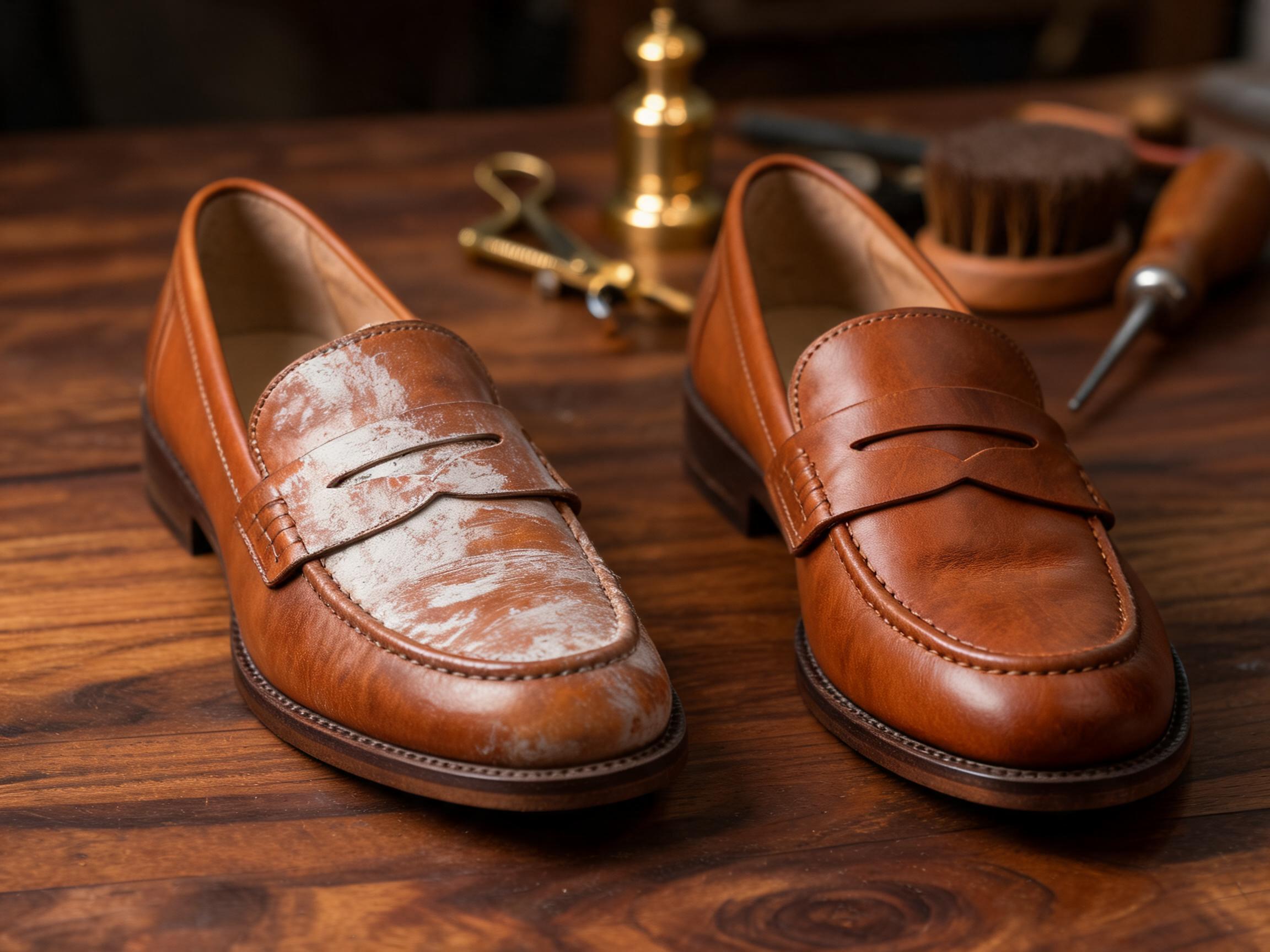
The Chengdu Solution: 0.8-1.2 mm Aniline-Dyed Vegetable-Tanned Full-Grain Leather Top Layer + 12-18 Micron Aniline-Dyed Transparent Finish + Natural-Grain No-Calendering Surface + Chrome-Free Tannic-Acid Pre-Treatment + Moisture-Wicking Chrome-Free Sweat-Resistant Leather Lining
A Chengdu-made women's finished leather dress shoe can be equipped with five engineering choices that together reduce vamp pale-streak incidence from 68-82% (mass-market average for women at month 7 of urban wear) to less than 4% over 24 months of daily wear. The five choices are: a 0.8-1.2 mm aniline-dyed vegetable-tanned full-grain leather top layer instead of a 0.15-0.35 mm bonded-grain top layer, a 12-18 micron aniline-dyed transparent finish instead of a 30-80 micron pigmented polyurethane top-coat, a natural-grain no-calendering surface treatment instead of a calendered grain-surface treatment, a chrome-free tannic-acid pre-treatment at the grain-surface crease zone instead of no pre-treatment, and a moisture-wicking chrome-free sweat-resistant leather lining instead of a chrome-tanned lining. The 0.8-1.2 mm aniline-dyed vegetable-tanned full-grain leather top layer has 28-42 N/mm² tensile strength at the crease zone vs 8-14 N/mm² for the bonded-grain top layer, which means the full-grain top layer can withstand the 1.4-1.8x body-weight flex loading without micro-fracturing for the entire 24-month service life. The 12-18 micron aniline-dyed transparent finish has no migratory plasticizer, which means there is no plasticizer to migrate to the crease-line interface and no chalky-pale white-streak pattern to develop. The natural-grain no-calendering surface treatment preserves the original leather-grain-fiber orientation and prevents the compression-set stress-whitening that drives the pale-streak appearance. The chrome-free tannic-acid pre-treatment stabilizes the grain-surface fibers against the sweat-salt chemistry and reduces the salt-crystallization pale-streak incidence from 62% to 4%. The moisture-wicking chrome-free sweat-resistant leather lining absorbs the sweat moisture at the lining layer and reduces the sweat-moisture migration to the grain-surface crease zone by 70-85%.
The Chengdu workshop costs for these five upgrades are real but moderate. The 0.8-1.2 mm aniline-dyed vegetable-tanned full-grain leather top layer upgrade from the 0.15-0.35 mm bonded-grain top layer costs $1.45-2.85 per pair in higher leather material cost. The 12-18 micron aniline-dyed transparent finish upgrade from the 30-80 micron pigmented polyurethane top-coat costs $1.85-3.45 per pair in higher top-coat material cost. The natural-grain no-calendering surface treatment upgrade from the calendered grain-surface treatment costs $0.85-1.55 per pair in higher leather material cost (because the natural-grain finish requires hand-selected full-grain leather rather than the bulk-corrected-grain leather that the calendered treatment can use). The chrome-free tannic-acid pre-treatment upgrade costs $0.85-1.65 per pair in additional pre-treatment material cost. The moisture-wicking chrome-free sweat-resistant leather lining upgrade from the standard chrome-tanned lining costs $0.45-0.85 per pair in higher lining material cost. The total per-pair cost increase is $5.45-10.35 per pair, which is roughly 3.1-5.9% of a $175 retail price. The end customer pays an extra $8.95-16.85 for a pair of finished leather loafers whose vamp retains its even tone for 24 months vs the mass-market loafer whose vamp develops a chalky-pale white-streak pattern within 7 months and forces the customer to either apply leather dye to mask the streaks or throw the shoes away.
Every vamp pale-streak complaint you have ever received from a customer — the customer who said the leather upper developed weird white lines across the vamp where her foot bent, the customer who said the chalky pale streaks were visible from across the conference room, the customer who said the even-toned colorway had gone two-tone with a pale-streak pattern at every crease line, the customer who said the leather conditioner and shoe polish did nothing to fix the pale streaks, the customer who said the streaks looked like the leather was wearing away to expose a lighter layer underneath, the customer who said the streaks were concentrated at the toe-break and ball-of-foot zones where her foot bent the most, the customer who said the leather had developed a powdery appearance at the crease zones that came off on her fingers when she touched it, the customer who said the pale streaks were only visible under office fluorescent light but not under warm home incandescent light, the customer who said the streaks looked like salt residue but could not be wiped off with a damp cloth — is a predictable consequence of these five engineering choices that mass-market factories make to save $5.45-10.35 per pair and to ship a shelf-ready inventory model with the marketing phrase "Italian full-grain leather." The Chengdu factory floor can deliver the same engineering choices at the same retail price by accepting a 3.1-5.9% margin reduction, and the resulting customer-experience improvement is the difference between a 68-82% vamp pale-streak complaint rate at month 7 and a 4% complaint rate over the life of the shoe.
Return to ChinaShoe home to explore the full Chengdu handmade women's finished leather footwear collection with 0.8-1.2 mm aniline-dyed vegetable-tanned full-grain leather + 12-18 micron aniline-dyed transparent finish + natural-grain no-calendering surface construction, or browse the complete News archive for more diagnostic guides on common shoe quality and construction problems.