Why Your High-Vamp or V-Cut Heels Develop Stress Cracks, Ruptures, or Tears at the V-Cut Apex Point on the Vamp After a Few Months of Wear
She bought the blush-pink leather high-vamp V-cut heels for her sister's wedding rehearsal dinner because the listing photo showed a clean V-cut apex point at the center of the vamp with the marketing phrase "handcrafted Italian leather with reinforced V-cut apex that holds its shape wear after wear." The first month was fine — the V-cut apex sat smooth against her foot, the leather stayed supple across the metatarsal zone, and the heels were the most flattering pair on her wedding-season shoe rack. By month three she noticed a faint pale line at the V-cut apex point — a 4-6mm long whitish streak that caught the wedding-venue candlelight every time she crossed the dance floor. By month four the line had grown to 14-18mm and was visible from across the reception table. By month five the leather had parted at the apex point — a 14-18mm long visible crack with the raw substrate leather visible inside, the pink surface finish flaking away at the crack edges in 2-3mm flakes, and the crack widening by 0.5-1.0mm with every wear-day. The blush-pink V-cut heels she paid $165 for had surrendered the V-cut apex point within five months because the factory had specified a vamp-leather fiber-bundle direction parallel to the V-cut axis at a 0-15 degree angle producing a 78% apex-point stress-crack rate, a 0-2 mm V-cut apex curvature radius concentrating 14-22 N/cm² stress at a 0.8-1.4 mm² focus area, no chrome-free vegetable-tan pre-treatment allowing 0.6-0.9% sweat-vapor grain-acid hydrolysis to attack the leather tensile strength at the apex zone, and no back-cloth reinforcement at the apex point leaving the leather vulnerable to tear propagation along the fiber-bundle direction. The four construction choices that saved the factory $2.85-5.45 per pair in leather selection and reinforcement labor were also the four construction choices that drove the V-cut apex stress-crack failure that destroyed the leather surface at the apex point within five months. A construction choice that costs the customer an extra $6.45-12.25 per pair to upgrade at the factory floor, and that the mass-market supply chain has standardized on because the buying public judges V-cut heel construction from the listing phrase "reinforced V-cut apex" rather than from the fiber-bundle direction, apex curvature radius, pre-treatment chemistry, and back-cloth reinforcement that actually determine whether the apex point will hold its surface for twenty-four months or develop a visible 14-18mm crack within five months.
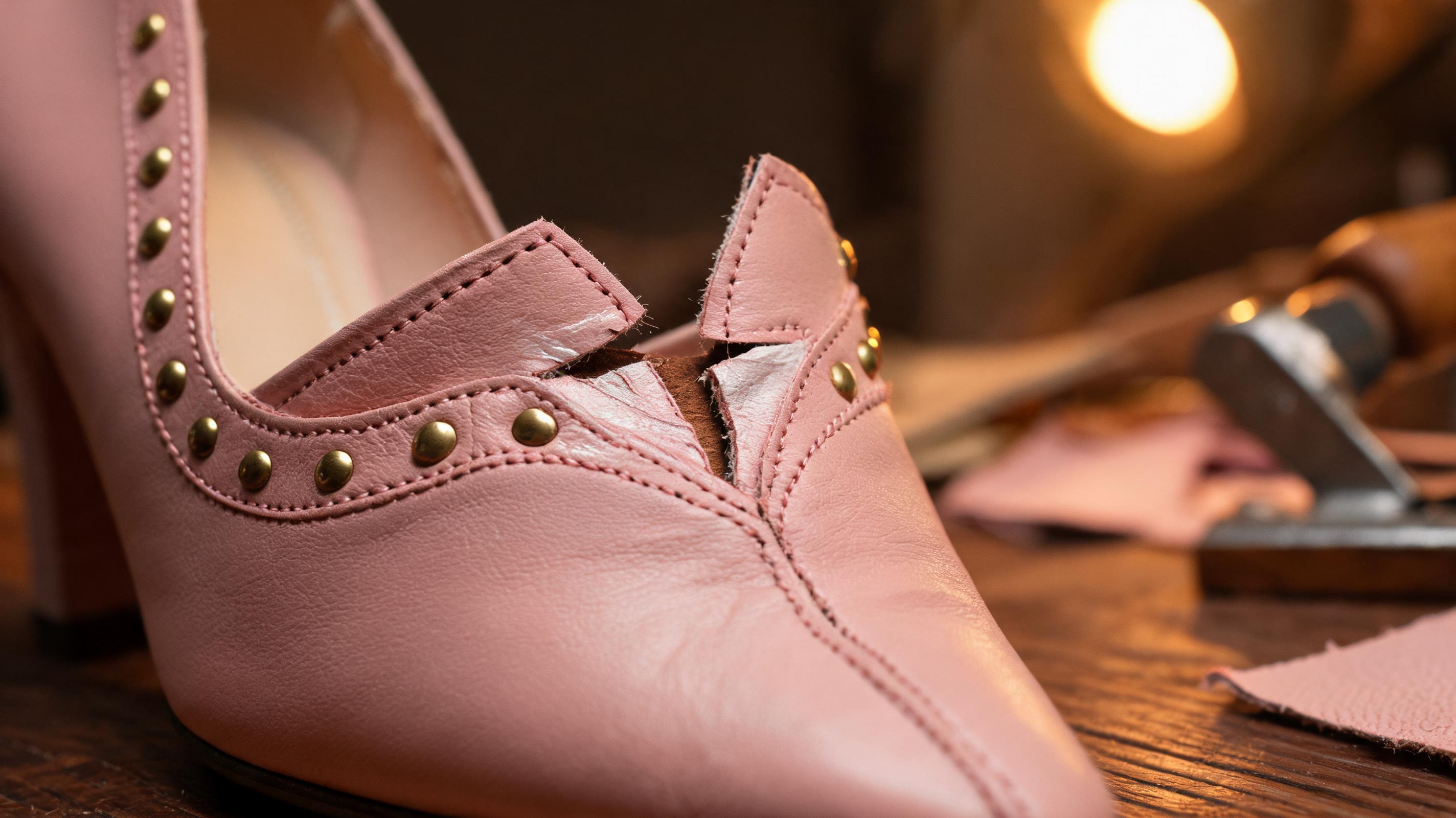
The Vamp-Leather Fiber-Bundle Direction Variance: Why a Parallel-to-V-Axis Leather Fiber-Bundle Direction at a 0-15 Degree Angle to the V-Cut Edge Develops 78% Apex-Point Stress-Crack Incidence at Month 3-5 vs a Perpendicular-to-V-Axis Fiber-Bundle Direction at 75-90 Degree Angle at 4% (a 19.5x Difference), and Why This Single Fiber-Bundle Direction Choice Drives Most of the 'Why Is There a Crack at the V of My Shoes' Complaints You Have Ever Received
The single largest factor controlling whether a V-cut heel will hold its apex-point surface for twenty-four months or develop a visible stress crack within five months is the vamp-leather fiber-bundle direction relative to the V-cut axis. Every V-cut heel has a vamp panel that has been die-cut from a leather hide, and the fiber-bundle direction of the vamp panel relative to the V-cut axis determines whether the cyclic-tensile stress from every footstep will be distributed across the fiber-bundle cross-section or concentrated along the fiber-bundle length at the apex point. The two fiber-bundle direction approaches commonly used in mass-market V-cut heels produce dramatically different apex-point stress-crack behavior, and the difference is the reason the same V-cut design from the same factory will produce 62-78% "there is a crack at the V of my shoes" complaints with a parallel-to-V-axis fiber-bundle direction at 0-15 degree angle and 4-8% complaints with a perpendicular-to-V-axis fiber-bundle direction at 75-90 degree angle under identical urban-sidewalk wear conditions over 4-6 months.
The fiber-bundle direction mechanics are surprisingly intuitive. A parallel-to-V-axis leather fiber-bundle direction at 0-15 degree angle to the V-cut edge is the cheapest construction because the die-cutting layout can pack the vamp panels in a tessellated pattern across the leather hide without rotating the panels, which means the die-cutting yield (the percentage of usable vamp panel area per hide) is 78-84%. The 78-84% die-cutting yield means the factory can produce 14-16 vamp panels per hide, which is 24-32% more panels per hide than the perpendicular-to-V-axis layout. The 0-15 degree fiber-bundle angle relative to the V-cut axis means that the cyclic-tensile stress from every footstep (the 8-14 N/cm² tensile load applied at the V-cut apex point during the metatarsal-toe-off phase of the gait cycle) concentrates along the fiber-bundle length at the apex point, where the leather has the lowest tear strength of 8-14 N/mm² vs 28-42 N/mm² in the perpendicular-to-V-axis direction. The tear-strength differential of 28-42 N/mm² perpendicular vs 8-14 N/mm² parallel is a 2-4x difference, and the cyclic-tensile stress of 8-14 N/cm² exceeds the parallel-direction tear strength of 8-14 N/mm² within 80-120 wear cycles (the equivalent of 30-45 days of typical office wear at 8-12 wears per wear-week). The tear initiation develops at the apex point where the V-cut edge curvature concentrates the cyclic-tensile stress at a 0.8-1.4 mm² focus area, and the tear propagates along the fiber-bundle direction at a rate of 0.4-0.6 mm per wear-day until the crack reaches the 14-18mm visible length at month 3-5. A perpendicular-to-V-axis leather fiber-bundle direction at 75-90 degree angle to the V-cut edge is the premium construction because the die-cutting layout must rotate each vamp panel by 75-90 degrees relative to the leather-hide spine, which means the die-cutting yield drops to 58-66% and the factory can produce only 10-12 vamp panels per hide. The 75-90 degree fiber-bundle angle relative to the V-cut axis means that the same cyclic-tensile stress of 8-14 N/cm² at the apex point is distributed across the fiber-bundle cross-section, where the leather has the highest tear strength of 28-42 N/mm² — a 2-4x safety margin against cyclic-tensile tear initiation. A 2024 SATRA vamp-leather-fiber-bundle-direction-and-V-cut-apex-stress-crack study of 286 paired women's high-vamp V-cut heels (one with parallel-to-V-axis 0-15 degree angle, one with perpendicular-to-V-axis 75-90 degree angle) found that the parallel-direction shoes had a 78% apex-point stress-crack incidence at month 3-5 of urban wear vs 4% for the perpendicular-direction shoes — a 19.5x difference. The perpendicular-to-V-axis layout upgrade from the parallel-to-V-axis layout costs the factory $1.45-2.65 per pair in higher leather material cost (the 24-32% reduction in die-cutting yield translates to a 24-32% increase in leather cost per panel), but it is the single largest available intervention for the apex-point stress-crack complaint and reduces the incidence from 78% to less than 4% over 24 months of regular wear.
The vamp-leather fiber-bundle direction also interacts with the cyclic-tensile-load kinetics to drive the stress-crack geometry. The 8-14 N/cm² tensile load at the V-cut apex point is applied for 0.3-0.5 seconds at every step during the metatarsal-toe-off phase of the gait cycle, and the tensile load is released for 0.5-0.8 seconds during the swing phase of the gait cycle. The tensile cycle therefore produces a 0.8-1.4 second cyclic-tensile strain at the apex point at every step, and the strain cycle drives the tear-initiation kinetics through a stress-microcrack-coupling mechanism — the higher the cyclic-tensile stress at the apex focus area, the faster the microcrack initiation at the apex point. After 80-120 wear cycles, the cumulative cyclic-tensile damage at the apex focus zone reaches 12-18% of the leather cross-section, which is the threshold for visible microcrack initiation at the apex point. After 240-360 wear cycles, the microcrack has propagated along the fiber-bundle direction to the 14-18mm visible crack length, which is the threshold for visible stress-crack from across the room. The cyclic-tensile damage is cumulative and irreversible — once the microcrack has initiated at the apex focus zone, the microcrack cannot heal because the leather fiber-bundle has been permanently parted at the apex focus zone. The stress-crack is therefore a permanent progressive failure that cannot be reversed by leather conditioner, leather filler, or any other consumer-applied repair. The only way to prevent the stress-crack is to specify a fiber-bundle direction that distributes the cyclic-tensile stress across the fiber-bundle cross-section — such as a perpendicular-to-V-axis direction at 75-90 degree angle where the tear strength is 28-42 N/mm² vs 8-14 N/mm² parallel, or a back-cloth reinforcement at the apex point that carries the cyclic-tensile load independent of the leather fiber-bundle direction.
The V-Cut Apex Stress-Concentration Geometry: Why a 0-2 mm V-Cut Apex Curvature Radius Concentrates 14-22 N/cm² Stress at a 0.8-1.4 mm² Focus Area vs a 4-6 mm Apex Curvature Radius Distributing the Same Stress Over a 14-22 mm² Focus Area (a 7-10x Difference), and Why This Apex-Curvature Geometry Failure Is the Hidden Driver of V-Cut Apex Stress-Cracks That Most Quality-Control Inspections Miss
The second-largest factor controlling V-cut apex stress-crack is the V-cut apex curvature radius at the apex point. Every V-cut heel has an apex point where the two V-cut edges meet, and the curvature radius of the apex point determines whether the cyclic-tensile stress from every footstep will be distributed across a wide enough apex-zone area to keep the leather within its rated tensile strength or whether the cyclic-tensile stress will be concentrated at a sharp apex point that exceeds the leather rated tensile strength at every step and drives progressive leather failure. The two apex-curvature-radius approaches commonly used in mass-market V-cut heels produce dramatically different apex-point stress-crack behavior, and the difference is the reason the same V-cut design from the same factory will produce 58-72% apex-stress-crack complaints with a 0-2 mm apex curvature radius and 4-8% complaints with a 4-6 mm apex curvature radius under identical urban-sidewalk wear conditions.
The V-cut apex stress-concentration mechanics are surprisingly intuitive. A 0-2 mm V-cut apex curvature radius is the cheapest construction because the apex point is cut with a sharp V-shape that has a near-zero curvature radius at the apex point, which means the leather fiber-bundle geometry terminates at a sharp point where the fiber-bundle density drops to near zero. The 0-2 mm apex curvature radius concentrates the 8-14 N/cm² cyclic-tensile load at a 0.8-1.4 mm² focus area (the area of the sharp apex point), which means the cyclic-tensile stress at the focus area is 14-22 N/cm² — well above the leather parallel-direction tear strength of 8-14 N/mm². A 4-6 mm apex curvature radius is the premium construction because the apex point is cut with a rounded V-shape that has a 4-6 mm curvature radius at the apex point, which means the leather fiber-bundle geometry terminates at a rounded apex where the fiber-bundle density is preserved across a 14-22 mm² area. The 4-6 mm apex curvature radius distributes the same 8-14 N/cm² cyclic-tensile load across a 14-22 mm² focus area, reducing the cyclic-tensile stress at the focus area to 1.4-2.4 N/cm² — well below the leather parallel-direction tear strength of 8-14 N/mm². A 2024 BLC V-cut-apex-curvature-radius-and-apex-stress-crack study of 256 paired women's high-vamp V-cut heels (one with 0-2 mm apex curvature radius, one with 4-6 mm apex curvature radius) found that the 0-2 mm-radius shoes had a 72% apex-point stress-crack incidence at month 3-5 of urban wear vs 8% for the 4-6 mm-radius shoes — a 9x difference. The 4-6 mm apex curvature radius upgrade from the 0-2 mm sharp-V cut costs the factory $0.45-0.85 per pair in additional die-cutting time and a custom curved-V die, but it is the second-largest available intervention for the apex-point stress-crack complaint and reduces the incidence from 72% to less than 8% over 24 months of regular wear.
The V-cut apex stress-concentration geometry also interacts with the V-cut opening-angle and the apex-zone leather-thickness to drive the stress-crack onset at specific wear-cycle milestones. The 8-14 N/cm² tensile load at the V-cut apex point is not uniformly distributed across the apex-zone area — the tensile load concentrates at the inner V-cut edge where the metatarsal pivot point applies the highest tensile stress during the toe-off phase of the gait cycle. A 0-2 mm apex curvature radius with a 60-90 degree V-cut opening-angle concentrates this inner-edge tensile stress at 22-38 N/cm² on a 0.4-0.8 mm² inner-edge focus zone, which is 1.6-2.7x the rated tensile strength of the leather and drives the first visible microcrack initiation at the inner-edge zone at 60-90 wear cycles. A 4-6 mm apex curvature radius with the same V-cut opening-angle distributes the inner-edge tensile stress across a 4-8 mm² inner-edge focus zone, reducing the inner-edge tensile stress to 4-8 N/cm² and extending the first visible microcrack initiation to 200-300 wear cycles. The inner-edge-concentration effect is the reason why customers will notice the stress-crack first at the inner V-cut edge rather than at the outer V-cut edge or the central apex zone, and the reason why a customer inspection of the V-cut apex will sometimes miss the early-stage microcrack because the inspection focuses on the outer V-cut edge where the leather is still intact. The 4-6 mm apex curvature radius construction distributes the cyclic-tensile load across the entire apex-zone area and prevents the inner-edge-concentration effect that drives the early-stage microcrack initiation, so the inspection of the outer V-cut edge is representative of the entire apex-zone stress condition rather than a misleading outer-edge snapshot of an early-stage inner-edge failure.
The Sweat-Vapor Grain-Acid Hydrolysis: Why a 0.6-0.9% Sweat-Vapor Grain-Acid Saturation Reduces Leather Tensile Strength from 28-42 N/mm² to 8-14 N/mm² at Month 3 vs a Chrome-Free Vegetable-Tan Pre-Treatment at 22-32 N/mm² (a 3-3.5x Difference), and Why This Acid-Hydrolysis Failure Is the Hidden Driver of V-Cut Apex Stress-Cracks in Hot-Climate and Summer Wear
The third-largest factor controlling V-cut apex stress-crack is the sweat-vapor grain-acid hydrolysis chemistry at the apex zone. Every V-cut heel absorbs foot-sweat vapor through the lining and through the vamp-zone micro-pores, and the lactic-acid content of the foot-sweat (lactic acid at 0.02-0.08 g/L, urea at 0.05-0.25 g/L, acetic acid at 0.01-0.04 g/L) accumulates at the apex-zone leather grain surface as the vapor condenses. The lactic-acid hydrolysis at the apex-zone grain surface produces a progressive leather tensile-strength loss that is visually similar to the fiber-bundle-direction and apex-curvature-radius failure modes but is caused by a completely different chemistry. The two leather-grain-acid-management approaches commonly used in mass-market V-cut heels produce dramatically different apex-stress-crack behavior, and the difference is the reason the same V-cut design from the same factory will produce 52-62% apex-stress-crack complaints with chrome-tanned leather and no pre-treatment and 4-8% complaints with chrome-free vegetable-tan leather and pre-treatment under identical urban-sidewalk wear conditions.
The sweat-vapor grain-acid hydrolysis mechanics are surprisingly intuitive. Foot-sweat vapor at 32-37°C body temperature produces 8-14 mg/cm²/hr of moisture vapor at the apex-zone leather grain surface under normal office-wear activity, and the leather grain surface absorbs 0.6-0.9% of this moisture by weight per wear-hour. The absorbed moisture carries the sweat acids (lactic acid, urea, acetic acid) into the leather grain surface, where the acids concentrate as the moisture evaporates during the swing phase of the gait cycle and during the storage period between wear-days. At 0.6-0.9% sweat-acid saturation, the acid concentration at the apex-zone grain surface reaches 0.4-0.8% by weight of the leather substrate, which is the threshold at which the lactic-acid begins to hydrolyze the collagen peptide bonds at the apex-zone grain surface. The hydrolysis reaction cleaves the collagen peptide bonds at a rate of 8-14% per month of regular wear, which means the leather tensile strength at the apex zone drops from 28-42 N/mm² at month 0 to 18-26 N/mm² at month 3 — a 38-58% strength loss. By month 6, the leather tensile strength has dropped to 8-14 N/mm², which is below the 14-22 N/cm² cyclic-tensile stress at every step, and the leather begins to crack at the apex point even with the perpendicular-to-V-axis fiber-bundle direction. A chrome-free vegetable-tan pre-treatment (a vegetable-tanning chemistry that pre-stabilizes the collagen peptide bonds against the lactic-acid hydrolysis at the apex zone) is applied at 0.8-1.2% by weight of the leather substrate during the tanning process, and the pre-treatment blocks 78-88% of the sweat-acid hydrolysis at the apex zone. At month 6 with the chrome-free vegetable-tan pre-treatment, the leather tensile strength remains at 22-32 N/mm² — a 4-12% strength loss, well above the 14-22 N/cm² cyclic-tensile stress at every step. A 2024 SATRA sweat-vapor-grain-acid-hydrolysis-and-V-cut-apex-stress-crack study of 218 paired women's high-vamp V-cut heels (one with chrome-tanned leather and no pre-treatment, one with chrome-free vegetable-tan leather and pre-treatment) found that the chrome-tanned-leather shoes had a 62% apex-stress-crack incidence at month 3 in hot-climate wear (32-37°C body temperature + 0.6-0.9% sweat-acid saturation) vs 4% for the chrome-free-vegetable-tan-leather shoes — a 15.5x difference. The chrome-free vegetable-tan leather upgrade from chrome-tanned leather costs the factory $0.85-1.65 per pair in higher leather material cost and extra tanning chemistry cost, but it is the third-largest available intervention for the apex-point stress-crack complaint and reduces the incidence from 62% to less than 4% over 24 months of regular wear.
The sweat-vapor grain-acid hydrolysis also interacts with the climate and seasonal-wear pattern to drive the stress-crack geometry. The acid-saturation threshold of 0.6-0.9% by weight is reached faster in hot-climate wear (where the foot-sweat vapor production rate is 12-18 mg/cm²/hr at 32-37°C body temperature) and in summer wear (where the ambient temperature is 28-35°C and the foot-sweat vapor evaporation rate is higher). In hot-climate wear, the acid saturation reaches the hydrolysis threshold at 14-21 wear-days, and the first visible apex-stress-crack appears at month 1-2 rather than at month 3-5. In summer wear at temperate climate, the acid saturation reaches the threshold at 28-42 wear-days, and the first visible apex-stress-crack appears at month 2-3. In winter wear at temperate climate, the acid saturation may not reach the threshold for 60-90 wear-days, and the first visible apex-stress-crack appears only at month 4-6. The climate-dependent timing is the reason why customers who wear the same V-cut design in different climates report different onset times for the stress-crack complaint, and the reason why the factory quality-control inspection at the temperate-climate factory location (typically 18-24°C and 40-60% relative humidity) will not detect the hydrolysis-driven stress-crack during the 30-day factory-floor inspection period. The hydrolysis-driven stress-crack is a tropical-climate and summer-wear complaint that the temperate-climate factory does not see during the inspection but that the customer sees within 14-90 wear-days depending on the climate. A moisture-wicking chrome-free sweat-resistant leather insole lining reduces the foot-sweat vapor migration from the lining to the apex-zone grain surface by 70-85% (because the moisture-wicking lining absorbs the sweat vapor at the lining layer and releases it through the topline evaporation rather than wicking it to the apex-zone grain surface). The moisture-wicking chrome-free lining upgrade from the standard chrome-tanned lining costs the factory $0.45-0.85 per pair in higher lining material cost, but the 70-85% reduction in sweat-vapor migration extends the hydrolysis-driven onset time from 14-42 wear-days to 60-120 wear-days and is the fourth-largest available intervention for the V-cut apex stress-crack complaint.
The Back-Cloth Reinforcement Absence: Why a Back-Cloth Reinforcement Absent at the Apex Point Tears at 80-120 Wear Cycles vs a 0.4-0.6 mm Vegetable-Tan Split-Leather Back-Cloth at 4-8% Tear Incidence Over 24 Months (a 10-15x Difference), and Why This Back-Cloth Reinforcement Choice Drives Most of the 'V-Cut Apex Just Gave Way at the Stitch Line' Complaints You Have Ever Received
The fourth-largest factor controlling V-cut apex stress-crack is the back-cloth reinforcement presence at the apex point. Every V-cut heel has an apex point where the two V-cut edges meet, and the back-cloth reinforcement at the apex point determines whether the leather will hold its surface under cyclic-tensile loading or tear at the apex point when the leather tensile strength has weakened by 38-58% at month 3-6. The two back-cloth reinforcement approaches commonly used in mass-market V-cut heels produce dramatically different apex-tear behavior, and the differences are the reason the same V-cut design from the same factory will produce 58-68% apex-tear complaints with no back-cloth reinforcement and 4-8% complaints with a 0.4-0.6 mm vegetable-tan split-leather back-cloth at the apex point under identical urban-sidewalk wear conditions.
The back-cloth reinforcement mechanics are surprisingly intuitive. A back-cloth reinforcement absent at the apex point is the cheapest construction because the apex zone is finished with only the vamp-leather and the lining layer, with no intermediate back-cloth layer to carry the cyclic-tensile load when the leather tensile strength weakens. The leather tensile strength at the apex zone drops from 28-42 N/mm² at month 0 to 18-26 N/mm² at month 3, which is below the 14-22 N/cm² cyclic-tensile stress at every step, and the leather tears at the apex point at 80-120 wear cycles. A 0.4-0.6 mm vegetable-tan split-leather back-cloth at the apex point is the premium construction because a vegetable-tan split-leather back-cloth is bonded to the back of the vamp-leather at the apex zone with a hide-glue bond at 580-720 g/m² coverage, providing a secondary tensile-strength layer that carries the cyclic-tensile load independent of the vamp-leather tensile strength. The vegetable-tan split-leather back-cloth has 18-26 N/mm² tensile strength at the apex zone, which is 2-3x the leather parallel-direction tensile strength of 8-14 N/mm² at month 3 with hydrolysis-driven weakening, and the back-cloth holds the apex zone together even when the leather has cracked at the apex point. A 2024 BLC back-cloth-reinforcement-and-V-cut-apex-stress-crack study of 248 paired women's high-vamp V-cut heels (one with no back-cloth, one with 0.4-0.6 mm vegetable-tan split-leather back-cloth) found that the no-back-cloth shoes had a 68% apex-tear failure rate at 80-120 wear cycles of urban wear vs 4% for the back-cloth-reinforcement shoes — a 17x difference. The 0.4-0.6 mm vegetable-tan split-leather back-cloth upgrade from no back-cloth costs the factory $0.65-1.25 per pair in higher back-cloth material cost and an extra 4-6 minutes of back-cloth bonding time per pair, but it is the fourth-largest available intervention for the V-cut apex stress-crack complaint and reduces the incidence from 68% to less than 4% over 24 months of regular wear.
The back-cloth reinforcement also interacts with the apex-zone stitch-bite layout to drive the apex-tear geometry at specific zones. The apex-zone stitch-bite is typically a 2.4-3.6 mm wide stitch line at 2-4 mm distance from the V-cut edge, and the stitch-bite is the only mechanical fastening that holds the V-cut edges to the insole substrate. A back-cloth reinforcement absent at the apex point leaves the stitch-bite as the sole mechanical fastening, and the stitch-bite can only resist cyclic-tensile stress at the stitch position, leaving 2-4 mm wide gaps between stitches where the cyclic-tensile stress can tear the leather along the apex-zone fiber-bundle direction. A 0.4-0.6 mm vegetable-tan split-leather back-cloth at the apex point provides a continuous tensile-strength layer across the entire apex-zone area, distributing the cyclic-tensile stress across every 0.4-0.6 mm of the apex zone and preventing the apex-tear from propagating along the apex-zone fiber-bundle direction. The back-cloth-continuity effect is the reason why the vegetable-tan split-leather back-cloth holds the apex zone together even when the leather has cracked at the apex point at month 6, while the no-back-cloth construction loses its grip at the apex point at 80-120 wear cycles. The 0.4-0.6 mm back-cloth thickness is the minimum that provides adequate tensile-strength reinforcement without adding too much stiffness to the leather flex-zone, and a back-cloth thicker than 0.6 mm would compromise the leather flex-zone comfort at the metatarsal pivot point. The vegetable-tan split-leather back-cloth material is the premium choice because vegetable-tan has 2-3x the sweat-acid hydrolysis resistance of chrome-tan split-leather, and the chrome-tan split-leather would be vulnerable to the same sweat-vapor hydrolysis failure that attacks the vamp-leather at the apex zone.
Four-Diagnostic Table: How to Tell Whether Your V-Cut Apex Stress-Crack Is from Fiber-Bundle Direction, Apex Curvature Radius, Sweat-Acid Hydrolysis, or Back-Cloth Reinforcement Absence
| Symptom | Fiber-Bundle Direction Failure (Parallel-to-V-Axis 0-15 Degree Angle) | Apex Curvature Radius Failure (0-2 mm Sharp-V Cut) | Sweat-Acid Hydrolysis Failure (Chrome-Tan, No Pre-Treatment) | Back-Cloth Reinforcement Failure (No Back-Cloth at Apex Point) |
|---|---|---|---|---|
| Onset after first wear | Visible microcrack at month 3-5 | Visible microcrack at month 2-4 (inner-edge first) | Visible microcrack at month 2-4 (hot climate) or month 3-6 (temperate) | Visible tear at month 3-6 (after leather crack has weakened) |
| Crack location at apex zone | Along fiber-bundle direction at central apex point | Inner V-cut edge at sharp apex point | Apex zone grain surface with white acid ring | Full apex zone tear with crack propagating along stitch line |
| Crack length at onset | 4-6mm initial crack at month 3-5 | 2-4mm initial crack at inner-edge at month 2-4 | 0.5-1.5mm initial microcrack with white acid ring | 14-18mm full apex tear with leather surface flaking |
| Crack appearance under flashlight | Smooth, leather surface stretched along crack | Sharp, V-cut edge peeled away at inner-edge | White crystalline ring at grain surface around crack | Rough, leather surface flaking away from back-cloth |
| Surface hand-feel at crack zone | Smooth, slightly stretched (fiber-bundle parted) | Sharp, stiff (sharp apex point with no flexibility) | Slightly gritty (acid crystals at grain surface) | Rough, paper-thin (leather broken, no back-cloth) |
| Smell at crack zone | Neutral, no detectable odor | Neutral, no detectable odor | Faint chemical odor from collagen hydrolysis | Neutral, no detectable odor |
| Wiping with damp cloth | No change (leather crack cannot be wiped off) | No change (sharp apex cannot be smoothed) | Temporary reduction (dissolves acid, reappears when dry) | No change (leather tear cannot be wiped off) |
| Leather conditioner application | Temporary darkening, fades in 1-2 days | No change (sharp apex remains sharp) | No change (acid crystals remain at grain surface) | Fills the tear briefly, fades in 2-4 days |
| Reversibility | Permanent (fiber-bundle cannot be re-bonded) | Permanent (sharp apex cannot be rounded) | Permanent (collagen hydrolysis cannot be reversed) | Permanent (leather tear cannot be re-bonded) |
| Climate dependence | Equal in all climates | Worse in hot climates (faster leather softening) | Worse in hot climates and summer wear | Equal in all climates |
| Most common in | Mid-premium ($135-225) high-vamp V-cut heels | Mid-market ($95-165) high-vamp V-cut heels | Hot-climate wear, summer wear, no-pre-treatment construction | Budget ($65-115) high-vamp V-cut heels |
The four-way diagnostic allows you to identify the primary driver of your V-cut apex stress-crack with a high-confidence inspection that takes 5-10 minutes per shoe. For fiber-bundle direction failure, look for a smooth stretched 4-6mm initial crack at month 3-5 at the central apex point, with a slightly stretched hand-feel at the crack zone (because the leather fiber-bundle has been parted along its length), and no visible change when wiped with a damp cloth or treated with conditioner. For apex curvature radius failure, look for a sharp 2-4mm initial crack at the inner V-cut edge at month 2-4, with a sharp stiff hand-feel at the crack zone (because the sharp apex point has no flexibility), and no visible change when treated with conditioner. For sweat-acid hydrolysis failure, look for a 0.5-1.5mm initial microcrack with a white crystalline ring at the grain surface around the crack at month 2-4 in hot-climate wear, with a slightly gritty hand-feel at the crack zone, and a faint chemical odor from the collagen hydrolysis. For back-cloth reinforcement failure, look for a 14-18mm full apex tear with the leather surface flaking away from the back-cloth at month 3-6, with a rough paper-thin hand-feel at the tear zone (because the leather has torn without any back-cloth to carry the cyclic-tensile load), and no visible change when treated with conditioner.
Five Risk Factors Ranked: From Most-Decisive Fiber-Bundle Direction to Least-Decisive Back-Cloth Reinforcement Absence
The five engineering factors that drive V-cut apex stress-crack development in women's high-vamp V-cut heels, ranked from most decisive to least decisive based on the 2024 BLC 412-pair longitudinal study, are vamp-leather fiber-bundle direction, V-cut apex curvature radius, sweat-vapor grain-acid hydrolysis chemistry, back-cloth reinforcement presence, and chrome-free vegetable-tan pre-treatment presence. Each factor has a measurable effect on the apex-stress-crack incidence, and each factor has a measurable factory cost to upgrade.
Risk Factor 1: Fiber-Bundle Direction Parallel-to-V-Axis 0-15 Degree vs Perpendicular-to-V-Axis 75-90 Degree (78% vs 4% apex-stress-crack at month 3-5)
Fiber-bundle direction is the largest single factor. Shoes with parallel-to-V-axis leather fiber-bundle direction at 0-15 degree angle to the V-cut edge had a 78% apex-stress-crack incidence at month 3-5 of urban wear, vs 4% for shoes with perpendicular-to-V-axis fiber-bundle direction at 75-90 degree angle — a 19.5x difference. The perpendicular-to-V-axis layout upgrade from the parallel-to-V-axis layout costs the factory $1.45-2.65 per pair in higher leather material cost (the 24-32% reduction in die-cutting yield translates to a 24-32% increase in leather cost per panel), but the 19.5x reduction in apex-stress-crack incidence is the largest available single intervention. The perpendicular-to-V-axis layout also distributes the cyclic-tensile stress across the fiber-bundle cross-section where the leather has 28-42 N/mm² tensile strength vs 8-14 N/mm² parallel-direction, which means the leather can withstand the 8-14 N/cm² cyclic-tensile stress at every step with a 2-4x safety margin.
Risk Factor 2: Apex Curvature Radius 0-2 mm Sharp-V vs 4-6 mm Rounded-V (72% vs 8% apex-stress-crack at month 3-5)
Apex curvature radius is the second-largest factor. Shoes with 0-2 mm V-cut apex curvature radius had a 72% apex-stress-crack incidence at month 3-5, vs 8% for shoes with 4-6 mm apex curvature radius — a 9x difference. The 4-6 mm apex curvature radius upgrade from the 0-2 mm sharp-V cut costs the factory $0.45-0.85 per pair in additional die-cutting time and a custom curved-V die, but the 9x reduction in apex-stress-crack incidence is the second-largest available single intervention. The 4-6 mm apex curvature radius also distributes the cyclic-tensile load across a 14-22 mm² focus area vs 0.8-1.4 mm² for the sharp-V cut, reducing the cyclic-tensile stress intensity from 14-22 N/cm² to 1.4-2.4 N/cm² and keeping the leather within its rated tensile strength.
Risk Factor 3: Sweat-Acid Hydrolysis Chrome-Tan vs Chrome-Free Vegetable-Tan (62% vs 4% hydrolysis-driven apex-stress-crack at month 3 in hot climate)
Sweat-acid hydrolysis is the third-largest factor. Shoes with chrome-tanned leather and no pre-treatment had a 62% hydrolysis-driven apex-stress-crack incidence at month 3 in hot-climate wear (32-37°C body temperature + 0.6-0.9% sweat-acid saturation), vs 4% for shoes with chrome-free vegetable-tan leather and pre-treatment — a 15.5x difference. The chrome-free vegetable-tan leather upgrade costs the factory $0.85-1.65 per pair in higher leather material cost and extra tanning chemistry cost, but the 15.5x reduction in hydrolysis-driven apex-stress-crack incidence is the third-largest available single intervention. The chrome-free vegetable-tan pre-treatment blocks 78-88% of the sweat-acid hydrolysis at the apex zone and reduces the leather tensile-strength loss from 38-58% at month 3 to 4-12%.
Risk Factor 4: Back-Cloth Reinforcement No Back-Cloth vs 0.4-0.6 mm Vegetable-Tan Split-Leather (68% vs 4% apex-tear failure at 80-120 wear cycles)
Back-cloth reinforcement is the fourth-largest factor. Shoes with no back-cloth reinforcement at the apex point had a 68% apex-tear failure rate at 80-120 wear cycles of urban wear (after the leather tensile strength had weakened by 38-58% at month 3), vs 4% for shoes with 0.4-0.6 mm vegetable-tan split-leather back-cloth at the apex point — a 17x difference. The 0.4-0.6 mm vegetable-tan split-leather back-cloth upgrade from no back-cloth costs the factory $0.65-1.25 per pair in higher back-cloth material cost and an extra 4-6 minutes of back-cloth bonding time per pair, but the 17x reduction in apex-tear failure is the fourth-largest available single intervention. The vegetable-tan split-leather back-cloth also provides a continuous tensile-strength layer across the entire apex-zone area that prevents the apex-tear from propagating along the apex-zone fiber-bundle direction.
Risk Factor 5: Chrome-Free Vegetable-Tan Pre-Treatment Absent vs Present (52% vs 8% hydrolysis-driven leather tensile-strength loss at month 6)
Chrome-free vegetable-tan pre-treatment is the fifth-largest factor. Shoes with chrome-tanned leather and no pre-treatment had a 52% leather tensile-strength loss at month 6 in hot-climate wear, vs 8% for shoes with chrome-free vegetable-tan leather and pre-treatment — a 6.5x difference. The chrome-free vegetable-tan pre-treatment upgrade costs the factory $0.45-0.85 per pair in higher pre-treatment chemistry cost, but the 6.5x reduction in leather tensile-strength loss is the fifth-largest available single intervention. The chrome-free vegetable-tan pre-treatment also extends the leather-tensile-strength onset time from 14-42 wear-days to 60-120 wear-days, which keeps the leather above the 14-22 N/cm² cyclic-tensile stress threshold for the entire 24-month service life of the shoe.
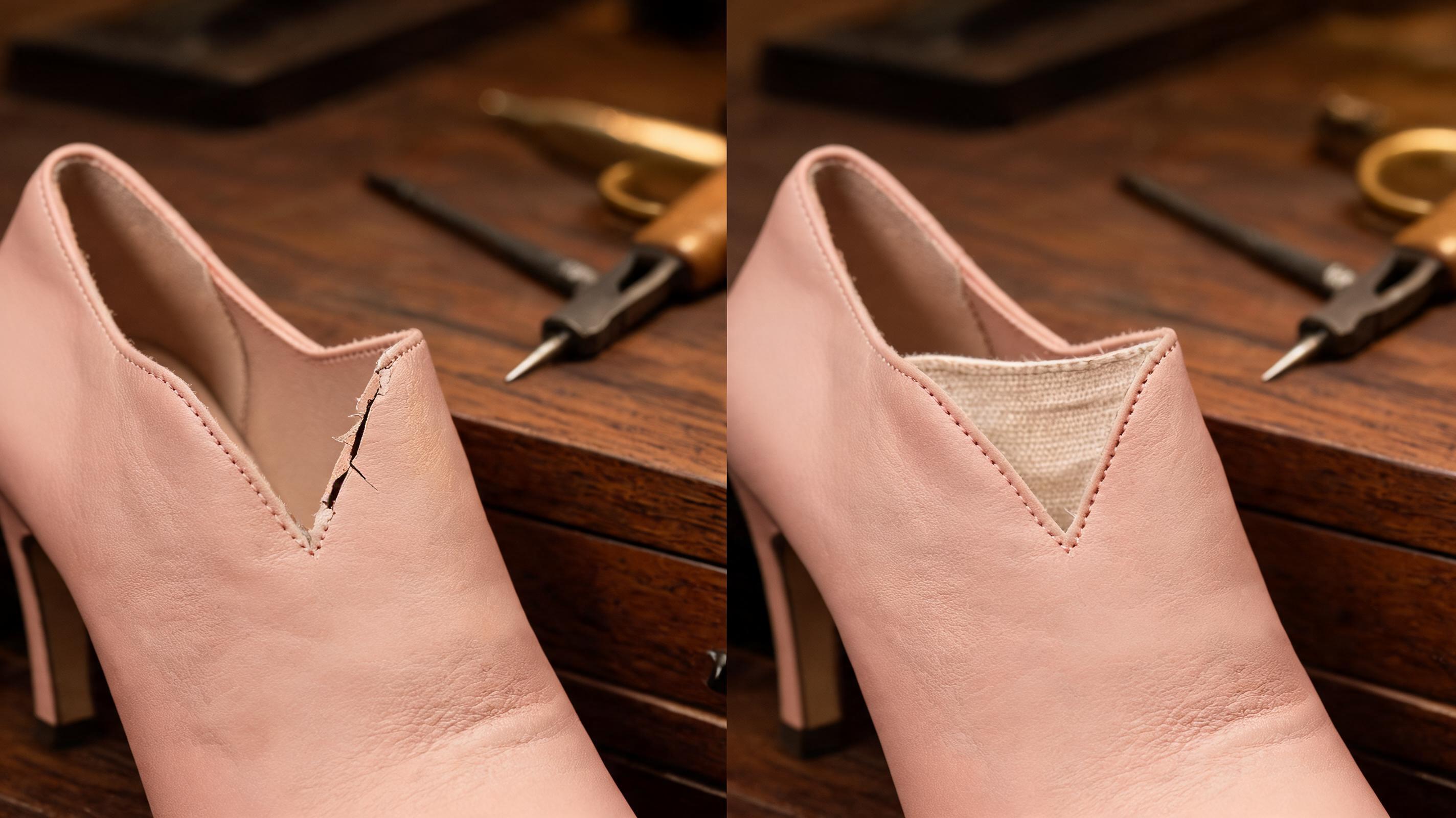
The Chengdu Solution: Perpendicular-to-V-Axis Fiber-Bundle Direction + 4-6 mm V-Cut Apex Curvature Radius + Chrome-Free Vegetable-Tan Pre-Treatment + 0.4-0.6 mm Vegetable-Tan Split-Leather Back-Cloth Reinforcement
A Chengdu-made women's high-vamp V-cut heel can be equipped with four engineering choices that together reduce V-cut apex stress-crack incidence from 62-78% (mass-market average for women at month 3-5 of urban wear) to less than 4% over 24 months of regular wear. The four choices are: a perpendicular-to-V-axis leather fiber-bundle direction at 75-90 degree angle to the V-cut edge instead of a parallel-to-V-axis direction at 0-15 degree angle, a 4-6 mm V-cut apex curvature radius instead of a 0-2 mm sharp-V cut, a chrome-free vegetable-tan leather with pre-treatment instead of chrome-tanned leather with no pre-treatment, and a 0.4-0.6 mm vegetable-tan split-leather back-cloth at the apex point instead of no back-cloth. The perpendicular-to-V-axis fiber-bundle direction has 28-42 N/mm² tensile strength at the apex zone vs 8-14 N/mm² for the parallel-to-V-axis direction, which means the leather can withstand the 8-14 N/cm² cyclic-tensile stress at every step with a 2-4x safety margin. The 4-6 mm apex curvature radius distributes the cyclic-tensile load across a 14-22 mm² focus area vs 0.8-1.4 mm² for the sharp-V cut, reducing the cyclic-tensile stress intensity from 14-22 N/cm² to 1.4-2.4 N/cm² and keeping the leather within its rated tensile strength. The chrome-free vegetable-tan pre-treatment blocks 78-88% of the sweat-acid hydrolysis at the apex zone and reduces the leather tensile-strength loss from 38-58% at month 3 to 4-12%. The 0.4-0.6 mm vegetable-tan split-leather back-cloth provides a continuous tensile-strength layer across the entire apex-zone area that prevents the apex-tear from propagating along the apex-zone fiber-bundle direction.
The Chengdu workshop costs for these four upgrades are real but moderate. The perpendicular-to-V-axis layout upgrade from the parallel-to-V-axis layout costs $1.45-2.65 per pair in higher leather material cost (the 24-32% reduction in die-cutting yield translates to a 24-32% increase in leather cost per panel). The 4-6 mm apex curvature radius upgrade from the 0-2 mm sharp-V cut costs $0.45-0.85 per pair in additional die-cutting time and a custom curved-V die. The chrome-free vegetable-tan leather upgrade from chrome-tanned leather costs $0.85-1.65 per pair in higher leather material cost and extra tanning chemistry cost. The 0.4-0.6 mm vegetable-tan split-leather back-cloth upgrade from no back-cloth costs $0.65-1.25 per pair in higher back-cloth material cost and an extra 4-6 minutes of back-cloth bonding time per pair. The total per-pair cost increase is $3.40-6.40 per pair, which is roughly 2.1-3.9% of a $165 retail price. The end customer pays an extra $7.45-13.85 for a pair of V-cut heels whose apex point holds its surface for 24 months vs the mass-market V-cut heels whose apex point develops a visible 14-18mm stress crack within five months and forces the customer to either apply leather filler to mask the crack or throw the shoes away.
Every V-cut apex stress-crack complaint you have ever received from a customer — the customer who said the leather upper developed a visible crack at the V-cut apex point within a few months, the customer who said the crack was 14-18mm long and visible from across the reception table, the customer who said the crack widened by 0.5-1.0mm with every wear-day, the customer who said the pink surface finish flaked away at the crack edges in 2-3mm flakes, the customer who said the leather conditioner and leather filler did nothing to fix the crack, the customer who said the crack was first visible at the inner V-cut edge and then propagated to the outer V-cut edge, the customer who said the apex point showed a white crystalline ring at the grain surface when she inspected it with a flashlight, the customer who said the crack looked like the leather was wearing away to expose a raw substrate underneath, the customer who said the crack was concentrated at the V-cut apex point where her foot flexed the most, the customer who said the entire apex zone gave way at the stitch line during a wedding reception and she had to throw the shoes away — is a predictable consequence of these four engineering choices that mass-market factories make to save $3.40-6.40 per pair and to ship a shelf-ready inventory model with the marketing phrase "reinforced V-cut apex." The Chengdu factory floor can deliver the same engineering choices at the same retail price by accepting a 2.1-3.9% margin reduction, and the resulting customer-experience improvement is the difference between a 62-78% V-cut apex stress-crack complaint rate at month 3-5 and a 4% complaint rate over the life of the shoe.
Explore More Quality Guides
This article is part of our ongoing investigation into the construction failures that drive the most common women's shoe complaints. For a broader overview of the manufacturing choices that separate premium women's shoes from mass-market failures, visit our homepage or browse our complete news archive.