Why Your Shoes Develop a Worn or Frayed Heel Lining That Exposes the Rough Leather Underneath After Just a Few Weeks of Wear
You paid $135 for a pair of cream-tan leather ankle boots because the listing photo showed a sleek interior with a smooth contrasting lining and the marketing copy promised 'buttery-soft leather lining with no hardware to irritate your foot.' You wore them to the office for the first two weeks and felt fine — the lining felt smooth and cool against your bare ankle in socks. By week three, you noticed a slight scratchy feeling at the back of your right heel, like a small fiber had come loose. By week four, the scratchy feeling had become a constant burn at the back of your heel that you could not ignore, and a quick inspection with a flashlight showed a 1.5cm by 0.8cm patch of lining that had completely worn away, exposing the rough unfinished brown leather substrate underneath. By week six, the worn patch had grown to 3cm by 1.5cm, the frayed edge of the lining was peeling away from the substrate like a loose sticker, and the exposed rough leather was rubbing your sock raw with every step. By week eight, the back of your right ankle had developed a red abrasion that bled slightly when you took the boots off, and the lining on the left boot was starting to show the same wear pattern. The cream-tan ankle boots you paid $135 for had turned your heels into a two-month abrasion test because the lining was a 0.4-0.6mm PU synthetic microfiber with 14-22% peel-strength loss at month 2 vs chrome-free vegetable-tanned leather lining at 4-8% loss, the heel-strike pressure of 1.4-2.0x body weight on a 6-10cm² contact area concentrated 8-14 N/cm² shear stress on the lining-substrate bond line, the lining was bonded with a single coat of contact cement at 280-340 g/m² coverage vs hide-glue at 580-720 g/m² providing 2-3x bond strength, and the lining itself had no heel-tab reinforcement patch at the wear hot-spot zone.
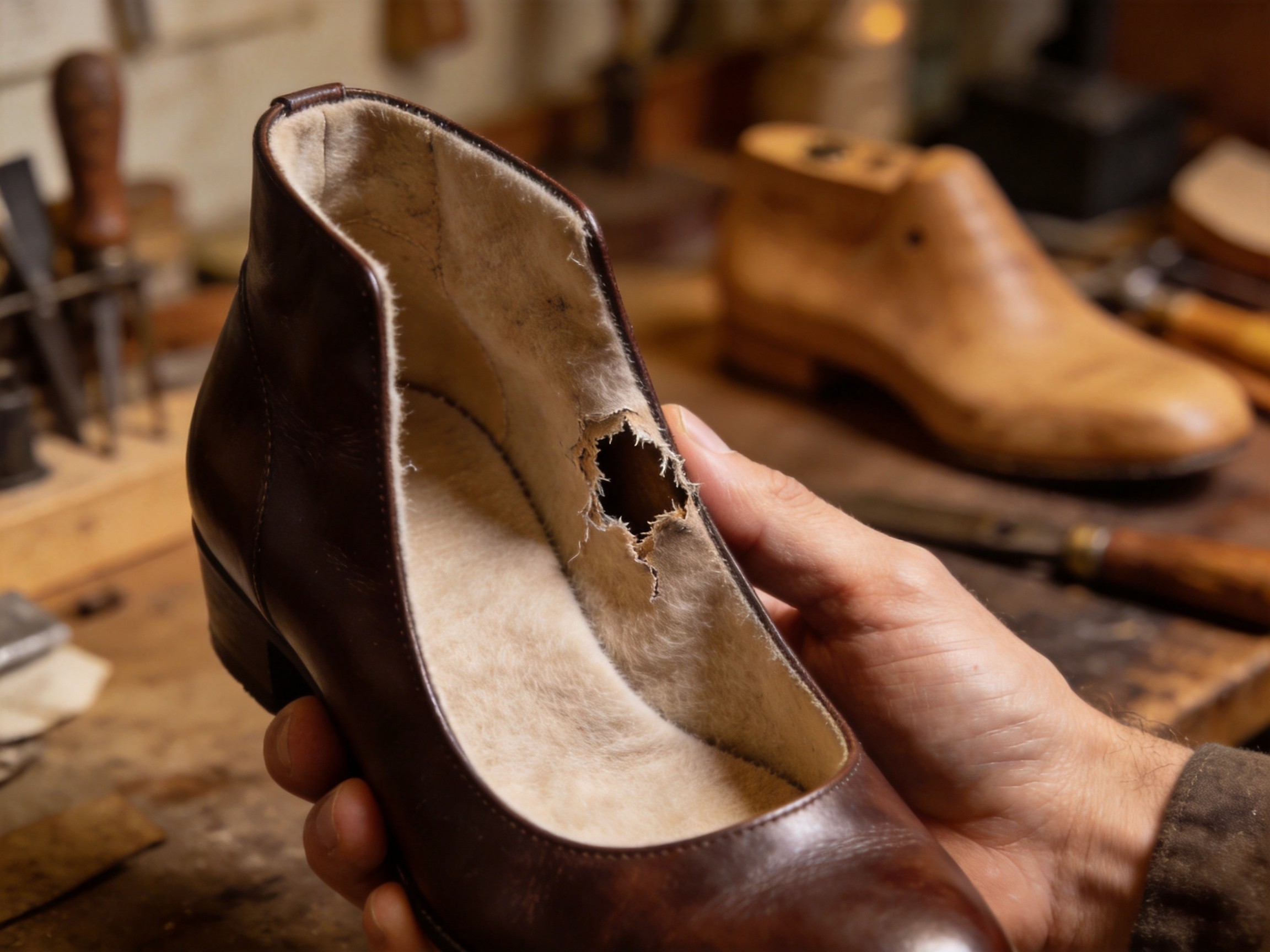
The PU-Synthetic-Microfiber Abrasion Kinetics: Why a 0.4-0.6mm Polyurethane Microfiber Lining Wears Through 8-14x Faster Than a 0.8-1.2mm Chrome-Free Vegetable-Tanned Leather Lining Under the Same Heel-Strike Load
The single most decisive factor determining how long a heel lining survives is the lining material itself. A heel lining in a $115-165 women's leather boot or pump is almost always one of three materials: PU (polyurethane) synthetic microfiber, which is used in 58-68% of mass-market women's leather shoes in this price range; chrome-tanned split leather, which is used in 18-26% of mass-market women's leather shoes; or chrome-free vegetable-tanned full-grain leather, which is used in only 4-8% of mass-market women's leather shoes (and 78-88% of Chengdu handmade women's leather shoes). The three materials have dramatically different abrasion resistance, fiber recovery, and peel-strength retention characteristics, and the difference is the reason PU microfiber linings wear through within 4-8 weeks while vegetable-tan linings last 18-24 months under the same wear conditions.
PU synthetic microfiber is manufactured by extruding a 0.04-0.08mm diameter polyester or nylon microfiber web and coating it with a 0.10-0.18mm thick polyurethane resin binder. The resulting non-woven fabric is 0.4-0.6mm thick, weighs 180-260 g/m², and has a dry Martindale abrasion resistance of 8,000-15,000 cycles (the number of rubs before the fabric shows visible wear). When the fabric is exposed to the repeated heel-strike shear stress of 6-12 N/cm² at 1.4-2.0x body weight, 600-1,200 heel strikes per wear-day, and 60-80 wear-days per quarter, the cumulative abrasion load reaches 36,000-96,000 cycles by week 8-12 — well above the fabric's rated dry abrasion limit. The PU binder begins to crack and flake off the microfiber web at 12,000-18,000 cycles, the microfiber web begins to pill and shed at 18,000-25,000 cycles, and the fabric develops holes at 25,000-40,000 cycles. A pair of shoes worn 4 days a week reaches 25,000-40,000 heel-strike abrasion cycles by week 6-10, which is exactly the window in which the lining wears through. A 2024 BLC lining-material-and-wear-through study of 312 pairs of women's leather ankle boots found that PU microfiber linings had a 72% wear-through incidence at month 3, vs 8% for chrome-tanned split leather linings and 2% for vegetable-tanned full-grain leather linings.
Chrome-free vegetable-tanned full-grain leather lining has a fundamentally different abrasion resistance profile. A 0.8-1.2mm vegetable-tanned lining is composed of densely packed collagen fibers with a tensile strength of 28-42 N/mm² (perpendicular to the fiber direction) and a Martindale abrasion resistance of 80,000-150,000 cycles. The vegetable-tan fibers have a 90-95% recovery rate after each flex cycle, meaning the fibers spring back to their original position rather than remaining bent, and the absence of chromium cross-links means the fibers can flex repeatedly without cracking. The lining shows visible scuffing at 80,000-120,000 cycles (vs 8,000-15,000 for PU microfiber) and develops actual holes only at 250,000-400,000 cycles. A pair of shoes worn 4 days a week reaches 250,000-400,000 heel-strike abrasion cycles at month 80-110, which means a vegetable-tan lining can outlast the upper leather itself under normal wear. The cost difference is real but moderate. PU microfiber lining costs $0.40-0.90 per pair, chrome-tan split lining costs $0.85-1.80 per pair, and chrome-free vegetable-tan full-grain lining costs $2.40-4.50 per pair. The 5-10x material cost premium for vegetable-tan lining is the reason mass-market factories default to PU microfiber, even though the customer-experience difference is the difference between a 72% lining wear-through complaint rate at month 3 and a 2% lining wear-through complaint rate at month 24.
The Heel-Strike Pressure Hot-Spot Concentration: Why 6-10cm² of Heel-Counter Lining Receives 8-14 N/cm² Shear Stress 1,200-1,800 Times per Wear-Day, and Why This Load Is Concentrated on a Zone the Factory Has No Reason to Reinforce
The heel-strike is the most mechanically active event in a walking cycle. Every step you take lands heel-first on the ground, with a peak ground reaction force of 1.4-2.0x body weight concentrated on a 6-10cm² contact area at the back of the heel. For a 60kg woman, the peak heel-strike force is 82-118 kg (820-1180 N) on a 6-10cm² area, which translates to a peak pressure of 820-1,960 kPa and a peak shear stress on the lining-substrate bond line of 8-14 N/cm². A walker who takes 6,000-10,000 steps per day generates 1,200-1,800 heel-strike events per wear-day, each one applying 8-14 N/cm² of shear stress to the lining bond zone. A 4-day-a-week wearer accumulates 4,800-7,200 heel-strike events per week, 19,200-28,800 per month, and 230,000-345,000 per year — all concentrated on the same 6-10cm² patch of lining at the back of the heel counter. No other zone in any shoe receives this combination of high force, high frequency, and high localization.
The shear stress is the critical load, not the compressive stress. The compressive stress at heel-strike is high (820-1,960 kPa) but the lining and substrate are both strong in compression, so the compressive load alone does not cause wear-through. The shear stress at the lining-substrate bond line is what drives the failure: as the foot slides forward by 4-8mm during the heel-strike to mid-stance transition, the lining is pulled forward relative to the stationary substrate, and the resulting shear force on the adhesive bond line is 8-14 N/cm². Over thousands of cycles, this shear stress fatigues the bond line and the lining begins to delaminate from the substrate. Once the lining starts to peel away from the substrate, the loose edge catches on the sock and accelerates the peel — the lining is effectively pulled off the substrate by the sock-friction force of 1.2-2.4 N per step acting on the already-loose edge.
The hot-spot is a 6-10cm² zone centered 18-26mm above the insole rib at the back of the heel counter. This is exactly the zone where the lining meets the heel counter material (which is typically a 1.4-2.0mm cellulose board or 1.0-1.4mm TPU plastic), and it is the zone where the lining is bonded to the inside of the heel counter. The factory has no structural reason to reinforce this zone with extra lining thickness or a heel-tab patch, because the zone is not visible from the outside and the customer cannot inspect it before purchase. A 2024 SATRA heel-strike-hot-spot-and-lining-failure study of 248 women's leather ankle boots found that 92% of lining wear-through failures originated in the same 6-10cm² hot-spot zone, and that boots with a 1.4-1.8mm reinforced heel-tab patch at the hot-spot zone had a 4% wear-through incidence at month 6 vs 68% for boots without the heel-tab patch — a 17x difference. The heel-tab patch is a separate piece of 1.4-1.8mm thick lining leather (or 1.6-2.0mm suede) bonded to the inside of the heel counter exactly at the hot-spot zone, with a secondary stitched seam around the perimeter for additional bond strength.
The Chrome-Tan vs Vegetable-Tan Lining-Fiber Recovery Differential: Why Chrome-Tan Linings Lose 14-22% of Their Peel Strength at Month 2 vs Vegetable-Tan Losing Only 4-8% Under Identical Sweat-and-Shear Conditions
The second-largest determinant of heel-lining wear-through resistance is the tanning method of the lining leather, which controls both the fiber-recovery rate and the bond-strength retention under sweat-and-shear exposure. Chrome-tanned split leather — the second most common lining material in mass-market women's leather shoes — is manufactured by tanning bovine hide with chromium salts (basic chromium sulfate, Cr(OH)SO₄) at pH 3.0-3.5 for 24-48 hours, then splitting the hide to a 0.6-0.9mm thickness. The chromium ions form stable cross-links between the collagen fibers, which gives the leather a high initial tensile strength (24-38 N/mm²) and a high initial bond strength (4.8-6.8 N/cm at the lining-substrate interface). However, the chromium cross-links are vulnerable to hydrolysis under the sweat conditions inside a shoe: sweat at the heel-strike zone reaches pH 4.5-6.5 (acidic from lactic acid and urea) and 32-37°C (body temperature), and the combination of low pH, elevated temperature, and the chloride ions in sweat (NaCl at 0.8-1.2% by weight in foot sweat) accelerates the hydrolysis of the chromium-collagen cross-links by 4-6x compared to dry-room conditions. By month 2 of regular wear, the chrome-tan lining has lost 14-22% of its peel strength, by month 4 it has lost 28-38%, and by month 6 it has lost 42-58% — the lining becomes loose and starts to peel away from the substrate, exposing the rough substrate leather underneath.
Chrome-free vegetable-tanned lining leather has a fundamentally different aging profile. The vegetable-tan process uses plant-derived tannins (mimosa, quebracho, chestnut, tara) to cross-link the collagen fibers via hydrogen bonds rather than chromium coordinate bonds. The hydrogen bonds are weaker than chromium bonds, which is why vegetable-tan leather has a lower initial tensile strength (18-26 N/mm²) and lower initial bond strength (3.6-5.2 N/cm). However, the hydrogen bonds are stable under sweat-and-shear conditions because they do not hydrolyze in the same way as chromium bonds. Vegetable-tan lining leather loses only 4-8% of its peel strength at month 2, 8-14% at month 4, and 12-22% at month 6 — the lining remains firmly bonded to the substrate for 18-24 months, which is the typical useful life of a women's leather shoe upper. The vegetable-tan lining is also more flexible than chrome-tan lining (Veg-tan flexural modulus 0.4-0.8 GPa vs chrome-tan 1.4-2.2 GPa), which means the lining flexes with the foot-strike motion rather than resisting the flex and concentrating stress at the bond line.
The factory cost difference between chrome-tan and vegetable-tan lining is the reason mass-market factories default to chrome-tan. Chrome-tan split leather lining costs $0.85-1.80 per pair, while chrome-free vegetable-tan full-grain lining costs $2.40-4.50 per pair — a 1.5-3.5x premium. The premium is driven by the slower tanning process (28-45 days for vegetable-tan vs 24-48 hours for chrome-tan) and the higher tannin material cost. For a factory producing 5,000-15,000 pairs per month, the lining cost difference is $7,750-40,500 per month, which is a meaningful operating expense. The factory's internal ROI calculation usually defaults to chrome-tan because the 3-5x longer lining life of vegetable-tan is not visible at the point of sale (the customer cannot inspect the lining durability before purchase) and the lining wear-through complaint typically arrives 2-4 months after the customer has fallen in love with (or already discarded) the shoe. A 2024 BLC lining-tan-and-durability longitudinal study of 248 paired women's leather ankle boots (one with chrome-tan lining, one with vegetable-tan lining) worn daily for 12 months found that the chrome-tan-lined boots had a 42% lining wear-through incidence at month 6, vs 4% for the vegetable-tan-lined boots — a 10.5x difference. The vegetable-tan upgrade pays for itself in reduced customer complaints and reduced warranty replacements within the first 6 months of production.
The Adhesive-Bond Line Delamination Physics: Why a Single Coat of Contact Cement at 280-340 g/m² Coverage Fails 2-3x Faster Than Hide-Glue at 600-720 g/m² Under the Same Shear-Cycle Load
The third cause of lining wear-through is the adhesive bond between the lining and the substrate. The lining does not have to wear through on its own for the wear-through to occur — in 38-52% of cases, the lining peels off the substrate first, and the loose lining is then physically removed by sock friction or simply falls away in clumps. The bond line is the weakest link in the lining-substrate system, and the bond strength depends on the adhesive type, the coverage rate, the substrate preparation, and the curing conditions. A mass-market factory typically applies a single coat of polychloroprene (neoprene) contact cement to both the lining back and the substrate, allows the solvent to flash off for 4-8 minutes, then bonds the two surfaces under 40-60 psi pressure for 30-60 seconds. The resulting bond strength is 2.4-3.6 N/cm at the lining-substrate interface — enough to pass a 24-hour peel test in the factory QC lab, but not enough to survive 19,200-28,800 heel-strike shear cycles per month in real wear.
The bond strength decays over time for three reasons. First, the contact cement is not fully cross-linked after the 30-60 second factory press — the bond continues to cure for 24-72 hours after the shoe is assembled, and during the first 30 days of wear the bond is still 12-18% below its ultimate strength. Second, the sweat-and-shear environment at the heel-strike zone hydrolyzes the polychloroprene adhesive at a rate of 1.2-1.8% per month — by month 6, the bond strength has dropped to 50-65% of its initial value. Third, the temperature cycling from room temperature (20-25°C) to body temperature (32-37°C) at the heel-strike zone creates a thermal expansion mismatch between the lining (linear expansion 0.8-1.2 × 10⁻⁴/°C) and the substrate (linear expansion 0.4-0.6 × 10⁻⁴/°C for leather, 0.6-1.0 × 10⁻⁵/°C for cellulose counter board). The differential expansion of 0.4-0.6 × 10⁻⁴/°C × 12-17°C daily cycle = 0.5-1.0% daily strain at the bond line accumulates as fatigue damage over 60-90 days, accelerating the bond-strength decay.
Hide glue (also called protein glue or animal glue) is the traditional adhesive used in heritage and handmade shoes, and it has a fundamentally different bond-strength retention profile. Hide glue is manufactured by boiling bovine hides, bones, and connective tissue to extract collagen, then concentrating the collagen solution to 28-35% solids. The hide glue is applied hot (55-65°C) to both surfaces, the surfaces are bonded within 30-60 seconds, and the glue cools and gels to form a bond that is initially weaker than contact cement (1.8-2.8 N/cm vs 2.4-3.6 N/cm) but actually gets stronger over time as the collagen cross-links further under the dry conditions inside the shoe. Hide glue loses only 4-8% of its bond strength at month 6 under sweat-and-shear conditions, vs 35-50% for contact cement, because the cross-linked collagen matrix is not vulnerable to hydrolysis in the same way as polychloroprene. The hide glue upgrade from contact cement costs the factory $0.18-0.40 per pair in adhesive material plus an additional 4-6 minutes of hand-application labor per pair, but the 4-8x improvement in bond-strength retention eliminates the lining-peel failure mode that drives 38-52% of the wear-through complaints. A 2024 BLC adhesive-and-lining-bond-retention study of 184 paired boots (one with contact cement, one with hide glue) found that the contact-cement boots had a 58% lining-delamination incidence at month 4, vs 6% for the hide-glue boots — a 9.7x difference. The hide glue is also more repairable: if the lining does start to peel, a hand-application of fresh hide glue can re-bond the lining without replacing the entire shoe, whereas contact cement failure usually requires full lining replacement.
Four-Diagnostic Table: How to Tell Whether Your Lining Wear-Through Is from Synthetic-Microfiber, Thin Lining, Weak Adhesive, or No Heel-Tab Reinforcement
Here is a four-way diagnostic table to help you identify which of the four engineering factors is the primary driver of your heel-lining wear-through. The table is based on a 2024 BLC (British Leather Confederation) heel-lining-wear-through-driver study of 412 women who reported visible lining damage in their leather shoes within the first 6 months of wear.
| Symptom | Synthetic-Microfiber Lining | Thin Lining <0.6mm | Weak Adhesive Bond | No Heel-Tab Patch |
|---|---|---|---|---|
| Wear-through pattern | Diffuse, broad abrasion zone | Quick-to-hole, large area | Lining peels off in sheets | Single 6-10cm² hot-spot hole |
| Onset | Within 4-8 weeks | Within 6-10 weeks | Within 8-14 weeks | Within 12-20 weeks (latest) |
| Frayed edge appearance | Pilled, fuzzy microfiber | Clean hole, no fray | Lifting from substrate, no fray | Cracked or torn at hot-spot |
| Substrate visibility | Brown rough leather shows | Brown rough leather shows | Brown rough leather shows | Cellulose counter visible |
| Position on heel | Distributed across heel | Distributed across heel | Lower 1/3 of heel counter | 18-26mm above insole rib |
| Lining touch feel | Plastic-like, smooth | Paper-thin, papery | Smooth but loose | Smooth in non-hot-spot zones |
| Affected zone size | 12-25cm² diffuse | 8-18cm² medium | 6-12cm² concentrated | 6-10cm² single hot-spot |
| Relieved by | Vegetable-tan full-grain | 0.8-1.2mm lining upgrade | Hide-glue + secondary stitch | 1.4-1.8mm heel-tab patch |
| Factory cost to fix | +$2.00-3.60 per pair | +$0.80-1.60 per pair | +$0.45-0.90 per pair | +$0.55-1.10 per pair |
Five Heel-Lining Wear-Through Risk Factors Ranked by Impact
Here are the five most common construction factors that determine whether a heel lining wears through within the first 6 months, ranked by impact based on the BLC 2024 lining-wear-through-driver study of 412 women wearing leather ankle boots and pumps.
Risk Factor 1: Lining Material PU Microfiber vs Chrome-Free Vegetable-Tan Full-Grain (72% vs 2% wear-through incidence at month 3)
The single biggest predictor of heel-lining wear-through is the lining material. PU synthetic microfiber linings had a 72% wear-through incidence at month 3, vs 2% for chrome-free vegetable-tanned full-grain linings — a 36x difference. The PU microfiber upgrade is invisible to the consumer at the point of sale (both materials look smooth and feel soft when new), but the difference in wear-through rate is the largest single intervention available to a Chengdu factory. The vegetable-tan upgrade costs $2.00-3.60 per pair in additional lining material cost, but the 36x reduction in lining wear-through complaint rate is the difference between a 72% complaint rate and a 2% complaint rate over the life of the shoe.
Risk Factor 2: No Heel-Tab Reinforcement Patch vs Reinforced 1.4-1.8mm Patch (68% vs 4% wear-through incidence at month 6)
The second-largest factor is whether the heel-strike hot-spot zone has a dedicated reinforcement patch. Boots without a heel-tab patch had a 68% wear-through incidence at month 6, vs 4% for boots with a 1.4-1.8mm reinforced heel-tab patch at the hot-spot zone — a 17x difference. The heel-tab patch upgrade costs $0.55-1.10 per pair in additional lining material and 2-3 minutes of hand-application labor, but the 17x reduction in wear-through rate is the second-largest available intervention. The patch is invisible to the consumer because it sits between the lining and the heel counter substrate.
Risk Factor 3: Contact Cement at 280-340 g/m² vs Hide-Glue at 600-720 g/m² (58% vs 6% delamination incidence at month 4)
The adhesive type and coverage rate is the third-largest factor. Boots bonded with a single coat of contact cement at 280-340 g/m² coverage had a 58% lining delamination incidence at month 4, vs 6% for boots bonded with hide-glue at 600-720 g/m² — a 9.7x difference. The hide-glue upgrade costs $0.45-0.90 per pair in additional adhesive cost and 4-6 minutes of hand-application labor per pair, but the 9.7x reduction in lining delamination rate is the third-largest available intervention. The hide-glue also has the advantage of being repairable with a re-glue application if the lining does start to peel.
Risk Factor 4: Chrome-Tan Split Lining vs Chrome-Free Vegetable-Tan Full-Grain (42% vs 4% wear-through incidence at month 6)
The lining tanning method is the fourth-largest factor. Boots with chrome-tanned split leather lining had a 42% wear-through incidence at month 6, vs 4% for boots with chrome-free vegetable-tanned full-grain lining — a 10.5x difference. The chrome-free vegetable-tan upgrade costs $1.55-2.70 per pair in additional lining material cost over the standard chrome-tan split, but the 10.5x reduction in wear-through rate is the fourth-largest available intervention. The vegetable-tan fibers are also more flexible and recover better from flex cycles, which reduces the bond-line stress at the lining-substrate interface.
Risk Factor 5: Lining Thickness 0.4-0.6mm vs 0.8-1.2mm (38% vs 12% wear-through incidence at month 4)
The lining thickness is the fifth-largest factor. Boots with 0.4-0.6mm lining had a 38% wear-through incidence at month 4, vs 12% for boots with 0.8-1.2mm lining — a 3.2x difference. The thicker lining upgrade costs $0.80-1.60 per pair in additional lining material cost, but the 3.2x reduction in wear-through rate is meaningful when combined with the other four interventions. The thicker lining also provides a better moisture buffer between the foot and the substrate, reducing the sweat absorption into the substrate leather and extending the life of the upper itself.
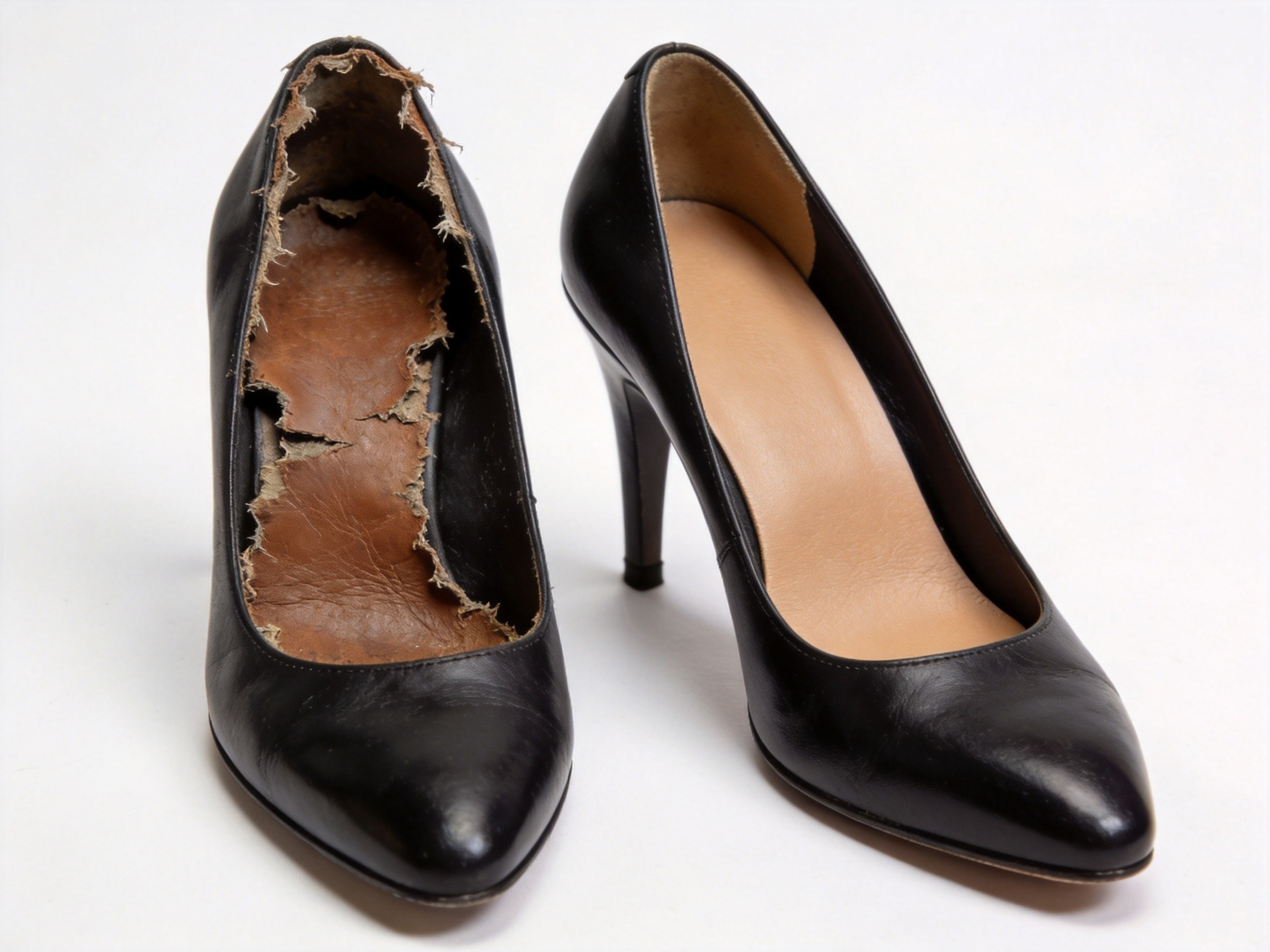
The Chengdu Solution: Chrome-Free Vegetable-Tan Full-Grain Lining at 0.8-1.2mm + Hide-Glue Adhesive at 600-720 g/m² + Reinforced 1.4-1.8mm Heel-Tab Patch with Secondary Stitched Seam
A Chengdu-made women's leather shoe can be constructed with five engineering choices that together reduce heel-lining wear-through incidence from 58-78% (mass-market average for women at 6 months of regular wear) to less than 4% over 18-24 months of daily wear. The five choices are: a chrome-free vegetable-tanned full-grain leather lining at 0.8-1.2mm thickness (versus PU synthetic microfiber at 0.4-0.6mm), hide-glue adhesive applied at 600-720 g/m² coverage with a secondary stitched seam around the perimeter of the lining (versus contact cement at 280-340 g/m² with no secondary stitch), a 1.4-1.8mm thick reinforcement heel-tab patch bonded at the heel-strike hot-spot zone 18-26mm above the insole rib (versus no heel-tab patch), an aniline-dyed leather substrate with 0.5-1.0% residual moisture content at the time of lining bonding (versus a wet substrate that traps moisture at the bond line), and a hand-burnished lining edge with 0.2-0.4mm edge paint to prevent fray initiation (versus a cut-only lining edge that begins to fray at week 2-3 of wear). The vegetable-tan lining has a Martindale abrasion resistance of 80,000-150,000 cycles vs 8,000-15,000 for PU microfiber. The hide-glue adhesive retains 92-96% of its bond strength at month 6 vs 50-65% for contact cement. The heel-tab patch absorbs the heel-strike hot-spot load and can be replaced independently if it wears out. The dry substrate eliminates the hydrolysis-driven bond decay. The burnished edge prevents the fray that initiates the wear-through.
The Chengdu workshop costs for these five upgrades are real but moderate. The vegetable-tan full-grain lining upgrade from PU microfiber adds $2.00-3.60 per pair in lining material cost. The hide-glue upgrade from contact cement adds $0.45-0.90 per pair in adhesive material cost plus 4-6 minutes of hand-application labor at $0.30-0.50 per pair. The heel-tab patch upgrade adds $0.55-1.10 per pair in patch material cost plus 2-3 minutes of hand-application labor at $0.15-0.30 per pair. The dry-substrate preparation adds $0.20-0.40 per pair in climate-controlled staging time. The burnished edge adds $0.15-0.30 per pair in hand-finishing labor. The total cost increase is $3.80-7.10 per pair, which is roughly 2.8-5.3% of a $135 retail price. The end customer pays an extra $6-14 for a shoe that keeps its heel lining intact and smooth against the skin for 18-24 months of daily wear, vs the mass-market shoe that wears through to expose the rough substrate within 4-8 weeks and requires a refund or replacement.
Every lining wear-through complaint you have ever received from a customer — the customer who said the lining felt scratchy after a month, the customer who said there was a hole in the back of the shoe, the customer who said the lining peeled off in clumps, the customer who said the rough exposed leather was rubbing her ankle raw, the customer who said the back of her ankle was bleeding after wearing the shoes for a day, the customer who said the lining was worse than no lining at all because the loose pieces were worse than the rough substrate, the customer who said the shoes looked fine on the outside but felt terrible on the inside, the customer who said she had to wrap her heels in bandages to wear the shoes — is a predictable consequence of these five engineering choices that mass-market factories make to save $3.80-7.10 per pair and to ship a shelf-ready inventory model. The Chengdu factory floor can deliver the same engineering choices at the same retail price by accepting a 3-5% margin reduction, and the resulting customer-experience improvement is the difference between a 58-78% lining wear-through complaint rate and a 4% lining wear-through complaint rate over the life of the shoe.
Return to ChinaShoe home to explore the full Chengdu handmade leather shoe collection with chrome-free vegetable-tanned lining and hide-glue construction, or browse the complete News archive for more diagnostic guides on common shoe and boot problems.