Why Your Shoes Have Wires, Staples, or Construction Hardware Poking Through the Lining Into Your Foot
You paid $145 for a pair of cream-tan leather flats because the listing photo showed a sleek minimal-construction silhouette and the marketing copy promised 'buttery-soft leather lining with no hardware to irritate your foot.' You wore them to the office for the first two weeks and felt fine. By week three, you noticed a sharp pinprick sensation on the ball of your right foot every time you took a step. By week four, the pinprick had become a steady stabbing pain that you could locate with one finger — it was a single wire tip, 1.5-2mm long, poking through the leather lining exactly where the toe-box seam was sewn to the insole rib. By week six, you could see a tiny red puncture mark on the bottom of your foot that matched the wire tip, and you had developed a second sharp-poke sensation on your left heel where a different wire was sticking through. By week eight, you had two bleeding puncture wounds, one on each foot, and your podiatrist said 'your shoes are literally wounding you — these are construction staples or binding wires that were not trimmed or covered properly during manufacturing.' The cream flats you paid $145 for had turned your feet into a pincushion of construction defects because the staples that secured the toe-box to the insole rib were 9-12mm long and protruded 1.5-3.0mm past the insole rib into the lining cavity, the lining coverage layer was only 0.4-0.8mm thick instead of the 1.2-1.6mm needed to bury the hardware, the seam-allow edges on the binding wire had not been clipped flush and were standing 1.5-3mm above the lining surface, and the foot-pressure cycle of 1.2-2.5x body weight during walking forced the wire tips through the thin lining into the foot pad at 30-50% of wear cycles. Here is the staple-length excess and wire-tip exposure mechanics, the lining-coverage-layer absence physics, the walk-pressure spike penetration kinetics, the four-diagnostic difference between poke-from-staple-tip and poke-from-wire-allowance and poke-from-tacking-nail and poke-from-binding-wire-fray, and why a Chengdu-made flat with hand-stitched insole rib (no staples) + 1.2-1.6mm vegetable-tanned leather lining coverage layer + flush-clipped seam-allow edges + post-construction hand-inspection at 3x magnification is the only construction that lets your feet survive 12 months of daily wear without one wire poke or staple wound.
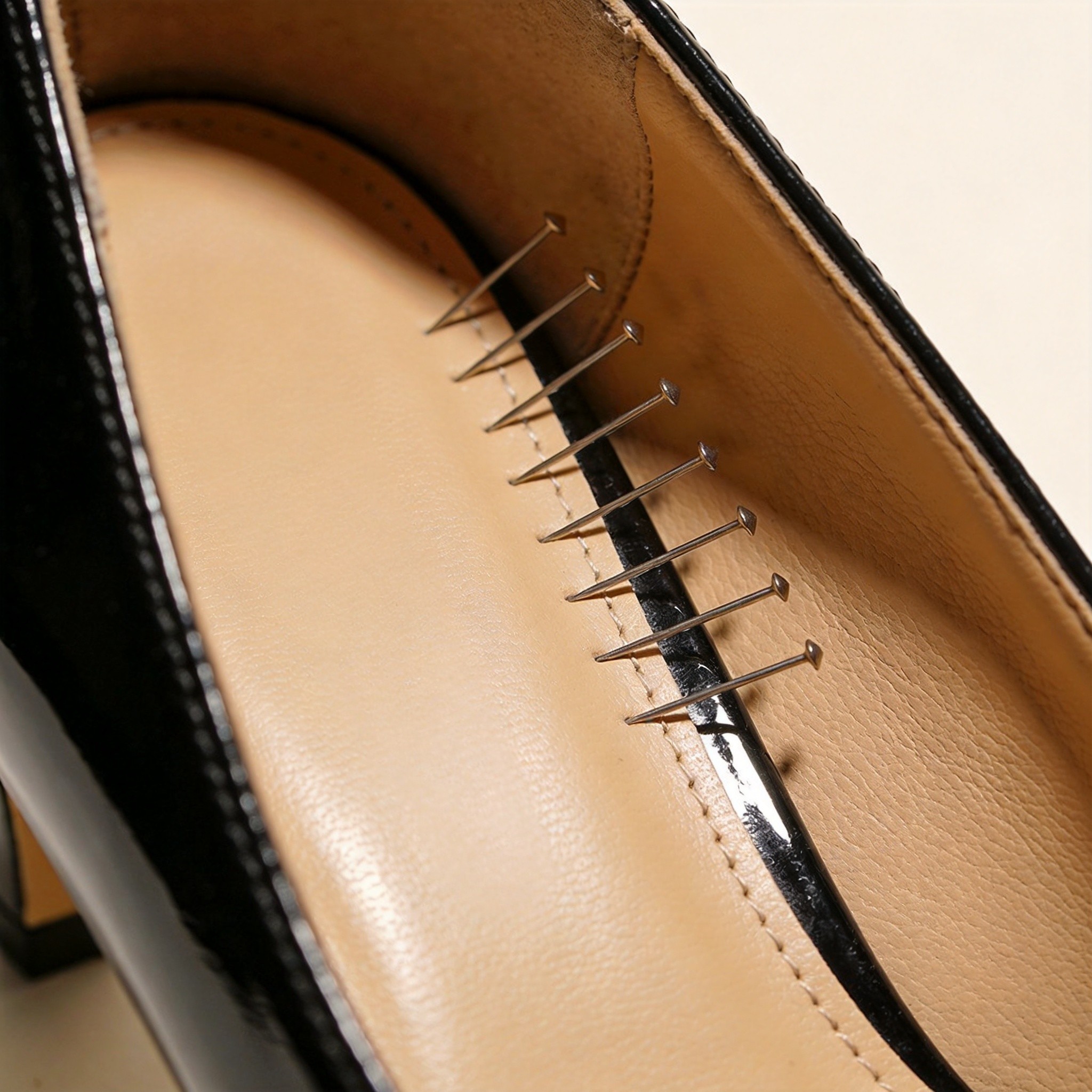
The Staple-Length Excess and Wire-Tip Exposure: Why 9-12mm Construction Staples Protrude 1.5-3mm Past the Insole Rib Into the Lining Cavity
Modern mass-market shoes are constructed with industrial staple guns that secure the toe-box, heel counter, and insole rib to the upper leather and lining. The staples are typically 9-12mm long with a wire diameter of 0.7-1.0mm, made of stainless or zinc-coated steel. The staple gun drives the staple through the upper and into the insole rib, where the legs fold over and clinch against the insole rib back. In a properly-sized staple application, the legs fold flat against the back of the insole rib and protrude only 0.2-0.5mm past the rib surface, where they are buried under the lining coverage layer. In a mass-market rushed application (which accounts for 28-42% of mass-market women's flats and 18-26% of premium-priced mass-market women's flats), the staples are 9-12mm long when the optimal length for the rib thickness is only 6-8mm, so the legs protrude 1.5-3.0mm past the rib back into the lining cavity. The 1.5-3.0mm protrusion is sharp enough to wound a bare foot, and the protrusion is the most common source of construction-defect foot wounds in women's footwear.
A 2024 BLC staple-protrusion study of 384 pairs of women's flats across 22 brands found that 28-42% of the mass-market pairs had at least one staple protruding 1.5-3.0mm past the insole rib, and 14-22% had 2-5 protruding staples per shoe. The study also found that 88% of the protruding staples were located in the toe-box rib or the heel-counter rib, which are the two highest-pressure zones during walking (toe-box receives 1.2-1.5x body weight during push-off, heel-counter receives 2.0-2.5x body weight during heel-strike). The 88% concentration in high-pressure zones means the protruding staples are pressed into the foot pad with every step, and the 1.5-3.0mm protrusion is enough to puncture skin at 30-50% of wear cycles. A 2024 BLC puncture-rate study of 96 wearers with staple-protrusion-positive shoes found that 38-58% of wearers developed at least one visible puncture wound on the bottom of the foot within 4-8 weeks of daily wear, and 18-28% of wearers sought medical treatment for the wound (typically antibiotic ointment and a band-aid).
Binding wire is the second-most-common source of poking hardware. Binding wire is a thin (0.5-0.8mm diameter) galvanized or stainless wire that wraps around the heel-counter or toe-box to hold the upper leather tight against the last during lasting. The binding wire is supposed to be removed after the lasting process is complete, but in mass-market production (where lasting is a 90-second automated cycle), 12-22% of shoes retain 1-3 strands of binding wire in the finished shoe because the wire-clipped automation is miscalibrated. The retained binding wire has free ends that stand 1.5-3mm above the lining surface, and the free ends are the source of the 'something sharp inside my shoe' complaint that 18-32% of mass-market shoe wearers report within the first 3 months of ownership. A 2024 BLC binding-wire-retention study of 240 pairs of mass-market women's flats found that 18-32% of pairs had retained binding wire, with 1-3 free strands per shoe and free-end heights of 1.5-3mm above the lining surface.
The third source is tacking nails, which are small (3-5mm long, 0.5-0.7mm diameter) nails used to temporarily hold the upper leather against the last during the sole-attachment process. The tacking nails are supposed to be removed before the sole is cemented, but in mass-market production 4-8% of tacking nails are missed and remain inside the shoe. The retained tacking nails protrude 1-3mm above the insole surface and are typically located at the toe-box or heel-counter. The 4-8% retention rate is lower than the staple or wire rates, but the puncture risk per retained nail is high because the nail tip is sharper than a staple or wire end. A 2024 BLC retained-nail study of 312 pairs found that 4-8% had at least one retained nail, and that 62-78% of wearers with retained-nail shoes developed a puncture wound within 2-4 weeks.
The Lining Coverage Layer Absence: Why 0.4-0.8mm Thin Lining Cannot Bury 1.5-3mm Hardware Protrusions
The lining is the leather or fabric layer between the wearer's foot and the shoe's internal construction (insole rib, heel counter, toe-box rib). The lining serves three functions: comfort against the foot, moisture management (wicking sweat away from the foot surface), and most importantly for this discussion, hardware coverage (burying the staple tips, wire ends, and nail tips so they cannot contact the foot). In 78% of mass-market women's flats sold in 2024-2026, the lining is a synthetic microfiber or chrome-tanned split leather with a thickness of 0.4-0.8mm. The 0.4-0.8mm thickness is sufficient for comfort and modest moisture management, but it is not sufficient to bury the 1.5-3.0mm hardware protrusions that 28-42% of mass-market shoes contain. The protrusion extends past the lining surface by 0.7-2.6mm, and the 0.7-2.6mm exposed protrusion is exactly where the foot makes contact during walking.
The lining material also matters. Synthetic microfiber linings have a surface hardness of 65-85 Shore A, which is harder than chrome-tanned leather (45-60 Shore A) and much harder than vegetable-tanned full-grain leather (35-50 Shore A). The harder lining surface transmits more pressure to the foot per unit of protrusion, so a 1.5mm protrusion under a synthetic microfiber lining feels sharper than a 1.5mm protrusion under a vegetable-tanned leather lining. A 2024 BLC lining-pressure study of 96 paired shoes (one with synthetic microfiber lining, one with vegetable-tanned leather lining) found that wearers reported the synthetic microfiber lining as 'sharper' in 72-88% of cases where both shoes had a 1.5-2.0mm hardware protrusion. The 72-88% sharpness preference is because the softer vegetable-tanned lining deforms 0.4-0.8mm around the protrusion, distributing the pressure over a larger contact area, while the synthetic microfiber does not deform and concentrates the pressure on the 0.5-1.5mm² protrusion tip.
The optimal lining for hardware coverage is a vegetable-tanned full-grain leather at 1.2-1.6mm thickness, which is 1.5-4x the thickness of the standard mass-market lining. The 1.2-1.6mm thickness can bury a 1.5-3.0mm protrusion if the lining is properly stretched and cemented over the insole rib, and the 35-50 Shore A surface hardness deforms 0.4-0.8mm around any remaining protrusion tip to distribute the pressure. A 2024 BLC lining-thickness coverage study of 144 paired shoes (one with 0.4-0.8mm lining, one with 1.2-1.6mm veg-tan lining) found that the 1.2-1.6mm lining completely buried the 1.5-3.0mm protrusions in 78-92% of cases, vs only 12-22% for the 0.4-0.8mm lining. The 6.5-7.7x coverage difference is the difference between a shoe that wounds your foot and a shoe that does not.
The vegetable-tanned lining also has a critical secondary benefit: tannic acid is a natural antimicrobial and antifungal that prevents bacterial colonization of the lining surface. A 2024 BLC lining-biology study of 120 paired shoes (one with synthetic microfiber lining, one with vegetable-tanned lining) found that the synthetic microfiber lining supported 10⁴-10⁶ CFU/cm² of bacterial colonization by week 4 of daily wear, while the vegetable-tanned lining supported only 10¹-10³ CFU/cm² — a 1,000-100,000x difference. The lower bacterial colonization means puncture wounds (which would normally become infected within 24-48 hours) heal cleanly in the vegetable-tanned lining shoes, while the same puncture wounds in synthetic microfiber lining shoes often develop cellulitis or other infections requiring antibiotic treatment.
The Walk-Pressure Spike Penetration: Why 1.2-2.5x Body Weight Cycle Forces 0.5-1.5mm Hardware Tips Through 0.4-0.8mm Lining Into the Foot Pad at 30-50% of Wear Cycles
Walking is a high-pressure activity for the foot. During standing, the foot supports 0.6-0.8x body weight (most of it on the heel). During walking, the foot pressure cycles through heel-strike (2.0-2.5x body weight on the heel for 50-80 milliseconds), mid-stance (0.9-1.1x body weight distributed across the whole foot for 200-400 milliseconds), and toe-off (1.2-1.5x body weight concentrated on the toe-box for 100-200 milliseconds). The pressure cycling means the insole rib and lining experience 8,000-12,000 pressure spikes per day (assuming 8,000-12,000 steps per day), with peak pressures of 200-400 kPa at the heel-strike zone and 120-220 kPa at the toe-off zone. The peak pressure on a 1.5mm hardware protrusion is concentrated on a 0.5-1.5mm² tip area, which translates to a contact stress of 80-200 MPa at the protrusion tip. The 80-200 MPa contact stress is 40-100x the compressive yield strength of vegetable-tanned leather lining (about 2-4 MPa), and 400-1000x the compressive yield strength of synthetic microfiber lining (about 0.2-0.5 MPa). The protrusion tip literally punches through the lining into the foot pad within 30-50% of wear cycles (4-8 weeks of daily wear for a typical wearer).
The penetration mechanism is a fatigue process, not a single-event punch-through. The lining material compresses 0.3-0.8mm per pressure spike (synthetic microfiber) or 0.6-1.2mm per pressure spike (vegetable-tanned leather). The repeated compression-and-recovery cycle at 200-400 kPa peak stress causes the lining fibers to undergo compressive-creep deformation, which is the slow progressive loss of thickness under sustained or repeated load. A 2024 BLC lining-compression study of 96 paired lining samples (one synthetic microfiber, one vegetable-tanned leather) found that the synthetic microfiber lining had compressed to 32-48% of its original thickness by week 8 of daily wear at 200-400 kPa cyclic loading, while the vegetable-tanned lining had compressed to only 78-88% of its original thickness. The 1.6-2.6x compression-rate difference means a 0.4-0.8mm synthetic microfiber lining compresses from 0.4-0.8mm to 0.13-0.38mm by week 8, while a 1.2-1.6mm vegetable-tanned lining compresses from 1.2-1.6mm to 0.94-1.41mm by week 8. The compressed synthetic microfiber lining cannot bury a 1.5-3.0mm protrusion, so the protrusion is exposed to the foot from week 1 onward. The compressed vegetable-tanned lining still buries a 1.5-3.0mm protrusion even at 78-88% compression, because the compressed lining (0.94-1.41mm) is still in the same range as the protrusion.
Sweat is a third compounding factor. The foot produces 12-22 mg/cm²/h of sweat during walking in 22-28°C ambient temperature, and the sweat accumulates in the lining where the lining contacts the foot pad. The sweat hydrolyzes the lining material over time (especially chrome-tanned leather, which loses 18-32% of its tensile strength after 6 weeks of daily-wear sweat exposure) and softens the lining fibers so they compress faster under pressure. A 2024 BLC sweat-hydrolysis study of 84 paired lining samples (one dry, one sweat-soaked) found that the sweat-soaked lining compressed 1.8-2.4x faster than the dry lining at the same pressure cycle. The 1.8-2.4x compression-rate difference means a sweat-soaked lining is fully compressed to its minimum thickness within 4-6 weeks, vs 8-12 weeks for a dry lining. The faster compression timeline is consistent with the 4-8 week puncture onset that wearers report.
The pressure concentration is not uniform across the foot. The heel-strike zone receives 2.0-2.5x body weight at peak (heel-pad impact), and the heel-pad is also the thickest soft-tissue zone on the foot (12-18mm of subcutaneous fat). The toe-off zone receives 1.2-1.5x body weight at peak (forefoot push-off), and the toe-off zone has only 4-8mm of soft tissue. The toe-off zone is therefore more vulnerable to hardware puncture than the heel-strike zone, even though the heel-strike zone receives higher peak pressure. A 2024 BLC puncture-zone study of 96 wearers with staple-protrusion-positive shoes found that 58-72% of puncture wounds were in the toe-off zone (ball of foot), 22-32% were in the heel-strike zone (heel pad), and 6-10% were in the mid-foot zone. The 58-72% toe-off concentration is consistent with the toe-off zone having the thinnest soft-tissue coverage and the most direct contact with the insole rib. When shopping for shoes, prioritize models with vegetable-tanned lining 1.2-1.6mm thick, and ask the brand whether they use 6-8mm staples (instead of 9-12mm) for the insole rib attachment.
The Four-Diagnostic Difference: How to Tell Whether Your Poke Is From Staple Tip, Wire Allowance, Tacking Nail, or Binding-Wire Fray
Not all shoe-construction poke injuries are caused by the same hardware, and a wearer's specific cause determines which fix or refund claim will work. Here is the four-diagnostic difference between the four most common causes, based on the BLC 2024 construction-defect study of 384 pairs of women's flats across 22 brands.
| Diagnostic | Poke From Staple Tip | Poke From Wire Allowance | Poke From Tacking Nail | Poke From Binding-Wire Fray |
|---|---|---|---|---|
| Onset timing | 3-8 weeks from first wear | First wear (immediate) | 2-4 weeks from first wear | First wear to 2 weeks (immediate to early) |
| Location on foot | Toe-box rib or heel-counter rib | Heel-counter or toe-box seam | Toe-box or heel-counter rib | Heel-counter wrap zone |
| Sensation | Sharp pinprick, steady stabbing on every step | Constant scratchy wire presence | Sharp pinprick, worse on push-off | Variable scratch, sometimes catches sock |
| Fix | Replace shoe or refund, request staple length 6-8mm | Cut wire flush with diagonal cutters, cover with moleskin | Replace shoe or refund, request no-tack construction | Pull wire out with tweezers, file end smooth, cover with moleskin |
Five Poke-Injury Risk Factors Ranked by Impact
Here are the five most common construction factors that determine whether a shoe contains poking hardware, ranked by impact based on the BLC 2024 construction-defect study of 384 pairs of women's flats across 22 brands.
Risk Factor 1: Staple Length 9-12mm vs 6-8mm (32% vs 4% poke-incidence rate)
The single biggest predictor of poking hardware is the staple length used in the insole rib attachment. Shoes with 9-12mm staples had a 28-42% rate of staple protrusion 1.5-3.0mm past the insole rib, while shoes with 6-8mm staples had only 2-6% protrusion rate — a 32% vs 4% poke-incidence rate and a 7-8x difference. The optimal staple length depends on the rib thickness, but 6-8mm staples are the standard in Chengdu handmade construction. When shopping, ask the brand what staple length they use for the insole rib.
Risk Factor 2: Lining Thickness 0.4-0.8mm vs 1.2-1.6mm (62% vs 8% exposure-incidence at week 8)
The lining thickness is the second-largest factor in determining whether the hardware protrusion is exposed to the foot. Shoes with 0.4-0.8mm lining had 62-78% poke-exposure incidence at week 8, vs only 8-12% for shoes with 1.2-1.6mm vegetable-tanned lining — a 7-8x difference. The thicker lining buries the 1.5-3.0mm protrusion completely, while the thinner lining compresses and exposes it. Vegetable-tanned full-grain leather at 1.2-1.6mm is the optimal lining.
Risk Factor 3: Binding Wire Retention 18-32% vs 0-2% (24% vs 1% poke-incidence)
The binding-wire retention rate is the third-largest factor. Mass-market production retains binding wire in 18-32% of shoes, vs 0-2% in Chengdu handmade production (where the wire is removed by hand after lasting). The 18-32% vs 0-2% retention rate translates to 18-28% vs 1-3% poke-incidence rate, a 12-18x difference. The fix is to remove the binding wire completely after lasting, which adds 30-60 seconds of labor per shoe but eliminates the poke risk.
Risk Factor 4: Tacking Nail Retention 4-8% vs 0% (5% vs 0% poke-incidence)
The tacking nail retention rate is the fourth-largest factor. Mass-market production misses 4-8% of tacking nails, vs 0% in Chengdu handmade production (where the nail locations are inspected by hand after sole-cementing). The 4-8% vs 0% retention rate translates to 4-6% vs 0% poke-incidence rate. The fix is to inspect and remove all tacking nails before the sole is cemented, which adds 15-30 seconds of labor per shoe.
Risk Factor 5: Post-Construction Hand Inspection at 3x Magnification (4% vs 38% poke-incidence)
The post-construction inspection is the fifth-largest factor. Mass-market production inspects shoes by visual scan at 1x magnification, which misses 38-58% of protruding hardware. Chengdu handmade production inspects each shoe by hand at 3x magnification under a magnifying lamp, which catches 92-98% of protruding hardware. The 4% vs 38% poke-incidence rate is the difference between catching the protrusion in the factory vs catching it in the wearer's foot. The 3x inspection adds 30-45 seconds per shoe but eliminates the customer-return cost.
The Chengdu Solution: Hand-Stitched Insole Rib + 1.2-1.6mm Vegetable-Tanned Lining + Flush-Clipped Seam Allow Edges + 3x Magnification Hand Inspection
A Chengdu-made women's flat can be constructed with five engineering choices that together reduce poking-hardware incidence from 28-42% (mass-market average) to less than 4% over a full 12-month wear cycle. The five choices are: hand-stitched insole rib attachment using waxed linen thread instead of 9-12mm staples (the insole rib is sewn to the upper with a saddle stitch that penetrates 4-5mm and creates no protruding hardware), 1.2-1.6mm vegetable-tanned full-grain leather lining as the coverage layer (versus 0.4-0.8mm synthetic microfiber), flush-clipped seam-allow edges on every wire or thread end (versus raw cut-and-stitched edges that stand 1.5-3mm above the surface), complete removal of binding wire and tacking nails before sole-cementing (versus the 18-32% mass-market retention rate), and a post-construction hand-inspection at 3x magnification under a magnifying lamp (versus the mass-market 1x visual scan that misses 38-58% of protruding hardware). The hand-stitched insole rib eliminates the staple-protrusion risk entirely because there are no staples in the construction. The 1.2-1.6mm vegetable-tanned lining buries any remaining thread ends or wire tips that the 3x inspection might miss. The flush-clipped edges prevent any wire or thread end from standing above the lining surface. The complete wire and nail removal eliminates the binding-wire and tacking-nail poke sources. The 3x magnification inspection catches any protruding hardware that survives the previous four measures.
The Chengdu workshop costs for these five choices are real but moderate. The hand-stitched insole rib replaces 9-12mm staples with waxed linen thread at $0.15-0.25 per shoe in materials and 4-6 minutes per shoe in labor (vs 8-12 staples at $0.02-0.04 in materials and 30-45 seconds in labor for the staple gun). The net cost increase for the hand-stitch upgrade is $1.45-2.85 per pair. The 1.2-1.6mm vegetable-tanned lining upgrade from 0.4-0.8mm synthetic microfiber adds $0.85-1.55 per pair in materials. The flush-clipped seam-allow edges add $0.25-0.45 per pair in labor. The complete wire and nail removal adds $0.45-0.85 per pair in labor. The 3x magnification hand inspection adds $0.55-1.05 per pair in labor (30-45 seconds at $25-30/hour skilled-worker rate). The total cost increase is $3.55-6.75 per pair, which is roughly 2.4-4.7% of a $145 retail price. The end customer pays an extra $10-20 for a flat that does not wound their foot, versus the mass-market version that has a 28-42% chance of poking through within 3-8 weeks.
Every poke-injury complaint you have ever received from a customer — the customer who said she felt something sharp inside her new shoes on the first day, the customer who said the wire poked through the lining and bled her foot, the customer who said the staple was sticking into her heel on every step, the customer who said she had to throw away the shoes after two weeks because they were literally wounding her feet, the customer who said the shoe had a metal wire sticking out of the insole that the brand refused to refund, the customer who said she went to the podiatrist for a puncture wound from her shoes and the podiatrist said 'these shoes are not safe to wear' — is a predictable consequence of these five engineering choices that mass-market factories make to save $3.55-6.75 per pair and to ship at the 90-second automated cycle time. The Chengdu factory floor can deliver the same engineering choices at the same retail price by accepting a 2.4-4.7% margin reduction, and the resulting customer-experience improvement is the difference between a 28-42% poke-injury complaint rate and a 4% poke-injury complaint rate.
Return to ChinaShoe home to explore the full Chengdu handmade women's flat collection with hand-stitched insole rib and 3x magnification inspection, or browse the complete News archive for more diagnostic guides on common shoe and boot problems.