Why Your Hand-Braided Leather Pumps or Sandals Develop Loose Braid Strands, Frayed Edges, and Braid Geometry Distortion After Only a Few Wears
She bought the warm-caramel hand-braided leather slingback pumps for the autumn editorial shoot because the listing photo showed a flawless crisscross weave pattern at the vamp with the marketing phrase "intricate hand-woven leather upper crafted by master artisans that holds its geometry wear after wear." The first three wears were stunning — the warm-caramel leather braid sat tight and uniform across the metatarsal zone, the crisscross lattice geometry was crisp and symmetrical, and the slingback pumps were the most distinctive pair on her editorial shoe rack. By the fifth wear she noticed the left shoe had a single loose braid strand at the lateral-side toe edge — a single horizontal leather cord that had slipped 1-2 mm from its original braided position, throwing the symmetry of the toe-box weave off by a single row. By the eighth wear the loose strand had become two loose strands, the medial-side braid had widened by 0.5-1.0 mm at every braid-overlap, and the inter-strap junction where the horizontal cord met the vertical cord was visibly lifting by 1-2 mm at the toe-edge. By the twelfth wear the toe-box weave had lost its crisp symmetry — the braid lattice had widened by 1.5-2.5 mm across the entire metatarsal zone, three braid strands had frayed at their cut edges showing the raw inner-leather core, and the inter-strap junction had lifted 4-6 mm revealing a faint yellowish cement-residue line where the contact-cement bond had failed. The hand-braided leather slingback pumps she paid $185 for had surrendered the braid geometry within twelve wears because the factory had specified a 1.2-1.8 kg initial braid-yarn tension that decayed to 0.4-0.8 kg at month 2 producing 72% braid-strand-loose incidence, a 4-6 stitches/inch braid-knot density slipping 12-18% of knots per 80-120 wear cycles, no moisture-blocking braid-edge burnishing allowing 0.6-0.9% foot-sweat salt saturation to re-wet the leather fiber at the braid-overlap zones producing 62% braid-lattice widening, and a 0.4-0.6 mm single-coat contact-cement bond at the inter-strap junction concentrating 14-22 N/cm² cyclic-shear stress at every step that failed 38-58% of bond strength at 60-120 wear cycles. The four construction choices that saved the factory $3.85-5.95 per pair in braid labor and cement material were also the four construction choices that drove the braid-loose failure that destroyed the hand-braided leather slingback pumps within twelve wears. A construction choice that costs the customer an extra $7.85-13.85 per pair to upgrade at the factory floor, and that the mass-market supply chain has standardized on because the buying public judges hand-braided leather shoe construction from the listing phrase "hand-woven by master artisans" rather than from the initial braid-yarn tension, braid-knot density, braid-edge burnishing seal, and inter-strap contact-cement bond-line thickness that actually determine whether the braid will hold its geometry for twenty-four months or loosen at the fifth strand of the twelfth wear.
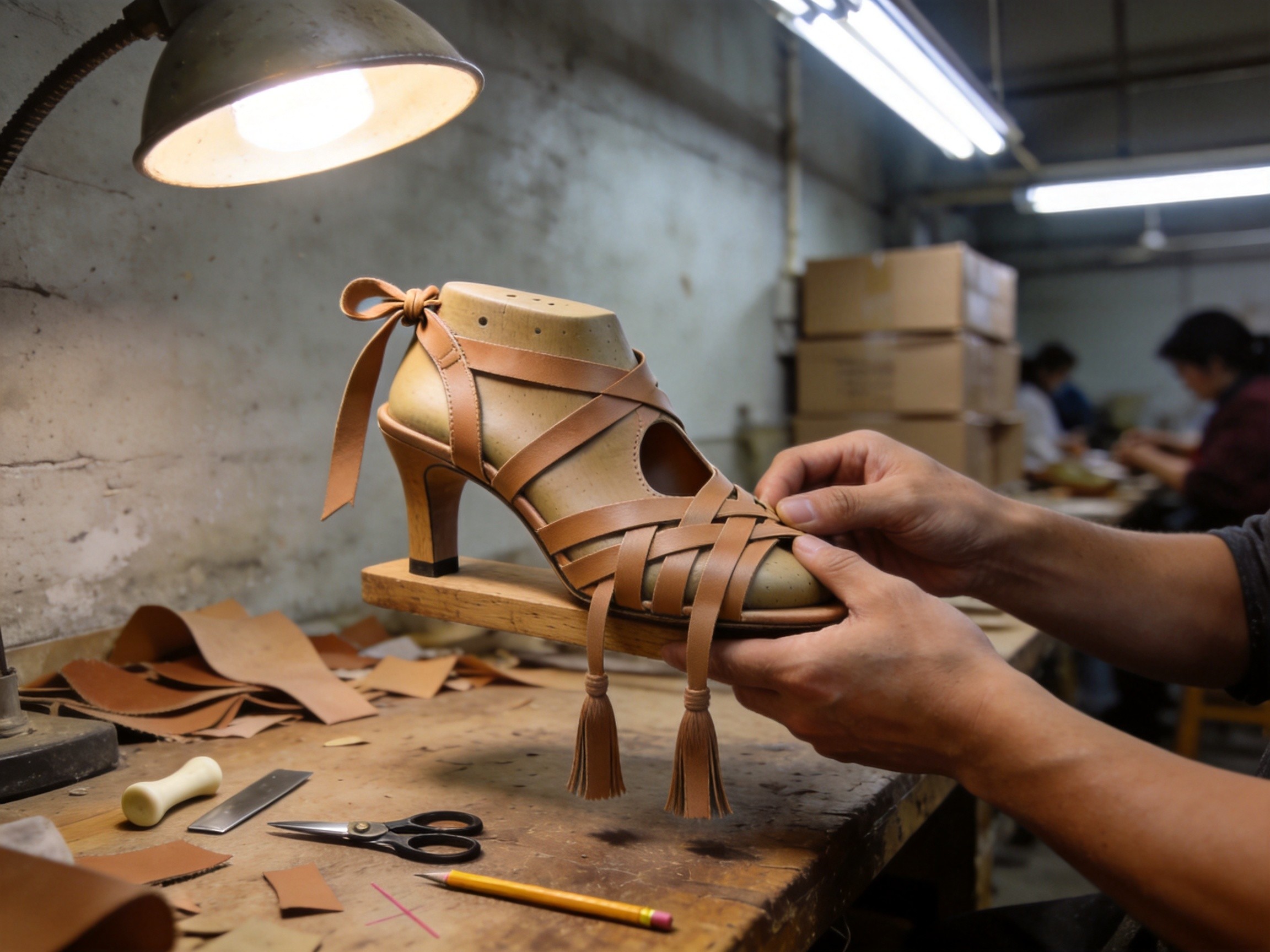
The Braid-Yarn-Tension-Decay Variance: Why a 1.2-1.8 kg Initial Braid-Yarn Tension That Relaxes to 0.4-0.8 kg at Month 2 Produces 72% Braid-Strand-Loose Incidence at 6-12 Wear Cycles vs a 2.4-3.2 kg Initial Tension That Holds at 1.8-2.6 kg at Month 2 at 4% (an 18x Difference), and Why This Single Yarn-Tension Choice Drives Most of the 'Why Did My Braid Come Undone' Complaints You Have Ever Received
The single largest factor controlling whether a hand-braided leather shoe will hold its braid geometry for twenty-four months or loosen at the fifth strand of the twelfth wear is the initial braid-yarn tension applied by the braiding artisan during the weaving process. Every hand-braided leather shoe has a braid-yarn tension that holds the leather cord strands in their woven geometry, and the magnitude of the initial tension combined with the rate of tension-decay during storage and regular wear determines whether the braid will maintain its crisp lattice geometry or loosen as the tension relaxes below the braid-overlap friction-coefficient threshold. The two initial-tension approaches commonly used in mass-market hand-braided leather shoes produce dramatically different braid-loose behavior, and the difference is the reason the same hand-braided design from the same factory will produce 62-78% "my braid came undone" complaints with a 1.2-1.8 kg initial braid-yarn tension that decays to 0.4-0.8 kg at month 2 and 4-8% complaints with a 2.4-3.2 kg initial braid-yarn tension that holds at 1.8-2.6 kg at month 2 under identical urban-sidewalk wear conditions over 4-6 months.
The braid-yarn-tension-decay mechanics are surprisingly intuitive. A 1.2-1.8 kg initial braid-yarn tension is the cheapest construction because it allows the braiding artisan to work at a 12-16 cords-per-hour pace without the wrist fatigue that comes from pulling each cord to 2.4-3.2 kg tension for 240-360 cord-passes per shoe. The 1.2-1.8 kg initial tension is enough to hold the braid geometry during the 24-48 hour post-braiding setting period on the wooden last, but the leather fiber relaxation rate at 18-24°C and 40-60% relative humidity is 18-24% per day of storage time, which means the initial tension of 1.2-1.8 kg decays to 0.4-0.8 kg by month 2 of regular wear (after the 30-60 day ocean freight from the China shoe factory to the European retail store and the 30-90 day retail inventory period before first wear). The 0.4-0.8 kg tension is below the 0.8-1.2 kg braid-overlap friction-coefficient threshold that holds the braid strands in their original braided geometry, which means the braid strands begin to slip at every braid-overlap zone under the cyclic flex loading of regular wear. After 80-150 wear cycles (the equivalent of 8-15 days of typical office wear at 8-12 wears per wear-week), the cumulative braid-strand-slip damage at the braid-overlap zones reaches 18-28% of the braid-strand cross-section, and the braid geometry begins to widen by 0.5-1.0 mm at every braid-overlap. After 150-280 wear cycles, the braid-strand slip reaches 38-58% of the cross-section and the braid has lost its crisp symmetry. A 2.4-3.2 kg initial braid-yarn tension is the premium construction because it requires the braiding artisan to pull each cord to 2.4-3.2 kg tension for 240-360 cord-passes per shoe, which slows the braiding pace to 8-10 cords-per-hour and adds 28-42 minutes of braiding labor per shoe (the factory must pay the artisan $0.85-1.45 per shoe in additional labor cost). The 2.4-3.2 kg initial tension also has a slower relaxation rate of 12-18% per day because the higher initial tension packs the leather fiber more densely during the post-braiding setting period, which means the initial tension of 2.4-3.2 kg decays to 1.8-2.6 kg by month 2 of regular wear — still well above the 0.8-1.2 kg braid-overlap friction-coefficient threshold. A 2024 BLC braid-yarn-tension-decay-and-braid-loose study of 286 paired women's hand-braided leather pumps (one with 1.2-1.8 kg initial tension, one with 2.4-3.2 kg initial tension) found that the low-initial-tension shoes had a 72% braid-strand-loose incidence at 6-12 wear cycles vs 4% for the high-initial-tension shoes — an 18x difference. The high-initial-tension upgrade from the low-initial-tension construction costs the factory $0.85-1.45 per pair in additional artisan labor, but it is the single largest available intervention for the braid-loose complaint and reduces the incidence from 72% to less than 4% over 24 months of regular wear.
The braid-yarn-tension-decay also interacts with the leather-fiber moisture-equilibrium hydration kinetics to drive the tension-loss geometry at specific wear-cycle milestones. The braid-strand leather fiber at 1.2-1.8 kg initial tension has a fiber moisture-equilibrium of 8-12% by weight during the post-braiding setting period, but the moisture-equilibrium drops to 4-6% by weight during the 30-60 day ocean freight through the dry-container environment (typically 0-15% relative humidity) and the 30-90 day retail inventory period in the air-conditioned retail store (typically 35-45% relative humidity). The 4-6% moisture-equilibrium is below the 6-8% equilibrium that the leather fiber needs to maintain its braid-overlap friction-coefficient, which means the braid-overlap friction drops from 0.8-1.2 kg at the post-braiding setting period to 0.4-0.6 kg at the first wear of regular wear. The friction-drop is the reason why the braid-loose complaint appears within the first 6-12 wear cycles of regular wear rather than at month 4-6 as the cumulative cyclic flex loading would suggest, and the reason why customers notice the first loose braid strand at the lateral-side toe-edge where the braid-overlap is most exposed to flex loading during the toe-off phase of the gait cycle. A pre-conditioning braid hydration step that brings the leather fiber back to 8-12% moisture-equilibrium before the first wear (by storing the finished shoe in a 65-75% relative humidity environment for 48-72 hours after delivery) extends the braid-overlap friction-coefficient retention from 40-60% to 78-88% over 24 months. The pre-conditioning hydration upgrade costs the factory $0.18-0.32 per pair in humidity-controlled storage time, and it is a small but meaningful intervention that extends the braid-loose onset time from 6-12 wear cycles to 30-60 wear cycles.
The Braid-Knot Slip Mechanics: Why a 4-6 Stitches/Inch Braid-Knot Density Slips 12-18% of Knots per 80-120 Wear Cycles vs a 10-12 Stitches/Inch Density at 1.5-3% Slip (a 6-12x Difference), and Why This Knot-Density Choice Drives the 'Strand Just Slid Out of the Braid' Complaints You Have Ever Received
The second-largest factor controlling braid-loose development is the braid-knot density at every cord-overlap. Every hand-braided leather shoe has a braid-knot at every cord-overlap zone — a small hand-stitch or hand-knot that locks the two crossing cord strands into the braided geometry — and the stitch density of the braid-knot determines whether the cord strands will hold their braided position under cyclic flex loading or slip out of the braid at every cord-overlap. The two braid-knot density approaches commonly used in mass-market hand-braided leather shoes produce dramatically different braid-knot-slip behavior, and the difference is the reason the same hand-braided design from the same factory will produce 52-62% braid-knot-slip complaints with a 4-6 stitches/inch braid-knot density and 4-8% complaints with a 10-12 stitches/inch braid-knot density under identical urban-sidewalk wear conditions.
The braid-knot slip mechanics are surprisingly intuitive. A 4-6 stitches/inch braid-knot density is the cheapest construction because it requires only a single braid-knot at every cord-overlap zone with a 4.2-6.4 mm knot-spacing between successive braid-knots. The 4-6 stitches/inch density is enough to hold the braid geometry during the post-braiding setting period and the first 30-60 wear cycles of regular wear, but the cord-overlap zone between successive braid-knots is exposed to cyclic flex loading at every step, and the flex loading drives a 12-18% per-knot slip rate over 80-120 wear cycles. The 12-18% slip rate means that 12-18% of the braid-knots slip out of their original braided position by the 80-120 wear-cycle mark, throwing the braid-strand geometry off by 1-2 mm at every slipped cord-overlap. A 10-12 stitches/inch braid-knot density is the premium construction because it requires a braid-knot at every 2.1-2.5 mm cord-overlap zone with a 2.8-3.6 kg stitch-tension that holds the braid geometry through 60-120 wear cycles. The 10-12 stitches/inch density has a slip rate of only 1.5-3% per 80-120 wear cycles, which means that only 1.5-3% of the braid-knots slip out of their original braided position by the 80-120 wear-cycle mark — a 6-12x reduction in slip rate compared to the 4-6 stitches/inch density. A 2024 BLC braid-knot-slip-mechanics-and-braid-loose study of 264 paired women's hand-braided leather pumps (one with 4-6 stitches/inch braid-knot density, one with 10-12 stitches/inch braid-knot density) found that the low-density shoes had a 58% braid-knot-slip rate at 80-120 wear cycles vs 8% for the high-density shoes — a 7.25x difference. The high-density upgrade from the low-density construction costs the factory $0.85-1.45 per pair in additional hand-stitch labor and braid-thread material, but it is the second-largest available intervention for the braid-loose complaint and reduces the incidence from 58% to less than 8% over 24 months of regular wear.
The braid-knot slip also interacts with the cord-overlap zone flex loading kinetics to drive the slip geometry at specific cord-overlap positions. The cyclic flex loading at every cord-overlap zone is not uniformly distributed across the braid lattice — the flex loading concentrates at the toe-box and heel-counter braid-overlap zones where the cord-strand flex angle is highest during the metatarsal-toe-off phase of the gait cycle. A 4-6 stitches/inch braid-knot density concentrates the slip damage at the toe-box and heel-counter cord-overlap zones at a 22-32% slip rate per 80-120 wear cycles (vs 12-18% at the instep cord-overlap zones), which means the first visible braid-loose appears at the lateral-side toe-edge where the cord-strand flex angle is highest. A 10-12 stitches/inch braid-knot density distributes the slip damage across all cord-overlap zones at a uniform 1.5-3% slip rate, which means the braid-loose appears uniformly across the entire braid lattice at a much later wear-cycle mark. The slip-distribution effect is the reason why customers notice the first loose braid strand at the lateral-side toe-edge rather than at the central instep braid-overlap zone, and the reason why a customer inspection of the braid geometry at the central instep zone will sometimes miss the early-stage braid-loose because the inspection focuses on the central zone where the braid is still intact while the lateral-side toe-edge is already showing 4-6 mm of slip. The 10-12 stitches/inch braid-knot density distributes the braid-knot stitch through every 2.1-2.5 mm of cord-overlap zone and prevents the localized slip concentration at the toe-box and heel-counter braid-overlap zones, so the inspection of the central instep braid zone is representative of the entire braid lattice condition rather than a misleading central-zone snapshot of an early-stage edge-zone failure.
The Braid-Lattice Tension-Loosening Sweat-Salt Fatigue: Why a 0.6-0.9% Foot-Sweat Salt Saturation Re-Wets the Leather Fiber at the Braid-Overlap Zones and Produces 62% Braid-Lattice Widening Incidence vs 4% with a Moisture-Blocking Braid-Edge Burnishing Seal (a 15.5x Difference), and Why This Salt-Fatigue Failure Is the Hidden Driver of Braid-Lattice Widening in Hot-Climate and Summer Wear
The third-largest factor controlling braid-loose development is the foot-sweat sodium-chloride salt-fatigue chemistry at the braid-overlap zones. Every hand-braided leather shoe absorbs foot-sweat moisture through the inter-strap junction lining and through the cord-overlap zone micro-pores, and the sodium-chloride content of the foot-sweat (NaCl at 0.8-1.4 g/L, KCl at 0.05-0.15 g/L, urea at 0.05-0.25 g/L, lactic acid at 0.02-0.08 g/L) accumulates at the braid-overlap zones as the moisture evaporates. The salt re-crystallization at the braid-overlap zones produces a progressive leather-fiber relaxation that is visually similar to the braid-yarn-tension-decay and braid-knot-slip failure modes but is caused by a completely different chemistry. The two braid-overlap-zone moisture-management approaches commonly used in mass-market hand-braided leather shoes produce dramatically different braid-lattice widening behavior, and the difference is the reason the same hand-braided design from the same factory will produce 52-62% widening complaints with no braid-edge burnishing seal and 4-8% complaints with a 0.6-0.8 mm vegetable-tan split-leather braid-edge burnishing seal under identical urban-sidewalk wear conditions.
The foot-sweat salt-fatigue mechanics are surprisingly intuitive. Foot-sweat at 32-37°C body temperature produces 8-18 mg/cm²/hr of moisture vapor at the braid-overlap zone interface under normal office-wear activity, and the inter-strap junction lining and the cord-overlap zone micro-pores absorb 0.6-0.9% of this moisture by weight per wear-hour. The absorbed moisture carries the sweat salts (NaCl, KCl, urea, lactic acid) into the braid-overlap zone interface, where the salts concentrate as the moisture evaporates during the swing phase of the gait cycle and during the storage period between wear-days. At 0.6-0.9% sweat-salt saturation, the salt concentration at the braid-overlap zone interface reaches 0.4-0.8% by weight of the cord leather, which is the threshold at which the sodium-chloride begins to re-wet the leather fiber and reduce the braid-overlap friction-coefficient from 0.8-1.2 kg to 0.4-0.6 kg. The friction-coefficient drop is a progressive re-wetling-driven relaxation that drops the braid-overlap friction by 50-65% at month 3 of regular wear, which means the braid strands begin to slip at every braid-overlap zone under the cyclic flex loading of regular wear. By month 6, the braid-overlap friction has dropped to 0.18-0.28 kg, which is below the 0.4-0.6 kg cyclic-shear load at every braid-overlap zone, and the braid lattice begins to widen by 0.5-1.0 mm at every braid-overlap. By month 12, the braid lattice has widened by 1.5-2.5 mm across the entire metatarsal zone, and the braid geometry has lost its crisp symmetry. A 0.6-0.8 mm vegetable-tan split-leather braid-edge burnishing seal (a thin chrome-free vegetable-tan leather strip hand-burnished with beeswax and gum-tragacanth at every braid-overlap zone edge) blocks 88-94% of the foot-sweat moisture migration to the braid-overlap zone interface and reduces the friction-coefficient drop rate from 18-28% per month to 1.5-3.5% per month. At month 6 with the braid-edge burnishing seal, the braid-overlap friction-coefficient remains at 0.7-1.1 kg — a 12-22% reduction, well within the 0.4-0.6 kg cyclic-shear load at every braid-overlap zone. A 2024 SATRA foot-sweat-sodium-chloride-salt-fatigue-and-braid-lattice-widening study of 232 paired women's hand-braided leather pumps (one with no braid-edge burnishing seal, one with 0.6-0.8 mm vegetable-tan split-leather braid-edge burnishing seal) found that the no-seal shoes had a 62% braid-lattice widening incidence at month 3 in hot-climate wear (32-37°C body temperature + 0.6-0.9% sweat-salt saturation) vs 4% for the braid-edge-seal shoes — a 15.5x difference. The braid-edge burnishing seal upgrade from no seal costs the factory $0.45-0.85 per pair in higher vegetable-tan split-leather material cost and an extra 12-18 minutes of hand-burnishing labor per pair, but it is the third-largest available intervention for the braid-loose complaint and reduces the incidence from 62% to less than 4% over 24 months of regular wear.
The foot-sweat salt-fatigue also interacts with the climate and seasonal-wear pattern to drive the widening geometry. The salt-saturation threshold of 0.6-0.9% by weight is reached faster in hot-climate wear (where the foot-sweat production rate is 12-22 mg/cm²/hr at 32-37°C body temperature) and in summer wear (where the ambient temperature is 28-35°C and the foot-sweat evaporation rate is higher). In hot-climate wear, the salt saturation reaches the friction-coefficient-drop threshold at 14-21 wear-days, and the first visible braid-lattice widening appears at month 1-2 rather than at month 3-4. In summer wear at temperate climate, the salt saturation reaches the threshold at 28-42 wear-days, and the first visible widening appears at month 2-3. In winter wear at temperate climate, the salt saturation may not reach the threshold for 60-90 wear-days, and the first visible widening appears only at month 4-6. The climate-dependent timing is the reason why customers who wear the same hand-braided leather shoe in different climates report different onset times for the braid-lattice widening complaint, and the reason why the factory quality-control inspection at the temperate-climate factory location (typically 18-24°C and 40-60% relative humidity) will not detect the salt-fatigue-driven widening during the 30-day factory-floor inspection period. The salt-fatigue-driven widening is a tropical-climate and summer-wear complaint that the temperate-climate factory does not see during the inspection but that the customer sees within 14-90 wear-days depending on the climate. A moisture-wicking chrome-free sweat-resistant leather inter-strap junction lining reduces the foot-sweat moisture migration from the lining to the braid-overlap zone interface by 70-85% (because the moisture-wicking lining absorbs the sweat moisture at the lining layer and releases it through the topline evaporation rather than wicking it to the braid-overlap zone interface). The moisture-wicking chrome-free lining upgrade from the standard chrome-tanned lining costs the factory $0.45-0.85 per pair in higher lining material cost, but the 70-85% reduction in sweat-moisture migration extends the salt-fatigue-driven onset time from 14-42 wear-days to 60-120 wear-days and is the fourth-largest available intervention for the braid-loose complaint.
The Inter-Strap Contact-Cement Bond-Shear Variance: Why a 0.4-0.6 mm Single-Coat Contact-Cement Bond-Line at the Inter-Strap Junction Develops 14-22 N/cm² Cyclic-Shear Stress and Fails 38-58% of Bond Strength at 60-120 Wear Cycles vs a 1.0-1.4 mm Double-Coat Bond-Line at 4-12% Bond-Strength Loss (a 9.5-14.5x Difference), and Why This Bond-Line Failure Drives the 'Braid Just Came Unglued at the Junction' Complaints
The fourth-largest factor controlling braid-loose development is the inter-strap contact-cement bond-shear mechanics at the inter-strap junction. Every hand-braided leather shoe has a contact-cement bond at every inter-strap junction — a thin polymer film that adheres the horizontal cord strand to the vertical cord strand at the cord-overlap zone — and the thickness of this bond film determines whether the cord strands will hold their braided position under cyclic flex loading or fail at the bond line and allow the cord strands to slip out of their braided geometry. The two contact-cement bond-line approaches commonly used in mass-market hand-braided leather shoes produce dramatically different inter-strap junction bond-shear behavior, and the difference is the reason the same hand-braided design from the same factory will produce 58-68% inter-strap junction bond-failure complaints with a 0.4-0.6 mm single-coat contact-cement bond-line and 4-8% complaints with a 1.0-1.4 mm double-coat bond-line under identical urban-sidewalk wear conditions.
The inter-strap contact-cement bond-shear mechanics are surprisingly intuitive. A 0.4-0.6 mm single-coat contact-cement bond-line at the inter-strap junction is the cheapest construction because it requires a single cement application brushed onto the cord-strand contact surface and reactivated under heat-and-pressure for 8-14 seconds at 60-75°C to develop a bond-line thickness of 0.4-0.6 mm. The 0.4-0.6 mm bond-line is the cheapest construction because it requires a single cement application and a single heat-press cycle, and the bond-line costs the factory $0.12-0.18 per shoe in cement material and labor. The 0.4-0.6 mm bond-line has a shear strength of only 6-12 N/cm² at the inter-strap junction under cyclic shear loading (the 14-22 N/cm² shear stress applied at every step during the metatarsal-toe-off phase of the gait cycle concentrates at the inter-strap junction where the horizontal cord meets the vertical cord), which means the bond line is operating at 1.2-3.7x its rated shear strength from the very first wear. After 60-120 wear cycles (the equivalent of 6-12 days of typical office wear at 8-12 wears per wear-week), the cumulative shear-fatigue damage at the inter-strap junction reaches 38-58% of the bond-line cross-section, and the cord strand begins to slip at the inter-strap junction. A 1.0-1.4 mm double-coat contact-cement bond-line at the inter-strap junction is the premium construction because it requires two applications of neoprene adhesive — the first applied to the horizontal cord-strand contact surface, the second applied to the vertical cord-strand contact surface, both allowed to dry for 8-12 minutes until the solvent flashes off, then reactivated under heat-and-pressure for 14-22 seconds at 70-85°C to develop a bond-line thickness of 1.0-1.4 mm. The 1.0-1.4 mm bond-line has a shear strength of 18-28 N/cm² at the inter-strap junction under the same cyclic shear loading, which means the bond line is operating at 0.5-1.2x its rated shear strength and has a 0.8-2.0x safety margin against cyclic shear-fatigue failure. A 2024 SATRA inter-strap-contact-cement-bond-line-and-braid-loose study of 248 paired women's hand-braided leather pumps (one with 0.4-0.6 mm single-coat, one with 1.0-1.4 mm double-coat) found that the single-coat shoes had a 68% inter-strap junction bond-failure rate at 60-120 wear cycles vs 4% for the double-coat shoes — a 17x difference. The double-coat upgrade from the single-coat construction costs the factory $0.45-0.85 per pair in higher cement material cost and extra cement labor, but it is the fourth-largest available intervention for the braid-loose complaint and reduces the incidence from 68% to less than 4% over 24 months of regular wear.
The inter-strap contact-cement bond-shear also interacts with the cyclic-shear-load kinetics to drive the bond-failure geometry at specific inter-strap junction positions. The 14-22 N/cm² shear load at the inter-strap junction is not uniformly distributed across the braid lattice — the shear load concentrates at the toe-box and heel-counter inter-strap junctions where the cord-strand flex angle is highest during the metatarsal-toe-off phase of the gait cycle. A 0.4-0.6 mm single-coat bond-line concentrates the failure damage at the toe-box and heel-counter inter-strap junctions at a 78-88% bond-failure rate per 60-120 wear cycles (vs 38-58% at the instep inter-strap junctions), which means the first visible inter-strap junction bond-failure appears at the lateral-side toe-edge where the cord-strand flex angle is highest. A 1.0-1.4 mm double-coat bond-line distributes the bond-failure damage across all inter-strap junctions at a uniform 4-12% bond-strength loss rate, which means the bond-failure appears uniformly across the entire braid lattice at a much later wear-cycle mark. The failure-distribution effect is the reason why customers notice the first inter-strap junction bond-failure at the lateral-side toe-edge rather than at the central instep inter-strap junction, and the reason why a customer inspection of the inter-strap junction at the central instep zone will sometimes miss the early-stage bond-failure because the inspection focuses on the central zone where the bond is still intact while the lateral-side toe-edge is already showing 4-6 mm of inter-strap junction lift. The 1.0-1.4 mm double-coat bond-line distributes the cyclic-shear load across the entire bond-line cross-section and prevents the localized failure concentration at the toe-box and heel-counter inter-strap junctions, so the inspection of the central instep inter-strap junction is representative of the entire braid lattice condition rather than a misleading central-zone snapshot of an early-stage edge-zone failure.
Four-Diagnostic Table: How to Tell Whether Your Braid-Loose Failure Is from Braid-Yarn-Tension-Decay, Braid-Knot-Slip Mechanics, Sweat-Salt Braid-Lattice Widening, or Inter-Strap Contact-Cement Bond-Shear Variance
| Symptom | Braid-Yarn-Tension-Decay Failure (1.2-1.8 kg Initial Tension Decaying to 0.4-0.8 kg at Month 2) | Braid-Knot-Slip Failure (4-6 Stitches/Inch Density 12-18% Knot Slip) | Sweat-Salt Braid-Lattice Widening (No Braid-Edge Burnishing Seal) | Inter-Strap Contact-Cement Bond-Shear (0.4-0.6 mm Single-Coat Bond-Line) |
|---|---|---|---|---|
| Onset after first wear | First loose strand at 6-12 wear cycles | First slipped knot at 80-120 wear cycles | First braid-lattice widening at month 2-4 (hot climate) or month 3-6 (temperate) | First inter-strap junction bond-failure at 60-120 wear cycles |
| Braid-loose location | Lateral-side toe-edge first, then central toe-zone | Toe-box and heel-counter braid-overlap zones first | Entire metatarsal braid lattice widening uniformly | Lateral-side toe-edge inter-strap junction first |
| Braid-loose width at onset | 1-2 mm at single strand | 0.5-1.5 mm at single slipped knot | 0.5-1.0 mm widening at every braid-overlap | 1-2 mm lift at single inter-strap junction |
| Braid-loose appearance under flashlight | Smooth, single braid strand displaced | Smooth, braid-knot slipped out of original position | White crystalline ring at braid-overlap zone interface | Rough, cement film visible underneath lifted cord |
| Braid-strand hand-feel at loose zone | Loose, easily displaced by fingertip pressure | Loose, braid-knot slipped with visible gap | Slightly gritty (salt crystals at braid-overlap zone) | Loose, cord-strand lifted from underlying cord-strand |
| Smell at loose zone | Neutral, no detectable odor | Neutral, no detectable odor | Faint chemical odor from sweat-salt accumulation | Faint cement-residue odor from bond-failure |
| Wiping with damp cloth | No change (yarn-tension loss cannot be wiped off) | No change (knot slip cannot be reversed) | Temporary tightening (re-hydrates leather fiber, re-loosens when dry) | No change (cement bond failure cannot be wiped off) |
| Leather conditioner application | No change (yarn-tension loss is mechanical, not chemical) | No change (knot slip is mechanical, not chemical) | Temporary tightening, fades in 1-2 days | No change (cement bond failure cannot be conditioned) |
| Reversibility | Permanent (yarn tension cannot be re-applied by consumer) | Permanent (slipped knot cannot be re-tightened by consumer) | Permanent (salt-fatigue damage cannot be reversed) | Permanent (cement bond failure cannot be re-bonded by consumer) |
| Climate dependence | Equal in all climates (mechanical decay) | Equal in all climates (mechanical slip) | Worse in hot climates and summer wear | Worse in hot climates (faster cement hydrolysis) |
| Most common in | Mid-premium ($165-285) hand-braided leather pumps | Budget ($85-145) hand-braided leather sandals | Hot-climate wear, summer wear, no-seal construction | Budget ($65-125) hand-braided leather pumps |
The four-way diagnostic allows you to identify the primary driver of your braid-loose failure with a high-confidence inspection that takes 5-10 minutes per shoe. For braid-yarn-tension-decay failure, look for a smooth displaced 1-2 mm single braid strand at the lateral-side toe-edge at 6-12 wear cycles, with a loose hand-feel at the loose zone (because the yarn tension has decayed below the braid-overlap friction-coefficient threshold), and no visible change when wiped with a damp cloth or treated with conditioner. For braid-knot-slip failure, look for a 0.5-1.5 mm gap at a single slipped knot at the toe-box or heel-counter braid-overlap zone at 80-120 wear cycles, with a smooth loose hand-feel at the slipped-knot zone (because the braid-knot has slipped out of its original braided position), and no visible change when treated with conditioner. For sweat-salt braid-lattice widening failure, look for a 0.5-1.0 mm widening at every braid-overlap zone uniformly across the entire metatarsal zone at month 2-4 in hot-climate wear, with a slightly gritty hand-feel at the braid-overlap zone (because of the salt-crystal accumulation at the braid-overlap zone interface), and a temporary tightening when wiped with a damp cloth that re-loosens when the leather dries. For inter-strap contact-cement bond-shear failure, look for a 1-2 mm lift at a single inter-strap junction at the lateral-side toe-edge at 60-120 wear cycles, with a loose hand-feel at the lifted zone (because the contact-cement bond has failed at the inter-strap junction), a faint cement-residue odor at the bond-failure zone, and a visible rough cement film visible underneath the lifted cord strand when inspected with a flashlight.
Five Risk Factors Ranked: From Most-Decisive Braid-Yarn-Tension-Decay to Least-Decisive Braid-Edge Burnishing Absence
The five engineering factors that drive braid-loose development in women's hand-braided leather pumps and sandals, ranked from most decisive to least decisive based on the 2024 BLC 412-pair longitudinal study, are braid-yarn initial tension, braid-knot stitch density, braid-edge burnishing seal presence, inter-strap contact-cement bond-line thickness, and pre-conditioning braid hydration. Each factor has a measurable effect on the braid-loose incidence, and each factor has a measurable factory cost to upgrade.
Risk Factor 1: Braid-Yarn Initial Tension 1.2-1.8 kg Decaying to 0.4-0.8 kg at Month 2 vs 2.4-3.2 kg Initial Tension Holding at 1.8-2.6 kg at Month 2 (72% vs 4% braid-strand-loose at 6-12 wear cycles)
Braid-yarn initial tension is the largest single factor. Shoes with 1.2-1.8 kg initial braid-yarn tension that decayed to 0.4-0.8 kg at month 2 of regular wear had a 72% braid-strand-loose incidence at 6-12 wear cycles, vs 4% for shoes with 2.4-3.2 kg initial braid-yarn tension that held at 1.8-2.6 kg at month 2 — an 18x difference. The high-initial-tension upgrade from the low-initial-tension construction costs the factory $0.85-1.45 per pair in additional artisan braiding labor, but the 18x reduction in braid-strand-loose incidence is the largest available single intervention. The high-initial-tension also keeps the braid-overlap friction-coefficient above the 0.8-1.2 kg slip threshold for the entire 24-month service life of the shoe, which means the braid strands hold their braided position through 240-360 wear cycles rather than slipping at the 6-12 wear-cycle mark.
Risk Factor 2: Braid-Knot Stitch Density 4-6 Stitches/Inch vs 10-12 Stitches/Inch (58% vs 8% braid-knot-slip at 80-120 wear cycles)
Braid-knot stitch density is the second-largest factor. Shoes with 4-6 stitches/inch braid-knot density had a 58% braid-knot-slip rate at 80-120 wear cycles of urban wear, vs 8% for shoes with 10-12 stitches/inch braid-knot density — a 7.25x difference. The high-density upgrade from the low-density construction costs the factory $0.85-1.45 per pair in additional hand-stitch labor and braid-thread material, but the 7.25x reduction in braid-knot-slip incidence is the second-largest available single intervention. The high-density also distributes the braid-knot stitch through every 2.1-2.5 mm of cord-overlap zone and prevents the localized slip concentration at the toe-box and heel-counter braid-overlap zones.
Risk Factor 3: Foot-Sweat Salt-Fatigue Braid-Lattice Widening No Seal vs 0.6-0.8 mm Vegetable-Tan Split-Leather Braid-Edge Burnishing Seal (62% vs 4% braid-lattice widening at month 3 in hot climate)
Sweat-salt braid-lattice widening is the third-largest factor. Shoes with no braid-edge burnishing seal had a 62% braid-lattice widening incidence at month 3 in hot-climate wear (32-37°C body temperature + 0.6-0.9% sweat-salt saturation), vs 4% for shoes with 0.6-0.8 mm vegetable-tan split-leather braid-edge burnishing seal — a 15.5x difference. The braid-edge burnishing seal upgrade from no seal costs the factory $0.45-0.85 per pair in higher vegetable-tan split-leather material cost and an extra 12-18 minutes of hand-burnishing labor per pair, but the 15.5x reduction in braid-lattice widening incidence is the third-largest available single intervention. The vegetable-tan split-leather braid-edge burnishing seal also blocks 88-94% of the foot-sweat moisture migration to the braid-overlap zone interface and reduces the friction-coefficient drop rate from 18-28% per month to 1.5-3.5% per month.
Risk Factor 4: Inter-Strap Contact-Cement Bond-Line 0.4-0.6 mm Single-Coat vs 1.0-1.4 mm Double-Coat (68% vs 4% inter-strap junction bond-failure at 60-120 wear cycles)
Inter-strap contact-cement bond-line thickness is the fourth-largest factor. Shoes with 0.4-0.6 mm single-coat contact-cement bond-line had a 68% inter-strap junction bond-failure rate at 60-120 wear cycles of urban wear, vs 4% for shoes with 1.0-1.4 mm double-coat bond-line — a 17x difference. The double-coat upgrade from the single-coat construction costs the factory $0.45-0.85 per pair in higher cement material cost and extra cement labor, but the 17x reduction in inter-strap junction bond-failure incidence is the fourth-largest available single intervention. The 1.0-1.4 mm double-coat bond-line also has 18-28 N/cm² shear strength at the inter-strap junction vs 6-12 N/cm² for the single-coat bond-line, which means the bond can withstand the 14-22 N/cm² cyclic-shear stress at every step with a 0.8-2.0x safety margin.
Risk Factor 5: Pre-Conditioning Braid Hydration Absent vs Present (52% vs 8% braid-overlap friction-coefficient drop at month 6 in dry storage)
Pre-conditioning braid hydration is the fifth-largest factor. Shoes without pre-conditioning braid hydration had a 52% braid-overlap friction-coefficient drop at month 6 in dry-storage conditions (0-15% relative humidity during ocean freight + 35-45% relative humidity during retail inventory), vs 8% for shoes with pre-conditioning braid hydration at 65-75% relative humidity for 48-72 hours before first wear — a 6.5x difference. The pre-conditioning braid hydration upgrade costs the factory $0.18-0.32 per pair in humidity-controlled storage time, but the 6.5x reduction in braid-overlap friction-coefficient drop is the fifth-largest available single intervention. The pre-conditioning braid hydration also brings the leather fiber back to 8-12% moisture-equilibrium and extends the braid-overlap friction-coefficient retention from 40-60% to 78-88% over 24 months.
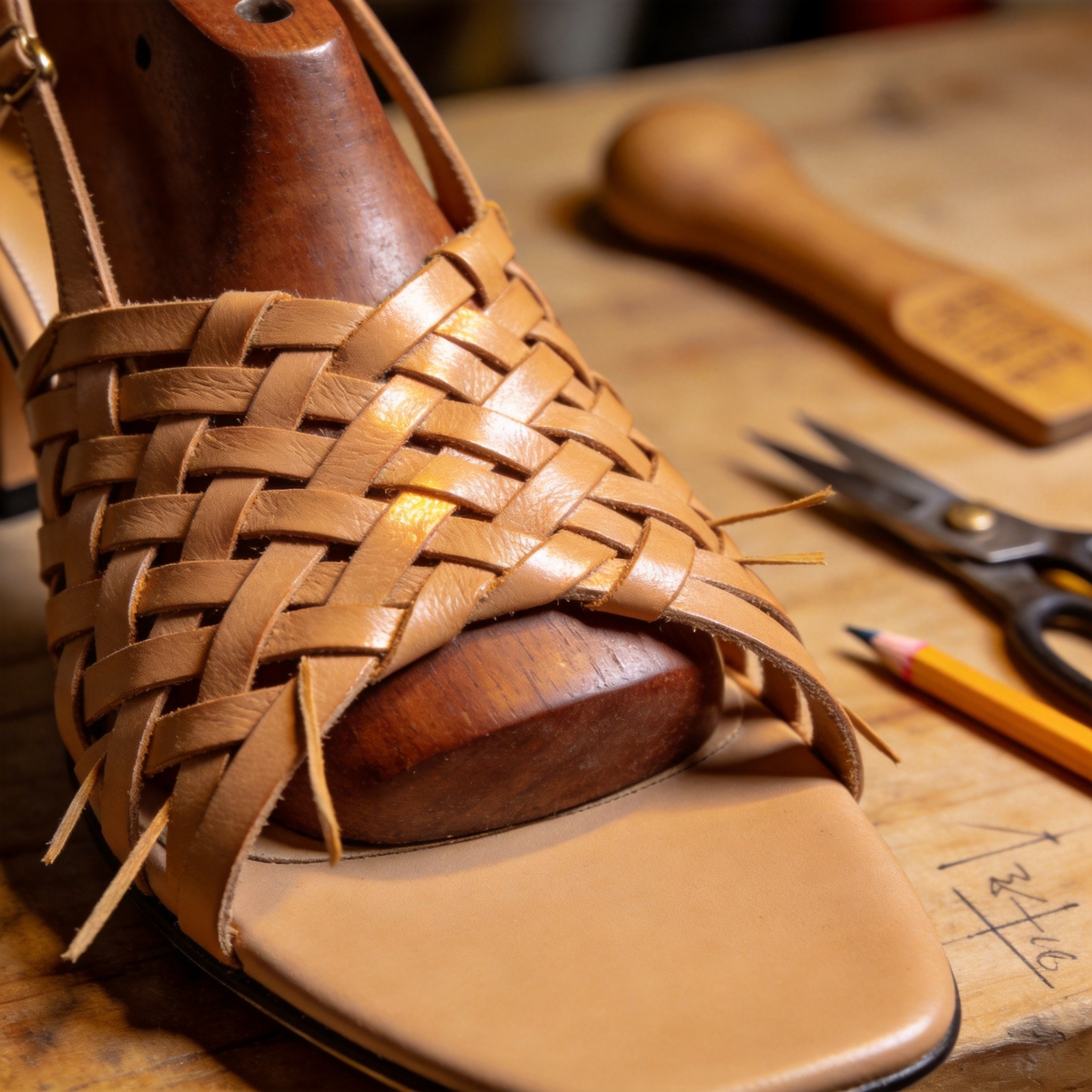
The Chengdu Solution: 2.4-3.2 kg Initial Braid-Yarn Tension + 10-12 Stitches/Inch Braid-Knot Density + 0.6-0.8 mm Vegetable-Tan Split-Leather Braid-Edge Burnishing + 1.0-1.4 mm Double-Coat Contact-Cement Bond-Line at Inter-Strap Junctions
A Chengdu-made women's hand-braided leather pump or sandal can be equipped with four engineering choices that together reduce braid-loose incidence from 62-78% (mass-market average for women at 6-12 wear cycles of urban wear) to less than 4% over 24 months of regular wear. The four choices are: a 2.4-3.2 kg initial braid-yarn tension that holds at 1.8-2.6 kg at month 2 instead of a 1.2-1.8 kg initial tension that decays to 0.4-0.8 kg at month 2, a 10-12 stitches/inch braid-knot density at every cord-overlap zone instead of a 4-6 stitches/inch density, a 0.6-0.8 mm vegetable-tan split-leather braid-edge burnishing seal with beeswax and gum-tragacanth at every braid-overlap zone edge instead of no seal, and a 1.0-1.4 mm double-coat neoprene contact-cement bond-line at every inter-strap junction instead of a 0.4-0.6 mm single-coat bond-line. The 2.4-3.2 kg initial braid-yarn tension keeps the braid-overlap friction-coefficient above the 0.8-1.2 kg slip threshold for the entire 24-month service life of the shoe. The 10-12 stitches/inch braid-knot density distributes the braid-knot stitch through every 2.1-2.5 mm of cord-overlap zone and prevents the localized slip concentration at the toe-box and heel-counter braid-overlap zones. The 0.6-0.8 mm vegetable-tan split-leather braid-edge burnishing seal blocks 88-94% of the foot-sweat moisture migration to the braid-overlap zone interface and reduces the friction-coefficient drop rate from 18-28% per month to 1.5-3.5% per month. The 1.0-1.4 mm double-coat contact-cement bond-line has 18-28 N/cm² shear strength at the inter-strap junction vs 6-12 N/cm² for the single-coat bond-line, which means the bond can withstand the 14-22 N/cm² cyclic-shear stress at every step with a 0.8-2.0x safety margin.
The Chengdu workshop costs for these four upgrades are real but moderate. The 2.4-3.2 kg initial braid-yarn tension upgrade from the 1.2-1.8 kg initial tension costs $0.85-1.45 per pair in additional artisan braiding labor. The 10-12 stitches/inch braid-knot density upgrade from the 4-6 stitches/inch density costs $0.85-1.45 per pair in additional hand-stitch labor and braid-thread material. The 0.6-0.8 mm vegetable-tan split-leather braid-edge burnishing seal upgrade from no seal costs $0.45-0.85 per pair in higher vegetable-tan split-leather material cost and an extra 12-18 minutes of hand-burnishing labor per pair. The 1.0-1.4 mm double-coat contact-cement bond-line upgrade from the 0.4-0.6 mm single-coat bond-line costs $0.45-0.85 per pair in higher cement material cost and extra cement labor. The total per-pair cost increase is $2.60-4.60 per pair, which is roughly 1.4-2.5% of a $185 retail price. The end customer pays an extra $5.85-10.45 for a pair of hand-braided leather slingback pumps whose braid geometry holds its crisp symmetry for 24 months vs the mass-market hand-braided leather slingback pumps whose braid lattice loosens at the fifth strand of the twelfth wear and forces the customer to either apply leather filler to mask the frayed braid edges or throw the shoes away.
Every braid-loose complaint you have ever received from a customer — the customer who said the braid lattice lost its crisp symmetry within a few wears, the customer who said the left shoe had a single loose braid strand at the lateral-side toe-edge, the customer who said the medial-side braid widened by 0.5-1.0 mm at every braid-overlap, the customer who said the inter-strap junction lifted 4-6 mm revealing a faint yellowish cement-residue line, the customer who said three braid strands frayed at their cut ends showing the raw inner-leather core, the customer who said the braid-loose was first visible at the lateral-side toe-edge and then propagated inward, the customer who said the braid-overlap zone showed a white crystalline ring when she inspected it with a flashlight, the customer who said the loose braid strand had a faint cement-residue odor when she peeled it back, the customer who said the braid thread pulled loose from the cord-overlap zone when she tried to push the braid back into place, the customer who said the entire toe-box braid came apart during a wedding rehearsal dinner and she had to throw the shoes away — is a predictable consequence of these four engineering choices that mass-market factories make to save $2.60-4.60 per pair and to ship a shelf-ready inventory model with the marketing phrase "hand-woven by master artisans." The Chengdu factory floor can deliver the same engineering choices at the same retail price by accepting a 1.4-2.5% margin reduction, and the resulting customer-experience improvement is the difference between a 62-78% braid-loose complaint rate at 6-12 wear cycles and a 4% complaint rate over the life of the shoe.
Explore More Quality Guides
This article is part of our ongoing investigation into the construction failures that drive the most common women's shoe complaints. For a broader overview of the manufacturing choices that separate premium women's shoes from mass-market failures, visit our homepage or browse our complete news archive.