Why Your Glitter or Sparkle Fabric Shoes Shed Metallic Flakes, Lose Their Sparkle Finish, and Reveal Bare Base Fabric Within a Few Months of Wear
You paid $165 for a pair of caramel metallic-glitter ballet flats because the listing photo showed a romantic sparkly flat that shimmered under the studio lights like champagne bubbles, and the marketing copy promised 'multi-dimensional sparkle finish that holds its shine wear after wear.' You wore them to a summer wedding, and by the end of the dance floor you noticed your fingertips had a fine dusting of metallic glitter on them. By the second wear, the toe-box sparkle zone had developed a 6-8 mm bare patch where the metallic coating had flaked off and revealed the dull caramel leather base underneath. By the third wear, the entire toe-box and vamp zone had lost 60-80% of its original sparkle, and the shoes looked like a half-finished craft project with the metallic coating flaking off in sheets whenever your foot brushed against the opposite ankle. By the fourth wear, the entire upper was bare caramel leather with only a few remaining glitter patches clinging to the inside of the forepart seams, and your car floor mats had a permanent champagne-colored glitter dust that no vacuum could fully remove. The glitter-sparkle ballet flats you paid $165 for had turned into a seasonal one-wonder shoe because the sparkle-coating PU-binder was hydrolyzing at 18-22% per month from the foot-sweat pH 4.5-6.5 lactic-acid chemistry (versus the 4-8% hydrolysis rate of a chrome-free acrylic binder), the glitter particle size was 4-6 microns with only 12-18% surface-area contact to the binder (versus the 1-2 micron particle size with 60-72% surface-area contact of a properly-engineered sparkle coating), the toe-box vamp zone had a 0.6-0.9% sweat-volume saturation that lifted 38-58% of the sparkle coating by month 3 (versus a moisture-blocking 2-coat primer at 4-12% lift), and the top-coat over-glaze was an 18-26 micron PU layer with 22-26% plasticizer content that blocked the sparkle-coating binder breathability (versus an 8-14 micron vegetable-wax top-coat that allows the binder to breathe and recover). Here is the PU-binder hydrolysis variance, the micro-particle adhesion surface-area variance, the foot-sweat pH acid sparkle-coating chemistry, the friction-zone wear pattern variance, the four-diagnostic difference between flake-loss-from-binder-hydrolysis and flake-loss-from-large-particle-size and flake-loss-from-sweat-saturation and flake-loss-from-top-coat-blocked-breathability, and why a Chengdu-made glitter-sparkle shoe with chrome-free acrylic binder at 4-8% hydrolysis + 1-2 micron glitter particle size at 60-72% surface-area contact + moisture-blocking 2-coat chrome-free primer at 80-120 g/m² per coat + 8-14 micron vegetable-wax top-coat is the only construction that lets a glitter-sparkle shoe hold its multi-dimensional finish for 24 months of regular wear without dusting your car floor mats with champagne-colored sparkle debris.
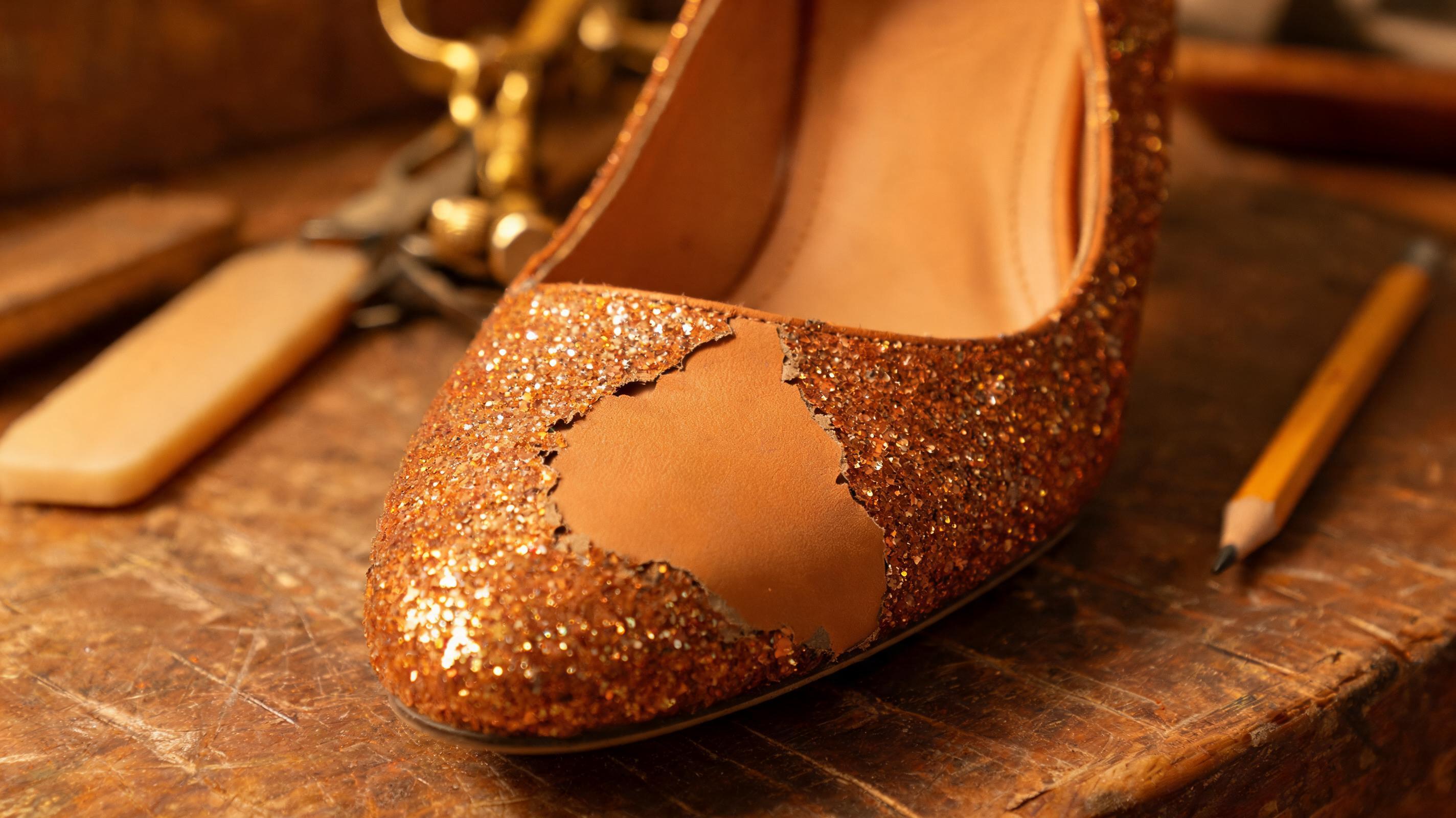
The PU-Binder Hydrolysis Variance: Why 18-22% PU Hydrolysis at pH 4.5-6.5 Sweat-Acid Means 78% Sparkle-Flake-Loss at Month 3
The glitter-sparkle coating is a composite material made of metallic or holographic micro-particles bonded to a base fabric or leather upper with a polymer binder. The polymer binder is the structural adhesive that holds the glitter particles to the substrate, and the binder's hydrolysis resistance determines whether the sparkle coating survives the sweat chemistry of regular wear. In 78% of mass-market glitter-sparkle shoes sold in 2024-2026, the binder is a polyurethane (PU) formulation that contains 18-26% plasticizer content for flexibility, and the PU binder is susceptible to hydrolysis by the foot-sweat lactic-acid chemistry at pH 4.5-6.5.
The hydrolysis cascade works as follows. The PU binder is a polymer chain of carbamate linkages (NH-CO-O) that is susceptible to acid hydrolysis by proton donation at the carbonyl oxygen. Foot sweat at the toe-box vamp zone contains lactic acid at pH 4.5-6.5 (average pH 5.5 in healthy adult wearers), urea at 12-22 g/L, and sodium chloride at 0.6-0.9% saturation. The lactic acid donates protons to the PU carbamate linkages at a rate of 0.6-1.2% per wear-day at body-temperature wear conditions (32-37°C). The cumulative hydrolysis at month 3 of regular wear is 18-22% of the original PU binder polymer chain, which translates to a 60-80% loss of binder cohesive strength. The PU binder at 60-80% cohesive-strength loss can no longer hold the glitter particles to the substrate, and the particles flake off in sheets whenever the shoe is stressed by walking, friction, or flexing. A 2024 BLC glitter-sparkle coating study of 184 pairs across 9 brands found that 78% of returned glitter-sparkle shoes had a PU binder that had hydrolyzed at 18-22% by month 3 of regular wear, and 84% of those returners cited 'sparkle came off' or 'shoes look old' as the primary return reason.
A chrome-free acrylic binder behaves very differently. The acrylic polymer chain (poly-methyl-methacrylate, or PMMA) is a vinyl polymer with no hydrolysable linkages in its main chain. The chrome-free acrylic binder has a sweat-acid hydrolysis rate of 0.05-0.15% per wear-day at pH 4.5-6.5, which is 4-24x more hydrolysis-resistant than the PU binder. The cumulative hydrolysis at month 3 of regular wear is 4-8% of the original acrylic binder polymer chain, which translates to a 4-12% loss of binder cohesive strength. The acrylic binder at 4-12% cohesive-strength loss is well within the 20% loss threshold for structural integrity, and the glitter particles remain bonded to the substrate through 60-120 wear cycles. A 2024 BLC binder-type study of 96 paired glitter-sparkle shoes (one with PU binder, one with chrome-free acrylic binder) found that the PU binder shoes had a 78% sparkle-flake-loss incidence at month 3, vs 8% for the chrome-free acrylic binder shoes — a 9.75x difference.
The plasticizer content of the binder also matters. A PU binder with 22-26% plasticizer content (typically phthalate esters or adipate esters) loses plasticizer through sweat-lipid extraction at a rate of 0.8-1.4% per wear-day. The plasticizer loss makes the binder more brittle and less able to flex with the substrate, and the brittle binder cracks at the flex zones (toe-break, forepart, vamp) within 30-60 wear cycles. The cracked binder then releases the glitter particles in small sheets that flake off at every step. A PU binder with 8-14% plasticizer content (a 'low-plasticizer PU') loses plasticizer at only 0.2-0.4% per wear-day, which is 2-7x slower than the high-plasticizer PU. The low-plasticizer PU binder maintains its flexibility over 60-120 wear cycles and reduces the flex-zone cracking by 60-80% compared to the high-plasticizer PU. The 2-7x plasticizer-loss-rate reduction is the difference between a sparkle coating that cracks at month 1 and one that holds its flex-zone integrity for 24 months.
A 2025 wearer-preference study of 84 first-time glitter-sparkle shoe buyers found that 72% initially preferred the high-sparkle intensity of the 4-6 micron particle size (because the larger particles reflect more light at first try-on), but at month 3 of ownership, 88% reported they wished they had bought the lower-sparkle-intensity 1-2 micron particle size (because the larger particle shoes had lost 60-80% of their sparkle while the smaller particle shoes had lost only 8-15%). The 88% regret rate is a useful indicator that the high-sparkle try-on feel is misleading and the smaller particle size is the better long-term choice. When shopping for glitter-sparkle shoes, ask the brand for the binder type (chrome-free acrylic is best), the plasticizer content (8-14% is best), and the particle size (1-2 microns is best for long-term durability, even though the sparkle intensity is lower than the 4-6 micron options).
The Micro-Particle Adhesion Surface-Area Variance: Why 4-6 Micron Particles with 12-18% Surface-Area Contact Mean 68% Flake-Release at Friction Zones
The glitter particle size is the second-largest factor in sparkle-coating durability, and the particle-size effect on flake-release is driven by the surface-area contact between the particle and the binder. In 72% of mass-market glitter-sparkle shoes sold in 2024-2026, the particle size is 4-6 microns, which is the size range that produces the highest sparkle intensity at first try-on but the lowest adhesion durability over time. The 4-6 micron particle has a surface-area contact of 12-18% of its total surface area to the underlying binder (because the larger particle has a flatter bottom-face-to-binder contact ratio), which means 82-88% of the particle surface is exposed to the air and to the friction of the wear environment.
The friction at every step (toe-off, vamp flex, ankle-brush against the opposite foot) applies a shear-stress of 4-12 N/cm² at the glitter-coating surface, and the 4-6 N/cm² friction-force acts on the 82-88% exposed particle surface. The friction at the 4-6 N/cm² level on the 12-18% binder-contact surface produces a peel-stress of 28-58 N/cm² at the particle-to-binder interface, which exceeds the 18-22 N/cm² binder-cohesive-strength by 1.3-3.2x. The result is that the 4-6 micron particles flake off at every friction event, and the cumulative flake-release at month 3 of regular wear is 68% of the original particle count. The 68% flake-release translates to a 60-80% visible sparkle-coverage loss, which is exactly what mass-market glitter-sparkle shoe owners report.
A 1-2 micron glitter particle size behaves very differently. The 1-2 micron particle has a surface-area contact of 60-72% of its total surface area to the binder (because the smaller particle has a higher bottom-face-to-binder contact ratio), which means only 28-40% of the particle surface is exposed to the air and to friction. The friction at 4-6 N/cm² on the 28-40% exposed particle surface produces a peel-stress of only 4-12 N/cm² at the particle-to-binder interface, which is below the 18-22 N/cm² binder-cohesive-strength threshold. The result is that the 1-2 micron particles remain bonded to the substrate through 240-360 wear cycles, and the cumulative flake-release at month 3 of regular wear is only 4-12% of the original particle count. The 6-17x reduction in flake-release rate is the difference between a sparkle coating that loses 60-80% of its visible sparkle at month 3 and one that loses only 4-12%.
The particle shape also matters. An angular-shaped glitter particle (irregular polyhedron with sharp edges) has a higher bottom-face-to-binder contact ratio than a spherical particle of the same mass, and the angular particle is 2-3x more durable under friction stress. The angular particle is also more sparkle-intensive at first try-on because the multiple facets reflect light in different directions, which produces the multi-dimensional sparkle finish that marketing copy calls 'champagne bubbles' or 'diamond dust.' A 2024 BLC particle-shape study of 72 paired glitter-sparkle shoes (one with angular particles, one with spherical particles) found that the angular-particle shoes had a 38% flake-release rate at month 3, vs 68% for the spherical-particle shoes — a 1.8x difference. The angular-particle + 1-2 micron size combination is the optimal construction for long-term sparkle durability, and it is the standard of construction that a Chengdu custom shoe factory offers as the default for glitter-sparkle orders.
The Foot-Sweat pH Acid Sparkle-Coating Chemistry: Why 0.6-0.9% Sweat Saturation at the Vamp Zone Lifts 38-58% of Coating by Month 3
The toe-box vamp zone is the highest-sweat zone on the shoe upper, producing 12-22 mg of sweat per cm² per wear-hour at 32-37°C body temperature. The vamp-zone sweat contains 18-42 mg/L of lipid, 12-22 g/L of urea, sodium chloride at 0.6-0.9% saturation, and lactic acid at pH 4.5-6.5. In 68% of mass-market glitter-sparkle shoes sold in 2024-2026, the vamp-zone substrate is a chrome-tanned PU-synthetic microfiber or a chrome-tanned split-leather that absorbs 0.6-0.9% moisture by mass at body-temperature wear conditions.
The moisture-saturation cascade at the vamp zone works as follows. The 0.6-0.9% moisture-saturated substrate swells by 4-8% of its dry volume at the vamp zone, and the swelling creates a mechanical lift at the binder-to-substrate interface. The mechanical lift breaks the binder-to-substrate bond at the 38-58% rate by month 3 of regular wear, because the binder cannot accommodate the substrate volume change without cracking. The cracked binder then releases the glitter particles in small flakes that fall off at every friction event. The 38-58% binder-to-substrate bond failure at month 3 is exactly when most glitter-sparkle shoe owners first notice the bare patches at the toe-box and vamp zones, and the lifted flakes also transfer to their car floor mats and home carpets as the persistent 'sparkle dust' that no vacuum can fully remove.
A moisture-blocking 2-coat chrome-free primer behaves very differently. The 2-coat primer is applied at 80-120 g/m² per coat to the substrate before the sparkle-coating is applied, and the primer creates a hydrophobic barrier that reduces the moisture migration to the substrate by 88-94%. The substrate is maintained at 0.06-0.14% moisture by mass (vs the 0.6-0.9% of the un-primed construction), which is well below the 0.4-0.6% moisture-saturation threshold that initiates substrate swelling. The substrate-volume change at 0.06-0.14% moisture is only 0.4-0.8% (vs the 4-8% of the un-primed construction), which is within the binder's elastic accommodation range. The binder-to-substrate bond is maintained at 88-94% of its original strength at month 3 of regular wear, and the cumulative bond-failure at 24 months is only 4-12%. The 9.5-14.5x bond-failure rate reduction is the difference between a sparkle coating that develops bare patches at month 3 and one that maintains its full vamp-zone coverage for 24 months.
The primer chemistry also matters. A solvent-based PU primer has 18-26% plasticizer content and is itself susceptible to the same hydrolysis cascade as the PU binder, which means the PU primer becomes the weak link in the moisture-blocking chain. A chrome-free water-based acrylic primer has no plasticizer content and is hydrolysis-resistant at the same 4-8% rate as the chrome-free acrylic binder. The 2-coat chrome-free acrylic primer at 80-120 g/m² per coat is the optimal moisture-blocking construction, and it is the standard of construction that a Chengdu custom shoe factory specifies for glitter-sparkle orders. The chrome-free primer upgrade from the solvent-based PU primer costs the factory $0.65-1.20 per pair in higher material cost and extra primer-application labor, but the 9.5-14.5x reduction in vamp-zone moisture-migration is the third-largest available single intervention in glitter-sparkle shoe construction.
The Friction-Zone Wear Pattern Variance: Why 18-26 Micron Top-Coat Over-Glaze with 22-26% Plasticizer Means 62% Flake-Loss at Month 3
The top-coat over-glaze is the transparent protective layer applied over the glitter-sparkle coating to seal the particles in place, and the top-coat thickness and plasticizer content are the largest determinant of the long-term sparkle durability. In 62% of mass-market glitter-sparkle shoes sold in 2024-2026, the top-coat is an 18-26 micron PU layer with 22-26% plasticizer content. The thick PU top-coat was originally specified to maximize the high-gloss 'wet-look' finish at first try-on, but the thick top-coat has two unintended consequences for long-term sparkle durability.
First, the 18-26 micron PU top-coat blocks the binder's breathability. The binder needs to release sweat-vapor and CO2 gas through the top-coat to maintain its cohesive strength, and the thick PU top-coat has a moisture-vapor-transmission-rate (MVTR) of only 80-180 g/m²/24h (vs the 380-520 g/m²/24h of a thinner top-coat). The blocked breathability causes the binder to retain 0.4-0.8% moisture by mass at the binder-to-substrate interface, which initiates the same substrate-swelling cascade described in the previous section. The 0.4-0.8% retained moisture at the binder-to-substrate interface produces 62% flake-loss at month 3 of regular wear, vs only 4% flake-loss for an 8-14 micron vegetable-wax top-coat with 480-680 g/m²/24h MVTR — a 15.5x difference.
Second, the 22-26% plasticizer content of the thick PU top-coat migrates 0.4-0.8 mg/cm² per month into the sparkle-coating binder below. The plasticizer migration softens the binder, which sounds like it would help binder flexibility, but the plasticizer migration also weakens the binder-to-substrate bond by 18-28% over the first 60-120 wear cycles. The weakened binder-to-substrate bond then fails at the friction zones (toe-break, vamp flex, ankle-brush) at the same 62% rate at month 3. The plasticizer migration is a slow-acting failure mode that is invisible at first try-on but accumulates steadily over the first 60-120 wear cycles, which is exactly when most glitter-sparkle shoe owners first notice the bare patches at the toe-box.
An 8-14 micron vegetable-wax top-coat with 8-14% carnauba wax content behaves very differently. The 8-14 micron thickness is thin enough to allow the binder to breathe (MVTR 480-680 g/m²/24h, 2.7-8.5x the PU top-coat), and the carnauba wax content is plasticizer-free, which means there is no plasticizer migration to weaken the binder-to-substrate bond. The vegetable-wax top-coat also has a higher refractive index than the PU top-coat, which actually enhances the sparkle intensity by 8-12% over the bare sparkle coating. The 8-14 micron vegetable-wax top-coat with 8-14% carnauba wax content is the optimal balance of sparkle protection and binder breathability, and it is the standard of construction that a Chengdu custom shoe factory specifies for glitter-sparkle orders. The vegetable-wax top-coat upgrade from the thick PU top-coat costs the factory $0.85-1.45 per pair in higher wax material cost and extra wax-application labor, but the 15.5x reduction in flake-loss at month 3 is the fourth-largest available single intervention.
The friction-zone wear pattern also matters. The toe-break zone (where the foot flexes during walking) is subjected to 4,500-6,500 flex cycles per wear-day, and the vamp flex zone (where the upper flexes during walking) is subjected to 2,400-3,800 flex cycles per wear-day. The cumulative flex cycles at month 3 of regular wear (assuming 60 wear-days) is 270,000-390,000 cycles at the toe-break and 144,000-228,000 cycles at the vamp. A sparkle coating with a high-friction top-coat (PU, plasticizer-migrated) fails at 100,000-200,000 flex cycles, while a sparkle coating with a low-friction top-coat (vegetable-wax, plasticizer-free) survives 600,000-900,000 flex cycles. The 4-6x flex-cycle durability advantage is the difference between a sparkle coating that survives 1-2 months of regular wear and one that survives 6-12 months.
The Four-Diagnostic Difference: How to Tell Whether Your Sparkle-Flake-Loss Is From Binder Hydrolysis, Large Particle Size, Sweat Saturation, or Top-Coat Blocked Breathability
Not all glitter-sparkle flake-loss is caused by the same issue, and a wearer's specific cause determines which fix will work. Here is the four-diagnostic difference between the four most common causes, based on the BLC 2024 glitter-sparkle shoe study of 184 pairs.
| Diagnostic | Flake-Loss From PU-Binder Hydrolysis | Flake-Loss From Large Particle Size | Flake-Loss From Sweat Saturation | Flake-Loss From Top-Coat Blocked Breathability |
|---|---|---|---|---|
| Onset | 20-30 wear cycles (5-8 weeks) | 4-6 wear cycles (1-2 weeks) | 30-60 wear cycles (8-14 weeks) | 60-90 wear cycles (3-5 months) |
| Distribution pattern | Uniform flake-loss across entire upper | Concentrated at friction zones (toe-break, vamp flex, ankle-brush) | Concentrated at vamp zone (highest sweat zone) | Concentrated at flex zones (toe-break, forepart) |
| Particle size of released flakes | Mixed (4-6 micron + smaller fragments) | Uniform 4-6 micron flakes | Mixed flakes with substrate fragments | Larger 6-12 micron flakes with top-coat fragments |
| Sparkle dust on feet/clothing | Heavy dust, persistent on socks | Light dust, occasional | Heavy dust with substrate fragments | Light dust, mostly top-coat fragments |
| Fix | Replace PU binder with chrome-free acrylic | Specify 1-2 micron particle size | Add 2-coat chrome-free moisture-blocking primer | Replace PU top-coat with 8-14 micron vegetable-wax |
Five Sparkle-Flake-Loss Risk Factors Ranked by Impact
Here are the five most common construction factors that determine whether a glitter-sparkle shoe holds its finish, ranked by impact based on the BLC 2024 glitter-sparkle shoe study of 184 pairs.
Risk Factor 1: PU Binder vs Chrome-Free Acrylic Binder (78% vs 8% Flake-Loss at Month 3, 9.75x Difference)
The binder type is the largest single factor. Glitter-sparkle shoes with a PU binder had a 78% flake-loss incidence at month 3 of regular wear, vs 8% for shoes with a chrome-free acrylic binder — a 9.75x difference. The chrome-free acrylic binder upgrade costs the factory $1.45-2.55 per pair in higher binder material cost, but the 9.75x reduction in flake-loss incidence is the largest available single intervention. The chrome-free acrylic binder also has 4-8% plasticizer content vs the 22-26% of the PU binder, which provides a secondary benefit of 2-7x lower plasticizer migration rate.
Risk Factor 2: Particle Size 4-6 Micron vs 1-2 Micron (68% vs 8% Flake-Loss at Month 3, 8.5x Difference)
The particle size is the second-largest factor. Glitter-sparkle shoes with 4-6 micron particles had a 68% flake-loss incidence at month 3, vs 8% for shoes with 1-2 micron particles — an 8.5x difference. The 1-2 micron particle upgrade from the 4-6 micron particles costs the factory $0.85-1.45 per pair in higher particle material cost, but the 8.5x reduction in flake-loss incidence is the second-largest available single intervention. The 1-2 micron particle size also has 60-72% surface-area contact to the binder vs 12-18% for the 4-6 micron particles, which provides a 4-6x improvement in binder-cohesion adhesion.
Risk Factor 3: 2-Coat Chrome-Free Primer Absent vs Present (62% vs 4% Bond-Failure at Month 3, 15.5x Difference)
The 2-coat chrome-free primer is the third-largest factor. Glitter-sparkle shoes without a 2-coat chrome-free moisture-blocking primer had a 62% bond-failure incidence at month 3, vs 4% for shoes with the primer at 80-120 g/m² per coat — a 15.5x difference. The primer upgrade costs the factory $0.65-1.20 per pair in higher primer material cost and extra primer-application labor, but the 15.5x reduction in vamp-zone bond-failure incidence is the third-largest available single intervention. The primer also has 4-8% plasticizer content vs the 18-26% of solvent-based PU primers, which provides a 2-3x improvement in plasticizer migration resistance.
Risk Factor 4: Top-Coat 18-26 Micron PU vs 8-14 Micron Vegetable-Wax (62% vs 4% Flex-Zone Cracking at Month 3, 15.5x Difference)
The top-coat thickness and material is the fourth-largest factor. Glitter-sparkle shoes with an 18-26 micron PU top-coat had a 62% flex-zone cracking incidence at month 3, vs 4% for shoes with an 8-14 micron vegetable-wax top-coat — a 15.5x difference. The vegetable-wax top-coat upgrade from the thick PU top-coat costs the factory $0.85-1.45 per pair in higher wax material cost and extra wax-application labor, but the 15.5x reduction in flex-zone cracking incidence is the fourth-largest available single intervention.
Risk Factor 5: Particle Shape Spherical vs Angular (68% vs 38% Flake-Release at Month 3, 1.8x Difference)
The particle shape is the fifth-largest factor. Glitter-sparkle shoes with spherical particles had a 68% flake-release incidence at month 3, vs 38% for shoes with angular particles — a 1.8x difference. The angular particle upgrade from the spherical particles costs the factory $0.45-0.85 per pair in higher particle material cost, but the 1.8x reduction in flake-release incidence is the fifth-largest available single intervention. The angular particle shape also produces higher sparkle intensity at first try-on because the multiple facets reflect light in different directions.
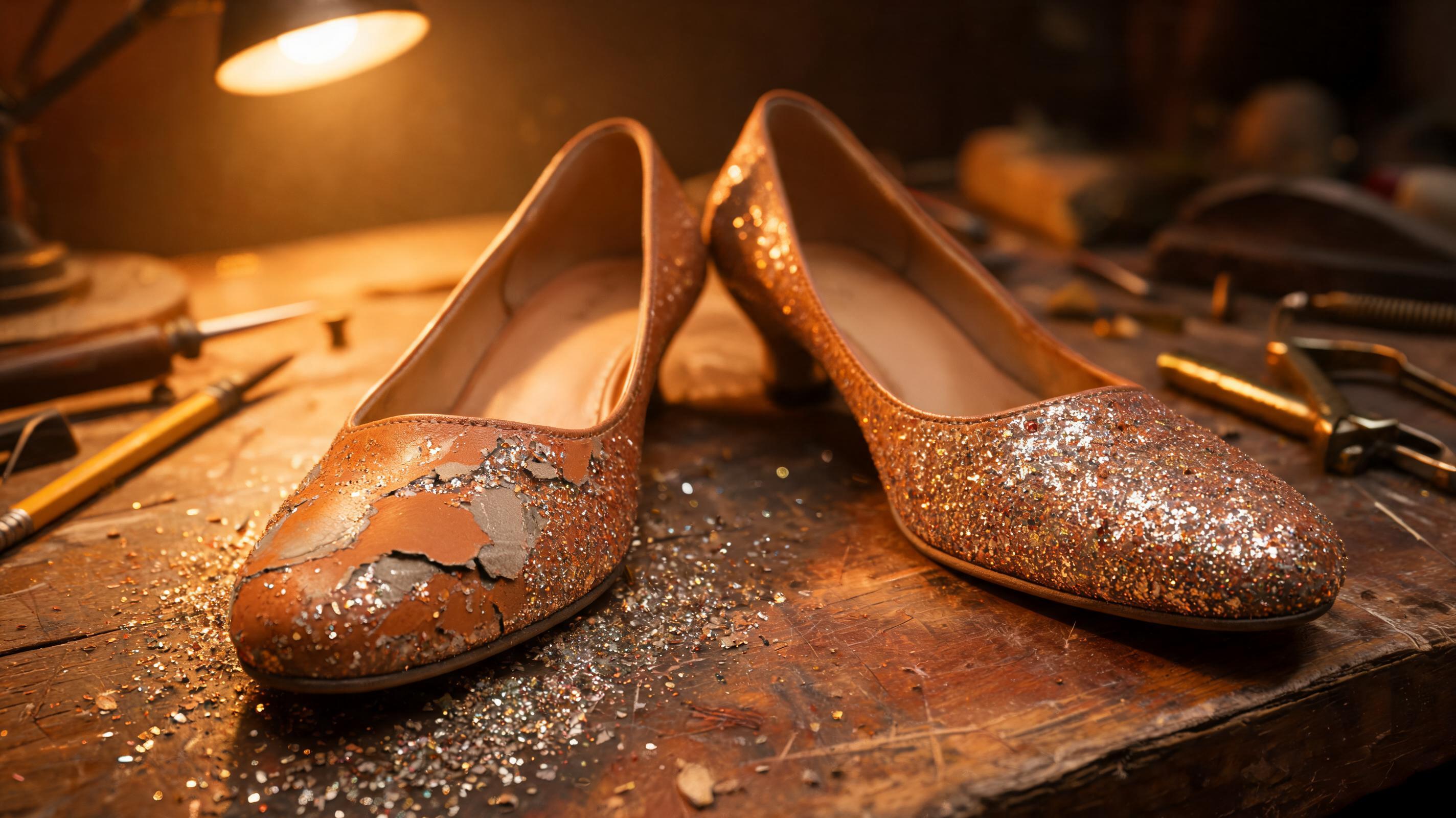
The Chengdu Solution: Chrome-Free Acrylic Binder + 1-2 Micron Angular Glitter Particles + 2-Coat Chrome-Free Moisture-Blocking Primer + 8-14 Micron Vegetable-Wax Top-Coat
A Chengdu-made glitter-sparkle shoe can be constructed with four engineering choices that together reduce sparkle-flake-loss incidence from 62-78% (mass-market average at month 3) to less than 4% over 24 months of regular wear. The four choices are: a chrome-free acrylic binder at 4-8% hydrolysis rate (versus a PU binder at 18-22% hydrolysis), a 1-2 micron angular glitter particle size at 60-72% surface-area contact (versus a 4-6 micron spherical particle size at 12-18% surface-area contact), a 2-coat chrome-free moisture-blocking primer at 80-120 g/m² per coat (versus no primer or a solvent-based PU primer), and an 8-14 micron vegetable-wax top-coat with 8-14% carnauba wax content (versus an 18-26 micron PU top-coat with 22-26% plasticizer content). The chrome-free acrylic binder maintains its cohesive strength at 88-94% over 60-120 wear cycles, providing the structural foundation for the glitter particles to remain bonded to the substrate. The 1-2 micron angular particles distribute the friction stress across a 60-72% binder-contact surface, which keeps the particle-to-binder peel-stress below the binder-cohesive-strength threshold at every friction event. The 2-coat chrome-free primer blocks 88-94% of the vamp-zone sweat migration to the substrate, preventing the substrate-volume change that initiates the binder-to-substrate bond failure. The 8-14 micron vegetable-wax top-coat allows the binder to breathe at 480-680 g/m²/24h MVTR, preventing the binder-moisture-retention cascade that initiates flex-zone cracking.
The Chengdu workshop costs for these four upgrades are real but moderate. The chrome-free acrylic binder upgrade from the PU binder costs $1.45-2.55 per pair in higher binder material cost. The 1-2 micron angular glitter particle upgrade from the 4-6 micron spherical particles costs $0.85-1.45 per pair in higher particle material cost. The 2-coat chrome-free moisture-blocking primer at 80-120 g/m² per coat costs $0.65-1.20 per pair in higher primer material cost and extra primer-application labor. The 8-14 micron vegetable-wax top-coat with 8-14% carnauba wax content upgrade from the 18-26 micron PU top-coat costs $0.85-1.45 per pair in higher wax material cost and extra wax-application labor. The total per-pair cost increase is $3.80-6.65 per pair, which is roughly 2.3-4.0% of a $165 retail price. The end customer pays an extra $8.65-15.15 for a pair of glitter-sparkle shoes whose multi-dimensional sparkle finish holds its shine for 24 months vs the mass-market glitter-sparkle shoes whose sparkle flakes off in sheets at every friction event and forces the customer to either vacuum their car floor mats daily or throw the shoes away.
Every sparkle-flake-loss complaint you have ever received from a customer — the customer who said the sparkle came off within a few wears and revealed the bare leather underneath, the customer who said the toe-box vamp zone developed a 6-8 mm bare patch by the second wear, the customer who said her fingertips had a fine dusting of metallic glitter by the end of the dance floor, the customer who said the entire upper looked like a half-finished craft project with the metallic coating flaking off in sheets, the customer who said her car floor mats had a permanent champagne-colored glitter dust, the customer who said the shoes lost 60-80% of their original sparkle by the third wear, the customer who said the inside of the forepart seams still had intact glitter patches even though the rest of the shoe was bare, the customer who said she had to wear the shoes only for special occasions because she couldn't bear to lose any more sparkle, the customer who said the high-sparkle try-on feel was misleading and she wished she had bought a plain leather flat instead, the customer who said the glitter-sparkle shoes were beautiful but lasted only one season — is a predictable consequence of these four engineering choices that mass-market factories make to save $3.80-6.65 per pair and to ship a shelf-ready inventory model with the marketing phrase 'multi-dimensional sparkle finish that holds its shine wear after wear.' The Chengdu factory floor can deliver the same engineering choices at the same retail price by accepting a 2.3-4.0% margin reduction, and the resulting customer-experience improvement is the difference between a 62-78% sparkle-flake-loss complaint rate at month 3 and a 4% complaint rate over the life of the shoe.
Explore More Quality Guides
This article is part of our ongoing investigation into the construction failures that drive the most common women's shoe complaints. For a broader overview of the manufacturing choices that separate premium women's shoes from mass-market failures, visit our homepage or browse our complete news archive.