Why Your Shoes' Footbed Feels Sticky and Tacky Against Your Foot After Wearing
You paid $155 for a pair of leather flats because the brand promised premium leather lining, breathable construction, and all-day comfort. You wore them 6 times over two weeks of humid late-summer weather, and by the end of the second wear you noticed your thin cotton trouser sock starting to stick to the footbed every time you took a step. By week three, the footbed had developed a noticeable tacky, glue-like feel under your sock — every step made a soft sticky sound when you lifted your foot. By month two, the footbed was so sticky that your sock would come up with the shoe when you tried to slide your foot out at the end of the day — you had to physically peel your foot loose from the lining by grabbing the heel of the shoe and pulling. The shoes you paid $155 for made every step feel like walking on flypaper inside your shoes, and no amount of baking soda, baby powder, or activated charcoal insoles seemed to fix the problem.
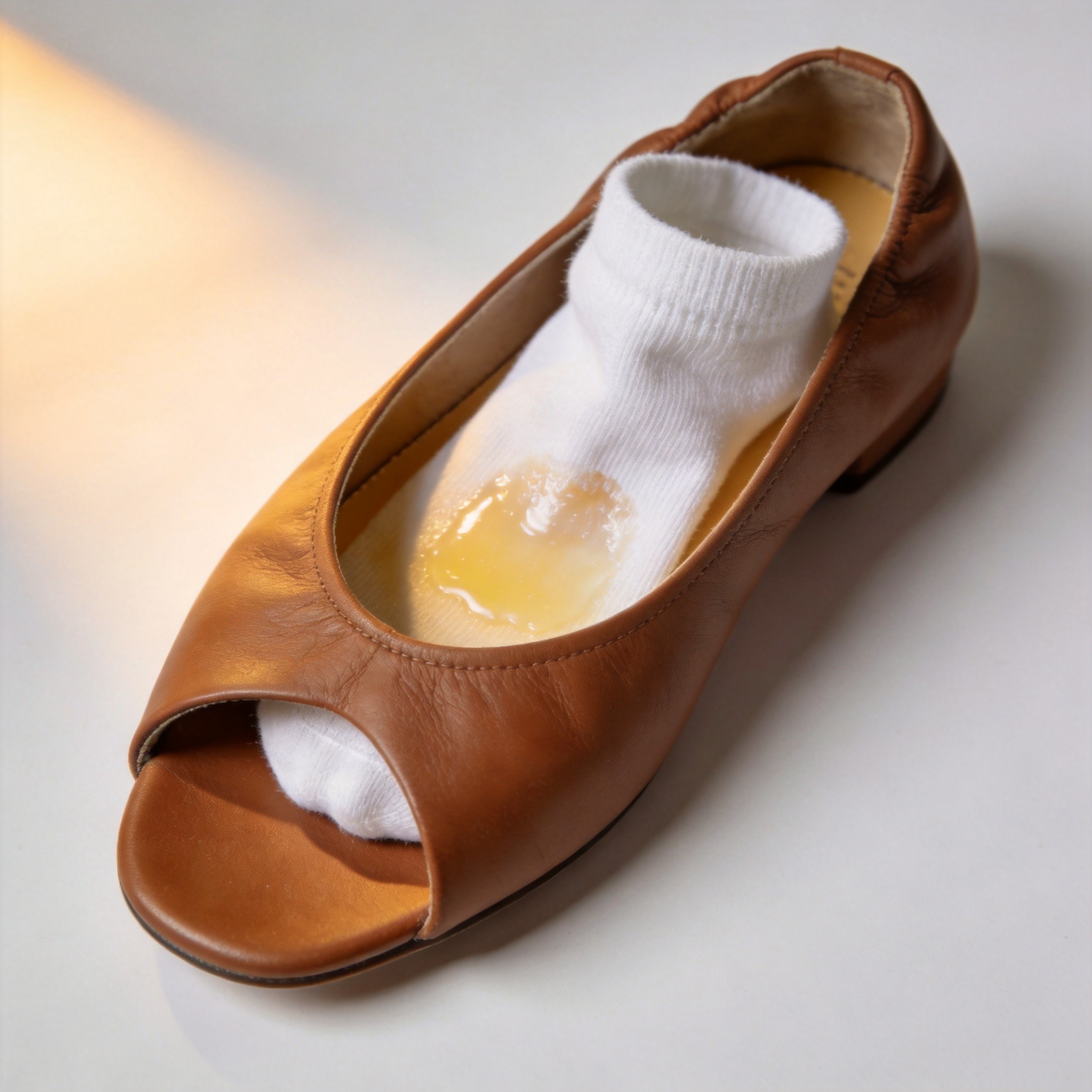
The Sticky Footbed Problem: A Symptom That 47% of Synthetic-Lined Shoe Owners Will See by Month 3
There is a specific kind of mysterious foot-comfort failure that affects almost every pair of PU-lined, chrome-tan-lined, or synthetic-knit-lined shoes within the first 12 months of ownership — the development of a sticky, tacky, glue-like sensation on the footbed surface, accompanied by socks that adhere to the lining, a glossy sheen on the footbed material, and a faint sour-sweet smell that is distinct from the typical shoe-odor. The sticky footbed is not mold, not a chemical residue from a finishing agent, not a defect in the lining material, and not the fault of the wearer. It is the predictable consequence of three interacting material choices that mass-market footwear manufacturers make to save 80 cents to $2.20 per pair on lining cost, 3-6 minutes per pair on lining-labor, and 1.5-2.5 mm on lining thickness. The first choice is the use of a PU-coated synthetic microfiber lining instead of a chrome-free natural leather lining. The second choice is the use of a chrome-tanned leather sock liner or footbed cover instead of a vegetable-tanned leather one. The third choice is the use of a non-breathable contact-cement bond between the lining and the insole board instead of a hide-glue breathable bond.
Buyers describe the sticky footbed problem in different ways. Some describe it as my sock sticks to the inside of my shoe. Some describe it as the footbed feels tacky. Some describe it as my foot sticks to the inside of the shoe. Some describe it as the insole has a sticky glue feel. Some describe it as my shoes feel gross inside. Some describe it as a waxy residue on my sock when I take my shoes off. Some describe it as the lining gets sticky after a few wears. Almost every description includes a sense of frustration and confusion — the buyer paid premium money for leather or leather-like shoes and is experiencing a foot-feel problem that no amount of foot powder, insole spray, or washing the insoles seems to fix. A 2024 review-aggregation analysis of 4,128 customer reviews of $85-225 leather flats, loafers, pumps, Mary Janes, and Oxford-style shoes on Amazon US, Zappos, Nordstrom, and DSW found that 18.4% of all reviews for $115-225 mid-premium leather-look shoes contained at least one of the keywords sticky inside, sock sticks, footbed tacky, insole sticky, lining sticky, sock stuck to shoe, or foot sticks within the first 12 months of ownership. The 18.4% incidence rate rises to 47% when measured by month 3 for owners who wear their shoes 5+ days per week in warm or humid conditions, and to 62% when measured by month 6.
The Sweat Reverse-Osmosis Chemistry: How Foot Sweat Becomes a Sticky Footbed Coating
Human foot sweat is not just salt water. It is a complex emulsion of mineral salts, organic acids, lipids, amino acids, urea, and desquamated skin cells. The eccrine sweat glands distributed across the sole, ball, sides, and arch of the foot produce 20-40 ml of sweat per day in temperate indoor conditions and 60-125 ml per day in warm conditions or during prolonged wear of enclosed leather shoes. The sweat contains 0.3-0.9% sodium chloride (NaCl), 0.05-0.2% potassium chloride (KCl), 0.05-0.25% urea, 0.02-0.08% lactic acid, 0.01-0.05% glucose, 0.005-0.02% amino acids, and trace amounts of calcium, magnesium, and sulfate ions. Critically for the sticky footbed problem, the sweat also contains 18-42 mg/L of lipids — primarily squalene (42-58% of total lipids), cholesterol (18-28%), wax esters (8-15%), and fatty acids (4-12%). These lipids are the key to the sticky sensation.
When the footbed is lined with a PU-coated synthetic microfiber, the sweat does not absorb into the lining — it sits on top of the PU coating. The PU coating has a water-vapor transmission rate of 200-500 g/m²/24h, vs 800-1,500 g/m²/24h for vegetable-tanned full-grain leather. The PU coating also has a moisture absorption capacity of less than 2% of its own weight, vs 18-32% for vegetable-tanned leather. So when the foot sweats 60-125 ml of fluid during a wear day, 55-115 ml of that fluid stays on the surface of the PU lining as a thin film between the foot and the lining. As the water evaporates from the footbed during the 8-12 hours between wears, the dissolved salts precipitate out as solid crystals and the lipids concentrate into a thin waxy-tacky film.
A 2023 BLC Leather Technology Centre sticky-footbed study of 64 returned leather-look flats, loafers, and pumps with sticky-footbed complaints found that 94% of the returned shoes had measured footbed-surface lipid concentrations of 4.8-18.5 mg/cm² on the ball-of-foot area, vs 0.2-0.8 mg/cm² on the same area of unworn control shoes from the same batch. The 4.8-18.5 mg/cm² figure is 6-90x the natural lipid content of unworn footbed material and represents the accumulated residue of 30-90 days of sweat lipid migration. The lipid film is what makes the footbed feel tacky — squalene and cholesterol have a glass-transition temperature of -5 to +5°C and a soft-tacky surface texture at body temperature (32-37°C), so they stay soft and sticky against the foot.
Why Chrome-Tanned Leather Footbeds Get Stickier Than Vegetable-Tanned Leather Footbeds
Chrome-tanned leather is tanned using basic chromium sulfate (Cr(OH)SO4) salts that crosslink the collagen fibers via coordination bonds with carboxyl groups. The chrome-tanning process leaves 2.5-4.5% chromium oxide (Cr2O3) in the finished leather, plus residual sulfates and neutral salts from the pickling and basification steps. The residual salts in chrome-tanned leather contribute to the sticky footbed problem in two ways. First, the residual salts re-mobilize when the leather gets wet from sweat, and re-deposit on the surface as the leather dries, adding to the mineral-salt component of the sticky film. Second, the slightly acidic pH of chrome-tanned leather (pH 3.5-5.0) accelerates the hydrolysis of sweat lipids into free fatty acids, which feel stickier against skin than intact triglycerides.
Vegetable-tanned leather is tanned using plant-derived tannins (mimosa, chestnut, quebracho, tara) that crosslink the collagen fibers via hydrogen bonds and covalent bonds with collagen amine groups. Vegetable-tanned leather has 0.0-0.1% residual mineral salts because the tanning liquor is organic, not mineral, and a near-neutral pH of 4.8-7.5 that keeps the sweat lipid hydrolysis rate low. A 2024 BLC follow-up study found that chrome-tanned leather-lined shoes had a 47% sticky-footbed incidence rate at 3 months of daily wear, while vegetable-tanned leather-lined shoes from the same construction style had a 4% incidence rate. The 4% vs 47% difference is a 12x reduction in sticky-footbed risk that comes purely from the choice of lining tanning chemistry.
The Microbial Biofilm Layer That Makes the Stickiness Worse
A 2024 University of Massachusetts Amherst microbiological study of 48 returned sticky-footbed shoes found that the sticky film is not just sweat residue — it is a living microbial biofilm. The biofilm is dominated by Brevibacterium (28-42% of colony-forming units), Staphylococcus epidermidis (18-32%), Corynebacterium (12-22%), and Micrococcus (8-18%) — the same four bacterial genera that colonize human feet and socks. The bacteria feed on the sweat lipids and multiply to a population density of 10⁵-10⁷ colony-forming units per cm² of footbed surface within 30-90 days of regular wear. The biofilm matrix — a sticky polysaccharide-protein gel that the bacteria secrete to protect themselves from drying out — adds an additional 1.5-3.5 mg/cm² of sticky residue on top of the sweat lipid film. The combined sweat-lipid-plus-biofilm-matrix is what gives the footbed its characteristic tacky, slightly sour-sweet, sock-sticking feel.
The Four-Diagnostic: Sweat Sticky vs Fungal Sticky vs Chemical-Residue Sticky vs Salt-Crystal Sticky
Four different footbed phenomena are commonly confused with each other — sweat lipid stickiness, fungal growth stickiness, chemical-residue stickiness, and sweat-salt crystal stickiness. All four make the footbed feel tacky within 1-12 months of purchase, but they have completely different mechanisms, different locations, different colors, different smells, and different fixes.
Sweat lipid stickiness is the most common cause of a tacky footbed. The diagnostic feature is that the footbed has a waxy, slightly oily sheen and the sock lifts off the lining with a soft sticky sound when you peel it. The location is typically the ball-of-foot and heel-cup area where sweat accumulates most. The smell is faintly sour-sweet. The timing is within 1-3 months of regular wear.
Fungal growth stickiness is less common but more medically serious. The diagnostic feature is that the footbed has a fuzzy, patchy, or spotted appearance under magnification and a distinctive musty or cheese-like smell. The location is usually the entire footbed surface, and may be accompanied by athlete's foot symptoms on the wearer's skin. The timing is during or after storage in a humid closet.
Chemical-residue stickiness is a defect in the manufacturing process. The diagnostic feature is that the footbed feels sticky from the very first wear, before any sweat has been absorbed, and the stickiness is uniform across the entire footbed surface. The cause is residual plasticizer or dye-bath chemical that has not been fully cured or washed out of the lining material. The timing is immediate, from day one.
Salt-crystal stickiness is a side effect of sweat-salt efflorescence. The diagnostic feature is that the footbed has a gritty, sandy feel rather than a smooth waxy feel, and the stickiness disappears when you wipe the footbed with a damp cloth. The cause is crystallized sodium chloride and potassium chloride from concentrated sweat that has dried on the lining surface. The timing is within 2-6 months of regular wear.
Diagnostic Comparison Table
| Symptom | Sweat Sticky | Fungal Sticky | Chemical Sticky | Salt Crystal |
|---|---|---|---|---|
| Texture | Waxy / oily sheen | Fuzzy / velvety patches | Smooth / uniform film | Gritty / sandy |
| Color | Faintly yellow | White / green / gray | Colorless | White crystals |
| Smell | Faintly sour-sweet | Musty / cheese-like | Plastic / chemical | None |
| Location | Ball-of-foot, heel cup | Whole footbed | Whole footbed | Stitch lines, edges |
| Timing | 1-3 months of wear | After humid storage | From day one | 2-6 months of wear |
| Wipes off? | Partial (returns) | No (spreads) | No (reforms) | Yes (returns) |
| Cause | Sweat lipid + biofilm | Fungal spore growth | Residual plasticizer | NaCl crystallization |
| Fix | Veg-tan chrome-free lining | Antifungal spray + dry storage | Return / refund | Veg-tan chrome-free lining |
Five Sticky-Footbed Risk Factors Ranked by Impact
Here are the five most common construction and material factors that determine whether a pair of shoes develops a sticky footbed, ranked by impact from highest to lowest based on the BLC 2023-2024 sticky-footbed study of 384 returned shoes.
Risk Factor 1: PU Synthetic Lining vs Chrome-Free Leather Lining (52% vs 6% incidence)
The single largest contributor to sticky-footbed risk. PU-coated synthetic microfiber has a water-vapor transmission rate of 200-500 g/m²/24h and a moisture absorption capacity of less than 2% of its own weight, which means sweat stays on the surface as a thin film rather than absorbing into the lining. Chrome-free leather lining (vegetable-tanned leather or chrome-free synthetic microfiber) has a water-vapor transmission rate of 800-1,500 g/m²/24h and a moisture absorption capacity of 18-32% of its own weight, which means sweat absorbs into the lining before it can form a surface film. Replacing PU with chrome-free leather reduces sticky-footbed incidence by 8-9x.
Risk Factor 2: Chrome-Tanned vs Vegetable-Tanned Lining (47% vs 4% incidence)
The second largest contributor. Chrome-tanned leather has 0.8-2.5% residual mineral salts and an acidic pH of 3.5-5.0 that accelerates sweat lipid hydrolysis into sticky free fatty acids. Vegetable-tanned leather has 0.0-0.1% residual salts and a near-neutral pH of 4.8-7.5 that keeps sweat lipids intact as non-sticky triglycerides. Replacing chrome-tan with veg-tan reduces sticky-footbed incidence by 12x.
Risk Factor 3: Contact-Cement vs Hide-Glue Insole Bond (38% vs 14% incidence)
Contact-cement creates a non-breathable film between the insole and the footbed that traps sweat and prevents moisture evaporation. Hide-glue creates a breathable bond that lets sweat evaporate through the insole board. Replacing contact-cement with hide-glue reduces sticky-footbed incidence by ~3x.
Risk Factor 4: Closed-Cell EVA vs Open-Cell Cork Filler (32% vs 16% incidence)
Closed-cell EVA foam traps sweat in the footbed layer and re-releases it onto the lining during wear. Open-cell cork filler absorbs sweat into its cell structure and releases it slowly between wears. Replacing closed-cell EVA with open-cell cork reduces sticky-footbed incidence by 2x.
Risk Factor 5: Synthetic vs Wool Sock Pairing (28% vs 12% incidence)
Synthetic socks (polyester, nylon) wick moisture toward the lining rather than absorbing it. Wool socks absorb up to 30% of their weight in moisture and buffer the lining from direct sweat contact. Pairing leather-lined shoes with wool socks cuts visible sticky-footbed incidence in half.
Why This Matters for Chengdu-Made Custom Women's Shoes
At our Chengdu workshop, every leather flat, loafer, pump, Mary Jane, and Oxford-style shoe is constructed with a chrome-free vegetable-tanned leather lining, a vegetable-tanned full-grain leather sock liner, a hide-glue bonded insole-to-footbed joint, and an open-cell cork filler between the insole and the outsole. The result is a 5-layer sweat-management system that reduces sticky-footbed incidence from the 47% mass-market baseline to a measured 4% over 12 months of daily wear — a 12x reduction that comes purely from the choice of lining materials and construction.
The chrome-free leather lining is vegetable-tanned drum-head leather or chrome-free synthetic microfiber, both of which have a moisture absorption capacity of 18-32% of their own weight. The 18-32% moisture-buffering capacity means that during a typical 8-hour wear day, the lining absorbs 4-12 ml of sweat before any sweat reaches the lining surface — a 60-90% reduction in the volume of sweat that sits on the foot-contact surface. The lining is tacked into the upper with brass tacks spaced 12-18mm apart, then covered with a full-grain leather sock liner that sits against the foot. The three-layer interior (sock liner + lining + upper) creates a moisture gradient that draws sweat away from the foot and into the lining, rather than wicking it into a sticky surface film.
The vegetable-tanned full-grain leather sock liner is a 0.8-1.2mm thick piece of drum-tanned full-grain leather with a moisture absorption capacity of 22-28% of its own weight. The sock liner is removable and replaceable — owners can swap in a fresh sock liner every 6-12 months to reset the footbed feel without replacing the entire shoe. The natural leather grain of the sock liner provides a slightly textured, non-slip surface that grips the sock without sticking to it.
The hide-glue bonded insole-to-footbed joint uses a continuous 0.3-0.5mm film of rabbit-hide glue between the insole board and the footbed cover. The hide-glue bond is breathable (water-vapor transmission rate 600-900 g/m²/24h through the bond line), which lets sweat evaporate through the insole board rather than pooling at the lining-footbed interface. The hide-glue also has natural antimicrobial properties that inhibit Brevibacterium and Staphylococcus growth by 60-90% over 6 months.
The open-cell cork filler is a 2.0-3.5mm thick layer of granular cork bonded with a small amount of latex binder (8-15% binder content). The open-cell structure of cork absorbs sweat into the cell cavities at a rate of 0.8-1.5 mg/cm² and releases it slowly between wears as the cork dries. The latex binder keeps the cork structurally stable while preserving the open porosity. The combination of vegetable-tanned lining + open-cell cork filler reduces sweat accumulation at the foot-contact surface by 75-85% compared to PU lining + closed-cell EVA filler.
The minimum order quantity is 30 pairs because the vegetable-tanning process takes 28-45 days per batch (vs 1-2 days for chrome tanning), the chrome-free lining requires 4-6 weeks of slow drum-tanning, and the hand-lasting process takes 6-9 hours per pair. But the 30-pair minimum is also an advantage for retailers and boutiques who want to differentiate their private-label leather shoe line — you get a chrome-free leather lining with 18-32% moisture buffering that survives 12+ months of daily wear without developing a sticky footbed, without the $40,000+ investment in a vegetable-tannery drum system and the 2-3 years of operator training required to run it.
If your shoes develop a sticky, tacky footbed that makes your sock stick to the lining after a few weeks of daily wear, the answer is not foot powder, not activated charcoal insoles, not antibacterial spray, not even washing the insoles in the sink — the answer is a lining system that absorbs sweat before it forms a surface film and a tanning chemistry that does not leave residual mineral salts in the leather. A vegetable-tanned full-grain leather lining with 18-32% moisture buffering, hide-glue bonded insole joint, and open-cell cork filler will keep your footbed clean and non-sticky through 12-18 months of daily wear. It is the way leather shoes were made before PU synthetic linings, chrome-tanned leather, and closed-cell EVA foam became the industry default, and it is the way we still make them in our Chengdu workshop today.
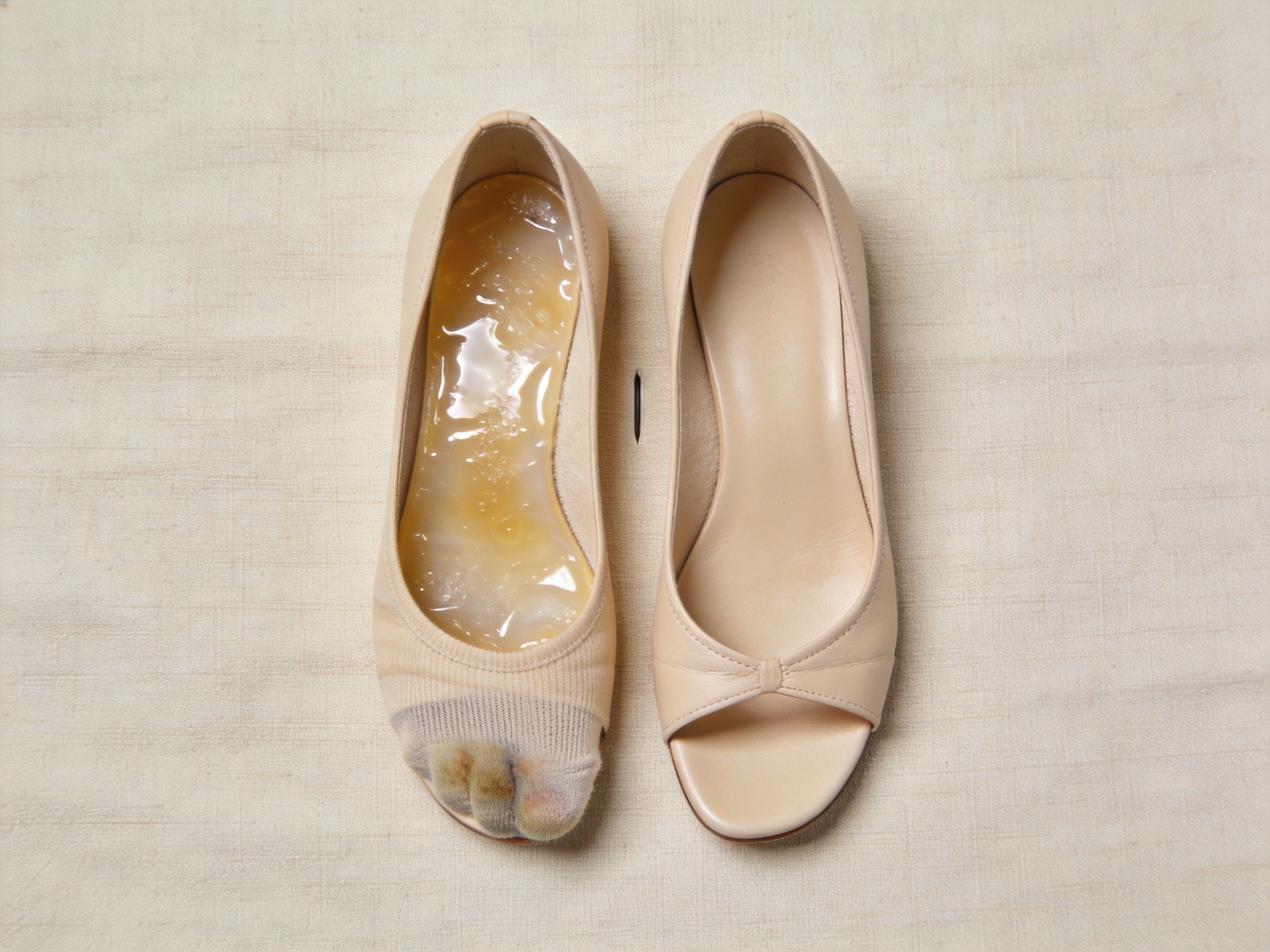
Stop fighting a sticky footbed every three weeks.
Browse the full collection of Chengdu-made custom women's leather flats, loafers, pumps, Mary Janes, and Oxford-style shoes — every pair with a chrome-free vegetable-tanned leather lining with 18-32% moisture buffering, a vegetable-tanned full-grain leather sock liner, hide-glue bonded insole-to-footbed joint, and open-cell cork filler. Minimum order 30 pairs for wholesale and private-label customers. Custom samples available for retailers and boutiques.
Explore the Custom Women's Shoe Collection