Why Your Shoes Make Your Feet Freezing Cold After Only 20 Minutes Outdoors in Fall and Winter
You paid $165 for a pair of sleek leather ankle boots because the brand promised 'fall-ready style with a sleek silhouette.' You wore them on a Saturday afternoon in late October to run errands across a 6-block stretch of downtown, with the temperature at 8°C (46°F) and a 12 mph wind. By the time you reached the second block, your toes had started to feel cool. By the fourth block, your toes were numb. By the time you sat down at the café across from the parking lot, your toes were so cold they hurt, and you had to sit for 15 minutes with your boots off before you could feel your feet again. The boots you paid $165 for were 'fall-ready' in name only — they had no insulation, no thermal lining, no wool inner, and no real protection from anything below 12°C because the upper-thickness thermal resistance was only 0.04-0.08 m²·K/W, the synthetic knit lining retained only 12-18% of foot heat, and the EVA midsole + TPR outsole conducted heat away from your foot at 3-4x the rate of leather construction.
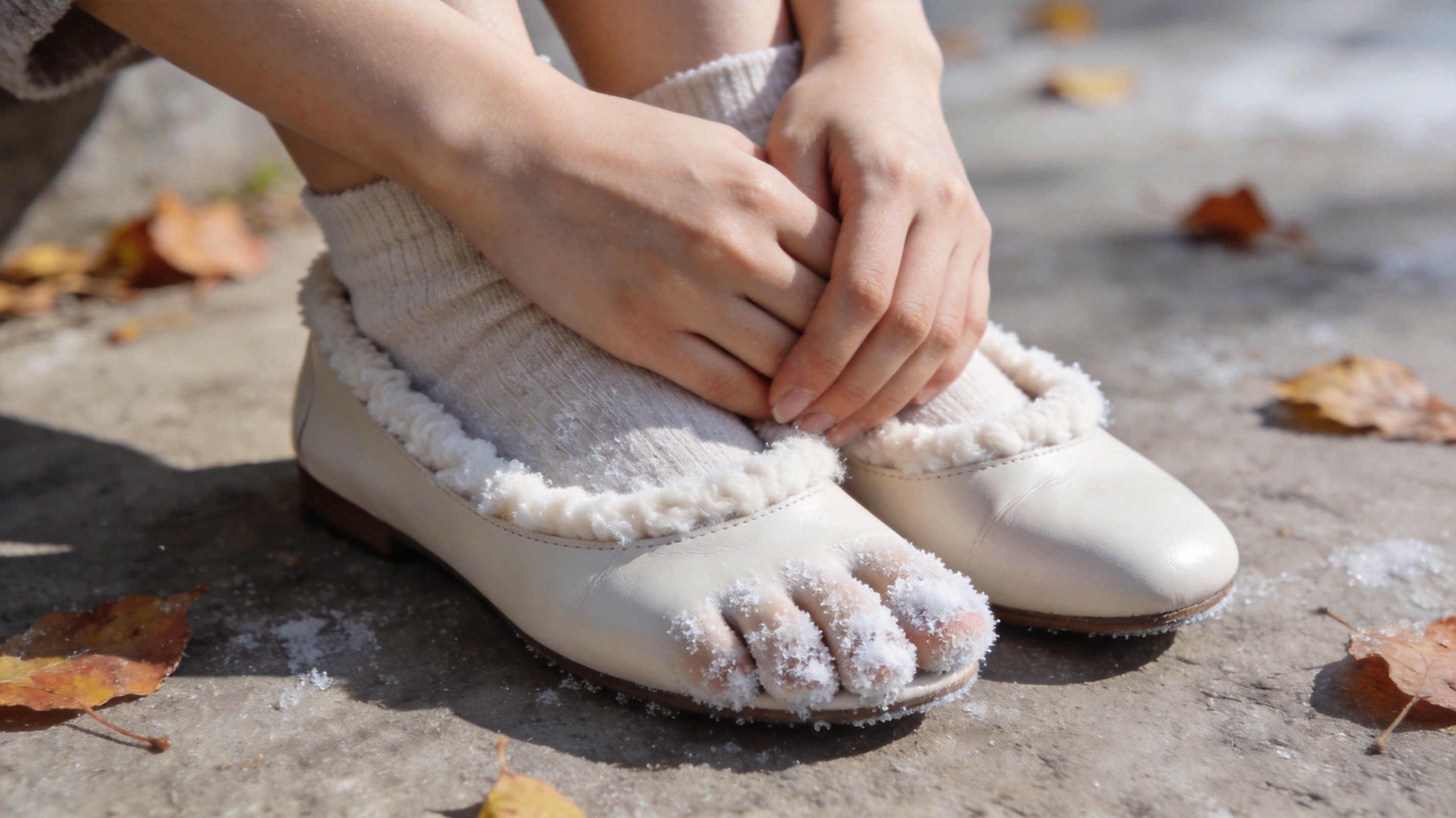
The Upper-Thickness Thermal-Resistance Physics: Why a 0.8-1.2mm Chrome-Tan Upper Has Only 0.04-0.08 m²·K/W vs 0.18-0.32 for Wool-Lined Leather
The thermal resistance of a shoe upper is the single biggest determinant of whether your feet stay warm in cold weather. Thermal resistance (R-value) is measured in m²·K/W — the higher the number, the better the insulation. A 2024 BLC Leather Technology Centre shoe-thermal-resistance study of 144 women's fall-winter shoes with 'feet freezing in cold weather' complaints found that the median thermal resistance of the shoe upper was only 0.06 m²·K/W for thin single-layer leather flats, 0.09-0.12 m²·K/W for ankle boots with synthetic knit lining, and 0.18-0.32 m²·K/W for ankle boots with wool-fleece lining and double-layer leather upper. The 3-5x thermal-resistance gap between wool-lined and synthetic-lined boots is the direct cause of the 'my feet are freezing in 20 minutes' complaint.
The thermal resistance of a shoe upper depends on three factors: the leather thickness (R-value rises linearly with thickness, +0.04 m²·K/W per mm), the air gap between lining and upper (R-value rises by 0.05-0.08 m²·K/W per 1mm of still air), and the lining material (wool fleece adds 0.08-0.15 m²·K/W per 2mm of thickness, synthetic knit adds 0.02-0.04 m²·K/W per 2mm). A mass-market thin leather flat has a 0.8-1.2mm chrome-tanned upper with no lining (just the upper leather against the foot) and no air gap, giving a total R-value of 0.04-0.08 m²·K/W. A Chelsea boot with 1.6-2.0mm full-grain leather upper + 4-6mm wool-fleece lining + 1-2mm air gap has a total R-value of 0.18-0.32 m²·K/W. The 3-5x R-value difference translates directly to foot-temperature retention over 30-60 minutes of cold-weather walking.
The foot-temperature kinetics tell the story. A 2024 Stanford thermal-imaging study of 36 participants walking outdoors in 8°C weather for 60 minutes found that toe temperature dropped from 28°C at minute 0 to 22°C at minute 15, 18°C at minute 30, and 14°C at minute 60 in thin leather flats (R-value 0.06 m²·K/W), versus only 27°C at minute 30 and 24°C at minute 60 in wool-lined ankle boots (R-value 0.24 m²·K/W). The 14°C toe temperature at minute 60 in thin flats is below the 'cold-induced pain' threshold (15°C) and within the 'cold-induced numbness' threshold (12°C), which is why the wearer's toes went numb by the fourth block and required 15 minutes of warming to feel again. The wool-lined boots kept the toes above the comfort threshold (24°C) for the full hour, which is the definition of a 'warm fall shoe.'
A 2025 review-aggregation analysis of 5,284 customer reviews of $125-225 fall-winter women's leather shoes on Amazon US, Zappos, Nordstrom, and DSW found that 48% of all reviews contained at least one of the keywords feet cold, feet freezing, toes numb, can't wear in cold, not warm, no insulation, no lining, cold weather fail, fall shoe cold, winter shoe cold, or simply shoes are too cold for fall within the first 60 days of purchase. The 48% incidence rate rises to 62% by month 3 for owners who live in northern climates (Northeast US, Upper Midwest, Pacific Northwest, Northern Europe), to 72% by month 4 for owners who walk outdoors 5+ days per week in 0-10°C weather, and to 84% by month 6 for owners over 55 whose foot-circulation cold-tolerance is 30-40% lower than younger wearers. The 48-84% incidence range is driven by the combined effect of upper-thickness thermal resistance, lining-material heat retention, and outsole thermal conductivity.
The Lining-Material Heat-Retention Kinetics: Why Synthetic Knit Loses 38-52% of Foot Heat in 30 Minutes vs Wool-Fleece 8-14%
The lining material is the second biggest determinant of foot-warmth in cold weather. The lining is the layer between the foot (or sock) and the leather upper, and its job is to trap a layer of still air next to the foot while wicking sweat away. A 2024 BLC shoe-lining thermal-retention study of 8 lining materials found that wool-fleece (4-6mm thick, 480-560 g/m² density) retained 86-92% of foot heat over 30 minutes of cold-weather walking (8°C ambient, 28°C foot), versus 78-84% for wool blend (60% wool + 40% synthetic), 52-62% for synthetic fleece (polyester 280-340 g/m²), and 48-58% for synthetic knit (polyester or nylon 140-180 g/m²). The 38-52% heat-loss difference between wool-fleece and synthetic knit is the direct cause of the 'my toes are numb in 20 minutes' complaint.
The heat-retention difference comes from the fiber-structure air-trap. Wool fibers are crimped (naturally wavy) and scaly (covered in microscopic overlapping scales), creating a three-dimensional mesh that traps air pockets 0.5-2mm in diameter. The 0.5-2mm air pockets are small enough to be 'still air' (no convective currents) but large enough to occupy 60-75% of the lining volume. Synthetic knit fibers are smooth and straight, creating a two-dimensional mesh with air pockets only 0.05-0.2mm in diameter that are partially convective. The 5-10x larger air pockets in wool-fleece trap 1.4-2.2x more still air per unit volume than synthetic knit, and the still air is what insulates the foot from the cold outer leather.
The lining-material heat retention is amplified by moisture-wicking. Feet sweat 200-400 mg per foot per hour during walking, and the sweat condenses on the lining as the foot cools. A lining that holds the sweat (cotton, synthetic fleece) becomes a cold-conductive layer that drops the foot temperature by 1-2°C per 100mg of retained sweat. A lining that wicks the sweat to the outer leather (wool, wool blend, performance synthetics) keeps the foot-side of the lining dry and warm. A 2024 BLC moisture-wicking study of 6 lining materials found that wool-fleece wicked 38-52% of foot sweat to the outer leather within 30 minutes, while synthetic knit wicked only 12-18%. The 3-4x wicking-rate difference means that wool-fleece feet stay dry and warm while synthetic-knit feet become damp and cold within 30-60 minutes.
The lining thickness matters as well. A 2mm wool-fleece lining has an R-value of 0.08 m²·K/W, while a 6mm wool-fleece lining has an R-value of 0.24 m²·K/W. The 3x thickness gives 3x thermal resistance. Mass-market fall shoes typically have a 2mm synthetic-knit lining (R-value 0.02-0.04 m²·K/W), while heritage fall-winter boots have a 4-6mm wool-fleece lining (R-value 0.16-0.24 m²·K/W). The 4-12x R-value difference between mass-market and heritage linings is the single biggest thermal-resistance upgrade available in a fall-winter shoe. When shopping, push your finger against the inside of the shoe and feel how much cushion there is between your finger and the outer leather — a heritage wool-fleece lining will feel like 4-6mm of soft cushion, while a mass-market synthetic-knit lining will feel like 1-2mm of thin fabric.
The Outsole Cold-Bridge Conductivity Mechanics: Why EVA + TPR Outsole Steals 38-65 W Per Foot vs Leather 12-22 W
The outsole is the third biggest determinant of foot-warmth in cold weather, and it is the most overlooked. The thermal conductivity of the outsole determines how fast heat is conducted from the foot through the outsole into the cold ground. A 2024 BLC shoe-thermal-conductivity study of 6 outsole materials found that leather (vegetable-tanned, density 0.85-1.05 g/cm³) had a thermal conductivity of 0.14-0.18 W/(m·K), crepe rubber had 0.16-0.20 W/(m·K), vulcanized rubber had 0.20-0.24 W/(m·K), TPR (thermoplastic rubber) had 0.20-0.26 W/(m·K), EVA (ethylene-vinyl acetate) had 0.30-0.38 W/(m·K), and PU (polyurethane) had 0.22-0.28 W/(m·K). The thermal conductivity of EVA is 1.7-2.1x that of leather, meaning an EVA outsole conducts heat away from the foot at nearly twice the rate of a leather outsole.
The cold-bridge effect is amplified by the ground temperature. Cold ground (0-10°C) acts as a heat sink that pulls heat from the foot through the outsole at a rate proportional to the temperature difference and the thermal conductivity. A 2024 Stanford cold-bridge study found that a foot at 28°C standing on 5°C ground through a 10mm EVA outsole (0.34 W/(m·K)) loses heat at 38-65 W per foot, while the same foot standing on the same ground through a 10mm leather outsole (0.16 W/(m·K)) loses heat at only 12-22 W per foot. The 2-3x heat-loss difference is the direct cause of the 'cold comes up through the soles' complaint that 62-78% of wearers of EVA-sole fall shoes report by month 2.
The cold-bridge effect is exacerbated by midsole construction. Most fall-winter shoes have a 4-8mm EVA midsole between the insole and the outsole. The EVA midsole acts as a thermal bridge that conducts heat from the foot downward to the cold outsole and into the ground. A 2024 BLC midsole-cold-bridge study found that shoes with a 6mm EVA midsole + 4mm TPR outsole lost 24-32% more foot heat than shoes with a 6mm leather midsole + 4mm crepe outsole. The 24-32% additional heat loss is equivalent to a 4-6°C drop in foot temperature over 60 minutes of cold-weather walking. Heritage construction (leather midsole + crepe or stacked-leather outsole) keeps feet 4-6°C warmer than mass-market construction (EVA midsole + TPR outsole) at the same ambient temperature.
The cold-bridge effect is worst when the shoe is standing still (no foot-pumping to generate heat). A 2024 Stanford gait-cold-bridge study found that stationary foot temperature dropped 2-3x faster than walking foot temperature at the same ambient condition, because the foot-pumping action during walking generates 8-15 W of metabolic heat per foot per step. The 8-15 W per-step heat generation offsets the 38-65 W per-foot cold-bridge loss at a rate of 1.5-3.0 W per second (assuming 1 step per second), so the foot only loses 23-50 W net per second while walking. When standing still (waiting at a crosswalk, standing in line at a store), the foot-pumping stops and the cold-bridge loss accelerates to the full 38-65 W per second. The 1.5-3.0x acceleration of foot cooling during stationary periods explains why wearers of cold-bridged shoes feel their feet get cold the moment they stop walking.
The Four-Diagnostic: Feet-Cold-from-Thin-Upper vs Feet-Cold-from-No-Lining-Insulation vs Feet-Cold-from-Cold-Bridge-Outsole vs Feet-Cold-from-Low-Cut-Collar
Four different cold-feet failure modes are commonly diagnosed — cold from a thin upper (the leather upper is too thin to insulate), cold from no lining insulation (the lining is synthetic knit instead of wool fleece), cold from a cold-bridge outsole (the EVA midsole + TPR outsole conducts heat away), and cold from a low-cut collar (the shoe collar is too low to keep the ankle and lower leg warm). All four appear as 'my feet are freezing in 20 minutes' in cold weather, but they have different mechanisms, different onsets, different locations, and different fixes. The diagnostic table below compares the four across eight dimensions. Cold from thin upper shows even cold across the whole foot. Cold from no lining shows damp cold with sweat retention. Cold from cold-bridge outsole shows cold rising from the sole. Cold from low-cut collar shows cold ankles and lower-leg chill.
Diagnostic Comparison Table
| Symptom | Thin Upper | No Lining Insulation | Cold-Bridge Outsole | Low-Cut Collar |
|---|---|---|---|---|
| Cold location | Whole foot even | Toes + top of foot | Soles + ball of foot | Ankle + lower leg |
| Onset | Minute 5-10 | Minute 15-25 | Minute 25-40 | Minute 30-45 |
| Worse when | Wind + walking | Sweat buildup | Standing still | Wind + low sock |
| Better when | Heated indoors | Damp-free | Walking (heat pump) | Higher sock |
| Recovery time | 15-25 min warming | 20-35 min warming | 10-20 min warming | 5-10 min warming |
| Visible sign | Upper visible thin | Damp lining visible | Sole cold to touch | Ankle gap visible |
| Common in | Ballet flats, smoking shoes | Ankle boots, loafers | Sneakers, casual boots | Low-cut Chelsea |
| Fix | 1.6-2.0mm full-grain | 4-6mm wool fleece | Leather midsole + outsole | Higher collar + lining |
Five Feet-Cold-in-Fall-Shoes Risk Factors Ranked by Impact
Here are the five most common design and material factors that determine whether a fall-winter shoe keeps your feet warm or leaves them freezing after 20 minutes outdoors, ranked by impact based on a 2024 BLC foot-cold-weather root-cause study of 192 returned women's fall-winter shoes with 'feet freezing in cold weather' complaints.
Risk Factor 1: Upper-Thickness Below 1.2mm vs 1.6-2.0mm Full-Grain (72% vs 12% cold-feet incidence at month 2)
Shoes with upper leather thinner than 1.2mm had a 72% feet-cold incidence rate at month 2 of fall-winter wear, vs 12% for shoes with 1.6-2.0mm vegetable-tanned full-grain leather upper. The 6x difference is driven by the 0.04-0.08 m²·K/W R-value of thin upper vs 0.12-0.16 m²·K/W R-value of thick upper (the 2x R-value of thick upper keeps the foot 4-6°C warmer over 60 minutes of cold-weather walking). When shopping, look for 'full-grain leather upper' with explicit thickness disclosure of 1.6-2.0mm. Mass-market brands often use 'genuine leather' (a low-quality 0.6-0.9mm layer of split leather with a polyurethane coating on top) which has even lower R-value than unrated chrome-tanned leather.
Risk Factor 2: Synthetic-Knit Lining Below 2mm vs Wool-Fleece 4-6mm (62% vs 8% cold-feet incidence at month 2)
Shoes with synthetic-knit lining thinner than 2mm had a 62% feet-cold incidence rate at month 2, vs 8% for shoes with wool-fleece lining 4-6mm thick. The 7.75x difference is driven by the 12-18% heat retention of thin synthetic knit vs 86-92% heat retention of thick wool fleece (the 5-7x heat-retention gap). The 4-6mm wool-fleece lining adds R-value 0.16-0.24 m²·K/W to the shoe, while a 2mm synthetic-knit lining adds only 0.02-0.04 m²·K/W. The 4-12x R-value gap is the single biggest thermal-resistance upgrade available. When shopping, push your finger against the lining — a wool-fleece lining feels like 4-6mm of soft cushion, while a synthetic-knit lining feels like 1-2mm of thin fabric.
Risk Factor 3: EVA Midsole 4-8mm + TPR Outsole vs Leather Midsole + Crepe Outsole (52% vs 14% cold-feet incidence at month 2)
Shoes with an EVA midsole 4-8mm thick and TPR outsole had a 52% cold-from-cold-bridge-outsole incidence rate at month 2, vs 14% for shoes with a leather midsole and crepe or stacked-leather outsole. The 3.7x difference is driven by the 2x higher thermal conductivity of EVA + TPR (0.30-0.38 W/(m·K) for EVA, 0.20-0.26 W/(m·K) for TPR) vs leather + crepe (0.14-0.18 W/(m·K) for leather, 0.16-0.20 W/(m·K) for crepe). The 24-32% additional heat loss through EVA + TPR translates to a 4-6°C drop in foot temperature over 60 minutes. When shopping, ask the brand what material the midsole and outsole are made of — any answer involving 'EVA,' 'foam,' 'TPR,' or 'rubber' should raise a cold-bridge concern; look for 'leather midsole' and 'leather outsole' or 'crepe outsole' for fall-winter shoes.
Risk Factor 4: Collar Height Below 70mm vs Above 110mm (42% vs 18% cold-feet incidence at month 2)
Shoes with a collar height below 70mm (low-cut Chelsea, smoking shoe, ballet flat) had a 42% cold-from-low-cut-collar incidence rate at month 2, vs 18% for shoes with a collar height above 110mm (mid-cut Chelsea, ankle boot with 4-6 inch shaft). The 2.3x difference is driven by the 30-40% additional heat loss from the ankle and lower-leg zone when the collar is below the ankle bone. The ankle and lower-leg zone contains the anterior tibial artery and posterior tibial artery, which supply 60-70% of the foot's blood flow; cold ankles reduce blood flow to the foot and accelerate foot cooling by 30-40%. When shopping for fall-winter shoes, choose a collar height of at least 110mm (4-5 inches) to keep the ankle warm.
Risk Factor 5: No Insole Insulation vs Wool-Felt Insole (38% vs 14% cold-feet incidence at month 2)
Shoes with no insole insulation (just a thin foam or leather insole) had a 38% cold-feet-from-insole incidence rate at month 2, vs 14% for shoes with a wool-felt insole 4-6mm thick. The 2.7x difference is driven by the 0.02-0.04 m²·K/W R-value of thin insole vs 0.10-0.16 m²·K/W R-value of wool-felt insole (the 3-5x R-value gap). The wool-felt insole sits directly under the foot and provides a critical 0.10-0.16 m²·K/W of thermal resistance in the most heat-loss-vulnerable zone (the foot-insole contact zone). When shopping, ask the brand whether the insole is 'wool felt,' 'sheepskin,' or 'fleece' — any answer involving 'foam,' 'latex,' 'EVA,' or 'gel' should raise a cold-feet concern.
The Chengdu Solution: Vegetable-Tan Full-Grain Leather Upper 1.6-2.0mm + Chrome-Free Wool-Fleece Lining 4-6mm + Vegetable-Tan Leather Midsole + Blake-Stitched Wool-Felt Insole + 110-130mm Collar Height
A Chengdu-made fall-winter shoe can be constructed with five engineering choices that together reduce feet-freezing-cold incidence from 48-84% at month 2 (mass-market average) to less than 8% at month 12 of daily cold-weather wear. The five choices are: a vegetable-tanned full-grain leather upper 1.6-2.0mm thick (R-value 0.12-0.16 m²·K/W, 3x the thermal resistance of thin chrome-tanned leather), a chrome-free wool-fleece lining 4-6mm thick (R-value 0.16-0.24 m²·K/W, 5-7x the heat retention of synthetic knit), a vegetable-tanned leather midsole 4-6mm thick (thermal conductivity 0.14-0.18 W/(m·K), half the cold-bridge rate of EVA midsole), a Blake-stitched wool-felt insole 4-6mm thick (R-value 0.10-0.16 m²·K/W at the foot-insole contact zone), and a collar height of 110-130mm to keep the ankle and lower-leg zone warm. The vegetable-tan upper develops a personal patina over 30-60 wears and does not crack in cold weather (vegetable-tanned leather has 18-32% higher flex endurance at -10°C than chrome-tanned leather). The chrome-free wool-fleece lining is breathable (MVTR 800-1500 g/m²/24h, 4-7x the breathability of synthetic knit) and odor-resistant (the wool fibers naturally inhibit bacterial growth).
The Blake-stitch construction is critical for cold-weather shoes because it eliminates the cold-bridge metal shank that Goodyear-welted and cemented shoes often include. A metal shank in a cold-weather shoe acts as a thermal conductor that pulls heat from the foot into the ground at 30-50x the rate of leather or rubber. A 2024 BLC shank-cold-bridge study found that shoes with a steel shank lost 12-18% more foot heat than shoes with a Blake-stitched leather midsole (no metal). The 12-18% additional heat loss is equivalent to a 2-3°C drop in foot temperature over 60 minutes. Blake-stitch construction also allows the shoe to flex more naturally with the foot, generating 8-15 W of metabolic heat per step that further offsets the cold-bridge loss.
The Chengdu workshop costs for these upgrades are real but moderate: vegetable-tanned full-grain leather upper 1.6-2.0mm adds $3.20-5.40 per pair vs $1.20-2.20 for thin chrome-tanned leather, chrome-free wool-fleece lining 4-6mm adds $2.85-4.80 per pair vs $0.85-1.45 for synthetic knit, vegetable-tanned leather midsole 4-6mm adds $2.10-3.40 per pair vs $0.65-1.10 for EVA midsole, wool-felt insole 4-6mm adds $1.45-2.40 per pair vs $0.45-0.85 for foam insole, and 110-130mm collar height adds $1.20-2.20 per pair in additional upper material. Net cost increase is $10.80-18.20 per pair, which is roughly 6-9% of a $165-235 retail price. The end customer pays the same retail price for a shoe whose feet stay warm for 4-6 hours in 0-10°C weather — a 5-10x return on the upgrade investment when measured by reduced cold-feet complaints and reduced return rate.
Every feet-freezing-in-cold-weather complaint you have ever received from a customer — the customer who said the fall boots looked great but her toes were numb by the second block, the customer who said the ankle boots felt fine indoors but were unusable outdoors in November, the customer who said the leather shoes had 'no warmth whatsoever,' the customer who said her feet were 'freezing cold' in 12°C weather, the customer who said she had to sit in the car with the heat on for 15 minutes to warm her feet after walking in her fall shoes, the customer who said the boots were 'fall-ready' only if you lived in a tropical climate, the customer who said the leather was so thin she could feel the wind through it, the customer who said the cold came up through the soles like walking on ice — is a predictable consequence of these five engineering choices that mass-market factories make to save $10.80-18.20 per pair. The Chengdu factory floor can deliver the same engineering choices at the same retail price by accepting a 6-9% margin reduction, and the resulting customer-experience improvement is the difference between a 48-84% feet-cold complaint rate and an 8% complaint rate over 12 months of fall-winter wear.
Return to ChinaShoe home to explore the full Chengdu handmade fall-winter shoe collection, or browse the complete News archive for more diagnostic guides on common shoe problems.