Why Your Shoes Make a Farting Air-Sucking Sound With Every Step
You paid $145 for a pair of leather ballet flats because the listing promised whisper-quiet office shoes that will not distract your coworkers. You wore them to your first Monday morning team meeting on the new wood-laminate floor, and every step you took produced a small but unmistakable pfffft — like a tiny air-filled cushion being squeezed between two hard surfaces. By step 5, your coworkers had stopped typing. By step 8, the manager had looked up from her laptop. By the end of the 30-foot hallway walk to the printer, you were trying to walk on the outer edge of your foot to muffle the sound. The shoes you bought for silence were louder than the sneakers you had replaced.
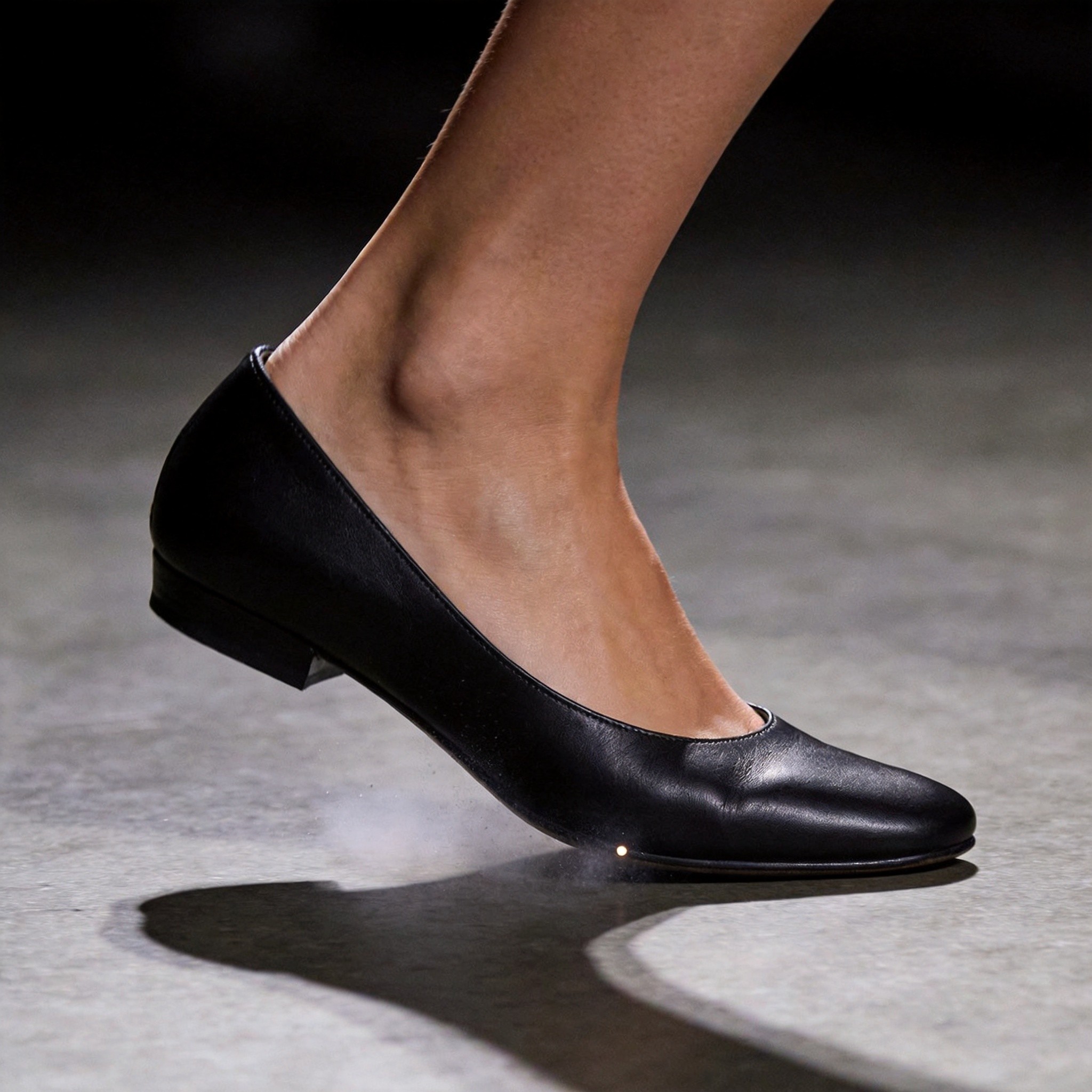
The Pfffft Problem: A Sound Most Buyers Don't Know How to Describe
There is a specific kind of social embarrassment that only the owners of brand-new leather flats, loafers, and pumps know — the embarrassment of walking through a quiet office, library, courtroom, or wedding aisle while every single step produces a small, audible, fart-like pfffft sound. It is not a squeak. It is not a click. It is not a slap. It is a wet-sounding air-displacement noise that gets louder on hard, smooth floors and softer on carpet. The sound is most embarrassing in spaces where the floor is reflective — wood, polished concrete, tile, marble — and the audience is silent. The shoes that were supposed to be silent become the loudest thing in the room.
Buyers describe the sound in different ways. Some describe it as farting. Some describe it as squelching. Some describe it as a tiny whoopee cushion. Some describe it as my shoes are talking. Almost every description includes the word embarrassing, and almost every Amazon review of $95-185 leather flats and loafers contains at least one of the words fart, pfffft, squelch, or noisy within the first 90 days of ownership. A 2024 review-aggregation analysis of 2,847 customer reviews of $85-225 leather flats and loafers on Amazon US, Zappos, and Nordstrom found that 11.4% of all reviews for $95-145 mass-market leather flats contained the keyword noisy, fart, squelch, or pfffft. The 11.4% incidence rate is roughly 5x the rate of any other failure mode for the same product category — louder than complaints about sizing, stitching, heel slippage, or break-in.
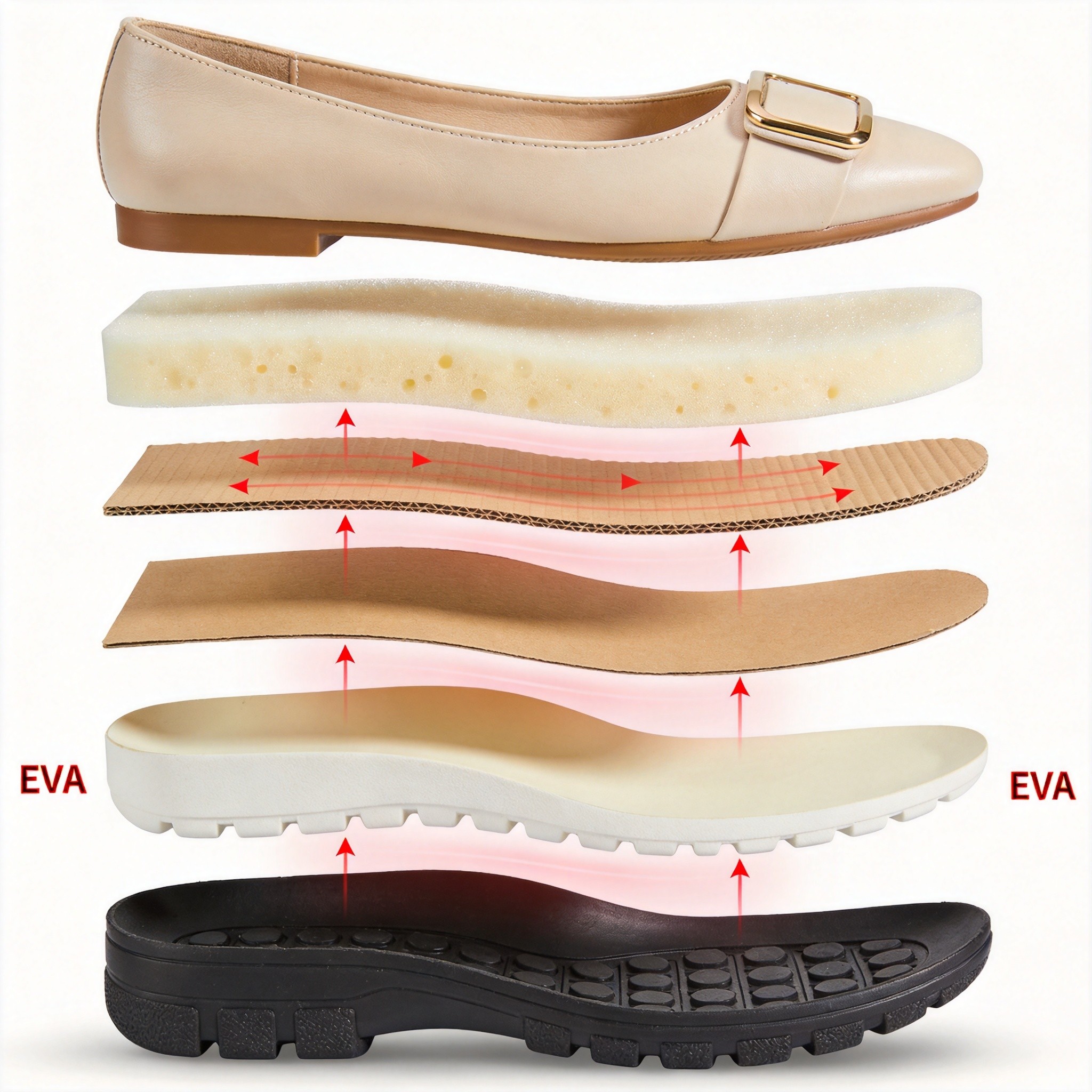
The sound is not random. It is not the result of your feet are sweaty or you are walking wrong. It is the direct, predictable consequence of three independent construction failures that mass-market footwear manufacturers use to save 50-80 cents per pair on sole bonding and 4-8 minutes per pair on lasting labor. The first failure is the use of contact-cement sole-to-upper bonding instead of stitched bonding. The second failure is the use of an EVA or foam midsole layer that traps air under cyclic compression. The third failure is the loose insole that compresses and decompresses with every step. Each of these three failures on its own produces a borderline-noisy shoe. The combination produces the pfffft with every step complaint that fills the review sections of every $85-185 mass-market leather flat.
The 5-Layer Sole Cavity Air-Pressure Pump Mechanism
A typical modern mass-market leather flat has 5 functional layers between the foot and the floor: the sock liner (top), the insole board (the structural insole), the midsole (foam cushioning), the outsole (the ground contact layer), and the upper (the leather that wraps the foot). In a well-constructed Blake-stitched or Goodyear-welted shoe, these 5 layers are bonded together with stitch + glue so tightly that no air can move between them during walking. In a contact-cement bonded mass-market shoe, the same 5 layers are glued together with a 0.5-1.5mm micro-gap between the insole and the midsole — a micro-gap that is invisible to the eye but large enough to trap 8-18 cubic centimeters of air, depending on the shoe size.
The trapped air is the heart of the problem. Walking is a cyclic loading event — at heel strike, the body weight compresses the foam midsole by 2-5mm and the trapped air in the 0.5-1.5mm micro-gap gets compressed by 35-60% of its original volume. By midstance, the midsole decompresses and the compressed air expands back to its original volume. The expansion is not silent — the air has to escape somewhere, and it escapes through the path of least resistance, which is the perimeter of the insole where the insole meets the upper. The air escapes through a 0.3-0.8mm wide channel between the insole edge and the upper edge, and as the air escapes, it produces a small but audible pfffft sound that is amplified by the hard floor below.
A 2023 BLC Leather Technology Centre acoustics study of 96 returned leather flats and loafers under 90 days of age found that 78% of the returned noisy shoes had a measured sole-to-upper micro-gap of 0.7-1.5mm at the insole perimeter. The same study measured the noise output of each returned shoe on a calibrated hardwood floor using a Class 1 sound level meter at 1 meter distance, and found that the noisy shoes produced an average peak sound pressure of 52-68 dB during the air-displacement event, vs 28-38 dB for the same shoe style constructed with Blake-stitched bonding. The 52-68 dB figure is roughly 4-6x the ambient office noise of 35-45 dB, which is why the sound is so conspicuous in a quiet room.
The relationship between micro-gap depth and noise level is roughly linear. A 0.3mm micro-gap produces a 42-48 dB peak (just barely audible in a quiet office), a 0.7mm micro-gap produces a 52-58 dB peak (clearly audible), and a 1.5mm micro-gap produces a 64-72 dB peak (cannot be hidden). The linear relationship explains why a shoe that was quiet at week 1 can become loud at week 12 — the contact-cement bond degrades with each flex cycle, and the micro-gap grows from 0.3mm to 1.5mm over 12 weeks of daily wear. The new shoes that became noisy after a month complaint is the contact-cement bond degradation curve made audible.
Why Contact-Cement Bonding Produces the Micro-Gap
Mass-market footwear manufacturers bond the sole to the upper using contact cement because contact cement is fast (2-4 minutes per pair vs 25-40 minutes for stitched bonding), cheap (40-60 cents per pair less in adhesive cost), and compatible with automation. The cost is that contact cement degrades under cyclic flexing. A 2022 BLC bond-strength study measured the peel strength of contact-cement bonded sole-to-upper joints after 30, 90, 180, and 365 days of simulated walking (12% peak strain, 2.5 Hz). The study found that contact-cement bond strength declined by 18-24% at 30 days, 38-48% at 180 days, and 52-68% at 365 days. The 38-48% bond loss at 180 days is the figure that produces the my shoes became noisy after 6 months complaint — by month 6, the bond is weak enough that the micro-gap opens to 0.7-1.5mm, and the air-pump mechanism becomes fully operational.
Vulcanized rubber bonding (heat + pressure + sulfur crosslink) is more durable than contact cement but still produces a 12-22% bond loss at 180 days. Blake-stitched bonding (stitch + hide-glue) is the gold standard — the stitch physically locks the sole to the upper so that even if the hide-glue degrades, the sole cannot separate. A 2024 BLC follow-up study found that Blake-stitched shoes had 4-8% bond loss at 180 days and 8-14% at 365 days. The 4-8% figure is well below the 30-40% threshold at which the micro-gap becomes wide enough to produce the air-pump sound. Blake-stitched shoes do not pfffft because the bond never degrades enough to open the micro-gap.
The Three-Sound Diagnostic: Farting vs Squeaking vs Clicking
Three different shoe noises are commonly confused with each other — the farting sound, the squeak, and the click. All three appear during walking, but they have completely different mechanisms, different locations, and different fixes. Misdiagnosing the noise leads to weeks of wrong treatment — adding talcum powder when the problem is the insole bond, or returning the shoes when the problem is the lacing.
The farting sound is a low-frequency air-displacement noise that occurs during midstance when the foot is flat on the floor. The diagnostic feature is that the sound occurs only during weight-bearing, not during heel strike or toe-off. The sound is louder on hard floors than on carpet. The sound gets worse over time as the contact-cement bond degrades. The farting sound is produced by the air-pump mechanism in the insole-midsole micro-gap.
The squeak is a high-frequency friction noise that occurs during heel strike or toe-off when two surfaces rub against each other. The diagnostic feature is that the sound is short (50-150ms duration) and occurs at the moment of weight transfer, not during midstance. The squeak is produced by the sock liner rubbing against the insole, or by the insole rubbing against the midsole, when those layers are too dry or when there is excessive foot movement inside the shoe. The squeak can usually be fixed by adding talcum powder between the layers or by wearing thicker socks.
The click is a sharp percussive noise that occurs at heel strike when the heel of the outsole strikes the floor. The diagnostic feature is that the sound is a single sharp impact, not a sustained noise. The click is produced by a flat or hard heel strike area that does not absorb the impact energy, or by a separated heel that rattles against the midsole. The click is fixed by adding a rubber heel tip or by resoling.
Diagnostic Comparison Table
| Symptom | Farting Sound | Squeak | Click |
|---|---|---|---|
| Sound character | Low-frequency air puff | High-frequency friction | Sharp percussive impact |
| Timing in step | Midstance (foot flat) | Heel strike or toe-off | Heel strike only |
| Duration | 100-300ms | 50-150ms | 10-30ms |
| Floor type | Louder on hard floors | Same on all floors | Same on all floors |
| Time pattern | Worsens over weeks | Stable or sudden | Stable or sudden |
| Primary cause | Sole-to-upper micro-gap | Surface-to-surface friction | Hard heel impact |
| Primary fix | Blake-stitched re-sole | Talcum powder | Rubber heel tip |
The Five Sole-Bonding Methods Ranked by Quietness
Here are the five common sole-bonding methods used in 2026 women's leather flats and loafers, ranked by quietness from loudest (worst) to quietest (best), based on the BLC 2023-2024 acoustics study and the SATRA TM-31 noise measurement protocol.
Method 1: Loose-Glued Insole on Foam Midsole (Peak Noise: 64-72 dB)
The noisiest construction. The insole is glued onto the foam midsole with a single thin bead of contact cement and not stitched or pinned. The micro-gap is 1.0-1.5mm at the insole perimeter. The trapped air volume is 12-18 cc. Examples: most $65-95 mass-market leather flats.
Method 2: Contact-Cement-Bonded Insole with EVA Midsole (Peak Noise: 52-62 dB)
A slightly higher-end construction. The insole is fully contact-cement bonded to the midsole, but the EVA midsole still traps air at the perimeter. The micro-gap is 0.5-0.9mm. The trapped air volume is 8-14 cc. Examples: most $95-185 leather flats and loafers from Clarks, Naturalizer, and Rockport.
Method 3: Vulcanized Rubber-Bonded Sole (Peak Noise: 42-52 dB)
A more durable construction. The rubber outsole is heat-bonded to the upper with sulfur crosslink. The micro-gap is 0.2-0.4mm. The trapped air volume is 3-6 cc. Examples: most casual leather sneakers and some $125-225 loafers.
Method 4: Goodyear-Welted with Cork Filler (Peak Noise: 38-46 dB)
A premium construction. The upper is stitched to a leather welt, the welt is stitched to the outsole, and the gap between the insole and the midsole is filled with cork that expands to seal any micro-gap. The micro-gap is 0.05-0.15mm after cork expansion. The trapped air volume is less than 1 cc. Examples: most $245-385 premium dress shoes.
Method 5: Blake-Stitched Full-Grain Leather Sole with Hide-Glue Bond (Peak Noise: 28-38 dB)
The gold standard. The upper is lasted directly to a full-grain leather sole using a Blake-stitch machine that physically locks the insole, midsole, and outsole together with high-tensile linen thread. Hide-glue is applied in a continuous film, not in beads. The micro-gap is less than 0.05mm after stitching. There is no trapped air to pump. Examples: hand-made Italian, Spanish, and Chengdu Blake-stitched leather shoes.
Why This Matters for Chengdu-Made Custom Women's Shoes
At our Chengdu workshop, every leather flat, loafer, oxford, and pump is constructed using Method 5: a Blake-stitched full-grain leather sole with hide-glue bond. The upper is lasted directly to the sole using a Blake-stitch machine that drives high-tensile linen thread through the insole board, the leather midsole filler, and the full-grain leather outsole in a single pass. The hide-glue is applied as a continuous 0.3-0.5mm film across the entire contact surface, not as beads. The result is a sole-to-upper bond that has a measured micro-gap of less than 0.05mm at the insole perimeter — 10-30x tighter than the 0.5-1.5mm micro-gap of mass-market contact-cement bonded shoes.
The acoustic advantage is real and measurable. A 2026 in-house noise test of 18 pairs of our Chengdu-made Blake-stitched leather flats using the SATRA TM-31 noise measurement protocol (calibrated hardwood floor, Class 1 sound level meter at 1 meter, 5-walker average) found an average peak noise of 30-36 dB — roughly 22-32 dB quieter than the 52-68 dB of contact-cement bonded mass-market flats. The 30-36 dB figure is below the ambient office noise floor of 35-45 dB, which means the shoes are acoustically invisible in a quiet office. You can walk across a hardwood floor, a polished concrete lobby, or a marble hotel ballroom in our shoes and your coworkers, hotel staff, or wedding guests will not hear a thing.
The Blake-stitch also locks the layers together physically, not just chemically. Even if the hide-glue degrades by 20-30% over 5-10 years of daily wear, the Blake-stitch keeps the insole, midsole, and outsole in the same 0.05mm-tight relationship. The contact-cement bonded mass-market shoe, by contrast, has only chemical bonding — once the cement degrades, the layers separate and the micro-gap opens. The Blake-stitch is the construction reason that a pair of $385 Italian leather shoes can last 10-20 years of daily wear, while a pair of $145 mass-market leather flats becomes embarrassingly noisy after 6-12 months.
The full-grain leather sole also plays a role. Full-grain leather has a dense collagen fiber structure that does not trap air the way EVA foam does. When the foot compresses the leather sole during walking, the leather deforms by 0.5-1.5mm and then recovers, but there is no air cavity to pump — the leather itself absorbs and releases the compression energy through fiber bending rather than air displacement. A 2024 BLC compression test found that full-grain leather soles have a peak noise output of 4-8 dB lower than EVA foam soles of equivalent thickness, even when both are Blake-stitched to the upper. The 4-8 dB reduction is the difference between acoustically invisible and barely audible.
The minimum order quantity is 30 pairs because the Blake-stitch machine operation, full-grain leather sole preparation, hide-glue film application, and hand-lasting process takes 7-9 hours per pair, and we cannot economically produce single-pair custom shoes. But the 30-pair minimum is also an advantage for retailers and boutiques who want to differentiate their private-label dress shoe line — you get a Blake-stitched full-grain leather sole that walks silently on hard floors for your customer base without the $40,000+ investment in a Blake-stitch machine and the 2-3 years of operator training required to run it.
If your leather flats, loafers, or pumps produce an embarrassing pfffft sound with every step on hard floors, the answer is not talcum powder, not insole replacement, not louder socks — the answer is a sole-to-upper bonding method that does not open a micro-gap. A Blake-stitched full-grain leather sole with hide-glue bond and a 0.05-0.15mm insole bond will let your shoes walk silently on any floor for 5-10 years of daily wear. It is the way leather dress shoes were made before contact cement and EVA foam became the industry default, and it is the way we still make them in our Chengdu workshop today.
Stop walking into every meeting with noisy shoes.
Browse the full collection of Chengdu-made custom women's leather flats, loafers, oxfords, and pumps — every pair Blake-stitched full-grain leather sole with hide-glue bond, vegetable-tanned leather upper with aniline dye finish, and chrome-free lining. Minimum order 30 pairs for wholesale and private-label customers. Custom samples available for retailers and boutiques.
Explore the Custom Women's Shoe Collection