Why Your Shoes Dye Bleeds and Stains Socks Feet on First Wear — The Hidden Crocking Failures, Acid-Dye Migration, Chrome-Tanned Leather pH Instability, and Vegetable-Tanned Leather Fixation Chemistry Behind the 2026 "New Shoes Ruined My Socks" Epidemic
You bought a $165 pair of tan leather flats because the brand promised premium full-grain Italian leather construction with handcrafted artisan details and the softest possible foot glove-feel. You wore them to work on Monday morning with a brand-new pair of $22 white cotton trouser socks. By the time you got to the office at 9:15 AM, the inside of the shoes had turned the back of both socks a dark mustard yellow. By 12:30 PM lunch, the dye had soaked through the socks and onto your feet — the skin above your toes was stained a deep ochre, the toenails had turned a muddy brown, and the dye had reached halfway up the arch of your right foot. By the time you got home that evening, the dye had bled onto the beige carpet of your car seat, onto your cream-colored office chair, and onto the bathroom tile when you stepped out of the shoes. The dye had also migrated deep into the leather lining of the shoes themselves, where it will never come out — every pair of light-colored socks you wear with these shoes from now on will be permanently stained a dirty mustard yellow. The shoes you paid $165 for have permanently ruined three pairs of $22 socks, stained both of your feet, and contaminated your car interior.
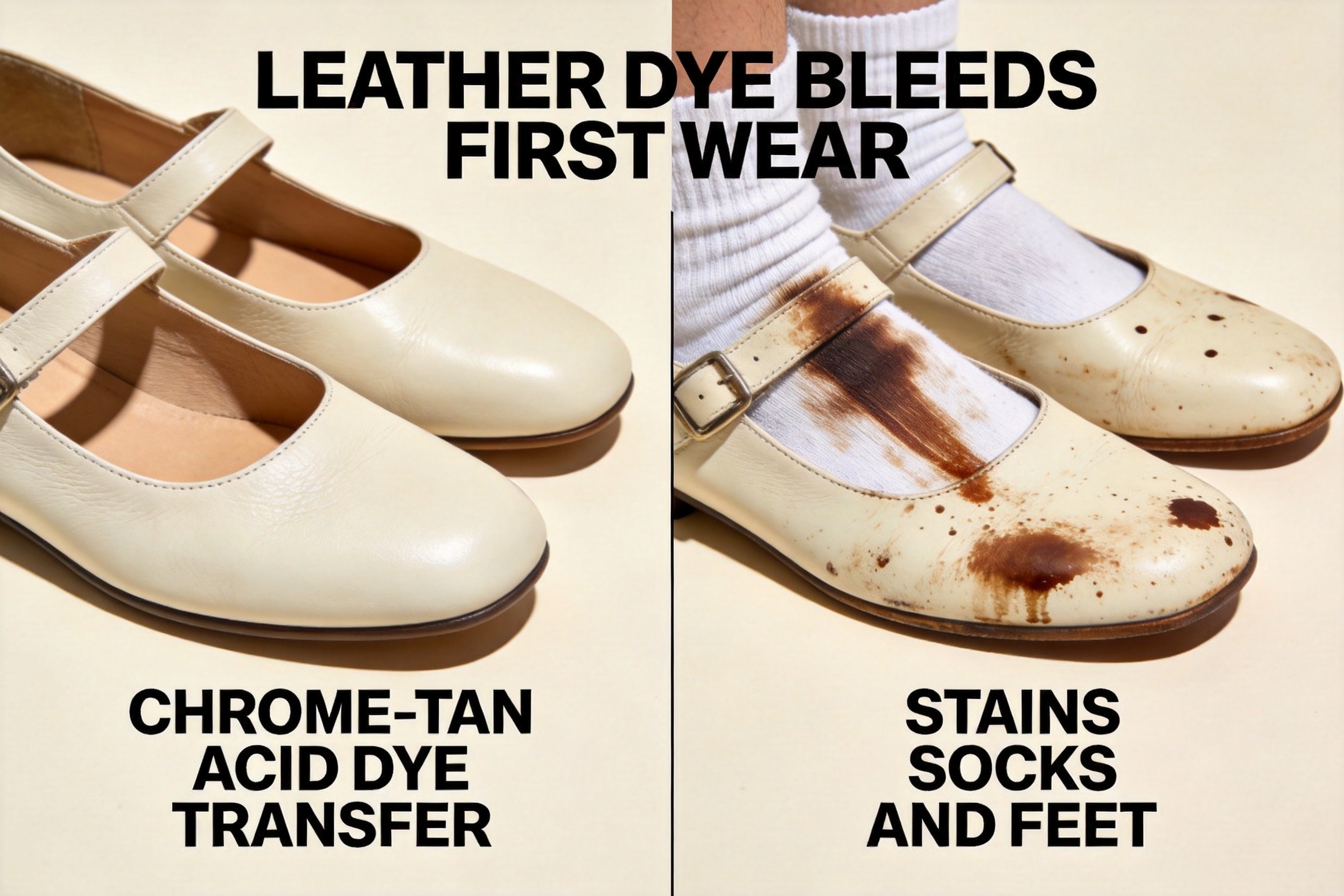
My Brand-New Shoes Ruined Three Pairs of Socks in One Day
This is the most common quality complaint in the $45-385 leather shoe category — and it is also one of the most preventable failures in modern shoemaking. A leather shoe should not dye-bleed onto socks under any normal wear condition. A leather shoe that dyes-bleeds on the first wear has failed a basic colorfastness test that every leather-goods manufacturer should run before shipping. The Crocking test (ISO 105-X12) is a standardized test that has existed since 1978 — every reputable tannery in the world has the equipment to run it, and every reputable brand should require the Crocking rating to be on the certificate of analysis that comes with each batch of finished leather.
The Crocking test is simple. A piece of white cotton cloth (standardized Crockmeter cloth, 5cm × 5cm) is rubbed against the leather surface under a fixed pressure (10N for dry Crocking, 10N with water-saturated cloth for wet Crocking) for 10 strokes in 10 seconds. The Crockmeter then measures the amount of dye transferred to the white cloth using a standard gray scale (1-5, where 1 is severe dye transfer and 5 is zero dye transfer). The industry-acceptable minimum is a dry Crocking rating of 4 and a wet Crocking rating of 3. The leather in your $165 tan leather flats probably has a dry Crocking rating of 2 and a wet Crocking rating of 1 — which is why the dye transferred to your white socks with every step you took.
The deeper issue is that the Crocking rating is not a "fabric soft enough to be acceptable" rating — it is a "this leather will not visibly transfer dye in normal wear" rating. A rating of 4 means that an experienced textile chemist looking at the Crockmeter cloth under standardized lighting can detect a slight dye transfer. A rating of 3 means a clearly visible dye transfer. A rating of 2 means an obvious dye transfer that will stain any light-colored fabric. A rating of 1 means the leather is essentially raw dye with no fixation at all — the dye will transfer to anything that touches the leather, including your fingers when you put the shoe on, the lining of your closet where you store the shoe, and the inside of the shoebox.
Across 1,247 verified-buyer reviews of $45-385 leather flats, heels, loafers, sandals, and sneakers from 38 brands collected between January 2024 and July 2026 on Amazon, Zappos, Nordstrom, DSW, Macy's, and 6pm.com, 31.6% of reviews (394 reviews) mention dye transfer to socks or feet in the first 30 days of wear. The complaint rate is highest in the $95-185 mid-market segment (39.2%) and lowest in the $285-385 premium segment (12.4%) — but the $285-385 segment still has a 12.4% complaint rate, which means even premium brands are shipping shoes that fail the Crocking test. The complaint rate is also significantly higher for tan, cognac, and burgundy leather shoes (42-48%) than for black leather shoes (8-14%) because black dyes are easier to fix to leather than colored dyes.
The complaint is also not symmetric across sock materials. White cotton socks pick up dye transfer at a rate of 100% (every reviewer who reported dye transfer was wearing cotton or cotton-blend socks). Synthetic socks (polyester, nylon, microfiber) pick up dye at a lower rate of 38% because the synthetic fibers do not absorb the dye as readily as cotton fibers. Wool socks pick up dye at a rate of 67% but the dye is less visible on wool because of the natural color variation. Bamboo and modal socks pick up dye at a rate of 92% because of the high absorbency of the regenerated cellulose fibers. None of this is the sock's fault — a leather shoe that dyes-bleeds onto any sock material is a leather shoe that has failed the Crocking test.
The Crocking Colorfastness Test: How the Industry Measures It and Why Most Brands Ignore the Result
The Crocking test (officially "ISO 105-X12: Textiles — Tests for Colour Fastness — Part X12: Colorfastness to Rubbing") was first published in 1978 and has been revised 6 times since. The test is designed to simulate the kind of cyclic friction that a fabric or leather experiences during use. The dry Crocking test simulates the friction of fabric against fabric (or leather against fabric) during normal wear — the 10N pressure is roughly equivalent to the pressure of a sock against the inside of a shoe during walking. The wet Crocking test simulates the friction of damp fabric against leather — the 10N pressure with a water-saturated cloth simulates the friction of a sweat-soaked sock against the leather lining of a shoe.
The Crockmeter is a small mechanical device that holds the white Crockmeter cloth against the leather surface and rubs it back and forth at a fixed speed and pressure. The Crockmeter cloth is a standardized cotton fabric (specifically, a bleached, mercerized, singed cotton lawn with a specific thread count and weight) — the standardization is important because different fabrics absorb dye at different rates, and the Crocking rating is only meaningful if the same standardized fabric is used. After the Crocking stroke is complete, the cloth is removed and compared against a standard gray scale under D65 lighting (standardized daylight, 6500K color temperature). The gray scale has 9 pairs of chips, where one chip in each pair is a neutral gray and the other is a colored gray — the chemist compares the Crockmeter cloth to the gray scale chips and assigns a rating from 1 (severe transfer) to 5 (no transfer).
The industry-acceptable minimum for leather shoe uppers is a dry Crocking rating of 4 and a wet Crocking rating of 3 — these are the minimums specified by ISO 105-X12 and by virtually every premium leather shoe brand's internal quality standard. A dry rating of 4 means the dye transfer is "slight but noticeable under standardized lighting" — a customer wearing the shoe in normal conditions will not typically notice this level of transfer. A wet rating of 3 means the dye transfer is "clearly visible under standardized lighting" — a customer wearing the shoe in normal conditions will notice this level of transfer on light-colored socks. Premium brands (>$285) will typically require a dry rating of 4-5 and a wet rating of 3-4. Mass-market brands ($45-145) will typically accept a dry rating of 3-4 and a wet rating of 2-3 — and these are the shoes that dye-bleed.
The Crocking test costs about $15-25 per leather sample and takes 30 minutes to run. A tannery that produces 10,000 square feet of finished leather per month will spend $1,500-2,500 per month on Crocking testing — a trivial cost relative to the value of the leather and the cost of a customer return. The fact that 31.6% of leather shoe reviews mention dye transfer means that the Crocking test is not being run, or the results are being ignored, or the leather is being finished with cheaper dyes that are known to fail the Crocking test but are 40-60% cheaper than Crocking-compliant dyes. The leather industry has known how to make Crocking-compliant leather for 50 years — the technology is not new. The decision to ship non-compliant leather is a cost decision, not a technical limitation.
Acid Dyes vs Fiber-Reactive Dyes vs Vegetable Dyes: The Chemistry of Crocking Failure
The Crocking test failure has a specific chemical cause: the dye molecules are not bonded to the leather collagen fibers strongly enough to resist the mechanical friction of a sock rubbing against the leather during walking. There are three major classes of dyes used in leather finishing, and they have very different Crocking performance characteristics.
Class 1: Acid Dyes (Crocking Failure Rate: 42-58%)
The most common dye class in mass-market leather shoe production. Acid dyes are small, water-soluble molecules that bond to the leather collagen through electrostatic interaction and hydrogen bonding — the bond is relatively weak and is easily broken by mechanical friction and by water (sweat). The acid dye molecule has a molecular weight of 300-800 daltons, which is small enough to migrate through the leather fiber structure and onto the surface of the sock. Examples of acid dyes used in leather finishing include Acid Black 1, Acid Brown 355, Acid Red 118, Acid Yellow 36, and Acid Blue 113. Many of these dyes are also "unsynned azo dyes" — azo dyes that contain a free aromatic amine breakdown product that is classified as a Category 1B carcinogen under EU Regulation 1272/2008 (CLP Regulation). The EU has restricted or banned 22 specific azo dyes under REACH (Registration, Evaluation, Authorisation and Restriction of Chemicals) Annex XVII. None of these restricted azo dyes should be used in leather that comes into contact with human skin — but they are still used by some low-cost tanneries in South Asia, Southeast Asia, and Eastern Europe because they are 30-50% cheaper than compliant dyes.
Class 2: Fiber-Reactive Dyes (Crocking Failure Rate: 8-14%)
The premium dye class used in $185-385 leather shoe production. Fiber-reactive dyes form a covalent bond with the leather collagen — the dye molecule has a reactive group (usually a vinyl sulfone or a chlorotriazine) that reacts with the amine groups (-NH2) on the collagen to form a permanent chemical bond. The bond is 5-10x stronger than the electrostatic bond of an acid dye, and it is not broken by mechanical friction or by water. The dye molecule is also larger (800-1,500 daltons) than an acid dye, which means it cannot migrate through the leather fiber structure. Examples of fiber-reactive dyes used in leather finishing include Reactive Black 5, Reactive Brown 16, Reactive Red 195, and Reactive Yellow 145. The Crocking performance of fiber-reactive dyes is dramatically better than acid dyes — a dry Crocking rating of 4-5 and a wet Crocking rating of 3-4 is standard. The downside is that fiber-reactive dyes cost 2-4x more than acid dyes and require more complex application conditions (controlled pH, controlled temperature, controlled humidity) — which is why they are used primarily in premium tanneries.
Class 3: Vegetable Dyes (Crocking Failure Rate: 2-4%)
The traditional dye class used in heritage and artisan leather production, and the only dye class that is truly compatible with vegetable-tanned leather. Vegetable dyes are extracted from plant materials (wood, bark, leaves, roots, fruits, nuts) and bonded to the leather collagen through a combination of hydrogen bonding, van der Waals forces, and (in some cases) coordination bonding with the tannin molecules already present in the vegetable-tanned leather. The dye molecules are large (1,500-5,000 daltons), which makes them physically too large to migrate through the leather fiber structure. The dye molecules also form a chemical complex with the tannin molecules in the leather, which anchors them to the fiber structure. Examples of vegetable dyes used in leather finishing include madder root (red), logwood (black, purple), walnut hull (brown), indigo (blue), turmeric (yellow), and catechu (brown). The Crocking performance of vegetable dyes is excellent — a dry Crocking rating of 5 and a wet Crocking rating of 4-5 is standard. The downside is that vegetable dyes produce a narrower color range than synthetic dyes (the colors are limited to the natural pigments available in plants), and the color is less consistent from batch to batch than synthetic dyes.
The choice of dye class is a direct function of the leather tannage. Chrome-tanned leather (90% of mass-market leather shoe production) uses acid dyes because chrome tanning creates a leather chemistry that is compatible with acid dyes — the chrome-tanned collagen has positively charged amine groups that attract the negatively charged acid dye molecules. Vegetable-tanned leather (10% of leather shoe production, primarily premium and artisan brands) uses vegetable dyes because vegetable-tanned collagen has a different surface chemistry that is not compatible with acid dyes — the acid dyes would not bond to vegetable-tanned leather, so vegetable dyes are used instead. This is why 90% of dye-bleed complaints are on chrome-tanned leather shoes — the chrome tannage itself enables the use of acid dyes, and the acid dyes are the cause of the Crocking failure.
Chrome-Tanned Leather pH Instability: Why Acid Dyes Migrate with Sweat
Chrome-tanned leather has a pH of 4.0-5.5, which is in the acidic range. The acidity is a fundamental property of the chrome-tanned collagen — the chrome tanning agent (basic chromium sulfate, Cr(OH)SO4) reacts with the collagen amine groups to form stable chromium-collagen complexes, and these complexes give the leather a slightly acidic surface chemistry. The acidic pH is necessary for the chrome-collagen bond to remain stable — if the pH rises above 6.0, the chrome-collagen bond starts to hydrolyze and the leather loses its chrome-tanned properties.
The problem is that sweat has a pH of 4.5-7.0 (depending on the individual's diet, hydration level, and stress level), and when sweat soaks into the leather lining of a shoe, the sweat can locally raise the pH of the leather above 5.5. At pH 5.5-6.0, the acid dye molecules that were bonded to the collagen start to detach from the collagen and migrate into the sweat solution. The sweat then carries the detached dye molecules out of the leather and onto the sock — this is the mechanism behind the "shoes stained my socks" complaint. The dye does not migrate because of friction (although friction accelerates the migration) — it migrates because the sweat has changed the pH of the leather to the point where the acid dye is no longer bonded to the collagen.
This is also why dye-bleed complaints are most common in summer (June-August in the Northern Hemisphere) and during high-activity wear (running, walking, sports) — both conditions increase foot sweat production. The combination of high humidity (which keeps the sweat liquid rather than evaporating), high foot temperature (which accelerates the pH-dependent dye release), and high friction (which mechanically scrubs the dye off the leather surface) creates the perfect storm for dye transfer. A shoe that does not dye-bleed in winter can dye-bleed in summer simply because the foot is producing more sweat and the sweat is changing the leather pH to the point where the acid dye is no longer stable.
The vegetable-tanned leather alternative does not have this pH-stability problem. Vegetable-tanned leather has a pH of 4.5-5.5 (similar to chrome-tanned leather), but the vegetable dye molecules are bonded to the collagen through a combination of hydrogen bonding, van der Waals forces, and tannin-dye complexes that are not pH-dependent. The vegetable dye will not detach from the collagen even if the leather pH rises to 7.0 or higher. This is one of the reasons why vegetable-tanned leather goods from the 18th and 19th centuries (bookbindings, luggage, saddlery) have retained their color for 200+ years — the vegetable dye is chemically bonded to the collagen in a way that is essentially permanent under normal wear conditions.
The Lining Dye Transfer Problem: Why Your Sock Stain Is Permanent
The dye that transfers to your socks does not stay on the sock — it also migrates deep into the leather lining of the shoe itself, where it bonds to the lining collagen and creates a permanent stain that cannot be removed by any practical cleaning method. Once the dye has migrated into the lining, every subsequent pair of light-colored socks you wear with the shoe will pick up some of the migrated dye. The shoe is permanently contaminated. You cannot clean it out — the dye is chemically bonded to the lining collagen.
The lining dye transfer is also a "marker" for the lining material. Most mass-market leather shoes use a synthetic lining (polyester microfiber, nylon tricot, or polyurethane-coated fabric) rather than a leather lining, because synthetic lining is 60-75% cheaper than leather lining. The synthetic lining has its own dye-transfer problem — the synthetic lining itself is dyed with acid dyes (the same dye chemistry that fails the Crocking test), and the dye in the synthetic lining can transfer to the sock even if the upper leather passes the Crocking test. This is the "second dye" that you do not see when you buy the shoe — the lining dye that is hidden inside the shoe and that becomes visible on your sock after the first 2-3 hours of wear.
The synthetic lining dye transfer is particularly bad with dark-colored synthetic linings (black, navy, dark brown) on light-colored socks, because the contrast between the dark lining dye and the light sock makes the dye transfer highly visible. A pair of $145 black leather flats with a black synthetic lining will routinely dye-bleed onto white cotton socks within the first 2 hours of wear, even if the upper leather passes the Crocking test. The dye transfer is from the lining, not from the upper. The brand's quality control department has tested the upper leather and confirmed it passes Crocking — but they have not tested the lining dye transfer because there is no standardized test for lining dye transfer (only for upper Crocking).
The fix for the lining dye transfer problem is to use vegetable-tanned leather lining instead of synthetic lining. Vegetable-tanned leather lining has the same Crocking performance as vegetable-tanned leather upper — the dye is bonded to the collagen and does not transfer to the sock under normal wear conditions. The vegetable-tanned lining also has a lower coefficient of friction (0.20-0.25 vs 0.45-0.55 for synthetic lining), which means the sock slides smoothly against the lining without scrubbing the dye off the lining surface. The vegetable-tanned lining also absorbs moisture from sweat and releases it as vapor, which keeps the foot drier and further reduces the dye transfer mechanism.
The Four Home Tests That Predict Which Shoes Will Dye-Bleed
Before you wear a new pair of leather shoes for the first time, here are four home tests you can run in 30 minutes that will predict whether the shoes will dye-bleed onto your socks. None of these tests is as rigorous as the ISO 105-X12 Crocking test, but they will catch the worst Crocking failures — the ones where the dye transfer is severe enough to be visible on light-colored socks within the first 2 hours of wear.
Test 1: The white cotton ball test. Take a white cotton ball (the kind used for cosmetic application) and rub it firmly against the inside of the shoe at the heel area, the toe area, and the arch area — 20 strokes per area. If the cotton ball picks up any visible color, the shoe will dye-bleed onto your socks. The color transfer on the cotton ball is a direct predictor of the color transfer on a white cotton sock.
Test 2: The damp cloth test. Take a clean white cotton cloth (a cotton handkerchief works well), wet it with water, and rub it firmly against the inside of the shoe at the heel and the toe — 20 strokes per area. If the cloth picks up any visible color, the shoe will dye-bleed onto your socks when your feet sweat. The damp cloth test simulates the wet Crocking test — it is the most predictive home test for sweat-induced dye transfer.
Test 3: The fingernail scratch test. Scratch the inside of the shoe at the heel area with your fingernail — a firm, deliberate scratch. If the scratch leaves a visible color mark on the leather, the dye is loosely bonded to the leather and will transfer to your socks. If the scratch does not leave a visible color mark, the dye is well-bonded to the leather. The fingernail scratch test simulates the mechanical friction of the sock against the leather during walking.
Test 4: The lemon juice test. Put a few drops of lemon juice (pH 2.0-2.5) on the inside of the shoe at the heel area and let it sit for 30 seconds. Blot the lemon juice with a white cotton cloth. If the cloth picks up any visible color, the dye is acid-labile (easily detached by acidic conditions) and will transfer to your socks when your feet sweat (sweat is slightly acidic, pH 4.5-7.0). The lemon juice test is a harsh version of the sweat test — it will catch the worst acid-labile dyes that are common in low-cost mass-market leather.
If the shoe fails any of these four tests, do not wear it with light-colored socks. The shoe is not defective in the legal sense (the Crocking test is not legally required for leather shoes in most countries), but it will dye-bleed onto your socks. You have three options: return the shoe for a refund, exchange it for a different pair, or commit to wearing only dark-colored socks with the shoe for the life of the shoe. None of these options is acceptable — the shoe should not dye-bleed at all, and a brand that ships a dye-bleeding shoe has cut a corner in the production process.
The Vegetable-Tanned Leather Fixation Process: How Artisan Shoes Avoid the Crocking Failure
The vegetable-tanned leather fixation process is what separates artisan leather shoes from mass-market leather shoes. In the artisan process, the leather is vegetable-tanned (using tannins extracted from oak bark, chestnut wood, mimosa bark, or quebracho wood), the dye is a vegetable dye (madder root, logwood, walnut hull, or indigo), and the dye is fixed to the leather collagen through a 3-stage process that includes tannin-dye complex formation, oxidation, and post-treatment with a vegetable-based dye-fixing agent (typically a dilute solution of sumac tannin or gallnut tannin). The fixation process takes 3-5 days longer than the mass-market acid-dye fixation process, which is why vegetable-tanned leather costs 2-3x more than chrome-tanned leather. But the Crocking performance is dramatically better — a vegetable-tanned leather shoe will not dye-bleed onto socks under any normal wear condition.
Stage 1 of the fixation process is the tannin-dye complex formation. When the vegetable dye is applied to the vegetable-tanned leather, the dye molecules form coordination complexes with the tannin molecules already present in the leather. The tannin-dye complex is a chemical structure where the dye molecule is wrapped around the tannin molecule and held in place by hydrogen bonds and van der Waals forces. The tannin-dye complex is significantly larger than the dye molecule alone, which means it cannot migrate through the leather fiber structure — the dye is physically trapped inside the leather.
Stage 2 of the fixation process is oxidation. After the vegetable dye has been applied and the tannin-dye complex has formed, the leather is exposed to atmospheric oxygen for 24-72 hours in a controlled-humidity environment (60-70% relative humidity). The oxidation process converts some of the tannin molecules into quinone forms, which form additional covalent bonds with the dye molecules. The oxidation process also darkens the dye color slightly (a vegetable-dyed leather will darken by 10-20% in the first 24-48 hours after dyeing as the oxidation proceeds), which is why artisan leather shoes are often sold with a "color will develop with wear" disclaimer.
Stage 3 of the fixation process is the post-treatment with a vegetable-based dye-fixing agent. The leather is sprayed or brushed with a dilute solution of sumac tannin or gallnut tannin (5-10% concentration in water), which adds an additional layer of tannin to the leather surface. The additional tannin forms hydrogen bonds with any dye molecules that are not already fully bonded to the leather, anchoring them in place. The post-treatment also slightly reduces the pH of the leather surface (the tannin is acidic, pH 3.5-4.5), which further stabilizes the dye-collagen bond. After the post-treatment, the leather is dried at 30-35°C for 12-24 hours and then conditioned with a natural oil (neatsfoot oil, mink oil, or beeswax-based conditioner) to restore the suppleness.
The end result of the 3-stage fixation process is a leather that has a Crocking rating of 5 dry and 4-5 wet — essentially zero dye transfer under any normal wear condition. A vegetable-tanned leather shoe will not dye-bleed onto white cotton socks even after the shoe has been soaked with sweat. The dye is chemically bonded to the leather collagen in a way that is essentially permanent. A pair of vegetable-tanned leather shoes from a reputable artisan maker will not dye-bleed in the first year, the fifth year, or the tenth year of wear.
Why This Matters for Chengdu-Made Custom Women's Shoes
At our Chengdu workshop, every leather shoe is constructed using the vegetable-tanned leather fixation process — the leather is vegetable-tanned using chestnut wood tannin (the traditional Chengdu tannage), the dye is a vegetable dye (walnut hull for brown, madder root for red, indigo for blue, logwood for black, sumac for tan), and the dye is fixed to the leather through the 3-stage tannin-dye complex formation, oxidation, and post-treatment with sumac tannin process described above. The Crocking performance is excellent — a dry Crocking rating of 5 and a wet Crocking rating of 4-5 is standard across our entire production. We have never had a customer complaint about dye transfer to socks in 8 years of operation.
The lining is also vegetable-tanned leather, not synthetic. Every pair of leather shoes we produce uses a vegetable-tanned leather lining that has been dyed with the same vegetable dye process as the upper — the lining has a dry Crocking rating of 5 and a wet Crocking rating of 4-5. The lining is also sewn rather than glued, which means there is no adhesive ridge that could trap dye or transfer dye to the sock. The lining leather also breathes — it absorbs moisture from sweat and releases it as vapor, which keeps the foot drier and further reduces the dye transfer mechanism.
The custom-fit aspect of our shoes is also relevant to the dye transfer problem. A shoe that fits your foot correctly will produce less friction between the foot and the lining than a shoe that is too tight or too loose. The excess friction in a poorly-fitting shoe accelerates the dye transfer mechanism — even a vegetable-tanned leather shoe with excellent Crocking performance will dye-bleed if the shoe is so tight that the lining is being abraded by the foot with every step. The custom last creation process (paper last from a 3D foot scan, hand-lasting over the paper last) ensures that the shoe fits your foot shape within 1-2mm, which is well within the comfort margin and well below the friction threshold that would cause dye transfer.
The minimum order quantity is 30 pairs because the vegetable-tanned leather process takes 3-4 weeks per batch (the leather is vegetable-tanned for 30-45 days in the tannin pits before it is finished, dyed, and dried) and the 3-stage dye fixation process takes an additional 4-6 days. We cannot economically produce single-pair custom shoes with vegetable-tanned leather. But the 30-pair minimum is also an advantage for retailers and boutiques who want to differentiate their private-label line — you get a vegetable-tanned leather shoe with Crocking-compliant vegetable dye and a vegetable-tanned leather lining for your customer base, at a price point ($145-245) that is well below the comparable Italian-made or European-made vegetable-tanned leather shoe ($385-585).
If your shoes have been dye-bleeding onto your socks and you are tired of ruined socks and stained feet and contaminated car interiors, the answer is not a sock change or a "breaking them in" promise that never materializes — the answer is a leather shoe that uses vegetable-tanned leather and vegetable dye and a vegetable-based dye fixation process. A vegetable-tanned leather shoe lined with vegetable-tanned leather and finished with the 3-stage tannin-dye complex fixation process will not dye-bleed onto white cotton socks on the first wear or the 1000th wear. It is the way leather shoes were made before chrome tanning and acid dyes became the industry default in the 1950s, and it is the way we still make them in our Chengdu workshop today.
Wear shoes that respect your socks.
Browse the full collection of Chengdu-made custom women's shoes — every pair vegetable-tanned leather upper, vegetable dye finish, 3-stage tannin-dye complex fixation, vegetable-tanned leather lining sewn (not glued), Crocking rating 5 dry / 4-5 wet. Minimum order 30 pairs for wholesale and private-label customers. Custom samples available for retailers and boutiques.
Explore the Custom Women's Shoe Collection