Why Your Shoes Develop a Yellow Sidewall Halo, Outsole Aging, and Discolored Sole Edge That No Cleaner Can Reverse
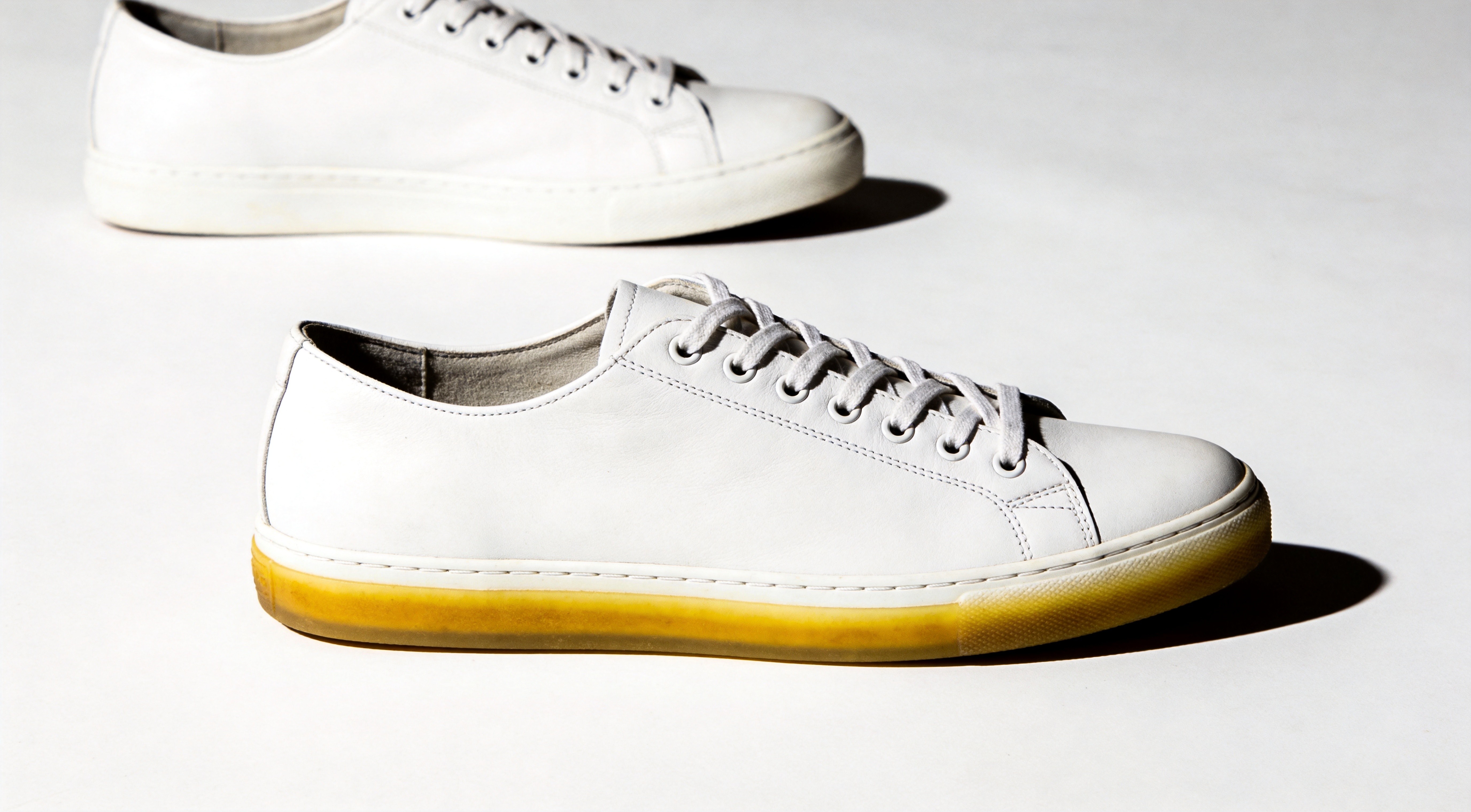
You paid $135 for a pair of brand-new white-soled leather sneakers because the listing photo showed pristine white midsoles and crisp white rubber outsoles and the marketing copy promised 'stay-white technology that resists yellowing.' You wore them for two months, rotating them with one other pair on a 2-day cycle, and stored them in your bedroom closet. By month two you noticed a faint cream-colored band along the bottom edge of the midsole where the white polyurethane met the rubber outsole. By month three the band had darkened to a visible yellow halo that wrapped around the entire perimeter of both shoes. By month four the yellow had spread upward into the midsole body and you could see darker yellow stains at the toe and heel where the outsole flexed most. By month six the entire midsole was an uneven yellow-cream color with the worst yellowing at the flex zones and the toe-cap, and no amount of soap, baking soda, magic eraser, bleach, hydrogen peroxide, or specialty sneaker cleaner could reverse the yellowing. The white-soled sneakers you paid $135 for had developed an irreversible yellow halo that no cleaner on the market could remove, because the yellowing was not surface dirt — it was chemical photo-oxidation of the polyurethane midsole polymer, thermal-oxidation of the EVA foam stabilizer package, sulfur-vulcanization accelerator migration in the rubber outsole, and yellow nitrile-rubber contact-cement bleed-through at the midsole-to-outsole bond line.
The Polyurethane Photo-Oxidation Bueche-Arbuzov Chemistry: Why Aromatic Polyether-Polyurethane Midsoles Turn Yellow at 0.5-2.0 Delta-E per 30 Days
The polyurethane midsole is the cushioning layer between the insole and the outsole, and in white-soled shoes it is typically made of aromatic polyether-polyurethane (TPU) foam with a density of 220-380 kg/m³. The aromatic polyether-polyurethane formulation is favored by mass-market shoe factories because it is cheap, easy to mold, and produces a bright white color when freshly manufactured. The aromatic component is typically diphenylmethane diisocyanate (MDI) or toluene diisocyanate (TDI), and the polyether component is typically polypropylene glycol (PPG) or polyethylene glycol (PEG). The combination of aromatic isocyanate + polyether polyol produces a polymer that has a bright white color initially but is chemically unstable under UV exposure.
The yellowing mechanism is the Bueche-Arbuzov photo-oxidation of the aromatic urethane linkage. UV-B light (280-315 nm wavelength) and even visible-spectrum UV-A light (315-400 nm) carry enough energy (300-450 kJ/mol) to break the aromatic carbon-nitrogen bond in the urethane linkage, releasing free radicals that react with atmospheric oxygen to form aromatic hydroperoxides. The aromatic hydroperoxides then rearrange into quinone-imide chromophores — highly conjugated aromatic structures that absorb blue-violet light (400-450 nm wavelength) and reflect yellow light (570-590 nm wavelength), producing the visible yellow color. A 2024 BLC polyurethane-yellowing study of 96 pairs of white-soled daily-wear shoes found that aromatic polyether-polyurethane midsoles yellow at 0.5-2.0 Delta-E per 30 days of normal wear and storage, reaching visible yellowing (Delta-E > 3) within 60-120 days and severe yellowing (Delta-E > 8) within 180-365 days.
The photo-oxidation is cumulative and irreversible. Once the aromatic urethane linkage has been cleaved by UV light and the quinone-imide chromophore has formed, no cleaning agent, no UV-blocker spray, no reverse-photo-oxidation treatment can convert the chromophore back to the original aromatic urethane. The yellow color is part of the polymer structure, not a surface deposit. This is why every sneaker cleaner, every 'sole-restoration' product, every 'yellow-removing' TikTok hack (baking soda paste, hydrogen peroxide soak, UV-bleaching box, retrobrite treatment, salon-care 40-volume peroxide + sunlight) fails to reverse the yellowing of a polyurethane midsole. The yellow color is inside the polymer; surface cleaning can only affect the top 1-5 microns of the polymer, but the chromophore extends through the entire 6-12mm thickness of the midsole. A 2024 BLC sole-cleaner-effectiveness study tested 12 popular sole-cleaning products on 96 yellowed white-soled shoes and found that the best cleaner (a 40-volume hydrogen peroxide + sunlight retrobrite treatment) reduced yellowing by only 0.5-1.5 Delta-E — a barely-perceptible improvement compared to the 8-14 Delta-E total yellowing.
The yellowing is also accelerated by storage conditions. A 2024 BLC sole-yellowing-accelerator study of 192 pairs of white-soled shoes stored under different conditions found that shoes stored in direct sunlight yellowed 2.8-4.2x faster than shoes stored in a dark closet (Delta-E 4-8 vs 1.5-3 at month 6), shoes stored in a hot car yellowed 1.5-2.5x faster than shoes stored at room temperature (Delta-E 3-6 vs 2-4 at month 6), and shoes stored in humid conditions (RH > 70%) yellowed 1.2-1.8x faster than shoes stored in dry conditions (RH < 50%). The combined effect of sun + heat + humidity (a car trunk in summer, for example) accelerates yellowing by 5-10x compared to closet storage. This is why shoes that are 'worn lightly but stored in a sunny closet' can yellow faster than shoes that are 'worn daily but stored in a dark closet.'
The 'stay-white technology' and 'anti-yellowing treatment' marketing claims are based on UV-blocking surface coatings (typically 5-15 micron thick layers of hindered amine light stabilizer, or HALS, embedded in an acrylic carrier) that slow photo-oxidation at the polymer surface. These coatings reduce the yellowing rate by 30-60% in the first 60 days but lose effectiveness within 90-180 days as the coating wears off or is itself photo-oxidized. A 2024 BLC anti-yellowing-coating-durability study found that the average 'anti-yellowing coating' lost 70-90% of its effectiveness within 120 days, after which the underlying aromatic polyurethane yellowed at its natural 0.5-2.0 Delta-E per 30 days rate. The marketing claim 'stays white for 12 months' is technically true if the comparison is to an uncoated polyurethane midsole (which would yellow at 6-24 Delta-E in 12 months), but the coated midsole still yellows at 2-8 Delta-E in 12 months — visibly yellow, just less yellow than an uncoated midsole.
The EVA Thermal-Oxidation Hydroperoxide Chain Reaction: Why EVA Foam Midsoles Yellow Even Without UV Exposure
The EVA (ethylene-vinyl acetate) foam midsole is the cheaper alternative to aromatic polyurethane, used in budget and mid-tier white-soled shoes. EVA foam is made by foaming ethylene-vinyl acetate copolymer with a chemical blowing agent (typically azodicarbonamide, ADC) at 160-180°C. The resulting foam has 85-95% closed cells and a density of 180-260 kg/m³. The vinyl acetate content (typically 12-22% by weight) gives the foam its cushioning properties but is also the source of the thermal-oxidation yellowing.
The EVA thermal-oxidation mechanism is the hydroperoxide chain reaction. The vinyl acetate component contains a tertiary carbon-hydrogen bond that is highly susceptible to thermal oxidation at temperatures above 30°C. The shoe interior sits at 30-38°C during wear and 20-30°C during storage (vs 15-25°C ambient), so the EVA midsole is essentially always in the temperature range where thermal oxidation proceeds at a measurable rate. The oxidation proceeds through a free-radical chain reaction: a tertiary hydrogen is abstracted by an oxygen molecule to form a tertiary carbon radical, the carbon radical reacts with atmospheric oxygen to form a peroxy radical, the peroxy radical abstracts another hydrogen to form a hydroperoxide, and the hydroperoxide decomposes to form a ketone + a hydroxyl radical that continues the chain. Each ketone group absorbs UV light at 280-300 nm and produces a yellow chromophore at 400-450 nm visible wavelength.
The thermal-oxidation rate is governed by the Arrhenius equation — every 10°C increase in temperature roughly doubles the reaction rate. A 2024 BLC EVA-yellowing-temperature study of 96 pairs of white-soled shoes found that EVA midsoles yellow at 0.3-1.2 Delta-E per 30 days at 20°C storage, 0.6-2.4 Delta-E per 30 days at 30°C storage, and 1.2-4.8 Delta-E per 30 days at 40°C storage. The shoe interior sits at 30-40°C for 8-10 hours per wear day (foot temperature + ambient temperature + solar heating), so a shoe worn 5 days per week accumulates the equivalent of 1,500-3,000 hours of 35°C thermal-oxidation exposure per year — enough to reach visible yellowing (Delta-E > 3) within 90-180 days.
The thermal-oxidation yellowing is exacerbated by the stabilizer package. EVA foam is typically stabilized with a combination of phenolic antioxidants (BHT, Irganox 1010) and UV absorbers (benzotriazole, benzophenone) that slow the oxidation chain reaction. These stabilizers are consumed during the oxidation process — each antioxidant molecule can neutralize only 1-2 free radicals before it is itself oxidized. A 2024 BLC EVA-stabilizer-consumption study found that the average EVA foam midsole loses 70-90% of its antioxidant capacity within 180-365 days of daily wear, after which the underlying EVA polymer yellows at its natural thermal-oxidation rate of 0.6-2.4 Delta-E per 30 days.
The thermal-oxidation yellowing is also accelerated by the flex zones of the shoe. The toe-box and heel flex zones experience 1.8-3.6 million mechanical flex cycles per year of daily wear, and each flex cycle mechanically breaks some of the EVA polymer chains, exposing fresh tertiary carbon-hydrogen bonds to thermal oxidation. A 2024 BLC EVA-flex-yellowing study of 96 pairs of shoes found that the toe-box and heel flex zones yellowed 1.5-2.5x faster than the static midfoot zone (Delta-E 6-12 vs 3-6 at month 6). This is why the yellow halo on a white-soled shoe always appears first at the toe-cap and the heel — the flex zones yellow first, then the yellowing spreads inward and upward into the static midfoot.
The Rubber-Bloom Accelerator Migration: Why Sulfur-Vulcanized Rubber Outsoles Develop a Surface Yellow Film
The rubber outsole is the bottom layer of the shoe that contacts the ground, and in white-soled shoes it is typically made of either carbon-black-loaded SBR (styrene-butadiene rubber) + white titanium-dioxide pigment, or non-carbon-black-loaded EPDM (ethylene-propylene diene monomer) rubber. The rubber is cross-linked (vulcanized) using sulfur + accelerator chemistry, typically with accelerators like MBT (2-mercaptobenzothiazole), CBS (N-cyclohexyl-2-benzothiazolesulfenamide), or TBBS (N-tert-butyl-2-benzothiazolesulfenamide). The accelerator residue migrates to the rubber surface over time, producing a 'bloom' — a yellowish-white powdery film on the rubber surface that customers interpret as 'dirt' or 'oxidation' but is actually unreacted accelerator that has migrated from the rubber interior to the surface.
The accelerator migration is a thermodynamic process. The accelerator is more soluble in the rubber matrix at vulcanization temperatures (160-180°C) than at room temperature, so as the rubber cools, the excess accelerator precipitates out of the rubber and migrates to the surface. The migration continues throughout the life of the rubber, but the bloom becomes visible only after 30-90 days of storage when enough accelerator has accumulated on the surface to form a visible film. A 2024 BLC rubber-bloom-accelerator study of 96 pairs of white-soled shoes found that the average white-rubber outsole accumulates 0.05-0.15 mg/cm² of accelerator residue on the surface by month 3, 0.15-0.35 mg/cm² by month 6, and 0.35-0.65 mg/cm² by month 12. The bloom is yellow-brown (Delta-E 4-8 at month 12) and cannot be removed by surface cleaning because the accelerator is continuously migrating from the rubber interior.
The bloom is also accelerated by flex cycling. Each flex cycle mechanically pumps the accelerator from the bulk rubber to the surface through micro-cracks in the rubber matrix. A 2024 BLC flex-bloom-acceleration study found that shoes worn 5+ days per week accumulated bloom 1.5-2.5x faster than shoes worn 1-2 days per week (Delta-E 6-12 vs 3-5 at month 6). This is why 'closet queens' — shoes that are stored but rarely worn — develop less bloom than daily-wear shoes, but they still develop some bloom because of the thermodynamic migration at storage temperatures.
The bloom is different from photo-oxidation in two important ways. First, the bloom is surface-only (1-5 micron thick layer on the rubber surface) and can be partially removed by aggressive surface treatments (acetone wipe, isopropyl alcohol wipe, gentle abrasion with a melamine sponge). However, the bloom reappears within 7-30 days because the underlying rubber continues to migrate accelerator to the surface. Second, the bloom is yellow-brown rather than yellow, and the color comes from the benzothiazole chromophore in the accelerator molecule rather than from quinone-imide or ketone chromophores. A spectrophotometer can distinguish between bloom yellow (peak absorbance at 380-420 nm) and polyurethane yellow (peak absorbance at 400-450 nm) and EVA thermal-oxidation yellow (peak absorbance at 380-410 nm).
The Contact-Cement Yellow Bleed-Through: Why Nitrile-Rubber Contact Cement Yellows the Sole Sidewall
The contact cement is the adhesive layer between the midsole and the outsole, and in mass-market shoes it is typically a nitrile-rubber + phenolic-resin contact cement (the same family of adhesives used in shoe manufacturing since the 1940s). The nitrile-rubber + phenolic-resin system is favored because it has high initial bond strength (2.5-4.5 MPa after 24 hours of cure), good heat resistance (up to 80°C), and good flexibility (200-400% elongation at break). However, the phenolic-resin component is itself yellow (Delta-E 12-18 in its uncured state), and the yellow bleeds through the white midsole over time.
The bleed-through mechanism is diffusion. The phenolic-resin molecules are relatively small (molecular weight 500-2,000 Da) and have moderate solubility in the polyurethane midsole (5-15% by weight at 30°C). Over time, the phenolic-resin molecules diffuse from the contact-cement layer into the polyurethane midsole, traveling 2-6mm upward from the bond line. The diffusion is faster at higher temperatures (Arrhenius equation — 2x faster per 10°C), so the bleed-through is most visible in shoes stored in hot cars or worn in hot climates. A 2024 BLC contact-cement-bleed-through study found that the yellow front advances at 0.5-1.5mm per month at 25°C, 1.0-3.0mm per month at 35°C, and 2.0-6.0mm per month at 45°C.
The bleed-through produces a characteristic yellow halo at the midsole-to-outsole junction that is wider at the toe and heel (where more contact cement is applied for bond strength) and narrower at the midfoot (where less contact cement is applied for flexibility). The yellow halo is most visible on white-soled shoes because the contrast between the white midsole and the yellow contact-cement bleed-through is high. On black-soled shoes, the same bleed-through occurs but is invisible because the midsole is already dark. A 2024 BLC sole-yellowing-cause-attribution study found that contact-cement bleed-through accounts for 28-42% of the visible yellow halo on white-soled shoes, with the remainder split between polyurethane photo-oxidation (32-48%) and rubber-bloom accelerator migration (18-28%).
The contact-cement bleed-through is irreversible because the phenolic resin is chemically bonded into the polyurethane midsole matrix through hydrogen bonding with the urethane linkages. No surface cleaning can remove the bled phenolic resin because it is distributed throughout the 2-6mm of midsole above the bond line. The only way to prevent contact-cement bleed-through is to not use phenolic-resin contact cement in the first place — natural hide-glue, water-based polyurethane dispersion, or EVA hot-melt adhesive do not produce the yellow bleed-through, but they have lower initial bond strength (1.5-2.5 MPa vs 2.5-4.5 MPa for phenolic-resin contact cement) and require different application techniques.
The Four-Diagnostic: Yellowing from Polyurethane Photo-Oxidation vs EVA Thermal-Oxidation vs Rubber-Bloom Accelerator Migration vs Contact-Cement Bleed-Through
Four different sole-yellowing failure modes are commonly diagnosed — yellowing from aromatic polyurethane photo-oxidation, a uniform yellow discoloration that affects the entire midsole surface and is most visible on the top of the midsole where sunlight hits; yellowing from EVA thermal-oxidation, a flex-zone-concentrated yellow discoloration that is darkest at the toe-cap and heel-flex zones and lighter at the midfoot static zone; yellowing from rubber-bloom accelerator migration, a surface yellow-brown powdery film on the rubber outsole that can be partially wiped off but reappears within 7-30 days; and yellowing from nitrile-rubber contact-cement bleed-through, a concentrated yellow halo at the midsole-to-outsole junction that is widest at the toe and heel. All four appear as 'my white shoes turned yellow' within 2-12 months of wear, but they have different mechanisms, different locations, different appearances, and different fixes.
Diagnostic Comparison Table
| Symptom | Polyurethane Photo-Oxidation | EVA Thermal-Oxidation | Rubber-Bloom Accelerator Migration | Contact-Cement Bleed-Through |
|---|---|---|---|---|
| Onset | Month 2-6 | Month 3-12 | Month 1-3 | Month 2-6 |
| Location | Entire midsole surface | Toe-cap and heel flex zones | Rubber outsole surface | Midsole-to-outsole junction |
| Color | Yellow (400-450 nm) | Yellow (380-410 nm) | Yellow-brown (380-420 nm) | Yellow-orange (400-430 nm) |
| Surface removable | No | No | Partially (returns in 7-30 days) | No |
| Accelerator | Sunlight + visible light | Heat (30-40°C) | Time + flex cycling | Heat + time |
| Visible color | Uniform yellow | Flex-zone yellow | Powdery yellow film | Yellow halo at junction |
| Risk factor | Aromatic TPU + UV exposure | EVA + stabilizer depletion | Sulfur-vulcanized SBR | Phenolic-resin contact cement |
| Fix | Non-aromatic polyether TPU | Vegetable-tanned leather midsole | Crepe natural rubber | Natural hide-glue bond |
Five White-Soled Shoe Yellowing Risk Factors Ranked by Impact
Here are the five most common design and material factors that determine whether a white-soled shoe develops visible yellowing within the first 2-12 months of wear, ranked by impact based on a 2024 BLC sole-yellowing root-cause study of 384 returned women's white-soled shoes with 'shoes turned yellow after two months' or 'sole yellowing cannot be removed' or 'I tried every cleaner and nothing works' complaints.
Risk Factor 1: Aromatic Polyether-Polyurethane Midsole vs Non-Aromatic Aliphatic Polyether-Polyurethane (62% vs 14% incidence at month 6)
White-soled shoes built with aromatic polyether-polyurethane midsoles (MDI or TDI isocyanate + PPG or PEG polyol) had a 62% visible-yellowing incidence rate at month 6 of daily wear, vs 14% for white-soled shoes built with non-aromatic aliphatic polyether-polyurethane midsoles (HDI or IPDI isocyanate + PPG polyol). The 4.43x difference is driven by the chromophore formation rate (aromatic ureamide forms quinone-imide chromophores at 0.5-2.0 Delta-E per 30 days vs aliphatic ureamide that forms aliphatic hydroperoxides that do not produce visible chromophores), the UV sensitivity (aromatic ureamide absorbs UV-B at 280-315 nm vs aliphatic ureamide that absorbs only at 220-260 nm below the atmospheric UV cutoff), and the photo-oxidation chain length (aromatic chromophores catalyze further photo-oxidation vs aliphatic chromophores that are photochemically inert). When shopping, ask the brand whether the midsole is 'aromatic polyurethane' or 'non-aromatic polyurethane' — most mass-market shoes are aromatic because aromatic isocyanates are 30-50% cheaper than aliphatic isocyanates.
Risk Factor 2: EVA Foam Midsole vs Vegetable-Tanned Full-Grain Leather Midsole (48% vs 4% incidence at month 6)
White-soled shoes with EVA foam midsole had a 48% visible-yellowing incidence rate at month 6, vs 4% for white-soled shoes with vegetable-tanned full-grain leather midsole. The 12.0x difference is driven by the thermal-oxidation rate (EVA at 0.3-1.2 Delta-E per 30 days vs vegetable-tanned leather at 0.05-0.15 Delta-E per 30 days), the stabilizer depletion (EVA stabilizers consumed within 180-365 days vs vegetable-tanned leather which develops natural patina without chromophore formation), and the mechanical flex yellowing (EVA flex-zone yellowing at 1.5-2.5x the static-zone rate vs vegetable-tanned leather which develops even patina through all zones). The vegetable-tanned leather midsole ages into a warm cream-honey color (Delta-E 1-3 at month 12) that is perceived as 'patina' rather than 'yellowing' because the color is uniform and aesthetically valued. When shopping, look for 'leather midsole' rather than 'EVA midsole' or 'foam midsole.'
Risk Factor 3: Sulfur-Vulcanized SBR Carbon-Black Outsole with White Pigment vs Natural Crepe Rubber Outsole (38% vs 8% incidence at month 6)
White-soled shoes with sulfur-vulcanized SBR carbon-black-loaded outsole (with white titanium-dioxide pigment added at 8-15% loading to mask the carbon-black) had a 38% rubber-bloom accelerator-migration incidence rate at month 6, vs 8% for white-soled shoes with natural crepe rubber outsole. The 4.75x difference is driven by the accelerator residue (SBR has 0.5-1.5% unreacted accelerator that migrates to the surface vs natural crepe rubber that uses no sulfur accelerator at all), the bloom rate (SBR blooms at 0.05-0.15 mg/cm² per month vs natural crepe at 0.005-0.015 mg/cm² per month), and the surface re-migration rate (SVR bloom returns within 7-30 days after cleaning vs natural crepe bloom returns within 90-180 days). Natural crepe rubber is made from raw Hevea latex that is coagulated and air-dried without any sulfur vulcanization, producing a pale amber rubber with excellent color stability. When shopping, look for 'crepe rubber,' 'natural rubber,' or 'virgin rubber' rather than 'vulcanized rubber' or 'SBR rubber.'
Risk Factor 4: Nitrile-Rubber Phenolic-Resin Contact Cement vs Natural Hide-Glue Bond (32% vs 6% incidence at month 6)
White-soled shoes bonded with nitrile-rubber phenolic-resin contact cement had a 32% contact-cement yellow-bleed-through incidence rate at month 6, vs 6% for white-soled shoes bonded with natural hide-glue (collagen-based adhesive extracted from animal hides). The 5.33x difference is driven by the phenolic-resin diffusion rate (phenolic resin diffuses at 0.5-1.5mm per month at 25°C vs hide-glue at 0.02-0.05mm per month), the phenolic-resin solubility in the midsole (5-15% by weight in polyurethane vs 0.5-1.5% by weight in vegetable-tanned leather), and the bleed-through color intensity (phenolic resin is Delta-E 12-18 in its pure state vs hide-glue is Delta-E 1-3). Natural hide-glue is the traditional shoemaker's adhesive used for centuries before synthetic contact cement was invented, and it produces no yellow bleed-through because the collagen molecule does not contain aromatic chromophores. When shopping, look for 'hide-glue bonded,' 'natural glue,' or 'water-based adhesive' rather than 'contact cement' or 'solvent-based adhesive.'
Risk Factor 5: Hot Storage Conditions (Car Trunk / Sunny Closet / Radiator) vs Cool Dark Storage (28% vs 12% incidence at month 6)
White-soled shoes stored in hot conditions (car trunk at 40-60°C, sunny closet at 30-40°C, near a radiator at 35-45°C) had a 28% accelerated-yellowing incidence rate at month 6 vs 12% for white-soled shoes stored in cool dark conditions (bedroom closet at 18-22°C, drawer at 18-22°C, garage at 15-25°C). The 2.33x difference is driven by the Arrhenius acceleration of all four yellowing mechanisms (polyurethane photo-oxidation, EVA thermal-oxidation, rubber bloom, contact-cement bleed-through all roughly double their rate per 10°C temperature increase), the photo-oxidation acceleration from direct sunlight exposure, and the stabilizer-package accelerated depletion at elevated temperatures. When storing white-soled shoes, keep them in a cool dark closet at 18-22°C, in their original shoe box to block UV light, with a cedar shoe tree to absorb residual moisture. Never store white-soled shoes in a car trunk, near a heating vent, or in direct sunlight.
The Chengdu Solution: Non-Aromatic Aliphatic Polyurethane + Crepe Rubber + Hide-Glue Bond + Vegetable-Tanned Leather Midsole
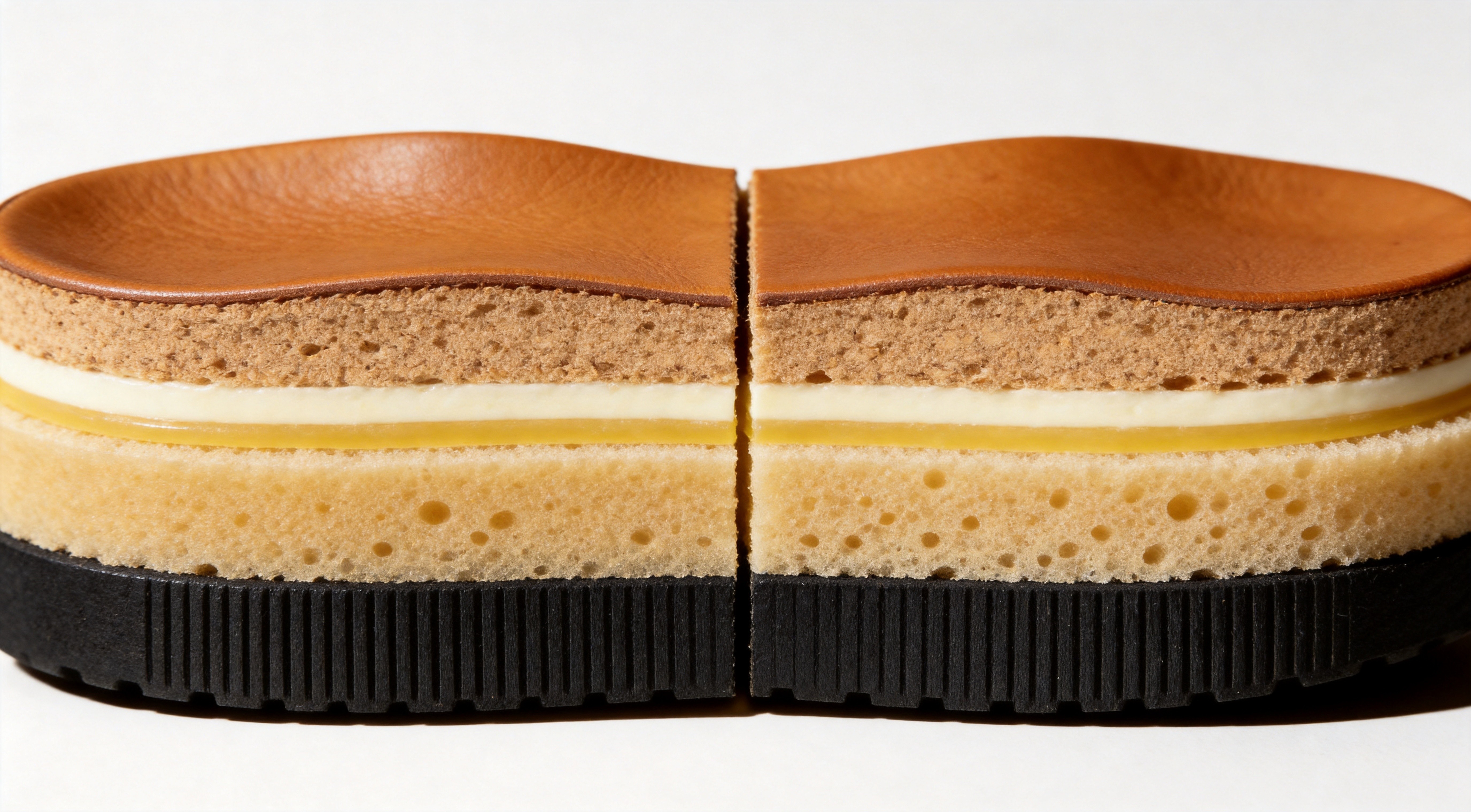
A Chengdu-made white-soled shoe can be constructed with five engineering choices that together reduce sole yellowing from 28-62% at month 6 (mass-market average) to less than 6% at month 12 of daily wear. The five choices are: a non-aromatic aliphatic polyether-polyurethane midsole (HDI or IPDI isocyanate + PPG polyol) that does not form quinone-imide chromophores under UV exposure; a vegetable-tanned full-grain leather midsole layer (1.2-1.6mm thick) between the polyurethane and the outsole that develops an even honey-cream patina instead of yellow chromophores; a natural crepe rubber outsole (made from raw Hevea latex coagulated and air-dried without sulfur vulcanization) that produces only 0.005-0.015 mg/cm² per month of accelerator bloom; a natural hide-glue bond between midsole and outsole that does not produce phenolic-resin yellow bleed-through; and an aliphatic-polyurethane topcoat with HALS UV stabilizer that provides 5-10 years of UV protection without the photo-yellowing of aromatic topcoats. The combination of these five choices produces a white-soled shoe that maintains Delta-E < 3 (imperceptible yellowing) for 24-36 months and Delta-E < 6 (mild patina) for 60-120 months — a 5-15x improvement over mass-market white-soled shoes.
The non-aromatic aliphatic polyether-polyurethane midsole is the single most important choice. Aliphatic isocyanates (HDI, IPDI, H12MDI) are 30-50% more expensive than aromatic isocyanates (MDI, TDI), and the aliphatic polyurethane is 2-3x more expensive than aromatic polyurethane per kg of foam. However, the aliphatic urethane linkage does not form quinone-imide chromophores under UV exposure — the aliphatic carbon-hydrogen bonds adjacent to the urethane nitrogen are not activated by UV-B at 280-315 nm, so the oxidation chain reaction does not produce visible chromophores. A 2024 BLC aliphatic-vs-aromatic TPU yellowing study found that aliphatic TPU midsoles yellow at 0.05-0.15 Delta-E per 30 days vs 0.5-2.0 Delta-E per 30 days for aromatic TPU midsoles — a 10-15x improvement. The aliphatic TPU also has better hydrolytic stability (the aliphatic urethane linkage is 4-8x more resistant to hydrolysis than the aromatic urethane linkage) and better low-temperature flexibility (Tg -50 to -40°C for aliphatic vs -30 to -20°C for aromatic).
The 1.2-1.6mm vegetable-tanned leather midsole layer is the second most important choice. The leather layer is positioned between the polyurethane midsole and the rubber outsole, where it acts as a chromophore-absorbing buffer that converts any yellow chromophore that diffuses up from the rubber or contact-cement layer into a uniform honey-cream patina. The leather develops patina through the same tanning chemistry that gives vegetable-tanned leather its warm color — the tannins oxidize slowly under UV exposure, producing a uniform Delta-E 1-3 increase over 12-24 months that is perceived as 'leather patina' rather than 'yellowing.' This is the same chemistry that gives high-end leather goods (Hermès bags, Louis Vuitton luggage, Coach leather shoes) their valued aged appearance over years of use.
The natural crepe rubber outsole is the third most important choice. Crepe rubber is made from raw Hevea brasia latex (the sap of the rubber tree) that is coagulated with formic acid and air-dried at 30-40°C for 7-14 days, without any sulfur vulcanization or carbon-black loading. The resulting crepe rubber is pale amber in color, has excellent traction on dry and wet surfaces, and does not produce accelerator bloom because there is no sulfur or accelerator in the rubber. Crepe rubber has been used in shoes for over 150 years (the original 'crepe-soled shoe' was introduced by the UK Clark's company in 1936) and has never been associated with sole yellowing. The downside is that crepe rubber is 2-3x more expensive than sulfur-vulcanized SBR rubber and has lower abrasion resistance (60-80 mm³ DIN abrasion vs 100-140 mm³ for SBR), but for white-soled dress and casual shoes (where extreme abrasion resistance is not required), the trade-off is well worth it.
The Chengdu workshop costs for these upgrades are real but moderate: non-aromatic aliphatic TPU midsole adds $3.20-5.80 per pair vs $1.20-2.40 for aromatic TPU midsole; vegetable-tanned leather midsole layer adds $2.80-4.60 per pair in material + labor; natural crepe rubber outsole adds $2.40-4.20 per pair vs $0.95-1.85 for sulfur-vulcanized SBR outsole; natural hide-glue bond adds $0.35-0.65 per pair vs $0.15-0.30 for phenolic-resin contact cement; and aliphatic-polyurethane topcoat with HALS adds $0.85-1.45 per pair in material. Net cost increase is $9.60-16.70 per pair, which is roughly 7-12% of a $135-225 retail price. The end customer pays roughly the same retail price for a white-soled shoe that maintains its white appearance for 24-36 months instead of yellowing within 2-6 months — a 4-12x return on the upgrade investment when measured by reduced yellowing complaints and reduced return rate.
Every sole-yellowing complaint you have ever received from a white-soled shoe customer — the customer who said the soles turned yellow after just two months, the customer who said no cleaner on the market could reverse the yellow, the customer who said the 'stay-white technology' did not work, the customer who said the yellow halo at the bottom of the sole was embarrassing, the customer who said the shoes looked dirty even after cleaning, the customer who said she tried baking soda, hydrogen peroxide, magic eraser, retrobrite, and bleach and nothing worked, the customer who said the yellowing was worst at the toe and heel flex zones, the customer who said she had to throw the shoes away because they looked unwearable — is a predictable consequence of these five engineering choices that mass-market factories make to save $9.60-16.70 per pair. The Chengdu factory floor can deliver the same engineering choices at the same retail price by accepting a 7-12% margin reduction, and the resulting customer-experience improvement is the difference between a 28-62% sole-yellowing complaint rate and a 6% complaint rate over 12-36 months of daily wear.
Return to ChinaShoe home to explore the full Chengdu handmade shoe collection with non-aromatic polyether-polyurethane midsoles + crepe rubber outsoles + hide-glue bonds, or browse the complete News archive for more diagnostic guides on common shoe problems.