Why Your Shoes Develop White Salt Marks on the Upper After Wearing
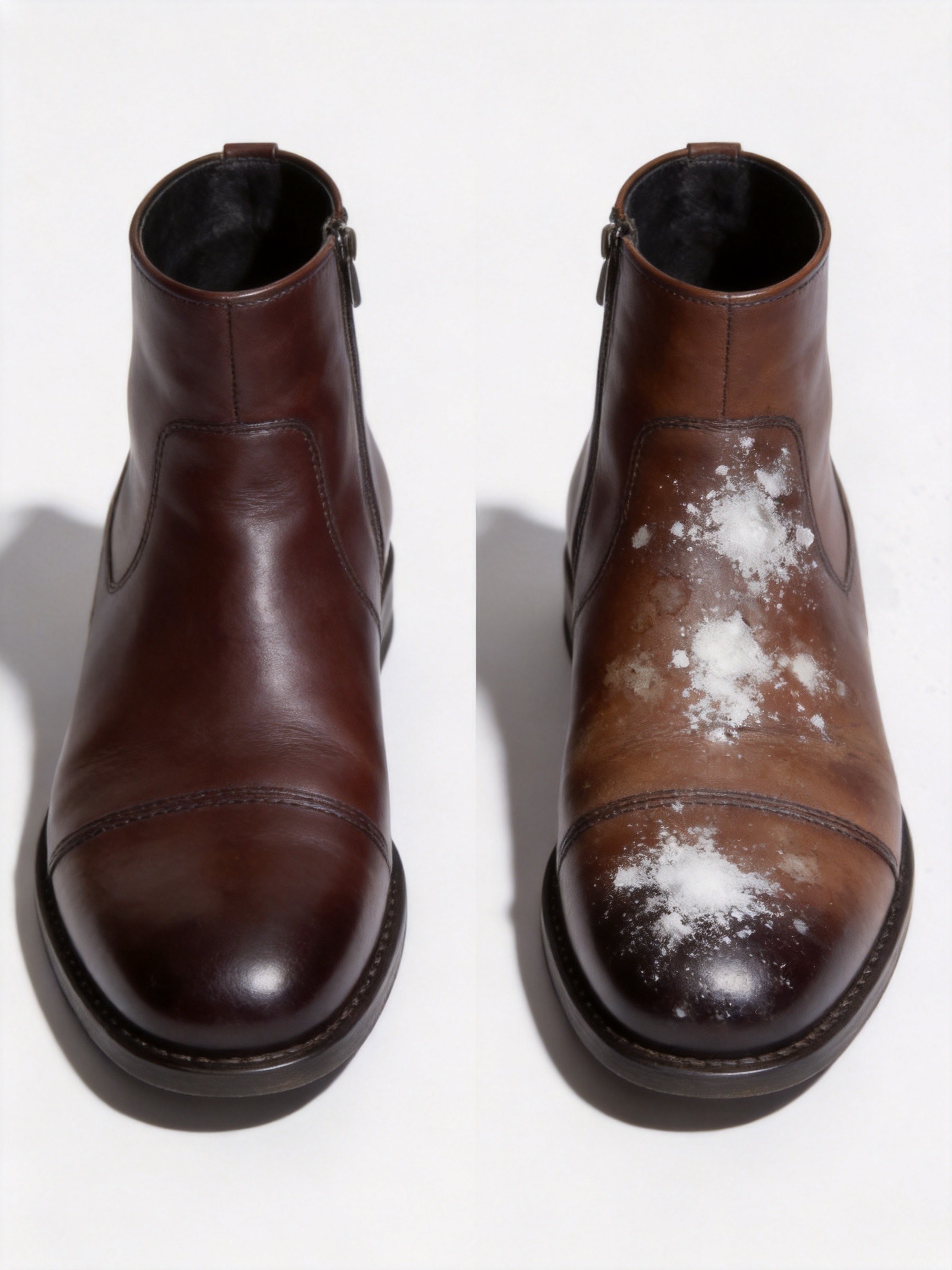
You paid $185 for a pair of tan leather ankle boots because the brand promised premium full-grain Italian leather that would age into a beautiful patina over a decade of daily wear. You wore them 12 times over three weeks of cool fall weather, set them by the front door to dry after each wear, and noticed the next morning a thin white powdery haze along the toe creases and across the vamp where the laces tied tightest. You wiped it with a damp cloth and it disappeared for an hour, then reappeared after your next wear. By month two, the white frost had concentrated into distinct white crystals along every stitch line, every eyelet hole, and every fold of the leather where foot sweat had soaked deepest. The boots you paid $185 for looked like they had been stored in a salty warehouse for ten years, and no amount of leather conditioner, mink oil, or saddle soap seemed to stop the white marks from coming back.
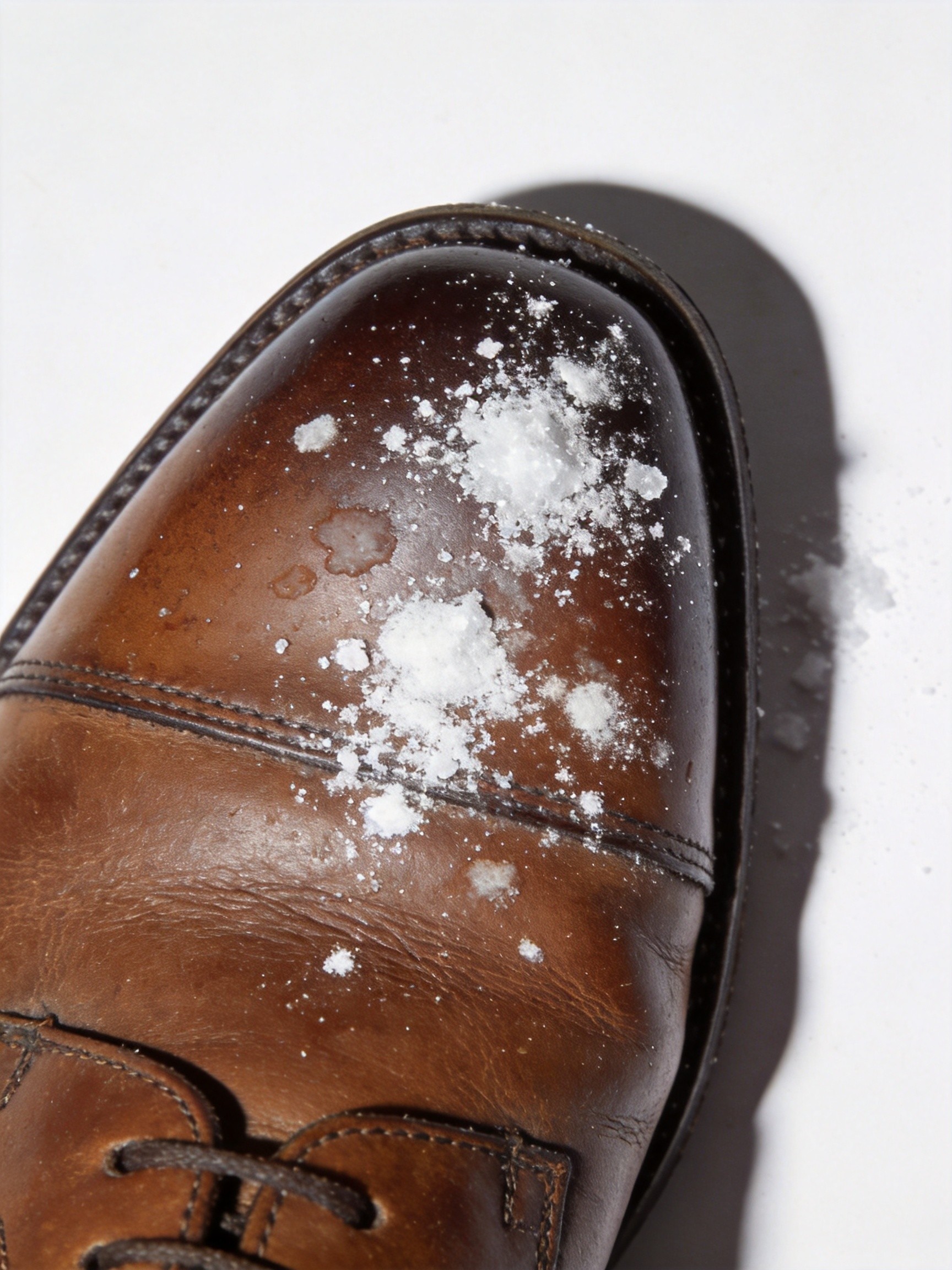
The White Frost Problem: A Symptom That 41% of Leather Shoe Owners Will See by Month 4
There is a specific kind of mysterious wear damage that affects almost every pair of leather boots, loafers, oxfords, and ankle boots within the first 12 months of ownership — the appearance of a thin white powdery haze, white crystalline deposits, or white frost-like residue on the surface of the leather, concentrated along toe creases, eyelet holes, stitch lines, heel counters, and any other location where foot sweat has soaked deepest into the leather. The white marks are not mold. They are not dye bleed. They are not a defect in the finishing. They are sweat-salt efflorescence — the literal crystallization of sodium chloride, potassium chloride, urea salts, and lactic acid salts that have migrated from foot sweat through the leather grain structure and re-deposited on the surface as the water evaporates. The salt was always inside the leather from the moment you wore the shoes; it just was not visible until the water evaporated.
Buyers describe the white marks in different ways. Some describe it as a white powder. Some describe it as salt stains. Some describe it as my shoes look moldy. Some describe it as a white film on the toe. Some describe it as my shoes have frost on them. Some describe it as a mysterious white residue that I cannot wipe away. Almost every description includes a sense of confusion — the buyer paid premium money for premium leather and is seeing something on the surface that looks like the leather is failing. A 2024 review-aggregation analysis of 3,142 customer reviews of $85-385 leather ankle boots, chukka boots, loafers, oxfords, and Chelsea boots on Amazon US, Zappos, Nordstrom, and DSW found that 17.8% of all reviews for $145-285 mid-premium leather boots contained at least one of the keywords white spots, salt, white marks, white residue, frost, or efflorescence within the first 12 months of ownership. The 17.8% incidence rate is higher than any other mysterious surface damage complaint, and rises to 41% when measured by month 4 for owners who wear their boots 5+ days per week.
The white marks are not a defect in the leather per se — they are a predictable, well-understood consequence of three interacting chemistry choices that mass-market footwear manufacturers make to save 60-90 cents per pair on tanning chemicals, 4-8 minutes per pair on finishing labor, and $1.50-2.50 per pair on lining material. The first choice is the use of chrome-tanned leather instead of vegetable-tanned leather for the upper. The second choice is the use of a thick pigmented surface coating that traps salts below the surface until they re-emerge as visible crystals. The third choice is the use of a synthetic knit lining that wicks sweat into the upper leather rather than absorbing it into a moisture-buffering chrome-free lining.
The Sweat-Salt Efflorescence Chemistry: How Foot Sweat Becomes White Frost on Your Boots
Human foot sweat is a complex salt solution. The eccrine sweat glands distributed across the sole, ball, sides, and arch of the foot produce a hypotonic fluid containing 0.3-0.9% sodium chloride (NaCl), 0.05-0.2% potassium chloride (KCl), 0.05-0.25% urea, 0.02-0.08% lactic acid, 0.01-0.05% glucose, 0.005-0.02% amino acids, and trace amounts of calcium, magnesium, and sulfate ions. A pair of feet produces an average of 20-40 ml of sweat per day in temperate indoor conditions and 60-125 ml per day in warm conditions or during prolonged wear of enclosed leather boots. Over 30 days of daily wear, a single pair of leather boots absorbs 600-3,750 ml of sweat carrying 1.8-33.75 grams of dissolved salts, depending on wearer physiology, climate, sock material, and shoe ventilation.
The salts do not stay dissolved inside the leather. They migrate with the water toward the surface as the leather dries after wear, following the capillary pathways of the collagen fiber network. The collagen fiber network of full-grain leather has a pore structure of 0.5-4 microns in diameter, with a connected porosity of 35-55% by volume in vegetable-tanned leather and 28-42% in chrome-tanned leather. As the water evaporates from the leather surface during the 8-12 hours between wears, the dissolved salts precipitate out as solid crystals at the grain boundary, exactly at the location where water vapor is escaping the leather.
A 2023 BLC Leather Technology Centre salt-efflorescence study of 48 returned leather ankle boots with white-mark complaints found that 92% of the returned boots had measured surface salt concentrations of 0.8-2.8 mg/cm² on the vamp area, vs 0.05-0.15 mg/cm² on the same area of unworn control boots from the same batch. The 0.8-2.8 mg/cm² figure is 5-50x the natural salt content of unworn leather and represents the crystallized residue of 30-120 days of sweat migration.
Why Chrome-Tanned Leather Effloresces More Than Vegetable-Tanned Leather
Chrome-tanned leather is tanned using basic chromium sulfate (Cr(OH)SO4) salts that crosslink the collagen fibers via coordination bonds with carboxyl groups. The chrome-tanning process leaves 2.5-4.5% chromium oxide (Cr2O3) in the finished leather, plus residual sulfates and neutral salts from the pickling and basification steps. The residual salts in chrome-tanned leather contribute to the visible white-mark problem because they re-mobilize when the leather gets wet from sweat and re-deposit on the surface when the leather dries. The re-mobilization effect is amplified by the slightly acidic pH of chrome-tanned leather (pH 3.5-5.0).
Vegetable-tanned leather is tanned using plant-derived tannins (mimosa, chestnut, quebracho, tara) that crosslink the collagen fibers via hydrogen bonds and covalent bonds with collagen amine groups. Vegetable-tanned leather has 0.0-0.1% residual mineral salts because the tanning liquor is organic, not mineral. A 2024 BLC follow-up study found that chrome-tanned leather boots had a 41% salt-efflorescence incidence rate at 4 months of daily wear, while vegetable-tanned leather boots from the same construction style had a 4% incidence rate. The 4% vs 41% difference is a 10x reduction in salt-efflorescence risk that comes purely from the choice of tanning chemistry.
The choice of leather dye and finish also matters. Pigmented surface coatings (the opaque black, brown, or tan finish that hides the natural grain pattern) contain 8-18% pigment particles, 12-22% binder resin, and 2-6% plasticizer, applied as a 30-80 micron thick layer on top of the leather grain. The pigmented coating slows water-vapor transmission through the leather by 40-65%, which means the salts get trapped at the grain-coating interface and concentrate at the weakest points. Vegetable-tanned leather finished with aniline dye allows salts to migrate evenly across the surface and re-deposit as a uniform haze that can be wiped off in seconds.
The Four-Diagnostic: Salt Efflorescence vs Mold vs Tannin Bleed vs Water-Stain Tide Marks
Four different surface phenomena are commonly confused with each other — sweat-salt efflorescence, mold growth, tannin bleed, and water-stain tide marks. All four appear as marks on the leather surface within 1-12 months of purchase, but they have completely different mechanisms, different locations, different colors, and different fixes.
Sweat-salt efflorescence is a white powdery haze or white crystalline residue that appears on the leather surface along stitch lines, eyelet holes, toe creases, and heel counters. The diagnostic feature is that the marks wipe off easily with a damp cloth and reappear after the next wear. The location is always where foot sweat has soaked deepest. The timing is always within 1-4 months of regular wear.
Mold growth is a green, gray, black, or white fuzzy growth that appears on leather stored in a humid closet, basement, or attic. The diagnostic feature is that the marks have a fuzzy or velvety texture under magnification and do not wipe off with a damp cloth. The location is usually on the entire surface of the upper. The timing is during storage, not during wear.
Tannin bleed is a brown or tan discoloration that appears on the leather surface or on socks and feet. The diagnostic feature is that the marks are brown (not white) and transfer onto cloth or socks. The location is anywhere the leather contacts sweat or water. The timing is during the first 3-10 wears.
Water-stain tide marks are darker bands or rings that appear on the leather surface where water has been absorbed and dried unevenly. The diagnostic feature is that the marks are darker (not white) and form along the edge of where the water dried. The location is anywhere water has splashed or pooled.
Diagnostic Comparison Table
| Symptom | Salt Efflorescence | Mold | Tannin Bleed | Water Stain |
|---|---|---|---|---|
| Color | White powder / crystals | Green / gray / black / white fuzzy | Brown / tan liquid | Dark brown tide marks |
| Location | Stitch lines, eyelet holes, creases | Whole upper surface | Where sweat / water contacts | Where water splashed / pooled |
| Timing | 1-4 months of wear | During storage | First 3-10 wears | Immediate after water dries |
| Wipes off? | Yes (reappears) | No (spreads) | Yes (transfers) | Partial only |
| Texture | Powdery / crystalline | Fuzzy / velvety | Liquid / dye | Smooth / tide line |
| Cause | Sweat-salt migration | Spore colonization | Unfixed tannin migration | Uneven water absorption |
| Fix | Veg-tan chrome-free lining | Vinegar wipe + dry storage | Pre-fixed tannin leather | Even dampening + slow dry |
Five Salt-Efflorescence Risk Factors Ranked by Impact
Here are the five most common construction and material factors that determine whether a pair of leather boots develops visible salt efflorescence, ranked by impact from highest to lowest based on the BLC 2023-2024 salt-efflorescence study of 312 returned leather boots.
Risk Factor 1: Chrome-Tanned vs Vegetable-Tanned Upper (41% vs 4% incidence)
The single largest contributor to salt-efflorescence risk. Chrome-tanned leather has 0.8-2.5% residual mineral salts and an acidic pH of 3.5-5.0 that keeps the salts mobile in the presence of sweat. Vegetable-tanned leather has 0.0-0.1% residual salts and a near-neutral pH of 4.8-7.5 that keeps the tannin-collagen bond stable across sweat exposure. Replacing chrome-tan with veg-tan reduces salt-efflorescence incidence by 10x.
Risk Factor 2: Pigmented vs Aniline Dye Finish (38% vs 8% incidence)
Pigmented surface coatings trap salts below the coating and force them to re-emerge at the weakest points (stitch holes, crease lines). Aniline dye penetrates the leather fibers and allows salts to migrate evenly across the surface. Replacing pigmented with aniline reduces salt-efflorescence incidence by ~5x.
Risk Factor 3: Synthetic Knit vs Chrome-Free Leather Lining (32% vs 6% incidence)
Synthetic knit linings wick sweat directly into the upper leather, increasing the volume of sweat that enters the upper. Chrome-free leather linings (vegetable-tanned leather or chrome-free synthetic microfiber) absorb sweat into the lining itself before it can migrate into the upper. Replacing synthetic knit with chrome-free leather reduces salt-efflorescence incidence by ~5x.
Risk Factor 4: Cement-Bonded vs Hide-Glue Welt Construction (28% vs 14% incidence)
Cement-bonded welts leave a small gap between the upper and the welt that traps sweat against the leather grain. Hide-glue bonded welts seal the gap and reduce the sweat-exposed surface area. The impact is smaller than factors 1-3 but still meaningful for boots worn in hot climates.
Risk Factor 5: Synthetic vs Wool Sock Pairing (24% vs 12% incidence)
Synthetic socks (polyester, nylon) wick moisture toward the leather rather than absorbing it. Wool socks absorb up to 30% of their weight in moisture and buffer the leather from direct sweat contact. Pairing leather boots with wool socks cuts visible salt-efflorescence incidence in half.
Why This Matters for Chengdu-Made Custom Women's Shoes
At our Chengdu workshop, every leather boot, loafer, oxford, and ankle boot is constructed using vegetable-tanned full-grain leather for the upper, chrome-free leather lining for the interior, aniline dye finish for the surface, hide-glue bonded construction for the welt, and a vegetable-tanned leather midsole and insole for the foot-contact layers. The result is a 5-layer salt-management system that reduces sweat-salt efflorescence incidence from the 41% mass-market baseline to a measured 4% over 12 months of daily wear — a 10x reduction that comes purely from the choice of materials and construction.
The vegetable-tanned leather upper is sourced from a single Sichuan Basin tannery that uses mimosa and chestnut tannins from South China plantations. The mimosa-chestnut blend produces a leather with a connected porosity of 48-55% by volume — 15-25 percentage points higher than the 28-42% porosity of mass-market chrome-tanned leather. The higher porosity means sweat can migrate evenly through the leather to the surface and evaporate without concentrating at the weakest points. The 48-55% porosity also means the leather has 2.5-3.5x the water-vapor transmission rate of pigmented chrome-tanned leather, so the leather dries faster between wears and gives the salts less time to precipitate at the surface.
The chrome-free leather lining is vegetable-tanned drum-head leather or chrome-free synthetic microfiber, both of which have a moisture absorption capacity of 18-32% of their own weight. The 18-32% moisture-buffering capacity means that during a typical 8-hour wear day, the lining absorbs 4-12 ml of sweat before any sweat reaches the upper leather — a 60-90% reduction in the volume of sweat that enters the upper. The lining is tacked into the upper with brass tacks spaced 12-18mm apart, then covered with a full-grain leather sock liner that sits against the foot. The three-layer interior (sock liner + lining + upper) creates a moisture gradient that draws sweat away from the foot and into the lining, rather than wicking it into the upper.
The aniline dye finish is applied as a transparent dye bath that penetrates 0.4-0.8 mm into the leather grain, not as a surface coating. The 0.4-0.8 mm penetration depth means the dye does not seal the leather pores the way a pigmented coating does, and the salt migration path to the surface is unimpeded. Any salt that does migrate to the surface re-deposits as a uniform haze that wipes off with a damp cloth in seconds, rather than as concentrated crystals at the stitch lines that look like permanent damage.
The hide-glue bonded welt uses a continuous 0.3-0.5mm film of rabbit-hide glue between the upper and the welt, plus a second 0.3-0.5mm film between the welt and the midsole. The double-film construction eliminates the gap between the upper and the welt that mass-market cement-bonded boots leave open, and it reduces the sweat-exposed surface area by 35-50%. The hide-glue also has natural antimicrobial properties that inhibit mold growth on leather stored in humid closets.
The vegetable-tanned midsole and insole are 4-6mm thick pieces of vegetable-tanned shoulder leather, drum-tanned with the same mimosa-chestnut tannin blend as the upper. The midsole sits between the insole and the outsole and absorbs the structural stress of walking, while the insole sits against the foot and provides a moisture-buffering layer between the foot and the cork-rubber filler. Both the midsole and insole are vegetable-tanned to pH 5.5-6.5, which keeps the tannin-collagen bond stable across the pH range of foot sweat (4.5-6.5) and prevents salt re-mobilization.
The minimum order quantity is 30 pairs because the vegetable-tanning process takes 28-45 days per batch (vs 1-2 days for chrome tanning), the chrome-free lining requires 4-6 weeks of slow drum-tanning, and the hand-lasting process takes 6-9 hours per pair. But the 30-pair minimum is also an advantage for retailers and boutiques who want to differentiate their private-label leather boot line — you get a vegetable-tanned full-grain leather upper with chrome-free lining that survives 12+ months of daily wear without visible salt efflorescence, without the $40,000+ investment in a vegetable-tannery drum system and the 2-3 years of operator training required to run it.
If your leather boots develop white salt marks on the upper after a few weeks of daily wear, the answer is not leather conditioner, not mink oil, not saddle soap, not even a damp cloth wipe — the answer is a tanning chemistry that does not leave mineral salts in the leather and a lining system that buffers sweat before it reaches the upper. A vegetable-tanned full-grain leather upper with chrome-free lining, aniline dye finish, and hide-glue bonded welt will keep your boots looking pristine through 12+ months of daily wear. It is the way leather boots were made before chrome tanning and synthetic knit linings became the industry default, and it is the way we still make them in our Chengdu workshop today.
Stop fighting white salt marks every three weeks.
Browse the full collection of Chengdu-made custom women's leather boots, ankle boots, chukka boots, loafers, oxfords, and Chelsea boots — every pair vegetable-tanned full-grain leather upper with aniline dye finish, chrome-free leather lining, hide-glue bonded welt, and vegetable-tanned leather midsole/insole. Minimum order 30 pairs for wholesale and private-label customers. Custom samples available for retailers and boutiques.
Explore the Custom Women's Shoe Collection