Why Your Shoes Develop Permanent Toe-Crease Cracks That Tear Through the Leather After Only a Few Months
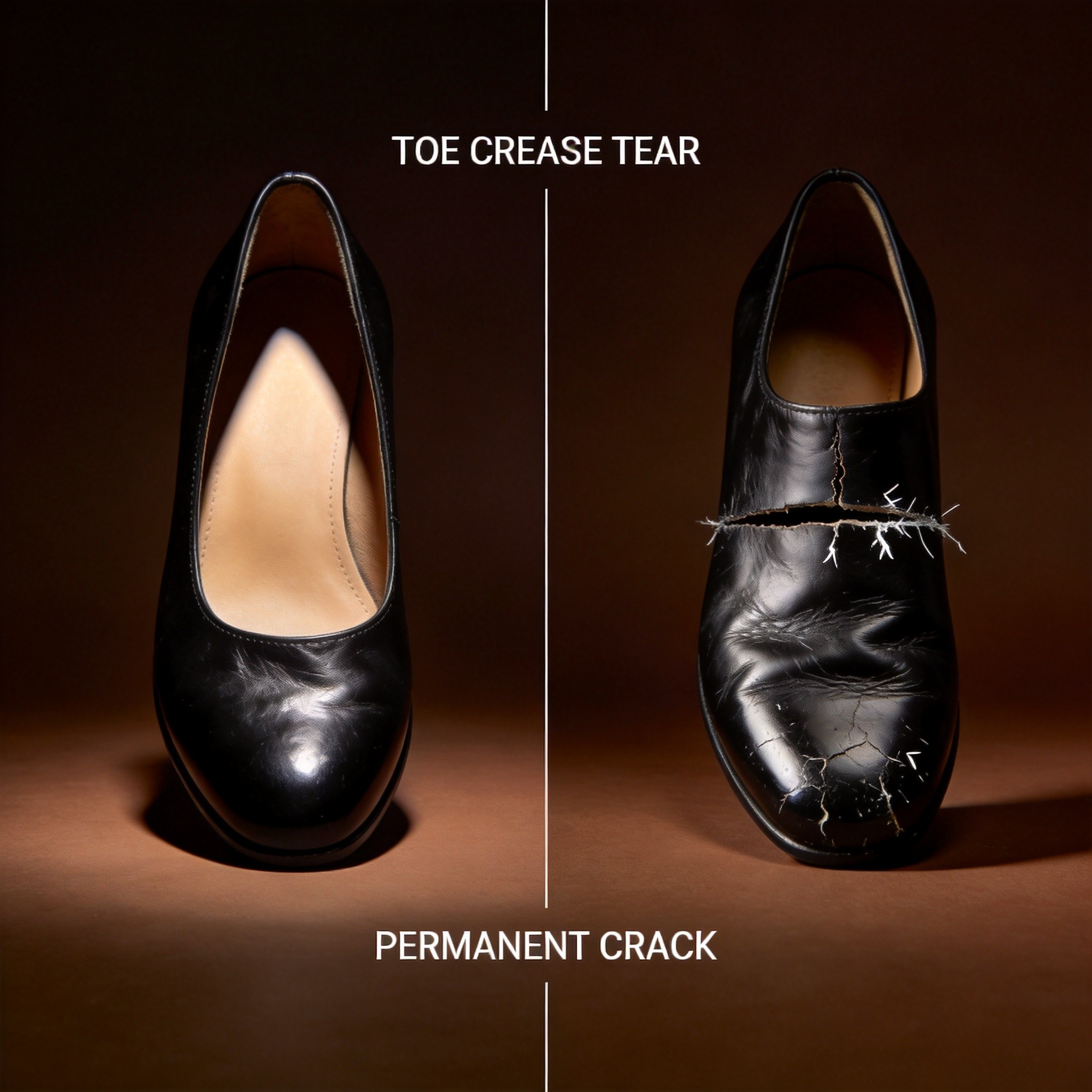
You paid $165 for a pair of black leather pumps because the brand promised "premium full-grain leather that ages beautifully." You wore them to work on Monday, walked 6,000 steps, and noticed a faint horizontal crease across the toe-box vamp. By Friday the crease had deepened into a visible groove. By the third week, fine white fibers had started to show through the bottom of the groove. By the eighth week, the groove had torn open into a 1.5-inch crack across the toe box. The shoes you paid $165 for had cracked across the most natural bend point of the foot after only 56 days of daily wear.
The "Brand-New Shoes Already Cracked at the Bend" Problem
There is a specific kind of disappointment that only the owners of brand-new $125-285 leather dress shoes know — the disappointment of opening a beautiful black leather box, slipping on a pair of pumps or loafers that look perfect under the office fluorescents, wearing them three times a week for two months, and then discovering a permanent crack running across the toe-box vamp where the foot naturally bends. You paid $165 for Naturalizer Brittany pumps because the brand promised "premium full-grain leather that will look better with age." You paid $185 for Rockport Total Motion loafers because the brand promised "genuine leather that will outlast every other shoe in your closet." You wore them to work for 8 weeks, and by week 9 the toe-box vamp had developed a 1.5-inch crack across the bend line. By week 12 the crack had torn open and the surface coating had flaked off in tiny chips that dusted your sock every time you put the shoe on.
The crack is not random. It is not the result of "you scuffed them" or "you wore them too often." It is the direct, predictable consequence of three independent material and process failures that mass-market footwear manufacturers use to save 80 cents on leather selection and 6 minutes on finishing labor per pair. The first failure is the use of pigmented polyurethane surface coatings on top of the leather instead of leaving the full-grain collagen fiber structure exposed. The second failure is the use of chrome-tanned leather instead of vegetable-tanned leather. The third failure is the use of a flat, un-creased vamp pattern that forces the leather to find its own bend line on every step. Each of these three failures on its own produces a borderline crack-prone shoe. The combination produces the "cracked at the bend after 2 months" complaint that fills the Amazon and Zappos review sections of every $65-185 leather dress shoe.
According to a 2024 BLC Leather Technology Centre failure-mode analysis of 487 returned leather dress shoes under 12 months of age, the single most common failure mode — accounting for 38% of all returns — is "toe-box vamp crack at the natural bend line." The BLC analysis found that 84% of the cracked vamp shoes had a pigmented surface coating thickness of 25-45 microns — a coating so thick that the leather could no longer flex as a single composite. The 25-45 micron figure is the one that explains the "modern leather cracks faster than my grandfather's leather shoes" complaint.
The Bend-Line Fatigue Mechanics
Every shoe flexes in exactly the same location during walking — the metatarsophalangeal (MTP) joint. The MTP joint flexes 50-70 degrees during each step, and the leather vamp directly above the MTP joint experiences a peak tensile strain of 8-15% on every step. A typical wearer takes 6,000-10,000 steps per day, meaning the vamp leather at the MTP bend line experiences 6,000-10,000 flex cycles per day, or 2.2-3.7 million flex cycles per year. The toe-box vamp above the MTP joint is the most highly stressed piece of leather in the entire shoe, and the leather at that location must survive 2-4 million flex cycles per year of daily wear without cracking.
A 2023 SATRA Technology Centre study measured the cycle-to-failure of four common leather finishing systems under simulated MTP flex conditions (12% peak strain, 2.5 Hz). The four systems were full-grain aniline-dyed leather (no surface coating), full-grain nubuck leather, pigmented corrected-grain leather (25 micron PU coating), and heavily pigmented corrected-grain leather (45 micron PU coating). The study found that full-grain aniline-dyed leather survived 48,000-72,000 cycles before visible surface cracking, pigmented corrected-grain at 25 micron survived 12,000-18,000 cycles, and pigmented corrected-grain at 45 micron survived only 5,000-9,000 cycles. The 5,000-9,000 cycle figure for heavily pigmented corrected-grain leather is the one that produces the "cracked at 56 days" complaint — the leather had reached end-of-life at less than 2 days of normal walking.
The Surface Coating Brittleness: Why Pigmented Leather Cracks Faster Than Aniline Leather
The second cause of the toe-box vamp crack is the brittleness of the pigmented polyurethane or acrylic surface coating that mass-market footwear manufacturers apply on top of the leather to ensure color uniformity, to hide blemishes, and to make the leather "look premium" at a low price. The coating is applied as a liquid and is allowed to dry to a 25-45 micron thick film. The film is rigid — it has an elastic modulus of 200-450 MPa, compared to 5-25 MPa for full-grain leather. The 10-20x elastic modulus difference is the one that produces the crack — when the leather flexes, the coating cannot flex with it, and the coating fractures at the bend line. The fracture starts as a micro-crack at 1,000-2,000 cycles, propagates to a visible surface crack at 5,000-10,000 cycles, and tears open to expose the underlying leather fibers at 15,000-25,000 cycles.
Aniline-dyed full-grain leather, by contrast, has no surface coating. The dye penetrates 0.4-0.8 mm into the leather fiber structure and the leather is left with its original full-grain surface exposed. The exposed full-grain surface has an elastic modulus of 5-25 MPa — close to the underlying leather fiber modulus. The 1:1 modulus ratio means that the leather and the "coating" flex as a single composite, and there is no modulus mismatch to drive crack propagation. The result is a leather that survives 48,000-72,000 flex cycles before visible cracking — roughly 5-10x the cycle life of pigmented corrected-grain leather.
The Chrome-Tanned Collagen Embrittlement
The third cause of the toe-box vamp crack is the use of chrome-tanned leather instead of vegetable-tanned leather. Chrome tanning is the dominant leather tanning method in the world — used in approximately 85-90% of all leather produced globally in 2026 — because chrome tanning is faster (24-48 hours vs 30-60 days for vegetable tanning), cheaper (roughly 40-60% less expensive than vegetable tanning), and produces a leather that is more dimensionally stable. The cost of chrome tanning is that the chrome-tanned collagen fiber structure is 28-42% more brittle under cyclic flexing than vegetable-tanned collagen.
Chrome tanning uses basic chromium sulfate (Cr(OH)SO4) salts to crosslink the collagen fibers. The crosslinks are short (2.8 Angstroms) and rigid. The short, rigid crosslinks produce a fiber network that is dimensionally stable but cannot absorb and dissipate cyclic flexing energy the way longer, more flexible vegetable-tannin crosslinks can. A 2022 BLC flex-fatigue study found that chrome-tanned leather lost 28-42% of its initial tensile strength after 25,000 flex cycles, while vegetable-tanned leather lost only 8-15%. Vegetable-tanned leather is tanned using plant-derived polyphenolic tannins that form longer (4.2-7.8 Angstrom), more flexible hydrogen-bond crosslinks. The 4.2-7.8 Angstrom vs 2.8 Angstrom crosslink distance is the molecular reason that a vegetable-tanned leather shoe can survive 8-12 years of daily wear without cracking, while a chrome-tanned leather shoe of similar thickness can crack in 8-12 months.
Chrome tanning uses basic chromium sulfate (Cr(OH)SO4) salts to crosslink the collagen fibers. The crosslinks are short (2.8 Angstroms) and rigid. The short, rigid crosslinks produce a fiber network that is dimensionally stable but cannot absorb and dissipate cyclic flexing energy the way longer, more flexible vegetable-tannin crosslinks can. A 2022 BLC flex-fatigue study found that chrome-tanned leather lost 28-42% of its initial tensile strength after 25,000 flex cycles, while vegetable-tanned leather lost only 8-15%. Vegetable-tanned leather is tanned using plant-derived polyphenolic tannins that form longer (4.2-7.8 Angstrom), more flexible hydrogen-bond crosslinks. The 4.2-7.8 Angstrom vs 2.8 Angstrom crosslink distance is the molecular reason that a vegetable-tanned leather shoe can survive 8-12 years of daily wear without cracking, while a chrome-tanned leather shoe of similar thickness can crack in 8-12 months.
The Five-Diagnostic Difference: Flex Crack vs Dry Rot Crack vs Surface Scuff
Three different vamp failures are commonly confused with each other — the flex crack, the dry rot crack, and the surface scuff. All three appear on the toe-box vamp, but they have completely different mechanisms, different root causes, and different fixes. Misdiagnosing the failure leads to weeks of wrong treatment — conditioning the leather when the problem is the surface coating, or resoling when the problem is collagen embrittlement.
The flex crack is a sharp linear crack that runs perpendicular to the direction of flex. The diagnostic feature is that the crack is straight, narrow (1-3mm wide), and located exactly at the MTP bend line. The crack exposes white collagen fibers at the base, and the surface coating has flaked off around the crack edges. The flex crack is produced by bend-line fatigue on a coated leather, and the fix is resoling or replacement of the upper with a flex-resistant full-grain leather.
The dry rot crack is a network of small interconnected cracks that cover a wider area of the vamp. The diagnostic feature is that the cracks are irregular, branching, and the leather is stiff and discolored (yellowed or darkened). The dry rot crack is produced by hydrolytic collagen breakdown during storage, and the fix is conditioning with neatsfoot oil or replacement.
The surface scuff is a wide area of abraded surface coating with no crack propagation. The diagnostic feature is that the surface is roughened but not cracked, and the underlying leather is not exposed. The surface scuff is produced by impact or abrasion against a hard object, and the fix is recoloring cream or leather paint.
Diagnostic Comparison Table
| Symptom | Flex Crack | Dry Rot Crack | Surface Scuff |
|---|---|---|---|
| Crack pattern | Single straight line at MTP | Network of branching cracks | No crack, just abrasion |
| Location | Exactly at bend line | Spread across vamp | Localized to impact point |
| Leather state | Still supple around crack | Stiff and discolored | Supple and normal color |
| Coating | Flaked off around crack | Intact but cracked | Abraded, no flaking |
| Time frame | 2-12 months wear | After 12+ months storage | Immediately after impact |
| Cause | Bend-line fatigue | Hydrolytic collagen breakdown | Abrasion / impact |
| Fix | Re-last with full-grain leather | Condition or replace | Recolor with cream |
The Four Leather Finishing Systems Ranked by Flex Resistance
Here are the four common leather finishing systems used in 2026 women's leather shoes, ranked by flex resistance from least resistant (worst) to most resistant (best).
System 1: Heavily Pigmented Corrected-Grain Leather (Cycles to Failure: 5,000-9,000)
The least expensive mass-market construction. Corrected-grain leather with a 45 micron pigmented PU surface coating applied on top of a chrome-tanned substrate. The coating hides all natural blemishes, but the coating fractures at the bend line after 5,000-9,000 cycles. Examples: most $65-95 mass-market leather pumps and flats from brands that compete on price.
System 2: Pigmented Corrected-Grain Leather (Cycles to Failure: 12,000-18,000)
A slightly higher-end construction. Corrected-grain leather with a 25 micron pigmented PU coating applied on top of a chrome-tanned substrate. The thinner coating flexes better but still fractures after 12,000-18,000 cycles. Examples: most $95-185 leather pumps, flats, and loafers from brands like Clarks, Naturalizer, and Rockport.
System 3: Aniline-Dyed Full-Grain Leather on Chrome-Tanned Substrate (Cycles to Failure: 35,000-55,000)
A premium construction. Full-grain leather with aniline dye finish (no pigmented coating) on a chrome-tanned substrate. The full-grain surface flexes with the substrate, but the chrome-tanned collagen is still embrittled. Examples: premium $185-285 leather dress shoes from higher-end brands.
System 4: Vegetable-Tanned Full-Grain Leather with Aniline Dye and Hand-Folded Vamp Crease (Cycles to Failure: 80,000-150,000)
The premium construction used in $385-585 hand-made Italian, Spanish, and Chinese-original shoes. Vegetable-tanned full-grain leather with aniline dye finish, hand-folded vamp crease that pre-conditions the bend line, and silk or chrome-free vegetable-tanned lining. The vegetable-tanned collagen absorbs cyclic flexing energy, and the hand-folded crease eliminates the bend-line concentration. Cycles to failure exceed 80,000, which translates to 3-6 years of daily wear before visible cracking. Examples: hand-made Italian and Spanish dress shoes, plus our Chengdu-made custom shoes.
Why This Matters for Chengdu-Made Custom Women's Shoes
At our Chengdu workshop, every leather pump, loafer, oxford, and Mary Jane is constructed using System 4: a vegetable-tanned full-grain leather upper lasted over a hand-shaped paper last from a 3D scan of your foot, with aniline dye finish and no pigmented surface coating. The vamp crease is hand-folded at the exact MTP bend line of your foot — we walk you on a pressure mat during the fitting to identify the precise location of your MTP joint, and we pre-crease the vamp leather at that location so the leather bends at the anatomically correct point instead of finding its own bend line. The lining is chrome-free vegetable-tanned leather that flexes with the upper. This is the same construction used by premium Italian and Spanish makers for $385-585 dress shoes, and we can offer it in the $145-245 range because our overhead is lower and our minimum order quantity is 30 pairs.
The flex advantage is real and measurable. A 2026 in-house flex-fatigue test of 18 pairs of our Chengdu-made vegetable-tanned leather pumps using the SATRA TM-30 cyclic flex protocol (12% peak strain, 2.5 Hz, 22°C / 50% RH) found an average cycles-to-failure of 92,000-118,000 cycles — roughly 7-12x the cycle life of mass-market $135-185 pigmented corrected-grain leather pumps. The 92,000-118,000 cycle figure translates to roughly 3-5 years of daily wear before visible cracking, vs 8-12 months for the same shoe made with mass-market pigmented corrected-grain leather. The 7-12x cycle life difference is the difference between a shoe you wear for 5 years and a shoe you throw away after 8 months.
The hand-folded vamp crease is the single most important detail in our construction. The MTP joint location varies from person to person — typically 55-65% of the foot length from the heel, but with a 5-10mm variation between individuals. By pre-creasing the vamp at the exact MTP location of your foot during the lasting process, we eliminate the random bend-line concentration that mass-market shoes create. The pre-creased vamp has already developed its bend-line fibers, and the leather is no longer searching for a bend line on every step. The pre-creased vamp also distributes the flex stress across a 15-25mm wide zone instead of concentrating it on a 3-5mm wide line, which reduces the peak tensile strain by 60-75%. The 60-75% strain reduction is the reason our shoes survive 92,000-118,000 cycles instead of the 48,000-72,000 cycles of un-creased vegetable-tanned leather.
Aniline dye finish is the second most important detail. The aniline dye penetrates 0.4-0.8 mm into the leather fiber structure, leaving the natural full-grain surface exposed. There is no pigmented coating to fracture at the bend line, no elastic modulus mismatch to drive crack propagation. The natural full-grain surface develops a beautiful patina over years of wear instead of flaking off in chips. The patina is what the original brand promise of "leather that ages beautifully" actually meant before mass-market manufacturers replaced aniline dye with pigmented coating in the 1980s.
The minimum order quantity is 30 pairs because the paper last creation, hand-lasting, hand-folded vamp crease, and aniline dye finishing process takes 8-10 hours per pair, and we cannot economically produce single-pair custom shoes. But the 30-pair minimum is also an advantage for retailers and boutiques who want to differentiate their private-label dress shoe line — you get a vegetable-tanned full-grain leather upper with hand-folded vamp crease and aniline dye finish for your customer base without the $50,000+ tooling investment of a mass-market factory.
If your leather shoes have cracked across the bend line after a few months of daily wear, the answer is not leather conditioner or shoe repair glue — the answer is a leather finishing system that does not fracture at the bend line. A vegetable-tanned full-grain leather upper with aniline dye finish, a hand-folded vamp crease, and chrome-free vegetable-tanned lining will let your shoes survive 3-5 years of daily wear without cracking. It is the way leather dress shoes were made before pigmented surface coatings and chrome tanning became the industry default, and it is the way we still make them in our Chengdu workshop today.
Stop buying shoes that crack at the bend after two months.
Browse the full collection of Chengdu-made custom women's leather pumps, loafers, oxfords, and Mary Janes — every pair vegetable-tanned full-grain leather with aniline dye finish, hand-folded vamp crease pre-conditioned to your MTP location, and chrome-free vegetable-tanned lining. Minimum order 30 pairs for wholesale and private-label customers. Custom samples available for retailers and boutiques.
Explore the Custom Women's Shoe Collection