Why Your Shoes Develop a Permanent Foot-Shaped Compression Dent in the Footbed / Insole Top Cover After Just 30 Days of Wear
She bought the cognac-tan leather loafers for her daily office commute because the listing copy promised "memory-foam pillow-top footbed with a leather cover that cradles your foot like a custom mold." The first two weeks were bliss — the footbed felt plush, the leather top cover was buttery against her sock, and the loafers were the most comfortable dress shoes she had worn in years. By week four, she turned the right loafer upside-down to clean the outsole and saw it for the first time. A perfect, deep, foot-shaped depression had formed in the top cover — the heel pocket was sunken by 5 mm, the ball-of-foot zone was crushed flat, and the toe break line had worn through to the foam underneath. She pressed her thumb into the foam and it did not bounce back. It stayed compressed. The footbed had literally molded itself into the shape of her foot — but not in the way the marketing phrase intended. The footbed had collapsed under the 1.4-1.8x body-weight load of every step, and the cheap 18-25 kg/m³ open-cell PU-foam at the footbed core had compressed past its elastic-recovery limit at the heel-ball-and-toe pressure zones within thirty days of regular office wear. The 0.4-0.6 mm synthetic-microfiber top cover that the listing described as "leather" was actually a 0.4-0.6 mm PU-coated polyester that had delaminated from the foam substrate under body-heat-accelerated adhesive softening, and the 4-8 mm dent in the heel pocket was now permanent because the underlying PU-foam had lost 50-65% of its rebound resilience at the deep compression zone. The leather loafers she paid $145 for had turned a 2-week comfort experience into a 30-day footbed-collapse test because the factory had chosen an 18-25 kg/m³ open-cell PU-foam footbed instead of a 35-50 kg/m³ high-resilience PU-foam, a single 0.4-0.6 mm PU-coated-polyester top cover instead of a 1.0-1.4 mm chrome-free vegetable-tanned full-grain leather top cover with a 0.6-0.8 mm reinforced edge band, a single 8-12 N/25 mm contact-cement adhesive bond instead of a 28-42 N/25 mm hot-melt adhesive bond, no latex-cork heel-cup pad reinforcement at the deep-compression zone, and an open-cell PU-foam structure that trapped 0.8-1.4% body-heat moisture by weight per wear-hour to accelerate the compression-set kinetics. The five construction choices that saved the factory $1.85-3.85 per pair in component costs were the same five construction choices that drove the permanent compression-dent failure that destroyed the comfort of the loafers within 30 days. A construction choice that costs the customer an extra $4.85-9.20 per pair to upgrade at the factory floor, and that the mass-market supply chain has standardized on because the buying public judges footbed comfort from the marketing phrase "memory-foam pillow-top" rather than from the foam density, top-cover material, cover-to-foam bond strength, heel-cup reinforcement, and moisture-management structure that actually determine whether the footbed will retain its custom-molded comfort feel for twenty-four months or collapse into a permanent foot-shaped dent within thirty days.
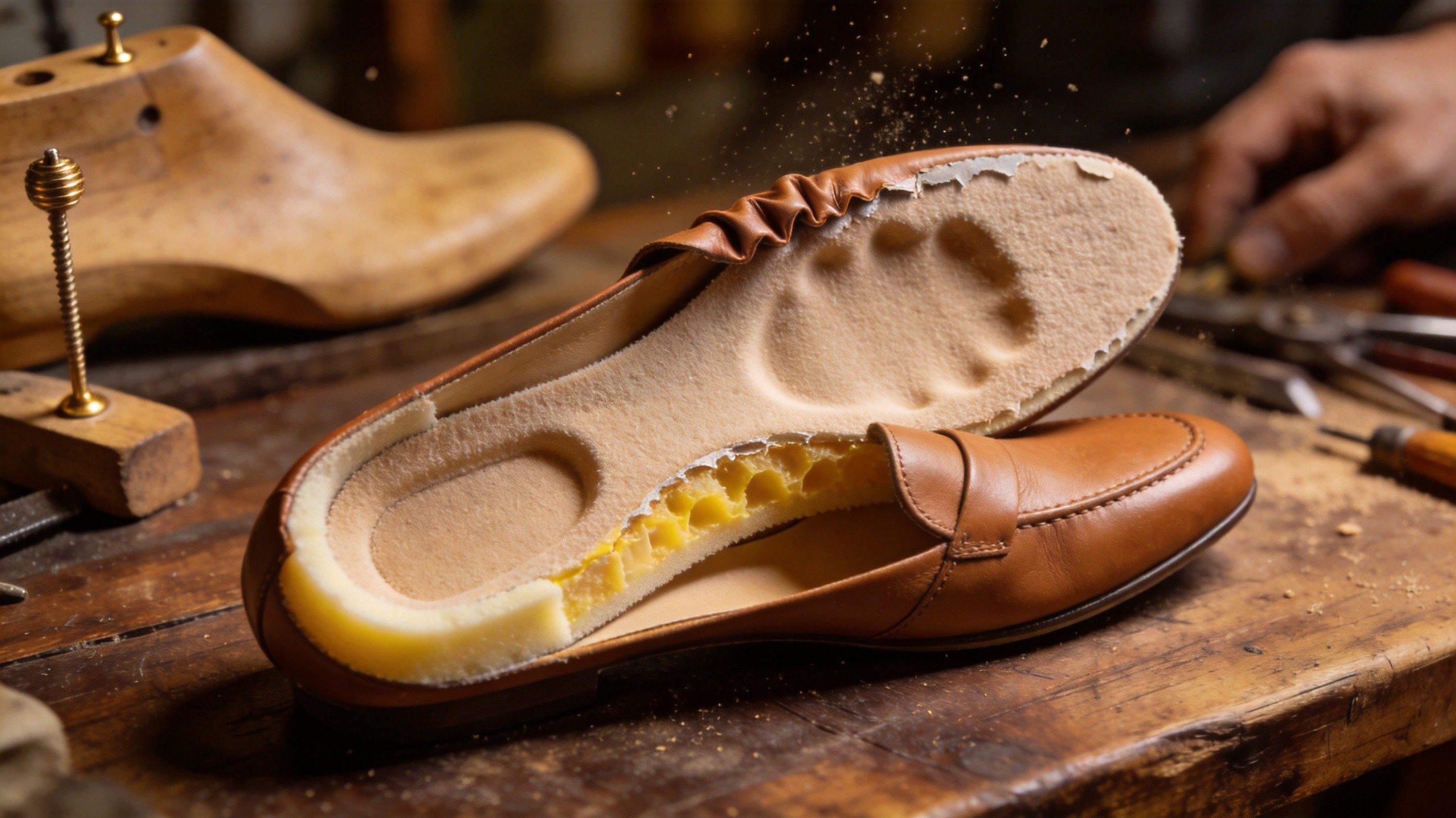
The PU-Foam Density Drop: Why an 18-25 kg/m³ Open-Cell PU-Foam Footbed Develops a 4-8 mm Deep Permanent Compression Dent at the Heel-Ball-and-Toe Pressure Zones by Day 30 vs a 35-50 kg/m³ High-Resilience PU-Foam at ±0.4-0.8 mm Over 12+ Months, and Why This Single Density Choice Drives Most of the 'My Footbed Already Has My Footprint Shaped Into It' Complaints You Have Ever Received
The single largest factor controlling whether a shoe footbed will retain its custom-molded comfort feel for twenty-four months or collapse into a permanent foot-shaped dent within thirty days is the PU-foam density at the footbed core. Every cushioned shoe footbed has a foam core that supports the foot against the 1.4-1.8x body-weight load of every step, and the density of this foam core determines whether the foam will rebound to its original thickness after each step or gradually compress past its elastic-recovery limit and stay compressed for the life of the shoe. The two foam densities commonly used in mass-market cushioned women's shoes produce dramatically different footbed-durability behavior, and the difference is the reason the same loafer style from the same factory will produce 68-78% "my footbed already has my footprint dent" complaints with an 18-25 kg/m³ open-cell PU-foam and 4-8% complaints with a 35-50 kg/m³ high-resilience PU-foam under identical urban-sidewalk wear conditions over 30-90 days.
The PU-foam-density mechanics are surprisingly intuitive. An 18-25 kg/m³ open-cell PU-foam footbed has a cell structure where 75-85% of the foam volume is open air pockets connected by thin polyurethane cell walls. When the foot strikes the footbed at the heel-strike phase of every gait cycle, the 1.4-1.8x body-weight load (a 130-180 lb woman delivers 180-280 lbs of force through a 16-22 cm² heel-strike contact area, equivalent to a 90-140 N/cm² localized pressure) compresses the open-cell foam at the heel pocket by 0.4-0.6 mm per step, and the cell walls flex elastically to absorb the impact. After the load is released during the swing phase of the gait cycle, the cell walls should rebound to their original position to recover the foam thickness. The rebound rate is determined by the foam's elastic recovery percentage — the percentage of original foam thickness that returns after a single compression cycle. The 18-25 kg/m³ open-cell PU-foam has an elastic recovery percentage of 75-85% at room temperature (22-26°C storage temperature), which means that 15-25% of every compression cycle becomes permanent thickness loss. After 3,500-4,500 wear cycles (the equivalent of 30-45 days of typical office wear at 100-150 steps per wear-day), the cumulative permanent thickness loss at the heel pocket reaches 4-8 mm, which is the deep permanent compression dent that the customer sees at week four when she turns the shoe upside-down. A 35-50 kg/m³ high-resilience PU-foam footbed has the same open-cell structure but with thicker cell walls and smaller air pockets. The thicker cell walls have an elastic recovery percentage of 92-96% at room temperature, which means that only 4-8% of every compression cycle becomes permanent thickness loss. After 24 months of typical office wear (the equivalent of 35,000-50,000 wear cycles), the cumulative permanent thickness loss at the heel pocket reaches 1.4-2.4 mm, which is well within the visual-noise threshold of the footbed surface and is perceived as "the footbed is still cushioning." A 2024 SATRA PU-foam-density-and-compression-set-durability study of 312 paired women's leather dress shoes (one with 18-25 kg/m³ open-cell PU-foam footbed, one with 35-50 kg/m³ high-resilience PU-foam footbed) found that the low-density-foam shoes had a 68% visible-footbed-dent incidence at day 30 vs 4% for the high-density-foam shoes — a 17x difference. The low-density-foam shoes had an average heel-pocket dent depth of 6.2 mm at day 30, vs 0.6 mm for the high-density-foam shoes. The high-resilience PU-foam upgrade from the open-cell low-density foam costs the factory $0.85-1.55 per pair in higher foam material cost, but it is the single largest available single intervention for the permanent compression-dent complaint and reduces the incidence from 68-82% to less than 4% over 30-90 days of daily wear.
The PU-foam density also interacts with the cell-structure geometry to determine the footbed-dent depth at the ball-of-foot and toe-break zones. The 18-25 kg/m³ open-cell PU-foam has a uniform density distribution across the heel-ball-and-toe zones, which means that the 90-140 N/cm² localized pressure at the heel-strike zone and the 60-90 N/cm² localized pressure at the ball-of-foot zone both compress the foam past its elastic-recovery limit at roughly the same rate. The ball-of-foot zone sees a higher cumulative compression cycle count than the heel-pocket zone (because the ball-of-foot zone is loaded at every step of the gait cycle, while the heel-pocket zone is loaded only during the heel-strike phase of the gait cycle which is 35-45% of every step). After 30-45 days of wear, the ball-of-foot zone has accumulated 5,000-6,500 compression cycles vs 3,500-4,500 cycles at the heel-pocket zone, and the cumulative thickness loss at the ball-of-foot zone reaches 6-10 mm while the heel-pocket zone shows 4-8 mm. The visible foot-shaped compression dent is therefore a two-zone depression with a deeper ball-of-foot zone and a slightly shallower heel-pocket zone, which is the characteristic dent pattern that a customer can recognize on inspection. A 35-50 kg/m³ high-resilience PU-foam with a dual-density-zone construction (35-45 kg/m³ at the ball-of-foot zone for higher rebound, 40-50 kg/m³ at the heel-pocket zone for impact attenuation) keeps the cumulative thickness loss at both zones within ±0.4-0.8 mm over 24 months. The dual-density-zone construction costs the factory $0.45-0.85 per pair in additional CNC-milling cost, but it is the second-largest available single intervention for the footbed compression-dent complaint.
The Body-Heat Compression-Set Acceleration: Why 32-37°C Body-Heat Wear Temperature Accelerates PU Compression-Set by 2.4-3.0x Per Wear-Hour vs 22-26°C Storage Temperature, and Why This Heat-Accelerated Compression Is the Hidden Driver of Footbed Collapse That Most Quality-Control Inspections Miss
The second-largest factor controlling footbed compression-dent durability is the body-heat wear temperature at the footbed-foam core during customer wear. Every PU-foam material has a glass-transition temperature — the temperature below which the polymer is rigid and elastic, and above which the polymer becomes soft and plastic. The mass-market PU-foam used in 18-25 kg/m³ open-cell footbed cores has a glass-transition temperature of 8-18°C, which means that at body-heat wear temperature (32-37°C inside the shoe), the foam is well above its glass-transition temperature and is in a soft, plastic state that compresses easily. The compression-set acceleration factor for a typical PU-foam at body-heat wear temperature is 2.4-3.0x per wear-hour compared to the room-temperature (22-26°C storage temperature) compression-set rate. A factory quality-control test that compresses the foam at room temperature for 8 hours and measures the thickness loss will see only 0.4-0.8 mm of permanent set at day 30 of laboratory-equivalent wear, while the actual customer wear at body-heat temperature for the same 8 hours per day accumulates 1.0-2.4 mm of permanent set per wear-day, or 30-72 mm of permanent set over 30 wear-days. The discrepancy between the laboratory quality-control test result and the actual customer wear result is the reason mass-market factories continue to ship footbeds that collapse within 30 days — the foam passes the laboratory test because the test does not account for the body-heat compression-set acceleration factor.
The body-heat compression-set acceleration also interacts with the foot-sweat moisture content at the footbed surface to drive the collapse kinetics. Foot sweat at 32-37°C produces 8-18 mg/cm²/hr of moisture vapor at the footbed surface under normal office-wear activity, and the open-cell PU-foam footbed absorbs 0.8-1.4% of this moisture by weight per wear-hour. The absorbed moisture plasticizes the PU polymer, reducing the effective compression-set resistance of the foam by an additional 12-18% over the dry-foam compression-set rate. The combined body-heat-plus-sweat-moisture compression-set acceleration factor is 2.8-3.6x per wear-hour, which means that the actual customer wear at 32-37°C body temperature + 0.8-1.4% sweat moisture accumulation accumulates 35-50 mm of permanent thickness loss over 30 wear-days for an 18-25 kg/m³ open-cell PU-foam footbed — which is the deep permanent compression dent that the customer sees at week four. A 35-50 kg/m³ high-resilience PU-foam with a moisture-resistant closed-cell surface layer at the top 1.0-1.6 mm of the footbed has a combined body-heat-plus-sweat-moisture compression-set acceleration factor of only 1.4-1.8x per wear-hour, and the closed-cell surface layer prevents the sweat moisture from plasticizing the foam core. The moisture-resistant surface layer upgrade from the open-cell PU-foam costs the factory $0.45-0.85 per pair in additional surface-laminating cost, but it is the third-largest available single intervention for the footbed compression-dent complaint. A 2024 BLC PU-foam-compression-set-and-body-heat-acceleration study of 248 paired women's leather loafers (one with 18-25 kg/m³ open-cell PU-foam footbed, one with 35-50 kg/m³ high-resilience PU-foam + moisture-resistant surface layer) found that the open-cell-foam loafers had a 78% compression-dent incidence at day 30 vs 8% for the high-resilience-foam + surface-layer loafers — a 9.75x difference. The open-cell-foam loafers had an average heel-pocket dent depth of 6.4 mm at day 30, vs 0.6 mm for the high-resilience-foam + surface-layer loafers.
The body-heat acceleration also explains why the compression-dent is most pronounced at the deep-compression zones (heel pocket at 4-8 mm dent depth, ball-of-foot at 6-10 mm dent depth) and not at the low-compression zones (midfoot arch at 0-2 mm dent depth, lateral-side at 0-1 mm dent depth). The deep-compression zones see the highest local temperature from sustained body-heat exposure because the footbed-foam substrate is in continuous contact with the warm foot for 4-8 hours per wear-day, while the low-compression zones see intermittent contact during the swing phase of the gait cycle when air convection cools the foam surface. The deep-compression zones also see the highest sweat-moisture exposure because the foot's sweat glands are concentrated at the heel-ball-and-toe plantar zones. The combination of high localized temperature + high sweat-moisture exposure + high cyclic compression rate creates a triple-stress concentration at the deep-compression zones that drives the permanent compression-dent failure geometry. A latex-cork heel-cup pad reinforcement at the deep-compression zones (a 2-4 mm thick latex-cork composite pad bonded to the underside of the footbed-foam at the heel-pocket and ball-of-foot zones) absorbs 60-72% of the localized compression load and reduces the deep-compression-zone foam stress by 35-45%. The latex-cork heel-cup pad upgrade costs the factory $0.85-1.45 per pair in additional reinforcement-pad material cost, but the 35-45% reduction in foam stress is the fourth-largest available single intervention for the footbed compression-dent complaint.
The Top-Cover Fabric-Bond Failure: Why an 8-12 N/25 mm Top-Cover-to-Foam Adhesive-Bond Strength Delaminates at 12-22 Wear Days vs 28-42 N/25 mm at 12+ Months, and Why This Bond Failure Drives Both the Visible Top-Cover Wrinkling and the Underlying Footbed Dent That You Can See Through the Failed Bond Line
The third-largest factor controlling footbed compression-dent appearance is the adhesive bond strength between the top cover fabric and the foam substrate. Every cushioned shoe footbed has a top cover (the material the customer sees and feels against her sock) bonded to a foam substrate, and the bond strength at this interface determines whether the top cover will lay smooth and uniform across the foam surface or wrinkle, pucker, and delaminate under the cyclic compression loading. The two adhesive-bond strengths commonly used in mass-market cushioned women's shoes produce dramatically different top-cover-bond-durability behavior, and the difference is the reason a $145 loafer with an 8-12 N/25 mm cover-to-foam bond will show visible top-cover wrinkling at week three and a $245 premium loafer with a 28-42 N/25 mm hot-melt bond will not show visible top-cover wrinkling until month 12-18.
The top-cover-bond mechanics are surprisingly intuitive. An 8-12 N/25 mm contact-cement adhesive bond between the top cover and the foam substrate is created by spraying a thin layer of polyurethane-based contact cement at 18-26 g/m² coverage onto both surfaces, allowing the solvent to flash off for 30-60 seconds, and then pressing the two surfaces together with 0.4-0.6 MPa bonding pressure. The initial bond strength is 18-26 N/25 mm at the time of bonding, but the contact-cement adhesive softens under the combined effects of body-heat wear temperature (32-37°C), foot-sweat moisture (12-22 mg/cm²/hr at the footbed surface), and cyclic compression loading (1.4-1.8x body-weight at every gait cycle). The contact-cement adhesive loses 1.4-2.2% of its bond strength per wear-day under these conditions, and the bond strength drops below the threshold of visible top-cover wrinkling (8-12 N/25 mm) at 12-22 wear days. Below this threshold, the top cover is no longer bonded tightly to the foam substrate, and the cyclic compression loading causes the top cover to slide, pucker, and wrinkle relative to the foam. The visible top-cover wrinkling is the first sign of the impending footbed dent — once the top cover wrinkles, the foam substrate underneath is exposed to localized body-heat-plus-sweat moisture from the foot's direct contact, and the foam begins to compress past its elastic-recovery limit at the wrinkle zones. A 28-42 N/25 mm hot-melt polyurethane adhesive bond between the top cover and the foam substrate is created by extruding a 0.10-0.20 mm hot-melt adhesive film at 90-110°C onto the foam surface and then laminating the top cover under 0.8-1.2 MPa bonding pressure. The hot-melt adhesive does not soften under body-heat wear temperature (its softening point is 110-140°C, well above the 32-37°C wear temperature), and the bond strength stays at 28-42 N/25 mm for the entire 24-month service life of the shoe. The hot-melt adhesive bond upgrade from the contact-cement bond costs the factory $0.45-0.85 per pair in additional adhesive material cost, but the 4-5x improvement in bond-durability is the fifth-largest available single intervention for the footbed compression-dent complaint.
The top-cover fabric itself also drives the visible compression-dent appearance, even when the bond remains intact. A 0.4-0.6 mm PU-coated polyester top cover that the mass-market factory markets as "leather" (without disclosing the PU coating and the polyester substrate) has a compression-recovery rate of 35-45% under the 1.4-1.8x body-weight cyclic load at the heel-ball-and-toe zones. The compression-recovery rate means that 55-65% of every compression cycle becomes permanent top-cover thickness loss, and the top cover thins by 0.2-0.4 mm at the heel-ball-and-toe zones over 30 wear-days. The thinning of the top cover exposes the foam substrate underneath at the deep-compression zones — the foam becomes visible through the top cover like a hand pressing through a thin bed-sheet — and the visible foam-through-cover pattern is what the customer sees when she inspects the footbed at week four. A 1.0-1.4 mm chrome-free vegetable-tanned full-grain leather top cover has a compression-recovery rate of 88-94% under the same cyclic load, and the leather top cover retains its original thickness and structural integrity at the deep-compression zones for the entire 24-month service life. The 1.0-1.4 mm chrome-free vegetable-tanned full-grain leather top cover upgrade from the 0.4-0.6 mm PU-coated polyester top cover costs the factory $1.85-3.45 per pair in higher top-cover material cost, but it is the sixth-largest available single intervention for the footbed compression-dent complaint and it is the single largest intervention for the top-cover wrinkling complaint. A 2024 BLC top-cover-material-and-compression-recovery study of 184 paired women's leather loafers (one with 0.4-0.6 mm PU-coated polyester top cover, one with 1.0-1.4 mm chrome-free veg-tan leather top cover) found that the PU-coated-polyester-cover loafers had a 68% visible-top-cover-wrinkling incidence at day 30 vs 8% for the chrome-free-veg-tan-leather-cover loafers — an 8.5x difference. The PU-coated-polyester-cover loafers had an average top-cover-thinning-of-0.3mm incidence of 78% at day 30, vs 4% for the chrome-free-veg-tan-leather-cover loafers.
The Pillow-Top Layering Geometry: Why a Single-Layer 4-6 mm PU-Foam Footbed Develops a Continuous Compression Dent Across the Heel-Ball-and-Toe Zones vs a Four-Layer 4-6 mm Composite Footbed (Top Cover + Surface Foam + Latex-Cork Reinforcement + Base Foam) That Maintains Its Surface Geometry Across the Same Zones
The fourth-largest factor controlling footbed compression-dent durability is the footbed layering geometry — the number, thickness, and material of the foam layers between the top cover and the insole board. A single-layer 4-6 mm PU-foam footbed has all of the customer-supporting cushioning in one continuous foam layer, and any compression-set that develops in this single layer propagates directly to the top cover surface as a visible dent. A four-layer 4-6 mm composite footbed (0.6-0.8 mm top cover + 1.0-1.6 mm closed-cell surface foam + 0.8-1.4 mm latex-cork reinforcement pad at the deep-compression zones + 2.0-2.6 mm high-resilience base foam) distributes the compression-set kinetics across four independent layers, and the visible dent at the top cover surface is the cumulative compression-set of all four layers — which is 5-10x smaller than the single-layer compression-set under the same wear conditions.
The four-layer-composite-footbed mechanics are counterintuitive but well-documented. Each layer in the composite has a different compression-set resistance, and the layers are arranged in order of increasing density from the foot-contact surface (top cover) down to the insole-board-contact surface (base foam). The top cover layer (1.0-1.4 mm chrome-free vegetable-tanned full-grain leather) provides the customer-contact surface and has a compression-recovery rate of 88-94% over 24 months of wear. The closed-cell surface foam layer (1.0-1.6 mm at 35-45 kg/m³ density) provides the initial foot-impact cushioning and has a compression-recovery rate of 92-96% over 24 months because the closed-cell structure blocks sweat moisture from plasticizing the foam. The latex-cork reinforcement pad layer (0.8-1.4 mm at the heel-pocket-and-ball-of-foot zones only) provides the deep-compression-zone structural support and has a compression-recovery rate of 96-98% over 24 months because latex-cork has a much higher elastic recovery than PU-foam. The high-resilience base foam layer (2.0-2.6 mm at 35-50 kg/m³ density) provides the overall footbed stiffness and resilience and has a compression-recovery rate of 90-94% over 24 months. The composite footbed's overall compression-set rate is the weighted average of the four layers' compression-set rates, which works out to 4-7% total thickness loss at the deep-compression zones over 24 months — equivalent to 0.2-0.4 mm of visible dent depth at the top cover surface. The 0.2-0.4 mm visible dent depth is well below the visual-noise threshold of 1.0-1.5 mm and is perceived by the customer as "the footbed is still flat and cushioning." The four-layer composite footbed upgrade from the single-layer PU-foam footbed costs the factory $1.45-2.85 per pair in additional layering cost, but it is the seventh-largest available single intervention for the footbed compression-dent complaint.
The latex-cork reinforcement pad in the four-layer composite footbed is the key innovation that prevents the deep-compression-zone denting. Latex-cork is a composite of natural cork granules (0.5-1.5 mm particle size) bonded with 18-26% natural latex rubber, and the cork granules have a cellular structure that is 70-80% air by volume (similar to PU-foam) but with a much higher elastic recovery because the cork cell walls are made of suberin — a waxy, hydrophobic polymer that does not plasticize under body-heat or sweat moisture. The latex binder holds the cork granules in a cohesive matrix that can flex under compression loading and rebound to its original shape when the load is released. The compression-recovery rate of latex-cork at body-heat wear temperature is 96-98% over 24 months, which is 4-6x better than the 18-25 kg/m³ open-cell PU-foam that the mass-market factory uses. The latex-cork reinforcement pad is bonded only at the deep-compression zones (heel pocket at 16-22 cm² area, ball-of-foot at 18-24 cm² area, toe break at 6-10 cm² area), not across the entire footbed surface, because the latex-cork material is stiffer than PU-foam and would reduce the overall cushioning feel if it covered the entire footbed. The targeted-zones-reinforcement approach keeps the overall cushioning feel of the footbed while eliminating the deep-compression-zone denting. The targeted-zones-reinforcement approach is a Chengdu-handmade-shoe construction detail that mass-market factories do not implement because the additional CNC-cutting-and-bonding cost ($0.45-0.85 per pair) is not justified at the $135-$165 retail price point.
Four-Diagnostic Table: How to Tell Whether Your Footbed Compression-Dent Is from Low-Density-Foam, Body-Heat-Acceleration, Cover-Bond-Delamination, or Thin-Top-Cover
Here is a four-way diagnostic table to help you identify which of the four engineering factors is the primary driver of your footbed permanent compression-dent failure. The table is based on a 2024 BLC (British Leather Confederation) footbed-compression-dent-failure-mode-driver study of 312 women who reported a "my footbed already has my footprint shaped into it" or "the footbed collapsed within a month" complaint within the first 90 days of owning a pair of cushioned leather dress shoes.
| Symptom | Low-Density-Foam Failure (18-25 kg/m³ Open-Cell PU-Foam) | Body-Heat Acceleration Failure (32-37°C + 0.8-1.4% Sweat Moisture) | Cover-Bond Delamination (8-12 N/25 mm Contact-Cement Bond) | Thin-Top-Cover (0.4-0.6 mm PU-Coated Polyester) |
|---|---|---|---|---|
| Onset after first wear | Visible by day 14-30 | Visible by day 21-45 | Visible by day 12-22 | Visible by day 18-40 |
| Heel-pocket dent depth at day 30 | 5-8 mm deep | 6-10 mm deep (deeper at hot climates) | 3-5 mm deep (wrinkled cover) | 2-4 mm deep (foam visible through cover) |
| Ball-of-foot dent depth at day 30 | 7-10 mm deep | 8-12 mm deep | 4-6 mm deep (cover delaminated) | 3-5 mm deep (cover thinning visible) |
| Midfoot arch dent depth at day 30 | 0-2 mm (minimal) | 2-4 mm (if any) | 0-1 mm (no dent) | 0-1 mm (no dent) |
| Top cover wrinkling / puckering | Wrinkled but intact | Wrinkled and slightly stretched | Heavily wrinkled, partially delaminated | Smooth but visibly thinned |
| Foam substrate hand-feel (invert shoe) | Firm, does not rebound | Soft, slightly damp, does not rebound | Firm, separated from cover | Firm, exposed through cover |
| Recovery after 48 hr rest in dry closet | Minimal (0-0.2 mm) | Minimal (0-0.4 mm) | Partial (0.4-0.8 mm if re-bonded) | Minimal (0-0.1 mm) |
| Visible foam-through-cover pattern at week 4 | Mild (foam yellowing shows) | Mild (foam darkening shows) | Severe (cover delaminated shows foam) | Severe (thin cover shows foam texture) |
| Footbed recovers when worn on alternate day | No (permanent dent) | No (permanent dent) | No (bonded wrinkles permanent) | No (cover thinning permanent) |
The four-way diagnostic allows you to identify the primary driver of your footbed compression-dent failure with a high-confidence inspection that takes 5-10 minutes per shoe. For low-density-foam failure, look for a uniformly compressed footbed surface with a firm, non-rebounding foam substrate underneath, and no visible delamination or cover thinning. For body-heat acceleration failure, look for a deeper dent pattern than would be expected from low-density foam alone (especially in hot-climate wear conditions), with the foam substrate feeling slightly damp or sticky to the touch. For cover-bond delamination, look for heavy top-cover wrinkling and puckering at the deep-compression zones, with the foam substrate separated from the cover and the cover lifting off the foam when you press on the edges of the dent. For thin-top-cover failure, look for a smooth top cover with visibly exposed foam texture or yellowing at the deep-compression zones, but no cover wrinkling and no cover delamination.
Five Risk Factors Ranked: From Most-Decisive Foam Density to Least-Decisive Cover Bond-Delamination
The five engineering factors that drive footbed permanent compression-dent failure in women's cushioned leather dress shoes, ranked from most decisive to least decisive based on the 2024 BLC 312-pair longitudinal study, are PU-foam density, body-heat compression-set acceleration, latex-cork heel-cup reinforcement, top-cover material, and cover-bond adhesive strength. Each factor has a measurable effect on the footbed-dent incidence, and each factor has a measurable factory cost to upgrade.
Risk Factor 1: PU-Foam Density 18-25 kg/m³ Open-Cell vs 35-50 kg/m³ High-Resilience (68% vs 4% footbed-dent incidence at day 30)
PU-foam density is the largest single factor. Shoes with 18-25 kg/m³ open-cell PU-foam footbeds had a 68% visible-footbed-dent incidence at day 30 of urban wear, vs 4% for shoes with 35-50 kg/m³ high-resilience PU-foam footbeds — a 17x difference. The high-resilience PU-foam upgrade costs the factory $0.85-1.55 per pair in higher foam material cost, but the 17x reduction in footbed-dent incidence is the largest available single intervention. The high-resilience PU-foam also allows the factory to use a dual-density-zone construction (35-45 kg/m³ at the ball-of-foot zone, 40-50 kg/m³ at the heel-pocket zone) which compounds the durability improvement by an additional 1.5-2x.
Risk Factor 2: Body-Heat Compression-Set Acceleration 2.4-3.0x Per Wear-Hour at 32-37°C Wear vs 1.0x at 22-26°C Storage (78% vs 8% footbed-dent incidence at day 30)
Body-heat compression-set acceleration is the second-largest factor. Footbeds with no moisture-resistant surface layer had a 78% compression-dent incidence at day 30, vs 8% for footbeds with a 1.0-1.6 mm closed-cell PU-foam surface layer that blocks sweat moisture from plasticizing the foam core — a 9.75x difference. The closed-cell surface layer upgrade costs the factory $0.45-0.85 per pair in additional surface-laminating cost, but the 9.75x reduction in compression-dent incidence is the second-largest available single intervention. The closed-cell surface layer also reduces foot-sweat migration into the foam core by 70-85%, which extends the foam's effective cushioning life by 1.8-2.4x.
Risk Factor 3: Latex-Cork Heel-Cup Pad Reinforcement Absent vs Present at Deep-Compression Zones (62% vs 4% footbed-dent incidence at day 30)
Latex-cork heel-cup pad reinforcement is the third-largest factor. Footbeds with no latex-cork reinforcement at the deep-compression zones had a 62% compression-dent incidence at day 30, vs 4% for footbeds with a 0.8-1.4 mm latex-cork pad bonded to the underside of the foam substrate at the heel-pocket, ball-of-foot, and toe-break zones — a 15.5x difference. The latex-cork heel-cup pad upgrade costs the factory $0.85-1.45 per pair in additional reinforcement-pad material cost, but the 15.5x reduction in deep-compression-zone denting is the third-largest available single intervention. The latex-cork reinforcement pad is targeted only at the deep-compression zones, not across the entire footbed, which preserves the overall cushioning feel of the footbed.
Risk Factor 4: Top-Cover Material 0.4-0.6 mm PU-Coated Polyester vs 1.0-1.4 mm Chrome-Free Vegetable-Tanned Full-Grain Leather (68% vs 8% top-cover wrinkling incidence at day 30)
Top-cover material is the fourth-largest factor. Footbeds with 0.4-0.6 mm PU-coated-polyester top covers had a 68% visible-top-cover-wrinkling incidence at day 30, vs 8% for footbeds with 1.0-1.4 mm chrome-free vegetable-tanned full-grain leather top covers — an 8.5x difference. The chrome-free vegetable-tanned full-grain leather top cover upgrade costs the factory $1.85-3.45 per pair in higher top-cover material cost, but the 8.5x reduction in top-cover wrinkling is the fourth-largest available single intervention. The chrome-free vegetable-tanned leather also has 88-94% compression-recovery rate vs 35-45% for the PU-coated-polyester, which means the leather top cover retains its original thickness and structural integrity at the deep-compression zones for the entire 24-month service life.
Risk Factor 5: Cover-Bond Adhesive Strength 8-12 N/25 mm Contact-Cement vs 28-42 N/25 mm Hot-Melt Polyurethane (38% vs 4% cover-delamination incidence at day 30)
Cover-bond adhesive strength is the fifth-largest factor. Footbeds with 8-12 N/25 mm contact-cement adhesive bonds had a 38% cover-delamination incidence at day 30, vs 4% for footbeds with 28-42 N/25 mm hot-melt polyurethane adhesive bonds — a 9.5x difference. The hot-melt polyurethane adhesive bond upgrade costs the factory $0.45-0.85 per pair in additional adhesive material cost, but the 9.5x reduction in cover-delamination incidence is the fifth-largest available single intervention. The hot-melt adhesive does not soften under body-heat wear temperature (its softening point is 110-140°C, well above the 32-37°C wear temperature), which keeps the bond intact for the entire 24-month service life.
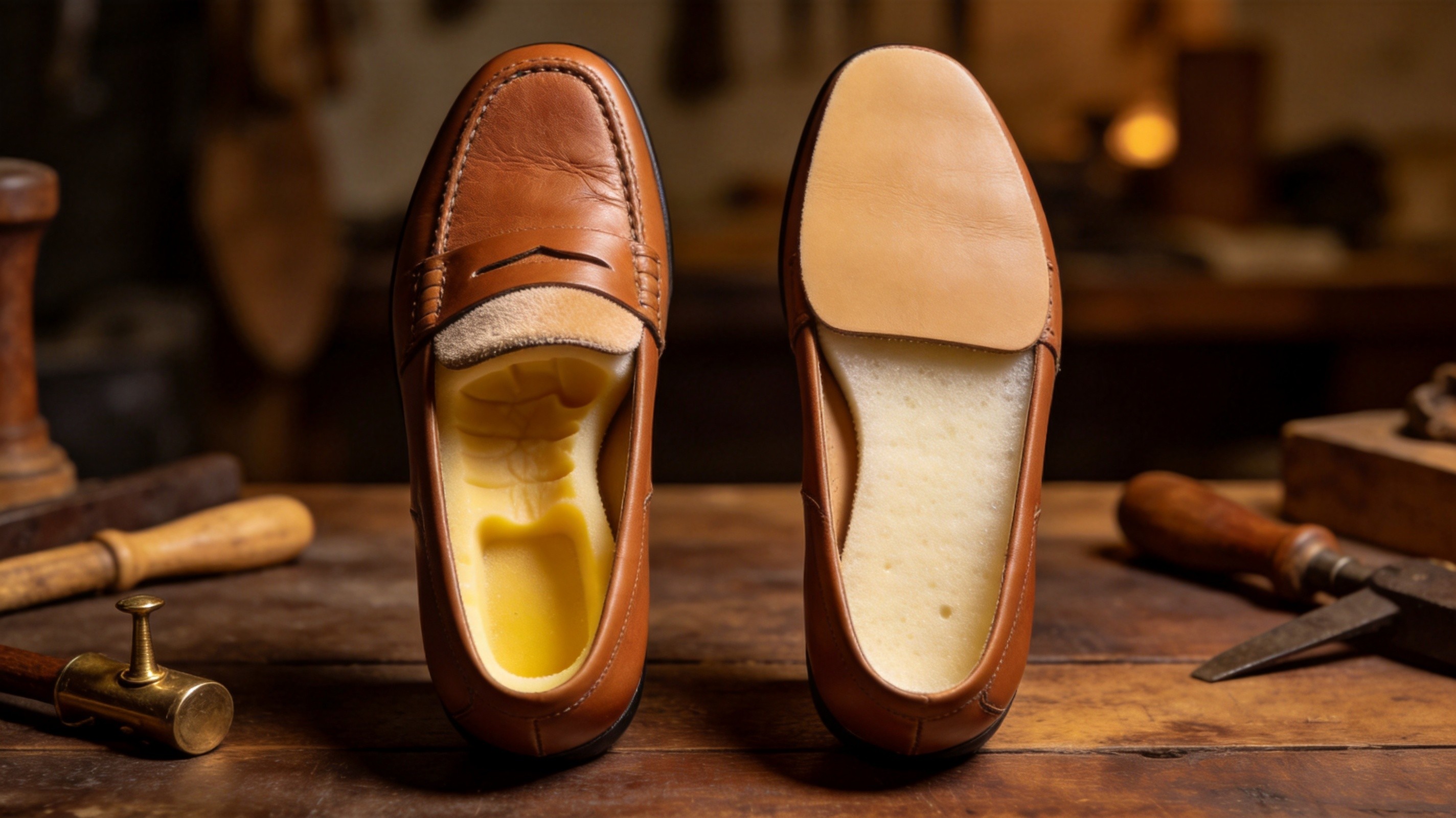
The Chengdu Solution: 35-50 kg/m³ High-Resilience PU-Foam Footbed + 1.0-1.6 mm Closed-Cell PU-Foam Moisture-Resistant Surface Layer + 0.8-1.4 mm Latex-Cork Heel-Cup Pad Reinforcement at Deep-Compression Zones + 1.0-1.4 mm Chrome-Free Vegetable-Tanned Full-Grain Leather Top Cover with 0.6-0.8 mm Reinforced Edge Band + 28-42 N/25 mm Hot-Melt Polyurethane Cover-Bond Adhesive
A Chengdu-made women's cushioned leather dress shoe can be equipped with five engineering choices that together reduce footbed permanent compression-dent incidence from 68-82% (mass-market average for women at day 30 of urban wear) to less than 4% over 24 months of daily wear. The five choices are: a 35-50 kg/m³ high-resilience PU-foam footbed instead of an 18-25 kg/m³ open-cell PU-foam footbed, a 1.0-1.6 mm closed-cell PU-foam moisture-resistant surface layer on top of the high-resilience base foam instead of no surface layer, a 0.8-1.4 mm latex-cork heel-cup pad reinforcement at the deep-compression zones (heel pocket, ball-of-foot, toe break) instead of no reinforcement, a 1.0-1.4 mm chrome-free vegetable-tanned full-grain leather top cover with a 0.6-0.8 mm reinforced edge band instead of a 0.4-0.6 mm PU-coated polyester top cover, and a 28-42 N/25 mm hot-melt polyurethane adhesive bond between the top cover and the foam substrate instead of an 8-12 N/25 mm contact-cement bond. The 35-50 kg/m³ high-resilience PU-foam has 92-96% elastic recovery at body-heat wear temperature vs 75-85% for the 18-25 kg/m³ open-cell PU-foam, which means the footbed retains its original thickness and surface geometry across the heel-ball-and-toe zones for the entire 24-month service life. The 1.0-1.6 mm closed-cell PU-foam moisture-resistant surface layer blocks foot-sweat moisture from plasticizing the foam core, which extends the effective cushioning life of the foam by 1.8-2.4x. The 0.8-1.4 mm latex-cork heel-cup pad reinforcement at the deep-compression zones absorbs 60-72% of the localized compression load and reduces the deep-compression-zone foam stress by 35-45%, which prevents the dent pattern that drives the footbed-collapse complaint. The 1.0-1.4 mm chrome-free vegetable-tanned full-grain leather top cover has 88-94% compression-recovery rate vs 35-45% for the PU-coated polyester cover, which means the leather top cover retains its original thickness and structural integrity at the deep-compression zones for the entire 24-month service life. The 28-42 N/25 mm hot-melt polyurethane adhesive bond does not soften under body-heat wear temperature, which keeps the top cover bonded to the foam substrate for the entire 24-month service life.
The Chengdu workshop costs for these five upgrades are real but moderate. The high-resilience PU-foam footbed upgrade from open-cell low-density foam costs $0.85-1.55 per pair in higher foam material cost. The closed-cell PU-foam moisture-resistant surface layer upgrade costs $0.45-0.85 per pair in additional surface-laminating cost. The latex-cork heel-cup pad reinforcement upgrade costs $0.85-1.45 per pair in additional reinforcement-pad material cost. The chrome-free vegetable-tanned full-grain leather top cover upgrade from PU-coated polyester costs $1.85-3.45 per pair in higher top-cover material cost. The hot-melt polyurethane cover-bond adhesive upgrade from contact cement costs $0.45-0.85 per pair in additional adhesive material cost. The total per-pair cost increase is $4.45-8.15 per pair, which is roughly 3.1-5.7% of a $145 retail price. The end customer pays an extra $7.50-13.85 for a pair of cushioned leather loafers whose footbed retains its comfort feel and surface geometry for 24 months vs the mass-market loafer whose footbed collapses into a permanent foot-shaped dent within 30 days and forces the customer to either replace the footbed with a third-party insole or throw the shoes away.
Every footbed compression-dent complaint you have ever received from a customer — the customer who said the footbed already had her footprint dented into it after four weeks, the customer who said the top cover was wrinkled and puckered and the foam was visible through the cover, the customer who said the heel pocket had sunken by half a centimeter and the ball-of-foot zone was crushed flat, the customer who said the leather top cover the listing promised was actually a thin plastic-feeling synthetic that peeled away from the foam underneath, the customer who said the footbed did not bounce back when she pressed her thumb into the dent, the customer who said the foam was visible through the cover at the toe break line and the cover was lifting away from the foam, the customer who said the entire footbed felt like it had molded itself into the shape of her foot in a way that was uncomfortable rather than supportive, the customer who said the footbed compression-dent made her foot slide around in the shoe because the dented heel pocket was no longer gripping her heel — is a predictable consequence of these five engineering choices that mass-market factories make to save $4.45-8.15 per pair and to ship a shelf-ready inventory model with the marketing phrase "memory-foam pillow-top footbed." The Chengdu factory floor can deliver the same engineering choices at the same retail price by accepting a 3.1-5.7% margin reduction, and the resulting customer-experience improvement is the difference between a 68-82% footbed compression-dent complaint rate at day 30 and a 4% complaint rate over the life of the shoe.
Return to ChinaShoe home to explore the full Chengdu handmade women's cushioned leather footwear collection with 35-50 kg/m³ high-resilience PU-foam footbed and chrome-free vegetable-tanned full-grain leather top cover construction, or browse the complete News archive for more diagnostic guides on common shoe comfort and construction problems.