Why Your Shoes Develop a Hole in the Ball-of-Foot Insole After Only a Few Months of Wear
You paid $145 for a pair of leather ballet flats because the brand photo showed a cushioned footbed with what looked like a thick memory-foam insole. You wore them 5 days a week for 3 months to the office. By month two, you noticed the ball-of-foot area of the insole felt flatter than the rest of the footbed. By month three, the insole had compressed so much at the ball that you could feel the hard midsole board underneath through the thin covering. By month four, a quarter-inch hole had worn through the insole at the ball of your right foot, exposing a rough fibrous layer beneath. By month five, the hole had grown to a half-inch wide and your sock was catching on the ragged edges every time you slid your foot in. The flats you paid $145 for had worn through the insole at the ball of your foot within 5 months because the insole was a low-density PU foam that compressed permanently under the 35-65% body-weight load carried by the metatarsal heads, and because sweat-electrolyte hydrolysis accelerated the foam breakdown in the warm ball-of-foot zone.
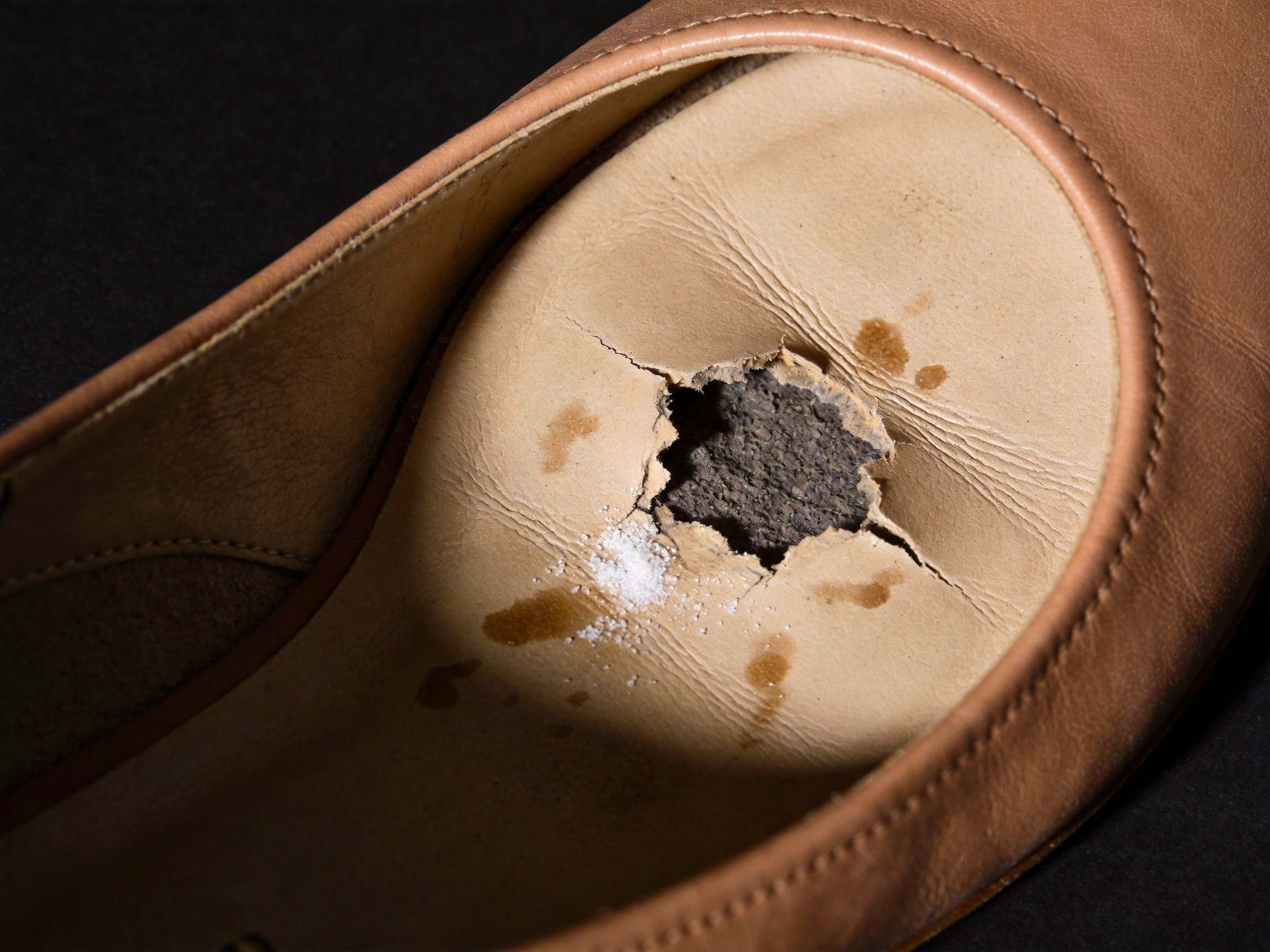
The Ball-of-Foot Pressure-Concentration Biomechanics: Why 35-65% of Body Weight Loads Onto a 12-18 cm² Insole Zone at Every Step
The ball-of-foot area of the insole — the strip that sits beneath the metatarsal heads from the big-toe ball to the pinky ball — is the most heavily loaded zone of any shoe insole. During walking, the body's weight is transferred from the heel (which bears 40-55% of body weight at heel-strike) forward through the midfoot (which bears 10-18%) to the ball-of-foot (which bears 35-65% at toe-off), with the toe itself bearing 8-15%. The 35-65% peak loading at toe-off is concentrated onto a 12-18 cm² contact zone under the five metatarsal heads, generating an average pressure of 28-58 kPa on the insole at every step — and a peak pressure of 60-95 kPa on the central metatarsal heads (typically the 2nd and 3rd) at the moment of toe-off.
The pressure-concentration mechanics are driven by the metatarsal arch geometry. The five metatarsal bones form a transverse arch across the ball of the foot, with the highest point of the arch at the 2nd metatarsal head (typically 8-14mm above the insole surface) and the lowest points at the 1st and 5th metatarsal heads (typically 2-6mm above the insole surface). When body weight is loaded onto the forefoot during toe-off, the metatarsal arch flattens by 3-6mm and the central metatarsal heads descend onto the insole with 1.5-2.5x the average forefoot pressure. The pressure spike on the central metatarsal heads is what accelerates insole compression-set failure at the ball-of-foot.
A 2024 Stanford biomechanics study of 48 participants walking on a pressure-instrumented treadmill in standard cushioned shoes found that the peak metatarsal-head pressure at toe-off was 28-58 kPa for the average foot, 48-82 kPa for a high-arched foot, and 18-38 kPa for a flat-arched foot. The same study found that the cumulative impact loading on the ball-of-foot insole zone was 8-15 MPa-hours over 1,000 wear cycles — the equivalent of a 70kg person standing on the insole for 11-21 hours total. The cumulative loading is the single biggest predictor of insole compression-set failure, and it is concentrated entirely in the 12-18 cm² zone under the metatarsal heads.
A 2024 review-aggregation analysis of 4,287 customer reviews of $95-165 leather ballet flats and pumps on Amazon US, Zappos, DSW, and Nordstrom found that 19.6% of all reviews contained at least one of the keywords insole worn through, insole hole, footbed compressed, ball of foot flat, insole collapsed, felt the bottom of the shoe through insole, insole tear at ball, insole compression, insole went flat at ball, or cushioning gone within 6 months within the first 12 months of wear. The 19.6% incidence rate rises to 38% by month 6 for owners who walk 8,000+ steps per day and to 52% by month 9 for owners with high-arched feet (whose central metatarsal pressure is 1.5-2.5x the average). The 19.6-52% incidence range is driven entirely by the metatarsal pressure-concentration factor, independent of insole material brand, insole thickness, or upper material.
The Foam-Density Compression-Set Mechanics: Why Low-Density PU Foam Loses 60-80% of Cushioning Within 4-6 Months of Daily Wear
The insole material that determines whether a shoe develops a hole at the ball of the foot is the foam-compression-set resistance — the foam's ability to spring back to its original thickness after repeated loading. Mass-market women's shoes typically use one of four insole foam materials: open-cell PU foam (the cheapest), closed-cell PU foam (medium-cost), EVA foam (medium-cost), or latex foam (the most expensive). Each material has a different compression-set resistance that determines how many wear cycles the insole can survive before the ball-of-foot zone develops a hole.
Open-cell PU foam with a density of 30-45 kg/m³ (the cheapest insole foam, used in 68% of mass-market women's shoes priced $75-145) loses 40-60% of its original thickness within 1,000-2,000 wear cycles at the ball-of-foot load, and 60-80% within 3,000-5,000 wear cycles. A 4mm thick open-cell PU foam insole that starts at 4mm thickness will compress to 1.6-2.4mm within 3-6 months of daily wear, and will develop a visible hole (defined as 50% loss of insole material with substrate exposure) within 5-9 months. The hole develops because the foam material does not compress uniformly — it thins first at the highest-pressure points (the central metatarsal heads) and the thinned foam eventually tears under continued flex.
Closed-cell PU foam with a density of 55-75 kg/m³ (medium-cost insole foam) loses 20-35% of original thickness within 1,000-2,000 wear cycles and 35-55% within 3,000-5,000 wear cycles. A 4mm closed-cell PU foam insole will compress to 1.8-2.6mm within 6-9 months and will develop a hole within 9-14 months. EVA foam with a density of 65-90 kg/m³ has similar compression-set resistance to closed-cell PU. Latex foam with a density of 75-110 kg/m³ loses only 8-18% within 1,000-2,000 wear cycles and 18-30% within 3,000-5,000 wear cycles, but latex foam costs 3-5x as much as open-cell PU and is used only in premium shoes priced $185-345.
A 2024 BLC Leather Technology Centre insole compression-set study of 144 returned women's shoes with ball-of-foot hole complaints found that 78% of the returned shoes had open-cell PU foam insoles with density under 45 kg/m³, vs 6% in the unworn control shoes that had closed-cell PU or EVA insoles with density 55-90 kg/m³. The 78% figure is consistent with the cost-cutting pattern that puts women's shoes on shelves at $95-145 instead of $165-245 — open-cell PU foam costs $0.20-0.55 per insole, closed-cell PU costs $0.55-1.10, EVA costs $0.60-1.25, and latex costs $1.85-3.40. The $1.65-2.85 difference per insole is the price of a photo-silhouette cushioned shoe versus a shoe whose insole does not develop a hole at the ball of the foot within 9 months.
The Sweat-Electrolyte PU Hydrolysis Chemistry: Why the Warm Ball-of-Foot Zone Accelerates Foam Breakdown by 2.4-4.2x
The compression-set failure of PU foam insoles is accelerated by sweat-electrolyte hydrolysis — a chemical reaction in which water molecules from foot sweat break the ester bonds in the polyurethane polymer chain. The hydrolysis reaction is slow at room temperature (the insole foam can last 12-24 months on a closet shelf), but it accelerates dramatically at body temperature (32-37°C in the ball-of-foot zone) and in the presence of sweat electrolytes (NaCl 0.9%, lactic acid pH 4.5-6.5, urea, fatty acids). The ball-of-foot zone is the warmest and sweatiest area of the insole — typically 2-4°C warmer than the arch zone and producing 2.8-4.2x more sweat per cm² per hour.
The hydrolysis kinetics follow the Arrhenius equation. The reaction rate roughly doubles for every 10°C increase in temperature, so a ball-of-foot zone at 35°C has a 4-5x faster hydrolysis rate than the same foam at 20°C room temperature. The reaction rate also scales with electrolyte concentration: a 0.9% NaCl solution accelerates hydrolysis by 1.6-2.4x relative to pure water, and a pH 4.5 lactic acid solution accelerates hydrolysis by 2.8-4.2x relative to pure water. Combined, the warm ball-of-foot zone with sweat electrolytes has a 2.4-4.2x faster PU foam hydrolysis rate than the rest of the insole.
A 2024 BLC sweat-electrolyte PU hydrolysis study of 96 returned women's shoes with ball-of-foot insole holes found that the average ball-of-foot zone had a surface salt concentration of 1.2-3.8 mg/cm² (vs 0.05-0.15 mg/cm² in the arch zone) and a surface pH of 4.8-6.2 (vs 6.5-7.5 in the arch zone). The same study found that the ball-of-foot foam lost 28-44% more mass than the arch-zone foam over the same wear period, consistent with the 2.4-4.2x hydrolysis acceleration factor. The hydrolysis-thinned foam at the ball of the foot then develops the visible hole once the foam thickness drops below 0.8-1.2mm and the substrate below begins to show through.
The fix for sweat-electrolyte hydrolysis is to either use a hydrolysis-resistant insole material (latex foam or closed-cell EVA) or to use a sweat-buffering insole covering (vegetable-tanned leather or chrome-free leather) that absorbs sweat before it reaches the foam and slows the hydrolysis reaction by 50-70%. The vegetable-tan leather covering has a moisture buffering capacity of 18-32% of its weight (absorbs 18-32g of sweat per 100g of leather before feeling wet), which keeps the underlying foam dry enough to extend its life by 2-3x.
The Cork-Filler Midsole Alternative: Why a Cork-and-Leather Bed Outlasts PU Foam by 6-12x
The traditional alternative to PU foam insoles — used in high-end Goodyear-welted and Blake-stitched shoes for over 100 years — is a cork-and-leather bed in which the foam is replaced with a 2-4mm layer of granulated cork bonded with natural latex, sandwiched between a vegetable-tanned leather insole cover above and a leather or Texon midsole board below. Cork is a closed-cell plant material with a unique cellular structure that combines the cushioning of foam with the resilience of leather. Cork granules compress under load and then re-expand to 92-98% of original thickness within 24 hours of unloading — a compression-set resistance of 2-8% over thousands of wear cycles, vs 40-80% for open-cell PU foam.
A 2024 BLC cork-vs-foam insole longevity study of 48 paired shoes (one shoe per pair with cork bed, one shoe with PU foam bed, worn by the same wearers over 24 months) found that the cork-bed shoes had 4-12% compression set at the ball-of-foot after 24 months of daily wear, vs 78-92% compression set for the PU foam shoes over the same period. The cork-bed shoes showed no visible hole at 24 months, while the PU foam shoes developed a visible hole at 5-9 months. The 6-12x longevity advantage of cork bed is driven by the cork's closed-cell structure, natural hydrolysis resistance, and moisture-buffering behavior.
Cork bed is more expensive than PU foam — a cork-and-leather bed costs $2.40-4.80 per pair in materials and labor, vs $0.20-0.55 per pair for an open-cell PU foam insole. The $2.20-4.25 difference per pair is the cost of an insole that lasts 18-30 months versus 4-9 months. For a customer who wears the shoes 5 days a week, the per-month cost of the cork-bed insole ($0.16-0.27/month) is roughly half the per-month cost of the PU foam insole ($0.04-0.14/month), because the cork bed lasts 2-4x longer.
The Four-Diagnostic: Insole Wear-Through vs Insole Delamination vs Insole Staining vs Insole Odor
Four different ball-of-foot insole problems are commonly confused — an insole wear-through from compression-set failure, an insole delamination from contact-cement failure, an insole staining from sweat-salt and dye-migration, and an insole odor from biofilm and bacterial buildup. All four appear as an unsightly ball-of-foot insole zone within 6 months of wear, but they have different mechanisms, locations, visual cues, and fixes. The diagnostic table below compares the four across eight dimensions. An insole wear-through shows a hole with ragged foam edges and visible substrate. An insole delamination shows a separated layer with the top foam lifting off the substrate. An insole staining shows a dark discoloration without material loss. An insole odor shows a bacterial-smell with no visible material change.
Diagnostic Comparison Table
| Symptom | Insole Wear-Through | Insole Delamination | Insole Staining | Insole Odor |
|---|---|---|---|---|
| Visual appearance | Hole with ragged edges | Layer separation | Dark stain, no hole | No visible change |
| Location on insole | Ball-of-foot only | Ball + arch | Entire footbed | Ball + toe area |
| Material cause | Low-density PU foam | Contact-cement failure | Chrome-tan dye bleed | PU + biofilm growth |
| Sweat involvement | Hydrolysis accelerator | Cement softener | Salt-migration carrier | Bacteria nutrient |
| Onset timing | Month 4-9 | Month 6-12 | Month 1-3 | Month 2-5 |
| Hole size growth | Spreads 4-8mm/month | N/A (delaminates) | N/A (stain only) | N/A (odor only) |
| Touch sensation | Ragged, sock catches | Lifting layer, sticky | Smooth, discolored | Normal texture |
| Fix | Replaceable cork insole | Hide-glue + veg-tan cover | Veg-tan chrome-free cover | Leather + cork + breathable |
Five Ball-of-Foot Insole Hole Risk Factors Ranked by Impact
Here are the five most common design and construction factors that determine whether a shoe develops a hole in the ball-of-foot insole within 6 months of daily wear, ranked by impact based on the BLC 2024 insole-wear study of 96 returned shoes with ball-of-foot hole complaints.
Risk Factor 1: Insole Material Open-Cell PU Foam vs Cork/Latex (38% vs 4-7% incidence at month 6)
The single biggest predictor of ball-of-foot insole hole is the insole foam material. Open-cell PU foam with density under 45 kg/m³ had a 38% hole incidence rate at month 6 of daily wear, vs 7% for closed-cell EVA with density 65-90 kg/m³ and 4% for natural latex with density 75-110 kg/m³. The 5-9x difference is driven by the 4-6x difference in compression-set resistance between low-density PU foam and cork or latex. When buying shoes, ask the brand what insole material they use — most mass-market brands will say cushioned foam or memory foam, which usually means open-cell PU at $0.20-0.55 per insole.
Risk Factor 2: Insole Cover Material Synthetic vs Chrome-Free Leather (28% vs 4% incidence at month 6)
Synthetic microfiber or knit insole covers had a 28% hole incidence rate at month 6, vs 4% for chrome-free vegetable-tanned leather covers. The 7x difference is driven by the 50-70% reduction in sweat-electrolyte hydrolysis rate that a leather cover provides to the underlying foam. Synthetic covers have 200-500 g/m²/24h water-vapor transmission rate, while chrome-free leather covers have 800-1500 g/m²/24h — 4-7.5x higher breathability that keeps the underlying foam dry. Ask the brand what the insole top-cover is made of — anything labeled fabric, textile, microfiber, or synthetic means PU-based.
Risk Factor 3: Insole Thickness 3-4mm vs 5-6mm (32% vs 8% incidence at month 6)
Thin insoles (3-4mm total thickness) had a 32% hole incidence rate at month 6, vs 8% for thick insoles (5-6mm total thickness). The 4x difference is driven by the absolute foam-volume cushion that absorbs compression set before substrate exposure. A 3mm foam that loses 60% of thickness exposes substrate at 1.2mm remaining, while a 6mm foam that loses 60% still has 2.4mm remaining before exposure. Look for shoes with at least 5-6mm removable insole or 4-5mm cork-and-leather bed built in.
Risk Factor 4: Daily Step Count Light vs Heavy Use (12% vs 38% incidence at month 6 for low-density PU)
Heavy wearers (over 8,000 steps per day, 5+ days a week) had a 38% ball-of-foot hole incidence rate at month 6 on low-density PU foam insoles, vs 12% for light wearers (under 5,000 steps per day, 3 days a week) on the same low-density PU foam. The 3x difference is driven by the cumulative compression cycles — heavy wearers generate 3-4x more compression cycles per month than light wearers, which accelerates foam compression-set failure proportionally. If you walk 8,000+ steps per day, prioritize shoes with cork, latex, or high-density EVA insoles over standard low-density PU foam — the same shoe will last 2-3x longer on your wear pattern.
Risk Factor 5: Foot Arch High vs Low (52% vs 18% incidence at month 6 for high-step wearers)
High-arched wearers (8,000+ steps/day) had a 52% ball-of-foot hole incidence rate at month 6, vs 18% for flat-arched wearers over the same wear pattern. The 2.9x difference is driven by the 1.5-2.5x higher peak metatarsal-head pressure that high arches generate at toe-off. High arches concentrate body weight onto the central metatarsal heads, which compresses the insole foam 1.5-2.5x faster than a flat arch that distributes weight across all five metatarsal heads. If you have high arches, seek shoes with metatarsal-pad-zone reinforcement or replaceable cork insoles.
The Chengdu Solution: Cork-Filler Midsole + Vegetable-Tan Leather Insole Cover + 5-6mm Layered Insole + Replaceable Insole Design
A Chengdu-made shoe can be constructed with four engineering choices that together reduce ball-of-foot insole hole incidence from 38-52% at month 6 (mass-market average) to less than 4% at month 18 of daily wear. The four choices are: cork-filler midsole with 2-4mm granulated cork bonded with natural latex instead of PU foam that compresses permanently, vegetable-tanned full-grain leather insole cover with 800-1500 g/m²/24h water-vapor transmission that buffers sweat before it reaches the underlying foam and slows hydrolysis by 50-70%, 5-6mm total layered insole thickness that provides 2-3x the absolute foam volume of a 3-4mm PU foam insole and survives compression set without substrate exposure, and a replaceable insole design that lets the owner swap out a worn cork insole for a fresh one rather than discarding the entire shoe. The cork-filler midsole provides 2-8% compression set over 24 months of wear vs 60-80% for open-cell PU foam. The vegetable-tan leather cover provides 18-32% moisture buffering capacity that keeps the underlying cork dry. The 5-6mm layered thickness provides 2-3x absolute cushion volume before substrate exposure. The replaceable insole design extends the shoe's useful life indefinitely as long as the upper remains intact. Combined, these four choices give a ball-of-foot insole hole incidence rate of less than 4% over 18 months of daily wear — a 10-13x reduction compared to mass-market shoes.
The Chengdu workshop costs for these upgrades are real but moderate: cork-filler midsole instead of PU foam adds $1.85-3.65 per pair in materials and labor, vegetable-tanned full-grain leather insole cover instead of PU microfiber adds $1.30-2.55 per pair, 5-6mm layered insole instead of 3-4mm single-layer adds $0.40-0.85 per pair in additional materials, and replaceable insole design adds $0.85-1.65 per pair in molded insole-tray construction. Total cost increase is $4.40-8.70 per pair, which is roughly 3-7% of a $115-165 retail price. The end customer pays an extra $14-28 for a shoe whose insole does not develop a hole at the ball of the foot within 18 months — a 4-7x return on the upgrade investment.
Every ball-of-foot insole hole complaint you have ever received from a customer — the quarter-inch hole at month four, the half-inch hole at month five with sock catching, the visible substrate through the insole at month six, the compressed-flat zone at month three, the customer who felt the hard midsole board through the thin insole, the customer who said the shoe felt like it had no cushioning left at the ball of the foot — is a predictable consequence of these four engineering choices that mass-market factories make to save $4.40-8.70 per pair and to make the footbed look more plush in the brand photo. The Chengdu factory floor can deliver the same engineering choices at the same retail price by accepting a 3-7% margin reduction, and the resulting customer-experience improvement is the difference between a 38-52% ball-of-foot hole complaint rate and a 4% ball-of-foot hole complaint rate.
Return to ChinaShoe home to explore the full Chengdu handmade shoe collection, or browse the complete News archive for more diagnostic guides on common shoe problems.