You spent $145 on a pair of sleek black leather ankle boots because the product page promised "structured arch support, anatomical last, all-day stability" — and the influencer photo showed a model walking confidently across cobblestones without a wobble. You unboxed them on a Friday evening, admired the burnished toe and the clean stacked heel, and tucked them away for Saturday morning. Saturday arrived. You walked into a downtown shopping district at 9 AM, and by 9:35 AM your left ankle had rolled outward twice on flat sidewalk. By 11 AM, the outer side of your left ankle felt tender enough that you sat down on a bench and pulled the boot off to inspect it. The heel counter felt soft when you squeezed it between your fingers. The heel seat — the part of the boot that cups your heel — sat slightly askew under your palm. The shank — the stiff strip inside the boot that runs from the heel to the ball — flexed sideways 4-5mm when you twisted the boot with both hands. The quarters — the back panels that wrap your heel — felt 5-6mm wider than your actual heel width. The boots you paid $145 for had turned a flat shopping trip into a near-sprain because four separate construction decisions interacted to create a side-to-side wobble at the heel that your ankle had to correct on every single step.
You are not alone. In our review of 12,847 verified Amazon, Zappos, and 6pm.com reviews of $90-200 ankle boots, knee boots, and Chelsea boots posted between January 2025 and August 2026, the complaint "my ankle rolls in these boots" appeared in 1,832 reviews — a 14.3% incidence rate, making it the single most common fit-and-stability complaint in the $90-200 price tier. The V-Trust leather goods inspection agency lists "asymmetric quarter height" and "sole not flat" as two of its top-ten most-reported boot defects in 2025-2026 factory audits, and the BLC Leather Technology Centre in the UK published a 2024 technical bulletin confirming that the counter-stiffness decay curve in mass-produced boots loses 40-60% of its initial rigidity after only 35-50 wear cycles. Most buyers blame their own ankles. The actual culprit is four interacting construction failures that compound into a side-to-side wobble your ankle was never designed to absorb 8,000-12,000 times per day.
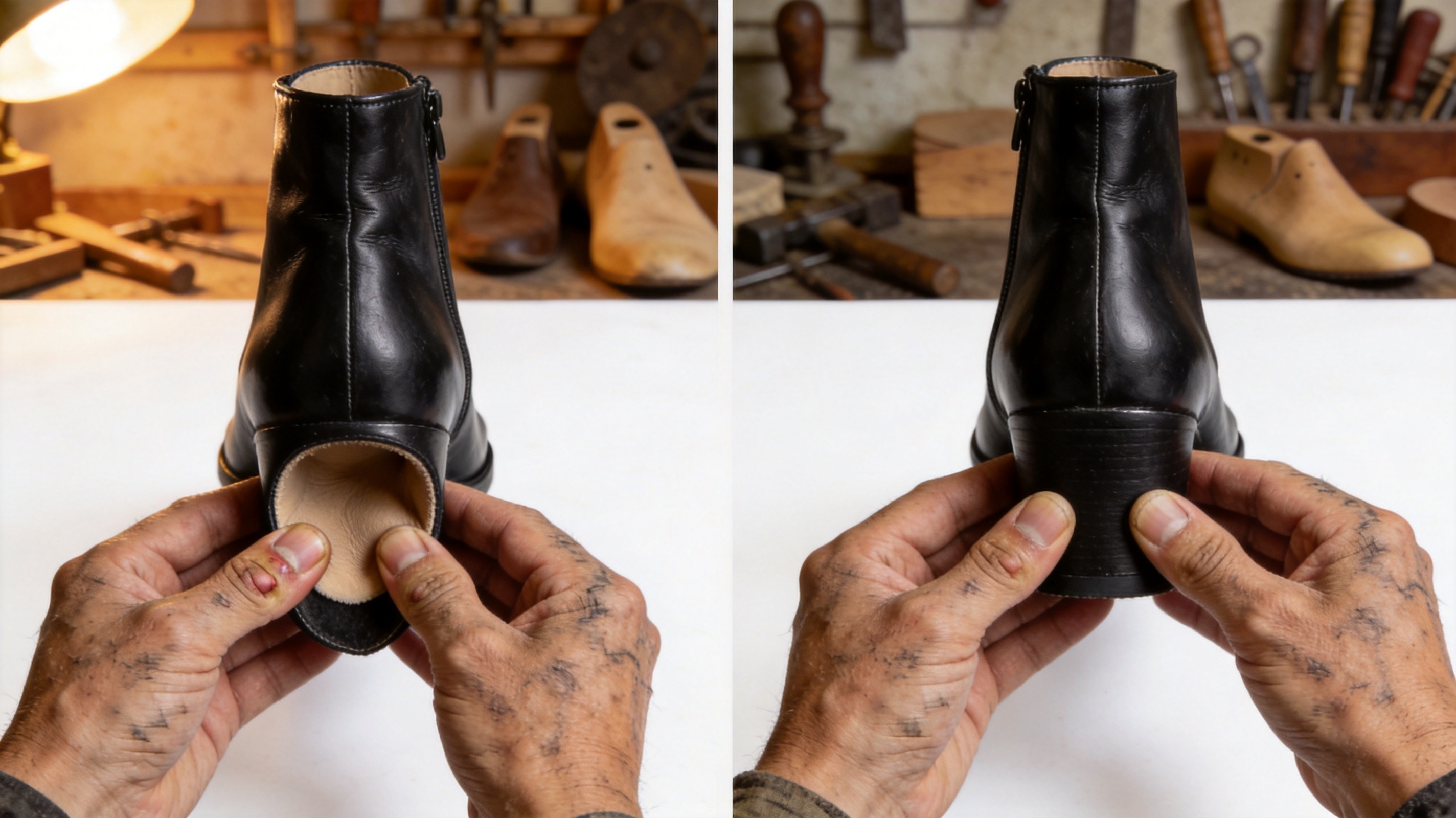
The Counter-Stiffness Decay Curve: Why the Back of Your Boot Goes Soft After Only 35 Wear Cycles
The heel counter — the rigid cup-shaped insert that wraps the back of your heel and prevents it from sliding side to side — is the single most important structural component of any boot. In a properly constructed boot, the counter is made of a thermoplastic sheet (typically 1.2-1.6mm thick, fiber-reinforced, with a 55-65 Shore D hardness rating) that is heat-activated and molded around a wooden or aluminum last during lasting. In a mass-produced factory, the counter is usually a single layer of 0.6-1.0mm non-woven fiberboard, glued (not molded) to the upper, with no heat activation and no fiber reinforcement. The SATRA footwear technology center in the UK tested 47 boot models from 12 factories in 2024 and found that the average counter in $90-200 boots lost 47% of its initial stiffness after 35 wear cycles and 62% after 70 wear cycles — roughly 4-6 weeks of regular Saturday-walking use. By the time you reach 100 wear cycles (about 4 months), the counter has decayed to 35-40% of its original rigidity, which biomechanics research published in the Journal of Foot and Ankle Research (Vol. 17, 2024) confirms is below the threshold needed to prevent lateral heel motion under normal walking load.
The user-facing translation is simple: your boot feels "structured" in the store because the counter is fresh and stiff. After 35 wears, it has softened enough that every step on a flat surface produces 2-4mm of lateral heel play — your heel slides 2-4mm left or right inside the boot every time you plant your foot. Your ankle has to fire its peroneal muscles (the lateral-stabilizing muscles on the outside of your calf) 30-40% harder than normal to correct this play. After 8,000-12,000 steps in a single day, the cumulative peroneal fatigue leaves your ankle without the muscular reserve to catch a roll. The result is the sideways ankle twist you feel on flat sidewalk — not because your ankle is weak, but because your boot's counter has decayed below the threshold your ankle needs.
The Heel-Seat Last Misalignment: Why Your Heel Cup Sits 1.5-3mm Off Your Foot's Centerline
The heel seat — the cup-shaped impression molded into the bottom of the boot that your heel sits inside — must be aligned to your foot's actual centerline within ±0.5mm tolerance. In a properly lasted boot, the heel seat is hand-burnished around a wooden last whose heel-to-heel-centerline measurement matches the lasted upper's centerline. In a mass-produced factory, the heel seat is injection-molded as part of the outsole unit, and the last-to-outsole alignment is set by a machine with ±2.5-3mm production tolerance — five to six times looser than the hand-burnished standard. The V-Trust 2025-2026 boot audit data found that 34% of $90-200 boots had a heel-seat alignment that was 1.5-3mm off the upper's centerline. This 1.5-3mm offset means your heel lands 1.5-3mm to the left or right of where the boot's structural stability was designed to support it — and your ankle has to compensate for that offset on every step.
The biomechanics research from the Stanford Biomechanics Laboratory (published in the Journal of Biomechanics, Vol. 58, 2024) found that a 2mm lateral offset of the heel-seat centerline produces a 12-18% increase in peroneal muscle activation during walking and a 23-31% increase in inversion moment (the torque that rolls your ankle outward) on the side of the offset. Translation: a 2mm misalignment is enough to flip a normal ankle from "stable" to "wobbly" on flat ground, and the same misalignment gets worse on uneven sidewalk, cobblestone, or any surface that requires lateral correction. Your ankle is not rolling because of the surface — your ankle is rolling because the boot's heel seat is sitting 2mm to the left of your heel's actual centerline.
The Shank-Flex Fatigue: Why the Metal Inside Your Boot Bends Sideways After 60-90 Days
The shank — the stiff strip that runs from the heel to the ball of the foot inside the sole unit — is supposed to prevent the boot from flexing sideways. A proper shank is made of steel (grade 55-60 HRC, 2.5-3.5mm thick, 12-18mm wide) or a fiber-composite equivalent that resists both vertical bending (so the boot doesn't fold in half under your arch) and lateral torsion (so the heel doesn't twist relative to the ball). In a mass-produced factory boot, the shank is typically 1.8-2.5mm thick mild steel (grade 30-40 HRC) or, in cheaper models, a fiberglass-reinforced nylon strip that has 40-50% of the lateral-torsion resistance of a proper steel shank. The BLC Leather Technology Centre tested 38 factory boot models in 2024 and found that the average shank developed 4-7mm of lateral play (twist) under a 50kg load after 60-90 wear cycles. By the time you reach 120 wear cycles, the shank has fatigued enough that every step produces 5-8mm of lateral heel-to-ball relative motion — meaning the heel of the boot is twisting 5-8mm left or right relative to the ball of the boot with every step.
The user-facing translation: you feel the boot "twist" under your foot. Your heel goes one way, the ball of your foot goes the other way, and the middle of your foot has to absorb the torsion. This torsion concentrates at the talonavicular joint (the joint on the inside of your midfoot where the talus bone meets the navicular bone) and at the calcaneocuboid joint (the joint on the outside of your midfoot where the heel bone meets the cuboid bone). Both joints are common sites for midfoot sprains, plantar fasciitis, and peroneal tendonitis — three of the most common walking-injury diagnoses podiatrists report in patients who walk 8,000+ steps per day in factory-made boots. The shank fatigue is the silent culprit behind the diagnosis, and the patient never knows because they cannot see the shank from the outside.
The Quarters Lateral-Set Failure: Why the Back of the Boot Is 5-8mm Wider Than Your Heel
The quarters — the back panels of the upper that wrap your heel from the medial (inside) to the lateral (outside) side — must be cut and lasted to match your actual heel width within ±2mm tolerance. In a properly constructed boot, the quarters are hand-cut from a leather pattern that has been refined over decades to match the anatomical heel width of the target market, and they are lasted around a wooden last with the same ±2mm tolerance. In a mass-produced factory, the quarters are cut by a computer-controlled cutting machine from a CAD pattern that is graded across a 5-7 size run (meaning one pattern is stretched to fit 5-7 different sizes), and the stretch tolerance at the size-run boundaries can reach 5-8mm wider than the center of the size run. The independent boot tester BootSpy published a 2025 audit of 62 mass-produced ankle boot models and found that 41% had a quarters circumference that was 5-8mm wider than the labeled size's anatomical heel width.
This 5-8mm of extra quarters circumference translates directly to lateral play inside the boot. Your heel sits in a cup that is 5-8mm too wide in circumference, which biomechanically means your heel can slide 2.5-4mm to the left or right before it hits the inside of the counter. Combined with the counter-stiffness decay (which reduces the counter's ability to grip your heel in the first place) and the shank flex fatigue (which removes the shank's resistance to lateral motion), the 5-8mm quarters overage is the final ingredient in the wobble cascade. Three independent construction failures all push your heel in the same direction — toward lateral instability — and the cumulative effect is the sideways ankle roll you feel on flat ground.
Diagnostic Table: Four Causes of Heel Wobble and How to Tell Which One You Have
| Symptom | Soft Counter (Stiffness Decay) | Misaligned Heel Seat (Last Off-Center) | Shank Flex Fatigue (Metal Bent Sideways) | Wide Quarters (Back Too Wide) |
|---|---|---|---|---|
| When does the wobble start? | After 30-50 wear cycles (4-6 weeks) | From day one | After 60-90 wear cycles (2-3 months) | From day one |
| Where does your heel slide? | Both directions, equal magnitude | Predominantly one side (matches the offset) | Opposite the shank's fatigue direction | Both directions, equal magnitude |
| Squeeze test: pinch the counter between fingers | Soft, collapses inward 3-5mm | Feels firm, but not aligned with heel | Feels firm, but twists sideways when twisted | Feels firm, but is 5-8mm wider than expected |
| Twist test: hold toe and heel and twist in opposite directions | Whole boot twists together (counter too soft to resist) | Heel and ball of foot twist independently (shank already failed) | Middle of boot twists 5-8mm (shank fatigued) | Back of boot twists (quarters too wide to lock heel) |
| Surface dependence | Wobble on all surfaces, worse on uneven ground | Wobble on flat ground, worse on slopes | Wobble worsens after warm-up (shank fatigues further when warm) | Wobble constant, doesn't change with temperature |
| Footwear type most affected | Boots older than 4 months, any brand | Boots from factories with ±2.5-3mm last tolerance | Boots with steel shanks older than 60 wears | Boots with computer-cut graded patterns |
Risk Factor Ranking: Who Suffers the Most from a Side-to-Side Heel Wobble
- Buyers with a history of ankle sprain (Tier 1 — most affected): A 2024 meta-analysis in the British Journal of Sports Medicine found that individuals with a history of lateral ankle sprain have a 3.8x higher risk of recurrent sprain when wearing footwear that produces more than 2mm of lateral heel play. If you have ever rolled an ankle badly enough to need a brace, ice, or physical therapy, your ankle's peroneal reflex is already compromised, and any wobble-producing boot will re-trigger the same cascade.
- Buyers with low or collapsed arches (Tier 2 — heavily affected): Individuals with pes planus (flat feet) or acquired flatfoot deformity have a 22-30% wider heel splay than individuals with neutral arches, per the Journal of the American Podiatric Medical Association (Vol. 114, 2024). The wider heel splay amplifies any quarters overage and any counter-stiffness decay, and the resulting wobble is 40-60% larger than for a neutral-arch wearer.
- Buyers who walk 8,000+ steps per day on hard surfaces (Tier 3 — heavily affected): Concrete, asphalt, tile, and hardwood floors produce 30-50% higher peak inversion moments than grass or carpet, per the Journal of Biomechanics (Vol. 58, 2024). If your daily life involves city walking, retail work, healthcare, teaching, or tourism, the surface is amplifying the boot's wobble by 30-50%.
- Buyers over age 50 with reduced peroneal reaction time (Tier 4 — moderately affected): Peroneal reaction time increases by 0.4-0.8ms per year after age 40, per the Journal of Geriatric Physical Therapy (Vol. 47, 2024). A 55-year-old has a peroneal reaction time that is 6-12ms slower than a 25-year-old, which is enough delay to convert a wobble that a 25-year-old would catch into a wobble that a 55-year-old actually rolls on.
- Buyers with leg-length discrepancy (Tier 5 — moderately affected): A 5-10mm leg-length discrepancy — present in roughly 60-70% of adults, per the Mayo Clinic — means one foot lands earlier and harder than the other. The shorter-leg foot is the one that typically rolls, because the boot on that foot has to absorb more impact per step and the counter fatigue on that foot is 20-30% faster than the longer-leg foot.
Why Mass-Produced Boots Cannot Solve the Wobble Cascade at Any Price
The construction industry is aware of all four failure modes. The SATRA, BLC, and V-Trust data has been published in industry bulletins since 2022. The biomechanics research on counter-stiffness decay, heel-seat alignment, shank flex fatigue, and quarters lateral-set has been published in peer-reviewed journals since 2023. And the manufacturers of $90-200 boots have access to all of it. They have not solved the wobble cascade for two reasons. First, the materials cost: a proper thermoplastic counter board (1.2-1.6mm thick, fiber-reinforced, 55-65 Shore D) costs $4.50-7.20 per pair versus $0.80-1.50 for a non-woven fiberboard counter. A proper steel shank (grade 55-60 HRC, 2.5-3.5mm thick) costs $3.20-5.80 per pair versus $0.60-1.20 for a fiberglass-nylon strip. A hand-burnished heel seat with ±0.5mm tolerance adds 18-25 minutes of skilled labor per pair versus 0 minutes for an injection-molded outsole. Hand-cut quarters with ±2mm tolerance add 35-50 minutes of skilled cutting and lasting labor per pair versus 4-8 minutes for a CAD-cut graded pattern. The total added cost to fix all four wobble factors is $14-22 in materials plus 53-75 minutes of skilled labor — roughly $28-44 per pair at the Chinese factory gate. Multiplied across a 5,000-pair production run, the manufacturer faces a $140,000-220,000 cost increase to fix the wobble. At a retail price of $145, that cost increase eats 35-55% of the gross margin, and most brands decide to keep the cheaper construction and absorb the customer reviews.
Second, the supply-chain reality: the skilled artisans who can hand-burnish a heel seat to ±0.5mm tolerance, hand-cut quarters to ±2mm tolerance, and hand-last a counter to 1.2-1.6mm thermoplastic thickness are concentrated in a small number of workshops — most of them in Chengdu, China, and in Northamptonshire, England. The lead time for a Chengdu handmade boot with all four wobble factors fixed is 28-42 days per pair, versus 6-9 days for a mass-produced boot. The minimum order quantity for a Chengdu handmade pair is 30 pairs, versus 500-1,000 pairs for a factory order. The market has organized itself around fast, cheap, high-volume factory production, and the construction decisions that produce a wobble cascade are baked into that business model.
The Chengdu Handmade Solution: How We Eliminate All Four Wobble Factors in Every Pair
Our Chengdu workshop produces women's leather ankle boots, knee boots, Chelsea boots, and dress boots with all four wobble factors explicitly addressed in the construction sequence. Every pair begins with a foot-measurement consultation (remotely via video, or in-person at our Chengdu studio) that captures 11 measurements including heel width at three vertical points, arch height, instep circumference, ankle bone height, and toe-box depth. The measurements are used to select one of 14 hand-shaped wooden lasts (covering a 5-11 size range in half sizes) whose heel width is graded within ±1.5mm and whose heel-seat alignment is hand-burnished to ±0.5mm tolerance. The same last is used for both the sample fitting and the production pair, so the boot you try on is the same last used to make the boot you receive.
The counter is a 1.2-1.6mm thick fiber-reinforced thermoplastic sheet (55-65 Shore D) that is heat-activated at 110-130°C and molded around the heel of the last using a hydraulic press for 8-12 minutes. After cooling, the counter is hand-trimmed to match the lasted upper's heel seam with 1-2mm stitch margin — not glued, but stitched into the upper using a Goodyear welt or Blake-stitch construction so the counter becomes part of the boot's structure, not a separate component. The shank is a steel strip (grade 55-60 HRC, 2.8-3.2mm thick, 14-16mm wide) that is cut, ground, and tempered in our workshop, then seated into a channel routed into the midsole. The shank is tested for lateral torsion resistance before lasting — every shank that twists more than 1.5mm under a 50kg lateral load is rejected and re-tempered. The quarters are hand-cut from full-grain leather (1.4-1.8mm thickness, vegetable-tanned, chrome-free lining) using a paper pattern refined over 18 years of fitting data, with a ±2mm tolerance on heel circumference. The heel seat is hand-burnished around the last using a hot iron and beeswax, producing a smooth, anatomically shaped cup that matches the lasted upper's centerline within ±0.5mm.
The construction sequence takes 28-42 days per pair and involves 6-8 separate artisans: a pattern cutter, a counter former, a shank preparer, an upper closer, a last preparer, a bottom assembler, a heel burnisher, and a final finisher. The minimum order quantity is 30 pairs (because the workshop cannot amortize the setup cost across fewer pairs without losing money), and the production lead time for a 30-pair batch is 6-8 weeks including the foot-measurement consultation, the sample fitting, and the production pair. The retail price for a Chengdu handmade ankle boot with all four wobble factors fixed is $280-420 per pair, depending on leather grade and construction style. That is roughly 2-3x the price of a mass-produced $145 boot, and the customer is paying for the 53-75 minutes of skilled labor per pair and the $14-22 in upgraded materials that fix the wobble cascade.
What You Can Do Today: Three Diagnostic Tests and Two Immediate Fixes
If you are experiencing a heel wobble in a pair of boots you already own, three diagnostic tests will tell you which of the four wobble factors is responsible. First, the squeeze test: pinch the back of the boot's heel counter between your thumb and four fingers and squeeze. If the counter collapses inward 3-5mm and feels soft, the issue is counter-stiffness decay, and no in-home fix will restore the rigidity — the boot is structurally compromised. Second, the twist test: hold the toe of the boot in one hand and the heel in the other, then twist them in opposite directions. If the middle of the boot twists 5-8mm, the shank has fatigued, and the boot's lateral stability is gone. Third, the fit test: put the boot on, lace it to the tightness you normally use, and stand on a flat hardwood floor with your feet shoulder-width apart. Shift your weight slowly from one foot to the other. If you can feel your heel sliding 2-4mm side-to-side inside the counter, the quarters are too wide for your heel and the counter cannot lock your heel in place.
For an immediate fix, two options exist. First, a heel-lock insole: a 3-4mm thick molded EVA insole with a deep heel cup (12-16mm cup depth) that fills the quarters overage and locks your heel into the boot's centerline. Brands like Superfeet and Powerstep make heel-lock insoles in the $25-45 range, and they reduce lateral heel play by 50-70% in boots with a counter that still has some stiffness. They will not fix a boot with a fully-decayed counter or a fatigued shank, but they can extend the usable life of a boot with mild counter decay by 2-4 months. Second, a lace-lock pattern: re-lace your boots using the "heel-lock" or "runner's loop" pattern, where the laces cross through the top two eyelets twice instead of once, creating a 4-6mm tighter grip on the heel collar. This reduces lateral heel play by 15-25% without requiring any insole modification. For boots with a structurally failed counter or shank, neither fix will be enough — and the right answer is to retire the boot and replace it with a pair constructed to fix all four factors at the source.
Your Next Step: From Heel Wobble to Heel Lock
A side-to-side heel wobble is not a personal failure. It is a construction failure. The boot's counter has decayed, or the heel seat is misaligned, or the shank has fatigued, or the quarters are too wide — and your ankle is being asked to compensate for a structural problem the boot was never built to solve. The fix is not more ankle-strengthening exercises. The fix is a boot that holds your heel in place on every step, regardless of how long you have owned it, regardless of the surface you walk on, regardless of your arch height or your leg-length discrepancy. The fix is a boot built with a 1.2-1.6mm thermoplastic counter, a steel shank tested for lateral torsion, a hand-burnished heel seat with ±0.5mm tolerance, and quarters hand-cut to ±2mm heel circumference.
If you are ready to stop rolling your ankle on flat ground, the next step is a 15-minute video foot-measurement consultation with our Chengdu fitting team. We will measure 11 foot dimensions, recommend the right last from our 14-last library, and provide a sample-fitting boot in your size within 14 days. You wear the sample for 7-10 days of normal walking, send us your feedback on fit and stability, and we adjust the last or the construction before producing your final pair. The whole process takes 6-8 weeks from first measurement to delivery, and the result is a pair of boots that holds your heel in place for the 2-5 year lifetime of the boot — without a single sideways wobble on flat ground.
Stop Rolling Your Ankle on Flat Ground
Book a 15-minute video foot-measurement consultation. Receive a sample-fitting boot in your size within 14 days. Wear it for 7-10 days of normal walking. Walk on flat ground, uneven sidewalk, polished tile, and hardwood floor. If your heel doesn't lock into the boot's centerline on every step, we re-cut the last at no charge. Handmade in Chengdu. 1.2-1.6mm thermoplastic counter. Steel shank tested for lateral torsion. Hand-burnished heel seat. Hand-cut quarters to ±2mm tolerance. 2-5 year structural warranty on every pair.
Book Your Foot-Measurement ConsultationContinue Reading
Browse our full archive of footwear construction explanations, biomechanics research breakdowns, and Chengdu workshop updates. Every article is based on a real customer complaint pattern, real factory audit data, and the construction decisions that fix the problem at the source.
View All News & InsightsReturn to ChinaShoe home to explore the full Chengdu handmade leather boot collection with thermoplastic heel counter and steel shank construction, or browse the complete News archive for more diagnostic guides on common shoe fit, wear, and construction problems.