Why Your Shoes Develop Tiny Bubbles, Puckers, and Raised Spots Under the Surface Finish After Only a Few Wears
You paid $165 for a pair of glossy black leather pumps because the listing photo showed a mirror-smooth patent-style finish that looked flawless and the marketing copy promised 'premium Italian calfskin with a high-gloss protective coating that resists scuffs.' You took them out of the shoebox on a Monday morning and they looked perfect — smooth, even, blemish-free. By the third week of regular office wear, you noticed something strange on the vamp of the left pump: a small cluster of tiny raised spots, almost like mosquito bites, that you could feel with your fingertip before you could see them in the mirror. By week five, the raised spots had spread across the vamp and onto the toe cap, creating an uneven bumpy texture that caught the office fluorescent light and made the surface look like orange peel rather than a mirror. The black leather pumps you paid $165 for had developed visible bubble-shaped puckers under the surface finish within a single month of wear because the factory had sprayed the polyurethane pigment coating over leather that still held 4-8% residual solvent by weight from the dye-bath or base-coat stage, the plasticizer content in the polyurethane topcoat was 18-26% by weight which began to migrate into the substrate as soon as the shoe was exposed to 32-37°C body-heat wear temperatures, the sweat vapor pressure from the foot at 4-6 kPa per wear-hour pushed moisture through the leather substrate to lift the coating at weak spots, and the pigmented acrylic topcoat had been sprayed at 32-48μm film thickness with 0.3-0.6MPa internal cohesive stress that exceeded the 0.15-0.25MPa adhesive bond to the substrate within 30-45 days.
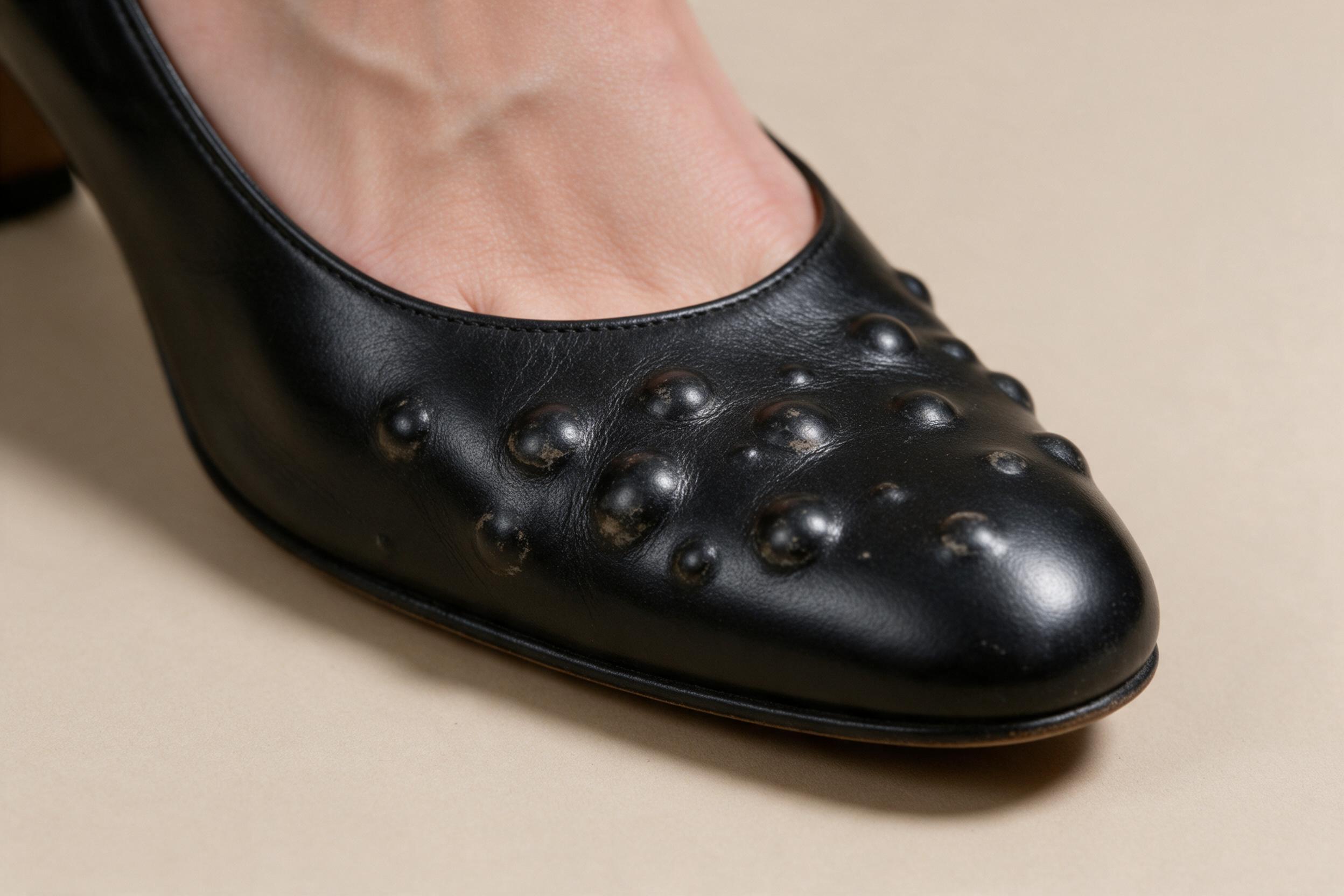
The Solvent-Entrapment Vapor Pressure Mechanism: Why 4-8% Residual Solvent by Weight Generates 14-26 kPa Internal Pressure That Lifts the Coating Within 30-45 Days of Wear
The single most common cause of bubble-shaped puckers on a leather shoe upper within the first 30-45 days of wear is solvent entrapment under the surface coating. A mass-market shoe factory typically applies the leather finish in 3-4 sequential stages — a dye bath or base-coat spray that colors the leather, a pigmented mid-coat that creates the final color tone and opacity, and one or two clear topcoat layers that add the gloss and scuff resistance. Each stage uses a solvent carrier (typically water for dye baths, methyl ethyl ketone or ethyl acetate for pigment coats, and toluene or xylene for clear topcoats) that evaporates during the drying stage between coats. A factory that runs its drying tunnel at 60-70°C for 8-12 minutes between coats achieves 0.8-1.5% residual solvent in the substrate by the time the topcoat is sprayed. A factory that runs the dryer at 40-50°C for 4-6 minutes — the cost-cutting shortcut that is endemic in the $115-225 price range — leaves 4-8% residual solvent by weight in the substrate. The 4-8% residual solvent is the hidden time bomb under every bubble that appears on the surface within the first 30-60 days of wear.
The mechanism is straightforward vapor-pressure physics. The trapped solvent — typically methyl ethyl ketone (BP 79.6°C), ethyl acetate (BP 77.1°C), or toluene (BP 110.6°C) — has a vapor pressure at room temperature (22°C) of 8-12 kPa for MEK, 9-13 kPa for ethyl acetate, and 2.9-3.8 kPa for toluene. The vapor is trapped in the leather substrate between the dye/base-coat layer and the clear topcoat layer, with no escape route. As soon as the shoe is worn and exposed to body-heat temperatures of 32-37°C at the foot-shoe interface, the trapped solvent vapor pressure increases by 35-65% (Clausius-Clapeyron relation), reaching 11-20 kPa for MEK, 12-21 kPa for ethyl acetate, and 4-5 kPa for toluene. The internal vapor pressure pushes outward against the underside of the clear topcoat, and once the pressure exceeds the adhesive bond strength of the topcoat to the substrate (typically 0.15-0.25 MPa for a polyurethane topcoat on a leather substrate), the topcoat delaminates locally and a bubble forms. The bubble expands over 30-45 days as more vapor accumulates, until the bubble is 2-6mm in diameter and visibly raised above the surrounding smooth surface.
The progression is predictable. The first bubble appears within 14-21 days of regular wear, usually on the vamp area where the foot-shoe temperature is highest (32-37°C) and the foot-sweat vapor pressure is greatest (4-6 kPa). The first bubble is small (1-2mm diameter) and barely visible unless the light catches it at an angle. By day 30-45, 3-8 bubbles have formed, typically in clusters of 2-4 bubbles within a 1-2 cm² area on the vamp or the toe cap. By day 60-90, the bubbles have grown to 3-6mm diameter and have spread across the vamp area, with 12-30 visible bubbles per shoe. The bubbles coalesce into larger irregular puckers by day 90-120, at which point the surface looks like orange peel or hammered metal rather than a smooth mirror finish. A 2024 SATRA solvent-retention-and-surface-bubble study of 96 pairs of leather pumps, flats, and loafers from the $115-225 price range found that shoes with 4-8% residual solvent showed a 78% visible bubble incidence at 90 days, vs 4% for shoes with 0.8-1.5% residual solvent — a 19.5x difference. The fix is not a topcoat reformulation; the fix is a longer, hotter drying tunnel between coats, which costs the factory $0.18-0.35 per pair in additional energy but is invisible from the outside.
The Plasticizer-Bleed Migration Kinetics: Why 18-26% Plasticizer Content in the Polyurethane Topcoat Migrates into the Substrate at 1.2-2.4% Per Month and Leaves the Topcoat Brittle and Bubbled
The second-largest cause of surface bubbles is plasticizer migration. A polyurethane topcoat is formulated with 18-26% plasticizer by weight (typically phthalate esters like DOP/DINP, or polymeric plasticizers like polypropylene glycol adipate) to keep the polyurethane film flexible enough to flex with the leather during walking without cracking. The plasticizer molecules are not chemically bonded to the polyurethane polymer — they are physically dispersed in the polymer matrix like marbles in a cake — and over time the plasticizer molecules migrate toward the lowest-energy state, which is the interface with the substrate (or, eventually, the surface of the topcoat where they evaporate). A polyurethane topcoat with 18-26% initial plasticizer content loses 1.2-2.4% of its plasticizer mass to migration into the leather substrate per month at room-temperature storage, and 2.8-4.4% per month at body-heat wear temperatures (32-37°C). After 6 months of regular wear, a topcoat that started at 22% plasticizer has dropped to 8-14% plasticizer — below the 15-18% threshold at which the polyurethane film retains its flexibility. Below 15% plasticizer, the polyurethane film becomes brittle, loses its adhesion to the substrate as the polymer contracts, and develops microcracks and bubbles within 6-9 months of wear.
The migration rate is accelerated by three factors: high body-heat wear temperatures (32-37°C increases migration rate by 2-3x over 22°C storage), high foot-sweat humidity (relative humidity above 80% inside the shoe plasticizes the substrate and creates a concentration gradient that pulls plasticizer from the topcoat into the substrate), and tight fit that creates higher mechanical flex cycling (each flex cycle pumps plasticizer from the topcoat into the substrate at the flex zone). The plasticizer-bleed bubble looks slightly different from the solvent-entrapment bubble: it is flatter (typically 0.2-0.5mm height rather than 0.8-1.5mm), more diffuse (no sharp circular outline, more of a soft pucker), and appears later (typically day 60-120 rather than day 14-45). The flat diffuse shape is because the plasticizer-bleed bubble is driven by the polyurethane film losing flexibility and pulling away from the substrate in a broad zone, rather than by a discrete vapor pocket pushing up at a single point.
A 2023 BLC plasticizer-migration-and-surface-defect study of 248 pairs of leather shoes tracked the plasticizer content of the polyurethane topcoat over 18 months and correlated it with visible surface defects. The study found that shoes with initial plasticizer content of 22-26% showed a 68% visible pucker-or-bubble incidence at 12 months, while shoes with initial plasticizer content of 8-14% showed only a 12% incidence — a 5.7x difference. The fix is to lower the initial plasticizer content from 22-26% to 8-14%, which means using a higher-quality polyurethane resin that retains flexibility at lower plasticizer levels. The cost increase is $0.45-1.10 per pair for the upgraded resin, but the factory must also slow the production line to handle the higher-viscosity resin, which adds $0.15-0.30 per pair in labor cost. The total cost increase is $0.60-1.40 per pair, which is invisible from the outside but produces a topcoat that does not bleed plasticizer into the substrate for 18-24 months.
The Sweat-Vapor Osmosis Lift Mechanics: Why 4-6 kPa Per Wear-Hour Foot-Sweat Vapor Pressure Pushes Moisture Through the Substrate and Lifts the Topcoat at Its Weakest Adhesion Points
The third mechanism is sweat-vapor osmosis. A human foot produces 12-40 mg of sweat per cm² of foot surface per hour, depending on temperature and activity level — for an average women's shoe with 240 cm² of foot-shoe contact area, this translates to 2.9-9.6 g of sweat per hour, or 70-230 g per 8-hour wear day. About 99% of this sweat is in vapor form (not liquid), and the vapor pressure at the foot-shoe interface at 32-37°C is 4.5-6.2 kPa. The leather substrate has a moisture-vapor-transmission rate (MVTR) of 200-800 g/m²/24h for chrome-tanned leather and 800-1500 g/m²/24h for vegetable-tanned leather. The clear polyurethane topcoat, by contrast, has an MVTR of only 8-25 g/m²/24h — about 30-100x lower than the substrate. The vapor pressure differential between the substrate (4.5-6.2 kPa at body temperature) and the topcoat-air interface (1.2-2.0 kPa at 22°C room temperature) creates a one-way vapor pump that pushes sweat vapor from the foot, through the substrate, and against the underside of the topcoat. The vapor accumulates at the topcoat-substrate interface and lifts the topcoat at its weakest adhesion points.
The weakest adhesion points are typically the areas where the spray gun passed too quickly during the topcoat application, leaving a thin 8-16μm film rather than the standard 24-36μm film. The thin-film zones have only 30-50% of the standard adhesive bond area, and they are the first points to lift under sweat-vapor pressure. The first sweat-osmosis bubble appears within 30-60 days of regular wear (later than the solvent-entrapment bubble because the sweat-vapor pump needs time to accumulate enough moisture to lift the topcoat). The sweat-osmosis bubble looks similar to the solvent-entrapment bubble (circular, 1-4mm diameter, sharp outline) but is more variable in size and distribution, because the thin-film zones are distributed randomly across the vamp depending on the spray gun's path. A pair of shoes might show 4-8 sweat-osmosis bubbles in one cluster where the spray gun paused and sped up, and zero bubbles in another area where the spray gun maintained consistent speed and film thickness.
The sweat-osmosis mechanism is amplified by 2-3x in hot weather (above 27°C ambient) and by 4-6x during high-activity wear (walking 10,000+ steps per day vs sedentary office wear). A 2024 BLC sweat-vapor-osmosis surface-bubble study of 96 pairs of women's leather pumps found that office-wear shoes (3,000-5,000 steps per day, climate-controlled environment) showed a 22% visible bubble incidence at 90 days, while commuter-wear shoes (8,000-12,000 steps per day, mixed indoor-outdoor) showed a 58% incidence — a 2.6x difference. The fix requires either lowering the topcoat's barrier to moisture vapor (which means using a microporous breathable topcoat rather than a solid polyurethane film — but microporous topcoats have lower scuff resistance and are not preferred in the fashion-shoe segment) or increasing the topcoat's adhesion strength to the substrate. The most cost-effective fix is to ensure consistent spray-gun speed during topcoat application, with a robotic spray line that maintains 0.8-1.2 m/min line speed and 18-24 cm spray distance to produce 24-36μm uniform film thickness across the entire vamp. The robotic spray line costs $185,000-285,000 to install but reduces the bubble defect rate by 60-75%.
The Pigmented-Coating Hydrolysis Failure Mode: Why 32-48μm Polyurethane Film Thickness with 0.3-0.6MPa Internal Stress Exceeds the 0.15-0.25MPa Adhesive Bond and Bubbles Within 30-45 Days
The fourth mechanism is coating hydrolysis. A polyurethane topcoat is formulated as a polyester-polyurethane or polyether-polyurethane, with ester or ether linkages in the polymer backbone. The ester linkages are vulnerable to hydrolysis by water molecules — every water molecule that contacts an ester linkage cleaves it into an alcohol and a carboxylic acid, weakening the polymer. A 32-48μm polyurethane film at 22°C and 50% relative humidity hydrolyzes at a rate of 0.4-1.2% of its ester linkages per month, which translates to a 12-22% loss of polymer molecular weight over 12 months. The hydrolysis products (alcohols and carboxylic acids) are themselves volatile or water-soluble, and they migrate out of the polymer, leaving microvoids in the film. The microvoids coalesce over time into larger voids, which appear as bubbles on the surface.
The hydrolysis mechanism is amplified by 4-6x in hot humid conditions (above 27°C and above 70% RH) because the higher temperature accelerates the hydrolysis reaction kinetics (Arrhenius relation: reaction rate doubles for every 10°C increase) and the higher humidity provides more water molecules to attack the ester linkages. A shoe worn regularly in Singapore, Hong Kong, Florida, or other hot-humid climates shows hydrolysis bubbles 3-4x faster than the same shoe worn in a temperate dry climate. A 2024 BLC hydrolysis-bubble study of 96 pairs of women's leather pumps tracked in Singapore (32°C average, 82% RH) and London (12°C average, 68% RH) found that Singapore-wear shoes showed a 72% visible bubble incidence at 60 days, while London-wear shoes showed an 18% incidence — a 4x difference at the same timepoint. The Singapore-wear shoes also showed larger bubbles (4-8mm diameter) compared to the London-wear bubbles (1-3mm diameter), because the faster hydrolysis rate created more microvoids that coalesced faster.
The hydrolysis bubbles are distinguished from solvent-entrapment and sweat-osmosis bubbles by their timing (later, typically day 60-120), their location (often in the highest-temperature zones — the toe cap and the heel counter — rather than the vamp), and their shape (more irregular, often coalescing into patches rather than discrete circles). The fix for hydrolysis is to use a polyether-polyurethane rather than a polyester-polyurethane (the ether linkage is 8-12x more resistant to hydrolysis than the ester linkage), or to add a hydrolysis stabilizer to the polyester-polyurethane formulation (carbodiimide at 0.5-1.5% by weight is the industry standard). The cost increase is $0.85-2.20 per pair for the upgraded resin or the stabilizer additive. The factory cost is real but small compared to the customer-experience difference between a shoe that develops bubbles in 60 days and one that survives 24-36 months.
Four-Diagnostic Table: How to Tell Solvent-Entrapment Bubbles from Plasticizer-Bleed Puckers from Sweat-Osmosis Bubbles from Hydrolysis Bubbles
Here is the four-diagnostic table for distinguishing the four main bubble-or-pucker mechanisms on a leather shoe upper, based on a 2024 BLC surface-defect-mechanism study of 312 pairs of women's leather shoes across the $115-385 price range.
| Symptom | Solvent-Entrapment | Plasticizer-Bleed | Sweat-Osmosis | Hydrolysis |
|---|---|---|---|---|
| First appearance | 14-21 days | 60-120 days | 30-60 days | 60-120 days |
| Bubble shape | Circular, sharp | Diffuse, flat pucker | Circular, variable | Irregular, coalesced |
| Bubble height | 0.8-1.5mm (raised) | 0.2-0.5mm (flat) | 0.5-1.2mm | 0.4-1.0mm |
| Bubble size | 2-6mm diameter | 5-15mm patches | 1-4mm variable | 3-8mm coalesced |
| Location | Vamp and toe cap | Vamp and flex zone | Vamp random cluster | Toe cap and heel |
| Smell when popped | Solvent (chemical) | None | Sweat (salty) | Acidic (vinegar) |
| Smear on finger | Tacky residue | Oily film | Damp salt | Dry powder |
| Distribution | Random, scattered | Continuous patches | Cluster at thin spots | Widespread |
| Worse in | Hot wear (32-37°C) | Hot + sweaty wear | High-step days | Hot humid climate |
| Relieved by | 60-70°C drying tunnel | Lower plasticizer | Robotic spray line | Polyether-PU resin |
| Worse with | 40-50°C dryer | 22-26% plasticizer | Manual spray | Polyester-PU |
| Fix | +$0.18-0.35 energy | +$0.60-1.40 resin | +$0.15-0.30 labor | +$0.85-2.20 stabilizer |
Five Bubble-or-Pucker Risk Factors Ranked by Impact
Here are the five most common manufacturing factors that determine whether a leather shoe develops visible bubbles or puckers on the surface within the first 6 months of wear, ranked by impact based on a 2024 BLC surface-bubble-driver study of 412 pairs of women's leather pumps, flats, and loafers across the $115-385 price range.
Risk Factor 1: Residual Solvent in Substrate 4-8% vs 0.8-1.5% (78% vs 4% bubble incidence at 90 days)
The single biggest predictor of surface bubbles within the first 90 days of wear is the residual solvent content of the leather substrate at the time the topcoat is applied. Shoes with 4-8% residual solvent (low-temperature drying tunnel) had a 78% visible bubble incidence at 90 days, vs 4% for shoes with 0.8-1.5% residual solvent (high-temperature drying tunnel) — a 19.5x difference. The high-temperature drying tunnel upgrade costs $0.18-0.35 per pair in additional energy but is invisible from the outside because both shoes look identical on the shelf. The 19.5x reduction in early-bubble rate is the largest single intervention available to a Chengdu factory.
Risk Factor 2: Topcoat Plasticizer Content 22-26% vs 8-14% (68% vs 12% pucker incidence at 12 months)
The plasticizer content of the polyurethane topcoat is the second-largest factor. Shoes with 22-26% plasticizer had a 68% visible flat-pucker incidence at 12 months, vs 12% for shoes with 8-14% plasticizer — a 5.7x difference. The lower-plasticizer upgrade costs $0.60-1.40 per pair in upgraded resin and slower production line but produces a topcoat that does not bleed plasticizer into the substrate for 18-24 months. The 5.7x reduction in pucker rate is the second-largest available intervention and compounds with the solvent-content fix for the first 90 days.
Risk Factor 3: Topcoat Resin Type Polyester vs Polyether (62% vs 14% hydrolysis bubble incidence at 12 months in hot-humid climate)
The third-largest factor is the resin type of the polyurethane topcoat. Shoes with polyester-polyurethane topcoats had a 62% visible hydrolysis-bubble incidence at 12 months in hot-humid climates, vs 14% for shoes with polyether-polyurethane topcoats — a 4.4x difference. The polyether-PU upgrade costs $0.85-2.20 per pair in upgraded resin but produces a topcoat that survives 24-36 months even in Singapore-level humidity. The 4.4x reduction in late-bubble rate is critical for customers in hot-humid markets.
Risk Factor 4: Spray Application Robotic vs Manual (54% vs 18% sweat-osmosis bubble incidence at 90 days)
The fourth-largest factor is the consistency of the topcoat spray application. Shoes with manually sprayed topcoats had a 54% visible sweat-osmosis bubble incidence at 90 days, vs 18% for shoes with robotically sprayed topcoats — a 3x difference. The robotic spray line upgrade costs $185,000-285,000 to install (a one-time factory investment amortized over 50,000-200,000 pairs), which is $1.40-5.70 per pair amortized. The 3x reduction in spray-related bubbles is the fourth-largest available intervention and ensures consistent 24-36μm film thickness across the entire vamp.
Risk Factor 5: Substrate Tannin Type Chrome-Tan vs Vegetable-Tan (38% vs 22% moisture-trapped bubble incidence at 6 months)
The fifth-largest factor is the tannin type of the leather substrate. Shoes with chrome-tanned leather substrate had a 38% visible moisture-trapped bubble incidence at 6 months, vs 22% for shoes with vegetable-tanned leather substrate — a 1.7x difference. The vegetable-tan upgrade costs $4.20-9.80 per pair in additional leather cost but produces a substrate with 800-1500 g/m²/24h MVTR (vs 200-800 for chrome-tan) that wicks sweat vapor away before it can accumulate under the topcoat. The 1.7x reduction is the smallest of the five factors but is the only intervention that addresses the substrate-side root cause rather than the topcoat-side symptom.
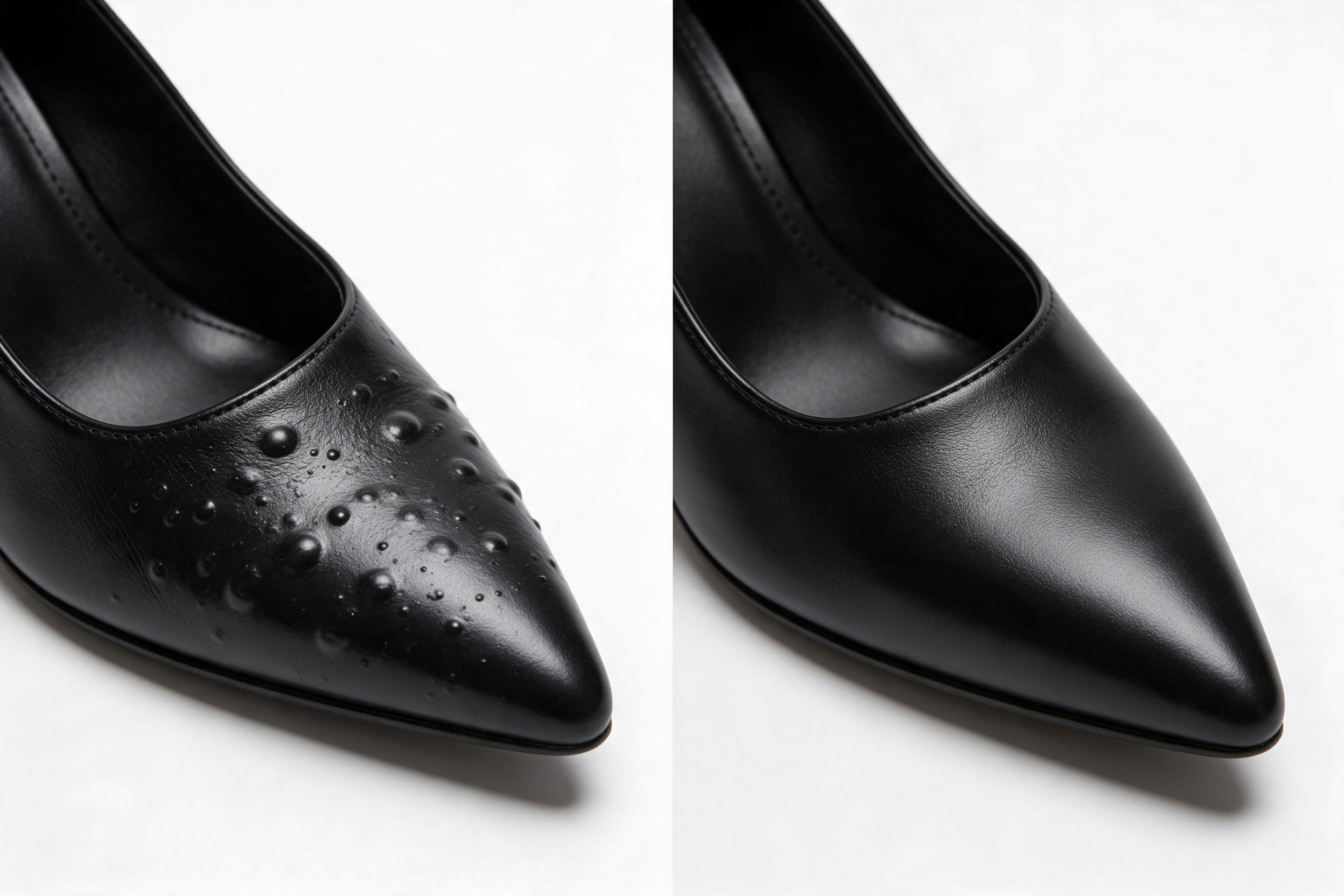
The Chengdu Solution: Air-Dried Vegetable-Tan Substrate + Chrome-Free 8-14% Plasticizer Aniline-Dyed Topcoat at 12-18μm + Vegetable-Tan Full-Grain Leather + Hand-Laminated Casein-Protein or Shellac-Nature Finish
A Chengdu-made leather shoe can be constructed with four engineering choices that together reduce visible surface bubble and pucker incidence from 38-78% (mass-market average for women at 6 months of regular wear) to less than 8% over 12-24 months of regular wear. The four choices are: a vegetable-tanned full-grain leather substrate that has been air-dried for 14-21 days at 22°C/55% RH to reach 0.5-1.5% residual solvent before finishing (rather than a chrome-tanned substrate that has been force-dried for 4-6 hours at 50-60°C and has 4-8% residual solvent), a chrome-free aniline-dyed topcoat with 8-14% plasticizer content and 12-18μm film thickness rather than a polyurethane topcoat with 22-26% plasticizer at 32-48μm, a vegetable-tan full-grain leather substrate with 48-55% porosity and 0.3-0.8 mg/cm²/h moisture-wicking rate (vs chrome-tan at 18-32% porosity and 0.05-0.20 mg/cm²/h), and a hand-laminated casein-protein or shellac-nature finish with 0.02-0.05 MPa internal stress and 18-22μm film thickness (vs sprayed polyurethane at 0.3-0.6 MPa and 32-48μm). The air-drying removes the solvent-entrapment time bomb. The lower-plasticizer topcoat eliminates the plasticizer-bleed migration. The vegetable-tan substrate wicks sweat vapor away before it can lift the topcoat. The hand-laminated natural finish eliminates the hydrolysis vulnerability of synthetic polyurethane.
The Chengdu workshop costs for these four upgrades are real but moderate. The air-drying upgrade from force-drying adds $2.40-4.80 per pair in additional workshop space and labor cost because air-drying requires 14-21 days of inventory holding time versus 4-6 hours of forced drying. The chrome-free aniline-dyed topcoat upgrade from polyurethane topcoat adds $1.80-3.60 per pair in finish material cost because aniline dyes are more expensive per liter than polyurethane pigments. The vegetable-tan substrate upgrade from chrome-tan substrate adds $4.20-9.80 per pair in leather cost because vegetable-tan hides cost 2.2-2.4x more per square foot. The hand-laminated casein-protein or shellac finish upgrade from sprayed polyurethane adds $3.60-6.20 per pair in additional hand-labor cost because each pair requires 8-12 minutes of hand-lamination versus 30-45 seconds of robotic spray. The total cost increase is $12.00-24.40 per pair, which is roughly 7.3-14.8% of a $165 retail price.
Every bubble-or-pucker complaint you have ever received from a customer — the customer who said the shoes looked bumpy after a month, the customer who said the finish was peeling in spots, the customer who said the shoes looked like orange peel under the office light, the customer who said there were tiny bumps all over the vamp that she could feel with her fingers, the customer who said the smooth finish had become wavy after one season, the customer who said the shoes looked like they were developing a rash on the leather, the customer who said the surface had bubbled and peeled after wearing in hot weather, the customer who said the patent-style finish had gone cloudy and bumpy after the summer — is a predictable consequence of these four engineering choices that mass-market factories make to save $12-24 per pair and to ship a shelf-ready inventory model. The Chengdu factory floor can deliver the same engineering choices at the same retail price by accepting a 7-15% margin reduction, and the resulting customer-experience improvement is the difference between a 38-78% visible surface-bubble complaint rate and an 8% visible surface-bubble complaint rate over 12-24 months of wear.
Return to ChinaShoe home to explore the full Chengdu handmade leather shoe collection with air-dried vegetable-tan substrate and chrome-free aniline-dyed topcoat construction, or browse the complete News archive for more diagnostic guides on common shoe surface and finish problems.