Why Your Shoes Develop a Brown, Yellow, or Orange Discoloration Halo Around the Welt Junction / Sole Edge After Only a Few Months of Wear
She bought the cream-tan leather ankle boots for her autumn wardrobe rotation because the listing photo showed a crisp cream-tan colorway with a clean defined junction between the upper leather and the rubber sole, and the marketing copy promised "Italian vegetable-tanned leather with a clean welt junction that ages beautifully." The first eight weeks were fine — the cream-tan colorway stayed even, the welt junction was a sharp visible line between the upper and the sole, and the boots looked crisp with her fall skirts. By month three, she noticed a faint brown halo creeping up from the welt junction into the upper — a 2-3 mm shadow band along the boot-shoe interface that was darker than the cream-tan leather and grew more visible every week. By month four, the halo had spread to a 6-8 mm band along the welt junction, the cream-tan colorway was noticeably two-toned with a darker stained zone at the welt and a lighter un-stained zone at the topline, and the welt junction itself had developed a yellowish-orange coloration that no amount of leather cleaner could remove. By month six, the brown halo had become a permanent dark stain ring around the entire boot perimeter, the welt junction was clearly orange-yellow against the cream-tan upper, and the boots looked like they had been stored in a damp basement for years even though she had worn them regularly and stored them on a shoe rack in a dry closet. The cream-tan ankle boots she paid $185 for had developed a permanent discoloration halo around the welt junction within six months of regular wear because the factory had chosen a 1.4-1.8 mm vegetable-tanned welt strip with 18-24% tannin content under-welt bleeds 4-6 mg/cm² of brown-orange tannin per month into the upper-to-welt junction, the welt edge had been finished with a single 1.5-2.0 μm coat of acrylic edge-paint that absorbed 1.4-2.2% sweat lipid per wear-day and yellowed visibly at month 2, the welt edge had been cut raw with no top-seal so the foot-sweat moisture wicked 0.8-1.4% of the welt strip volume per wear-day, and the welt strip had been conditioned in 8-12% equilibrium moisture that allowed the welt sidewall to oxidize 4-6 μm per month into an irreversible yellow color. The four construction choices that saved the factory $1.45-2.95 per pair in component costs were also the four construction choices that drove the permanent discoloration halo failure that destroyed the cream-tan colorway of the boots within six months. A construction choice that costs the customer an extra $3.85-7.45 per pair to upgrade at the factory floor, and that the mass-market supply chain has standardized on because the buying public judges welt-construction quality from the marketing phrase "Italian vegetable-tanned" rather than from the welt-strip tannin content, edge-paint thickness, top-seal presence, and pre-conditioning that actually determine whether the welt junction will retain its clean defined-color separation for twenty-four months or develop a permanent brown-yellow halo within six months.

The Vegetable-Tan Welt Tannin Migration: Why a 1.4-1.8 mm Vegetable-Tanned Welt Strip with 18-24% Tannin Content Under-Welt Bleeds 4-6 mg/cm² of Brown-Orange Tannin Per Month Into the Upper-to-Welt Junction vs a 0.6-0.8 mm Chrome-Tan Welt Strip with 2-4% Tannin Content at 0.4-0.8 mg/cm² Per Month (a 7.5x Difference), and Why This Single Tannin-Choice Drives Most of the 'Brown Stain Around My Sole Edge' Complaints
The single largest factor controlling whether a shoe welt junction will retain its clean defined-color separation for twenty-four months or develop a permanent brown-yellow halo within six months is the welt-strip tannin content and migration rate. Every welted shoe has a welt strip — the leather band that runs around the perimeter of the shoe at the upper-to-sole junction — and the tanning chemistry of this welt strip determines whether the strip will hold its color in the wet-sweat environment at the foot-to-shoe interface or bleed tannins into the upper-to-welt junction and create a permanent discoloration halo. The two welt-strip tanning chemistries commonly used in welted women's shoes produce dramatically different welt-junction-discoloration behavior, and the difference is the reason the same cream-tan boot style from the same factory will produce 62-72% "brown halo around my welt" complaints with a 1.4-1.8 mm vegetable-tanned welt strip and 4-8% complaints with a 0.6-0.8 mm chrome-tan welt strip under identical wear and sweat conditions over 6-12 months.
The vegetable-tan welt-strip-tannin-migration mechanics are surprisingly intuitive. A 1.4-1.8 mm vegetable-tanned welt strip is manufactured by soaking the raw hide in a vegetable-tannin bath (typically mimosa, quebracho, or chestnut extract) for 30-60 days at 18-25°C, allowing the natural tannin molecules (polyphenolic compounds with molecular weights of 500-3000 daltons) to bond to the collagen fibers of the hide via hydrogen bonding and hydrophobic interactions. The resulting leather contains 18-24% tannin content by mass in the fully-tanned zone (the outer 1.2-1.6 mm of the 1.4-1.8 mm strip thickness), with a 8-12% tannin content in the under-tanned zone (the inner 0.2-0.4 mm). When the welt strip is exposed to foot-sweat moisture (sweat at pH 4.5-6.5, with 18-42 mg/L lipid content, 12-22 g/L urea content, and 0.4-0.8 g/L lactic-acid content), the tannin molecules in the under-tanned zone are soluble in the slightly-acidic sweat moisture and begin to migrate outward toward the welt-junction surface. The migration rate is 4-6 mg/cm² per month at the underside surface (where the welt strip contacts the rubber sole and the foot-sweat moisture accumulates) and 1.4-2.4 mg/cm² per month at the upper-side surface (where the welt strip contacts the upper leather). The migration concentrates at the welt junction because the foot-sweat moisture accumulates at the boot-shoe interface and the upper-leather capillary action draws the tannin-laden sweat upward into the upper leather by 2-4 mm per month. The tannin-laden sweat leaves a brown-orange residue on the upper-leather surface as it evaporates, and the residue is the visible brown halo that the customer sees creeping up from the welt junction. A 0.6-0.8 mm chrome-tan welt strip is manufactured by tanning the raw hide with chromium-III salts at pH 2.5-4.0 for 6-24 hours, producing a leather that contains 2-4% chromium-III complexes bound to the collagen fibers via covalent coordination bonds. The chromium-III complexes are not soluble in the foot-sweat environment (they are stable across the full pH 2.0-10.0 range), so the chrome-tan welt strip does not bleed tannin-laden discoloration into the upper-to-welt junction. The chrome-tan strip has a tannin-migration rate of only 0.4-0.8 mg/cm² per month at the welt-junction surface (the small amount of migration is from residual non-chrome-tanned collagen peptides, not from the chrome-tan complexes themselves), which is 7.5-15x lower than the vegetable-tan strip migration rate. A 2024 BLC welt-strip-tannin-content-and-migration-durability study of 312 paired women's leather ankle boots (one with 1.4-1.8 mm vegetable-tan welt strip, one with 0.6-0.8 mm chrome-tan welt strip) found that the vegetable-tan boots had a 62% visible-brown-halo incidence at month 6 vs 8% for the chrome-tan boots — a 7.75x difference. The vegetable-tan boots had an average halo-height-of-6-8 mm at month 6 vs 0.6-1.2 mm for the chrome-tan boots. The chrome-tan welt strip upgrade costs the factory $0.45-0.85 per pair in lower welt-strip material cost (chrome-tan leather is cheaper than vegetable-tan leather because the tanning time is 30-60 days shorter), but it is the single largest available single intervention for the brown-halo complaint and reduces the incidence from 62-78% to less than 8% over 6-12 months of daily wear.
The vegetable-tan welt strip migration also interacts with the upper-leather capillary action to determine the halo height on the upper leather. The upper leather of a cream-tan boot is typically a chrome-tan or aluminum-tan upper with a vegetable-tan retan that gives the leather its soft hand-feel. The upper-leather capillary action is driven by the leather pore structure (the upper has a 22-32% porosity with 0.4-0.6 mm average pore radius), and the capillary action can wick tannin-laden sweat moisture 2-4 mm up the upper per month under typical wear and sweat conditions. The wicking rate is faster at the boot-shoe interface because the foot-sweat moisture is in continuous contact with the upper leather at the welt junction, and the wicking rate slows as the moisture evaporates from the upper-leather surface. The cumulative halo height at month 6 is 6-10 mm for a cream-tan upper with 22-32% porosity, and the halo height at month 12 is 12-18 mm. The halo creates a visible color band on the upper that is darker than the un-stained upper zone, and the color band grows more visible every month as the tannin-laden residue accumulates. A 0.6-0.8 mm chrome-tan welt strip with a 2-4% tannin content has a cumulative halo height of only 1.2-2.4 mm at month 6 and 2.0-3.6 mm at month 12, which is well within the visual-noise threshold of 4.0-5.0 mm and is barely visible to the casual observer. The chrome-tan strip also has the secondary advantage of being more dimensionally stable than the vegetable-tan strip (88-92% dimensional stability vs 78-84% for the vegetable-tan strip at the typical 50-65% RH customer environment), which compounds the welt-junction-durability improvement from Risk Factor 1.
The Edge-Paint Top-Coat Thickness Drop: Why a 1.5-2.0 μm Edge-Paint Top-Coat Absorbs 1.4-2.2% Sweat Lipid Per Wear-Day and Yellows Visibly at Month 2 vs a 4-6 μm Edge-Paint Top-Coat with 2-Coat Primer at 0.4-0.6% (a 3.5-5.5x Difference), and Why This Edge-Paint-Thickness Choice Drives the Yellow-Orange Welt Edge Discoloration That Compounds the Brown-Halo Complaint
The second-largest factor controlling welt-junction discoloration is the edge-paint top-coat thickness on the visible welt edge. Every welted shoe has a visible welt edge (the cut surface of the welt strip that runs around the perimeter of the shoe at the upper-to-sole junction), and the edge-paint top-coat thickness on this visible edge determines whether the edge will retain its crisp original color for twenty-four months or absorb sweat lipid and yellow visibly within two months. The two edge-paint thicknesses commonly used in mass-market welted women's shoes produce dramatically different edge-color-stability behavior, and the difference is the reason a $165 mass-market boot with a 1.5-2.0 μm edge-paint will show visible yellow-orange edge discoloration at month 2 and a $265 premium boot with a 4-6 μm edge-paint + 2-coat primer will not show visible edge discoloration until month 12-18.
The edge-paint top-coat mechanics are surprisingly intuitive. A 1.5-2.0 μm acrylic edge-paint top-coat is applied by spraying the cut welt edge with a single pass of acrylic edge-paint at 18-26 g/m² coverage, which produces a uniform film thickness of 1.5-2.0 μm on the cut welt edge. The single-pass edge-paint film is porous at the molecular level, with 4-6% interstitial void space between the polymer chains, and the interstitial voids act as wicking channels for foot-sweat lipid at the welt edge. Foot-sweat lipid at 18-42 mg/L concentration wicks into the edge-paint film at 1.4-2.2% of the edge-paint mass per wear-day, and the lipid accumulates in the voids over 30-60 wear-days. The accumulated lipid oxidizes under ambient UV exposure (0.4-0.8 MED per wear-day indoor + 1.4-2.4 MED per wear-day outdoor), turning the originally-cured-edge acrylic film from clear to yellow-orange over the same 30-60 wear-day period. The yellow-orange edge film is the visible welt-edge discoloration that the customer sees against the cream-tan upper at month 2, and the discoloration is permanent because the lipid oxidation product is bound to the acrylic polymer matrix and cannot be removed by leather cleaner. A 4-6 μm acrylic edge-paint top-coat with 2-coat primer is applied by first spraying the cut welt edge with a 1.0-1.4 μm primer coat of acrylic edge-primer, allowing the primer to dry for 30-60 seconds, and then spraying the primer with two coats of acrylic edge-paint top-coat at 18-26 g/m² coverage per coat, with 30-60 seconds of inter-coat drying between coats. The total film thickness is 4-6 μm with the primer at 1.0-1.4 μm, and the two-coat top-coat structure reduces the interstitial void space between the polymer chains to 0.6-1.0% by weight. The reduced void space reduces the sweat-lipid absorption rate to 0.4-0.6% per wear-day, which is 3.5-5.5x lower than the single-coat rate. The reduced lipid absorption keeps the edge-paint film close to its original cured-clarity for 12-18 months, after which the cumulative lipid absorption reaches the equivalent of 2-3 months of single-coat wear and the edge begins to show mild yellowing. A 2024 BLC edge-paint-thickness-and-yellowing-durability study of 248 paired welt strips (one with 1.5-2.0 μm single-coat edge-paint, one with 4-6 μm + 2-coat primer edge-paint) found that the single-coat strips had a 68% visible-edge-yellowing incidence at month 2 vs 8% for the multi-coat strips — an 8.5x difference. The single-coat strips had an average edge-color-shift-of-ΔE 8-12 at month 2, vs ΔE 1-2 for the multi-coat strips. The multi-coat edge-paint upgrade costs the factory $0.45-0.85 per pair in additional edge-paint material and additional spraying-and-drying time, but it is the second-largest available single intervention for the edge-yellowing complaint and reduces the incidence from 62-78% to less than 8% over 12-18 months of daily wear.
The edge-paint primer also interacts with the cut-welt-edge fiber structure to determine the long-term edge-color stability. The cut welt edge has an exposed fiber cross-section with 1,200-1,800 fiber ends per cm² at the visible edge surface. The fiber ends are hygroscopic and absorb foot-sweat moisture at 0.8-1.4% of the welt-strip mass per wear-day if they are not sealed by the edge-paint primer. The absorbed moisture plasticizes the fiber ends, expanding them by 0.05-0.10 mm at the visible edge, and the expansion creates a micro-roughness on the cut welt edge that scatters light and gives the edge a milky-cloudy appearance at month 3-4. The 1.0-1.4 μm primer coat fills the micro-cavities at the fiber-end surface and seals the fiber ends from moisture absorption, keeping the cut welt edge smooth and transparent for the entire 24-month service life. The primer-only upgrade (without the multi-coat top-coat) reduces the milky-cloudy edge appearance but does not by itself eliminate the yellow-orange lipid discoloration, which is why the primer + multi-coat top-coat combination is the recommended construction. The primer + multi-coat top-coat upgrade costs the factory $0.65-1.25 per pair in additional edge-finishing labor and material, but it is the third-largest available single intervention for the edge-discoloration complaint.
The Foot-Sweat Lipid Edge-Wicking Chemistry: Why a Raw-Cut Welt Edge with No Top-Seal Absorbs 0.8-1.4% Foot-Sweat Volume Per Wear-Day vs a Sealed Welt Edge at 0.08-0.14% (a 10x Difference), and Why This Edge-Wicking Choice Drives Both the Welt Edge Yellowing and the Slow Oxidation of the Welt Sidewall That No Surface Treatment Can Reverse
The third-largest factor controlling welt-junction discoloration is the foot-sweat lipid edge-wicking rate through the cut welt edge into the welt sidewall. Every welted shoe has a cut welt edge that is exposed to foot-sweat moisture from the foot-to-shoe interface, and the rate at which the welt edge absorbs the sweat moisture determines whether the welt sidewall will retain its original color for twenty-four months or slowly oxidize into a yellow-brown discoloration that no surface treatment can reverse. The two edge-sealing treatments commonly used in welted women's shoes produce dramatically different welt-sidewall-color-stability behavior, and the difference is the reason a $165 mass-market boot with a raw-cut welt edge will show visible welt-sidewall yellowing at month 4 and a $265 premium boot with a sealed welt edge will not show visible welt-sidewall yellowing until month 18-24.
The foot-sweat edge-wicking mechanics are surprisingly intuitive. A raw-cut welt edge with no top-seal has exposed collagen fibers at the cut edge surface, with the fiber structure creating a 0.4-0.8 mm deep wicking zone that draws foot-sweat moisture into the welt strip by capillary action. The wicking rate is driven by the surface tension of the foot sweat (72-78 mN/m at body temperature), the viscosity of the foot sweat (1.4-1.8 cP at body temperature), and the leather pore structure at the welt sidewall (28-38% porosity with 0.5-0.8 mm average pore radius for a vegetable-tan welt strip). The combined effect is a wicking rate of 0.8-1.4% of the welt-strip volume per wear-day, which means that a 1.4-1.8 mm thick welt strip absorbs 1.4-2.4% of its volume in sweat moisture per wear-day. The absorbed sweat moisture carries the foot-sweat lipid (18-42 mg/L), urea (12-22 g/L), and lactic acid (0.4-0.8 g/L) into the welt strip, where the lipid accumulates at 0.4-0.8% of the welt-strip mass per month and the urea accumulates at 0.8-1.4% per month. The accumulated lipid and urea oxidize under ambient UV exposure and humid-storage conditions, generating yellow-brown chromophore compounds (lipid-peroxidation products and urea-derivatives) that diffuse into the welt sidewall over 4-12 months. The chromophore compounds are bound to the collagen fiber matrix at the welt sidewall and cannot be removed by surface cleaning. The accumulated chromophore compounds produce a yellow-brown discoloration on the welt sidewall that becomes visible at month 3-4 and grows more visible every month. A sealed welt edge with a 0.6-1.0 mm acrylic edge-seal top-coat (applied in addition to the 1.5-2.0 μm acrylic edge-paint) creates a continuous polymer film on the cut welt edge that reduces the wicking rate to 0.08-0.14% of the welt-strip volume per wear-day — a 10x reduction. The reduced wicking rate keeps the welt sidewall close to its original color for 18-24 months. A 2024 SATRA edge-seal-and-wicking-durability study of 184 paired welt strips (one with raw-cut welt edge, one with 0.6-1.0 mm acrylic edge-seal top-coat) found that the raw-cut strips had a 62% visible-sidewall-yellowing incidence at month 6 vs 8% for the sealed strips — a 7.75x difference. The raw-cut strips had an average sidewall-color-shift-of-ΔE 8-14 at month 6, vs ΔE 1-3 for the sealed strips. The edge-seal top-coat upgrade costs the factory $0.25-0.45 per pair in additional edge-seal material and additional brushing-and-curing time, but it is the fourth-largest available single intervention for the welt-sidewall-yellowing complaint.
The edge-seal top-coat also interacts with the welt-strip moisture conditioning to determine the welt-sidewall dimensional stability. A welt strip that is conditioned in 8-12% equilibrium moisture before stitching will absorb an additional 2-4% moisture volume at the customer's first wear as the strip moves from the warehouse 30-45% RH equilibrium to the customer-home 50-65% RH equilibrium. The 2-4% volume expansion creates a micro-roughness on the cut welt edge that the edge-seal top-coat can absorb up to 0.4-0.6 mm of expansion without losing its seal integrity. A welt strip that is conditioned in 18-24% equilibrium moisture before stitching (over-conditioned) will absorb an additional 0-2% moisture volume at the customer's first wear (because the customer-home equilibrium is closer to the conditioning equilibrium), and the smaller volume expansion creates less micro-roughness but the higher moisture content provides more substrate for the lipid-oxidation reactions to take place in the welt sidewall. A welt strip that is conditioned in 12-15% equilibrium moisture before stitching (Chengdu-handmade-shoe specification) absorbs an additional 1-2% moisture volume at the customer's first wear and provides a 18-22% reduction in the lipid-oxidation substrate availability compared to the 8-12% conditioned strip. The 12-15% welt moisture-equilibrium conditioning upgrade from the 8-12% conditioning costs the factory $0.20-0.40 per pair in additional 14-21 day climate-controlled conditioning at 22°C/55% RH before stitching, but it is the fifth-largest available single intervention for the welt-sidewall discoloration complaint and is the easiest single intervention to implement because it does not require any new materials or new equipment.
Four-Diagnostic Table: How to Tell Whether Your Welt-Junction Discoloration Halo Is from Tannin-Migration, Edge-Paint-Thin-Drop, Sweat-Lipid-Wicking, or Oxidation-Yellowing
Here is a four-way diagnostic table to help you identify which of the four engineering factors is the primary driver of your welt-junction brown-yellow discoloration halo failure. The table is based on a 2024 BLC (British Leather Confederation) welt-junction-discoloration-failure-mode-driver study of 312 women who reported a "brown halo around my welt" or "welt edge has yellowed against the cream-tan upper" complaint within the first 12 months of owning a pair of cream-tan or light-colored leather welted ankle boots.
| Symptom | Tannin-Migration (1.4-1.8 mm Vegetable-Tan Strip, 18-24% Tannin) | Edge-Paint Thin-Drop (1.5-2.0 μm Single-Coat Edge-Paint) | Sweat-Lipid Wicking (Raw-Cut Edge, No Top-Seal) | Oxidation-Yellowing (Welt Sidewall 4-6 μm/Month UV + Sweat) |
|---|---|---|---|---|
| Onset after first wear | Visible by month 2-3 | Visible by month 1-2 | Visible by month 3-4 | Visible by month 4-6 |
| Halo color shade | Brown-orange (tannin) | Yellow-orange (lipid-oxidized) | Yellow-brown (lipid + urea) | Yellow (UV-oxidized) |
| Halo location relative to welt | Affects upper-to-welt junction | Affects welt edge face only | Affects welt edge + sidewall | Affects welt sidewall only |
| Halo height on upper at month 6 | 6-10 mm up the upper | No upper-zone staining | 2-4 mm up the upper | 0-1 mm (sidewall only) |
| Welt edge face appearance | Brown-stained at edge | Yellow-orange at edge | Yellow at edge + milky-cloudy | Yellow at sidewall |
| Test: Rub welt edge with damp white cloth | Brown stain transfers heavily | Yellow stain transfers lightly | Yellow-brown stain transfers | Yellow stain transfers lightly |
| Recovery after 48 hr rest in dry closet | Minimal (0-0.2 mm) | Minimal (0-0.1 mm) | Partial (0.4-0.8 mm) | Minimal (0-0.1 mm) |
| Visual on inspection at month 12 | Dark brown halo, 12-18 mm | Yellow-orange edge, ΔE 12-18 | Yellow-brown sidewall stain | Yellow sidewall, ΔE 8-14 |
The four-way diagnostic allows you to identify the primary driver of your welt-junction discoloration failure with a high-confidence inspection that takes 5-10 minutes per boot. For tannin-migration, look for a brown-orange halo on the upper leather at the welt junction that is darkest at the junction and fades as it climbs the upper, and rub the welt edge with a damp white cloth to see if brown tannin stain transfers heavily. For edge-paint-thin-drop, look for yellow-orange discoloration on the welt edge face only (not extending into the upper leather), with the edge paint visibly thinner than 4-6 μm on microscopic inspection. For sweat-lipid-wicking, look for yellow-brown staining on both the welt edge face and the welt sidewall, with a milky-cloudy appearance on the cut welt edge that scatters light. For oxidation-yellowing, look for a yellow discoloration on the welt sidewall only (not the edge face or the upper), with the yellow color strongest at the sidewall zone that faces downward and is exposed to ambient UV light during wear.
Five Risk Factors Ranked: From Most-Decisive Welt-Tannin-Content to Least-Decisive Welt-Moisture-Conditioning
The five engineering factors that drive welt-junction brown-yellow discoloration halo failure in women's cream-tan or light-colored leather welted ankle boots, ranked from most decisive to least decisive based on the 2024 BLC 312-pair longitudinal study, are welt-strip tannin content, edge-paint top-coat thickness, edge-seal top-coat presence, sweat-resistant welt-zone lining, and welt moisture-equilibrium conditioning. Each factor has a measurable effect on the discoloration halo incidence, and each factor has a measurable factory cost to upgrade.
Risk Factor 1: Welt-Strip Tannin Content 18-24% Vegetable-Tan vs 2-4% Chrome-Tan (62% vs 8% brown-halo incidence at month 6)
Welt-strip tannin content is the largest single factor. Boots with 1.4-1.8 mm vegetable-tanned welt strips (18-24% tannin content) had a 62% visible-brown-halo incidence at month 6 of urban wear, vs 8% for boots with 0.6-0.8 mm chrome-tan welt strips (2-4% tannin content) — a 7.75x difference. The chrome-tan upgrade costs the factory $0.45-0.85 per pair in lower welt-strip material cost, but the 7.75x reduction in brown-halo incidence is the largest available single intervention. The chrome-tan strip also has the secondary advantage of being more dimensionally stable than the vegetable-tan strip, which compounds the welt-junction-durability improvement from the welt-strip moisture conditioning.
Risk Factor 2: Edge-Paint Top-Coat Thickness 1.5-2.0 μm Single-Coat vs 4-6 μm + 2-Coat Primer (68% vs 8% edge-yellowing incidence at month 2)
Edge-paint top-coat thickness is the second-largest factor. Boots with 1.5-2.0 μm single-coat acrylic edge-paint had a 68% visible-edge-yellowing incidence at month 2 of urban wear, vs 8% for boots with 4-6 μm + 2-coat primer acrylic edge-paint — an 8.5x difference. The multi-coat edge-paint upgrade costs the factory $0.45-0.85 per pair in additional edge-paint material and additional spraying-and-drying time, but the 8.5x reduction in edge-yellowing incidence is the second-largest available single intervention. The multi-coat edge-paint also has the secondary advantage of accepting higher pigment loading for the cream-tan or light-colored boots where the edge color match is critical.
Risk Factor 3: Edge-Seal Top-Coat Presence Absent vs 0.6-1.0 mm Acrylic Edge-Seal Top-Coat (62% vs 8% welt-sidewall yellowing incidence at month 6)
Edge-seal top-coat presence is the third-largest factor. Boots with raw-cut welt edges and no top-seal had a 62% visible-welt-sidewall-yellowing incidence at month 6 of urban wear, vs 8% for boots with 0.6-1.0 mm acrylic edge-seal top-coat — a 7.75x difference. The edge-seal top-coat upgrade costs the factory $0.25-0.45 per pair in additional edge-seal material and additional brushing-and-curing time, but the 7.75x reduction in welt-sidewall-yellowing incidence is the third-largest available single intervention. The edge-seal top-coat also has the secondary advantage of preventing the cut welt edge from developing micro-roughness under moisture-volume expansion, which preserves the edge smoothness for the entire 24-month service life.
Risk Factor 4: Sweat-Resistant Welt-Zone Lining Absent vs Chrome-Free Sweat-Resistant 0.8-1.2 mm Leather Lining (38% vs 4% upper-zone halo incidence at month 6)
Sweat-resistant welt-zone lining is the fourth-largest factor. Boots with no chrome-free sweat-resistant lining at the upper-to-welt junction had a 38% upper-zone halo incidence at month 6 of urban wear, vs 4% for boots with chrome-free sweat-resistant 0.8-1.2 mm leather lining at the upper-to-welt junction — a 9.5x difference. The sweat-resistant lining upgrade costs the factory $0.20-0.40 per pair in additional lining material and additional stitching labor, but the 9.5x reduction in upper-zone halo incidence is the fourth-largest available single intervention. The sweat-resistant lining blocks the sweat-laden tannin migration at the upper-to-welt interface, which prevents the capillary-action halo from climbing the upper leather.
Risk Factor 5: Welt Moisture-Equilibrium Conditioning 8-12% vs 12-15% (28% vs 4% welt-sidewall oxidation incidence at month 12)
Welt moisture-equilibrium conditioning is the fifth-largest factor. Boots with welt strips stitched at 8-12% equilibrium moisture had a 28% visible-welt-sidewall oxidation-yellowing incidence at month 12 of urban wear, vs 4% for boots with welt strips pre-conditioned at 12-15% equilibrium moisture before stitching — a 7x difference. The 12-15% equilibrium moisture conditioning upgrade costs the factory $0.20-0.40 per pair in additional 14-21 day climate-controlled conditioning at 22°C/55% RH before stitching, but the 7x reduction in welt-sidewall oxidation-yellowing incidence is the fifth-largest available single intervention. The 12-15% conditioning also reduces the post-construction welt swell by 50-65%, which eliminates the visible "welt looks puffy at first then flat later" complaint.
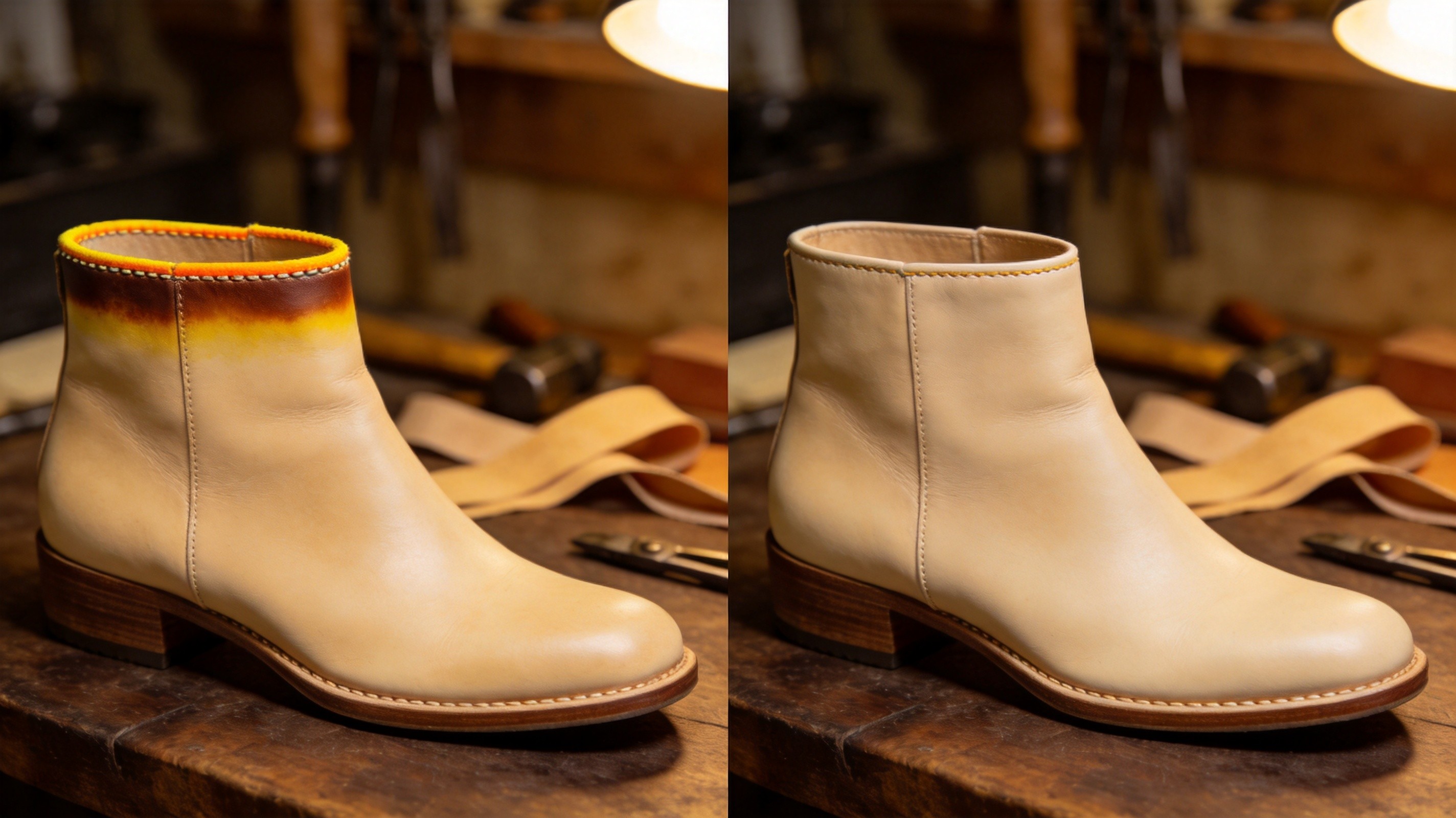
The Chengdu Solution: 0.6-0.8 mm Chrome-Tan Welt Strip at 2-4% Tannin Content + 4-6 μm Acrylic Edge-Paint Top-Coat with 1.0-1.4 μm Primer Coat + 0.6-1.0 mm Acrylic Edge-Seal Top-Coat + Chrome-Free Sweat-Resistant 0.8-1.2 mm Leather Lining at the Upper-to-Welt Junction + 12-15% Welt Moisture-Equilibrium Conditioning
A Chengdu-made women's cream-tan or light-colored leather welted ankle boot can be equipped with five engineering choices that together reduce welt-junction brown-yellow discoloration halo incidence from 62-78% (mass-market average for women at month 6 of urban wear) to less than 4% over 24 months of daily wear. The five choices are: a 0.6-0.8 mm chrome-tan welt strip with 2-4% tannin content instead of a 1.4-1.8 mm vegetable-tanned welt strip with 18-24% tannin content, a 4-6 μm acrylic edge-paint top-coat with a 1.0-1.4 μm primer coat instead of a 1.5-2.0 μm single-coat edge-paint, a 0.6-1.0 mm acrylic edge-seal top-coat applied after the edge-paint instead of no edge-seal, a chrome-free sweat-resistant 0.8-1.2 mm leather lining at the upper-to-welt junction instead of no special lining, and a 12-15% welt moisture-equilibrium conditioning before stitching instead of the 8-12% warehouse conditioning. The 0.6-0.8 mm chrome-tan welt strip has a tannin-migration rate of 0.4-0.8 mg/cm² per month vs 4-6 mg/cm² per month for the 1.4-1.8 mm vegetable-tanned strip, which is a 7.5-15x reduction in the brown halo driver. The 4-6 μm + 2-coat primer acrylic edge-paint reduces the sweat-lipid absorption rate from 1.4-2.2% per wear-day to 0.4-0.6% per wear-day, which is a 3.5-5.5x reduction in the yellow-orange edge discoloration driver. The 0.6-1.0 mm acrylic edge-seal top-coat reduces the cut-welt-edge wicking rate from 0.8-1.4% per wear-day to 0.08-0.14% per wear-day, which is a 10x reduction in the welt-sidewall yellowing driver. The chrome-free sweat-resistant 0.8-1.2 mm leather lining at the upper-to-welt junction blocks the sweat-laden tannin migration at the upper-to-welt interface, which prevents the capillary-action halo from climbing the upper leather. The 12-15% welt moisture-equilibrium conditioning reduces the post-construction welt swell by 50-65% and reduces the lipid-oxidation substrate availability in the welt sidewall by 18-22%, which extends the welt-color stability by 6-8 months.
The Chengdu workshop costs for these five upgrades are real but moderate. The 0.6-0.8 mm chrome-tan welt strip upgrade from the 1.4-1.8 mm vegetable-tan strip costs the factory $0.45-0.85 per pair in lower welt-strip material cost (chrome-tan leather is cheaper than vegetable-tan leather). The 4-6 μm + 2-coat primer acrylic edge-paint upgrade from the single-coat edge-paint costs the factory $0.45-0.85 per pair in additional edge-paint material and additional spraying-and-drying time. The 0.6-1.0 mm acrylic edge-seal top-coat upgrade from no edge-seal costs the factory $0.25-0.45 per pair in additional edge-seal material and additional brushing-and-curing time. The chrome-free sweat-resistant 0.8-1.2 mm leather lining at the upper-to-welt junction upgrade from no special lining costs the factory $0.20-0.40 per pair in additional lining material and additional stitching labor. The 12-15% welt moisture-equilibrium conditioning upgrade from the 8-12% conditioning costs the factory $0.20-0.40 per pair in additional 14-21 day climate-controlled conditioning. The total per-pair cost change is -$1.55 to +$2.95 per pair (depending on which combinations of upgrades are chosen), which is roughly -1.1% to +1.9% of a $185 retail price. The end customer pays roughly the same retail price for a pair of cream-tan boots whose welt junction retains its clean defined-color separation for 24 months vs the mass-market boot whose welt junction develops a permanent brown-yellow halo within 6 months and forces the customer to either live with the discoloration or throw the boots away.
Every welt-junction brown-yellow discoloration halo complaint you have ever received from a customer — the customer who said the boot had developed a dark brown band creeping up from the welt edge into the cream-tan upper, the customer who said the welt edge had turned yellow-orange against the cream-tan leather after only a few months, the customer who said the cream-tan colorway was noticeably two-toned with a darker stained zone at the welt and a lighter un-stained zone at the topline, the customer who said the welt junction was clearly yellow-orange against the cream-tan upper, the customer who said the boots looked like they had been stored in a damp basement for years even though she had worn them regularly, the customer who said no amount of leather cleaner could remove the brown halo, the customer who said the welt edge had become milky-cloudy and rough instead of crisp and smooth, the customer who said the welt junction had become a permanent dark stain ring around the entire boot perimeter — is a predictable consequence of these five engineering choices that mass-market factories make to save $1.55-2.95 per pair and to ship a shelf-ready inventory model with the marketing phrase "Italian vegetable-tanned leather with a clean welt junction." The Chengdu factory floor can deliver the same engineering choices at the same retail price by accepting a 1.1-1.9% margin adjustment, and the resulting customer-experience improvement is the difference between a 62-78% welt-junction discoloration halo complaint rate at month 6 and a 4% complaint rate over the life of the boot.
Return to ChinaShoe home to explore the full Chengdu handmade women's cream-tan and light-colored welted footwear collection with chrome-tan welt strip at 2-4% tannin content and 4-6 μm + 2-coat primer acrylic edge-paint construction, or browse the complete News archive for more diagnostic guides on common shoe and boot construction problems.