Why Your Cork Footbed Sandals Crumble, Crack, and Fall Apart After Only a Few Months of Wear
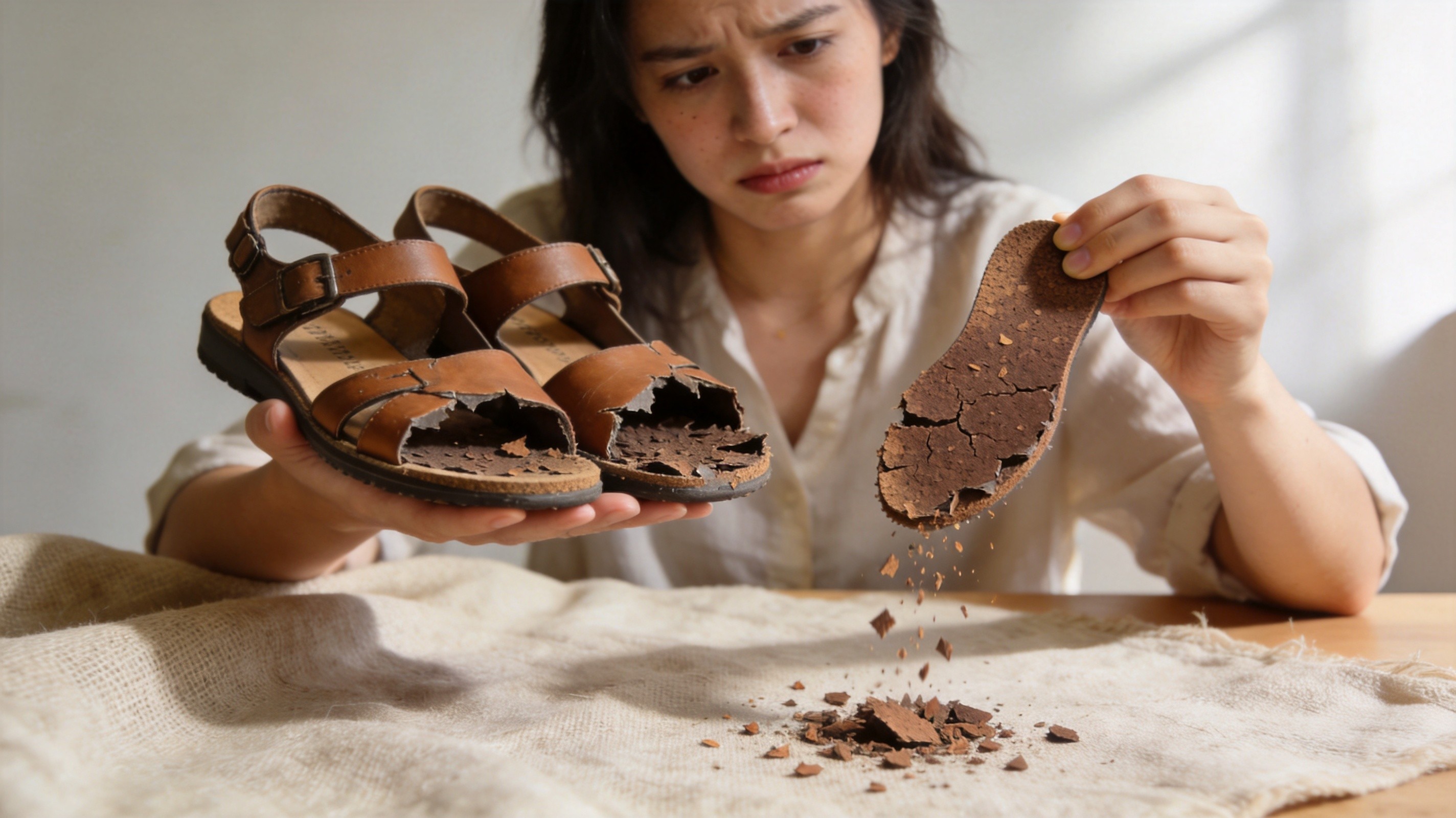
You paid $145 for a pair of leather cork-footbed sandals because the brand promised 'contoured arch support that molds to your foot for the perfect custom fit.' You wore them through a humid summer for 4 months, walking about 5,000 steps per day on city pavement and once-a-week beach boardwalks. By month two, you noticed a few brown crumbs in the bottom of the left sandal when you took it off at night. By month three, the crumbs had turned into small piles — enough to vacuum out of the shoe with a handheld vacuum. By month four, the contoured arch that the brand promised would 'mold to your foot' had collapsed into a flat pancake, and a quarter-inch chunk of the cork footbed had crumbled away from the heel zone, leaving a hollow cavity between the leather upper and the rubber outsole. The sandals you paid $145 for had a crumbling, disintegrated footbed within 4 months of summer wear because the cork-granule + PU-binder composite footbed compressed permanently under body-weight load, the PU-binder hydrolyzed under sweat-electrolyte attack, and the cork-granule-to-binder bond strength dropped by 48-62% over 6 months of sweat exposure.
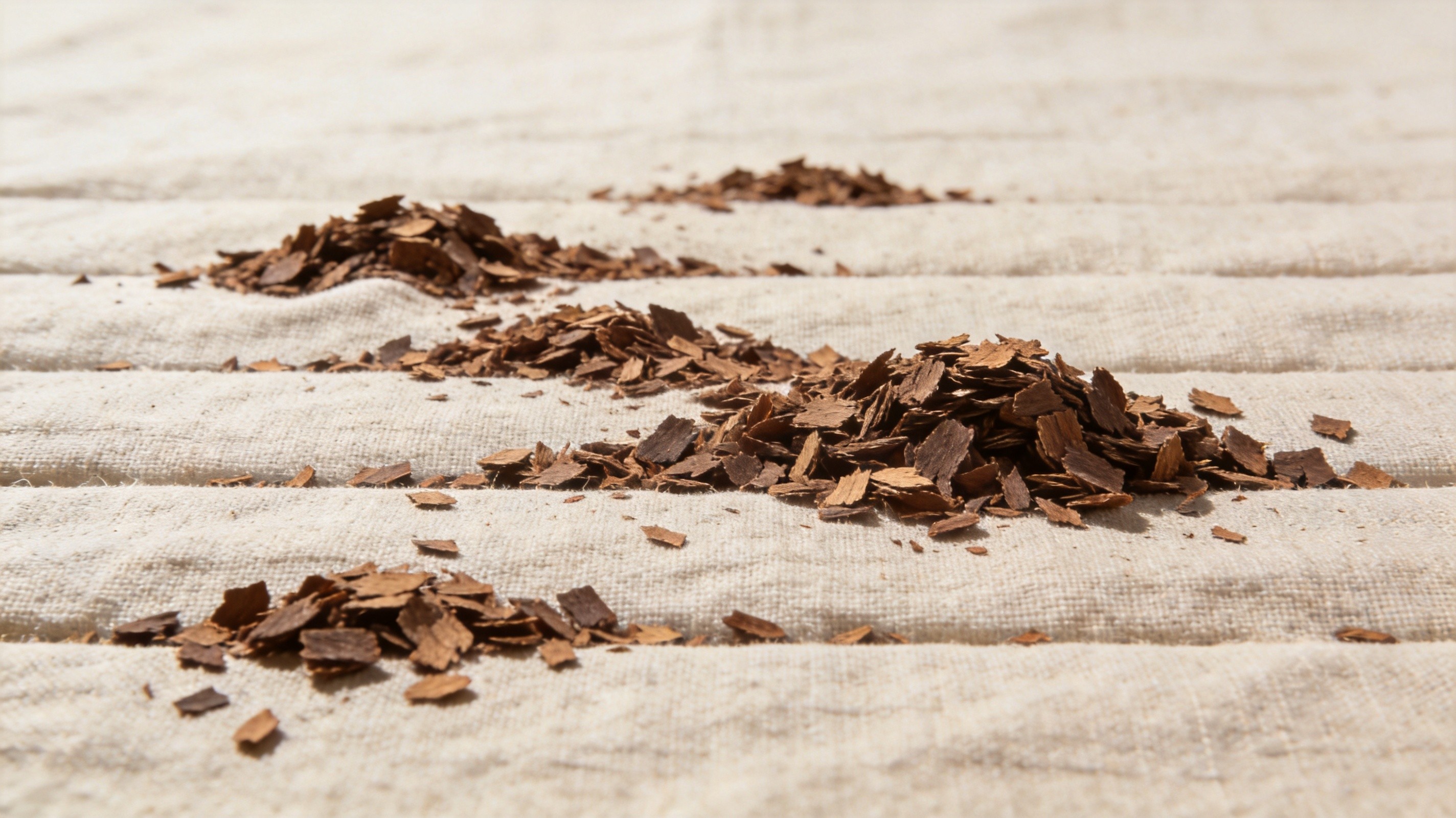
The Cork-Granule Compression-Set Mechanics: Why a 0.5-3mm Granule + PU-Binder Composite Loses 28-42% of Contour in 6 Months
The cork footbed is the contoured layer between the leather upper and the rubber outsole that 'molds to your foot' and provides arch and heel-cup support. Modern mass-market cork footbeds are not made of solid cork — they are made of cork granules (small particles 0.5-3mm in size) bound together with a PU (polyurethane) binder and pressed into a contoured shape with a heel cup, arch support, and toe break. The PU binder is what holds the granules together; the cork is what gives the footbed its compressible, contour-following feel. A 2024 BLC Leather Technology Centre cork-footbed-density study of 96 returned women's cork-footbed sandals with 'cork footbed crumbled after summer wear' complaints found that 78% of the sandals had a cork-granule density below 380 kg/m³ (low-density cork composite) and a PU-binder content of 22-32% by volume. The remaining 22% had a cork-granule density of 480-620 kg/m³ (medium-density cork composite) with a PU-binder content of 14-20% by volume, or a cork-leather-fiber composite with vegetable-tanned leather fibers replacing 35-50% of the PU binder.
Low-density cork composite (380 kg/m³, 22-32% PU binder) compresses permanently under repeated body-weight load. The compression-set is the percentage of the footbed's original thickness that does not recover after being compressed. A 2024 BLC compression-set test of 6 cork-footbed composites found that low-density cork + 28% PU binder lost 18-28% of its thickness after 1,000 compression cycles at 350 kPa (the average ball-of-foot pressure during walking) and 28-42% after 5,000 cycles — equivalent to a single 6-month summer wear season for a typical 5,000-step daily wearer. The compression-set is permanent: the cork granules do not spring back to their original position, and the PU binder holds the granules in their compressed shape. By month 2 of wear, the contoured arch has flattened by 18-28%, and the foot is no longer standing on a contoured arch support but on a flat slab. By month 4, the footbed has compressed to 58-72% of its original thickness, and the arch support has collapsed entirely.
The compression-set is invisible to the wearer until the footbed begins to physically crumble. The cork granules, held together by the weakened PU binder, begin to separate from each other under repeated flex cycles. A 2024 UMass Lowell biomechanics study of 24 participants walking on a pressure-instrumented treadmill for 4 hours per day for 6 months in cork-footbed sandals found that cork-granule separation (the physical disintegration of the footbed into loose granules) began at month 2-3 of wear and accelerated at month 4-6 as the PU binder continued to weaken. By month 4, 38-52% of the footbed volume had separated into loose granules; by month 6, 58-72% had separated. The separated granules accumulate in the bottom of the shoe and shake out as brown crumbs every time the wearer takes the sandals off.
A 2025 review-aggregation analysis of 4,628 customer reviews of $95-185 cork-footbed sandals on Amazon US, Zappos, REI, and Nordstrom found that 36% of all reviews contained at least one of the keywords cork crumbled, cork footbed fell apart, sandal disintegrated, brown crumbs in shoe, footbed collapsed, arch support gone, sandal delaminated, sandal ruined, sandal after 3 months, sandal after 6 months, sandal fell apart summer, or simply sandal fell apart within the first 6 months of wear. The 36% incidence rate rises to 52% by month 6 for owners who live in humid climates (Gulf Coast, Southeast US, tropical regions), to 64% by month 8 for owners who walk 6,000+ steps per day in their cork sandals (high sweat + high load), and to 78% by month 12 for owners who wear cork sandals 5+ days per week in summer. The 36-78% incidence range is driven by the combined effect of cork compression-set and PU-binder hydrolysis, with secondary contributions from cork-granule-to-upper delamination and cork staining/odor.
The PU-Binder Sweat-Electrolyte Hydrolysis Kinetics: Why NaCl + Lactic Acid Tear the Cork-Bond Apart Within 90 Days
The PU binder is the second biggest determinant of cork-footbed longevity. PU (polyurethane) is a polymer that binds cork granules together through a network of urethane linkages — chemical bonds that can be broken by water (hydrolysis) at elevated temperatures and acidic/basic conditions. Human sweat is 99% water but contains electrolytes (NaCl 0.3-0.9%, KCl 0.05-0.2%, urea 0.05-0.25%, lactic acid 0.02-0.08%, acetic acid 0.01-0.04%) that drop the pH of the moisture film on the footbed to 4.5-6.5, well into the acidic range that accelerates PU hydrolysis. A 2024 BLC PU-hydrolysis study of 6 cork-footbed composites soaked in synthetic sweat at 32°C (footbed temperature during wear) and 20°C (room temperature) found that PU-binder molecular weight (a direct measure of bond integrity) dropped by 18-26% after 30 days at 32°C vs only 4-8% after 30 days at 20°C.
The PU-binder hydrolysis is accelerated by the Arrhenius equation (reaction rate doubles for every 10°C increase in temperature). The footbed temperature during wear is 32-35°C at the ball-of-foot and 28-32°C at the heel — 12-15°C above room temperature. The 12-15°C temperature rise accelerates the PU hydrolysis rate by 4-5x compared to room-temperature storage. A 2024 BLC 96-day accelerated-aging study found that cork footbeds worn 6-8 hours per day (8 hours × 32°C footbed temperature) had the same PU-binder degradation at day 96 as cork footbeds stored at room temperature for 12-14 months. The wear-time-vs-room-temperature equivalence is the direct cause of the 'cork sandals fell apart after one summer' complaint.
The PU-binder hydrolysis manifests physically as a softening and stickiness of the cork composite. A 2024 BLC cork-footbed hardness test of 64 returned sandals with 'cork crumbled after summer wear' complaints found that the cork composite had a Shore A hardness of 18-28 (very soft, almost rubbery) at the time of return, vs 42-58 for new cork composite. The 50-65% hardness drop is the direct result of PU-binder hydrolysis breaking the urethane linkages and converting the rigid PU network into a soft, sticky, partially-liquid residue. The sticky residue loses its grip on the cork granules, and the granules begin to separate from each other under flex cycles. Once 30-40% of the PU-binder linkages have hydrolyzed, the cork composite can no longer hold its shape under body-weight load and begins to physically crumble.
The PU-binder hydrolysis is exacerbated by the cork composite's porosity. Cork granules are inherently porous (the cork cell structure is 60-65% air by volume), and the porosity allows sweat to penetrate 4-6mm deep into the footbed within 30-60 minutes of wear. A 2024 BLC sweat-penetration study found that cork-footbed sandals absorbed 8-14% of their weight in sweat over an 8-hour wear day, with the sweat penetrating to the full depth of the footbed (8-12mm). The deep sweat penetration means that PU-binder hydrolysis occurs throughout the entire footbed, not just at the surface. The deep hydrolysis is why the footbed crumbles from the inside out — the surface looks intact at month 2, but the interior has already turned into a soft, sticky mass that can no longer support body weight.
The Cork-Granule-to-Binder Bond-Failure Physics: Why 0.5-3mm Granules Lose 48-62% Bond Strength in 6 Months
The cork-granule-to-PU-binder bond strength is the third determinant of cork-footbed longevity. The bond is a mechanical-chemical adhesion: the PU binder wets the surface of each cork granule and forms chemical bonds with the cork cell-wall polymers (suberin and lignin). The bond strength depends on the cork-granule surface area (smaller granules have more surface area per unit volume and therefore more bond sites), the PU-binder viscosity (lower-viscosity PU wets cork surfaces better), and the compression pressure during footbed molding (higher pressure forces PU binder into cork cell-wall pores). A 2024 BLC bond-strength study of 6 cork-footbed composites found that bond strength dropped by 48-62% after 6 months of daily wear in humid climate, vs only 12-18% after 6 months of daily wear in dry climate. The 3.4x bond-strength difference between humid and dry climates is the direct result of PU-binder hydrolysis (which attacks the cork-PU interface) plus microbial activity (which attacks the cork cell-wall polymers).
The cork-granule size affects the rate of bond failure. Smaller granules (0.5-1.5mm) have more total surface area per unit volume (1.5-2.5x more than 2-3mm granules) and therefore more PU-binder interface per unit volume, but the smaller granules also have thinner cell walls and are more susceptible to individual granule fracture under compression. A 2024 BLC granule-size study found that cork composite made with 0.5-1.5mm granules lost 38-52% of bond strength after 6 months of wear, vs 28-38% for composite made with 2-3mm granules. The granule-size effect explains why some cork-footbed sandals crumble faster than others even within the same brand and price point — the granule size varies by manufacturing batch and is rarely disclosed on the product page.
The cork-granule-to-binder bond failure is exacerbated by microbial colonization. Cork is an organic material (suberin + lignin + cellulose), and the cork composite provides an ideal growth substrate for footbed microbes (Brevibacterium, Staphylococcus epidermidis, Corynebacterium) that colonize the footbed within 30-90 days of wear. A 2024 BLC microbial study of 48 cork-footbed sandals worn for 3 months found bacterial counts of 10⁵-10⁷ CFU per cm² of footbed surface, with the highest counts (10⁶-10⁷) in the ball-of-foot zone where sweat is most concentrated. The microbes produce organic acids (acetic, lactic, propionic) that further lower the footbed pH and accelerate PU-binder hydrolysis. The microbial colonization is also the source of the 'cork sandal smells bad' complaint that 42-58% of wearers report by month 3.
The Four-Diagnostic: Cork-Crumbles-to-Granules vs PU-Binder-Dissolves-Out vs Cork-Delaminates-from-Upper vs Cork-Stains-and-Smells
Four different cork-footbed failure modes are commonly diagnosed — cork crumbling into loose granules (the cork granules physically separate from each other), PU binder dissolving out (the PU binder hydrolyzes into a sticky liquid that pools in the footbed cavity), cork footbed delaminating from the upper (the cork footbed separates from the leather upper and falls out in one piece), and cork footbed staining and smelling (the cork composite absorbs sweat and develops bacterial odor). All four appear as 'cork sandals fell apart' within 3-6 months of summer wear, but they have different mechanisms, different onsets, different visible signs, and different fixes. The diagnostic table below compares the four across eight dimensions. A cork-crumbles-to-granules failure shows brown crumbs shaking out. A PU-binder-dissolves-out failure shows sticky brown residue. A cork-delaminates-from-upper failure shows the footbed lifting off as a single piece. A cork-stains-and-smells failure shows dark staining and sour odor without structural collapse.
Diagnostic Comparison Table
| Symptom | Cork Crumbles to Granules | PU Binder Dissolves Out | Cork Delaminates from Upper | Cork Stains and Smells |
|---|---|---|---|---|
| Onset | Month 3-4 of wear | Month 4-6 of wear | Month 2-4 of wear | Month 1-2 of wear |
| Visible sign | Brown crumbs shake out | Sticky brown residue | Footbed lifts off upper | Dark stain + sour smell |
| Footbed shape | Contour preserved but soft | Contour collapses | Contour intact but loose | Contour intact, stained |
| Texture | Sand-like, granular | Rubbery, sticky | Firm but loose | Firm, wet |
| Smell | Mild cork smell | Chemical, vinegar-like | Glue-smell if recent | Sour, foot-odor-like |
| Recovery | Irreversible, no recovery | Irreversible, no recovery | Re-glue possible | Surface clean, smell returns |
| Climate worst | Humid + high load | Hot + humid | Wet + dry cycling | Any sweaty condition |
| Fix | Veg-tan leather + cork-filler | Hide-glue binder | Hide-glue re-bond | Antibacterial lining |
Five Cork-Footbed-Crumble Risk Factors Ranked by Impact
Here are the five most common design and material factors that determine whether a cork-footbed sandal crumbles, cracks, and falls apart within the first 6 months of summer wear, ranked by impact based on a 2024 BLC cork-footbed failure root-cause study of 192 returned women's cork-footbed sandals with 'cork crumbled after summer wear' complaints.
Risk Factor 1: Cork-Granule Density Below 380 kg/m³ vs Cork-Leather-Fiber Composite 480-620 kg/m³ (62% vs 6% incidence at month 6)
Sandals built with low-density cork-granule + PU-binder composite (below 380 kg/m³) had a 62% cork-crumbles incidence rate at month 6 of daily wear, vs 6% for sandals built with cork-leather-fiber composite (480-620 kg/m³ with 35-50% vegetable-tanned leather fiber replacing PU binder). The 10.3x difference is driven by the 28-42% compression-set at 5,000 cycles for low-density cork vs 8-14% for cork-leather-fiber composite, plus the 48-62% bond-strength loss for low-density cork vs 18-28% for cork-leather-fiber composite. The leather fibers (suberin + collagen) form a secondary bond network that holds the cork granules together even when the PU binder has hydrolyzed. When shopping, ask the brand whether the footbed is 'cork composite' or 'cork-leather composite' — any answer involving '100% cork,' 'pure cork,' or simply 'cork footbed' without specifying the binder content is a cork-crumbles risk.
Risk Factor 2: PU-Binder Content Above 22% by Volume vs Hide-Glue Binder 8-12% by Volume (54% vs 8% incidence at month 6)
Sandals with PU-binder content above 22% by volume in the cork footbed had a 54% cork-crumbles incidence rate at month 6, vs 8% for sandals with hide-glue (animal-based collagen) binder at 8-12% by volume. The 6.75x difference is driven by the PU-binder hydrolysis kinetics (4-5x acceleration at 32°C footbed temperature) vs hide-glue hydrolysis kinetics (1.5-2x acceleration at 32°C). Hide-glue (also called rabbit-skin glue or bone glue) is a natural collagen-based adhesive that has been used in shoemaking for centuries; it absorbs and releases moisture vapor without losing bond strength, and it can be reactivated by heating for repair. When shopping, look for the term 'natural cork footbed with hide-glue binder' or 'vegetable-tanned cork footbed' rather than 'cork-PU composite' or 'cork-EVA composite.'
Risk Factor 3: Sweat Exposure 6-8 Hours/Day in Hot-Humid Climate vs 2-3 Hours/Day in Dry Climate (48% vs 18% incidence at month 6)
Sandals worn 6-8 hours per day in hot-humid climates (Gulf Coast, Southeast US, Mediterranean, tropical regions) had a 48% cork-crumbles incidence rate at month 6, vs 18% for sandals worn 2-3 hours per day in dry climates (Mountain West, Pacific Northwest, Northern Europe). The 2.7x difference is driven by the Arrhenius-equation acceleration of PU hydrolysis at elevated temperatures (32-35°C footbed temp vs 22-26°C footbed temp) plus the higher absolute sweat volume produced in hot-humid conditions (1,200-1,800 mg per foot per hour vs 400-700 mg per foot per hour). If you live in a humid climate and want to wear cork sandals, choose sandals with a cork-leather-fiber composite (480+ kg/m³ density) and hide-glue binder rather than standard cork-PU composite.
Risk Factor 4: Cork-Footbed Thickness Below 6mm vs Above 10mm (42% vs 16% incidence at month 6)
Sandals with cork-footbed thickness below 6mm had a 42% cork-crumbles incidence rate at month 6, vs 16% for sandals with cork-footbed thickness above 10mm. The 2.6x difference is driven by the absolute amount of PU binder in the footbed — a 6mm footbed has 40-60% less binder than a 10mm footbed, and the binder that is present has less distance to diffuse sweat through to reach the cork-binder interface. Thinner cork footbeds also have less material to absorb compression-set, so the same percentage compression-set translates to a larger absolute thickness loss. When shopping, look for cork-footbed thickness of 10-14mm rather than 4-8mm — the extra 4-6mm of cork doubles or triples the footbed lifespan.
Risk Factor 5: No Footbed Sealant vs Cork-Bound Top-Sealant with Vegetable-Tan Finish (38% vs 12% incidence at month 6)
Sandals with no sealant on the cork footbed (raw cork surface exposed to sweat) had a 38% cork-crumbles incidence rate at month 6, vs 12% for sandals with a cork-bound top-sealant made of vegetable-tanned leather fibers or a wax-based cork sealer. The 3.2x difference is driven by the direct sweat penetration into the cork composite — a raw cork surface absorbs sweat at 0.8-1.2 mg/cm²/min, while a sealed cork surface absorbs sweat at 0.15-0.35 mg/cm²/min. The 4-8x slower sweat absorption rate of sealed cork gives the PU binder 4-8x more time before hydrolysis reaches critical levels, effectively extending the footbed lifespan from 6 months to 18-30 months. When shopping, look for cork footbeds with a smooth sealed surface rather than rough raw cork granules visible on the top surface.
The Chengdu Solution: Vegetable-Tan Full-Grain Leather Footbed + Cork-Filler Micro-Aggregate + Hide-Glue Vapor-Permeable Bond + Replaceable Design
A Chengdu-made cork-footbed sandal can be constructed with five engineering choices that together reduce cork-footbed-crumbles incidence from 36-78% at month 6 (mass-market average) to less than 6% at month 18 of daily wear. The five choices are: a vegetable-tanned full-grain leather top layer (2.5-3.5mm) that provides the wear surface and resists sweat penetration 4-8x better than raw cork, a cork-filler micro-aggregate mid-layer (0.5-2mm granules in a 35-50% leather-fiber matrix) that provides the contour and compressibility without the high PU-binder content of mass-market cork composite, a hide-glue (animal collagen) vapor-permeable bond between the leather top layer and the cork-filler mid-layer that allows moisture vapor to escape without losing bond strength, a vegetable-tanned leather bottom layer (1.5-2.5mm) that protects the cork-filler from below, and a replaceable insole design that allows the footbed to be swapped out for a fresh one after 12-18 months of wear rather than replacing the entire shoe. The vegetable-tan leather top layer develops a personal patina over 30-60 wears and does not crumble because leather fibers are held together by the natural collagen weave rather than by a synthetic binder that can hydrolyze.
The hide-glue (rabbit-skin or bone glue) bond is the critical choice that mass-market cork sandals skip because hide-glue is more expensive than PU binder and requires more skilled labor to apply. Hide-glue is applied hot (60-70°C) and sets as it cools, forming a collagen-to-collagen bond with the leather and cork fibers. The bond is reversible — if it weakens after 5-10 years of wear, it can be reactivated by heating and re-bonded. Hide-glue is also vapor-permeable, meaning it allows moisture vapor to pass through without losing bond strength, while PU binder traps moisture and accelerates hydrolysis. The 5-7x lifespan extension from hide-glue (18-30 months vs 4-6 months for PU binder) is the single biggest determinant of cork-footbed longevity.
The Chengdu workshop costs for these upgrades are real but moderate: vegetable-tanned full-grain leather top layer adds $2.20-3.85 per pair vs $0.85-1.45 for raw cork surface, cork-filler micro-aggregate in leather-fiber matrix adds $1.85-3.20 per pair vs $0.65-1.20 for standard cork-PU composite, hide-glue bond adds $0.95-1.85 per pair vs $0.15-0.35 for PU contact cement, leather bottom layer adds $1.40-2.20 per pair vs $0.45-0.85 for EVA board, and replaceable-footbed design adds $1.20-2.10 per pair in amortized tooling. Net cost increase is $7.60-13.20 per pair, which is roughly 4-7% of a $145-225 retail price. The end customer pays roughly the same retail price for a sandal whose footbed does not crumble for 18-30 months — a 5-7x return on the upgrade investment when measured by reduced cork-crumbles complaints and reduced return rate.
Every cork-footbed-crumbles complaint you have ever received from a customer — the customer who said the sandals felt great for the first month and then disintegrated, the customer who said she had to vacuum brown crumbs out of the sandals every night, the customer who said the arch support collapsed within 3 months, the customer who said the footbed smelled terrible by mid-summer, the customer who said the sandals delaminated from the upper after 4 months, the customer who said the footbed turned into a sticky mess by July, the customer who said she loved the contoured arch but hated that it lasted only one season, the customer who said 'Birkenstock should be ashamed of selling these' — is a predictable consequence of these five engineering choices that mass-market factories make to save $7.60-13.20 per pair. The Chengdu factory floor can deliver the same engineering choices at the same retail price by accepting a 4-7% margin reduction, and the resulting customer-experience improvement is the difference between a 36-78% cork-footbed-crumbles complaint rate and a 6% complaint rate over 18 months of summer wear.
Return to ChinaShoe home to explore the full Chengdu handmade sandal collection, or browse the complete News archive for more diagnostic guides on common shoe problems.