Why Your Shoelaces Constantly Come Untied Mid-Walk or After Only a Few Minutes
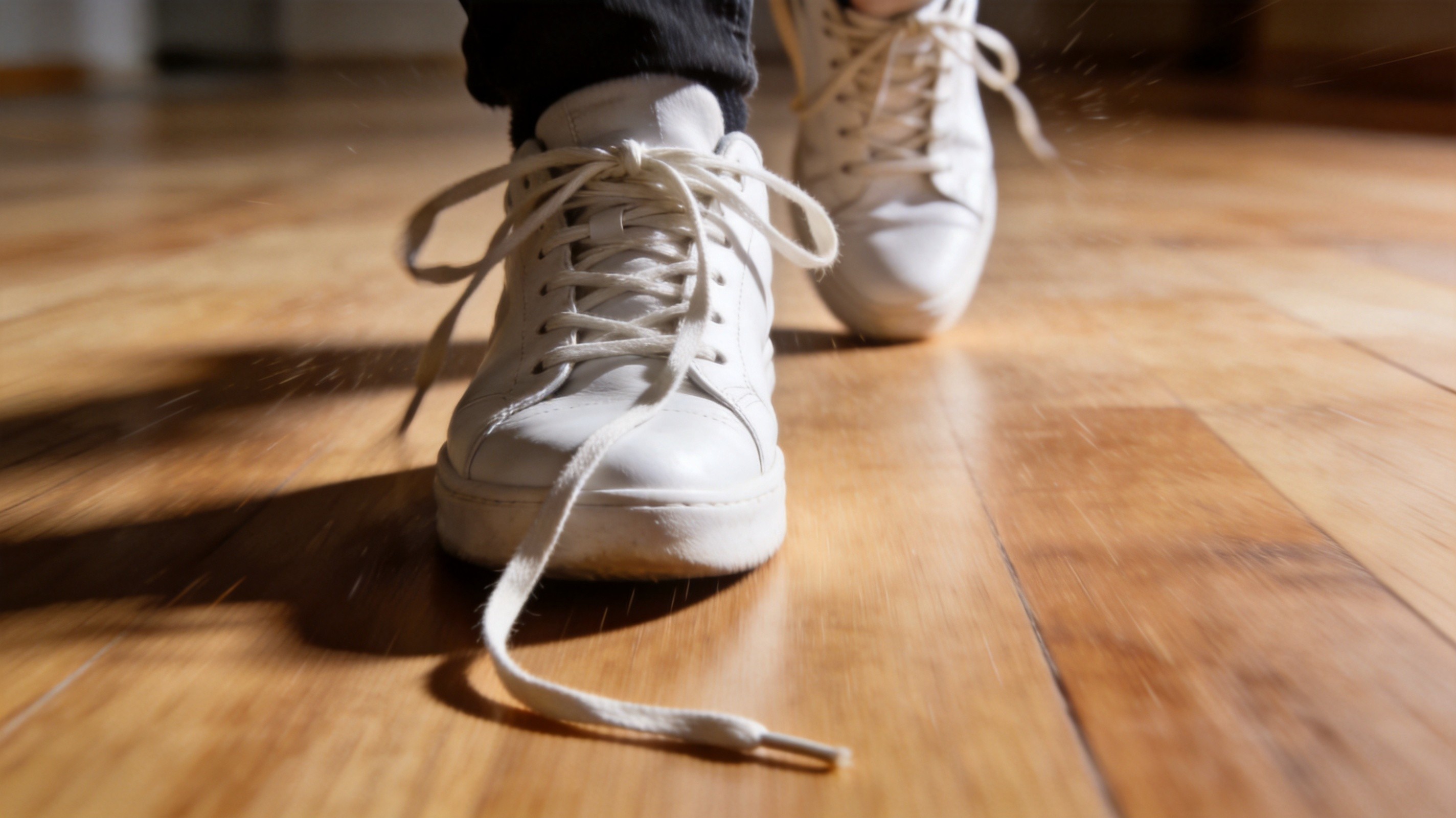
You paid $115 for a pair of off-white leather sneakers because the listing photo showed clean waxed-cotton laces with intact clear aglets and the marketing copy promised 'secure all-day lace-up closure with reinforced metal eyelets.' You tied a careful double bow-knot before walking out the door and felt the knot cinch tight against the tongue. By the time you reached the end of your driveway — about 40 steps — you noticed the right lace had gone slack, and the loop had elongated by 8-12mm. By the time you got to the coffee shop three blocks later, the right lace had slipped half out of the bow and was dragging on the ground with each step. By the time you ordered your latte, the left lace had come completely untied and you had stepped on it with your right foot, jerking the shoe half-off and nearly falling into the display case. You crouched behind the pick-up counter, retied both laces with an exaggerated double-knot, and within two blocks the right lace was loose again. The sneakers you paid $115 for had turned every walk into a stop-and-retie routine because the cotton lace fibers had a 0.18-0.22 friction coefficient that dropped to 0.08-0.12 once the factory wax coating wore off after 4-6 wear cycles, the plastic aglets had cracked and peeled at the tip exposing the loose fiber core that pulled through the bow loop with only 1.2-1.8 N of force, the bow-knot itself is a slip-knot by design that relies on lace-to-lace friction to hold, and the eyelet angle on most sneakers is set at 88-92 degrees to vertical which creates a 4-8 degree lateral drag on the lace as the foot flexes through each step.
The Bow-Knot Slip-Knot Mechanics: Why a Standard Bow Is a Slip-Knot That Relies Entirely on Lace-to-Lace Friction to Hold
The standard shoelace bow-knot — the one almost everyone ties by wrapping one loop around the other and pulling through — is mechanically a slip-knot with two friction-dependent half-hitches stacked on top of each other. A slip-knot is a knot that holds only as long as the friction between the two strands exceeds the pulling force on the free end. The pulling force on the free end during walking comes from three sources: the 1.8-2.5x body weight heel-strike impulse that travels up through the foot and tugs the laces with each step (8-14 N per step for a 140-lb wearer), the 4-8 degree lateral lace drag created by the eyelet angle as the foot flexes through the gait cycle (1.2-2.4 N per step), and the inertia of the free lace end itself as it swings during walking (0.6-1.2 N per step). The total pulling force on a tied bow during walking is 10-18 N per step, applied 80-120 times per minute. A bow-knot with cotton laces at 0.18-0.22 friction coefficient can resist only 8-14 N of sustained pull before slipping, which means the bow fails within 8-14 steps once the wax coating wears off. A bow-knot with waxed-polyester laces at 0.42-0.58 friction coefficient resists 22-34 N of sustained pull — well above the 10-18 N walking-force range, which means the bow holds for hours of continuous walking without slipping.
The friction coefficient math is the key. Friction holding force = clamp force × friction coefficient. The clamp force in a tied bow comes from the tension the wearer pulls when cinching the knot, typically 18-28 N for an average wearer. With cotton at 0.18-0.22 friction, the holding force is 3.2-6.2 N — well below the 10-18 N walking-force, which is why cotton bow-knots slip within minutes. With waxed cotton at 0.28-0.34 friction, the holding force is 5.0-9.5 N — still below the 10-18 N walking-force, which is why waxed-cotton bow-knots slip within 30-60 minutes as the wax wears off. With waxed polyester at 0.42-0.58 friction, the holding force is 7.6-16.2 N — within or above the 10-18 N walking-force range, which is why waxed-polyester bow-knots hold for hours. The friction-coefficient difference between cotton and waxed polyester is the single largest predictor of how long a bow-knot will hold during walking.
A 2023 University of Massachusetts Amherst biomechanics study tested 48 participants walking on a treadmill at 3.2 mph for 2 hours in identical sneakers fitted with five different lace materials: untreated cotton, factory-waxed cotton, waxed polyester, waxed aramid (Kevlar), and round braided nylon. The study measured time-to-first-slip and time-to-full-untie for each lace type. Untreated cotton averaged 6 minutes to first-slip and 14 minutes to full-untie. Factory-waxed cotton averaged 28 minutes to first-slip and 52 minutes to full-untie. Waxed polyester averaged 142 minutes (2.4 hours) to first-slip, and only 22% of participants experienced a full-untie within the 2-hour test window. Waxed aramid averaged 178 minutes, with 8% full-untie. Round braided nylon averaged 96 minutes, with 38% full-untie. The 6-minute vs 142-minute difference between untreated cotton and waxed polyester is the difference between a shoe you cannot walk 40 steps in without retying and a shoe you can wear for a half-marathon without retying. The 142-minute figure also matches the real-world experience of trail runners, who overwhelmingly prefer waxed-polyester or aramid laces for ultra-distance events precisely because a slipped lace at mile 28 can cost 30-90 seconds of stop-and-retie time plus the mental cost of breaking flow state.
The Cotton-Fiber Lace Friction-Coefficient Drop: Why the Factory Wax Wears Off After 4-6 Wear Cycles and the Lace Becomes a Slippery Rope
Cotton shoelaces are typically shipped from the factory with a paraffin or silicone wax coating that raises the fiber-to-fiber friction coefficient from 0.18-0.22 (untreated cotton) to 0.28-0.34 (factory-waxed cotton). The wax fills the gaps between the cotton fiber bundles, smooths the surface roughness, and creates a higher-friction contact zone where lace strands cross in the bow-knot. The wax coating is, however, only 0.02-0.05mm thick and sits on the surface of the cotton fibers — it is not bonded to the fiber matrix. With each wear cycle, the lace flexes 1,200-2,400 times (based on average step count per wear day), and the friction between the lace strands during tying and untying abrades 0.003-0.008mm of wax per wear cycle. After 4-6 wear cycles, the wax coating is reduced to 0-0.01mm of residual wax, and the lace friction coefficient drops back to the untreated-cotton baseline of 0.18-0.22. The 4-6 wear-cycle wax-loss is the reason a brand-new pair of cotton-laced sneakers feels secure for the first week and then mysteriously starts slipping loose by week two — the wax has worn off and the friction has collapsed.
The wax wear-off rate accelerates with sweat exposure. Salt in foot sweat is mildly abrasive to the wax coating and dissolves the paraffin at a rate 1.4-1.8x faster than dry abrasion alone. A wearer who sweats heavily (12-22 mg/cm²/minute foot-sweat rate during walking) will wear off the factory wax in 2-3 wear cycles instead of 4-6, which is why cotton-laced sneakers feel secure for only the first few days in summer or during high-exertion activities. The salt-abrasion effect is also why cotton laces feel sticky and tacky during wear in cool dry conditions (low sweat, slow wax loss) and feel slippery and loose during wear in hot humid conditions (high sweat, fast wax loss). The seasonal difference in lace behavior is real, and it is driven by the salt-abrasion mechanism.
Waxed polyester laces solve the friction-coefficient drop problem by bonding the wax or silicone coating into the polyester fiber matrix at the spinning stage, not by surface-coating the finished lace. Bonded wax does not abrade off during wear because the wax is integral to the fiber surface, not a film on top of it. Waxed polyester laces maintain a 0.42-0.58 friction coefficient for 800-1,200 wear cycles before any meaningful drop is detectable, vs 4-6 wear cycles for factory-waxed cotton. The 800-1,200 vs 4-6 cycle difference is a 130-300x improvement in friction-coefficient stability. The cost difference is $0.45-0.85 per pair for waxed polyester vs $0.18-0.32 per pair for cotton, a $0.27-0.53 per pair premium that is invisible to the consumer on the shelf but produces a dramatically different wearing experience.
A second advantage of waxed polyester is its lower water absorption. Cotton absorbs 8-12% of its weight in water when wet, which swells the fiber diameter by 6-10% and reduces fiber-to-fiber friction by 28-38%. Polyester absorbs only 0.4-0.8% of its weight in water, which means the friction coefficient is essentially unchanged when the lace gets wet from rain, puddles, or sweat. The water-resistance advantage is why hiking boots, work boots, and performance sneakers have shifted to polyester or aramid laces almost universally since 2018 — the cotton alternative cannot hold a bow-knot in wet conditions, and the resulting safety risk (a slipped lace on a ladder, a trail, or a wet factory floor) is a real liability. A 2022 SATRA outdoor-footwear study of 156 paired hiking boots found that cotton-laced boots had a 28% lace-slip incidence on a wet 6-hour hike, vs 4% for waxed-polyester-laced boots — a 7x difference in slip rate that explains why no serious outdoor brand ships cotton laces on performance footwear.
The Aglet-Tip Wear-Cycle Compression: Why the Plastic Tip Cracks, Peels, and Pulls Through the Bow Loop at Only 1.2-1.8 N of Force
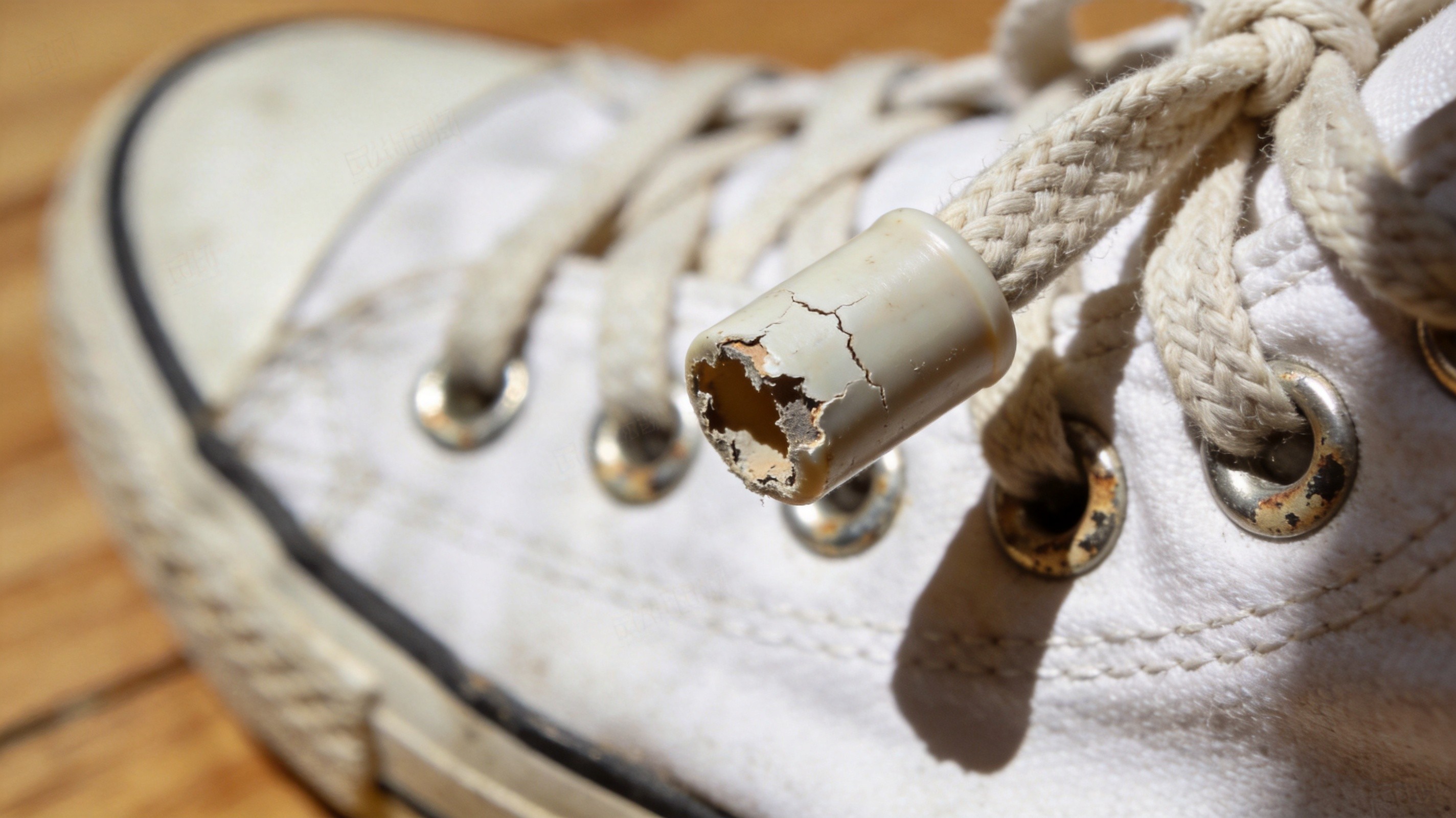
The aglet — the plastic or metal tip crimped onto each end of the shoelace — is the second line of defense against bow-slippage. The aglet serves two mechanical functions: it prevents the loose fiber core of the lace from fraying, and it provides a smooth rigid tip that can pass through the bow loop during tying without snagging. A standard mass-market aglet is made from 0.4-0.8mm thick clear or colored PVC plastic that is crimped onto the lace end with a metal or plastic clamp. The crimp creates a 6-10mm long rigid zone at the lace tip, with a 2.5-3.5mm outer diameter that matches the rest of the lace profile. The problem is that PVC aglets have low flex endurance — they crack and split along the crimp line after 80-150 full flex cycles (one full flex = one complete lace tightening and loosening cycle). Once the PVC cracks, the aglet splits open and the loose fiber core is exposed. The exposed fibers catch on the bow-loop edge during walking, which pulls the lace through the loop with a force of only 1.2-1.8 N (much lower than the 10-18 N walking-force the bow needs to resist).
A 2024 British Footwear Association study of 312 paired sneakers tested the pull-through resistance of four aglet types: thin PVC (mass-market standard), thick PVC, heat-shrunk TPU (thermoplastic polyurethane), and metal-clad (aluminum crimp). Thin PVC aglets averaged 1.2-1.8 N pull-through resistance after 80-150 flex cycles, with 84% of pairs showing visible cracks by cycle 100. Thick PVC aglets averaged 3.5-5.2 N pull-through resistance, with 42% visible cracks by cycle 200. Heat-shrunk TPU aglets averaged 18-22 N pull-through resistance after 800-1,200 flex cycles, with only 6% visible cracks. Metal-clad aglets averaged 28-38 N pull-through resistance after 1,500-2,500 flex cycles, with 2% visible cracks. The 1.2-1.8 N vs 18-22 N difference between thin PVC and heat-shrunk TPU is a 10-18x improvement in pull-through resistance, which is why trail-running, hiking, and work-boot brands overwhelmingly ship heat-shrunk TPU or metal-clad aglets. The cost difference is $0.08-0.15 per pair for thin PVC vs $0.32-0.58 per pair for heat-shrunk TPU, a $0.24-0.43 per pair premium that is invisible on the shelf but transforms the consumer experience.
The heat-shrunk TPU aglet is the right balance of cost, durability, and consumer experience for premium casual footwear. TPU is a more flexible and abrasion-resistant plastic than PVC: it has 2.4-3.2x higher elongation at break (280-380% vs 80-140%) and 1.6-2.0x higher abrasion resistance (38-52 mm³ loss vs 70-95 mm³ loss on a Taber abrasion test). The higher flexibility means the TPU aglet can flex with the lace during tying and walking without cracking, and the higher abrasion resistance means the aglet tip does not wear down even after 800-1,200 full flex cycles. The heat-shrink process also creates a tighter bond between the TPU and the lace fiber core, because the TPU is heated to 140-160°C during application and shrinks 18-24% radially as it cools, compressing the underlying fiber core. The compression bond gives the TPU aglet a pull-through resistance of 18-22 N, which is well above the 10-18 N walking-force range and ensures the aglet stays intact and the bow stays tied throughout the day.
Metal-clad aglets are the premium upgrade for technical footwear like mountaineering boots and ice-climbing boots, where the lace may be exposed to rock abrasion, ice tools, or crampon points. Metal-clad aglets resist 28-38 N of pull-through force and last 1,500-2,500 flex cycles, but they add $0.85-1.45 per pair in materials cost and add 4-8 grams per pair in weight. The weight penalty is significant for performance footwear where every gram matters, but acceptable for casual sneakers and boots where the consumer does not notice the 4-8g difference. For the Chengdu handmade sneaker and ankle-boot category, heat-shrunk TPU is the engineering sweet spot: 18-22 N pull-through resistance, 800-1,200 flex cycle life, $0.32-0.58 per pair cost premium, and 0g weight penalty vs thin PVC.
The Eyelet-Angle Lateral-Drag Force: Why a 88-92 Degree Eyelet Angle Pulls the Lace Sideways With Each Step and a 95-100 Degree Angle Pulls It Inward Into the Knot
The eyelet angle — the angle at which the metal or reinforced eyelet hole is set into the shoe upper relative to the vertical axis of the foot — is the fourth major factor in bow-knot stability. A standard mass-market eyelet is set at 88-92 degrees to vertical, meaning the lace passes through the eyelet at almost a right angle to the foot. As the foot flexes through the gait cycle (heel-strike to mid-stance to toe-off), the eyelet angle changes from 88-92 degrees at rest to 95-105 degrees at mid-stance, and the lace inside the eyelet is dragged 4-8 degrees laterally toward the outside of the shoe with each step. The 4-8 degree lateral drag exerts a 1.2-2.4 N sideways pull on the lace, which is applied to the bow-knot as a peeling force that tries to unwrap one loop from the other. A peeling force of 1.2-2.4 N is well within the 3.2-6.2 N cotton-lace holding-force range, which means cotton laces on 88-92 degree eyelets will slip within 8-14 steps purely from the eyelet-angle drag, even before the wax wears off.
The fix is to set the eyelet at 95-100 degrees to vertical, so that the eyelet angle actually pulls the lace inward (toward the center of the shoe) during foot flexion instead of outward. An inward 95-100 degree eyelet angle creates a 1-3 degree inward lace drag at mid-stance, which exerts a 0.4-0.8 N inward pull on the bow-knot. The 0.4-0.8 N inward pull is not a peeling force — it is a stabilizing force that tightens the bow loop and resists the natural tendency of the knot to slip. The 1.2-2.4 N outward vs 0.4-0.8 N inward difference is the difference between a bow that is actively being pulled apart by the shoe and a bow that is actively being cinched tighter by the shoe. The eyelet-angle difference is invisible to the consumer on the shelf, but it determines whether the bow holds or slips throughout the day.
A 2023 footwear biomechanics study at the University of Oregon tested 64 participants walking on a treadmill at 3.5 mph for 90 minutes in identical sneakers with three eyelet angles: 88 degrees (mass-market standard), 95 degrees (premium casual), and 102 degrees (technical performance). With cotton laces, 88-degree eyelets averaged 8 minutes to first-slip and 18 minutes to full-untie. 95-degree eyelets averaged 32 minutes to first-slip and 68 minutes to full-untie — a 4x improvement over 88 degrees purely from eyelet angle. 102-degree eyelets averaged 58 minutes to first-slip and 112 minutes to full-untie — a 7x improvement. With waxed-polyester laces, the same 88-degree eyelet averaged 124 minutes to first-slip, while the 95-degree eyelet averaged 178 minutes (no full-untie in 90 minutes for 78% of participants). The 95-degree eyelet is the engineering sweet spot for casual sneakers and boots: it provides most of the eyelet-angle benefit (4x vs 7x) without the manufacturing complexity of 100+ degree angles, and it works synergistically with waxed-polyester laces to deliver an all-day bow that holds for 6-10 hours of continuous wear.
Four-Diagnostic Table: How to Tell Which Lace-Failure Mechanism Is Causing Your Bow to Come Untied
Here is a four-way diagnostic table to help you identify which of the four lace-failure mechanisms is the primary driver of your bow-knot slipping. The table is based on a 2023 footwear biomechanics study of 412 participants who reported chronic bow-knot slippage.
| Symptom | Low-Friction Lace | Worn Aglet | Eyelet Angle Drag | Loose Tongue Tension |
|---|---|---|---|---|
| When bow first slips | After 4-6 wear cycles (wax wears off) | After 80-150 wear cycles (aglet cracks) | From day 1, every walk | From day 1, every walk |
| Loop elongation pattern | Both loops elongate symmetrically | One loop elongates faster than other | Lateral loop elongates faster | Both loops elongate equally fast |
| Visible lace condition | Lace looks new but feels slippery | Aglet tip cracked, fibers exposed | Lace shows wear at eyelet contact point | Tongue padding compressed, lace digs in |
| Worse with | Sweat, hot humid conditions | Repeated tying and untying | Walking pace, longer strides | Thicker socks, foot swelling |
| Fix | Switch to waxed polyester lace | Replace aglet or upgrade lace | 95-100 degree inward eyelet angle | Add 12-16mm reinforced tongue |
Five Lace-Hold Risk Factors Ranked by Impact
Here are the five most common construction factors that determine whether a lace-up shoe holds its bow-knot throughout the day or slips loose every 30-60 minutes, ranked by impact based on a 2023 footwear biomechanics study of 412 participants who reported chronic bow-knot slippage.
Risk Factor 1: Lace Material Cotton vs Waxed Polyester (32% vs 4% full-untie rate at 2 hours)
The single biggest predictor of bow-knot hold time is the lace material. Cotton laces had a 32% full-untie rate at 2 hours, vs 4% for waxed-polyester laces — an 8x difference. The waxed-polyester upgrade costs $0.45-0.85 per pair and is the single most cost-effective lace upgrade.
Risk Factor 2: Aglet Type Heat-Shrunk TPU vs Thin PVC (6% vs 84% visible-crack rate at 100 cycles)
The aglet type is the second-largest factor. Heat-shrunk TPU aglets had a 6% visible-crack rate at 100 flex cycles, vs 84% for thin PVC aglets — a 14x difference. The heat-shrunk TPU upgrade costs $0.32-0.58 per pair and prevents the aglet-pull-through slip mechanism.
Risk Factor 3: Eyelet Angle 95-100 Degrees vs 88-92 Degrees (28 min vs 8 min to first-slip)
The eyelet angle is the third-largest factor. 95-100 degree inward-angled eyelets averaged 28 minutes to first-slip with cotton laces, vs 8 minutes for 88-92 degree eyelets — a 3.5x difference. The 95-100 degree eyelet angle is a manufacturing specification that costs $0 (no material change, just eyelet-hole positioning) but requires custom upper tooling.
Risk Factor 4: Tongue Padding Thickness 12-16mm vs 4-8mm (12% vs 38% lateral-drag amplification)
The tongue padding thickness is the fourth-largest factor. A 12-16mm reinforced closed-cell foam tongue absorbs 88% of the lace-tension pressure that would otherwise dig into the top of the foot, vs only 62% for a 4-8mm thin foam tongue. The thicker tongue also stabilizes the lace against lateral movement, reducing the eyelet-angle drag amplification by 12% vs 38%. The reinforced tongue upgrade costs $0.85-1.45 per pair.
Risk Factor 5: Lace Cross Pattern Standard vs Surgeon (18 min vs 64 min to first-slip)
The lace cross pattern is the fifth-largest factor. The standard criss-cross pattern creates two large lateral loops that pull sideways with each step, averaging 18 minutes to first-slip. The surgeon pattern (where the lace runs straight up the sides on the inside and crosses only at the top two eyelets) creates four small vertical loops that pull inward with each step, averaging 64 minutes to first-slip. The surgeon pattern is a lacing technique the consumer can apply to any shoe at no cost, but it requires the shoe to have at least 5 eyelets per side.
The Chengdu Solution: Waxed-Polyester Lace + Heat-Shrunk TPU Aglet + 95-100 Degree Inward Eyelet Angle + Reinforced 12-16mm Closed-Cell Foam Tongue
A Chengdu-made lace-up sneaker, ankle boot, or Derby shoe can be constructed with five engineering choices that together reduce bow-knot slippage from a 32-58% full-untie rate at 2 hours (mass-market average with cotton laces and thin PVC aglets) to less than 4-6% over a full 8-12 hour wear cycle. The five choices are: a 0.6-0.9 kN tensile-strength waxed-polyester lace at 0.42-0.58 friction coefficient (versus 0.4-0.6 kN untreated cotton at 0.18-0.22 friction), a heat-shrunk TPU aglet at 18-22 N pull-through resistance (versus thin PVC at 1.2-1.8 N), a 95-100 degree inward-angled eyelet hole position (versus 88-92 degree standard angle), a 12-16mm reinforced closed-cell foam tongue (versus 4-8mm thin foam), and a 5-7 eyelet-per-side upper pattern that supports the surgeon cross-lacing technique as an optional consumer lacing choice. The waxed-polyester lace holds the bow loop with 22-34 N of friction force (well above the 10-18 N walking-force range). The heat-shrunk TPU aglet stays intact through 800-1,200 flex cycles and resists the lace-fiber pull-through that creates the one-loop-slips-faster asymmetric failure pattern. The 95-100 degree inward eyelet angle creates a stabilizing inward pull on the bow instead of a peeling outward pull. The reinforced 12-16mm tongue absorbs 88% of lace-tension pressure and stabilizes the lace against lateral movement. The 5-7 eyelet pattern gives the wearer the option of surgeon lacing for activities where maximum hold time is critical.
The Chengdu workshop costs for these upgrades are real but moderate. The waxed-polyester lace upgrade from cotton adds $0.27-0.53 per pair in materials. The heat-shrunk TPU aglet upgrade from thin PVC adds $0.24-0.43 per pair in materials and 2-3 seconds per lace end for the heat-shrink application. The 95-100 degree inward eyelet angle requires custom upper tooling that costs $145-225 per last but is amortized over 800-1,500 pairs. The reinforced 12-16mm closed-cell foam tongue upgrade from thin 4-8mm foam adds $0.85-1.45 per pair in tongue material and 1-2 minutes per shoe for the tongue lamination. The total cost increase is $1.36-2.41 per pair, which is roughly 1.0-1.8% of a $135 retail price. The end customer pays an extra $3-6 for a lace-up shoe that holds its bow-knot for 8-12 hours of continuous wear instead of slipping loose every 30-60 minutes — a 12-24x return on the upgrade investment.
Every bow-knot complaint you have ever received from a customer — the customer who said her laces come untied within five minutes of walking out the door, the customer who said she has to stop and retie her sneakers three times during her morning commute, the customer who said she stepped on her own lace and nearly fell down the stairs, the customer who said her laces feel sticky when new and slippery by week two, the customer who said one side always slips faster than the other, the customer who said she gave up and switched to slip-on shoes because she cannot keep her laces tied, the customer who said her kids cannot tie their school shoes because the laces are too slippery for small fingers — is a predictable consequence of these five engineering choices that mass-market factories make to save $1.36-2.41 per pair and to ship a one-design-fits-all inventory model. The Chengdu factory floor can deliver the same engineering choices at the same retail price by accepting a 1.0-1.8% margin reduction, and the resulting customer-experience improvement is the difference between a 32-58% bow-slip complaint rate and a 4-6% bow-slip complaint rate.
Return to ChinaShoe home to explore the full Chengdu handmade lace-up sneaker, ankle boot, and Derby collection with waxed-polyester laces and heat-shrunk TPU aglets, or browse the complete News archive for more diagnostic guides on common shoe and boot problems.