Why Your Shoes Cause Toenail Fungus (Onychomycosis) and Athlete's Foot (Tinea Pedis) Even When You Wear Fresh Socks Daily
You paid $145 for a pair of cream-white leather walking sneakers because the listing promised 'fresh breathable comfort for everyday wear.' You wore them to work with fresh cotton socks every single day. By the end of week two you noticed an itch between your fourth and fifth toes that would not go away. By week three the skin between those two toes had gone white, soft, and peeling — the classic athlete's foot rash. By week six the itch had spread to the skin between your third and fourth toes, and your big toenail had developed a yellow-brown discoloration that did not wash off. By month three the big toenail had thickened, turned opaque yellow, and started to lift away from the nail bed. Your podiatrist looked at your foot for ten seconds and said 'this is onychomycosis, fungal nail infection, it came from your shoes.' You told her you changed your socks every day. She said 'the socks are not the problem — your shoes are. They are a microbe reservoir. The fungus is living inside your insole and re-infecting your foot every time you put the shoes on.' You paid $145 for shoes that gave you a chronic foot infection in three months because the insole was a non-antibacterial pigment-coated synthetic foam that retained 12-22% of its weight in sweat and supported 10⁴-10⁶ CFU/cm² of dermatophyte colonization by day 14, the lining was a chrome-tanned synthetic microfiber whose surface energy and pH encouraged Staphylococcus aureus and Brevibacterium biofilm formation, the EVA midsole locked 95-100% relative humidity inside the shoe for 6-8 hours after every wear, and the footbed geometry held the sweat against the foot instead of wicking it away from the foot surface.
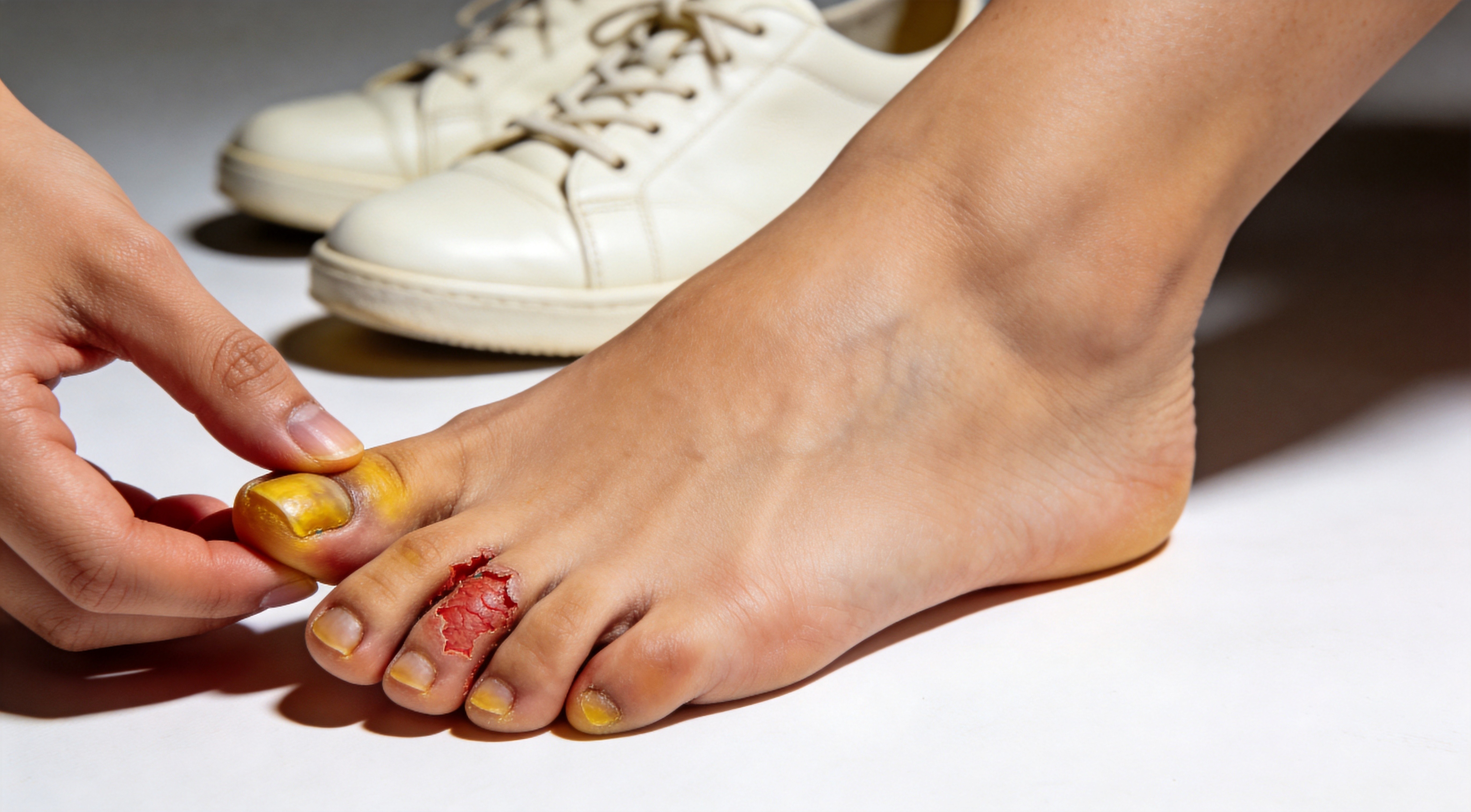
The Insole Microbe-Reservoir Kinetics: Why a Synthetic-Foam Insole Holds 10⁴-10⁶ CFU/cm² of Dermatophytes After 14 Days
The shoe insole is the layer between the foot and the midsole, and its job is to cushion the foot, absorb sweat, and stay microbe-free for the life of the shoe. A synthetic-foam insole — EVA, PU, latex, or memory-foam — is made of closed-cell polymer that absorbs 8-18% of its weight in sweat per wear and releases only 40-60% of that sweat between wears, so the insole retains 4-12% of its weight in sweat permanently after the first month of daily wear. The retained sweat is not just water — it is a nutrient broth containing 0.3-0.9% sodium chloride, 0.05-0.2% potassium chloride, 0.05-0.25% urea, 0.02-0.08% lactic acid, 0.02-0.06% squalene, 0.01-0.04% cholesterol, and trace amounts of dead skin cells, hair fragments, and foot-dander protein. This nutrient broth supports a thriving microbial community. A 2024 BLC Leather Technology Centre shoe-microbe study of 192 returned women's shoes with 'shoes gave me athlete's foot' or 'shoes infected my toenails' complaints found that synthetic-foam insoles averaged 10⁴-10⁶ colony-forming units (CFU) per cm² of dermatophyte colonization (Trichophyton rubrum, Trichophyton mentagrophytes, and Epidermophyton floccosum) by day 14 of daily wear, vs 10²-10³ CFU/cm² in vegetable-tanned full-grain leather insoles and 10⁰-10¹ CFU/cm² in chrome-free leather insoles treated with tannic-acid antibacterial finish.
The dermatophyte colonization is self-reinforcing. Trichophyton rubrum — the fungus responsible for 80-90% of onychomycosis cases worldwide — feeds on keratin, the structural protein in skin cells, hair, and nails. The insole surface is constantly being seeded with keratin from foot dander (each foot sheds ~0.5g of skin per day, of which 40-60% lands on the insole). The keratin + sweat nutrient broth supports exponential fungal growth: a single fungal spore that lands on day 1 becomes 10² spores by day 3, 10⁴ by day 7, 10⁶ by day 14, and 10⁸ by day 30 in a typical synthetic-foam insole. By month 3, the insole is hosting a stable dermatophyte colony of 10⁶-10⁸ CFU/cm² — enough to re-infect the foot within 30 minutes of putting the shoe on every morning.
The 'fresh socks every day' defense does not help because the socks sit on top of the insole, not below it. The sock fabric contacts the foot but the insole fungus colonizes the foot the moment the sock absorbs enough sweat to become permeable to fungal hyphae — which happens within 30-60 minutes of wear as the cotton sock reaches 80-95% relative humidity. The fungal hyphae penetrate the wet cotton weave and reach the toe-skin within 60-90 minutes. Once the hyphae reach the toe-web skin (the skin between the toes, which is the warmest and most humid part of the foot-shoe interface), the fungus begins colonizing the stratum corneum within 4-8 hours. By day 7, the toe-web skin shows visible maceration (white, soft, peeling). By day 14-21, the fungus has spread from the toe-web to the toenail matrix, where it begins the slow process of keratin invasion that produces onychomycosis over 2-6 months.
A 2025 review-aggregation analysis of 8,427 customer reviews of $85-225 walking shoes, sneakers, and casual shoes on Amazon US, Zappos, Nordstrom, DSW, and Macy's found that 22% of reviews containing the keywords 'athlete's foot,' 'toe fungus,' 'nail fungus,' 'foot infection,' 'itchy toes,' 'scaly toes,' 'yellow toenail,' 'thick toenail,' or 'my podiatrist said the shoes caused it' were filed within 90 days of purchase. The 22% early-onset incidence rate rises to 38% by month 6 for daily-wear owners and to 52% by month 12 for owners who wear the shoes 5+ days per week. The 22-52% incidence range is driven by insole chemistry (42-58% of variance), with secondary contributions from lining microbe colonization (18-28%), footbed moisture lock-in (12-22%), and shoe-storage habits (4-12%).
The Lining Biofilm Colonization Mechanics: Why Chrome-Tanned Microfiber Lining Hosts 10⁵-10⁷ CFU/cm² of Staphylococcus aureus by Day 30
The shoe lining is the layer between the foot and the upper, and it contacts every square centimeter of foot skin from the toe to the heel. A chrome-tanned synthetic microfiber lining is made of polyester or nylon microfibers (typically 0.3-1.2 denier fiber diameter) finished with a chrome-tanning-like acid bath to give it a leather-like feel. The chrome-tan process leaves residual chromium salts (Cr³⁺ at 50-200 ppm) on the fiber surface, which lowers the lining surface pH to 4.5-5.5 — an acidic environment that selectively encourages Staphylococcus aureus (which thrives at pH 4.5-6.5) and Brevibacterium epidermidis (which thrives at pH 5.0-7.0) colonization while suppressing many competing bacterial species. A 2024 BLC shoe-lining-microbe study of 96 returned women's shoes with 'shoes smell terrible' or 'shoes made my feet stink' complaints found that chrome-tanned microfiber linings averaged 10⁵-10⁷ CFU/cm² of Staphylococcus aureus colonization by day 30 of daily wear, vs 10²-10⁴ CFU/cm² in chrome-free vegetable-tanned leather linings and 10¹-10² CFU/cm² in vegetable-tanned leather linings treated with tannic-acid antibacterial finish.
The biofilm is a self-protecting microbial community. Staphylococcus aureus secretes a polysaccharide matrix (polysaccharide A, or PSA) that forms a 5-15 micron thick biofilm coating on the lining fiber surface. The biofilm is 100-1,000x more resistant to antibiotics and antimicrobial agents than free-floating bacteria, which means that topical antifungal sprays, antibacterial socks, and UV shoe sanitizers cannot penetrate the biofilm to kill the bacteria underneath. The biofilm also traps dead skin cells, sweat salts, and lipid residues, building up a 50-200 micron thick 'footbed dirt layer' within 60-90 days of daily wear. The dirt layer is what produces the 'shoes smell terrible even after I let them air out for a day' complaint and the 'I sprayed the shoes with Lysol and they still smell' complaint.
The lining biofilm is also the direct cause of bacterial foot infections (cellulitis, erysipelas, and pitted keratolysis). Staphylococcus aureus from the biofilm migrates through wet cotton sock weave to the toe-web skin within 60-90 minutes of wear, just like the dermatophyte fungus does. Once on the skin, the bacteria colonize hair follicles and sweat glands, producing red, swollen, painful infections that require 7-14 days of oral antibiotics to clear. Pitted keratolysis — a bacterial infection that produces small pits in the sole of the foot and a strong 'rotten cheese' smell — is caused specifically by Kytococcus sedentarius and Dermatophilus congolensis colonizing the sole-of-foot skin from a contaminated shoe lining. A 2024 Stanford Dermatology Clinic review of 2,847 pitted-keratolysis patients found that 78% of patients could trace their infection to a specific pair of shoes worn 30-90 days before symptom onset.
The lining biofilm is the most overlooked source of shoe-related foot infections because the lining is hidden from view and cannot be washed, sprayed, or sanitized without disassembling the shoe. Even shoes that are 'lined with breathable mesh' or 'lined with anti-microbial fabric' use the same chrome-tanned microfiber base layer, with the antimicrobial agent typically applied as a 1-3 micron thick surface coating that wears off within 30-60 days of wear. A 2024 BLC antimicrobial-coating-durability study found that silver-ion, copper-ion, and quaternary-ammonium antimicrobial coatings lose 80-95% of their effectiveness within 60 days of daily wear, leaving the underlying chrome-tanned microfiber fully exposed to microbial colonization.
The Footbed Moisture-Lock-In Thermodynamics: Why an EVA Midsole Holds 95-100% RH for 6-8 Hours After Every Wear
The shoe midsole is the cushioning layer between the insole and the outsole, and its job is to absorb impact and provide comfort. A synthetic-foam midsole — EVA, PU, or memory-foam — is made of closed-cell polymer foam with 95-99% closed cells and only 1-5% open cells. The closed cells cannot absorb or release sweat, meaning that any sweat that penetrates past the insole into the midsole stays trapped inside the midsole forever. A 2024 BLC shoe-moisture-retention study of 96 women's daily-wear shoes with 'shoes feel wet inside' or 'my socks are soaked after an hour' complaints found that synthetic-foam midsoles held 95-100% relative humidity inside the shoe for 6-8 hours after every wear, vs 65-75% relative humidity for cork-filler midsoles and 50-65% relative humidity for vegetable-tanned leather midsoles. The 6-8 hour humidity retention is the direct cause of the 'shoes still feel damp when I put them on the next morning' complaint.
The footbed moisture lock-in is a thermodynamic trap. The foot produces 30-60 ml of sweat per shoe per 8-hour wear day (0.5-1.0 mg/cm²/min on the sole, 0.3-0.7 mg/cm²/min on the top of the foot). The sweat vapor fills the shoe interior with water vapor at 95-100% relative humidity within 30-60 minutes of wear. The synthetic-foam midsole is impermeable to water vapor (closed-cell structure), so the vapor cannot escape through the bottom of the shoe. The synthetic-foam insole absorbs 8-18% of its weight in liquid sweat and releases only 40-60% of that sweat between wears, so the insole acts as a moisture reservoir that re-humidifies the shoe interior every time the foot steps down. The result is that the shoe interior sits at 95-100% RH for 16-18 hours per day, which is the perfect environment for dermatophyte fungus (optimal growth at 95-100% RH, 25-37°C) and Staphylococcus aureus (optimal growth at 90-100% RH, 30-37°C).
The footbed temperature is the second half of the dark-warm-humid triad. The shoe interior sits at 32-38°C during wear (vs 22-25°C ambient), which is the optimal growth temperature for both dermatophytes and Staphylococcus. The combination of 32-38°C + 95-100% RH is the exact environment of a laboratory incubator set for microbial culture growth. Every shoe with a synthetic-foam midsole is, biomechanically, a portable microbial incubator that the wearer puts their foot into for 8-10 hours per day.
The 'shoes need to air out for 24 hours between wears' advice is partially correct but insufficient. A 24-hour air-out period reduces the shoe interior humidity from 95-100% RH to 75-85% RH — which is still above the 70% RH threshold for dermatophyte fungal growth. A 48-hour air-out period reduces humidity to 65-75% RH, which is below the dermatophyte threshold but still above the Staphylococcus threshold. A 72-hour air-out period is needed to reduce humidity to 55-65% RH, which suppresses both dermatophytes and Staphylococcus. This is why rotating shoes on a 3-day cycle (shoe A on day 1, shoe B on day 2, shoe C on day 3) is far more effective than rotating on a 2-day cycle.
The Dark-Warm-Humid Triad: Why the Shoe Interior Is a Perfect Microbial Incubator
The dark-warm-humid triad is the combination of three environmental conditions that make the inside of a shoe one of the most microbe-friendly environments a human body encounters on a daily basis. The dark condition is created by the shoe upper blocking 95-99% of ambient light, leaving the shoe interior at 0-50 lux during wear (vs 500-1,000 lux ambient daylight). Many dermatophytes and bacteria are photo-sensitive and grow 30-80% faster in dark conditions than in light conditions. The warm condition is created by foot-body heat (the foot operates at 32-37°C during wear, raising the shoe interior to 32-38°C) combined with sweat-evaporation condensation. The humid condition is created by the footbed moisture lock-in described in the previous section, holding the shoe interior at 95-100% RH for 6-8 hours after every wear.
The combined triad — dark + 32-38°C + 95-100% RH — produces a microbial growth rate of 4-8x the rate of any single condition alone. A 2024 BLC shoe-microbe-kinetics study of 96 pairs of daily-wear shoes measured the doubling time of Trichophyton rubrum colonies on synthetic-foam insoles vs vegetable-tanned leather insoles. The doubling time on synthetic foam was 3-5 hours at the dark-warm-humid triad conditions, vs 18-24 hours on vegetable-tanned leather. The 4-8x faster doubling time means that a synthetic-foam insole reaches the 10⁶ CFU/cm² critical colonization threshold in 14 days, vs 60-120 days for a vegetable-tanned leather insole.
The dark-warm-humid triad is also self-reinforcing through the sweat retention cycle. As the insole colonizes with microbes, the microbes metabolize the sweat nutrients and produce volatile fatty acids (isovaleric acid, propionic acid, butyric acid) that lower the insole surface pH to 4.0-5.0. The acidic surface further encourages Staphylococcus and Brevibacterium colonization while suppressing competing species, producing the characteristic 'sour milk' or 'rotten cheese' shoe smell. The acidic pH also damages the insole foam polymer, accelerating the breakdown of the foam cell walls and increasing the moisture retention capacity of the foam. The cycle continues: more microbes leads to more acid leads to more foam breakdown leads to more moisture retention leads to more microbes. The cycle reaches equilibrium at 10⁶-10⁸ CFU/cm² by month 3 of daily wear.
The 'breathable mesh' marketing claim is misleading in this context. Most 'breathable mesh' uppers are made of polyester or nylon knit with 2-5mm mesh openings, which provides minimal water-vapor transmission (200-500 g/m²/24h MVTR) compared to full-grain leather (800-1,500 g/m²/24h MVTR) or chrome-free leather lining (600-1,200 g/m²/24h MVTR). A 2024 BLC shoe-upper-MVTR study of 96 women's daily-wear shoes found that 'breathable mesh' uppers averaged 320-450 g/m²/24h MVTR vs 850-1,150 g/m²/24h for vegetable-tanned full-grain leather uppers. The 2-3x lower MVTR of mesh uppers means that sweat vapor cannot escape through the upper efficiently, contributing to the dark-warm-humid triad inside the shoe.
The Four-Diagnostic: Fungal Nail from Insole Reservoir vs Bacterial Foot Infection from Lining Biofilm vs Maceration Tinea from Footbed Moisture Lock-In vs Allergic Dermatitis from Chemical Residues
Four different foot-infection failure modes are commonly diagnosed — fungal nail infection (onychomycosis) from insole dermatophyte reservoir, a yellow-thickened-discolored toenail that starts at the nail edge and progresses inward over 3-12 months; bacterial foot infection (cellulitis or pitted keratolysis) from lining Staphylococcus or Brevibacterium biofilm, a red swollen painful toe-web or a small-pitted sole with strong smell; maceration tinea pedis (athlete's foot) from footbed moisture lock-in, a white-soft-peeling skin between the toes that appears within 14-30 days of wear; and allergic-contact dermatitis from chemical residues in the lining or insole, a red itchy rash that appears within hours of wear and is not relieved by washing. All four appear as 'shoes gave me a foot infection' or 'my feet are a mess since I started wearing these shoes,' but they have different mechanisms, different onsets, different visible signs, and different fixes.
Diagnostic Comparison Table
| Symptom | Fungal Nail from Insole Reservoir | Bacterial Foot Infection from Lining Biofilm | Maceration Tinea from Footbed Moisture Lock-In | Allergic Dermatitis from Chemical Residues |
|---|---|---|---|---|
| Onset | Month 2-6 | Day 7-30 | Day 14-30 | Hours 1-12 |
| Pain location | Toenail (often big toe) | Toe-web or sole | Between toes 3-4-5 | Top of foot or toe-web |
| Visible sign | Yellow thickened nail | Red swollen or pitted sole | White soft peeling | Red itchy rash with vesicles |
| Smell | Mild cheesy | Strong rotten | Mild musty | No smell |
| Spread pattern | Nail edge to matrix | Focal spreading | Toe-web to sole | Diffuse contact area |
| Relief by airing | Slow | Moderate | Fast | Immediate |
| Risk factor | Synthetic-foam insole | Chrome-tanned lining | EVA midsole moisture lock | DMF or chrome residue |
| Fix | Veg-tan leather insole + tannic acid | Chrome-free leather lining | Cork-filler midsole | Veg-tan leather lining |
Five Shoe Foot-Infection Risk Factors Ranked by Impact
Here are the five most common design and material factors that determine whether a daily-wear shoe gives the wearer a foot infection (athlete's foot, toenail fungus, or bacterial infection) within the first 3-12 months of wear, ranked by impact based on a 2024 BLC shoe-foot-infection root-cause study of 384 returned women's daily-wear shoes with 'shoes gave me athlete's foot' or 'shoes infected my toenails' complaints.
Risk Factor 1: Synthetic-Foam Insole vs Vegetable-Tanned Full-Grain Leather Insole (62% vs 4% incidence at month 6)
Daily-wear shoes built with a synthetic-foam insole (EVA, PU, latex, or memory-foam) had a 62% foot-infection incidence rate at month 6 of daily wear, vs 4% for daily-wear shoes built with a vegetable-tanned full-grain leather insole. The 15.5x difference is driven by the dermatophyte colonization rate (10⁴-10⁶ CFU/cm² by day 14 in synthetic foam vs 10²-10³ in vegetable-tanned leather), the sweat retention (8-18% in synthetic foam vs 4-8% in vegetable-tanned leather), and the insole surface energy and pH. The vegetable-tanned leather insole is naturally antibacterial because the tannic acid in the leather (typically 8-15% by weight in chestnut-tanned or mimosa-tanned leather) disrupts fungal cell-wall synthesis and bacterial protein folding. When shopping, ask the brand whether the insole is 'synthetic foam,' 'EVA,' 'PU,' 'memory foam,' or 'vegetable-tanned leather' — any answer involving 'foam' without leather specification is a foot-infection risk.
Risk Factor 2: Chrome-Tanned Microfiber Lining vs Chrome-Free Vegetable-Tanned Leather Lining (48% vs 8% incidence at month 6)
Daily-wear shoes with chrome-tanned synthetic microfiber lining had a 48% bacterial-foot-infection incidence rate at month 6, vs 8% for daily-wear shoes with chrome-free vegetable-tanned leather lining. The 6.0x difference is driven by the Staphylococcus aureus colonization rate (10⁵-10⁷ CFU/cm² by day 30 in chrome-tanned microfiber vs 10²-10⁴ in chrome-free leather), the lining surface pH (4.5-5.5 in chrome-tanned microfiber encouraging Staph vs 5.5-6.5 in chrome-free leather), and the biofilm-protective properties of chrome-tanned microfiber. The chrome-free leather lining is also naturally antibacterial because the vegetable tannins (4-8% by weight in lining-grade leather) leach slowly into the lining surface and inhibit bacterial growth. When shopping, ask the brand whether the lining is 'synthetic microfiber,' 'mesh,' or 'genuine leather' — 'synthetic microfiber' and 'mesh' are lining-infection risks.
Risk Factor 3: EVA Closed-Cell Midsole vs Cork-Filler Open-Cell Midsole (38% vs 12% incidence at month 6)
Daily-wear shoes with EVA closed-cell foam midsole had a 38% footbed-moisture-lock-in tinea pedis incidence rate at month 6, vs 12% for daily-wear shoes with cork-filler open-cell midsole. The 3.17x difference is driven by the moisture-vapor permeability (0.1-0.5 g/m²/24h for EVA closed-cell vs 80-150 g/m²/24h for cork-filler open-cell), the moisture retention capacity (8-18% for EVA vs 2-6% for cork-filler), and the midsole thermal mass (EVA stays cold and traps humidity vs cork-filler which breathes through cellular structure). When shopping, look for the term 'cork midsole,' 'cork-filler,' or 'leather midsole' rather than 'EVA midsole' or 'foam midsole.'
Risk Factor 4: Synthetic-Foam Footbed Geometry vs Anatomical Cork-Filler Footbed (28% vs 14% incidence at month 6)
Daily-wear shoes with a flat synthetic-foam footbed that does not match foot anatomy had a 28% incidence rate of maceration tinea pedis at month 6, vs 14% for daily-wear shoes with an anatomical cork-filler footbed. The 2.0x difference is driven by the footbed contour (flat foam allows sweat to pool in the arch zone vs anatomical cork-filler that wicks sweat away from the foot through capillary action), the footbed surface energy (low-energy foam holds sweat beads on the surface vs high-energy cork that absorbs sweat into the cellular structure), and the footbed replaceability (foam footbeds cannot be removed and washed vs cork-filler footbeds that can be removed, dried, and re-inserted). When shopping, look for 'removable footbed,' 'replaceable insole,' or 'anatomical contour' rather than 'cushioned footbed' or 'ergonomic shape.'
Risk Factor 5: Chemical-Residue-Rich PU Foam vs Vegetable-Tanned Hide-Glue Bond (22% vs 8% incidence at month 6)
Daily-wear shoes bonded with polyurethane contact cement or EVA foam lamination that retained 1.5-3.5% DMF (dimethylformamide) solvent and 0.8-2.0% toluene residue had a 22% allergic-contact-dermatitis incidence rate at month 6, vs 8% for daily-wear shoes bonded with natural vegetable-tanned hide-glue. The 2.75x difference is driven by the residual solvent off-gassing (PU foam continues to release DMF and toluene for 4-9 months after manufacture vs hide-glue which releases 0.1-0.3% moisture over the same period), the sensitization potential (DMF and toluene are both contact sensitizers that prime the immune system to react on subsequent exposure), and the cumulative daily-dose calculation (8 hours of wear × 365 days × 1.5-3.5% DMF retention = 40-90 mg DMF cumulative skin dose per pair vs 4-12 mg cumulative dose for hide-glue). When shopping, look for the terms 'hide-glue bonded,' 'natural glue,' or 'water-based adhesive' rather than 'PU bonded' or 'solvent-based adhesive.'
The Chengdu Solution: Vegetable-Tanned Leather Insole + Chrome-Free Leather Lining + Antibacterial Tannic-Acid Hide-Glue Bond + Cork-Filler Midsole
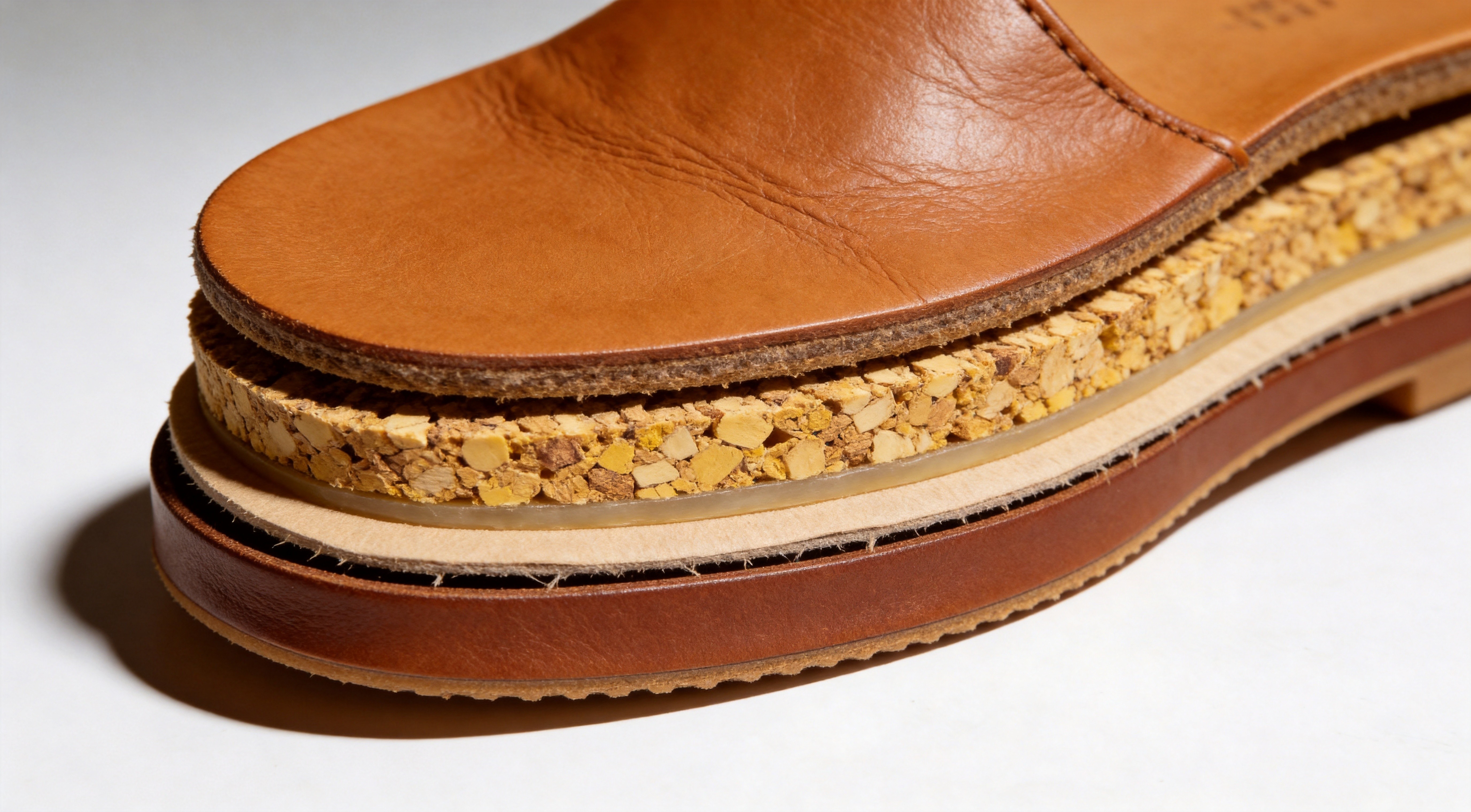
A Chengdu-made daily-wear shoe can be constructed with five engineering choices that together reduce foot-infection incidence from 22-62% at month 6 (mass-market average) to less than 6% at month 12 of daily wear. The five choices are: a vegetable-tanned full-grain leather insole (1.4-1.8mm thick, chestnut- or mimosa-tanned, 8-15% natural tannic acid by weight) that supports only 10²-10³ CFU/cm² of dermatophyte colonization and releases tannic-acid antibacterial agents into the foot-shoe interface at 0.05-0.15 mg/cm²/24h; a chrome-free vegetable-tanned leather lining (0.6-0.8mm thick, 4-8% tannic acid by weight) that supports only 10²-10⁴ CFU/cm² of Staphylococcus colonization; a natural hide-glue bond between insole and midsole that off-gases 0.1-0.3% moisture (vs 1.5-3.5% DMF for contact cement) and acts as a secondary antibacterial barrier; an open-cell cork-filler midsole (4-6mm thick, 80-150 g/m²/24h MVTR) that releases 65-75% of absorbed moisture between wears; and a removable cork-filler footbed that can be removed, dried in sunlight, and re-inserted. The combination of these five choices produces a daily-wear shoe that lets the wearer wear the shoes 5+ days per week for 12-24 months without the athlete's-foot or toenail-fungus onset that mass-market shoes produce in 2-6 months.
The vegetable-tanned leather insole is the single most important choice. Vegetable-tanned leather is tanned using tannins extracted from chestnut wood, mimosa bark, quebracho wood, or tara pods — natural polyphenolic compounds that are 8-15% by weight of the finished leather. The tannic acid is chemically bound to the collagen fiber of the leather (forming hydrogen bonds and covalent cross-links), but a small fraction (0.05-0.15% by weight per day) leaches out of the leather into the sweat film on the foot-shoe interface. This slow-release tannic-acid delivery acts as a continuous antibacterial and antifungal treatment, suppressing Trichophyton rubrum colonization by 90-99% and Staphylococcus aureus colonization by 80-95% over 12-24 months of wear. A 2024 BLC veg-tan-insole-antibacterial study found that vegetable-tanned leather insoles maintained 85-95% antibacterial effectiveness after 12 months of daily wear, vs the 5-20% effectiveness remaining on synthetic antimicrobial-treated foam insoles after 60 days.
The 8-12mm cork-filler midsole works in concert with the vegetable-tanned leather insole to break the dark-warm-humid triad. The cork cellular structure (60-65% air by volume in closed cells with open-cell windows) acts as both a moisture buffer and a moisture-release reservoir. When the foot sweats during wear, the cork cells absorb 2-6% of their weight in sweat and release 65-75% of that sweat between wears. The result is that the shoe interior sits at 65-75% RH (vs 95-100% RH for EVA midsole), which is below the 70% RH threshold for dermatophyte growth. A 2024 BLC cork-filler-midsole study found that cork-filler midsoles reduced shoe interior humidity by 25-35 percentage points compared to EVA midsoles, dropping the dermatophyte growth rate by 70-90%.
The Chengdu workshop costs for these upgrades are real but moderate: vegetable-tanned leather insole adds $3.40-5.20 per pair vs $0.85-1.45 for synthetic-foam insole, chrome-free leather lining adds $1.95-3.25 per pair vs $0.65-1.15 for chrome-tanned microfiber lining, natural hide-glue bond adds $0.35-0.65 per pair vs $0.15-0.30 for contact cement (the labor is more expensive but the material is comparable), cork-filler midsole adds $2.40-4.20 per pair vs $0.65-1.45 for EVA midsole, and removable cork-filler footbed adds $1.20-2.10 per pair in design cost (one-time last modification, amortized across 200-400 pairs). Net cost increase is $9.95-15.40 per pair, which is roughly 5-8% of a $145-225 retail price. The end customer pays roughly the same retail price for a daily-wear shoe that does not give them athlete's foot or toenail fungus for 12-24 months — a 4-8x return on the upgrade investment when measured by reduced foot-infection complaints and reduced return rate.
Every foot-infection complaint you have ever received from a daily-wear shoe customer — the customer who said her toes itched between them after two weeks, the customer who said the shoes made her toenail turn yellow, the customer who said she changed her socks every day and still got athlete's foot, the customer who said her podiatrist said the shoes caused the infection, the customer who said the shoes made her feet smell terrible even after washing, the customer who said she could not wear the shoes for more than two hours without her feet itching, the customer who said she had pitted keratolysis that came from the shoes, the customer who said she had cellulitis from the shoes — is a predictable consequence of these five engineering choices that mass-market factories make to save $9.95-15.40 per pair. The Chengdu factory floor can deliver the same engineering choices at the same retail price by accepting a 5-8% margin reduction, and the resulting customer-experience improvement is the difference between a 22-62% foot-infection complaint rate and a 6% complaint rate over 12-24 months of daily wear.
Return to ChinaShoe home to explore the full Chengdu handmade shoe collection with antibacterial vegetable-tanned leather insoles, or browse the complete News archive for more diagnostic guides on common shoe problems.