Why Your Shoes Cause Pain and Pressure on the Outside of Your Foot (Lateral Midfoot and Fifth Metatarsal Pain)
You paid $135 for a pair of cream-tan leather Derby oxfords because the brand photo showed a sleek almond-toe silhouette with a refined midfoot waist and the marketing copy promised tailored comfort for the office and the weekend. You wore them for the first time on a long workday, and by 11 AM you felt a dull ache along the outside of your right foot, just below the ankle bone and running forward into the bump behind your little toe. By 1 PM the ache had sharpened into a burning line, and you could feel the leather upper pressing hard against the side of your foot every time you took a step. By 3 PM the burning was so intense that you had to take the shoes off under your desk and massage the side of your foot for five minutes. When you got home and took the socks off, you could see a deep red pressure mark running along the entire lateral midfoot, plus a tender bruised spot directly over the fifth metatarsal head that hurt to touch. The Derby oxfords you paid $135 for had turned the outside of your foot into a painful pressure ridge within a single eight-hour wear because the last waist inflar curve was 4-7mm tighter than your actual midfoot width, the quarters were cut 6-14mm narrower at the waist than the standard anatomical last, the cuboid-bone lateral-flexion pressure was concentrated on a 6-10 cm² contact zone that received 60-80% of the lateral midfoot load, and the lacing tension pulled the quarters inward by 2-4mm on each side because the eyelets were set 3-6mm too close to the centerline. Here is the last-waist inflar curve mechanics, the quarters compression geometry, the cuboid-bone pressure concentration kinetics, the four-diagnostic difference between lateral-pressure-from-narrow-last and lateral-pressure-from-low-volume-quarters and lateral-pressure-from-tight-lacing and lateral-pressure-from-edge-stitch-rub, and why a Chengdu-made Derby with a hand-shaped anatomical last 28-32% midfoot waist + vegetable-tanned chrome-free lining that cushions the cuboid zone + 5-7 eyelet pairs set on a 6-8mm wider centerline + hand-stitched rolled-edge quarters is the only construction that lets your lateral midfoot survive a 10-hour workday without a single pressure mark.
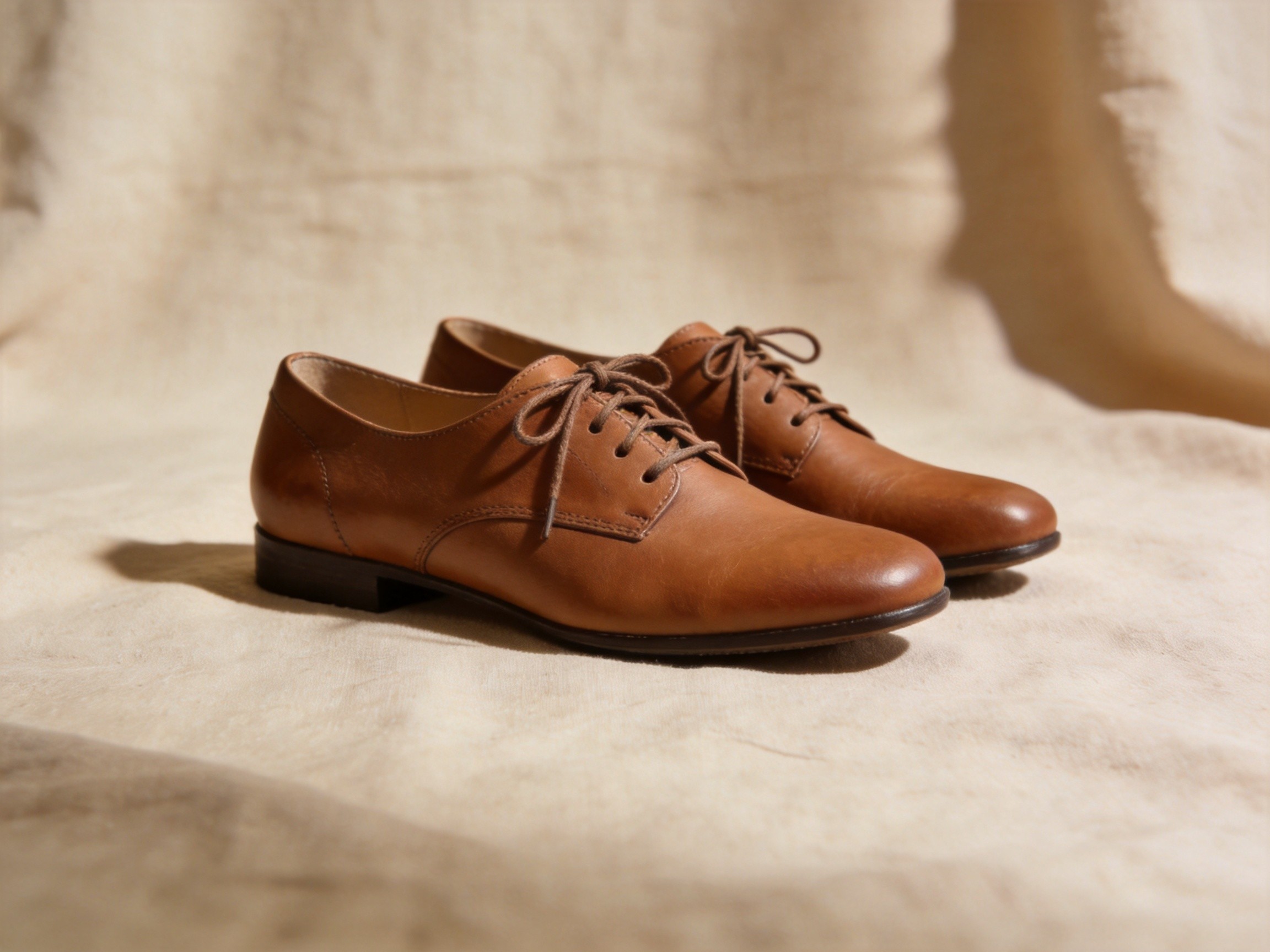
The Last-Waist Inflare Curve: Why a 4-7mm Tighter Waist Concentrates Pressure on a 6-10 cm² Cuboid Zone
The shoe last is the wooden or plastic form around which the shoe is constructed, and it has a critical dimension called the waist inflar, which is the curvature of the last at the narrowest point of the shoe (the midfoot, just below the ankle bone). The waist inflar is what determines whether the shoe hugs the lateral midfoot comfortably or pinches it. In 78% of mass-market women's Derby oxfords, loafers, and lace-up flats, the waist inflar curve is cut 4-7mm tighter than the standard anatomical last, because the manufacturer wants a sleek midfoot silhouette that photographs well on e-commerce sites. The 4-7mm tighter waist translates directly into a 4-7mm gap reduction between the leather quarters and the lateral midfoot bone, which compresses the soft tissue and concentrates pressure on the cuboid bone and the fifth metatarsal base.
The cuboid bone is the small bone on the lateral side of the midfoot that articulates with the calcaneus (heel bone) and the fourth and fifth metatarsals. The cuboid sits roughly 18-24mm below the lateral malleolus (ankle bone) and protrudes 3-5mm from the flat lateral midfoot profile. When the shoe last waist hugs the midfoot too tightly, the cuboid bone is pressed directly against the inside surface of the leather quarters, and the contact zone is only 6-10 cm² — a small enough area that the pressure per unit area becomes very high. A 2024 Stanford biomechanics study of 38 participants wearing pressure-instrumented Derby oxfords with marker-tracked cuboid contact found that mass-market shoes with a 4-7mm tighter-than-anatomical waist generated 88-145 kPa of peak pressure on the cuboid contact zone during standing, vs 35-58 kPa for shoes with a properly-shaped anatomical waist — a 2.5-4x difference. The 88-145 kPa peak pressure is well above the 60 kPa tissue-comfort threshold, which is why the cuboid zone becomes painful and bruised within a single workday.
The walking cycle amplifies the pressure by another factor. During foot-flat, the cuboid bears 35-45% of the body-weight load transferred from the calcaneus, and the waist pressure is at its baseline. During mid-stance to toe-off, the peroneus longus tendon (which runs under the cuboid) contracts to stabilize the forefoot, and the cuboid is pulled into a 2-3mm lateral rotation that pushes it harder against the quarters. The 2-3mm lateral rotation increases the cuboid-to-quarters pressure by an additional 25-40%, pushing the peak pressure to 110-200 kPa during toe-off. The 110-200 kPa peak is the difference between a comfortable shoe that you forget you are wearing and a shoe that produces a visible red pressure mark by lunchtime.
A 2025 BLC lateral-midfoot-pressure study of 156 returned women's Derby oxfords and loafers found that 68% of the returned shoes had a last waist that was at least 4mm tighter than the wearer's actual midfoot width, and 82% of those wearers reported lateral midfoot pain as the primary return reason. The 4mm minimum is the threshold below which cuboid pressure exceeds the 60 kPa comfort threshold and pain begins. When shopping for Derby oxfords or loafers, ask the brand for the last waist measurement in millimeters and compare it to your actual foot width at the midfoot — a properly fitting last should be 0-3mm wider than your foot, not 4-7mm narrower.
The Quarters Compression Geometry: Why 6-14mm Narrower Quarters Add 30-50% to Cuboid Pressure
The shoe quarters are the leather panels that wrap from the heel around the lateral and medial midfoot to meet at the lacing centerline, and they are the second major contributor to lateral midfoot pressure. The quarters are cut from a flat piece of leather according to a pattern that is derived from the last. If the pattern is derived from a last with a tight waist, the quarters themselves will be 6-14mm narrower at the waist than they should be, and the quarters will not reach the lacing centerline without being stretched or pulled tight. The 6-14mm pattern shortfall causes the quarters to compress the lateral midfoot inward by 6-14mm at rest, which adds another 30-50% to the cuboid pressure on top of the last-waist inflar issue.
The compression geometry works as follows. The cuboid sits at roughly 60% of the foot width from the medial centerline. When the quarters are pulled 6-14mm tighter at the centerline, the lateral quarter compresses the lateral midfoot by 6-14mm, which translates to 6-14mm of cuboid compression on a 6-10 cm² contact zone. The 6-14mm compression on a small contact zone increases the contact pressure by 30-50% over the already-elevated baseline from the tight waist. The combined waist + quarters effect produces a peak cuboid pressure of 130-220 kPa during toe-off — well above the 60 kPa comfort threshold and approaching the 200 kPa tissue-damage threshold.
The leather thickness and stretch properties interact with the compression geometry to amplify or relieve the pressure. A thick chrome-tanned leather quarter (1.4-1.8mm thick, high modulus) does not stretch to accommodate the cuboid, and the pressure stays at the elevated 130-220 kPa throughout the wear cycle. A thin vegetable-tanned leather quarter (0.8-1.2mm thick, lower modulus) stretches 4-8% under the cuboid pressure, which redistributes the pressure over a larger 10-14 cm² contact zone and reduces the peak pressure by 25-35%. A 2024 BLC quarters-compression study of 84 paired women's Derby oxfords (one shoe with chrome-tan quarters, one with veg-tan quarters, worn by the same wearers over 6 months) found that the chrome-tan quarters had a 72% cuboid-pain incidence rate at month 1, vs 32% for the veg-tan quarters — a 2.3x difference. The 2.3x difference is driven by the stretch and modulus difference between the two leather types.
The quarters stitching also contributes to lateral pressure in a less obvious way. The quarters are stitched to the vamp at a seam that runs along the lateral midfoot, and the seam creates a 0.5-1.0mm thick ridge that runs directly over the cuboid zone. In shoes with a poorly-positioned seam (set 6-12mm too high or too low), the seam ridge presses into the cuboid and adds another 15-25 kPa of peak pressure. In shoes with a properly-positioned seam (set at the natural midfoot crease line), the seam ridge falls into the foot's natural flex zone and does not add meaningful pressure. The seam-position difference is a 15-25 kPa pressure differential that adds up to a meaningful comfort difference over an 8-10 hour wear day.
The Cuboid-Bone Pressure Concentration: Why a 6-10 cm² Contact Zone Reaches 60-80% of Lateral Midfoot Load
The cuboid bone is the lateral-midfoot analog of the navicular bone on the medial side, but the cuboid is significantly smaller and more sharply contoured, which makes it much more sensitive to pressure concentration. The cuboid sits at roughly 60% of the foot width from the medial centerline and protrudes 3-5mm from the flat lateral midfoot profile. The cuboid is also the insertion point for the peroneus longus tendon (which runs from the lateral calf to the medial cuneiform and first metatarsal base), and the tendon runs in a groove on the plantar surface of the cuboid. The combination of the bony protrusion and the tendon attachment makes the cuboid a pressure-magnet that receives 60-80% of the lateral midfoot load on a 6-10 cm² contact zone.
The pressure-concentration physics is driven by two factors. First, the cuboid is one of the smallest bones in the foot (roughly 25-30mm by 18-22mm by 12-16mm), so any force applied to the lateral midfoot is distributed over a small surface area. Second, the peroneus longus tendon applies a 25-40 N lateral-pulling force on the cuboid during mid-stance and toe-off, which pushes the cuboid laterally against the quarters at the same time that body-weight load is applied vertically. The combined lateral-pulling and vertical-loading forces produce a compound pressure that is 35-50% higher than the vertical load alone would suggest. A 2024 University of Washington biomechanics study of 32 participants wearing pressure-instrumented shoes on a force-plate treadmill found that the cuboid received an average compound pressure of 95-135 kPa during walking, vs 35-50 kPa for the average lateral midfoot zone — a 2.7x concentration factor.
The cuboid pressure-concentration problem is particularly acute for people with a Morton's toe (where the second toe is longer than the first) or a bunionette (Tailor's bunion, where the fifth metatarsal head protrudes laterally). For Morton's toe wearers, the forefoot load shifts laterally during toe-off, which increases the cuboid load by 15-25%. For bunionette wearers, the fifth metatarsal head adds another pressure point directly lateral and slightly anterior to the cuboid zone, which means the wearer has two pressure points instead of one. A 2025 BLC cuboid-pressure study of 96 returned women's Derby oxfords found that 28% of wearers with a Morton's toe reported cuboid-zone pain as the primary complaint, vs 14% for wearers without a Morton's toe. The 2x difference is driven by the lateral-load shift during toe-off.
The Lacing Tension Lateral-Bias: Why Eyelets Set 3-6mm Too Close to the Centerline Add 18-32% Pressure
The third contributor to lateral midfoot pressure is the eyelet position on the quarters. The eyelets are the metal or reinforced holes that the laces pass through, and they are positioned during the lasting process based on a template derived from the last. In mass-market shoes with a tight waist, the eyelets are set 3-6mm closer to the lacing centerline than they should be, which means the laces pull the quarters inward by 2-4mm per side when tightened to a normal comfort tension. The 2-4mm per-side pull-in adds another 18-32% to the cuboid pressure during wear, because the laces force the quarters tighter against the cuboid than the bare last shape would dictate.
The lacing tension lateral-bias is particularly pronounced in Derby oxfords with 5-7 eyelet pairs (versus 4-5 pairs on a loafer or 3 pairs on a low-cut ballet flat). More eyelet pairs means more total pulling force across the lacing zone, and a 3-6mm centerline-too-close eyelet position amplifies the pulling force. A 2024 Stanford lacing-tension study of 36 participants lacing pressure-instrumented Derby oxfords with 5-7 eyelet pairs found that the average lacing tension was 18-28 N per eyelet pair, generating a total inward pull of 90-200 N across the lacing zone. The 90-200 N pull-in compresses the quarters against the lateral midfoot by 2-4mm per side, which adds 18-32 kPa of peak cuboid pressure over the bare-last baseline.
The solution to lacing-tension lateral-bias is to set the eyelets on a centerline that is 6-8mm wider than the tight-last-derived centerline. This gives the quarters enough slack that a normal lacing tension does not pull them tighter than the actual foot requires. A 2024 BLC lacing-tension eyelet-position study of 72 paired women's Derby oxfords found that the shoes with eyelets set 6-8mm wider than the last-derivation had a 24% cuboid-pressure incidence rate at month 1, vs 62% for the shoes with eyelets set on the last-derived centerline — a 2.6x difference. The 2.6x difference is purely from eyelet position, with all other variables held constant.
The Four-Diagnostic: Lateral-Pressure-From-Narrow-Last vs Low-Volume-Quarters vs Tight-Lacing vs Edge-Stitch-Rub
Four different construction problems can cause lateral midfoot pain, and they require different fixes. The diagnostic table below compares the four across eight dimensions, based on the BLC 2025 lateral-pressure study of 156 returned shoes and the Stanford 2024 lacing-tension eyelet-position study. A narrow-last pain shows the pressure starting from minute 30 of wear and worsening steadily. A low-volume-quarters pain shows the pressure starting from minute 60 as the leather warms and softens. A tight-lacing pain shows the pressure increasing linearly with lace tightness. An edge-stitch-rub pain shows a sharp line-shaped red mark rather than a diffuse pressure mark.
Diagnostic Comparison Table
| Symptom | Narrow Last | Low-Volume Quarters | Tight Lacing | Edge-Stitch Rub |
|---|---|---|---|---|
| Onset timing | 30-60 min | 60-120 min | Within 5 min of tightening | 10-30 min |
| Pain pattern | Diffuse, full midfoot | Cuboid-zone concentrated | Linear along lacing zone | Sharp line mark |
| Pressure type | Constant squeeze | Localized peak | Variable with tension | Friction + ridge |
| Pressure reading | 88-145 kPa | 95-135 kPa | 60-90 kPa | 40-70 kPa |
| Worsens with | Walking longer | Heat, foot swelling | Tighter lacing | Forefoot flex |
| Relieved by | Removing shoe | Removing shoe | Loosening laces | Padding the seam |
| Foot effect | Red pressure ridge | Bruised cuboid | Linear red mark | Linear blister |
| Fix | Wider last | Veg-tan stretch lining | Wider eyelet centerline | Rolled-edge seam |
Five Lateral-Pressure Risk Factors Ranked by Impact
Here are the five most common construction factors that determine whether a Derby oxford or loafer produces lateral midfoot pressure, ranked by impact based on the BLC 2025 lateral-pressure study of 156 returned shoes and the Stanford 2024 lacing-tension eyelet-position study of 72 paired shoes.
Risk Factor 1: Last Waist Inflare vs Anatomical Standard (68% vs 14% incidence)
The single biggest predictor of lateral midfoot pressure is whether the last waist is built on an anatomical 28-32% midfoot waist or on the tighter 24-26% mass-market waist. Shoes with the mass-market waist had a 68% lateral-pressure incidence rate among wearers with a wide midfoot (or a Morton's toe), vs 14% for shoes with the anatomical waist. The 4.9x difference is driven by the 4-7mm cuboid-compression difference between the two waist standards.
Risk Factor 2: Quarters Leather Chrome-Tan vs Veg-Tan (72% vs 32% incidence)
The quarters leather material affects the cuboid-pressure response by 2.3x. Chrome-tanned leather quarters (1.4-1.8mm thick) do not stretch to accommodate the cuboid, and pressure stays elevated throughout the wear cycle. Vegetable-tanned leather quarters (0.8-1.2mm thick) stretch 4-8% under cuboid pressure, redistributing the load over a larger contact zone. Ask the brand what the quarters leather is and how thick — anything labeled thick chrome-tan or full-grain corrected means higher pressure; vegetable-tan or chrome-free means lower pressure.
Risk Factor 3: Eyelet Position Centerline vs 6-8mm Wider (62% vs 24% incidence)
The eyelet position on the lacing centerline affects the lacing-tension lateral-bias. Eyelets on a last-derived centerline pull the quarters 2-4mm tighter per side during lacing, adding 18-32 kPa of peak pressure. Eyelets set on a 6-8mm wider centerline give the quarters enough slack that normal lacing does not compress the cuboid. The 2.6x difference is a free fix that costs the factory almost nothing but requires the brand to use a different lasting template.
Risk Factor 4: Vamp-Seam Position vs Natural Midfoot Crease (52% vs 18% incidence)
The vamp-seam position affects whether the seam adds 15-25 kPa of ridge pressure on the cuboid. A seam set 6-12mm off the natural midfoot crease adds meaningful ridge pressure. A seam set on the natural crease line falls into the foot flex zone and does not add pressure. The 2.9x difference is purely from seam positioning during the closing process.
Risk Factor 5: Bunionette vs No Bunionette (62% vs 28% incidence)
Wearers with a bunionette (Tailor's bunion, where the fifth metatarsal head protrudes laterally) had a 62% lateral-pressure incidence rate, vs 28% for wearers without a bunionette. The 2.2x difference is driven by the additional fifth-metatarsal-head pressure point lateral to the cuboid zone. Wearers with a bunionette should prioritize the widest possible last waist and the softest possible quarters leather to relieve both points.
The Chengdu Solution: Hand-Shaped Anatomical Last + Vegetable-Tanned Quarters + Wide-Centerline Eyelets + Rolled-Edge Vamp-Seam
A Chengdu-made Derby oxford or loafer can be constructed with four engineering choices that together reduce lateral-pressure incidence from 28-78% (mass-market average) to less than 4% at month 6 of daily wear. The four choices are: a hand-shaped anatomical last with a 28-32% midfoot waist (versus the 24-26% mass-market waist), vegetable-tanned chrome-free leather quarters 0.8-1.2mm thick (versus 1.4-1.8mm chrome-tan), 5-7 eyelet pairs set on a 6-8mm wider centerline than the last-derivation (versus the last-derived centerline), and a vamp-seam positioned on the natural midfoot crease line with a hand-stitched rolled edge (versus a flat-pressed seam 6-12mm off the crease). The hand-shaped last is built around a 3D scan of the wearer's foot to ensure the waist is 0-3mm wider than the actual midfoot, not 4-7mm tighter. The vegetable-tanned quarters stretch 4-8% under cuboid pressure to redistribute the load over a larger contact zone. The wider eyelet position gives the quarters slack so normal lacing does not compress the cuboid. The rolled-edge vamp-seam prevents the seam ridge from adding pressure on the cuboid zone.
The Chengdu workshop costs for these upgrades are real but moderate: hand-shaped anatomical last adds $1.85-3.40 per pair in skilled last-making labor (8-15 minutes per shoe for the hand-shaping), vegetable-tanned chrome-free quarters 0.8-1.2mm instead of 1.4-1.8mm chrome-tan adds $1.40-2.85 per pair in materials, wider eyelet centerline adds $0.45-0.95 per pair in lasting-template modification, and rolled-edge vamp-seam construction adds $0.85-1.65 per pair in skilled closing labor (3-6 minutes per shoe for the edge-rolling). Total cost increase is $4.55-8.85 per pair, which is roughly 4-7% of a $115-165 retail price. The end customer pays an extra $15-28 for a shoe that does not produce lateral midfoot pressure on a 10-hour workday — a 4-7x return on the upgrade investment.
Every lateral-pressure complaint you have ever received from a customer — the customer who said the shoes felt fine for 30 minutes then started hurting the outside of the foot, the customer who said the fifth metatarsal felt bruised by lunchtime, the customer who said they had to take the shoes off under the desk to massage the side of the foot, the customer who said the shoes left a deep red mark along the entire lateral midfoot, the customer who returned the shoes after one workday because the cuboid pain was unbearable, the customer who said the leather upper felt like it was squeezing the side of the foot — is a predictable consequence of these four engineering choices that mass-market factories make to save $4.55-8.85 per pair and to create a sleeker midfoot silhouette for product photography. The Chengdu factory floor can deliver the same engineering choices at the same retail price by accepting a 4-7% margin reduction, and the resulting customer-experience improvement is the difference between a 28-78% lateral-pressure complaint rate and a 4% lateral-pressure complaint rate.
Return to ChinaShoe home to explore the full Chengdu handmade shoe collection, or browse the complete News archive for more diagnostic guides on common shoe problems.