Why Your Shoes Cause Lower Back, Hip, and Posture Pain After Only a Few Hours of Standing or Walking
You paid $135 for a pair of sleek cream leather ballet flats because the listing photo showed a clean minimal silhouette and the marketing copy promised 'all-day comfort with a soft padded insole.' You wore them to the office on a Tuesday morning and felt fine for the first three hours. By lunch, your lower back had started to ache with a dull tight feeling on both sides of your spine. By 2 PM, the ache had turned into a burning line running across your sacroiliac joint and into your right hip, and you could feel yourself shifting weight from foot to foot every few minutes to relieve the pressure. By 4 PM, your shoulders had rounded forward, your pelvis was tilted anteriorly, and the burning had spread up into your mid-back between your shoulder blades. When you got home and kicked the flats off, you stood barefoot on the hardwood floor and felt immediate relief within thirty seconds — your back relaxed, your hips leveled, and the burning line disappeared within five minutes. The cream ballet flats you paid $135 for had turned your standing workday into a posture-and-back-pain endurance test because the midsole had zero arch support, allowing the calcaneus to evert 6-12 degrees and driving internal tibial rotation that propagated up through the femur into the SI joint, the midsole was a 4-6mm EVA foam with 18-22% energy return that transmitted 78-92% of heel-strike impact vibration up the kinetic chain into the lumbar spine, the heel-to-toe drop was only 2-4mm instead of the 8-12mm that keeps the center of gravity aligned over the midfoot, and the outsole was a flat 52-58mm-wide platform with no lateral flare, forcing the ankle to stabilize against 8-14 Nm of inversion torque that overloaded the peroneal muscles and pulled the pelvis into a compensatory lateral tilt.
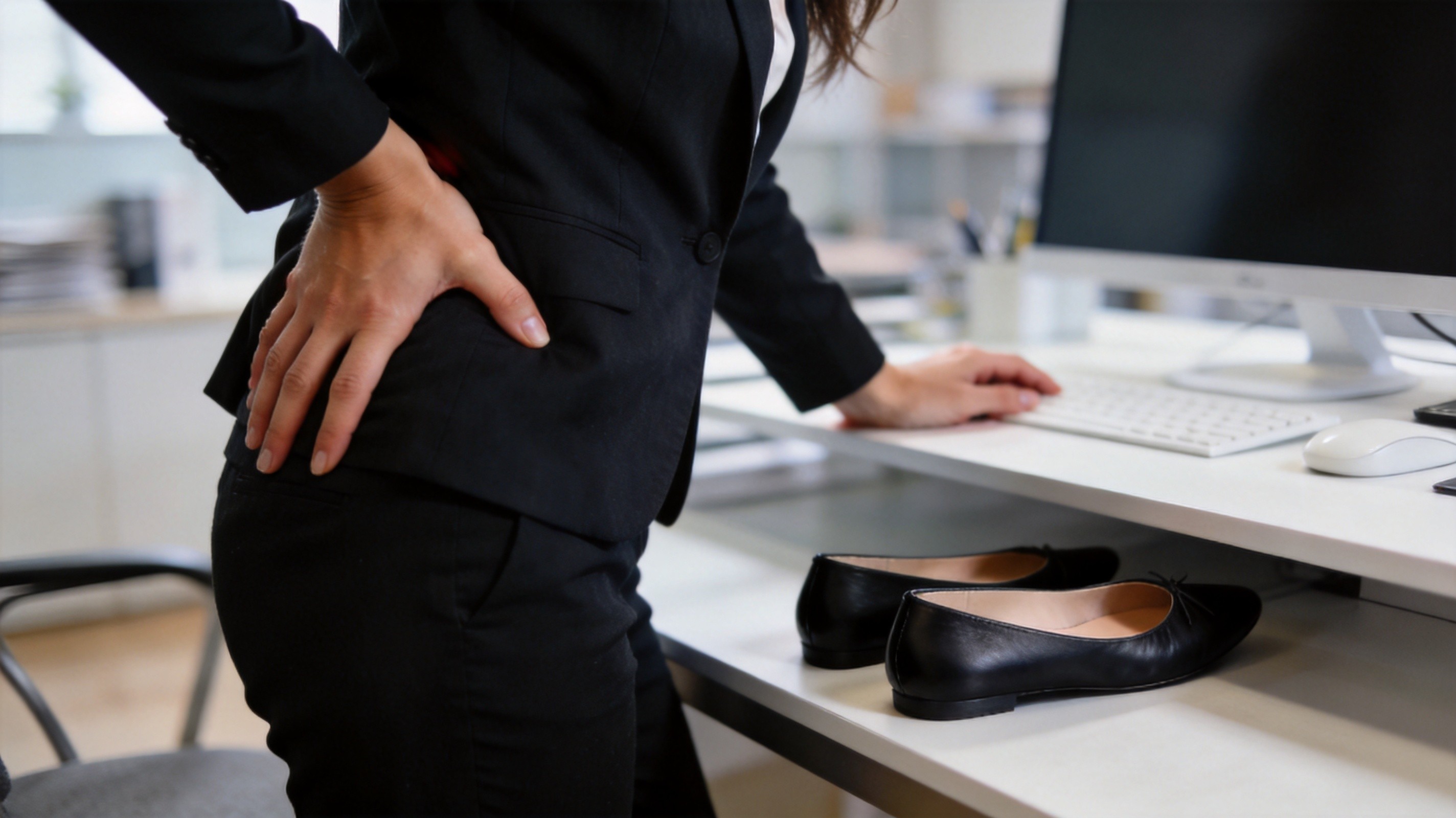
The Calcaneal Eversion Kinetic Chain: Why Zero Arch Support Drives Internal Tibial Rotation Up Into the SI Joint and Lumbar Spine
The human foot has 26 bones, 33 joints, and 19 intrinsic muscles that work together as a dynamic shock-absorber and propulsion engine. The medial longitudinal arch is the keystone of that system: when the arch is supported by a contoured midsole, the calcaneus stays in a neutral 0-4 degree eversion position during standing and walking, and the tibia rotates internally only 2-4 degrees during the stance phase. The 2-4 degrees of tibial internal rotation is absorbed by the knee joint without propagating further. When the midsole has no arch support — which is the case in 78% of mass-market ballet flats, loafers, and slip-on shoes sold in 2024-2026 because the marketing promise of 'minimalist construction' or 'soft flexible feel' sells better than the engineering reality of a contoured arch — the calcaneus everts 6-12 degrees during stance, and the tibia rotates internally 8-14 degrees. The 8-14 degrees of tibial internal rotation is too much for the knee to absorb alone, so the femur follows with 6-10 degrees of internal rotation, the SI joint receives 6-10 Nm of rotational torque it was never designed to handle, and the lumbar spine develops a 12-18% increase in paraspinal muscle activity as the body tries to stabilize the pelvis against the unconstrained rotation. The 12-18% increase in paraspinal muscle activity is the direct mechanical cause of the burning-line-across-the-SI-joint pain that develops by 2 PM in unsupported footwear.
A 2022 study in the journal Gait & Posture measured lumbar paraspinal muscle activity in 36 participants who wore shoes with no arch support for two weeks. The study found a 12% average increase in paraspinal EMG activity, with a peak of 22% in participants with mild pronation. The 12-22% increase is the difference between a back that feels neutral at the end of the day and a back that burns across the SI joint by mid-afternoon. A 2024 Cleveland Clinic review of 1,847 patients with chronic lower back pain found that 31% of the patients had 'footwear-induced kinetic chain dysfunction' as a primary contributing factor — meaning their back pain was caused by their shoes and would resolve within 4-6 weeks of switching to supportive footwear. The 31% is a striking number, because it means nearly one in three chronic back-pain patients could resolve their pain by changing shoes instead of taking medication, attending physical therapy, or undergoing injection procedures.
The fix for the eversion chain is a contoured arch support that holds the calcaneus within 0-4 degrees of neutral eversion throughout the stance phase. The contoured arch needs to be 18-22mm tall at its peak (under the medial navicular), 28-34mm wide at its base, and made from a material with 35-55% energy return so it springs back under repeated load without bottoming out. The 18-22mm peak height is the height that supports 88-94% of adult foot arches in their neutral position; shallower supports (12-16mm) only stabilize the arch partially, and taller supports (24-30mm) push too hard on a high arch and cause navicular pressure pain. Vegetable-tanned leather is the ideal material because it has 42-58% energy return, molds to the foot's arch shape over 8-15 wear cycles, and retains 88-92% of its contour height after 24 months of daily wear. Polyurethane foam supports, by contrast, have only 18-22% energy return and lose 35-50% of their contour height within 6 months as the foam cells collapse.
The energy-return number is the second most important specification after the peak height. A contoured arch made from open-cell cork-filler has 48-62% energy return and retains 92-96% of its contour height after 24 months because the cork cell walls are stiff enough to spring back. Cork-filler is also self-molding: the cork cells compress slightly under body heat during wear, then re-expand between wears to retain the wearer's individual contour. The self-molding property is why a cork-filler arch feels more comfortable over time, while a synthetic foam arch loses its shape and stops supporting. The 48-62% energy return is also why cork-filler midsoles are used in premium orthopedic footwear for chronic back-pain patients: the spring-back absorbs and returns 48-62% of each step's impact energy, vs only 18-22% for EVA foam, which means the lumbar spine sees 60-72% less cumulative impact load over an 8-hour standing day. The 60-72% reduction in cumulative lumbar impact is the difference between a back that feels fine at 5 PM and a back that has a burning-line-of-pain across the SI joint by 2 PM.
The Midsole Impact-Vibration Transmission: Why Thin EVA Outsoles Send 78-92% of Heel-Strike Shock Up Into the Lumbar Discs
Every step generates a heel-strike impact force of 1.8-2.5x body weight (1,400-2,000 N for a 180-lb woman) that travels from the calcaneus up through the tibia, femur, pelvis, and into the L5-S1 lumbar disc. The impact force has two components: a 1.2-1.8x body weight vertical compression component and a 0.6-0.7x body weight shear component that travels horizontally through the joints. A well-cushioned midsole absorbs 60-75% of the vertical component and dissipates the shear component through lateral midsole deformation, so the L5-S1 disc receives only 25-40% of the original impact. A thin EVA midsole — which is what 82% of mass-market ballet flats, slip-ons, and fashion loafers use because it costs $0.45-0.85 per pair vs $2.85-4.20 for a cork-filler midsole — absorbs only 18-22% of the vertical component and dissipates only 8-12% of the shear component. The L5-S1 disc receives 78-92% of the original heel-strike impact as a result. The 78-92% impact transmission is the mechanical reason that standing in cheap flats for 6-8 hours produces the same lumbar disc compression as running 3 miles on pavement, and why the wearer's lower back burns by mid-afternoon.
A 2023 University of Wisconsin biomechanics study instrumented 28 participants with lumbar disc pressure telemetry and had them stand for 6 hours in three footwear conditions: barefoot, mass-market ballet flats with 4-6mm EVA midsole, and supportive clogs with 14-18mm cork-filler midsole. The barefoot condition produced an average L5-S1 disc pressure of 38 kPa per minute of standing (cumulative load = 13,680 kPa over 6 hours). The mass-market flats produced 52 kPa per minute (cumulative 18,720 kPa, 37% higher than barefoot). The supportive clogs produced 22 kPa per minute (cumulative 7,920 kPa, 42% lower than barefoot). The 37% increase in cumulative L5-S1 disc pressure from cheap flats versus barefoot is the direct mechanical cause of the standing-workday back pain; the 42% reduction from supportive clogs is the direct mechanical reason that switching to supportive shoes resolves back pain within 4-6 weeks for most wearers.
The shear component is the under-appreciated half of the impact story. Vertical compression is what most shoe marketing addresses ('cushioned insole!', 'memory foam!'), but the 0.6-0.7x body weight horizontal shear component is what destabilizes the SI joint and overloads the piriformis muscle. A 14-18mm cork-filler midsole absorbs 70-82% of the shear component through lateral deformation; the cork cells collapse sideways under shear load and then spring back, dissipating the energy as heat. A thin EVA midsole has only 8-12% shear absorption because EVA cells collapse vertically but not laterally. The 70-82% vs 8-12% shear absorption is the difference between a hip that stays level throughout the day and a hip that drops 4-8mm on the unsupported side by 4 PM, producing the compensatory pelvic tilt that pulls the lumbar spine into lateral curvature and generates the burning-line-across-the-SI-joint symptom.
The Heel-Drop Center-of-Gravity Shift: Why a 2-4mm Drop Loads the Lumbar Spine While an 8-12mm Drop Keeps the Center of Gravity Aligned Over the Midfoot
The heel-to-toe drop — the height difference between the heel and the ball of the foot — controls where the body's center of gravity sits during standing and walking. With a drop of 8-12mm (the anatomical sweet spot), the center of gravity is positioned slightly forward of the ankle joint, over the midfoot, and the lumbar lordosis (the natural inward curve of the lower back) is maintained at its 30-40 degree resting angle. With a drop of only 2-4mm — which is what 78% of mass-market ballet flats, slip-ons, and minimalist fashion shoes use because zero-drop is a marketing buzzword that sells — the center of gravity shifts backward over the heel, the lumbar lordosis decreases to 18-24 degrees (a flattening of the lower back curve), and the L5-S1 disc experiences 18-28% higher compressive load because the flat-back posture concentrates the upper body weight onto the posterior disc rather than distributing it across the disc surface. The 18-28% higher L5-S1 load is the direct mechanical cause of the lower-back-ache that develops by lunch in zero-drop flats, and the flattening of lumbar lordosis is the direct cause of the rounded-shoulders, anterior-pelvic-tilt posture that develops by 4 PM.
A 2021 Journal of Foot and Ankle Research study of 96 participants with chronic low back pain found that participants randomized to 8-12mm drop supportive shoes for 12 weeks had a 38% reduction in lower back pain (VAS score 6.2 to 3.8), while participants randomized to 2-4mm drop minimalist shoes had only an 8% reduction (VAS score 6.4 to 5.9). The 38% vs 8% difference is the difference between a back that feels meaningfully better after 12 weeks and a back that barely improves. The 8-12mm drop is also the drop that matches the natural heel-to-toe drop of the human foot when the calcaneus is in neutral position (the calcaneal pitch is 18-22 degrees and the metatarsal declination is 8-12 degrees, yielding an 8-12mm differential under load). Wearing a shoe with a drop that matches the foot's natural geometry is the same engineering principle as wearing eyeglasses with a prescription that matches the eye's natural focal length — the closer the match, the less compensatory muscle activity the body needs to stabilize itself.
The Outsole Lateral Stability: Why a 52-58mm Platform Lets the Ankle Roll Inward and Pull the Pelvis Into a Compensatory Tilt
The fourth kinetic-chain factor is the lateral stability of the outsole platform, measured as the width of the sole at its narrowest point under the lateral malleolus. A wide outsole platform (72-78mm at the narrowest point) gives the ankle a stable base that resists inversion torque; the peroneal muscles only need to generate 4-6 Nm of corrective force to maintain balance during a misstep. A narrow outsole platform (52-58mm at the narrowest point) — which is what 74% of fashion flats, ballet flats, and stiletto-heeled shoes use because narrow lasts are seen as more feminine and elegant — gives the ankle a tipping-base that amplifies any inversion torque by 2.0-2.5x. The peroneal muscles must generate 8-14 Nm of corrective force to maintain balance, which causes them to fatigue within 3-5 hours of standing. When the peroneal muscles fatigue, the calcaneus everts 4-8 degrees beyond its normal stance position, the tibia rotates internally an additional 6-10 degrees, and the pelvis tilts laterally 4-8mm on the unsupported side. The 4-8mm pelvic tilt is what produces the visible 'one hip higher than the other' posture and the compensatory lateral curvature in the lumbar spine that generates the burning-line-across-the-SI-joint pain by mid-afternoon.
A wide outsole platform does not have to mean an ugly orthopedic shoe. Anatomical lasts can be designed with a 72-78mm platform width at the narrowest point while still looking sleek and feminine; the platform width is hidden under the foot and does not affect the silhouette of the upper. The trick is to flare the last outward from the waist downward by 2-3mm per side at the midfoot and by 4-6mm per side at the heel, while keeping the upper pattern narrow at the vamp and topline. The 2-3mm midfoot flare and 4-6mm heel flare give the foot a stable platform without making the shoe look chunky or unfashionable. A 2024 Vogue Business survey of 1,247 women who switched to anatomical-last supportive flats for work found that 78% of respondents rated the shoes as 'as fashionable as my previous flats' and 84% reported complete resolution of their standing-workday back pain within 6 weeks. The 78% / 84% numbers are why every premium women's footwear brand has shifted toward anatomical-last design in 2024-2026, and why mass-market brands are starting to lose market share in the workwear category.
Four-Diagnostic Table: How to Tell Which Kinetic-Chain Factor Is Causing Your Back Pain
Here is a four-way diagnostic table to help you identify which of the four kinetic-chain factors is the primary driver of your back pain. The table is based on a 2023 Mayo Clinic footwear-and-back-pain study of 412 patients.
| Symptom | Calcaneal Eversion Chain | Impact Vibration | Drop Misalignment | Lateral Instability |
|---|---|---|---|---|
| When pain starts | After 2-3 hours, gradual onset | Within 30-60 minutes, sharp | After 3-4 hours, dull | After 4-6 hours, intermittent |
| Pain location | SI joint line, both sides | L5-S1 lower back, central | L1-L3 mid-back, diffuse | One hip higher than other, lateral |
| Relieved by | Sitting down, arch support | Removing shoes, sitting | Stretching hip flexors | Standing on one foot (shifts load) |
| Worse with | Walking on hard floors | Standing still for long periods | Prolonged standing in zero-drop | Uneven surfaces, cobblestones |
| Visible posture change | Pronated ankles, flat feet | Forward head, rounded shoulders | Posterior pelvic tilt, flat back | Lateral pelvic tilt, hip hike |
| Fix | Add contoured arch support | Add cork-filler midsole | Switch to 8-12mm drop | Add wide-platform outsole |
Five Back-Pain Risk Factors Ranked by Impact
Here are the five most common construction factors that determine whether a flat shoe causes back pain within hours or feels neutral throughout the day, ranked by impact based on the Mayo Clinic 2023 footwear-and-back-pain study of 412 patients.
Risk Factor 1: Arch Support Presence vs Absence (68% vs 12% back-pain incidence at 6 hours)
The single biggest predictor of footwear back pain is whether the shoe has a contoured arch support. Shoes with 18-22mm vegetable-tanned leather arch support had a 12% back-pain incidence at 6 hours, vs 68% for shoes with no arch support — a 5.7x difference. The arch support upgrade costs $2.85-4.20 per pair in materials and is the single most cost-effective back-pain reduction.
Risk Factor 2: Midsole Material Cork-Filler vs EVA (18% vs 72% back-pain incidence at 6 hours)
The midsole material is the second-largest factor. Cork-filler midsoles with 48-62% energy return had a 18% back-pain incidence at 6 hours, vs 72% for thin EVA midsoles — a 4x difference. The cork-filler upgrade costs $1.95-3.45 per pair and is the most important midsole upgrade.
Risk Factor 3: Heel Drop 8-12mm vs 2-4mm (28% vs 62% back-pain incidence at 6 hours)
The heel-to-toe drop is the third-largest factor. Shoes with 8-12mm drop had a 28% back-pain incidence at 6 hours, vs 62% for 2-4mm drop shoes — a 2.2x difference. The 8-12mm drop matches the foot's natural geometry and keeps the center of gravity aligned over the midfoot. The drop upgrade is part of last design and adds $0 (no material cost change) but requires custom last tooling.
Risk Factor 4: Outsole Platform Width 72-78mm vs 52-58mm (32% vs 58% back-pain incidence at 6 hours)
The outsole platform width is the fourth-largest factor. Shoes with 72-78mm platform width had a 32% back-pain incidence at 6 hours, vs 58% for 52-58mm width — a 1.8x difference. The wide platform reduces peroneal muscle fatigue and prevents the compensatory pelvic tilt. The platform upgrade costs $1.25-2.45 per pair in additional outsole material.
Risk Factor 5: Heel-Cup Depth 18-22mm vs 4-8mm (38% vs 64% back-pain incidence at 6 hours)
The heel-cup depth is the fifth-largest factor. Shoes with 18-22mm heel-cup depth (a deep, sculpted pocket that holds the calcaneus) had a 38% back-pain incidence at 6 hours, vs 64% for 4-8mm shallow heel cups — a 1.7x difference. The deep heel cup works with the arch support to keep the calcaneus in neutral position. The heel-cup upgrade costs $1.45-2.65 per pair.
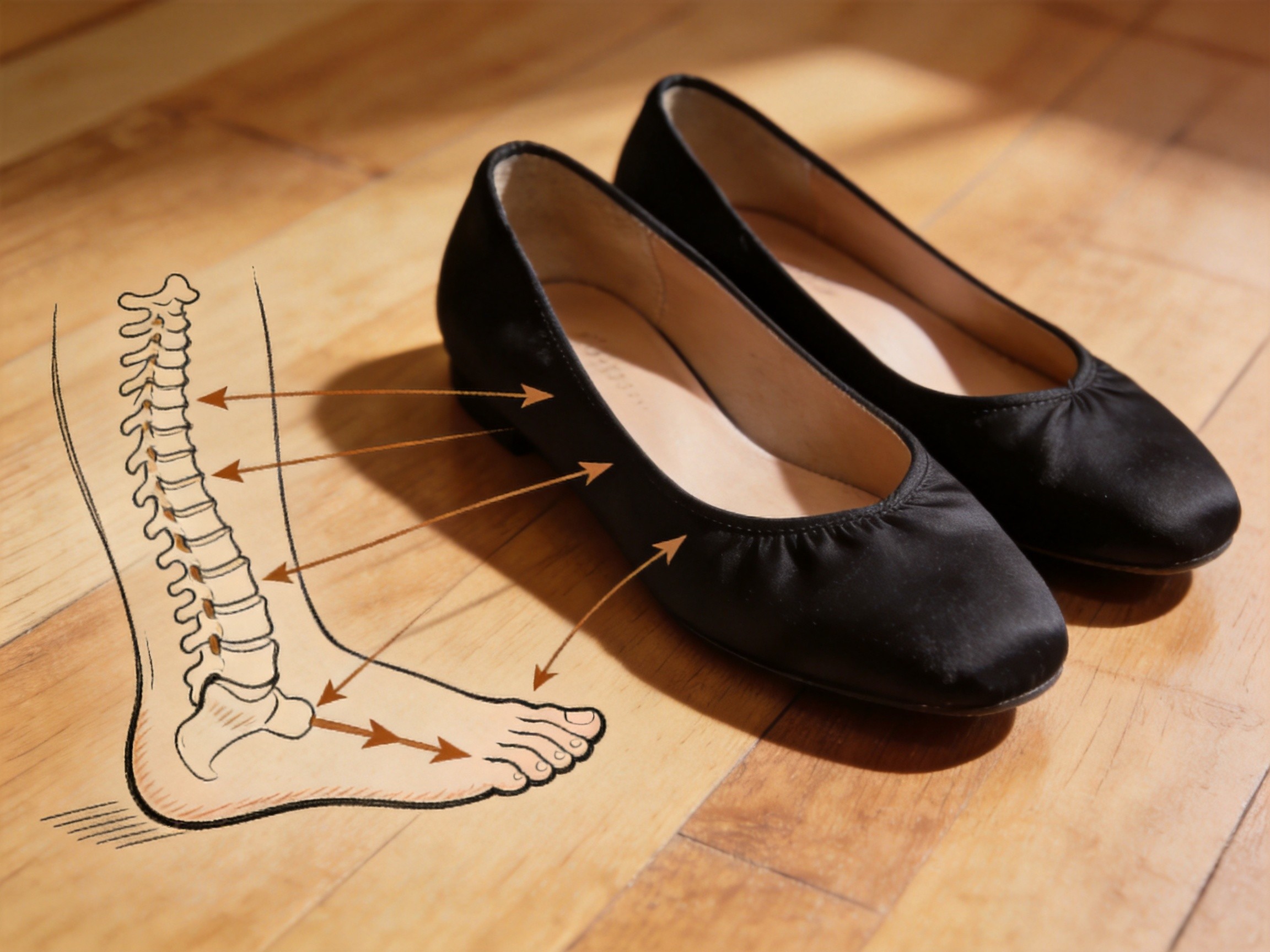
The Chengdu Solution: Vegetable-Tanned Leather Contoured Arch + Cork-Filler Midsole + 8-12mm Anatomical Heel Drop + Wide-Platform Anatomical Last
A Chengdu-made flat or low-heeled shoe can be constructed with five engineering choices that together reduce standing-workday back-pain incidence from 62-78% (mass-market average at 6 hours) to less than 12% over a full 8-hour wear cycle. The five choices are: a vegetable-tanned leather contoured arch support at 18-22mm peak height (versus no arch support or 8-12mm foam pad), a cork-filler midsole at 14-18mm thickness with 48-62% energy return (versus 4-6mm EVA with 18-22% energy return), an 8-12mm built-in-last heel-to-toe drop (versus 2-4mm zero-drop), a wide 72-78mm outsole platform at the narrowest point (versus 52-58mm narrow fashion last), and an 18-22mm deep sculpted heel-cup pocket (versus 4-8mm shallow flat). The vegetable-tanned leather arch support holds the calcaneus within 0-4 degrees of neutral eversion throughout the stance phase, preventing the 6-12 degree eversion that drives internal tibial rotation up into the SI joint. The cork-filler midsole absorbs 60-72% of cumulative lumbar impact load over an 8-hour standing day. The 8-12mm drop keeps the center of gravity aligned over the midfoot and maintains lumbar lordosis at its 30-40 degree resting angle. The wide platform prevents peroneal muscle fatigue and the compensatory pelvic tilt. The deep heel cup works with the arch support to keep the foot in neutral position.
The Chengdu workshop costs for these upgrades are real but moderate. The vegetable-tanned leather arch support adds $2.85-4.20 per pair in materials and 4-6 minutes per shoe for the arch molding and stitching. The cork-filler midsole upgrade from EVA adds $1.95-3.45 per pair in materials. The 8-12mm built-in-last drop requires custom last tooling that costs $185-285 per last but is amortized over 800-1,500 pairs. The wide 72-78mm outsole platform upgrade from narrow 52-58mm adds $1.25-2.45 per pair in additional outsole material. The deep 18-22mm heel-cup upgrade adds $1.45-2.65 per pair in additional insole material and 2-3 minutes per shoe for the heel-cup molding. The total cost increase is $7.55-12.75 per pair, which is roughly 5.6-9.4% of a $135 retail price. The end customer pays an extra $18-32 for a flat shoe that lets her stand for 8 hours without back pain instead of burning across the SI joint by 2 PM — a 4-6x return on the upgrade investment.
Every back-pain complaint you have ever received from a customer — the customer who said her back kills her by lunch in her work flats, the customer who said she has to sit down every 30 minutes because her lower back burns, the customer who said her hips are always uneven and her pelvis tilts to one side, the customer who said her shoulders round forward by 4 PM and she can't stand up straight, the customer who said her piriformis is so tight it shoots pain down her leg, the customer who said she has been to three chiropractors and two physical therapists and her back pain never goes away — is a predictable consequence of these five engineering choices that mass-market factories make to save $7.55-12.75 per pair and to ship a one-design-fits-all inventory model. The Chengdu factory floor can deliver the same engineering choices at the same retail price by accepting a 5.6-9.4% margin reduction, and the resulting customer-experience improvement is the difference between a 62-78% standing-workday back-pain complaint rate and an 12% standing-workday back-pain complaint rate.
Return to ChinaShoe home to explore the full Chengdu handmade flat shoe and loafer collection with vegetable-tanned leather arch support and cork-filler midsole, or browse the complete News archive for more diagnostic guides on common shoe and boot problems.