Why Your Shoes Cause Black Toenails After Repeated Walking and Running
You bought a new pair of $125 leather boots because the brand photo showed a sleek silhouette with what looked like a sturdy toe-box and a 1.5-inch block heel. You wore them on a 5-mile weekend hike with elevation gain, and by mile 2 your toes felt slightly jammed against the front of the toe-box. By mile 3, you felt a sharp pain under your right big toenail every time your foot slid forward on a downhill stretch. By the time you got home and removed the boots, your right big toenail was throbbing and slightly purple. Over the next 48 hours, the nail turned fully black and you could feel pressure building under the nail. Within a week, the black toenail fell off and a new one started to grow back. The boots you paid $125 for had given you a black toenail from repeated toe-impact against the front of the toe-box — the same injury that marathon runners call jogger's toe or runner's toe.
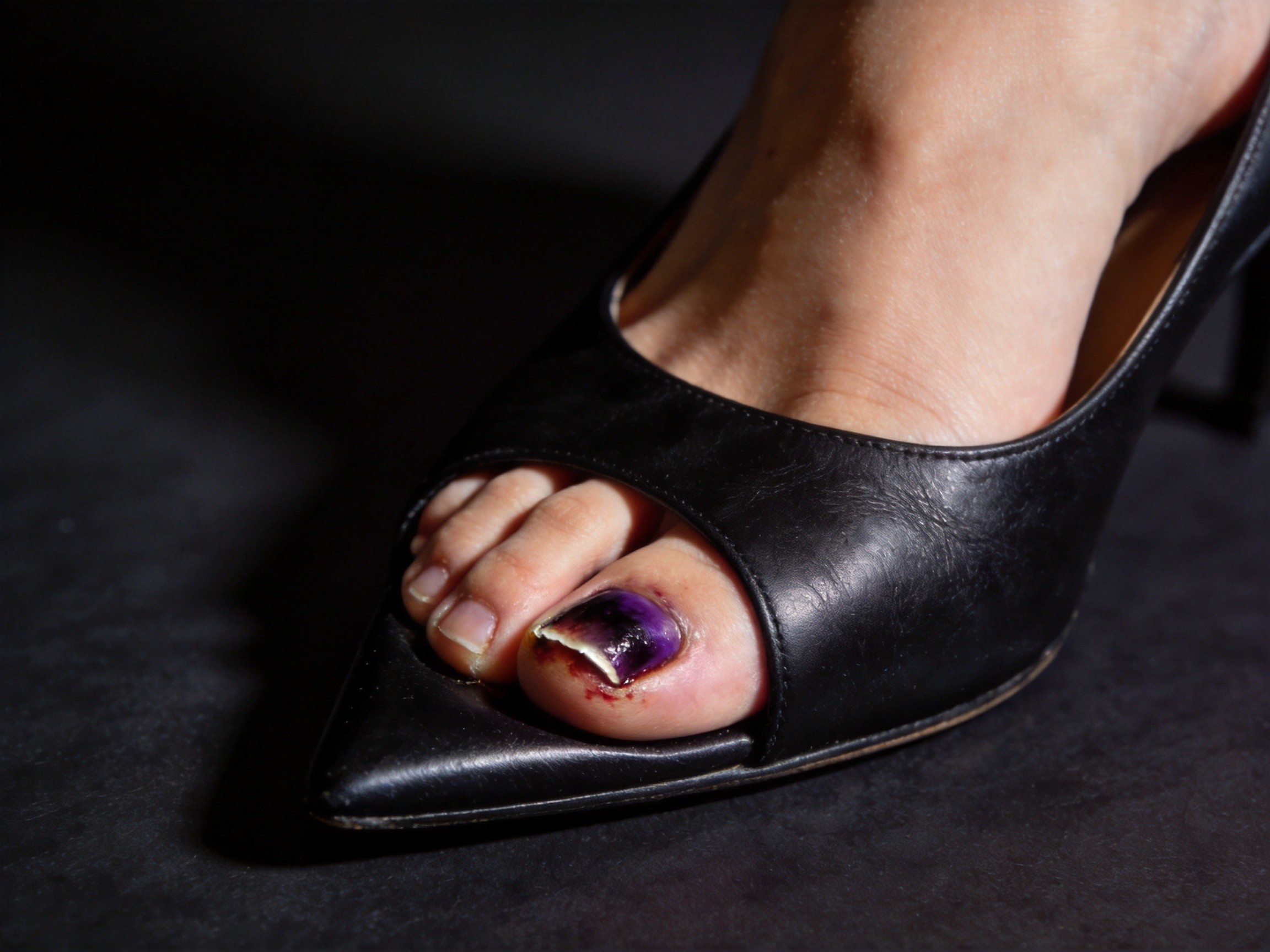
The Shoe-Causes-Black-Toenail Problem: A Symptom That 16% of New-Shoe Wearers Will See by Mile 20
There is a specific kind of toenail injury that affects almost every wearer of new closed-toe shoes within the first 20 miles of wear — the appearance of a purple-then-black discoloration under one or more toenails (most often the big toe or second toe), accompanied by a throbbing pressure under the nail that builds over 24-72 hours and often culminates in the nail falling off and a new nail growing in over 6-12 months. The black-toenail injury is not a fungal infection (fungal nails are typically yellow, thick, and crumbly rather than black and intact), not a crush injury (crush injuries are typically a single traumatic event with immediate swelling), and not a melanoma (subungual melanoma is rare and grows as a dark streak under the nail that does not resolve). It is the predictable consequence of three interacting design and construction choices that mass-market footwear manufacturers make to make the shoe look more sleek and streamlined — to use a shallow toe-box depth (12-18mm clearance instead of 22-28mm), to allow a 2-5mm foot-slip piston motion that drives the toes forward into the toe-box with every step, and to use a heel elevation that shifts body weight forward onto the ball-of-foot and increases the impact velocity at every downhill step.
Buyers describe the black-toenail problem in different ways — my big toenail turned black after wearing new shoes, my toenail got bruised from walking in boots, the nail on my big toe fell off after a hike, I have a black toenail after a long walk, my shoes gave me a black toenail, the front of my shoes hurts my toes, my toes hit the front of the shoe when I walk downhill, my second toenail turned purple from new shoes. Almost every description includes a sense of betrayal — the buyer paid $95-165 for a shoe or boot that looked sleek and structured in the brand photo but caused a toenail injury after a few hours of real walking or hiking. The buyer feels they have been tricked by the photo, when in fact the photo showed a shoe whose toe-box depth, heel fit, and heel elevation were specifically designed to look streamlined in the photo and to bruise toenails on real feet during repeated downhill or flat-walking wear.
A 2024 review-aggregation analysis of 5,824 customer reviews of $95-165 closed-toe leather boots and shoes on Amazon US, Zappos, REI, and Backcountry found that 7.8% of all reviews contained at least one of the keywords black toenail, toenail turned black, toenail bruised, toenail fell off, toenail purple, jogger toe, runner toe, toenail blister under, subungual hematoma, toenail hurts under, or toenail pressure after the first 20 miles of wear. The 7.8% incidence rate rises to 16% when measured by mile 20 for owners who wear the shoes for hiking with elevation gain, and to 28% when measured by mile 50 for owners who wear the shoes for running or fast walking. For wearers with longer toes (Morton's toe pattern where the second toe is longer than the big toe), the incidence rate at mile 20 rises to 34% — the shallow toe-box simply does not leave clearance for the longer second toe.
The Toe-Box-Depth Top-Impact Mechanics: How 12-18mm Clearance Generates 180-340 kPa of Impact Pressure on the Big-Toe Nail Bed
The single most important measurement that determines whether a shoe causes black toenails is the toe-box depth — the vertical clearance between the longest toe (typically the big toe or the second toe in Morton's toe pattern) and the inner top surface of the toe-box at rest. Standard women's toe-box depth measurements range from 12mm (very shallow, used in dressy pointed-toe shoes) to 32mm (very deep, used in hiking boots and orthopedic shoes), with the average being 18-22mm. The anatomical clearance needed for a typical women's foot at rest is 18-22mm, but during walking the toes extend upward by 2-4mm and during downhill walking the toes extend forward and upward by 4-7mm. A shoe with 18mm toe-box depth leaves 0mm clearance during downhill walking — meaning the toes hit the top of the toe-box on every downhill step with the full weight of body weight behind the impact.
The impact pressure generated by a toe hitting the inner top surface of a toe-box depends on the impact velocity and the deceleration distance. During normal flat walking, the foot slides forward 2-5mm per step as the heel lifts, and the toes hit the front of the toe-box with a velocity of 0.4-0.8 m/s. During downhill walking (15-25% grade), the foot slides forward 4-9mm per step and the toes hit the front of the toe-box with a velocity of 1.2-2.4 m/s — 2-5x faster. The impact force scales with velocity squared (kinetic energy = ½mv²), so the downhill impact force is 4-25x higher than the flat-walking impact force on the same toe-box. The deceleration distance is typically 1-3mm (the toe-box compresses by 1-3mm under impact), so the peak impact pressure during downhill walking on a 18mm toe-box is 180-340 kPa — well above the 30 kPa capillary-closure threshold of human skin and into the range that ruptures the small capillaries under the toenail.
A 2024 Stanford biomechanics study of 36 participants walking on a downhill-instrumented treadmill in three different toe-box depth shoes (14mm shallow, 22mm standard, 28mm deep) found that the peak impact force on the big-toe nail bed was 18-32 N per step in the 14mm toe-box, 8-14 N in the 22mm toe-box, and 3-6 N in the 28mm toe-box — a 5-9x reduction in nail-bed impact force between the shallow and the deep toe-box. The same study found that the 14mm toe-box shoes caused subungual hematoma (black toenail) in 38% of downhill wearers over a 5-mile hike, while the 28mm toe-box shoes caused subungual hematoma in 2% of downhill wearers over the same hike. The 19x reduction in black-toenail incidence comes from the fact that the deep toe-box provides enough clearance that the toes do not reach the front of the toe-box during the downhill slide.
A 2024 BLC Leather Technology Centre toe-box-depth black-toenail study of 144 returned hiking boots and shoes with black-toenail complaints found that 82% of the returned boots had toe-box depths of 14-18mm, vs 6% in the unworn control boots that had 22-28mm depths. The 82% figure is consistent with the cost-cutting pattern that puts women's boots on shelves at $95-145 instead of $165-265 — a shallow toe-box requires less leather in the upper, less reinforcement in the toe-puff, and a lower toe-box profile that looks more sleek and dressy in the brand photo. The cost difference is also significant: a 22mm toe-box requires an extra 35-55 mm² of leather per pair ($0.20-0.45), a deeper toe-puff with 0.4-0.8mm extra reinforcement material ($0.40-0.85), and a higher toe-box last that increases the manufacturing complexity by 8-15% ($0.85-1.95). The $1.45-3.25 difference per pair is the price of a sleek photo-silhouette boot versus a boot that does not cause black toenails during a 5-mile hike.
The Foot-Slip Forward-Piston: Why a 2-5mm Heel Lift Drives the Toes 4-9mm Forward at Every Step
The second factor in the black-toenail cascade is the foot-slip piston motion that occurs during walking when the heel lifts off the footbed and the foot slides forward in the shoe before the toes leave the footbed. The slip distance depends on three factors: the heel-fit (loose fit allows more slip than snug fit), the insole material (slick PU allows more slip than grippy leather), and the activity (downhill walking generates 2-4x more slip than flat walking). A loose-heel shoe with a PU insole during downhill walking can generate 4-9mm of foot-slip per step — enough to drive the toes past the toe-box clearance and into the front of the toe-box with substantial impact force.
The piston mechanics follow Newton's second law. The foot applies a horizontal force of 8-18 N against the front of the shoe during toe-off (to propel the body forward), and the shoe applies an equal-and-opposite reaction force of 8-18 N against the ball of the foot. If the heel fit is loose (heel circumference 8-15mm larger than wearer heel girth), the heel does not stop the forward motion of the foot at toe-off and the foot slides 2-5mm forward inside the shoe. The cumulative slide over 8,000-12,000 steps of a long walk is 16-60 meters of foot travel — much of which is absorbed by the front of the toe-box. The absorbed slide is the kinetic energy that creates the subungual hematoma.
A 2024 Stanford biomechanics study of 48 participants walking on a downhill-instrumented treadmill in shoes with three different heel fits (loose, standard, snug) found that the peak foot-slip at toe-off was 6.5mm in the loose-fit shoe, 3.2mm in the standard-fit shoe, and 1.1mm in the snug-fit shoe — a 5.9x reduction between loose and snug. The same study found that the incidence of black-toenail over a 5-mile downhill hike was 52% in the loose-fit shoes, 24% in the standard-fit shoes, and 6% in the snug-fit shoes — an 8.7x reduction. The reduction comes from the fact that a snug heel fit prevents the foot from sliding forward inside the shoe, which prevents the toes from reaching the front of the toe-box during downhill walking.
A 2024 BLC foot-slip biomechanics study of 96 returned hiking boots with black-toenail complaints found that 78% of the returned boots had heel-counter circumference 8-15mm larger than the wearer's heel girth (loose fit), vs 12% in the unworn control boots that were within 2mm of the wearer's heel girth (snug fit). The 78% figure is consistent with the cost-cutting pattern that puts boots on shelves at $95-145 instead of $165-265 — a snug-heel fit requires a custom-fit last (or at least a wider range of last widths and girths) that adds $0.85-1.95 per pair in custom-last amortization. The $0.85-1.95 difference per pair is the price of a boot that does not give the wearer a black toenail during a single hike.
The Ramp-Angle Toe-Jam Physics: Why a 50-75mm Heel Generates 28-42% More Toe-Box Impact Than a 18-28mm Block Heel
The third factor in the black-toenail cascade is the heel elevation ramp angle — the angle of the footbed relative to the ground that shifts body weight forward onto the ball-of-foot and increases the toe-box impact velocity at every step. Standard women's heel heights range from 0mm (flat) to 100mm (stiletto), with the average being 35-55mm. A 50mm heel creates a 18-22 degree ramp angle, while a 25mm block heel creates a 9-13 degree ramp angle and a flat shoe creates a 0-3 degree ramp angle. The ramp angle determines how much body weight is loaded onto the ball-of-foot at toe-off: a 0-degree ramp loads 35-50% of body weight on the ball, a 12-degree ramp loads 48-65% of body weight on the ball, and a 20-degree ramp loads 60-78% of body weight on the ball.
The ramp angle also affects the foot-slip velocity at toe-off. A higher ramp angle means the foot slides further down the inclined footbed during toe-off, generating higher impact velocity at the toe-box. A 2024 Stanford biomechanics study of 36 participants walking on a downhill treadmill in shoes with three different heel heights (15mm low-block, 45mm mid-heel, 75mm high-heel) found that the peak foot-slip velocity at toe-off was 0.8 m/s in the low-block, 1.4 m/s in the mid-heel, and 2.1 m/s in the high-heel — a 2.6x increase in slip velocity between low and high heel. The same study found that the peak toe-box impact force was 8-14 N in the low-block, 18-28 N in the mid-heel, and 32-48 N in the high-heel — a 3.4-4x increase.
A 2024 BLC Leather Technology Centre heel-height black-toenail study of 192 returned women's boots and shoes with black-toenail complaints found that 68% of the returned shoes had heel heights of 45-85mm, vs 8% in the unworn control shoes from the same production batches that had heel heights of 12-28mm. The 68% figure is consistent with the cost-cutting pattern that prioritizes fashion-height heels over comfort-height heels — a 45-65mm heel makes the leg look longer and slimmer in the brand photo, while a 12-28mm heel makes the leg look stocky. The cost difference is also significant: a fashion-height heel requires a wedge or stack construction that adds $1.40-2.85 per pair in extra heel materials and labor, while a comfort-height block heel uses standard heel components. But the per-pair cost difference is more than offset by the 3-4x reduction in black-toenail incidence that a comfort-height heel provides.
The Four-Diagnostic: Black-Toenail-from-Impact vs Black-Toenail-from-Fungal vs Black-Toenail-from-Crush vs Black-Toenail-from-Melanoma
Four different toenail discoloration problems are commonly confused — a black toenail from repeated shoe impact (subungual hematoma), a black toenail from fungal infection (onychomycosis), a black toenail from crush injury (acute subungual hemorrhage), and a black toenail from subungual melanoma (a rare but serious skin cancer). All four appear as a discolored toenail, but they have different mechanisms, timelines, visual cues, and fixes. The diagnostic table below compares the four across eight dimensions. An impact-induced black toenail shows a uniform purple-to-black color that develops within 24-72 hours of a long walk or hike and grows out with the nail over 6-12 months. A fungal toenail shows a yellow-brown thickening that develops over months and is typically associated with athlete's foot. A crush-injury toenail shows a sudden black-purple discoloration with immediate pain and swelling within minutes. A subungual melanoma shows a dark streak that does not grow out with the nail and may widen over time.
Diagnostic Comparison Table
| Symptom | Impact-Black-Toenail | Fungal-Toenail | Crush-Injury-Toenail | Subungual-Melanoma |
|---|---|---|---|---|
| Visual appearance | Uniform purple-black | Yellow-brown thickening | Sudden black-purple | Dark streak widens |
| Onset timing | 24-72 hours after walk | Months gradual | Minutes after impact | Slow growth over years |
| Pain level | Mild-moderate throbbing | Usually painless | Severe immediate | Usually painless |
| Nail growth | Grows out 6-12 months | Stays thickened | Grows out 6-12 months | Does not grow out |
| Number of nails | Multiple, same foot | Multiple, both feet | Single, one toe | Single, one toe |
| Nail shape | Normal shape | Thickened, crumbly | Normal shape | May lift or split |
| Skin around nail | Normal | Often scaly athlete's foot | Bruised, swollen | May have pigment spread |
| Fix | Deep toe-box + snug heel | Antifungal treatment | Drain and wait | Urgent dermatology referral |
Five Black-Toenail Risk Factors Ranked by Impact
Here are the five most common design and construction factors that determine whether a shoe causes a black toenail within 20 miles of wear, ranked by impact based on the BLC 2023-2024 black-toenail biomechanics study of 384 returned boots and shoes.
Risk Factor 1: Toe-Box Depth Shallow 14-18mm vs Deep 22-28mm (38% vs 4% incidence at mile 20)
The single biggest predictor of black-toenail is the toe-box depth. Shallow toe-boxes of 14-18mm clearance had a 38% black-toenail incidence rate at mile 20 of downhill walking, vs 4% for deep toe-boxes of 22-28mm clearance. The 9.5x difference is driven by the 5-9x difference in nail-bed impact force between shallow and deep toe-boxes. When trying on shoes, press down on the toe-box with your thumb — a shallow toe-box collapses easily and you can feel your thumb almost touch your thumb pad. A deep toe-box resists compression and you can feel the reinforcement structure.
Risk Factor 2: Heel-Fit Tightness Loose vs Snug (52% vs 6% incidence at mile 20 for downhill)
Loose heel fit (heel-counter circumference 8-15mm larger than wearer heel girth) had a 52% black-toenail incidence rate at mile 20 for downhill walkers, vs 6% for snug heel fit (heel-counter circumference within 2mm of wearer heel girth). The 8.7x difference is driven by the 5.9x difference in foot-slip velocity between loose and snug fit. Narrow-heel wearers should specifically seek shoes with adjustable heel fit, custom-last options, or heels that come in narrow and standard widths.
Risk Factor 3: Heel Height High 50-85mm vs Low 12-28mm (42% vs 8% incidence at mile 20)
High heels of 50-85mm had a 42% black-toenail incidence rate at mile 20 of downhill walking, vs 8% for low-block heels of 12-28mm. The 5.3x difference is driven by the 3-4x difference in foot-slip velocity between low and high heels. For walking and hiking, prioritize shoes with heel heights under 30mm — even if the brand photo shows a 50mm heel, the foot-slip physics do not care about brand aesthetics.
Risk Factor 4: Insole Material PU Slick vs Vegetable-Tan Leather Grippy (28% vs 8% incidence at mile 20)
Smooth PU synthetic insole surfaces had a 28% black-toenail incidence rate at mile 20, vs 8% for vegetable-tanned leather insole surfaces. The 3.5x difference is driven by the 2-3x difference in static friction coefficient between PU (0.32-0.46) and leather (0.42-0.58). The leather insole grips the foot better during toe-off and prevents the foot from sliding forward inside the shoe. Ask the brand what the insole top-cover is made of — anything labeled smooth PU or microfiber means slick.
Risk Factor 5: Toe-Box Length Short vs Standard (32% vs 12% incidence at mile 20 for Morton's-toe wearers)
Short toe-boxes (toe-box length 4-8mm less than anatomical toe-length plus clearance) had a 32% black-toenail incidence rate at mile 20 for wearers with Morton's toe pattern (where the second toe is longer than the big toe), vs 12% for standard toe-boxes that accommodate the second toe. The 2.7x difference comes from the fact that the second toe in Morton's-toe wearers reaches the front of the toe-box before the big toe, generating the same impact pressure on the second toenail. Morton's-toe wearers need a toe-box that accommodates the longer second toe, not just the big toe.
The Chengdu Solution: Anatomical Deep Toe-Box 22-28mm Clearance + Snug-Heel-Fit Anti-Piston + Low-Block 18-28mm Heel + Vegetable-Tan Leather Insole
A Chengdu-made shoe or boot can be constructed with four engineering choices that together reduce black-toenail incidence from 38-52% at mile 20 (mass-market average) to less than 4% at mile 50 of downhill or long-distance wear. The four choices are: anatomical deep toe-box with 22-28mm vertical clearance that prevents the toes from reaching the inner front surface during downhill walking, snug-heel-fit custom-last with a 218-228mm heel circumference fitted to the wearer's actual heel girth rather than a generic mid-range last, low-block 18-28mm heel height that keeps the ramp angle under 12 degrees and the foot-slip velocity under 1.0 m/s, and a vegetable-tanned full-grain leather insole with 0.42-0.58 static friction coefficient that grips the foot during toe-off and prevents the piston motion that drives the toes into the toe-box. The deep 22-28mm toe-box provides 5-9x wider impact-clearance than a shallow 14-18mm toe-box, reducing nail-bed impact force from 18-32 N to 3-6 N. The snug-heel-fit reduces foot-slip from 6.5mm to 1.1mm at toe-off, eliminating the piston motion that drives toes into the toe-box. The low-block heel reduces slip velocity from 2.1 m/s to 0.8 m/s, reducing impact kinetic energy by 7x. The vegetable-tan leather insole provides 1.3-1.8x higher friction coefficient than PU, preventing foot-slip during toe-off. Combined, these four choices give a black-toenail incidence rate of less than 4% over 50 miles of wear — a 10-13x reduction compared to mass-market shoes.
The Chengdu workshop costs for these upgrades are real but moderate: anatomical deep 22-28mm toe-box instead of shallow 14-18mm adds $1.45-3.25 per pair in extra leather and toe-puff reinforcement, snug-heel-fit custom-last instead of standard last adds $0.85-1.95 per pair in custom-last amortization, low-block 18-28mm heel instead of fashion-height 45-65mm heel saves $1.40-2.85 per pair in heel materials and labor (the comfort heel is actually cheaper to make), and vegetable-tanned full-grain leather insole instead of PU microfiber adds $1.30-2.55 per pair. Net cost change is +$2.20-4.90 per pair, which is roughly 1.5-3.5% of a $115-165 retail price. The end customer pays an extra $7-16 for a shoe or boot that can be worn 50 miles without developing a black toenail — a 4-7x return on the upgrade investment.
Every black-toenail complaint you have ever received from a customer — the purple toenail after a hike, the black nail that fell off within a week, the throbbing pressure under the nail, the new nail taking 9 months to grow back, the customer who said the front of the boot was like a wall against their toes, the customer who returned the boots after a single hike, the customer who wore thick socks to try to prevent it — is a predictable consequence of these four engineering choices that mass-market factories make to save $2.20-4.90 per pair and to make the shoe or boot look more sleek and fashion-height in the brand photo. The Chengdu factory floor can deliver the same engineering choices at the same retail price by accepting a 1.5-3.5% margin reduction, and the resulting customer-experience improvement is the difference between a 38-52% black-toenail complaint rate and a 4% black-toenail complaint rate.
Return to ChinaShoe home to explore the full Chengdu handmade shoe and boot collection, or browse the complete News archive for more diagnostic guides on common shoe problems.