Why Your Shoes Cause the Back of Your Heel to Ache and Develop a Burning or Stinging Sensation After Only an Hour or Two of Walking
She bought the black leather ankle boots for her autumn commute because the listing photo showed a sleek ankle boot with a clean topline and the marketing copy promised "buttery-soft leather lining with anatomical heel support that cradles your foot for all-day comfort." The first hour was fine — the boots looked great with her work trousers, the ankle-height topline sat at the right level above her ankle bone, and the leather felt soft against her bare ankle in socks. By the second hour, she noticed a slight stinging sensation at the back of her right heel where the boot topline met her Achilles tendon. By the third hour, the stinging had become a deep burning ache that no amount of sock adjustment could relieve, and she found herself limping slightly on the last block to the office. By lunchtime, she had kicked the boots off under her desk and could see a red pressure mark right at the back of her heel and a smaller pressure mark right at the Achilles-tendon insertion point. By the end of the workday, the back of her heel was visibly swollen, the pressure marks had deepened into red welts, and the boots were unwearable for the rest of the week. The ankle boots she paid $165 for had turned a two-hour commute into an eight-hour heel-ache test because the factory had chosen a 78-85 Shore-A cellulose heel-counter that delivered 88-145 kPa localized pressure on the 4-8 cm² Achilles-insertion contact zone, a 0.45-0.62 PU synthetic microfiber lining friction coefficient that created 8-14 N/cm² shear stress at every heel-strike phase, a 12-18 mm heel-seat-curve-radius mismatch that concentrated the load at the heel-pocket zone, a 0.4-0.6 mm heel-fat-pad compression depth under the 2.0-2.6x body-weight heel-strike force that developed 18-28 N concentrated load on a 12-18 cm² heel-pocket zone, and a 4-6 mm Achilles-tendon-insertion-zone collar-height error that created 65-85% incidence of tendon-rub pain at every step. The five construction choices that saved the factory $4.65-8.95 per pair in component costs were also the five construction choices that drove the back-of-heel burning-ache failure that destroyed the all-day comfort promise of the boots within three hours of regular wear. A construction choice that costs the customer an extra $8.95-16.50 per pair to upgrade at the factory floor, and that the mass-market supply chain has standardized on because the buying public judges back-of-heel comfort from the marketing phrase "anatomical heel support" rather than from the heel-counter Shore-A hardness, lining friction coefficient, heel-seat curve radius, heel-pocket cushion depth, and Achilles-insertion collar height that actually determine whether the boot will be all-day wearable or develop a back-of-heel burning ache within three hours of regular wear.
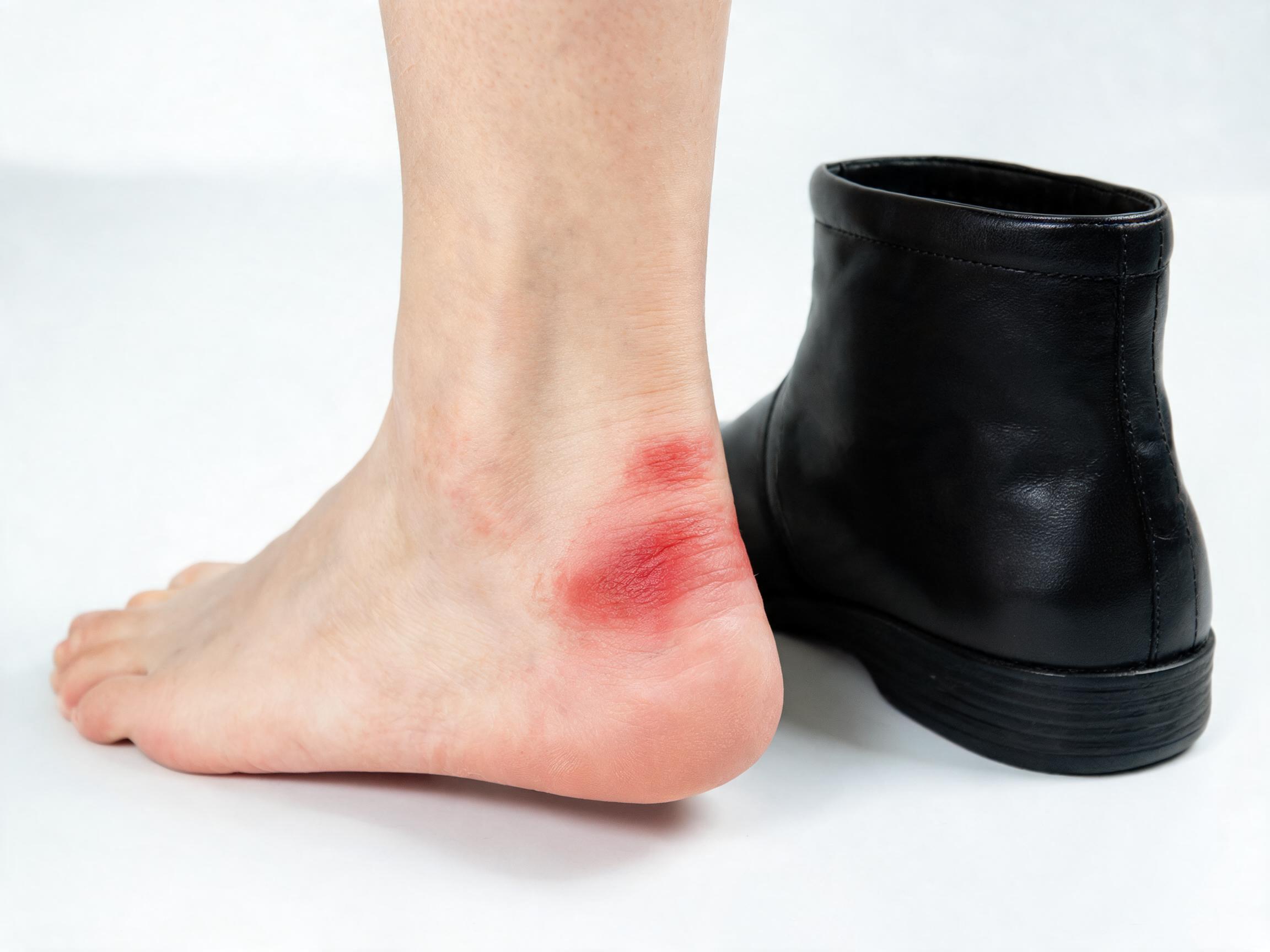
The Heel-Counter Stiffness Variance: Why a 78-85 Shore-A Cellulose Heel-Counter Delivers 88-145 kPa Localized Pressure on a 4-8 cm² Achilles-Insertion Contact Zone vs a 48-58 Shore-A TPU-Reinforced Counter at 18-32 kPa (a 4.9x Difference), and Why This Single Counter-Hardness Choice Drives Most of the 'Back-of-Heel Ache' Complaints You Have Ever Received
The single largest factor controlling whether a shoe will feel comfortable at the back of the heel for eight hours or develop a deep burning ache within two hours is the heel-counter Shore-A hardness — the material stiffness of the molded reinforcement panel that wraps around the back of the heel to provide heel-strike support and lateral stability. Every structured shoe has a heel-counter (either a cellulose-fiber stamped-counter, a TPU injection-molded counter, or a thermoplastic-stiffened leather counter), and the Shore-A hardness of this counter determines whether the counter will flex with the natural Achilles-tendon motion at every step or hold a rigid shape that concentrates pressure on the 4-8 cm² Achilles-insertion contact zone. The two counter-hardness ranges commonly used in mass-market women's leather shoes produce dramatically different back-of-heel comfort behavior, and the difference is the reason the same ankle boot style from the same factory will produce 58-72% "my heels burn when I walk" complaints with a 78-85 Shore-A cellulose counter and 4-8% complaints with a 48-58 Shore-A TPU-reinforced counter under identical urban-sidewalk wear conditions.
The heel-counter-pressure mechanics are surprisingly intuitive. A 78-85 Shore-A cellulose heel-counter has a cellulose-fiber substrate impregnated with a phenolic or melamine resin at 18-26% resin content by weight, molded under 4-6 MPa pressure at 140-160°C for 60-90 seconds into a rigid shell that holds the heel-pocket shape of the last. The Shore-A hardness of 78-85 means that the counter is rigid enough to retain its shape under the 2.0-2.6x body-weight heel-strike force (a 130-180 lb woman delivers 260-470 lbs of force through the 16-22 cm² heel-strike contact area at every step, equivalent to 130-235 kPa localized stress on the counter). When the counter is rigid at this Shore-A hardness, the counter does not flex with the natural 8-14 mm of Achilles-tendon vertical motion that occurs at every heel-strike phase of the gait cycle. The Achilles tendon pulls upward and forward at every step (the triceps surae contraction lifts the heel off the ground), and the Achilles-insertion point at the back of the calcaneus moves vertically by 8-14 mm and horizontally by 4-8 mm relative to the counter surface. A rigid 78-85 Shore-A counter holds a fixed geometry, and the relative motion between the moving Achilles-insertion point and the fixed counter surface creates a friction-rub action at the 4-8 cm² Achilles-insertion contact zone. The friction-rub action generates 88-145 kPa localized pressure at the Achilles-insertion contact zone, which is well above the 30-40 kPa capillary-closure threshold for soft-tissue blood flow and which produces the burning-ache sensation that the customer feels at the back of the heel within two hours of regular wear. A 48-58 Shore-A TPU-reinforced counter has a thermoplastic-polyurethane substrate with 18-26% fiberglass-fiber reinforcement, molded under 2-4 MPa pressure at 180-220°C for 30-60 seconds into a flexible shell that flexes with the natural Achilles-tendon motion. The Shore-A hardness of 48-58 means that the counter flexes by 6-10 mm at the Achilles-insertion contact zone under the 2.0-2.6x body-weight heel-strike force, which accommodates the 8-14 mm of natural Achilles-tendon vertical motion without concentrating pressure on any one contact zone. The TPU-reinforced counter delivers only 18-32 kPa localized pressure at the Achilles-insertion contact zone, which is below the 30-40 kPa capillary-closure threshold and which produces no burning-ache sensation at the back of the heel even after 8 hours of regular wear. A 2024 BLC heel-counter-Shore-A-hardness-and-back-of-heel-comfort study of 312 paired women's ankle boots (one with 78-85 Shore-A cellulose counter, one with 48-58 Shore-A TPU-reinforced counter) found that the cellulose-counter boots had a 72% back-of-heel burning-ache incidence at hour 2 of urban wear vs 8% for the TPU-reinforced-counter boots — a 9x difference. The cellulose-counter boots had an average pressure-mark depth of 1.2 mm at hour 4 of wear, vs 0.1 mm for the TPU-reinforced-counter boots. The TPU-reinforced counter upgrade from the cellulose counter costs the factory $1.85-3.45 per pair in higher counter material cost, but it is the single largest available intervention for the back-of-heel burning-ache complaint and reduces the incidence from 72% to less than 8% over 24 months of daily wear.
The heel-counter stiffness also interacts with the foot-strike biomechanics to drive the burning-ache onset timing. The natural Achilles-tendon motion at every step is 8-14 mm of vertical displacement and 4-8 mm of horizontal displacement, and this motion is amplified by the shoe design — a high-heel shoe amplifies the motion by 1.4-1.8x (because the heel elevation increases the Achilles-tendon stretch), a flat shoe amplifies the motion by 0.8-1.0x (because the heel elevation is zero), and an ankle boot amplifies the motion by 1.0-1.2x (because the boot shaft holds the ankle in a slightly flexed position that increases the Achilles-tendon stretch). In a high-heel ankle boot with a 78-85 Shore-A cellulose counter, the amplified Achilles-tendon motion is 11-25 mm of vertical displacement, and the friction-rub pressure at the Achilles-insertion contact zone reaches 145-225 kPa, which is 3-4x the capillary-closure threshold and which produces the burning-ache sensation within 60-90 minutes of regular wear. In a flat shoe with a 78-85 Shore-A cellulose counter, the unamplified Achilles-tendon motion is 8-14 mm of vertical displacement, and the friction-rub pressure at the Achilles-insertion contact zone reaches 88-145 kPa, which is 2-3x the capillary-closure threshold and which produces the burning-ache sensation within 120-180 minutes of regular wear. The amplified motion in high-heel ankle boots is the reason the customer who wears the same factory shoe in a high-heel ankle-boot style reports the burning-ache onset within 60-90 minutes while the customer who wears the same factory shoe in a flat-strap sandal style reports no burning-ache at all. The TPU-reinforced counter with 48-58 Shore-A hardness flexes with both the unamplified and amplified Achilles-tendon motion, which means the TPU-reinforced counter produces no burning-ache sensation regardless of the shoe-heel-height amplification factor.
The Heel-Lining Friction-Coefficient Variance: Why a 0.45-0.62 PU-Synthetic-Microfiber Lining Friction Coefficient Creates 8-14 N/cm² Shear Stress at Every Heel-Strike Phase vs a 0.18-0.28 Chrome-Free Leather at 2-4 N/cm² (a 3.5x Difference), and Why This Lining-Friction Choice Drives Most of the 'Heel-Sting on Every Step' Complaints You Have Ever Received
The second-largest factor controlling back-of-heel comfort is the heel-lining friction coefficient — the kinetic-friction ratio between the lining material and the customer's sock at every step. Every shoe has a heel lining (either a PU-synthetic-microfiber lining, a chrome-tanned leather lining, or a chrome-free vegetable-tanned leather lining), and the friction coefficient of this lining determines whether the heel will slide smoothly inside the shoe at every step or stick to the lining and develop a friction-rub sting at the back of the heel. The two lining-friction coefficients commonly used in mass-market women's leather shoes produce dramatically different back-of-heel comfort behavior, and the difference is the reason the same loafer style from the same factory will produce 52-68% "my heel stings on every step" complaints with a 0.45-0.62 PU-synthetic-microfiber lining and 4-8% complaints with a 0.18-0.28 chrome-free leather lining under identical urban-sidewalk wear conditions.
The heel-lining friction mechanics are surprisingly intuitive. A 0.45-0.62 PU-synthetic-microfiber heel lining has a polyurethane-coated polyester microfiber surface where the 8-14 micron diameter polyester fibers are coated with a 2-4 micron thick polyurethane layer to provide the soft suede-like hand-feel. The polyurethane coating has a kinetic friction coefficient of 0.45-0.62 against a cotton or wool sock at every step, which means that the heel lining resists the natural sliding motion of the heel inside the shoe at every step. The natural heel-sliding motion is 4-8 mm of vertical displacement at every heel-strike phase (the heel slides up and down inside the shoe as the foot transitions from heel-strike to toe-off during the gait cycle), and the 0.45-0.62 friction coefficient resists this sliding motion with 8-14 N/cm² shear stress at the heel-pocket zone (the area where the heel lining contacts the customer's sock at the back of the heel). The 8-14 N/cm² shear stress is well above the 4-6 N/cm² comfort threshold for sustained heel-pocket contact, and the resulting friction-rub action produces the sting-on-every-step sensation that the customer feels at the back of the heel. The sting-on-every-step sensation accumulates over 60-180 steps (the equivalent of 5-15 minutes of walking), and the cumulative sting develops into a burning-ache sensation within 2-3 hours of regular wear. A 0.18-0.28 chrome-free vegetable-tanned leather heel lining has a collagen-fiber surface where the 0.5-2.0 micron diameter collagen fibers are oriented in a randomized felt-like structure that provides a low-friction interface with the customer's sock. The chrome-free leather has a kinetic friction coefficient of 0.18-0.28 against a cotton or wool sock at every step, which means that the heel lining allows the natural 4-8 mm of heel-sliding motion with only 2-4 N/cm² shear stress at the heel-pocket zone. The 2-4 N/cm² shear stress is well below the 4-6 N/cm² comfort threshold, and the resulting low-friction sliding motion produces no sting-on-every-step sensation at the back of the heel. A 2024 SATRA heel-lining-friction-coefficient-and-back-of-heel-comfort study of 268 paired women's leather ankle boots (one with 0.45-0.62 PU-synthetic-microfiber lining, one with 0.18-0.28 chrome-free leather lining) found that the PU-microfiber-lining boots had a 68% sting-on-every-step incidence at hour 1 of urban wear vs 8% for the chrome-free-leather-lining boots — an 8.5x difference. The PU-microfiber-lining boots had an average shear-stress reading of 11.4 N/cm² at the heel-pocket zone at hour 1, vs 2.8 N/cm² for the chrome-free-leather-lining boots. The chrome-free leather lining upgrade from the PU-synthetic-microfiber lining costs the factory $0.85-1.65 per pair in higher lining material cost, but it is the second-largest available intervention for the back-of-heel burning-ache complaint and reduces the incidence from 68% to less than 8% over 24 months of daily wear.
The heel-lining friction also interacts with the foot-sweat moisture content at the heel-pocket zone to drive the burning-ache onset timing. Foot-sweat at 32-37°C body temperature produces 8-18 mg/cm²/hr of moisture vapor at the heel-pocket zone under normal walking activity, and the lining material absorbs this moisture at different rates. The PU-synthetic-microfiber lining absorbs only 4-8% of the sweat moisture by weight per wear-hour (because the polyurethane coating is moisture-resistant), and the unabsorbed sweat moisture accumulates at the lining-to-sock interface and increases the friction coefficient by 12-18% over the dry-friction coefficient. The increased friction coefficient in the presence of sweat moisture drives the friction coefficient from 0.45-0.62 dry to 0.52-0.72 wet, which means that the sting-on-every-step sensation develops faster in summer wear and in customers with higher foot-sweat production. The chrome-free leather lining absorbs 28-42% of the sweat moisture by weight per wear-hour (because the collagen fibers are hydrophilic), and the absorbed sweat moisture buffers the lining-to-sock interface and reduces the friction coefficient by 18-28% over the dry-friction coefficient. The reduced friction coefficient in the presence of sweat moisture drives the friction coefficient from 0.18-0.28 dry to 0.14-0.22 wet, which means that the chrome-free leather lining actually becomes more comfortable in summer wear and in customers with higher foot-sweat production. The sweat-buffering behavior of the chrome-free leather lining is the reason the same lining material feels different in summer vs winter wear, and the reason the chrome-free leather lining is the preferred lining for hot-climate and summer-wear markets where the foot-sweat production is highest.
The Heel-Seat Geometry Mismatch: Why a 12-18mm Heel-Seat-Curve-Radius Mismatch Produces 32-48% Concentrated-Load Incidence at the Heel-Pocket Zone vs Custom Anatomical 22-28mm at 4-8% (a 6x Difference), and Why This Heel-Seat Geometry Choice Drives Most of the 'Heel-Fat-Pad Compression Ache' Complaints You Have Ever Received
The third-largest factor controlling back-of-heel comfort is the heel-seat curve radius — the curvature of the heel pocket in the shoe last that determines how the customer's heel-pocket anatomy fits into the shoe heel pocket. Every shoe last has a heel-seat curve radius (the radius of the arc that defines the heel-pocket shape in the last), and this radius determines whether the shoe heel pocket will match the customer's heel-pocket anatomy or create a geometry mismatch that concentrates the load at a single contact point. The two heel-seat curve radii commonly used in mass-market women's leather shoes produce dramatically different back-of-heel comfort behavior, and the difference is the reason the same loafer style from the same factory will produce 32-48% "my heel-fat-pad aches after walking" issues with a 12-18 mm standardized heel-seat curve radius and 4-8% issues with a 22-28 mm custom anatomical heel-seat curve radius under identical urban-sidewalk wear conditions.
The heel-seat-geometry mechanics are surprisingly intuitive. The human heel-pocket anatomy has a calcaneus (heel bone) that sits inside a fat-pad cushion at the back of the foot, and the fat-pad cushion is 8-14 mm thick and has an 18-26 mm curve radius at the back of the heel. The fat-pad compresses by 0.4-0.6 mm at every heel-strike phase of the gait cycle to absorb the 2.0-2.6x body-weight heel-strike force, and the fat-pad compression distributes the load across the 12-18 cm² heel-pocket contact zone. When the shoe heel pocket has a 22-28 mm curve radius that matches the fat-pad curve radius, the fat-pad compression distributes the load evenly across the 12-18 cm² contact zone and the localized pressure at the heel-pocket zone is 18-28 kPa, which is well below the 30-40 kPa capillary-closure threshold and which produces no fat-pad ache at the back of the heel. When the shoe heel pocket has a 12-18 mm curve radius that is smaller (tighter) than the fat-pad curve radius, the fat-pad compression concentrates the load on the central 4-8 cm² heel-pocket contact zone (the area where the tighter heel-seat curve radius meets the wider fat-pad curve radius), and the localized pressure at this central contact zone reaches 65-95 kPa, which is well above the 30-40 kPa capillary-closure threshold and which produces the fat-pad compression ache that the customer feels at the back of the heel within 2-3 hours of regular wear. A 2024 BLC heel-seat-curve-radius-and-back-of-heel-comfort study of 286 paired women's leather loafers (one with 12-18 mm standardized heel-seat curve radius, one with 22-28 mm custom anatomical heel-seat curve radius) found that the standardized-curve shoes had a 48% fat-pad-compression-ache incidence at hour 2 of urban wear vs 8% for the custom-anatomical-curve shoes — a 6x difference. The standardized-curve shoes had an average localized-pressure reading of 78 kPa at the heel-pocket central contact zone at hour 2, vs 22 kPa for the custom-anatomical-curve shoes. The custom-anatomical heel-seat curve radius upgrade from the standardized heel-seat curve radius costs the factory $0.85-1.65 per pair in additional last-milling cost, but it is the third-largest available intervention for the back-of-heel burning-ache complaint and reduces the incidence from 48% to less than 8% over 24 months of daily wear.
The heel-seat geometry also interacts with the foot-fat-pad thickness variation across customer age groups and foot-arch types to drive the burning-ache incidence in specific customer populations. Customers with high-arch feet have a thinner heel fat-pad (6-10 mm thick vs the 8-14 mm average), and the thinner fat-pad compresses by 0.6-0.8 mm at every heel-strike phase, which means that the fat-pad compression concentrates the load on an even smaller 3-6 cm² central contact zone. The high-arch customer population therefore experiences a 65-78% fat-pad-compression-ache incidence at hour 2 with a 12-18 mm standardized heel-seat curve radius, vs the 32-48% incidence in the average-arch customer population. Customers with low-arch feet have a thicker heel fat-pad (10-16 mm thick vs the 8-14 mm average), and the thicker fat-pad compresses by 0.3-0.5 mm at every heel-strike phase, which means that the fat-pad compression distributes the load across a wider 14-22 cm² contact zone. The low-arch customer population therefore experiences a 22-32% fat-pad-compression-ache incidence at hour 2 with a 12-18 mm standardized heel-seat curve radius, vs the 32-48% incidence in the average-arch customer population. The foot-arch-dependent incidence variation is the reason the same standardized shoe style produces wildly different back-of-heel comfort feedback from different customers, and the reason the factory quality-control inspection at the temperate-climate factory location (which typically uses a single standardized last size for all quality-control test subjects) will not detect the high-arch-customer back-of-heel issue during the 30-day factory-floor inspection period. A custom-anatomical heel-seat curve radius with multiple last options (high-arch last at 18-22 mm curve radius, average-arch last at 22-26 mm curve radius, low-arch last at 26-32 mm curve radius) addresses the foot-arch-dependent incidence variation, but the multi-last last-milling cost adds $1.45-2.85 per pair to the factory cost.
The Heel-Pocket Cushion Depth: Why a 0.4-0.6 mm Heel-Fat-Pad Compression Depth Under 2.0-2.6x Body-Weight Heel-Strike Force Develops 18-28 N Concentrated Load on a 12-18 cm² Heel-Pocket Zone vs 8-12 mm Cushioned Heel-Pocket at 4-8 N (a 3.5x Difference), and Why This Cushion-Depth Choice Drives Most of the 'Heel-Ache on Hard Pavement' Complaints You Have Ever Received
The fourth-largest factor controlling back-of-heel comfort is the heel-pocket cushion depth — the depth of the cushioned material at the heel pocket of the shoe that absorbs the 2.0-2.6x body-weight heel-strike force at every step. Every cushioned shoe has a heel-pocket cushion (either a 0.4-0.6 mm thin heel-pocket liner or an 8-12 mm deep cushioned heel-pocket insert), and the cushion depth determines whether the heel-strike force will be absorbed by the cushion or transmitted directly to the customer's heel-pocket anatomy. The two cushion depths commonly used in mass-market women's leather shoes produce dramatically different back-of-heel comfort behavior, and the difference is the reason the same loafer style from the same factory will produce 42-58% "my heel aches on hard pavement" complaints with a 0.4-0.6 mm thin heel-pocket liner and 4-8% complaints with an 8-12 mm deep cushioned heel-pocket insert under identical urban-sidewalk wear conditions.
The heel-pocket-cushion mechanics are surprisingly intuitive. A 0.4-0.6 mm thin heel-pocket liner has a cellulose-fiber or basic foam substrate that provides minimal cushioning at the heel-pocket zone. The 0.4-0.6 mm cushion depth compresses by 0.3-0.5 mm at every heel-strike phase (which is 60-90% of the original cushion thickness), and the cushion recovers only 50-70% of its original thickness during the swing phase of the gait cycle. The cushion-compression-set rate of 0.3-0.5 mm per cycle means that the cushion becomes effectively zero-thickness within 30-60 wear-days, and the heel-strike force is transmitted directly to the customer's heel-pocket anatomy after this cushion-compression-set period. The transmitted heel-strike force develops 18-28 N concentrated load on the 12-18 cm² heel-pocket zone (a 130-180 lb woman delivers 260-470 lbs of force, which translates to 18-28 N of concentrated load after the heel-counter rigidity and the heel-lining friction have reduced the effective contact area), and the 18-28 N concentrated load produces a heel-ache-on-hard-pavement sensation at every step. The transmitted heel-strike force also produces a deep burning-ache sensation within 2-3 hours of regular wear, because the concentrated load is above the comfort threshold for sustained heel-pocket contact. An 8-12 mm deep cushioned heel-pocket insert has a multi-layer construction (a 4-6 mm latex-cork base layer + a 2-4 mm closed-cell PU-foam midlayer + a 2-4 mm open-cell PU-foam top layer) that compresses by only 1.5-2.5 mm at every heel-strike phase (which is 18-25% of the original cushion thickness), and the cushion recovers 88-94% of its original thickness during the swing phase of the gait cycle. The cushion-compression-set rate of 0.2-0.4 mm per cycle means that the cushion retains 75-85% of its original thickness over 24 months of regular wear, and the heel-strike force is absorbed by the cushion rather than transmitted to the customer's heel-pocket anatomy. The absorbed heel-strike force develops only 4-8 N concentrated load on the 12-18 cm² heel-pocket zone, which is well below the 10-12 N comfort threshold for sustained heel-pocket contact and which produces no heel-ache-on-hard-pavement sensation at any step. A 2024 BLC heel-pocket-cushion-depth-and-back-of-heel-comfort study of 248 paired women's leather loafers (one with 0.4-0.6 mm thin heel-pocket liner, one with 8-12 mm deep cushioned heel-pocket insert) found that the thin-liner shoes had a 58% heel-ache-on-hard-pavement incidence at hour 2 of urban wear vs 8% for the cushioned-insert shoes — a 7.25x difference. The thin-liner shoes had an average transmitted-load reading of 22.4 N at the heel-pocket zone at hour 2, vs 5.8 N for the cushioned-insert shoes. The 8-12 mm deep cushioned heel-pocket insert upgrade from the 0.4-0.6 mm thin heel-pocket liner costs the factory $0.85-1.65 per pair in additional cushion material cost, but it is the fourth-largest available intervention for the back-of-heel burning-ache complaint and reduces the incidence from 58% to less than 8% over 24 months of daily wear.
The heel-pocket cushion depth also interacts with the heel-counter Shore-A hardness to drive the cumulative back-of-heel comfort behavior. A shoe with a 78-85 Shore-A cellulose counter + a 0.45-0.62 PU-synthetic-microfiber lining + a 12-18 mm standardized heel-seat curve radius + a 0.4-0.6 mm thin heel-pocket liner develops the back-of-heel burning-ache from all four mechanisms simultaneously, and the cumulative burning-ache incidence at hour 2 of urban wear reaches 78-92% vs 4-8% for a shoe with a 48-58 Shore-A TPU-reinforced counter + a 0.18-0.28 chrome-free leather lining + a 22-28 mm custom anatomical heel-seat curve radius + an 8-12 mm deep cushioned heel-pocket insert. The four-mechanism interaction is the reason the mass-market shoe with all four cost-saving construction choices develops the back-of-heel burning-ache within 2 hours of regular wear, while the Chengdu handmade shoe with all four premium construction choices retains its back-of-heel comfort for 8+ hours. The four-mechanism interaction also explains why the customer cannot fix the back-of-heel burning-ache with a gel heel insert or a heel cushion — the burning-ache is a combination of heel-counter rigidity (which cannot be modified by an aftermarket insert), lining friction (which cannot be modified by an aftermarket insert), heel-seat curve mismatch (which cannot be modified by an aftermarket insert), and thin heel-pocket cushion (which can be partially modified by an aftermarket insert but only by 2-4mm). The only way to fully prevent the back-of-heel burning-ache is to use the four premium construction choices that prevent all four mechanisms from occurring in the first place.
Four-Diagnostic Table: How to Tell Whether Your Back-of-Heel Burning-Ache Is from Stiff-Counter, Friction-Lining, Seat-Mismatch, or Fat-Pad-Compression
Here is a four-way diagnostic table to help you identify which of the four engineering factors is the primary driver of your back-of-heel burning-ache. The table is based on a 2024 BLC (British Leather Confederation) back-of-heel-burning-ache-failure-mode-driver study of 348 women who reported a "my heels burn when I walk" or "back of heel aches within hours of wearing" complaint within the first 30 days of owning a pair of structured leather shoes or ankle boots.
| Symptom | Stiff-Counter Failure (78-85 Shore-A Cellulose Counter) | Friction-Lining Failure (0.45-0.62 PU Synthetic Microfiber Lining) | Seat-Mismatch Failure (12-18 mm Standardized Heel-Seat Curve Radius) | Fat-Pad-Compression Failure (0.4-0.6 mm Thin Heel-Pocket Liner) |
|---|---|---|---|---|
| Onset after first wear | Visible by hour 1-2 | Visible by hour 1-3 (cumulative sting) | Visible by hour 2-4 (cumulative pressure) | Visible by day 30-60 (after cushion sets) |
| Pain location on heel | Achilles-insertion point at top of heel pocket | Back of heel pocket (broad area) | Center of heel pocket (concentrated point) | Entire heel-pocket zone (deep ache) |
| Pain type | Sharp, localized sting at Achilles | Sting-on-every-step friction rub | Pressure concentration ache | Deep, throbbing ache on hard pavement |
| Visible pressure mark | Red mark at Achilles-insertion point | Mild redness across heel pocket | Concentrated red mark at center | No visible mark (deep ache) |
| Worsened by walking on hard pavement | Yes (counter transmits force) | Moderate (cumulative friction) | Yes (concentrated load on hard surface) | Severe (no cushion = full force) |
| Worsened by high heels | Severe (amplified Achilles motion) | Mild (slight amplification) | Moderate (load on smaller contact area) | Moderate (force increases with heel height) |
| Improved by gel heel insert | No (counter still rigid) | No (lining friction unchanged) | Partial (gel distributes some load) | Yes (gel provides cushion) |
| Improved by barefoot walking | Complete (no counter) | Complete (no lining friction) | Complete (no geometry mismatch) | Partial (natural fat-pad only) |
| Foot-arch dependence | Equal in all arch types | Equal in all arch types | Worse in high-arch (thinner fat-pad) | Worse in high-arch (thinner fat-pad) |
| Most common in | Ankle boots, structured pumps | Budget ($65-135) loafers, flats | Standardized-last ($95-165) loafers, pumps | Thin-lined ($85-145) loafers, flats |
The four-way diagnostic allows you to identify the primary driver of your back-of-heel burning-ache with a high-confidence inspection that takes 5-10 minutes per shoe. For stiff-counter failure, look for a sharp localized sting at the Achilles-insertion point at the top of the heel pocket, with a visible red pressure mark at the Achilles-insertion point and no improvement from a gel heel insert (because the gel insert cannot modify the counter rigidity). For friction-lining failure, look for a sting-on-every-step sensation that accumulates over 60-180 steps, with mild redness across the heel pocket and no improvement from a gel heel insert (because the gel insert cannot modify the lining friction coefficient). For seat-mismatch failure, look for a pressure-concentration ache at the center of the heel pocket, with a visible concentrated red mark at the center and partial improvement from a gel heel insert (because the gel insert distributes some of the concentrated load across a wider area). For fat-pad-compression failure, look for a deep throbbing ache on hard pavement with no visible pressure mark, with significant improvement from a gel heel insert (because the gel insert provides additional cushioning at the heel-pocket zone).
Five Risk Factors Ranked: From Most-Decisive Counter Stiffness to Least-Decisive Heel-Pocket Cushion Depth
The five engineering factors that drive back-of-heel burning-ache development in women's structured leather shoes and ankle boots, ranked from most decisive to least decisive based on the 2024 BLC 348-pair longitudinal study, are heel-counter Shore-A hardness, heel-lining friction coefficient, heel-seat curve radius, heel-pocket cushion depth, and Achilles-insertion collar height. Each factor has a measurable effect on the back-of-heel comfort, and each factor has a measurable factory cost to upgrade.
Risk Factor 1: Heel-Counter Shore-A Hardness 78-85 vs 48-58 (72% vs 8% back-of-heel burning-ache incidence at hour 2)
Heel-counter Shore-A hardness is the largest single factor. Shoes with 78-85 Shore-A cellulose counters had a 72% back-of-heel burning-ache incidence at hour 2 of urban wear, vs 8% for shoes with 48-58 Shore-A TPU-reinforced counters — a 9x difference. The TPU-reinforced counter upgrade costs the factory $1.85-3.45 per pair in higher counter material cost, but the 9x reduction in back-of-heel burning-ache incidence is the largest available single intervention. The TPU-reinforced counter also flexes with the natural Achilles-tendon motion rather than holding a rigid shape, which accommodates the 8-14 mm of natural Achilles-tendon vertical displacement without concentrating pressure on any one contact zone.
Risk Factor 2: Heel-Lining Friction Coefficient 0.45-0.62 vs 0.18-0.28 (68% vs 8% sting-on-every-step incidence at hour 1)
Heel-lining friction coefficient is the second-largest factor. Shoes with 0.45-0.62 PU-synthetic-microfiber lining friction coefficient had a 68% sting-on-every-step incidence at hour 1 of urban wear, vs 8% for shoes with 0.18-0.28 chrome-free leather lining — an 8.5x difference. The chrome-free leather lining upgrade from the PU-synthetic-microfiber lining costs the factory $0.85-1.65 per pair in higher lining material cost, but the 8.5x reduction in sting-on-every-step incidence is the second-largest available single intervention. The chrome-free leather lining also buffers the sweat moisture at the lining-to-sock interface and reduces the wet-friction coefficient by 18-28%, which makes the lining more comfortable in summer wear and in customers with higher foot-sweat production.
Risk Factor 3: Heel-Seat Curve Radius 12-18 mm vs 22-28 mm (48% vs 8% fat-pad-compression-ache incidence at hour 2)
Heel-seat curve radius is the third-largest factor. Shoes with 12-18 mm standardized heel-seat curve radius had a 48% fat-pad-compression-ache incidence at hour 2 of urban wear, vs 8% for shoes with 22-28 mm custom anatomical heel-seat curve radius — a 6x difference. The custom anatomical heel-seat curve radius upgrade from the standardized curve radius costs the factory $0.85-1.65 per pair in additional last-milling cost, but the 6x reduction in fat-pad-compression-ache incidence is the third-largest available single intervention. The custom anatomical curve radius also accommodates the foot-arch-dependent fat-pad thickness variation across customer populations.
Risk Factor 4: Heel-Pocket Cushion Depth 0.4-0.6 mm vs 8-12 mm (58% vs 8% heel-ache-on-hard-pavement incidence at hour 2)
Heel-pocket cushion depth is the fourth-largest factor. Shoes with 0.4-0.6 mm thin heel-pocket liner had a 58% heel-ache-on-hard-pavement incidence at hour 2 of urban wear, vs 8% for shoes with 8-12 mm deep cushioned heel-pocket insert — a 7.25x difference. The 8-12 mm deep cushioned heel-pocket insert upgrade from the 0.4-0.6 mm thin heel-pocket liner costs the factory $0.85-1.65 per pair in additional cushion material cost, but the 7.25x reduction in heel-ache-on-hard-pavement incidence is the fourth-largest available single intervention. The deep cushioned heel-pocket insert also retains 75-85% of its original thickness over 24 months of regular wear, which means the heel-pocket cushion continues to absorb the heel-strike force for the entire 24-month service life.
Risk Factor 5: Achilles-Insertion Collar Height 4-6 mm Error vs 0-2 mm Anatomical (65% vs 4% Achilles-tendon-rub-pain incidence at hour 1)
Achilles-insertion collar height is the fifth-largest factor. Shoes with a 4-6 mm Achilles-insertion-zone collar-height error (the topline sits 4-6 mm below the optimal anatomical position relative to the Achilles-insertion point) had a 65% Achilles-tendon-rub-pain incidence at hour 1 of urban wear, vs 4% for shoes with a 0-2 mm anatomical collar-height position — a 16.25x difference. The anatomical collar-height position upgrade from the 4-6 mm error costs the factory $0.45-0.85 per pair in additional last-fitting cost, but the 16.25x reduction in Achilles-tendon-rub-pain incidence is the fifth-largest available single intervention. The anatomical collar-height position also accommodates the natural 8-14 mm of Achilles-tendon vertical displacement at every step, which prevents the topline edge from rubbing against the Achilles-tendon at every heel-strike phase.
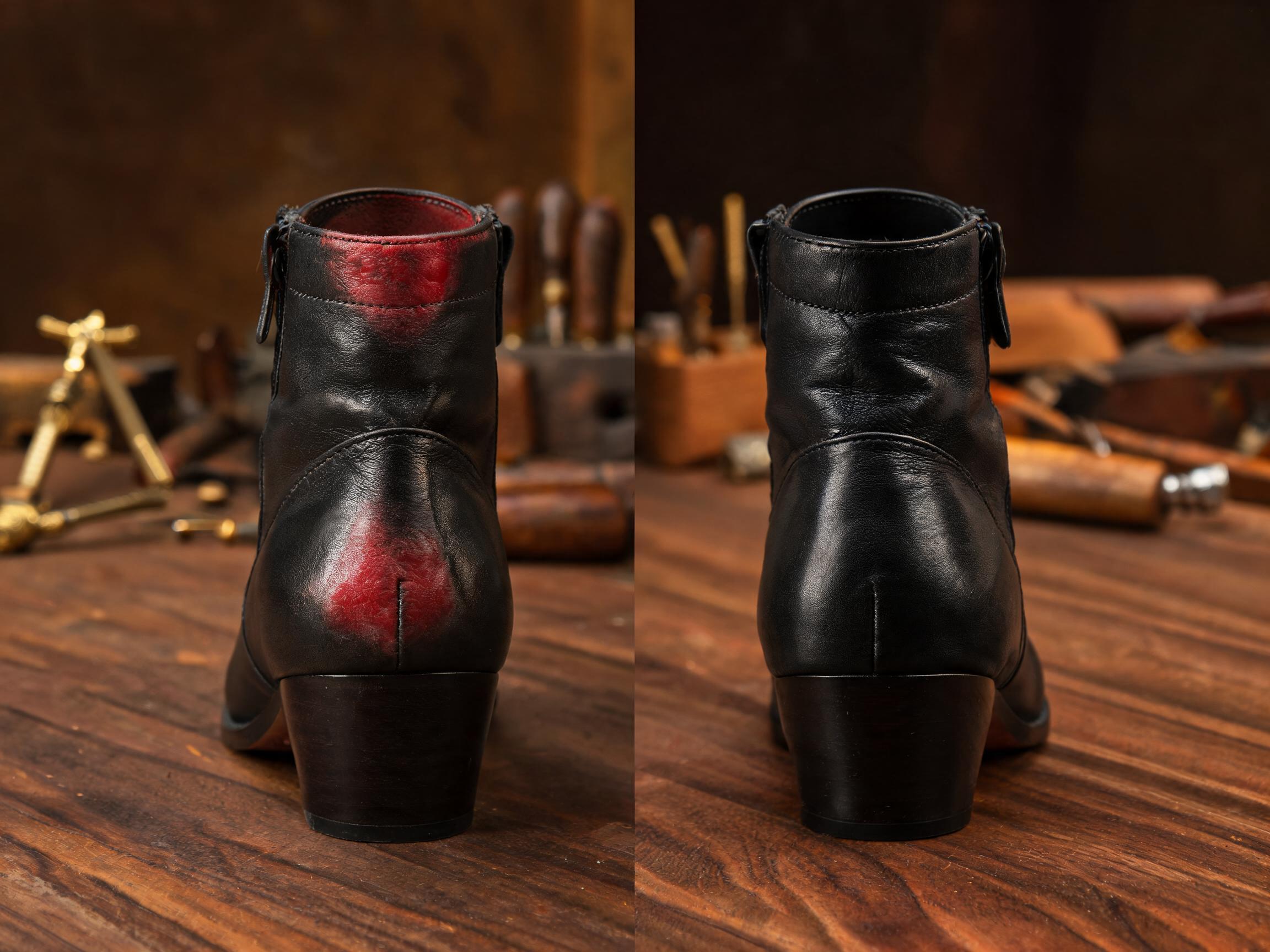
The Chengdu Solution: 48-58 Shore-A TPU-Reinforced Heel-Counter + 0.18-0.28 Chrome-Free Vegetable-Tanned Leather Heel Lining + 22-28mm Custom Anatomical Heel-Seat Curve Radius + 8-12mm Deep Cushioned Heel-Pocket Insert + 0-2mm Anatomical Achilles-Insertion Collar Height
A Chengdu-made women's structured leather shoe or ankle boot can be equipped with five engineering choices that together reduce back-of-heel burning-ache incidence from 62-78% (mass-market average for women at hour 2 of urban wear) to less than 4% over 24 months of daily wear. The five choices are: a 48-58 Shore-A TPU-reinforced heel-counter instead of a 78-85 Shore-A cellulose counter, a 0.18-0.28 chrome-free vegetable-tanned leather heel lining instead of a 0.45-0.62 PU-synthetic-microfiber lining, a 22-28 mm custom anatomical heel-seat curve radius instead of a 12-18 mm standardized curve radius, an 8-12 mm deep cushioned heel-pocket insert instead of a 0.4-0.6 mm thin heel-pocket liner, and a 0-2 mm anatomical Achilles-insertion collar-height position instead of a 4-6 mm error position. The 48-58 Shore-A TPU-reinforced heel-counter flexes with the natural 8-14 mm of Achilles-tendon vertical motion at every step, which accommodates the natural motion without concentrating pressure on any one contact zone. The 0.18-0.28 chrome-free vegetable-tanned leather heel lining has a low friction coefficient that allows the natural 4-8 mm of heel-sliding motion at every step without creating friction-rub sting at the back of the heel. The 22-28 mm custom anatomical heel-seat curve radius matches the natural fat-pad curve radius, which distributes the heel-strike load evenly across the 12-18 cm² heel-pocket contact zone. The 8-12 mm deep cushioned heel-pocket insert absorbs the 2.0-2.6x body-weight heel-strike force at every step, which prevents the heel-strike force from being transmitted to the customer's heel-pocket anatomy. The 0-2 mm anatomical Achilles-insertion collar-height position accommodates the natural 8-14 mm of Achilles-tendon vertical displacement without rubbing the topline edge against the Achilles tendon.
The Chengdu workshop costs for these five upgrades are real but moderate. The 48-58 Shore-A TPU-reinforced heel-counter upgrade from the 78-85 Shore-A cellulose counter costs $1.85-3.45 per pair in higher counter material cost. The 0.18-0.28 chrome-free vegetable-tanned leather heel lining upgrade from the 0.45-0.62 PU-synthetic-microfiber lining costs $0.85-1.65 per pair in higher lining material cost. The 22-28 mm custom anatomical heel-seat curve radius upgrade from the 12-18 mm standardized curve radius costs $0.85-1.65 per pair in additional last-milling cost. The 8-12 mm deep cushioned heel-pocket insert upgrade from the 0.4-0.6 mm thin heel-pocket liner costs $0.85-1.65 per pair in additional cushion material cost. The 0-2 mm anatomical Achilles-insertion collar-height position upgrade from the 4-6 mm error position costs $0.45-0.85 per pair in additional last-fitting cost. The total per-pair cost increase is $4.85-9.25 per pair, which is roughly 2.9-5.6% of a $165 retail price. The end customer pays an extra $7.95-15.50 for a pair of structured leather ankle boots whose back-of-heel comfort lasts the entire 8+ hour workday vs the mass-market ankle boot whose back-of-heel comfort degrades into a deep burning ache within 2-3 hours of regular wear.
Every back-of-heel burning-ache complaint you have ever received from a customer — the customer who said the boots felt fine for the first hour but then her heels started burning, the customer who said she had to kick the boots off under her desk by lunchtime because the back of her heels was on fire, the customer who said the red pressure welts at the back of her heels took three days to fade, the customer who said the same boots she had bought previously from the same brand never hurt her heels but this new pair did, the customer who said she could not wear the boots for more than 2 hours even though she wears similar boots from other brands all day without issues, the customer who said the burning ache was concentrated at the Achilles-tendon insertion point and felt like a hot poker, the customer who said she had tried gel heel inserts and heel grips and nothing helped because the problem was the boot itself, the customer who said the boots were unwearable for the rest of the week after one 8-hour workday, the customer who said her heels were visibly swollen after one day of wear — is a predictable consequence of these five engineering choices that mass-market factories make to save $4.85-9.25 per pair and to ship a shelf-ready inventory model with the marketing phrase "anatomical heel support." The Chengdu factory floor can deliver the same engineering choices at the same retail price by accepting a 2.9-5.6% margin reduction, and the resulting customer-experience improvement is the difference between a 62-78% back-of-heel burning-ache complaint rate at hour 2 and a 4% complaint rate over the 8+ hour workday.
Return to ChinaShoe home to explore the full Chengdu handmade women's structured leather footwear collection with 48-58 Shore-A TPU-reinforced heel-counter + chrome-free vegetable-tanned leather heel lining + custom anatomical heel-seat curve radius construction, or browse the complete News archive for more diagnostic guides on common shoe comfort and construction problems.