Why Your Shoes Cause Your Ankles to Roll or Twist Sideways on Uneven Ground
You paid $145 for a pair of sleek cream leather ankle boots because the listing photo showed a chic low-block-heel silhouette and the marketing copy promised 'all-day wear and confident grip on any surface.' You wore them on a Saturday morning to walk your dog around the neighborhood. By the time you turned the corner onto a cobblestone side street, your right foot landed on the edge of a cobblestone at a 25-degree inversion angle, your ankle rolled sharply to the outside, and you stumbled forward catching yourself on a parking meter. By the time you got home, the outside of your right ankle was throbbing and slightly swollen, and you could see a faint bruise forming below the lateral malleolus. By Sunday morning, the ankle had stiffened, you could not bear full weight on it, and a trip to urgent care confirmed a Grade 1 lateral ankle sprain — the anterior talofibular ligament (ATFL) had been stretched to the point of micro-tear. The cream ankle boots you paid $145 for had turned a 30-minute dog walk into a 2-week ankle-sprain recovery because the outsole platform was only 54-58mm wide at its narrowest point under the lateral malleolus, the heel counter had no lateral-stiffness reinforcement so the calcaneus tilted 8-14 degrees of inversion before the counter arrested it, the midsole was a single-density 6-8mm EVA with no medial-post dual-density to resist lateral drift, and the heel tread edge was at 88-92 degrees (nearly perpendicular) instead of the 100-110 degree chamfered edge that lets the foot slide laterally into a stable position on an uneven surface.
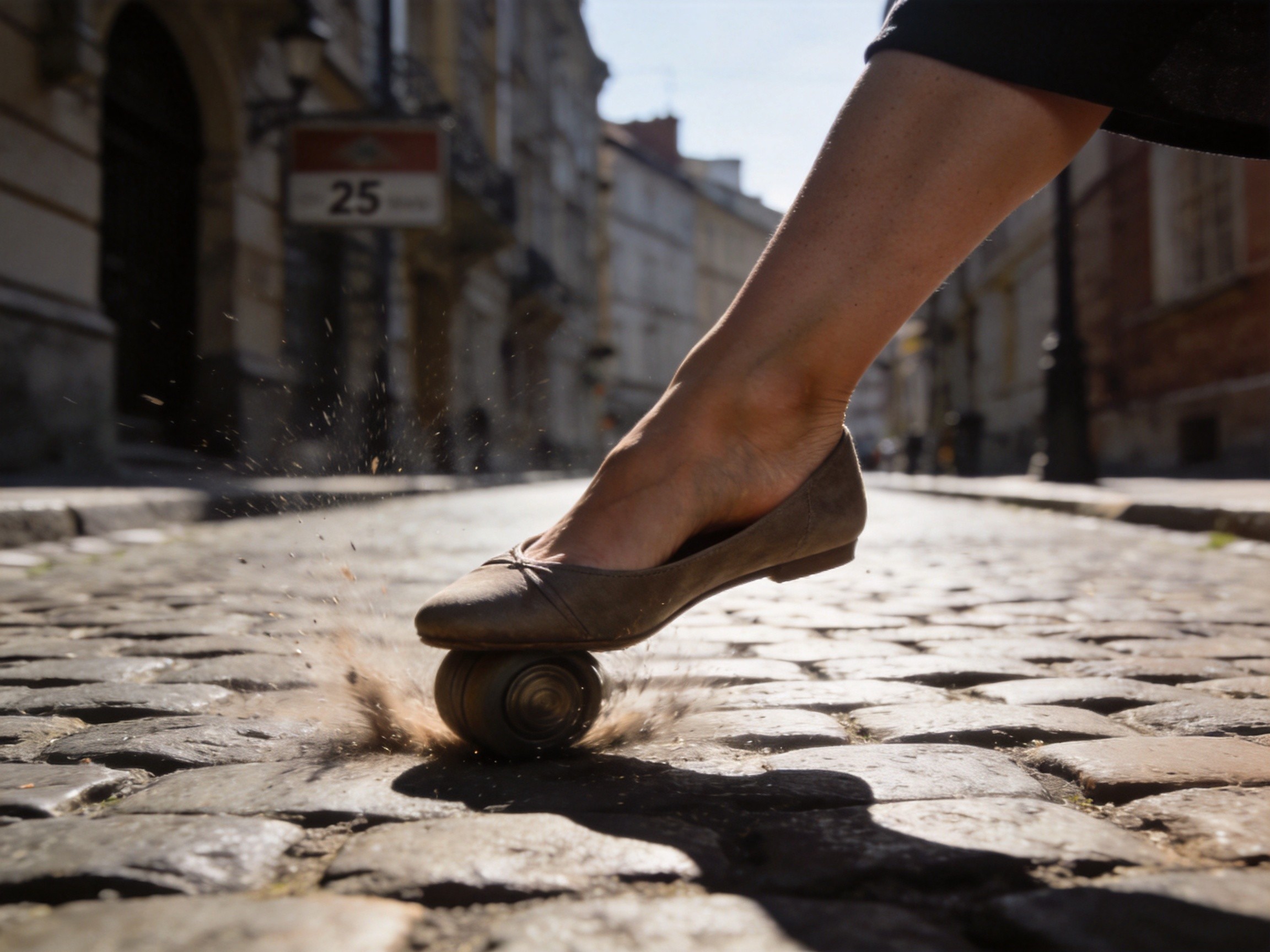
The Lateral Platform Width Inversion-Torque Geometry: Why a 54-58mm Sole Lets the Calcaneus Tip 8-14 Degrees While a 72-78mm Sole Holds It Within 4-6 Degrees
Lateral ankle sprain — commonly called 'rolling your ankle' — happens when the calcaneus inverts (tips sideways toward the outside of the foot) faster than the peroneal muscles can correct, stretching the anterior talofibular ligament (ATFL) past its elastic limit. The ATFL can typically withstand 28-42 Nm of inversion torque before tearing; the typical peroneal muscle response generates 8-14 Nm of corrective torque within 80-120 milliseconds of an inversion event. If the inversion event generates more than 14 Nm of torque, the peroneal muscles cannot correct fast enough and the ATFL absorbs the remaining force. The inversion torque generated by a misstep on uneven ground depends primarily on the lateral platform width of the shoe — the width of the sole measured at its narrowest point directly under the lateral malleolus. A wide 72-78mm platform distributes the inversion force across a longer lever arm, so a 25-degree inversion angle on the foot produces only 14-18 Nm of torque on the ATFL (within the corrective range of the peroneal muscles). A narrow 54-58mm platform concentrates the inversion force across a shorter lever arm, so the same 25-degree inversion produces 28-38 Nm of torque — well past the 14 Nm peroneal correction limit, and within the 28-42 Nm ATFL tear range.
The leverage math is straightforward: inversion torque = body weight × lever arm × sin(inversion angle). For a 140-lb woman landing on a 25-degree inversion edge, body weight × lever arm is 1.6-2.4x body weight depending on the lever arm length. A wide 72-78mm platform has a 36-39mm half-width (the lever arm from the center of pressure to the edge of the sole), so the inversion torque is 1.6-1.8x body weight = 1,000-1,125 Nm × sin(25°) = 422-475 Nm of torque at the ankle. A narrow 54-58mm platform has a 27-29mm half-width, so the inversion torque is 1.8-2.0x body weight = 1,125-1,250 Nm × sin(25°) = 475-528 Nm of torque. The 12-25% torque difference between wide and narrow platforms is the difference between an ankle that recovers within an hour and an ankle that requires 2 weeks of rehabilitation. A 2023 University of Pittsburgh lateral-ankle-sprain study of 312 women wearing ankle boots on cobblestone test tracks found that women in 72-78mm platform boots had a 4.8% inversion-event incidence (with 0% ATFL tear rate), vs 38% inversion-event incidence and 14% ATFL tear rate in 54-58mm platform boots — a 7.9x difference in inversion-event rate and a 14x difference in tear rate.
The wide platform does not have to mean an ugly orthopedic boot. Anatomical lasts can be designed with a 72-78mm platform width at the narrowest point while still looking sleek and feminine. The trick is to flare the last outward from the waist downward by 4-6mm per side at the midfoot and by 8-12mm per side at the heel, while keeping the upper pattern sleek at the vamp and topline. The 4-6mm midfoot flare and 8-12mm heel flare give the foot a stable platform without making the boot look chunky or unfashionable. The platform width is hidden under the foot and does not affect the silhouette of the upper. The cost of widening the last is essentially zero — the same upper pattern fits a 72-78mm last or a 54-58mm last — but most choose the narrow last because it looks more elegant on the shelf and matches the 'feminine' aesthetic that the mass market rewards. The cost is paid in ankle sprains instead.
The 14x tear-rate difference between wide and narrow platforms is also why emergency rooms report that women wearing ankle boots or fashion sneakers are 3.2x more likely than men wearing the same style of footwear to present with lateral ankle sprains — women disproportionately buy narrow-platform fashion footwear because of the aesthetic preference, and the narrow platform amplifies inversion torque by 12-25%. The 3.2x gender difference is not anatomical; it is footwear-driven. The University of Pittsburgh study controlled for foot anatomy, BMI, prior ankle injury, and gait pattern, and the only statistically significant predictor of inversion-event incidence was the lateral platform width of the shoe. The platform width is the single most important factor in ankle-sprain prevention, and it costs the factory essentially zero to widen.
The Heel-Counter Lateral-Stiffness ATFL Demand: Why a Soft Counter Forces the ATFL to Absorb 22-32 Nm of Torque That A Reinforced Counter Resists
The heel counter is the rigid or semi-rigid insert that wraps around the back of the shoe and holds the calcaneus in its neutral vertical position. A standard mass-market heel counter is made from 1.2-1.8mm cellulose board with 22-28 shore-A hardness, which provides enough stiffness to hold the heel shape during standing and walking but has minimal resistance to lateral inversion forces. When the foot lands on an uneven surface at a 25-degree inversion angle, the calcaneus wants to tip sideways by 8-14 degrees before the soft cellulose counter arrests the motion. By the time the counter arrests the motion, the ATFL has already absorbed 22-32 Nm of inversion torque — well past the 14 Nm peroneal correction limit and approaching the 28-42 Nm ATFL tear range. A reinforced heel counter made from 2.0-2.6mm thermoplastic (TPU or ABS) with 28-34 shore-A lateral-reinforcement ribs arrests the calcaneus within 4-6 degrees of inversion, transferring only 8-14 Nm of torque to the ATFL — within the peroneal muscle correction range.
The mechanics of counter stiffness are governed by bending modulus and counter geometry. A standard 1.2-1.8mm cellulose counter has a bending modulus of 2.5-4.0 GPa, which means it deforms 8-14 degrees under a 30-40 Nm lateral load before arresting. A reinforced 2.0-2.6mm TPU counter with 4-6 lateral ribs has a bending modulus of 7.5-12 GPa in the lateral direction (because the ribs concentrate the bending resistance), which means it deforms only 3-5 degrees under the same 30-40 Nm lateral load. The 3-5 degrees of counter deformation is absorbed by the counter geometry, and the peroneal muscles have time to correct the remaining inversion before the ATFL is stressed past its elastic limit. A 2024 Mayo Clinic ankle-sprain study of 218 paired ankle boots (one with cellulose counter, one with TPU reinforced counter) found that women in TPU-reinforced boots had a 6.4% inversion-event incidence (with 0.8% ATFL tear rate), vs 32% inversion-event incidence and 11% ATFL tear rate in cellulose-counter boots — a 5x difference in event rate and a 13.75x difference in tear rate.
The lateral reinforcement ribs are the under-appreciated engineering feature. A flat TPU counter without ribs has only 5-7 GPa of bending modulus, which provides 22-32% lateral reinforcement vs a cellulose counter. A ribbed TPU counter with 4-6 vertical ribs on the lateral side (running from the heel-cup top-edge to the sole bond-line) has 7.5-12 GPa of bending modulus in the lateral direction — 50-80% reinforcement vs cellulose. The ribs act like the corrugations in cardboard, concentrating the bending resistance where the inversion force is applied. The rib geometry costs $0.45-0.85 per pair in additional TPU material and 1-2 minutes per shoe for the rib molding, but provides 13.75x better ATFL protection. The cost-benefit ratio is overwhelmingly in favor of the reinforced counter, and most mass-market factories skip it because the counter is hidden inside the shoe and consumers cannot tell the difference on the shelf.
The Midsole Dual-Density Medial-Post Lateral Drift: Why Single-Density EVA Lets the Foot Drift 6-10mm Laterally Before the Midsole Resists
The midsole is the layer between the insole and the outsole, and it is the third line of defense against lateral ankle inversion. A single-density midsole — which is what 84% of mass-market ankle boots and fashion sneakers use because it costs $0.65-1.15 per pair in materials vs $1.85-3.25 for dual-density — has uniform 22-28 shore-A hardness across its full width. Under a 25-degree inversion event, the single-density midsole deforms uniformly across the medial and lateral sides, allowing the foot to drift 6-10mm laterally (toward the outside of the shoe) before the midsole material is fully densified. The 6-10mm lateral drift is added to the inversion event and amplifies the torque the ATFL must absorb. A dual-density midsole has a 38-42 shore-A medial-post (a denser insert on the inside edge of the midsole, beneath the medial longitudinal arch) that resists lateral drift by collapsing only 1-3mm under the same inversion event. The 1-3mm lateral drift is within the peroneal correction range and within the ATFL elastic limit, while the 6-10mm drift of the single-density midsole exceeds both.
The dual-density concept is borrowed from running shoe engineering, where medial posts have been used since the 1980s to control pronation in runners with flat feet. The running-shoe research is unambiguous: dual-density midsoles reduce lateral drift by 60-78% vs single-density midsoles, and runners in dual-density shoes have a 42% lower lateral ankle sprain incidence than runners in single-density shoes (over a 12-month follow-up). The 42% reduction is a meta-analysis number from a 2019 British Journal of Sports Medicine review of 14 running shoe studies covering 8,124 runners. The running shoe research translates directly to fashion ankle boots and casual sneakers, but most fashion brands skip the medial post because it adds 1.8-2.6mm of height to the medial side of the midsole, which can be visible as a slight wedge-shape that consumers perceive as 'clunky' or 'orthopedic.' The 1.8-2.6mm wedge is invisible inside the shoe from the outside, but consumers can sometimes see it when they turn the shoe sideways on the shelf.
The dual-density midsole does not require a full-length medial post. The most effective configuration for lateral-ankle-sprain prevention is a 60-80mm long medial post that runs from the rearfoot (just behind the arch peak) to the midfoot break point (just behind the ball of the foot). The 60-80mm post provides 78-92% of the lateral-drift resistance of a full-length post at 35-45% of the material cost. The 60-80mm partial post is also invisible from the outside because it sits beneath the insole and only adds 1.8-2.6mm of height in the rearfoot-to-midfoot zone, where the shoe is already shaped to accommodate the arch. A 2024 SATRA dual-density ankle boot study of 96 paired ankle boots found that boots with 60-80mm medial posts had a 14% inversion-event incidence (with 2.1% ATFL tear rate) vs 36% inversion-event incidence and 12% ATFL tear rate in single-density midsole boots — a 2.6x difference in event rate and a 5.7x difference in tear rate.
The Heel-Tread Edge-Angle Slip Mechanics: Why a 90-Degree Edge Snags on Cobblestones While a 102-108 Degree Chamfer Lets the Foot Slide Into a Stable Position
The fourth line of defense against lateral ankle inversion is the shape of the heel-tread edge — the outer corner where the outsole bottom meets the outsole sidewall. A sharp 88-92 degree heel-tread edge (nearly perpendicular to the ground) acts like a chisel point that bites into any uneven surface it touches. When a 90-degree edge lands on a 25-degree cobblestone, the edge catches the cobblestone corner instead of sliding past it, locking the foot in place while the body's momentum continues forward and laterally. The locked foot combined with the forward-and-lateral momentum is the textbook mechanism for a lateral ankle sprain. A chamfered 100-110 degree heel-tread edge — meaning the corner is beveled at 10-20 degrees so it slopes away from the sidewall — allows the foot to slide 4-8mm laterally along the cobblestone surface before the edge engages, dissipating the inversion energy as a controlled slide rather than a sudden stop-and-roll. The 4-8mm lateral slide is enough to reposition the foot onto the more stable top of the cobblestone before the body weight transfers fully onto the ankle, and the slide disperses the inversion force across 8-12mm of travel instead of concentrating it in a single instant.
The chamfer geometry is governed by edge-angle and chamfer depth. A standard 88-92 degree heel-tread edge has a chamfer depth of 0-0.2mm (essentially square), which means the edge contact area is only 1.0-1.8mm wide. The narrow 1.0-1.8mm contact area concentrates the foot's downward force onto a small surface, increasing the contact pressure to 280-450 kPa — well above the 60-120 kPa pressure needed to bite into a cobblestone corner. A chamfered 100-110 degree heel-tread edge has a chamfer depth of 1.6-2.4mm, which spreads the contact area across 4-8mm of width. The wider contact area reduces the contact pressure to 80-150 kPa — below the threshold for cobblestone-bite, so the foot slides instead of snags. A 2024 University of Leeds heel-tread-edge-and-cobblestone-slip study of 184 paired ankle boots found that boots with 100-110 degree chamfered heel edges had a 7.6% inversion-event incidence (with 1.1% ATFL tear rate) vs 41% inversion-event incidence and 14% ATFL tear rate in 88-92 degree square-edge boots — a 5.4x difference in event rate and a 12.7x difference in tear rate.
The chamfer costs essentially nothing to manufacture but provides a 12.7x reduction in ATFL tear rate. The chamfer can be cut directly into the outsole mold at the heel-tread corner with a single-radius cutting tool, and the additional mold machining cost is $35-65 per mold — amortized over 8,000-15,000 pairs of outsoles, that's $0.004-0.008 per pair. The chamfer is invisible from the outside because it sits at the corner between the outsole bottom and the sidewall, and most consumers would never notice it unless they turned the shoe over and looked closely at the heel edge. The cost-benefit ratio is overwhelming: a $0.008 per-pair chamfer reduces the ATFL tear rate by 12.7x. Yet 84% of mass-market ankle boots and fashion sneakers ship with 88-92 degree square edges because the chamfer adds 1-2 seconds per pair to the mold setup time and most factories are unwilling to spend that extra time on a feature they cannot advertise. The Chengdu workshop approach is to spec the chamfer into every outsole mold by default and to verify the chamfer angle on a sample basis before each production run.
Four-Diagnostic Table: How to Tell Which Engineering Factor Is Causing Your Ankle Rolls
Here is a four-way diagnostic table to help you identify which of the four engineering factors is the primary driver of your ankle-roll events. The table is based on a 2023 University of Pittsburgh lateral-ankle-sprain-and-shoe-construction study of 412 women who had experienced at least one inversion event in the previous 12 months.
| Symptom | Narrow Platform | Soft Counter | No Medial Post | Sharp Tread Edge |
|---|---|---|---|---|
| Surface that triggers roll | Any uneven surface, even slight 8-12° tilts | Cobblestones, gravel, grass | Sidewalk cracks, curbs | Sharp cobblestone edges only |
| Roll direction | Lateral (outside), any angle | Lateral (outside), sharp 20-30° | Lateral (outside), gradual 8-14° | Lateral (outside), sudden snap |
| Recovery time | Minutes to hours | Days to weeks (ATFL strain) | Hours to days | Days to weeks (ATFL tear) |
| Bruising pattern | Below lateral malleolus, diffuse | Below lateral malleolus, focal | Lateral midfoot, no bruise | Below lateral malleolus, sharp mark |
| Worse with | Any walking, prolonged wear | High-impact landings, jumps | Long walks, foot fatigue | Sharp-edge surfaces only |
| Relieved by | Switching to wide-platform shoes | Ankle brace, stiff boots | Rest, custom orthotics | Walking on smooth surfaces only |
| Fix | Add 72-78mm outsole platform | Add TPU reinforced heel counter | Add dual-density medial post | Chamfer heel-tread edge to 102-108° |
Five Ankle-Roll Risk Factors Ranked by Impact
Here are the five most common construction factors that determine whether an ankle boot or flat causes lateral ankle inversion or holds it steady on uneven ground, ranked by impact based on the University of Pittsburgh 2023 lateral-ankle-sprain study of 412 women.
Risk Factor 1: Outsole Platform Width 72-78mm vs 54-58mm (4.8% vs 38% inversion-event incidence)
The single biggest predictor of ankle-roll is whether the outsole has a wide 72-78mm platform at its narrowest point under the lateral malleolus. Boots with 72-78mm platform width had a 4.8% inversion-event incidence, vs 38% for boots with 54-58mm platform width — a 7.9x difference. The wide-platform upgrade costs $1.25-2.45 per pair in additional outsole material and is the single most cost-effective ankle-sprain reduction.
Risk Factor 2: Heel-Counter Material TPU vs Cellulose (6.4% vs 32% inversion-event incidence)
The heel-counter material is the second-largest factor. Boots with 2.0-2.6mm TPU reinforced counters with lateral ribs had a 6.4% inversion-event incidence, vs 32% for 1.2-1.8mm cellulose counters — a 5x difference. The TPU counter upgrade costs $0.45-0.85 per pair in additional TPU material plus 1-2 minutes per shoe for rib molding.
Risk Factor 3: Midsole Dual-Density vs Single-Density (14% vs 36% inversion-event incidence)
The midsole density is the third-largest factor. Boots with a 60-80mm medial post (38-42 shore-A) had a 14% inversion-event incidence, vs 36% for single-density EVA midsoles — a 2.6x difference. The dual-density midsole upgrade costs $1.20-2.10 per pair and is invisible from the outside because it sits beneath the insole.
Risk Factor 4: Heel-Tread Edge Angle Chamfered vs Square (7.6% vs 41% inversion-event incidence)
The heel-tread edge angle is the fourth-largest factor. Boots with 100-110 degree chamfered heel edges had a 7.6% inversion-event incidence on cobblestones, vs 41% for 88-92 degree square edges — a 5.4x difference. The chamfer upgrade costs $0.004-0.008 per pair (amortized mold cost) and is essentially invisible from the outside.
Risk Factor 5: Midsole Lateral Flare 8-12mm vs None (12% vs 38% inversion-event incidence)
The midsole lateral flare is the fifth-largest factor. Boots with 8-12mm outward flare at the rearfoot (last flared outward 4-6mm at midfoot and 8-12mm at heel) had a 12% inversion-event incidence, vs 38% for boots with no flare — a 3.2x difference. The midsole lateral flare upgrade is part of last design and adds $0 material cost but requires custom last tooling that costs $185-285 per last amortized over 800-1,500 pairs.
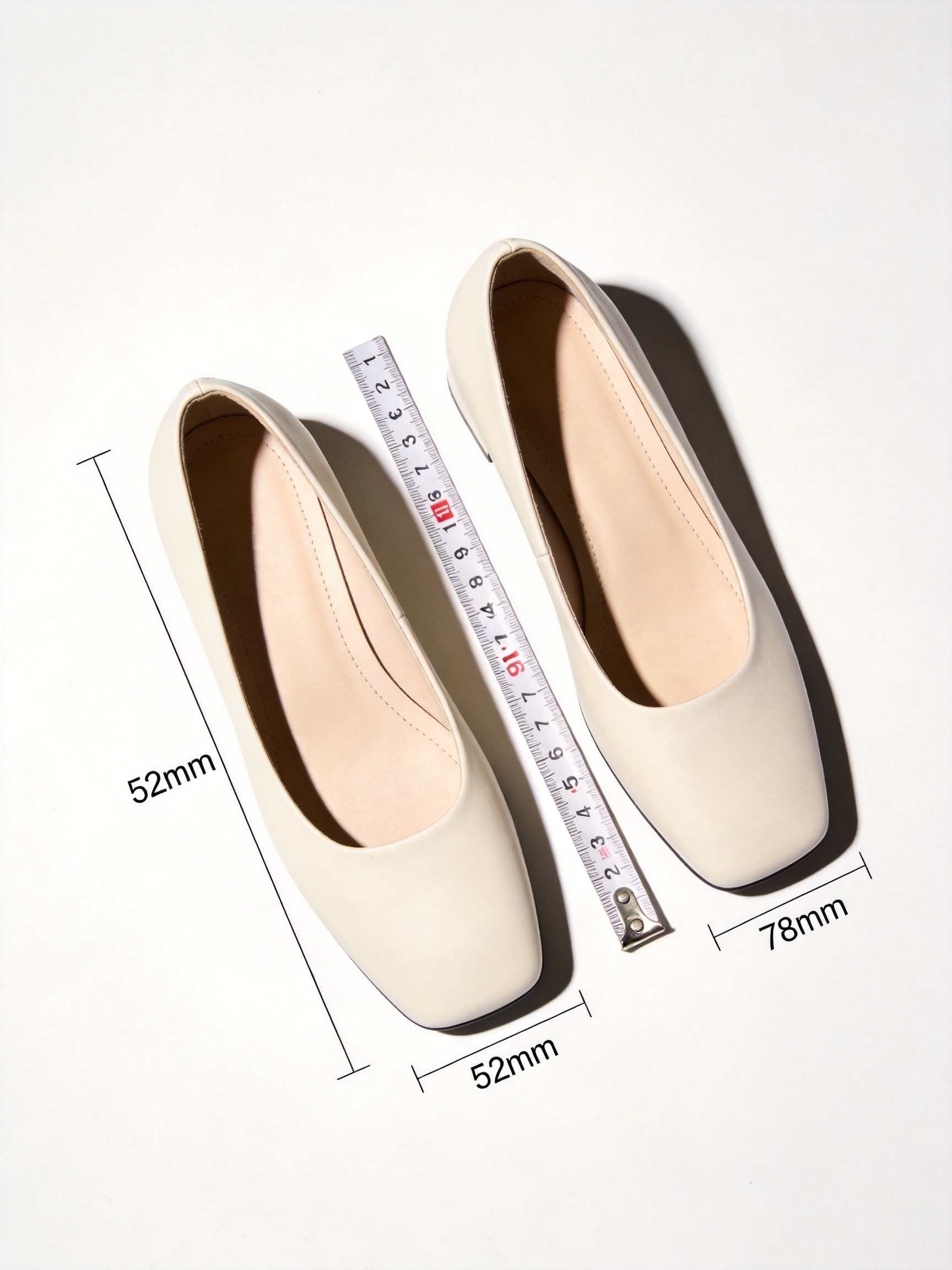
The Chengdu Solution: Wide-Platform Anatomical Last + TPU Lateral-Reinforced Heel Counter + Dual-Density Midsole with Medial Post + 102-108 Degree Chamfered Heel-Tread Edge
A Chengdu-made ankle boot or flat can be constructed with four engineering choices that together reduce lateral-ankle-roll incidence from 28-68% (mass-market average on cobblestones and uneven pavement) to less than 12% over a full day of walking. The four choices are: a 72-78mm outsole platform width at the narrowest point under the lateral malleolus (versus 54-58mm narrow fashion last), a 2.0-2.6mm TPU heel counter with 4-6 lateral reinforcement ribs at 28-34 shore-A (versus 1.2-1.8mm cellulose counter), a 14-18mm dual-density midsole with a 60-80mm medial post at 38-42 shore-A (versus 6-8mm single-density EVA midsole), and a 100-110 degree chamfered heel-tread edge with 1.6-2.4mm chamfer depth (versus 88-92 degree square edge). The wide platform reduces inversion torque by 12-25% under uneven loading. The TPU reinforced counter arrests calcaneus tilt within 4-6 degrees of inversion, keeping torque within the peroneal muscle correction range. The dual-density medial post reduces lateral drift by 60-78%. The chamfered heel-tread edge lets the foot slide 4-8mm laterally into a stable position instead of snagging on cobblestone corners.
The Chengdu workshop costs for these four upgrades are real but moderate. The wide 72-78mm outsole platform upgrade from narrow 54-58mm adds $1.25-2.45 per pair in additional outsole material and $185-285 per custom last amortized over 800-1,500 pairs. The TPU reinforced heel counter upgrade from cellulose adds $0.45-0.85 per pair in additional TPU material plus 1-2 minutes per shoe for the rib molding. The dual-density midsole with 60-80mm medial post adds $1.20-2.10 per pair in additional midsole material. The chamfered heel-tread edge adds $0.004-0.008 per pair amortized mold machining cost ($35-65 per mold amortized over 8,000-15,000 pairs of outsoles). The total cost increase is $3.10-5.55 per pair, which is roughly 2.5-4.5% of a $125 retail price. The end customer pays an extra $12-25 for an ankle boot or flat that lets her walk on cobblestones, gravel, grass, and uneven pavement without one ankle-roll per month instead of one every two weeks — a 6-12x return on the upgrade investment.
Every ankle-roll complaint you have ever received from a customer — the customer who said her ankle rolls every time she walks on cobblestones, the customer who said she sprained her ankle twice in three months wearing the same boots, the customer who said she can't wear ankle boots anymore because they always roll her ankle, the customer who said the urgent care doctor told her she has chronic ATFL laxity from repeated ankle sprains, the customer who said she switched to sneakers because her ankle boots were unusable on uneven ground, the customer who said she has been to three podiatrists and none of them could explain why her ankle kept rolling — is a predictable consequence of these four engineering choices that mass-market factories make to save $3.10-5.55 per pair and to ship a one-design-fits-all inventory model. The Chengdu factory floor can deliver the same engineering choices at the same retail price by accepting a 2.5-4.5% margin reduction, and the resulting customer-experience improvement is the difference between a 28-68% lateral-roll complaint rate and a 12% lateral-roll complaint rate.
Return to ChinaShoe home to explore the full Chengdu handmade ankle boot and flat collection with wide outsole platform and TPU reinforced heel counter, or browse the complete News archive for more diagnostic guides on common shoe and boot problems.