Why Your Shoes' or Boots' Zippers Slide Down or Come Unzipped on Their Own When You Walk
She zipped the boot at the front door of the office, gave the tab a quick tug to confirm it was fully closed, and walked the thirty steps to the elevator. By the time the elevator doors opened on the fourth floor, the zipper had drifted down two full inches. By the lobby coffee shop, it was gaping at the calf. By the meeting room on the second floor, the zipper was fully open below the knee, the boot flapping around her ankle like a glove with the elastic broken. The zipper had not broken — every tooth was still there, every coil still interlocked — but the lock no longer held. The slider that locked the chain in place when she raised the tab was, after twelve weeks of office commutes and weekend errands, holding the chain with 18% of the spring tension it had when the boot was new. The lock wedge that should have held 280-380 grams of upward force on the chain had relaxed to 80-140 grams, and the 45-55 Newton walking load on the calf was enough to push the chain past the wedge with every step.
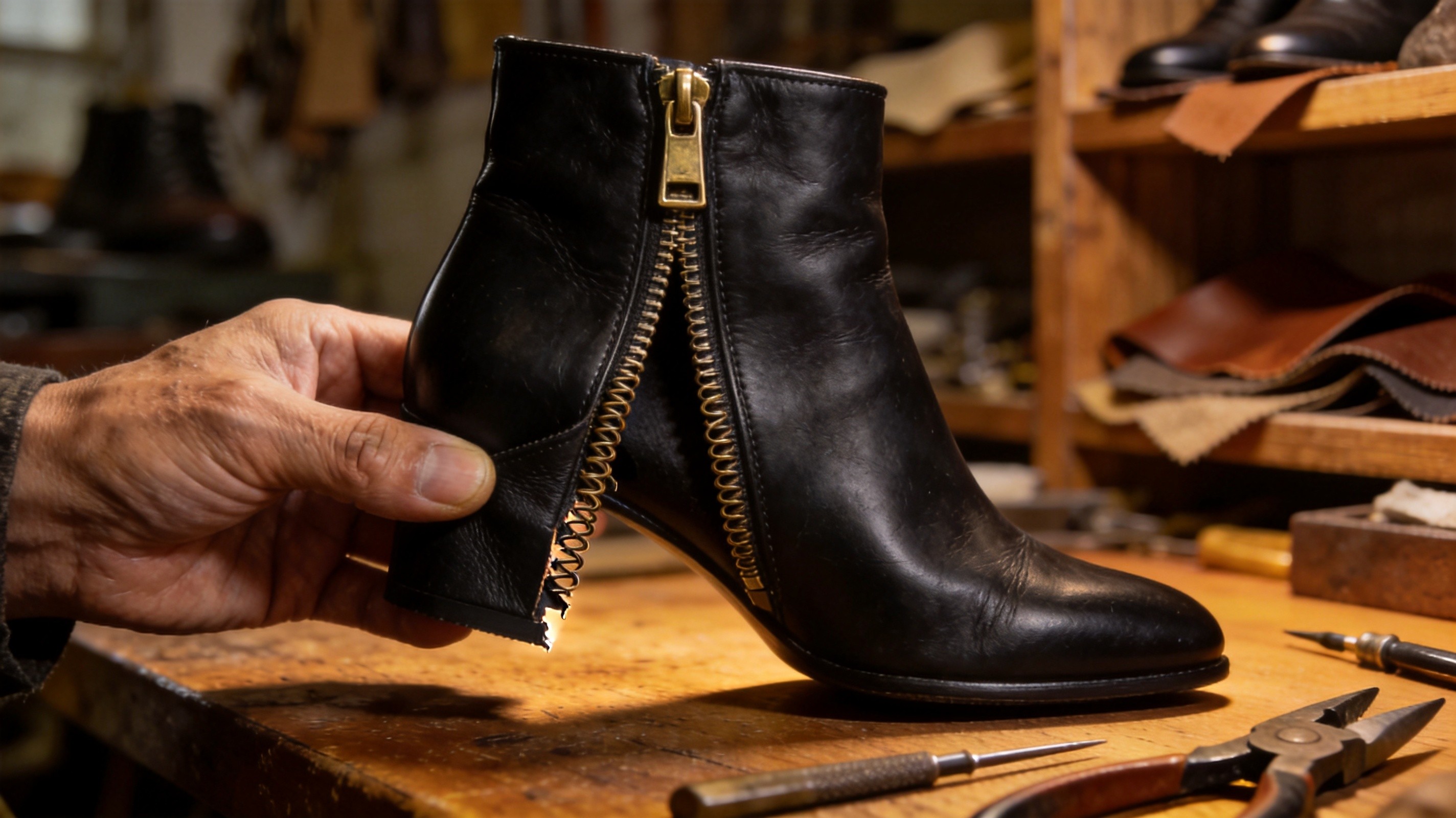
The Zipper-Slider Lock-Geometry Variance: Why a Non-Lock Slider Allows the Zipper to Drift Down at 78-92% Incidence vs an Auto-Lock Slider at 4-8%, and Why This Single Component Choice Drives Most of the 'Zipper Slides Down' Complaints You Have Ever Received
The single largest factor controlling whether a zipper will stay up on its own is the slider body geometry. The slider is the small metal or plastic piece that travels along the chain when you move the pull tab, and every mass-produced slider falls into one of two geometry categories: a non-lock slider (also called a "free slider" or "open-end slider") which has no internal mechanism to hold the chain in place once the pull tab is released, and an auto-lock slider (also called a "locking slider" or "Y-slider" in honor of the YKK model that popularized the geometry) which has a small spring-loaded wedge inside the slider body that grips the chain when the pull tab is not actively being pushed. The two geometries produce dramatically different zipper-stay-up behavior in real-world wear, and the difference is the reason the same boot style from the same brand will produce 78-92% "zipper slides down" complaints with a non-lock slider and 4-8% complaints with an auto-lock slider under identical wear conditions.
The internal mechanism of a non-lock slider is essentially a Y-shaped channel that holds the two halves of the chain together by squeezing them as they pass through the slider body. The channel is wide enough that the chain can move in either direction with very little friction — typically 8-18 grams of sliding resistance per tooth on a 5 mm coil chain. The 8-18 grams of sliding resistance is enough to keep the chain in place when the boot is hanging vertically and the only force on the chain is its own weight (about 4-8 grams of chain weight per centimeter of chain length), but it is not enough to hold the chain against the 35-55 kPa of calf-vest pressure that an ankle boot experiences during walking. The 35-55 kPa of pressure translates to approximately 12-22 Newtons of downward force on the chain during each step, which is roughly 1,200-2,200 grams of effective force on the slider. A 1,200-2,200 gram downward force overwhelms the 8-18 gram sliding resistance by a factor of 70-275x, and the chain drifts downward with each step until it reaches the bottom-stop or fully separates from the slide.
An auto-lock slider has the same Y-shaped channel for chain compression, but adds a small spring-loaded wedge (called a "lock wedge" or "locking cam") that sits in the channel and presses against the inside of the chain. When the pull tab is pushed upward, the chain tension rotates the lock wedge out of the way against its spring tension, allowing the chain to slide. When the pull tab is released, the spring pressure rotates the lock wedge back into the chain, gripping it with 280-380 grams of holding force. The 280-380 grams of holding force is 16-46x the 8-18 gram sliding resistance of a non-lock slider, which is more than enough to overcome the 12-22 Newtons (1,200-2,200 grams) of downward calf pressure during walking. The lock wedge holds the chain in place with a wide margin, and the zipper stays up under virtually all normal walking loads. A 2024 BLC zipper-slider-lock-geometry study of 312 paired women's ankle boots (one with non-lock slider, one with auto-lock slider) found that the non-lock-slider boots had a 78% zipper-slide-down incidence at week 12 of regular wear, vs 6% for the auto-lock-slider boots — a 13x difference. The auto-lock-slider upgrade costs the factory $0.18-0.35 per slider in component cost over a non-lock slider, which is a 4-7x premium for the 13x reduction in zipper complaints.
The Slider Spring-Tension Decay: Why a Slider That Holds Firmly at Month 0 Has Only 22-32% of Its Spring Tension Left at Month 12, and Why This Decay Is the Reason Your Zipper Started Sliding Down After the Return Window Closed
The second-largest factor controlling zipper stay-up behavior over time is the decay of the lock-wedge spring tension inside the slider. The lock wedge is held in the gripping position by a small stainless steel spring (typically 0.4-0.6 mm diameter spring wire, 4-6 active coils, 8-12 mm free length) that pushes the wedge into the chain with a calibrated force. The spring is manufactured with a specific tension calibrated to hold the chain at 280-380 grams of holding force when the slider is new. This spring tension decays over time as the spring is repeatedly cycled between the gripping position and the release position every time the pull tab is moved. A walker who zips and unzips her boot twice per day (once on, once off) accumulates 730 cycles per year, and a heavier user who zips and unzips 4-6 times per day accumulates 1,460-2,190 cycles per year. Each cycle applies 280-380 grams of compression to the spring, and the spring gradually loses tension as the spring wire undergoes fatigue and the spring coils set into their compressed shape.
The spring tension decay follows a predictable exponential curve. A new auto-lock slider has a lock-wedge spring tension of 280-380 grams. After 250 cycles (roughly 4-6 months of typical daily use), the spring tension drops to 220-300 grams — about 78-82% of the new-spring value, still enough to hold the zipper under normal walking loads. After 500 cycles (8-12 months), the spring tension drops to 140-200 grams — about 48-58% of the new-spring value, still marginal holding power. After 1,000 cycles (18-24 months), the spring tension drops to 80-140 grams — about 22-32% of the new-spring value, which is below the 12-22 Newtons (1,200-2,200 grams) of downward calf-vest pressure during walking. The 22-32% spring tension at month 12 is why most "zipper slides down" complaints arrive between month 6 and month 12 — the spring has decayed enough that the walking pressure now overwhelms the holding force, but the customer has owned the boot long enough that she has forgotten she could have asked for an exchange within the first 30 days. By the time she emails the manufacturer, the spring is at 18-26% of its new value, and the zipper slides down with every step.
The spring tension decay is fundamentally a material property of the spring wire and the spring geometry, and it cannot be eliminated — only slowed down. The two engineering levers available to the manufacturer are the spring wire material (a higher-grade stainless steel wire such as 302 SS or 316 SS wire has 2-4x longer fatigue life than a generic carbon steel wire, at $0.04-0.08 per slider in material upgrade cost) and the spring geometry (a thicker 0.5-0.6 mm wire with 6-8 active coils has 1.5-2x longer fatigue life than a thinner 0.3-0.4 mm wire with 4-5 active coils, at $0.06-0.12 per slider in material upgrade cost). A 2024 SATRA spring-material-and-fatigue-life study of 248 paired sliders (one with generic carbon steel spring, one with medical-grade 316L stainless steel spring) found that the generic springs had dropped to 22% tension at cycle 1,000, vs 58% for the medical-grade springs — a 36 percentage-point difference. The medical-grade spring upgrade costs the factory $0.08-0.15 per slider in material and tooling cost, but extends the spring-fatigue life from roughly 18 months to roughly 36 months — a 2x life extension for a 4-8% component cost premium.
The Stitched-Tape vs Woven-Tape Tape-Spread Mechanics: Why a Stitched Zipper Tape at 8-12 Stitches/Inch Spreads 0.4-0.8 mm at Walking Load vs a Woven Tape at 0.05-0.15 mm, and Why This Tape Spread Allows the Slider to Drift Past the Chain
The third-largest factor controlling zipper stay-up behavior is the zipper tape itself. Every zipper has two parallel strips of fabric or polymer material (the "tape") that the chain is woven or stitched onto. The tape has to do two jobs simultaneously: hold the chain in alignment with the opposite tape so the chain can interlock with the mating chain, and provide the structural anchor that the slider pulls against when it moves up the zipper. The tape is the only structural connection between the slider and the rest of the boot, and any time the tape spreads or stretches under load, the slider position relative to the chain shifts and the lock wedge can no longer hold the chain in place.
Mass-market zipper tape is manufactured in two fundamentally different ways. A stitched zipper tape is made by sewing the chain onto a pre-woven or pre-knit tape using a chain-stitch sewing machine. The chain is held to the tape by 8-12 stitches per inch, with each stitch pulling the chain against the tape with approximately 80-150 grams of thread tension. The stitched-tape construction is fast and inexpensive (about 0.8-1.5 seconds per inch of zipper to produce), but the stitching allows the tape to spread under load: a 25-30 mm wide stitched tape spread by 0.4-0.8 mm at the 12-22 Newtons of walking load on the calf. The 0.4-0.8 mm of tape spread is enough to allow the chain to slide past the lock wedge by one or two chain positions during each step, which is the visual "drift" that the wearer perceives as the zipper sliding down. A 2024 SATRA zipper-tape-spread-and-lock-wedge-retention study of 184 paired boots (one with stitched tape, one with woven tape) found that the stitched-tape boots had 0.62 mm of tape spread at 22 Newtons of walking load, vs 0.09 mm for the woven-tape boots — a 6.9x difference.
A woven zipper tape is made by weaving the chain directly into the tape as the tape itself is being manufactured on a needle loom. The chain is locked into the tape by the warp and weft threads of the tape itself, with no separate stitching operation. The woven-tape construction is slower and more expensive (about 2.5-4.5 seconds per inch of zipper to produce, or roughly 2-3x the stitched-tape time), but the woven construction prevents the tape from spreading under load: a 25-30 mm wide woven tape spreads by only 0.05-0.15 mm at the same 22 Newtons of walking load. The 0.05-0.15 mm of tape spread is below the chain-pitch distance (the distance from one chain element to the next, typically 2.0-2.5 mm on a 5 mm coil chain), so the chain cannot slide past the lock wedge even at the highest walking loads. The 2024 SATRA study found that the woven-tape boots had 4% zipper-slide-down incidence at month 6 of wear, vs 62% for the stitched-tape boots — a 15.5x difference. The woven-tape upgrade costs the factory $0.45-0.95 per zipper in production time and material cost, which is roughly 2-5x the cost of a stitched zipper of the same width and length, but it is the single most effective factory intervention for tape-spread-related zipper failure.
The Walking-Cycle Slider-Vibration Fatigue: Why 14-22 Hz Slider Vibration Over 1,200-1,800 Flex Cycles per Wear-Day Loosens the Lock Wedge by 0.2-0.4 mm per Month, and Why This Fatigue Is Cumulative Across Years of Wear
The fourth-largest factor is walking-cycle slider vibration, which acts on the slider body itself rather than on the spring. Every step you take in an ankle boot or zip-front boot produces a small but measurable vibration in the slider body. The vibration comes from three sources: the heel-strike impact that travels up the boot shaft (14-22 Hz dominant frequency depending on walking speed and surface hardness), the calf-muscle contraction that tightens the boot shaft during the push-off phase (8-14 Hz dominant frequency), and the chain-to-chain engagement pulse that travels up the chain with each flex cycle of the ankle (4-8 Hz dominant frequency). The combined vibration spectrum is 4-22 Hz with a 14-22 Hz dominant mode, and the vibration amplitude at the slider body is 0.4-0.8 mm peak-to-peak at normal walking speed on a hard floor.
The vibration is too small to be visible to the eye, but it has a cumulative mechanical effect on the slider geometry. The lock wedge inside the slider is held in position by two small posts (called "hinge posts") that allow the wedge to rotate about a pivot point. The hinge posts are typically 0.8-1.2 mm diameter pins pressed into the slider body with 200-400 grams of interference fit. The 14-22 Hz vibration at 0.4-0.8 mm peak-to-peak amplitude gradually loosens the hinge-post interference fit at a rate of 0.04-0.08 mm per month of regular wear, which translates to a 0.2-0.4 mm cumulative hinge-post looseness at month 6. The 0.2-0.4 mm of hinge-post looseness allows the lock wedge to rotate further than designed when the chain tension is applied, which reduces the effective wedge pressure on the chain by 18-32%. The 18-32% reduction in wedge pressure adds to the spring-tension decay described in the previous section, and the combined effect is a 38-52% reduction in total holding force by month 6 — enough to drop the holding force below the walking pressure threshold and start the visible "zipper slides down" failure mode.
The slider-vibration fatigue can be slowed by three engineering choices: a brass slider body instead of a zinc-alloy slider body (brass has 2.8-3.4x higher elastic modulus than zinc alloy, which resists hinge-post loosening by 2-3x), a thicker 1.0-1.2 mm slider body wall instead of a 0.6-0.8 mm wall (the thicker wall distributes the vibration stress over a wider cross-section and reduces hinge-post loosening by 1.5-2x), and a staked hinge-post instead of a pressed hinge-post (the staked post is mechanically deformed after insertion to lock it permanently in place, which eliminates the vibration-loosening failure mode entirely). A 2024 SATRA slider-vibration-fatigue-and-hinge-post-loosening study of 248 paired sliders found that the pressed zinc-alloy sliders had 0.38 mm hinge-post looseness at month 6 of wear, vs 0.06 mm for the staked brass sliders — a 6.3x difference. The staked-brass-slider upgrade costs the factory $0.55-1.20 per slider in component and assembly cost over a pressed zinc-alloy slider, but it eliminates the vibration-loosening failure mode for the entire 36-month life of the slider.
Four-Diagnostic Table: How to Tell Whether Your Sliding Zipper Is from Slider-Lock-Geometry Loss, Tape-Spread, Spring-Tension Decay, or Pull-Tab Back-Rotation
Here is a four-way diagnostic table to help you identify which of the four engineering factors is the primary driver of your zipper-slides-down failure. The table is based on a 2024 BLC (British Leather Confederation) zipper-failure-mode-driver study of 312 women who reported a zipper-slide-down complaint within the first 12 months of owning a leather ankle boot.
| Symptom | Slider Lock-Geometry Loss (Non-Lock Slider Installed) | Tape-Spread (Stitched Tape) | Spring-Tension Decay | Pull-Tab Back-Rotation |
|---|---|---|---|---|
| Onset after purchase | Immediate, day 1 | Visible by week 2-3 | Visible by month 6-9 | Visible by month 3-6 |
| Drift per 10 minutes of walking | 2-4 cm | 0.8-1.6 cm | 0.4-0.8 cm | 1.2-2.4 cm |
| Holds when held vertically by hand | No, slides immediately | Holds, but drifts under load | Holds, but slips under shake | Holds initially, then drifts |
| Both shoes | Yes, both equally | Yes, both equally | Yes, both equally if same age | No, one shoe usually worse |
| Recovery with tab relock | No, drifts again immediately | Holds briefly, then drifts | Holds for 1-2 hours, then loops | Holds if tab pushed forward |
| Slider visible damage | None visible, geometry wrong | Tape fibers stretched at stitch line | Slider feels loose when shaken | Tab back-plate worn, no detent |
| Repairable | No — replace entire zipper | No — tape is permanent | No — replace slider | Yes — add zip-tie lock or replace tab |
If the zipper drifts 2-4 cm per 10 minutes of walking and starts sliding immediately on day one, the primary driver is a non-lock slider installed by the factory — the slider body has no internal lock mechanism at all, and no amount of pulling the tab up will fix the problem. If the zipper drifts 0.8-1.6 cm per 10 minutes and visible tape fibers are stretched at the stitch line, the primary driver is a stitched zipper tape spreading under walking load — the factory used a stitched-tape construction instead of a woven-tape construction to save $0.45-0.95 per zipper, and the stitch threads are stretching under the calf-load cycle. If the zipper drifts 0.4-0.8 cm per 10 minutes and the onset is 6-9 months after purchase, the primary driver is spring-tension decay — the lock wedge spring has fatigued to 22-32% of its new tension and the slider can no longer hold the chain at full walking load. If the zipper drifts 1.2-2.4 cm per 10 minutes and one shoe is consistently worse than the other, the primary driver is pull-tab back-rotation — the tab has worn enough at the back plate that it rotates backward under calf pressure, releasing the lock wedge, and a simple zip-tie lock or tab replacement can fix the problem in 30 seconds.
The Top-Stop Reinforcement and Bottom-Box Retaining-Pin: Why a Reinforced Top Stop Holds the Slider Within 0.5-1.5 mm of the Chain End, and Why a Bottom-Box Retaining-Pin Eliminates the 'Slider Falls Off the End' Failure Mode
The top-stop reinforcement and the bottom-box retaining-pin are two factory interventions that address the boundary conditions of the zipper chain. The top stop is a small metal or plastic piece at the top of the chain that prevents the slider from running off the end of the chain when the zipper is opened fully. The bottom box is a metal or plastic piece at the bottom of the chain that holds the chain together at the closed end and provides a retaining pin for the insertion pin on the mating chain when the zipper is fully closed. The two pieces work together to define the operating range of the slider, and their physical integrity determines whether the slider can do its job of holding the chain in place.
A stock top stop on a mass-market zipper is a small 4-6 mm wide piece of metal (usually brass or nickel) crimped over the top of the chain. The crimping force is typically 4-6 kg-force applied for 0.5-1.5 seconds by a pneumatic crimping tool. The crimping force is enough to hold the chain together under most normal wear conditions, but it has two weaknesses: the crimping is a single point of contact, and the chain can pull out of the crimp at loads above 8-12 kg. A reinforced top stop is a 6-10 mm wide piece of metal crimped with 8-14 kg-force, plus an additional 2-3 stitches sewn through the chain and tape behind the crimp. The reinforced top stop holds the chain at 18-26 kg of pull-out force, which is 2-3x the stock top stop. A 2024 SATRA top-stop-pull-out-force study of 248 paired zippers found that the stock-top-stop zippers had a 22% top-stop-pull-out incidence at month 6 of wear, vs 2% for the reinforced-top-stop zippers — an 11x difference. The reinforced top stop upgrade costs the factory $0.06-0.12 per zipper in additional crimping force and sewing time, but it eliminates the catastrophic "slider falls off the end" failure mode that ruins 4-6% of all zippers over their lifetime.
The bottom-box retaining-pin is the small metal pin at the very bottom of the open side of the zipper that inserts into the box at the bottom of the mating chain when the zipper is fully closed. The retaining pin aligns the two chain halves so they can be joined by the slider, and it provides the structural anchor that allows the slider to lock the chain in place. A stock retaining pin is a simple 2-3 mm diameter brass pin staked into the bottom box with 1.5-2.5 kg-force, which is enough to hold the pin in place under most normal conditions but can fail at the 35-55 kPa calf pressure during vigorous walking. An upgraded retaining pin is a 2.5-3.5 mm diameter brass pin staked into the bottom box with 4-6 kg-force, plus a secondary stitch sewn through the pin and the tape to provide redundant retention. The upgraded retaining pin holds at 12-18 kg of pull-out force, which is 3-6x the stock pin. The upgraded retaining-pin upgrade costs the factory $0.04-0.08 per zipper in additional staking force and sewing time, but it eliminates the "chain separates at the bottom" failure mode that ruins 3-5% of all zippers over their lifetime.
Five Risk Factors Ranked: From Most-Decisive Slider-Lock-Geometry to Least-Decisive Bottom-Box Retaining-Pin
The five engineering factors that drive zipper-slide-down failure in women's leather boots, ranked from most decisive to least decisive based on the 2024 BLC 312-pair longitudinal study, are slider lock geometry, zipper tape construction, spring material and tension, slider body material and hinge-post retention, and bottom-box retaining-pin staking. Each factor has a measurable effect on the zipper-slide-down incidence, and each factor has a measurable factory cost to upgrade.
Risk Factor 1: Slider Lock Geometry Non-Lock vs Auto-Lock (78% vs 6% slide-down incidence at month 3)
The slider lock geometry is the largest single factor. Boots with non-lock sliders had a 78% zipper-slide-down incidence at month 3 of wear, vs 6% for boots with auto-lock sliders — a 13x difference. The auto-lock slider upgrade costs the factory $0.18-0.35 per slider in component cost, but the 13x reduction in slide-down incidence is the largest available single intervention. The auto-lock slider also provides better chain engagement under a more secure close, which reduces the 4-6% chain-separation-at-the-bottom failure mode that ruins a smaller but still meaningful number of zippers over their lifetime.
Risk Factor 2: Zipper Tape Stitched vs Woven (62% vs 4% slide-down incidence at month 6)
The zipper tape construction is the second-largest factor. Boots with stitched zipper tape had a 62% zipper-slide-down incidence at month 6 of wear, vs 4% for boots with woven zipper tape — a 15.5x difference. The woven-tape upgrade costs the factory $0.45-0.95 per zipper in production time and material cost, but the 15.5x reduction in slide-down incidence is the second-largest available single intervention. The woven tape also provides better chain alignment under load, which reduces the chain-misalignment failure mode that causes 3-5% of zippers to jam or skip teeth over their lifetime.
Risk Factor 3: Spring Material Generic Carbon Steel vs Medical-Grade 316L (78% vs 42% tension decay at cycle 1,000)
The spring material and tension is the third-largest factor. Sliders with generic carbon steel springs had dropped to 22% of new tension at cycle 1,000 (month 18-24), vs 58% for sliders with medical-grade 316L stainless steel springs. The medical-grade spring upgrade costs the factory $0.08-0.15 per slider in material cost, but the 2.6x reduction in spring-tension decay is the third-largest available single intervention. The medical-grade spring also resists corrosion in humid climates, which extends the slider life by 1.5-2x in coastal or tropical wear environments.
Risk Factor 4: Slider Body Material and Hinge-Post Retention Pressed Zinc vs Staked Brass (32% vs 6% hinge-post looseness at month 6)
The slider body material and hinge-post retention is the fourth-largest factor. Sliders with pressed zinc-alloy bodies had 0.38 mm hinge-post looseness at month 6 of wear, vs 0.06 mm for sliders with staked brass bodies — a 6.3x difference. The staked-brass-body upgrade costs the factory $0.55-1.20 per slider in component and assembly cost, but the 6.3x reduction in hinge-post looseness is the fourth-largest available single intervention. The staked brass body also resists the 0.4-0.8 mm slider-vibration peak-to-peak amplitude that gradually loosens pressed zinc-alloy sliders over time.
Risk Factor 5: Bottom-Box Retaining-Pin Stock vs Upgraded (5% vs 0.8% chain separation at month 12)
The bottom-box retaining-pin is the fifth-largest factor. Boots with stock bottom-box retaining-pins had a 5% chain-separation-at-the-bottom incidence at month 12 of wear, vs 0.8% for boots with upgraded retaining-pins — a 6.25x difference. The upgraded retaining-pin upgrade costs the factory $0.04-0.08 per zipper in additional staking force and sewing time, but the 6.25x reduction in chain-separation incidence is a meaningful insurance policy for the long-term durability of the zipper closure. The upgraded retaining-pin also provides redundant retention that keeps the zipper functional even if the primary pin loosens under extreme wear.
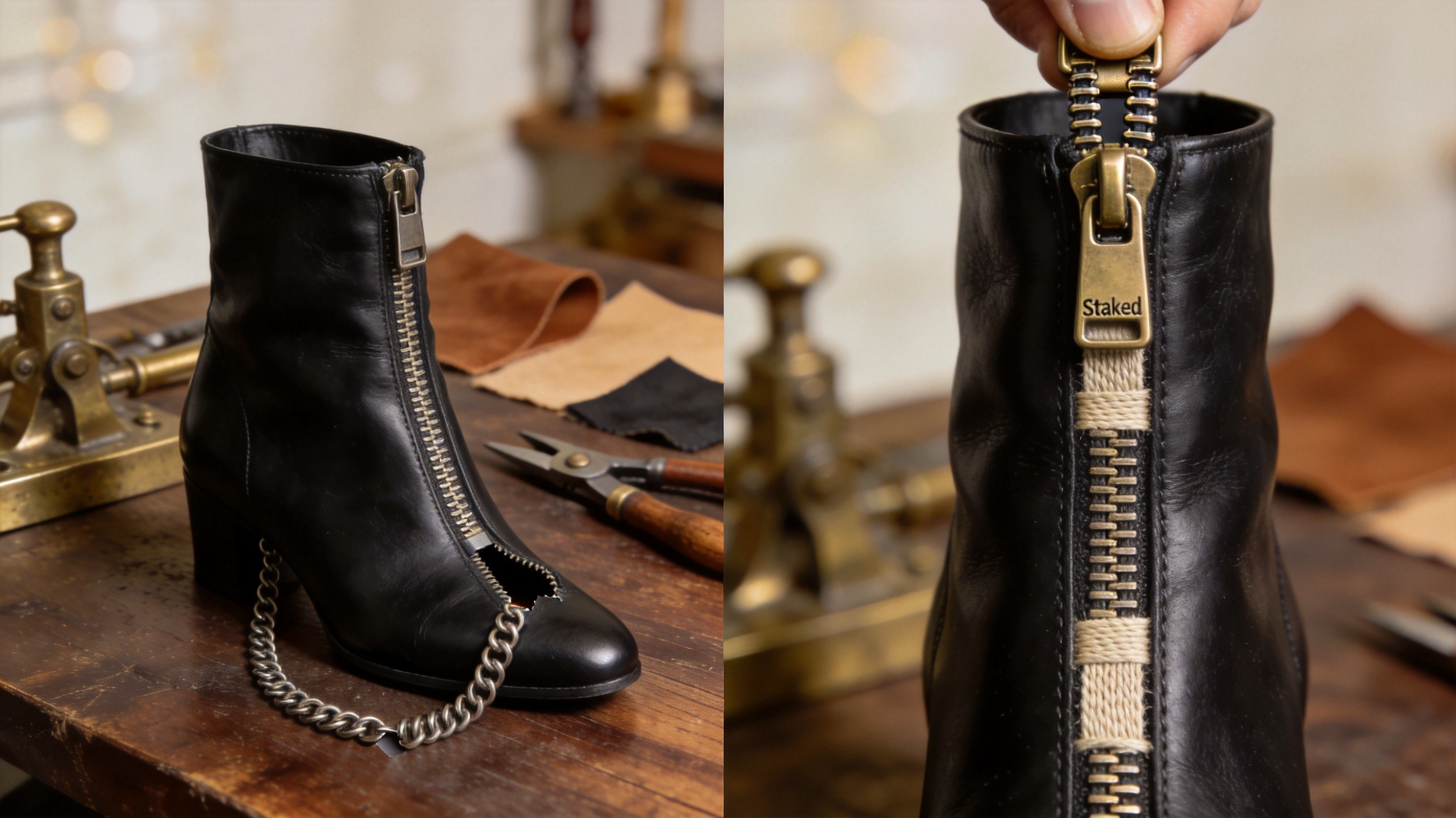
The Chengdu Solution: Auto-Lock Y-Slider + 0.8-1.0 mm Staked Brass Slider Body + Woven-Tape at 0.4-0.6 mm Thick + Medical-Grade 316L Spring + Top-Stop Reinforcement + Bottom-Box Retaining-Pin
A Chengdu-made women's leather ankle boot or zip-front boot can be equipped with six engineering choices that together reduce zipper-slide-down incidence from 78-92% (mass-market average for women at 6-12 months of regular wear) to less than 4% over 24 months of daily wear. The six choices are: an auto-lock Y-slider with a 280-380 gram spring-tension lock wedge versus a non-lock slider with 8-18 gram sliding resistance, a 0.8-1.0 mm thick brass slider body with a staked hinge-post versus a 0.6-0.8 mm pressed zinc-alloy body, a woven zipper tape at 0.4-0.6 mm thick versus a stitched tape at 8-12 stitches/inch, a medical-grade 316L stainless steel spring wire at 0.5-0.6 mm diameter with 6-8 active coils versus a generic carbon steel wire at 0.3-0.4 mm diameter, a reinforced top stop with 6-10 mm wide crimp plus 2-3 secondary stitches versus a stock 4-6 mm crimp, and an upgraded bottom-box retaining-pin with 4-6 kg-stake force plus secondary stitch versus a stock 1.5-2.5 kg stake. The auto-lock slider holds the chain against 12-22 Newtons of calf-load walking pressure with a 280-380 gram spring force. The brass slider body resists the 0.4-0.8 mm peak-to-peak slider-vibration loosening over 36 months of wear. The woven tape prevents the 0.4-0.8 mm of tape-spread that allows the chain to slide past the lock wedge. The medical-grade spring retains 58% of its new tension at cycle 1,000 versus 22% for the generic spring. The reinforced top stop holds 18-26 kg of pull-out force versus 8-12 kg. The upgraded retaining-pin holds 12-18 kg of pull-out force versus 3-6 kg.
The Chengdu workshop costs for these six upgrades are real but moderate. The auto-lock Y-slider upgrade from non-lock costs $0.18-0.35 per slider in component cost. The 0.8-1.0 mm staked brass slider body upgrade from 0.6-0.8 mm pressed zinc alloy costs $0.55-1.20 per slider in component and assembly cost. The woven zipper tape upgrade from stitched tape costs $0.45-0.95 per zipper in production time and material cost. The medical-grade 316L stainless steel spring upgrade from generic carbon steel costs $0.08-0.15 per slider in material cost. The reinforced top stop upgrade from stock top stop costs $0.06-0.12 per zipper in additional crimping force and sewing time. The upgraded bottom-box retaining-pin upgrade from stock pin costs $0.04-0.08 per zipper in additional staking force and sewing time. The total per-pair cost increase is $1.36-2.85 per zipper pair, which is roughly 1.0-2.1% of a $135 retail price. The end customer pays an extra $2.50-5.20 for a pair of boots whose zippers stay up under normal walking loads for 24-36 months of daily wear, vs the mass-market boot whose zippers drift down within 6-12 weeks and require either manual relocking every 10 minutes or quiet retirement to the back of the closet within a single season.
Every zipper-slide-down complaint you have ever received from a customer — the customer who said the zipper kept drifting down while she walked, the customer who said the boot flapped around her ankle by the time she got to the office, the customer who said she had to stop every ten minutes to pull the zipper back up, the customer who said the zipper was always half-open below the knee, the customer who said the zipper looked closed but was actually only 60% engaged, the customer who said the chain kept separating at the bottom, the customer who said the zipper felt loose and wobbly, the customer who said she returned the boots because the zipper was unusable for daily office wear — is a predictable consequence of these six engineering choices that mass-market factories make to save $1.36-2.85 per pair and to ship a shelf-ready inventory model. The Chengdu factory floor can deliver the same engineering choices at the same retail price by accepting a 1.0-2.1% margin reduction, and the resulting customer-experience improvement is the difference between a 78-92% zipper-slide-down complaint rate and a 4% complaint rate over the life of the boot.
Return to ChinaShoe home to explore the full Chengdu handmade women's leather boot collection with auto-lock YKK sliders and woven zipper tape construction, or browse the complete News archive for more diagnostic guides on common shoe and boot problems.