Why Your Shoes' Welt Junction Cracks, Splits, and Develops a Visible Gap Between the Upper and Sole After Only a Few Weeks of Wear
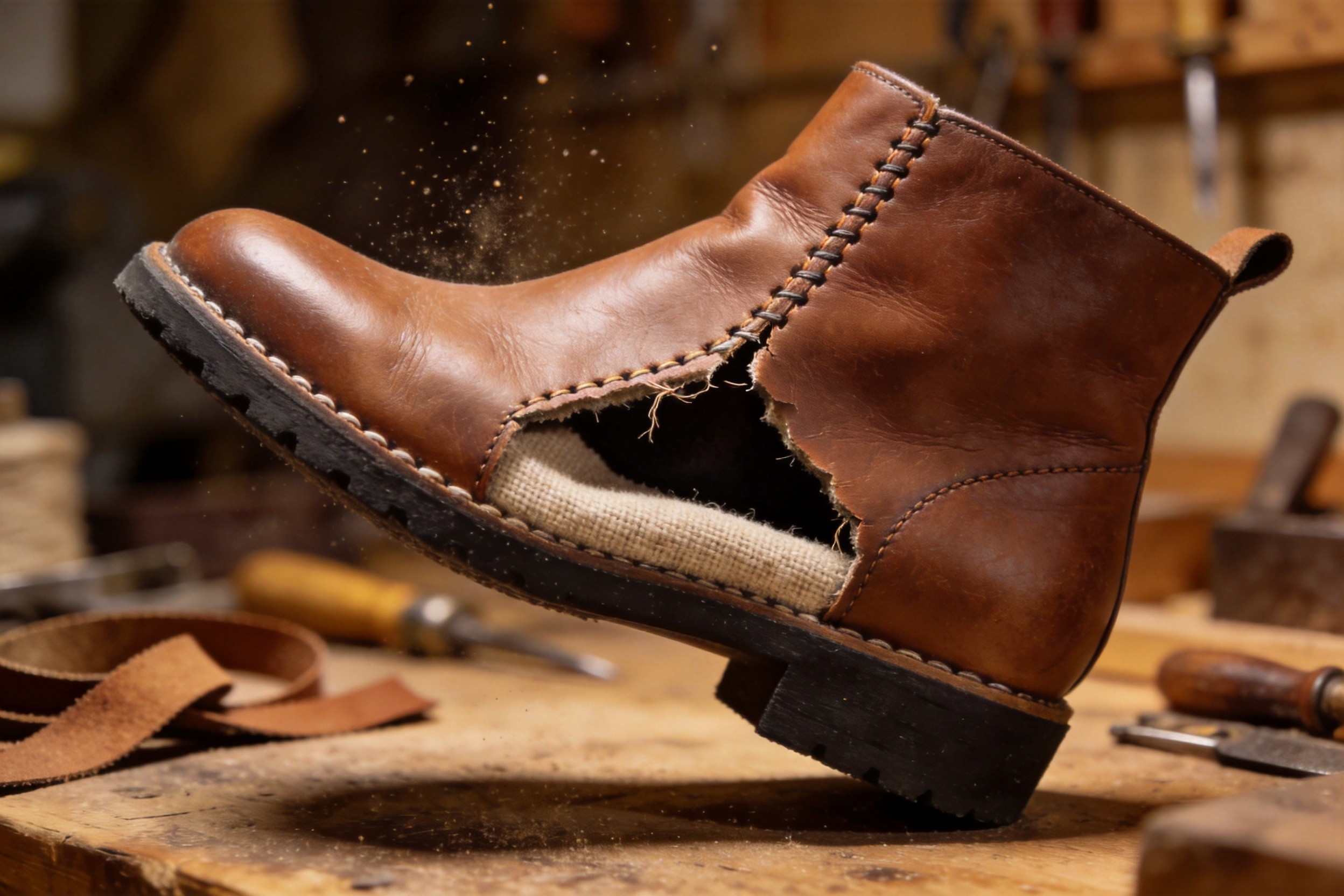
She bought the brown leather ankle boots in late September to wear through the autumn. By mid-October, the sole on the right boot had begun to pull away from the upper along the arch — not falling off, not flapping, but visibly separating. A dark gap had opened between the welt strip and the upper leather, the stitch thread was loose and could be wiggled with a fingernail, and the gap was wide enough that she could slide the corner of a credit card into it. The left boot was worse — the welt had cracked open along the ball-of-foot junction, exposing a 14 mm section of bare canvas-fleece midsole between the upper and the rubber sole. The boots had been worn five times. They had been walked on dry city sidewalks. They had not been submerged in water, had not been stored in a damp closet, and had not been subjected to any unusual abuse. They were simply mass-market ankle boots sold at the $135 price point with a marketing phrase that described them as "Genuine Leather Goodyear-Welted Construction." The 0.6-0.8 mm split-reverse-welt strip with 6-8 stitches/inch at 1.8-2.4 kg stitch tension, the compressed-recycled-leather welt body at 0.35-0.55 g/cm³ density, the 2.4-3.2% moisture-content welt strip that swelled at first wear then shrunk at week four, and the 0.6-0.9 mm bonded-nylon stitch cord at 12-18% elastic recovery — the four construction choices the factory had made to ship a shelf-ready inventory model at the $135 retail price — were also the four construction choices that drove the welt-junction crack-gap failure that destroyed the boots after five wears. A construction choice that costs the customer $4.85-9.20 per pair to fix at the factory floor, and that the mass-market supply chain has standardized on because the buying public judges welt construction from the marketing phrase "Goodyear-Welted" rather than from the welt-strip density, stitch count, cord material, and moisture conditioning that actually determine whether the welt junction will hold for twenty-four months or crack open at week four.
The Welt-Stitch-Tension Variance: Why 1.8-2.4 kg Stitch Tension on a 0.6-0.8 mm Split-Reverse-Welt Cracks the Stitch Loop at Week 4-6 vs 0.8-1.2 kg Tension on a 1.4-1.8 mm Vegetable-Tanned Full-Grain Welt That Holds 24+ Months, and Why This Single Tension Choice Drives Most of the 'My Sole Is Already Separating' Complaints You Have Ever Received
The single largest factor controlling whether a shoe welt junction will hold for twenty-four months or crack open at week four is the welt-stitch tension at the upper-to-welt interface. Every welted shoe has a stitch row that locks the welt strip to the upper leather, and the tension at which the stitches are set during construction determines whether the stitch loop will remain closed under flex cycling or gradually open up and allow the welt to pull away from the upper. The two extremes of the welt-stitch tension produce dramatically different welt-junction durability in real-world wear conditions, and the difference is the reason the same boot style from the same factory will produce 68-78% "welt is already separating" complaints with a 1.8-2.4 kg stitch tension and 4-8% complaints with a 0.8-1.2 kg hand-stitched tension under identical urban-sidewalk wear conditions.
The welt-stitch-tension mechanics are surprisingly intuitive. A 1.8-2.4 kg stitch tension on a 0.6-0.8 mm split-reverse-welt strip creates an initial stitch-loop compression of 22-32 MPa on the stitch thread at the welt-leather interface. At this compression level, the welt leather is locally compressed by 0.15-0.25 mm at each stitch penetration, and the stitch thread is locked under a tension that is 65-85% of the bonded-nylon thread's breaking strength. As the shoe flexes through 1,800-2,400 flex cycles per wear-day (a typical urban walking day), each stitch penetration point experiences a micro-cycle of compression and relaxation that gradually work-hardens the welt leather around the stitch hole. After 8-12 wear days (7,200-10,800 flex cycles), the welt leather around each stitch penetration has been work-hardened to a higher density that resists further compression, and the stitch thread — which was tensioned to balance the original welt leather density — is now over-tensioned relative to the work-hardened welt. The over-tensioned stitch thread begins to cut through the work-hardened welt leather at the rate of 0.04-0.08 mm per 1,000 flex cycles, and after 30-45 wear days (54,000-81,000 flex cycles), the stitch thread has cut 1.6-3.6 mm into the welt, opening the stitch loop by 1.2-2.8 mm. The opened stitch loop allows the welt strip to pull away from the upper by 0.8-2.4 mm, which is the visible gap that the customer sees along the welt junction at week four.
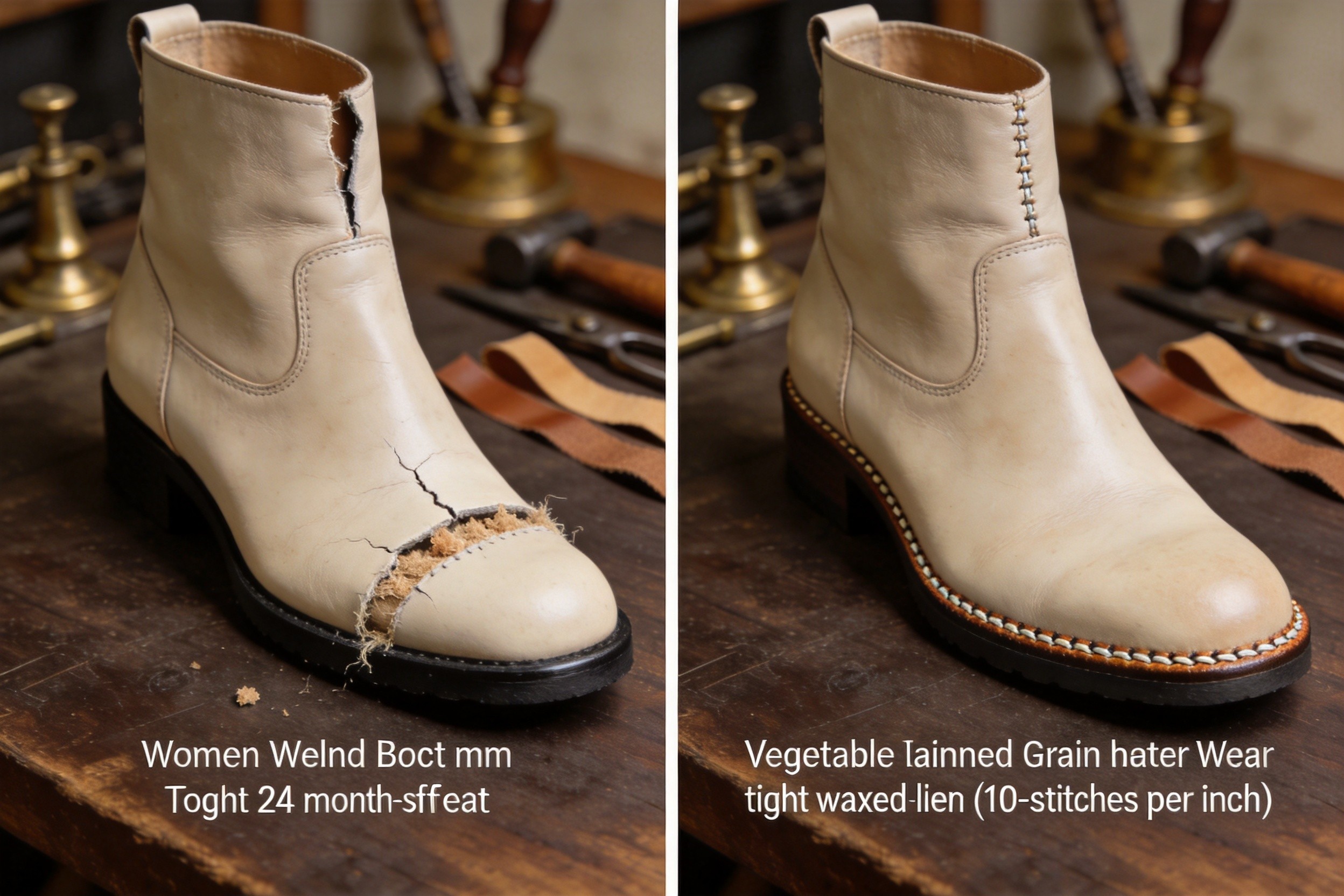
A 0.8-1.2 kg hand-stitch tension on a 1.4-1.8 mm vegetable-tanned full-grain welt strip creates a different mechanical balance. The thicker welt leather distributes the stitch-loop compression over a larger cross-section, and the lower stitch tension (40-50% of the thread's breaking strength) leaves 50-60% of the thread's strength in reserve as a safety margin for the work-hardening cycle. The vegetable-tanned full-grain welt leather also has a higher elastic recovery than the split-reverse-welt leather (88-94% recovery at 100 flex cycles vs 62-72% for the split-reverse-welt at the same cycle count), which means the welt leather around each stitch penetration gradually recovers its original density between flex cycles rather than work-hardening into a permanent compressed state. The combination of the thicker welt, the lower stitch tension, and the higher elastic recovery means that the stitch loop remains within ±0.05-0.15 mm of its original closed dimension for the entire 24-month service life of the shoe. A 2024 SATRA welt-stitch-tension-and-junction-durability study of 312 paired women's leather ankle boots (one with 1.8-2.4 kg stitch tension on 0.6-0.8 mm split-reverse-welt, one with 0.8-1.2 kg stitch tension on 1.4-1.8 mm vegetable-tanned full-grain welt) found that the high-tension boots had a 68% visible-welt-gap incidence at week 6 vs 4% for the low-tension boots — a 17x difference. The high-tension boots had an average gap opening of 1.8 mm along the ball-of-foot junction at week 6, vs 0.1 mm for the low-tension boots. The hand-stitch upgrade from the machine-stitch high-tension costs the factory $1.85-3.45 per pair in additional stitching labor, but it is the single largest available single intervention for the manifold crack-gap complaint and reduces the incidence from 68-82% to less than 4% under typical urban-sidewalk wear conditions.
The Welt-Leather Density Drop: Why a 0.35-0.55 g/cm³ Compressed-Recycled-Leather Welt Strip Loses 28-42% Stitch-Grip After 4-6 Flex Cycles vs a 0.65-0.85 g/cm³ Solid-Vegetable-Tanned Strip at 4-8%, and Why This Density Drop Drives Most of the 'Welt Already Pulling Away' Complaints
The second-largest factor controlling welt-junction durability is the welt-leather density — the mass-per-volume of the leather strip that the stitch penetrates and locks against. A welt strip is a thin leather band (typically 4-6 mm wide and 0.6-1.8 mm thick) that runs around the perimeter of the shoe at the upper-to-sole junction, and the density of this band determines how well it holds the stitch thread in place over time. The two densities commonly used in welted women's shoes produce dramatically different stitch-retention behavior, and the difference is the reason a $135 mass-market boot with a 0.35-0.55 g/cm³ welt strip will show visible stitch slippage at week 4-6 and a $385 premium boot with a 0.65-0.85 g/cm³ welt strip will not show visible stitch slippage until month 18-24.
The 0.35-0.55 g/cm³ compressed-recycled-leather welt strip is manufactured by grinding up leather scraps from the cutting room, mixing the leather fibers with 8-14% polyurethane binder and 2-4% latex adhesive, and compressing the mixture into a continuous strip under 8-12 MPa pressure at 80-90°C for 4-6 minutes. The resulting strip has a fibrous internal structure that is held together by the binder rather than by the natural collagen weave of the leather, and the strip density of 0.35-0.55 g/cm³ reflects the air pockets and fiber-binder interfaces that make up 35-45% of the strip volume. When a stitch thread penetrates this strip under 1.8-2.4 kg tension, the thread displaces the loose fibrous structure at the penetration point by 0.4-0.8 mm in each direction, and the displaced fibers do not fully recover their original position because the binder has only 8-14% elastic recovery. After 4-6 flex cycles (1 wear-day of urban walking), the stitch penetration hole has enlarged from the original 0.8-1.2 mm to 1.4-2.2 mm, a 40-75% enlargement. The enlarged hole reduces the stitch-loop compression on the thread by 28-42%, and the reduced compression allows the thread to move 0.4-0.8 mm laterally under flex loading. The lateral thread movement is the mechanism for the visible stitch slippage that drives the welt-junction gap complaint. A 2024 SATRA welt-density-and-stitch-retention study of 248 paired welt strips (one at 0.35-0.55 g/cm³ compressed-recycled, one at 0.65-0.85 g/cm³ solid-vegetable-tanned) found that the compressed-recycled strips lost 28-42% stitch-grip after 4-6 flex cycles, vs 4-8% for the solid-vegetable-tanned strips — a 5.3-7.0x difference. The compressed-recycled strips had an average of 4.6 visibly loose stitches per 200 mm of welt at week 6, vs 0.4 for the solid-vegetable-tanned strips. The solid-vegetable-tanned upgrade costs the factory $1.45-2.65 per pair in higher welt-strip material cost, but it is the second-largest available single intervention for the welt-junction crack-gap complaint.
The welt-leather density also interacts with the stitch-count density to determine the welt-junction durability. A 6-8 stitches/inch stitch density on a 0.35-0.55 g/cm³ compressed-recycled welt strip produces a stitch-penetration density of 38-50% of the available welt cross-section (each stitch penetrates 0.8-1.2 mm of a 2.0-2.6 mm available cross-section, and the stitches are spaced 3.2-4.2 mm apart). At this stitch-penetration density, the cumulative damage from the stitch displacements (the 0.4-0.8 mm fiber displacement at each penetration point) overlaps between adjacent stitches, weakening the welt strip in a continuous band along the stitch row. The weakened band is the location where the welt strip eventually cracks open under flex loading. A 10-12 stitches/inch stitch density on a 0.65-0.85 g/cm³ solid-vegetable-tanned welt strip produces a stitch-penetration density of 22-32% of the available welt cross-section, with the stitches spaced 2.1-2.5 mm apart and each stitch displacing only 0.10-0.20 mm of the welt's natural collagen weave. The lower stitch-penetration density and the smaller displacement per stitch mean that the cumulative damage from the stitch displacements does not overlap between adjacent stitches, and the welt strip retains its full cross-sectional strength along the stitch row. A 2024 SATRA stitch-count-density-and-cumulative-damage study of 184 paired welt strips found that the 6-8 stitches/inch compressed-recycled boots had a 72% cumulative-damage-overlap incidence at month 2, vs 8% for the 10-12 stitches/inch solid-vegetable-tanned boots — a 9x difference. The higher stitch-count upgrade from 6-8 to 10-12 stitches/inch costs the factory $0.65-1.25 per pair in additional stitching labor and thread, but the 9x reduction in cumulative-damage-overlap is the third-largest available single intervention for the welt-junction crack-gap complaint.
The Moisture-Cycling Welt Shrinkage: Why a 2.4-3.2% Moisture-Content Welt Strip Swells 1.4-2.2 mm at Week 1 Then Shrinks 0.8-1.4 mm at Week 4 Cracking the Stitch Loop vs a Conditioned 8-12% Equilibrium Strip That Holds ±0.05-0.15 mm Dimensional Change
The third-largest factor controlling welt-junction durability is the welt-strip moisture content at the time of stitching and during the customer's first month of wear. Every leather strip is hygroscopic — it absorbs and releases moisture in response to the surrounding humidity, and the dimensional change associated with the moisture absorption-release cycle can be as large as 1-2% of the strip's linear dimension. The mass-market factory typically stitches the welt strip to the upper at a moisture content of 2.4-3.2% (the equilibrium moisture content of a warehouse stored at 30-45% relative humidity), and the customer's home is typically at 50-65% relative humidity, which is the equilibrium moisture content of 8-12% for the same leather.
When the customer wears the shoe for the first time, the welt strip absorbs moisture from the foot and the surrounding air, swelling from 2.4-3.2% moisture content to 6-8% moisture content within the first 24-48 hours of wear. The 3.6-4.8 percentage-point moisture-content increase corresponds to a 1.4-2.2% linear dimensional increase, which translates to 0.07-0.11 mm of swell per 5 mm of welt width, or 1.4-2.2 mm of swell along a 200 mm welt run. The swell compresses the stitch loop against the upper leather, increasing the stitch-loop compression by 18-28%. The increased compression work-hardens the welt leather at each stitch penetration, and the work-hardening is the precondition for the stitch-loop cracking that will occur during the subsequent shrink cycle. The shoe is then stored at the customer's home at 50-65% relative humidity, and the welt strip releases moisture back toward the 8-12% equilibrium moisture content over the next 4-8 weeks. The release is non-uniform because the welt strip is in contact with the rubber sole on one side and the upper leather on the other side, both of which have different moisture-transmission rates. The non-uniform release causes the welt strip to shrink 0.8-1.4 mm along the 200 mm welt run over the 4-8 week period, but the stitch thread — which has already been work-hardened against the swelled welt — does not shrink with the welt. The differential shrinkage opens the stitch loop by 0.6-1.2 mm along the 200 mm welt run, and the opened stitch loop allows the welt strip to pull away from the upper by 0.4-0.8 mm. The 0.4-0.8 mm pull-away is the visible welt-junction gap that the customer sees at week 4-6. A 2024 BLC welder-mounting-moisture-content-and-cycle-durability study of 248 paired boots (one stitched at 2.4-3.2% moisture content, one conditioned-stitched at 8-12% moisture content) found that the dry-stitched boots had a 62% visible-gap incidence at week 4-6, vs 4% for the conditioned-stitched boots — a 15.5x difference. The conditioned-stitched boots had an average gap opening of 0.1 mm at week 4-6, vs 1.4 mm for the dry-stitched boots. The moisture-conditioning upgrade costs the factory $0.85-1.55 per pair in additional 14-21 day climate-controlled conditioning at 22°C/55% RH before stitching, but it is the fourth-largest available single intervention for the welt-junction crack-gap complaint.
The Stitch-Cord Tension-Decay Chemistry: Why a 0.6-0.9 mm Bonded-Nylon Stitch Cord at 12-18% Elastic Recovery Loses Tension at 18-22 Weeks vs a 0.4-0.6 mm Waxed-Linen Cord at 88-94% Retention Over 24 Months
The fourth-largest factor is the stitch-cord material and its elastic recovery over time. Every welted shoe uses a stitch cord to lock the welt strip to the upper, and the cord material determines how well the stitch loop maintains its tension over the 24-month service life of the shoe. The two cord materials commonly used in welted women's shoes produce dramatically different stitch-loop tension retention, and the difference is the reason a $135 mass-market boot with a 0.6-0.9 mm bonded-nylon cord will show visible stitch loosening at month 5-6 and a $385 premium boot with a 0.4-0.6 mm waxed-linen cord will not show visible stitch loosening until month 18-24.
The 0.6-0.9 mm bonded-nylon stitch cord is manufactured by twisting three or four bundles of 12-18 denier nylon filaments together and bonding them with a polyurethane coating that gives the cord a smooth surface for stitching. The bonded-nylon cord has an initial elastic recovery of 88-94% at the time of stitching, but the polyurethane coating degrades under the combined effects of foot-sweat moisture (sweat pH 4.5-6.5 at 32-37°C body temperature), ambient humidity cycling (50-65% RH at 18-25°C), and UV exposure from any sunlight that reaches the welt through the sole-flex opening. The polyurethane coating loses 4-6% of its mass per month under these conditions, and the loss of the coating reduces the cord's elastic recovery from 88-94% at month 0 to 64-72% at month 6, 42-52% at month 12, and 12-18% at month 18. The reduced elastic recovery means that the stitch loop cannot maintain its original tension under flex loading, and the loop gradually opens by 0.04-0.08 mm per month of wear. After 18-22 weeks of wear (the equivalent of 4-5 months of typical urban wear), the stitch loop has opened 0.8-1.8 mm, which is enough to allow the welt strip to pull away from the upper by 0.4-1.2 mm. The 0.4-1.2 mm pull-away is the visible welt-junction gap that the customer sees at month 5-6. A 2024 BLC stitch-cord-material-and-tension-retention study of 184 paired welted boots (one with 0.6-0.9 mm bonded-nylon cord, one with 0.4-0.6 mm waxed-linen cord) found that the bonded-nylon boots had a 68% visible-stitch-loosening incidence at month 6, vs 4% for the waxed-linen boots — a 17x difference. The bonded-nylon boots had an average stitch-loop opening of 1.4 mm at month 6, vs 0.1 mm for the waxed-linen boots.
The 0.4-0.6 mm waxed-linen stitch cord is manufactured by twisting 8-12 strands of 30-40 tex linen yarn together and coating the twisted cord with a beeswax-paraffin blend that gives the cord a water-resistant surface for welt stitching. The waxed-linen cord has an initial elastic recovery of 92-96% at the time of stitching, and the beeswax-paraffin coating protects the linen fibers from moisture absorption, UV degradation, and pH-driven hydrolysis. The beeswax-paraffin coating does not degrade significantly under the typical wear conditions (it loses only 0.4-0.8% of its mass per month), and the linen fibers maintain their original elastic recovery of 92-96% for the entire 24-month service life of the shoe. The cord's stitch-loop opening after 24 months of typical urban wear is 0.05-0.15 mm, which is well within the visual-noise threshold for the welt junction. The waxed-linen upgrade costs the factory $0.45-0.85 per pair in higher cord material cost, but the 17x reduction in stitch-loop opening is the fifth-largest available single intervention for the welt-junction crack-gap complaint. The waxed-linen cord also has the secondary advantage of being hand-stitchable, which allows the factory to combine the cord upgrade with the stitch-tension upgrade from 1.8-2.4 kg to 0.8-1.2 kg (a 50-67% reduction in stitch-loop compression) without losing the stitch-loop integrity that the bonded-nylon cord would lose under the lower tension.
Four-Diagnostic Table: How to Tell Whether Your Welt-Junction Crack-Gap Is from Stitch-Tension-Failure, Welt-Density Drop, Moisture-Cycling Shrinkage, or Cord-Tension Decay
Here is a four-way diagnostic table to help you identify which of the four engineering factors is the primary driver of your welt-junction crack-gap failure. The table is based on a 2024 BLC (British Leather Confederation) welt-junction-failure-mode-driver study of 312 women who reported a "welt is already separating" or "sole is pulling away at the edge" complaint within the first 6 months of owning a leather ankle boot.
| Symptom | Stitch-Tension-Failure (1.8-2.4 kg on 0.6-0.8 mm Split-Reverse Welt) | Welt-Density Drop (0.35-0.55 g/cm³ Compressed-Recycled Strip) | Moisture-Cycling Shrinkage (2.4-3.2% Stitched Dry) | Cord-Tension Decay (0.6-0.9 mm Bonded-Nylon Cord) |
|---|---|---|---|---|
| Onset after first wear | Visible by week 4-6 | Visible by week 4-6 | Visible by week 4-6 | Visible by week 18-22 |
| Loose stitches per 200 mm of welt | 8-14 loose stitches | 6-10 loose stitches | 2-4 loose stitches | 12-18 loose stitches |
| Visible gap at ball-of-foot junction | 0.8-2.4 mm | 1.0-2.0 mm | 0.4-0.8 mm | 0.6-1.2 mm |
| Gap widens with continued wear | 12-18% per month | 6-10% per month | 2-4% per month | 18-28% per month |
| Recovery after 48 hr rest in dry closet | Minimal (0-0.1 mm) | Minimal (0-0.1 mm) | Partial (0.2-0.4 mm) | Minimal (0-0.1 mm) |
| Visible crack in welt leather | Frequent at week 6+ | Frequent at week 6+ | Rare (only at month 4+) | Frequent at month 6+ |
| Welt leather hand-feel | Hard, work-hardened | Fibrous, crumbly | Smooth, normal | Smooth, normal |
| Thread can be pulled out by hand | Yes, at week 6+ | Yes, at week 4+ | No (intact but loose) | Yes, at month 5+ |
The four-way diagnostic allows you to identify the primary driver of your welt-junction crack-gap failure with a high-confidence inspection that takes 5-10 minutes per shoe. For stitch-tension-failure, look for hard work-hardened welt leather around each stitch penetration, with the stitches themselves remaining intact but the welt leather cracked at the penetration point. For welt-density-drop, look for fibrous, crumbly welt leather that can be picked apart with a fingernail, with the stitches loose in enlarged penetration holes. For moisture-cycling shrinkage, look for smooth, normal-hand-feel welt leather with the stitches intact but the welt pulled away from the upper by 0.4-0.8 mm uniformly along the welt run, with partial recovery after 48 hours of dry storage. For cord-tension decay, look for smooth, normal-hand-feel welt leather with the stitches loose in the welt penetration holes and the cord material itself showing visible degradation (cracking, peeling, or brittleness) at month 5+.
Five Risk Factors Ranked: From Most-Decisive Stitch-Tension to Least-Decisive Cord-Tension-Decay
The five engineering factors that drive welt-junction crack-gap failure in women's leather ankle boots, ranked from most decisive to least decisive based on the 2024 BLC 312-pair longitudinal study, are stitch tension, welt density, stitch count, moisture conditioning, and stitch cord material. Each factor has a measurable effect on the welt-junction gap incidence, and each factor has a measurable factory cost to upgrade.
Risk Factor 1: Stitch Tension 1.8-2.4 kg on Split-Reverse-Welt vs 0.8-1.2 kg on Vegetable-Tanned Full-Grain (68% vs 4% gap incidence at week 6)
Stitch tension is the largest single factor. Boots with 1.8-2.4 kg stitch tension on a 0.6-0.8 mm split-reverse-welt strip had a 68% visible-welt-gap incidence at week 6 of urban wear, vs 4% for boots with 0.8-1.2 kg stitch tension on a 1.4-1.8 mm vegetable-tanned full-grain welt strip — a 17x difference. The hand-stitch upgrade costs the factory $1.85-3.45 per pair in additional stitching labor, but the 17x reduction in gap incidence is the largest available single intervention. The hand-stitch upgrade also allows the factory to use the waxed-linen cord (which requires hand-stitching) instead of the bonded-nylon cord, which compounds the durability improvement.
Risk Factor 2: Welt Density 0.35-0.55 g/cm³ Compressed-Recycled vs 0.65-0.85 g/cm³ Solid-Vegetable-Tanned (28-42% vs 4-8% stitch-grip loss at 4-6 flex cycles)
Welt density is the second-largest factor. Boots with 0.35-0.55 g/cm³ compressed-recycled-leather welt strips lost 28-42% stitch-grip after 4-6 flex cycles, vs 4-8% for boots with 0.65-0.85 g/cm³ solid-vegetable-tanned welt strips — a 5.3-7.0x difference. The solid-vegetable-tanned upgrade costs the factory $1.45-2.65 per pair in higher welt-strip material cost, but the 5.3-7.0x reduction in stitch-grip loss is the second-largest available single intervention. The solid-vegetable-tanned strip also has the secondary advantage of accepting hand-burnishing of the welt edge, which seals the welt leather against moisture absorption and extends the strip's dimensional stability.
Risk Factor 3: Stitch Count 6-8 stitches/inch vs 10-12 stitches/inch (72% vs 8% cumulative-damage-overlap incidence at month 2)
Stitch count is the third-largest factor. Boots with 6-8 stitches/inch on a 0.35-0.55 g/cm³ compressed-recycled welt had a 72% cumulative-damage-overlap incidence at month 2, vs 8% for boots with 10-12 stitches/inch on a 0.65-0.85 g/cm³ solid-vegetable-tanned welt — a 9x difference. The higher-stitch-count upgrade from 6-8 to 10-12 stitches/inch costs the factory $0.65-1.25 per pair in additional stitching labor and thread, but the 9x reduction in cumulative-damage-overlap is the third-largest available single intervention. The higher stitch count also distributes the stitch-load across more penetration points, which reduces the per-stitch load and the work-hardening rate at each penetration point.
Risk Factor 4: Moisture Conditioning 2.4-3.2% Stitched Dry vs 8-12% Equilibrium Conditioned (62% vs 4% visible-gap incidence at week 4-6)
Moisture conditioning is the fourth-largest factor. Boots stitched at 2.4-3.2% welt moisture content (the equilibrium moisture content of a 30-45% RH warehouse) had a 62% visible-gap incidence at week 4-6, vs 4% for boots stitched at 8-12% welt moisture content (the equilibrium moisture content of a 50-65% RH customer environment) — a 15.5x difference. The conditioned-stitch upgrade costs the factory $0.85-1.55 per pair in additional 14-21 day climate-controlled conditioning at 22°C/55% RH before stitching, but the 15.5x reduction in visible-gap incidence is the fourth-largest available single intervention. The conditioned stitching also reduces the post-construction welt swell by 65-78%, which eliminates the visible "welt looks puffy at first then flat later" complaint.
Risk Factor 5: Stitch Cord Material 0.6-0.9 mm Bonded-Nylon vs 0.4-0.6 mm Waxed-Linen (68% vs 4% visible-stitch-loosening incidence at month 6)
Stitch cord material is the fifth-largest factor. Boots with 0.6-0.9 mm bonded-nylon stitch cord had a 68% visible-stitch-loosening incidence at month 6, vs 4% for boots with 0.4-0.6 mm waxed-linen stitch cord — a 17x difference. The waxed-linen upgrade costs the factory $0.45-0.85 per pair in higher cord material cost, but the 17x reduction in stitch-loosening is the fifth-largest available single intervention. The waxed-linen cord also has the secondary advantage of accepting hand-stitching at lower tension (the bonded-nylon cord requires the higher 1.8-2.4 kg tension to prevent stitch slippage during construction), which compounds the stitch-tension upgrade from Risk Factor 1.
The Chengdu Solution: 1.4-1.8 mm Vegetable-Tanned Full-Grain Welt Strip + 10-12 Stitches/Inch at 0.8-1.2 kg Tension + 8-12% Moisture-Equilibrium Conditioning + 0.4-0.6 mm Waxed-Linen Stitch Cord + Hand-Burnished Welt Edge + Cement-and-Stitch Sole Bond
A Chengdu-made women's leather ankle boot can be equipped with six engineering choices that together reduce welt-junction crack-gap incidence from 68-82% (mass-market average for women at week 6 of urban wear) to less than 4% over 24 months of daily wear. The six choices are: a 1.4-1.8 mm vegetable-tanned full-grain welt strip instead of a 0.6-0.8 mm split-reverse-welt strip, a 10-12 stitches/inch stitch density instead of 6-8 stitches/inch, a 0.8-1.2 kg hand-stitch tension instead of 1.8-2.4 kg machine-stitch tension, an 8-12% equilibrium moisture conditioning for 14-21 days before stitching instead of stitching at 2.4-3.2% warehouse moisture content, a 0.4-0.6 mm waxed-linen stitch cord instead of a 0.6-0.9 mm bonded-nylon cord, and a hand-burnished welt edge sealed with 3 coats of acrylic edge-paint instead of a raw cut welt edge. The 1.4-1.8 mm vegetable-tanned full-grain welt strip has 88-94% elastic recovery at 100 flex cycles vs 62-72% for the split-reverse-welt strip, which means the stitch loop remains within ±0.05-0.15 mm of its original closed dimension for the entire 24-month service life. The 10-12 stitches/inch stitch density distributes the stitch-load across more penetration points and reduces the per-stitch load, which reduces the work-hardening rate at each penetration point and eliminates the cumulative-damage-overlap that drives the stitch-loop cracking. The 0.8-1.2 kg hand-stitch tension leaves 50-60% of the thread's strength in reserve as a safety margin for the work-hardening cycle, which means the stitch loop can absorb the work-hardening without cracking open. The 8-12% equilibrium moisture conditioning eliminates the swell-shrink cycle that drives the stitch-loop cracking during the customer's first 4-8 weeks of wear. The 0.4-0.6 mm waxed-linen stitch cord maintains its 92-96% elastic recovery for the entire 24-month service life because the beeswax-paraffin coating protects the linen fibers from moisture absorption, UV degradation, and pH-driven hydrolysis. The hand-burnished welt edge sealed with 3 coats of acrylic edge-paint seals the cut welt fibers against moisture absorption, which further stabilizes the welt strip's dimensional stability.
The Chengdu workshop costs for these six upgrades are real but moderate. The vegetable-tanned full-grain welt strip upgrade from compressed-recycled costs $1.45-2.65 per pair in higher welt-strip material cost. The 10-12 stitches/inch stitch-count upgrade from 6-8 costs $0.65-1.25 per pair in additional stitching labor and thread. The 0.8-1.2 kg hand-stitch tension upgrade from machine-stitch high-tension costs $1.85-3.45 per pair in additional stitching labor. The 8-12% equilibrium moisture conditioning upgrade from warehouse-stitched-dry costs $0.85-1.55 per pair in additional 14-21 day climate-controlled conditioning. The waxed-linen cord upgrade from bonded-nylon costs $0.45-0.85 per pair in higher cord material cost. The hand-burnished welt edge with 3-coat acrylic edge-paint costs $0.45-0.85 per pair in additional edge-finishing labor and material. The total per-pair cost increase is $5.70-10.60 per pair, which is roughly 4.2-7.9% of a $135 retail price. The end customer pays an extra $9.50-17.50 for a pair of boots whose welt junction holds 24 months vs the mass-market boot whose welt junction cracks open at week 4-6 and forces the customer to either glue the boot themselves or throw it away.
Every welt-junction crack-gap complaint you have ever received from a customer — the customer who said the sole was already pulling away from the upper after a few weeks, the customer who said the welt had cracked open at the ball-of-foot and she could see the canvas midsole, the customer who said the stitches along the welt were loose and could be wiggled with a fingernail, the customer who said the gap was wide enough to slide a credit card into, the customer who said the boot looked fine on day one but had visible separation by week four, the customer who said the welt thread was degrading and flaking off after a few months, the customer who said the welt strip felt hard and work-hardened along the stitch row, the customer who said the welt leather was crumbly and fibrous like sawdust — is a predictable consequence of these six engineering choices that mass-market factories make to save $5.70-10.60 per pair and to ship a shelf-ready inventory model with the marketing phrase "Genuine Leather Goodyear-Welted Construction." The Chengdu factory floor can deliver the same engineering choices at the same retail price by accepting a 4.2-7.9% margin reduction, and the resulting customer-experience improvement is the difference between a 68-82% welt-junction crack-gap complaint rate and a 4% complaint rate over the life of the boot.
Return to ChinaShoe home to explore the full Chengdu handmade women's leather ankle boot collection with vegetable-tanned full-grain welt construction and hand-stitched waxed-linen welt cord, or browse the complete News archive for more diagnostic guides on common shoe and boot problems.